Brolly Academy | Snowflake
Snowflake Data Engineer
The Role, the Typical Pipeline, Skills JDs Ask For, Portfolio Pipelines, Certification and Pay (2026)
A practical 2026 guide to the Snowflake data engineer role in India: what the job involves, how a real Snowflake pipeline fits together, the skills Indian job descriptions ask for, how the role differs from a Snowflake developer, a sample day, three portfolio pipelines to build, the certification route, and dated job and pay numbers.
The Snowflake data engineer role explained: daily work, the typical pipeline, skills JDs ask for, three portfolio pipelines, certification route and pay.
By Brolly Academy Team · Brolly Academy · Updated 24 October 2026
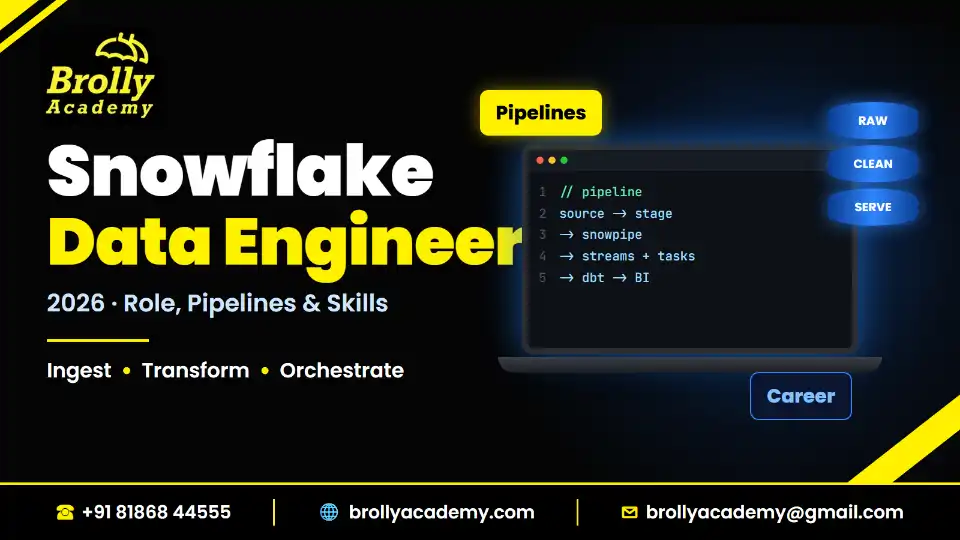
Table of Contents
1. Snowflake data engineer at a glance
2. What does a Snowflake data engineer do?
3. The typical Snowflake data pipeline, step by step
4. Core Snowflake features you will use every day
5. Snowflake data engineer skills: what job descriptions ask for
6. Snowflake data engineer vs Snowflake developer
7. A sample day for a Snowflake data engineer
8. How to become a Snowflake data engineer: a roadmap
9. Three portfolio pipelines to build
10. The certification route for Snowflake data engineers
11. Snowflake data engineer jobs in India: what the numbers say
Quick answer
A Snowflake data engineer builds and runs the pipelines that bring data into Snowflake, clean and model it, keep it fresh on a schedule, and keep it fast and affordable for analysts, BI tools and AI apps. The job covers six areas: ingestion, transformation, orchestration, data modelling, performance and cost. In the 14 Snowflake job descriptions we read on 25 October 2026, every one asked for SQL, 9 named dbt and 9 named Python. None accepted 0 years of experience; the lowest ask was 2 to 5 years.
- Core Snowflake features: stages, COPY INTO, Snowpipe, streams and tasks, dynamic tables, Time Travel, RBAC and resource monitors
- Companion tools: dbt, Python, Airflow, Git and CI/CD, and one cloud (AWS or Azure most often)
- Typical pay: AmbitionBox showed ₹10.1 to 11.1 lakh a year for Snowflake data engineers in India (2 to 9 years, 1.3k salaries, October 2026)
- Certification: SnowPro Core first, then SnowPro Advanced: Data Engineer (DEA-C02), which helps but is rarely mandatory
- Entry route: SQL, ETL or data analyst roles, or associate data engineer roles, then Snowflake-titled roles from about 2 years
Key takeaways
- A Snowflake data engineer owns the full flow, from raw files and databases to clean, modelled tables, not just SQL queries.
- The modern Snowflake stack is ELT: load raw data first, then transform inside Snowflake with SQL, dbt or dynamic tables.
- dbt and Python now appear in most Snowflake data engineer job descriptions, so SQL alone is not enough beyond entry level.
- Cost control is part of the job, because every running warehouse burns credits by the second.
- Job portal counts are keyword matches, not vacancies, and Snowflake-titled roles in India usually start at about 2 years of experience.
1. Snowflake data engineer at a glance
Short answer: It is a data engineering role where Snowflake is the main platform, and most of the work is building reliable ELT pipelines and keeping them fast and cheap.
If you are new to the platform itself, read what Snowflake does first. This post assumes you know Snowflake is a cloud data platform and focuses on the job.
2. What does a Snowflake data engineer do?
Short answer: A Snowflake data engineer gets data in, shapes it, schedules it, models it, tunes it and controls what it costs. Those six areas show up again and again in Indian job descriptions.
Here is each area in plain words.
Ingestion: getting data in
You bring data from source systems such as ERP, CRM, payment apps, logs and SaaS tools into Snowflake. Files usually land first in a stage, which is a named location (inside Snowflake or in your own S3, Azure or Google Cloud storage) that holds files before loading. You then load them with COPY INTO for batches, or with Snowpipe, Snowflake's serverless service that loads files automatically as they land in cloud storage. For row-level, near-real-time data, the Snowflake documentation (October 2026) describes Snowpipe Streaming, which writes rows straight into tables without staging files, with latency it states can be as low as about 5 seconds depending on the workload. Our guides on Snowpipe and COPY INTO go deeper.
Snowflake also offers Openflow, a data integration service built on Apache NiFi, with connectors for sources such as SharePoint, Salesforce, Kafka and change data capture from MySQL, PostgreSQL, Oracle and SQL Server, according to the Snowflake Openflow documentation (October 2026). Fivetran and Informatica are also commonly used with Snowflake.
Transformation: turning raw data into clean data
Snowflake work is mostly ELT (extract, load, transform). You load raw data first and transform it inside Snowflake using SQL, rather than transforming it on a separate ETL server. You clean types, remove duplicates, flatten JSON in VARIANT columns and apply business rules. dbt (data build tool) is the most common companion here: it lets you write each transformation as a SQL model, test it and run models in the right order.
Orchestration: making it run on time
Pipelines must run on a schedule or when new data arrives. Inside Snowflake you use streams (objects that record what changed in a table since you last read it) and tasks (scheduled SQL or stored procedure runs). Many teams also use an outside scheduler such as Apache Airflow. See our streams and tasks lab.
Data modelling: designing tables people can use
You design raw, staging and mart layers, fact and dimension tables, and history tracking such as SCD Type 2 (keeping old versions of a changing record). Kimball-style star schemas appear in many JDs. Our post on snowflake schema vs star schema explains the modelling side.
Performance: keeping queries fast
You read the Query Profile, fix exploding joins, pick sensible warehouse sizes and decide when clustering helps. Snowflake stores data in micro-partitions, which the documentation describes as automatic storage units of about 50 MB to 500 MB of uncompressed data, so good filters let Snowflake skip most of them. Our query optimization guide covers this.
Cost: spending credits wisely
Compute runs on virtual warehouses, which are clusters of compute you size and start or stop. They consume credits, Snowflake's billing unit. The Snowflake documentation (October 2026) says warehouses bill per second with a 60-second minimum each time they start, and credits per hour double at each size, from 1 for X-Small to 512 for 6X-Large. A data engineer sets auto-suspend, right-sizes warehouses and adds resource monitors so a bad job cannot burn the month's budget.
3. The typical Snowflake data pipeline, step by step
Short answer: Most Snowflake pipelines follow the same path: source systems, a landing stage, an ingestion service, a raw layer, change capture, transformation, modelled marts, then BI and apps, with monitoring across all of it.
Use this numbered flow as a reference architecture.
- Sources: databases (Oracle, SQL Server, PostgreSQL), SaaS apps, files from partners, and event streams such as Kafka.
- Landing: files land in cloud storage (S3, Azure Blob or Google Cloud Storage) and are exposed through an external stage, or uploaded to an internal stage with PUT.
- Ingestion: COPY INTO for scheduled batches, Snowpipe for files as they arrive, Snowpipe Streaming for rows, or Openflow and third-party connectors for databases and SaaS sources.
- Raw layer: data lands as-is in raw tables, often with JSON kept in a VARIANT column so nothing is lost.
- Change capture: a stream on each raw table records new and changed rows since the last run.
- Transformation: tasks run MERGE or INSERT logic on stream data, dynamic tables keep derived tables fresh, and dbt models build staging and intermediate layers.
- Marts: fact and dimension tables, with tests on keys and freshness, ready for reporting.
- Serving: BI tools commonly used with Snowflake (Power BI, Tableau), Streamlit apps, Secure Data Sharing to partners, and AI features.
- Operations: resource monitors, query history, alerts on failed tasks, and Git-based CI/CD for code changes.
Here are the tool choices at each step.
A note on status: the Snowflake documentation (October 2026) describes dbt Projects on Snowflake, which runs dbt Core inside Snowflake, but the page does not state whether it is generally available, so check before you depend on it at work. For the full ecosystem, see our guide to Snowflake tools.
4. Core Snowflake features you will use every day
Short answer: Streams, tasks, dynamic tables, Time Travel, cloning, RBAC and resource monitors are the daily toolkit, and you should be able to write simple versions of each from memory.
Tasks and streams
The tasks documentation (October 2026) says a task can run on a schedule, such as every 60 minutes or a cron expression, or only when a stream has data. A new task starts suspended, so you must resume it. Serverless tasks skip the WAREHOUSE line and let Snowflake manage compute. Task graphs chain several tasks in series or in parallel.
Simplified example (a task that runs only when the stream has new rows):
CREATE TASK load_clean_orders
WAREHOUSE = 'COMPUTE_WH'
SCHEDULE = '60 MINUTES'
WHEN SYSTEM$STREAM_HAS_DATA('orders_stream')
AS
INSERT INTO clean_orders
SELECT order_id, customer_id, amount FROM orders_stream;
ALTER TASK load_clean_orders RESUME;
Dynamic tables
A dynamic table stores the result of a SELECT and keeps it fresh to a target lag you choose. The dynamic tables documentation (October 2026) says the minimum target lag is 60 seconds, refresh mode can be INCREMENTAL, FULL or AUTO, and refreshes run on a named warehouse. They replace a lot of hand-written stream and task code for simple transformations.
Simplified example (based on the docs pattern):
CREATE OR ALTER DYNAMIC TABLE dt_orders
TARGET_LAG = '10 minutes'
WAREHOUSE = transform_wh
REFRESH_MODE = INCREMENTAL
AS
SELECT order_id, customer_id, amount, order_status
FROM raw_orders
WHERE order_status != 'returned';
Our dynamic tables lab shows refresh modes and monitoring.
Time Travel and cloning
Time Travel lets you query or restore data as it was at an earlier point. The Snowflake documentation (October 2026) says retention is up to 1 day on Standard Edition and up to 90 days on Enterprise and higher for permanent objects. After Time Travel ends, Fail-safe gives a further 7 days, but only Snowflake Support can recover data from it. Data engineers use Time Travel to undo a bad load and zero-copy cloning to build test copies of production data without paying for duplicate storage up front. See our Time Travel guide.
RBAC and service users
RBAC (role-based access control) means you grant privileges to roles and roles to users. Pipelines should run under a dedicated role and a service user. This matters more in 2026: Snowflake's phased MFA rollout ends single-factor password sign-in for human users, with the final phase estimated for August to October 2026, and legacy service users are being moved off passwords (Snowflake documentation, October 2026; Snowflake calls the dates estimates). Pipelines should use key-pair authentication, which needs at least a 2048-bit RSA key.
Resource monitors
Resource monitors track and cap warehouse credits. The Snowflake documentation (October 2026) says only ACCOUNTADMIN can create them, and they do not cover serverless or AI services, which need budgets instead.
Simplified example (based on the docs pattern):
CREATE OR REPLACE RESOURCE MONITOR de_monthly_limit
WITH CREDIT_QUOTA = 100
TRIGGERS ON 100 PERCENT DO SUSPEND;
ALTER WAREHOUSE transform_wh SET RESOURCE_MONITOR = de_monthly_limit;
5. Snowflake data engineer skills: what job descriptions ask for
Short answer: SQL is universal, dbt and Python come next, then cloud, orchestration, data modelling and Snowflake-specific features such as Snowpipe, streams, tasks and cost control.
We read 14 Snowflake job descriptions on Naukri and LinkedIn on 25 October 2026, from firms such as Infosys, Capgemini, TCS, HCLTech, EPAM, DTCC, Deloitte and Caterpillar. This table counts how many named each skill. Some JDs were one line long, so lower counts do not mean a skill is unimportant.
Cloud skills (AWS or Azure) appeared in most JDs, and Git with CI/CD appeared in the more detailed ones. Capgemini's JD was the most demanding: modular dbt models, SCD Type 2 through dbt snapshots, dbt tests, Snowpipe or Fivetran ingestion, warehouse sizing, clustering and resource monitors. Newer asks included Snowflake Cortex, Snowflake's built-in AI layer (named by TCS and EPAM), and AI-assisted coding tools.
Snowpark is Snowflake's library for writing DataFrame code in Python, Java or Scala that runs inside Snowflake. EPAM's senior role named "Snowpark for Python", so learn it once your SQL and dbt are solid.
6. Snowflake data engineer vs Snowflake developer
Short answer: The titles overlap a lot. A Snowflake developer leans towards SQL objects, procedures and reports inside Snowflake, while a Snowflake data engineer owns the end-to-end pipeline, including ingestion, orchestration, CI/CD and cost.
Indian listings often use both titles for the same job, so read the JD. This table shows the usual emphasis.
For the developer side in full, read our Snowflake developer guide. Administrators focus on accounts, users, security and governance rather than pipelines.
A Snowflake data engineer also differs from a Databricks or AWS data engineer mainly in the platform. On Snowflake you work in SQL-first warehouses and serverless services; on a lakehouse platform you work more in notebooks and Spark. The core skills, SQL, Python, modelling and orchestration, carry over between them.
7. A sample day for a Snowflake data engineer
Short answer: A typical day mixes pipeline checks, new development, code review and cost or performance fixes, often with a US or UK team at the other end.
Here is an illustrative day for a mid-level engineer at a GCC in Hyderabad. It is a composite, not one person's real schedule.
- 9:30 am, health check: open task history and pipeline alerts. Two tasks failed overnight because a source file arrived with a new column.
- 10:00 am, fix and backfill: update the file format and staging model, reload the failed files, and use Time Travel to compare the table before and after.
- 11:00 am, stand-up: agree priorities with the team lead and the business analyst.
- 11:30 am, new feature: build a dbt model for a new "returns" mart, with tests on primary keys and freshness.
- 2:00 pm, code review: review a teammate's pull request and spot a join that multiplies rows.
- 3:00 pm, cost review: a reporting warehouse runs all day. Lower its size, set a shorter auto-suspend, and attach a resource monitor.
- 4:30 pm, performance: read the Query Profile of a slow dashboard query and add a pre-aggregated dynamic table.
- 6:00 pm, overlap call: demo the new mart to the US product owner and note feedback.
Some roles keep late hours. Caterpillar's Bengaluru listing, for example, named a 1:00 pm to 10:00 pm IST shift, five days a week in the office (LinkedIn listing seen on 25 October 2026).
8. How to become a Snowflake data engineer: a roadmap
Short answer: Learn SQL and warehousing basics, then Snowflake loading and transformation, then dbt and Python, then orchestration and cost control, and prove it with two or three end-to-end pipelines.
This is our suggested order; the pace depends on your background.
- SQL and warehousing basics: joins, GROUP BY, window functions, CTEs, MERGE, plus facts, dimensions and SCDs. Start with our Snowflake SQL tutorial.
- Snowflake core: warehouses, databases, schemas, stages, file formats, COPY INTO, JSON with VARIANT, Time Travel and cloning, roles.
- Pipelines inside Snowflake: Snowpipe, streams, tasks, dynamic tables and stored procedures.
- dbt and Git: models, tests, snapshots, documentation, pull requests and a simple CI check.
- Python and one cloud: Python for scripts and the Snowflake Python connector, plus S3 or Azure Blob storage and IAM basics.
- Orchestration and operations: Airflow or task graphs, alerting, resource monitors and cost reviews.
- Certification and portfolio: SnowPro Core, then the projects in section 9, then the Advanced: Data Engineer exam once you have real experience.
The starting point differs by background:
- Freshers (B.Tech, BCA, B.Sc, MCA): build strong SQL and one end-to-end project first. Target associate or junior data engineer roles where Snowflake is a preferred skill.
- SQL developers and DBAs: your SQL and tuning skills transfer directly. Focus on stages, Snowpipe, dbt and cloud storage.
- ETL and Informatica developers: you already understand mappings, CDC and scheduling. Learn the ELT mindset, dbt and Snowflake-native streams and tasks.
- Data analysts: you know the business questions. Add modelling, dbt and pipeline scheduling.
Snowflake's own free learning helps at every stage. Its Hands-On Essentials track includes a Data Engineering Workshop badge, and Snowflake says the courses are free and many of the badges are free too (learn.snowflake.com, October 2026).
9. Three portfolio pipelines to build
Short answer: Build one batch pipeline, one near-real-time pipeline and one dbt project with tests and CI. Together they cover almost every skill in the table above.
Put each project in a public Git repo with a README, a flow diagram and a note on cost settings. For more ideas, see our list of Snowflake projects.
Pipeline 1: batch sales pipeline with streams and tasks
- Data: daily CSV files of orders, customers and products for a fictional retailer.
- Flow: upload files to S3, create an external stage and file format, load raw tables with COPY INTO, add a stream on the raw orders table, and run a task that merges new rows into a clean table.
- Model: a star schema with fact_orders, dim_customer and dim_product.
- Show: a Power BI or Tableau dashboard, plus a Time Travel query that recovers a deleted batch.
Pipeline 2: near-real-time events with Snowpipe and dynamic tables
- Data: JSON clickstream or delivery-tracking events generated by a small Python script.
- Flow: events land in cloud storage, Snowpipe auto-ingests them into a raw table with a VARIANT column, and a dynamic table flattens and aggregates them with a 1 to 10 minute target lag.
- Show: a Streamlit or BI view of live order status, and a note on how you chose the target lag and warehouse size.
Pipeline 3: dbt ELT project with tests, history and CI
- Data: a public dataset such as loans, sales or taxi trips.
- Flow: raw, staging, intermediate and mart models in dbt; SCD Type 2 with dbt snapshots; tests for uniqueness, not-null and freshness; a GitHub Actions check on every pull request.
- Ops: a separate role and service user with key-pair authentication, a resource monitor on the transform warehouse, and a short cost report.
10. The certification route for Snowflake data engineers
Short answer: Take SnowPro Core (COF-C03) first, then SnowPro Advanced: Data Engineer (DEA-C02). Certification helps you stand out, but most JDs we read did not demand it.
Here are the two exams at a glance, from Snowflake's official exam pages and certification FAQ (learn.snowflake.com, October 2026).
The DEA-C02 exam page (October 2026) lists domains including Data Movement (28%), Performance Optimization (19%), and Storage and Data Protection (14%), plus Data Governance and further domains. That maps closely to the six parts of the job in section 2.
Know the rules before you book. Snowflake's FAQ (October 2026) allows at most 4 attempts of the same exam in 12 months, with a 7-day wait between attempts and the full fee every time. Certifications are valid for 2 years and renew through Snowflake's Continuing Education programme. Exams run through Pearson VUE, online or at a test centre, and Indian candidates must bring the plastic PVC Aadhaar card. There is no free SnowPro exam, but completing Snowflake's Northstar SnowPro Core track earns a $50 voucher.
Our full guide to the Snowflake data engineer certification covers each domain, a study plan and practice questions.
On value: in the 14 JDs we read on 25 October 2026, SnowPro was required in only 1 (a Hyderabad administrator role) and preferred in 1 (Caterpillar). Treat it as a strong extra, not a ticket.
11. Snowflake data engineer jobs in India: what the numbers say
Short answer: Demand is real and concentrated in Bengaluru, Hyderabad, Pune and Chennai, mostly in IT services firms and GCCs, but portal numbers are keyword matches, not job counts.
We searched Naukri while logged out on 25 October 2026. These are keyword-match results that include duplicates, multi-city re-posts and roles that list Snowflake as one skill, so use them to compare, not to count vacancies.
The exact phrase "snowflake data engineer" returned only 329 results the same day, but page 1 was all "Snowflake Data Engineer" titles. It behaves like a near-exact title match, so it does not mean data engineer demand is small. City counts overlap, so do not add them up. LinkedIn showed 6,000+ results for "Snowflake" in India on the same date, and LinkedIn also adds loosely matched roles.
Companies with Snowflake data engineer listings seen on 25 October 2026 included Infosys ("Snowflake Data Engineer-Pan India", 2 to 5 years, Hyderabad, Pune and Bengaluru), Capgemini (4 to 9 years, hybrid), TCS (10 to 14 years, Hyderabad), IBM ("Data Engineer-Data Platforms-SnowFlake", several bands), EPAM Systems (senior and lead roles), Persistent Systems (Pune), PwC India (GCC advisory roles in Bengaluru and Gurgaon) and Ontimeglobal (Hyderabad, 3 to 6 years). These are listings, not hiring commitments.
Most roles were office-based: Naukri's work-mode filter marked 22,175 of the 25,910 India results as work from office.
For freshers, be honest with yourself. We found no "Snowflake trainee" or "Snowflake intern" titles. Filtering Naukri's "snowflake" search to 0 years left 589 results on 25 October 2026, and most were general data or analyst roles that mention Snowflake as one skill. Freshers usually enter as associate or junior data engineers. For example, Medpace listed a "Junior Data Engineer" role (0 to 1 years, Navi Mumbai) where Snowflake, Fivetran and dbt were preferred, and Yotta Techports listed an "Associate Data Forward Deployed Engineer" role in Hyderabad (0 to 3 years) with Snowflake as a good-to-have skill. For the Hyderabad market in detail, read our post on Snowflake jobs in Hyderabad.
12. Snowflake data engineer pay snapshot
Short answer: AmbitionBox showed a typical range of ₹10.1 to 11.1 lakh a year for Snowflake data engineers in India in October 2026, rising with experience.
These figures are AmbitionBox "typical ranges" shown to logged-out users in October 2026, with the sample size in brackets. Read them as guides, not offers.
AmbitionBox shows no 0 to 1 year band for this title, so there is no reliable fresher figure. Two listings give a sense of advertised pay: Infosys showed "8-14 Lacs PA" for 2 to 5 years, and Ontimeglobal showed "8-18 Lacs PA" for 3 to 6 years (Naukri, 25 October 2026).
Two cautions. First, the generic "Data Engineer" title on AmbitionBox showed ₹11.5 to 12.7 lakh (1.1 lakh salaries), but that sample includes product companies and banks, while Snowflake-titled samples are mostly IT services, so the titles are not directly comparable. Second, pay at Snowflake Inc itself is a different market from Snowflake roles at service firms. For city-wise, company-wise and developer pay, see our Snowflake developer salary guide.
13. How Brolly Academy helps
Short answer: Brolly Academy's 45-day Snowflake course builds the Snowflake core a data engineer needs, from stages and Snowpipe to tasks, streams and performance, with projects and interview preparation.
Our Snowflake training in Hyderabad runs for 45 days in classroom, live online and video modes. Fees on the course page (October 2026) are ₹8,999 for the video plan, ₹17,999 for the live online course and ₹22,999 for classroom training, with EMI options. The trainer, Mr. Bala Krishna, has 13+ years in data warehousing, SQL and Snowflake.
The syllabus has 15 modules. For data engineers, the most relevant are data loading and unloading (file formats, internal and external stages, COPY INTO), Snowpipe, JSON and semi-structured data, scheduling with tasks and streams, Time Travel and cloning, query caching, clustering and performance, and resource monitoring and credit usage. You build 6 projects, including an ETL pipeline project, and receive a Brolly Academy course completion certificate. SnowPro exams are run by Snowflake and their fees are separate.
To be clear about scope: dbt appears in the course's tools list, but Snowpark, dynamic tables, Cortex and Airflow are not syllabus modules. Plan to learn those alongside the course using the roadmap in section 8.
Build your first Snowflake data pipeline with a mentor
Book a free demo class to see how Brolly Academy's 45-day Snowflake course takes you from SQL basics to stages, Snowpipe, streams and tasks, with real projects and mock interviews. Choose classroom, live online or video learning to fit your schedule.
Frequently asked questions
What does a Snowflake data engineer do?
A Snowflake data engineer builds and runs pipelines that load data into Snowflake, transform and model it, and keep it fresh and affordable. The work covers six areas: ingestion with stages, COPY INTO, Snowpipe or connectors; transformation with SQL and dbt; orchestration with streams, tasks or Airflow; data modelling; performance tuning; and cost control with warehouse sizing and resource monitors.
Is Snowflake good for data engineering?
Yes, Snowflake is widely used for data engineering because it combines loading, transformation, scheduling and governance in one platform. Native features such as Snowpipe, streams, tasks and dynamic tables cover most pipeline needs, and tools like dbt and Airflow fit around it. Indian demand is strong too, with Naukri showing about 25,910 keyword-match results for "snowflake" on 25 October 2026.
How do I become a Snowflake data engineer?
Start with strong SQL and data warehousing basics, then learn Snowflake loading with stages, COPY INTO and Snowpipe. Next, learn streams, tasks and dynamic tables, then dbt with Git, then Python and one cloud such as AWS or Azure. Finish with orchestration and cost control, build two or three end-to-end portfolio pipelines, and take SnowPro Core when you are ready.
What skills does a Snowflake data engineer need?
The essential skill is SQL, which appeared in all 14 Snowflake job descriptions we read in October 2026. dbt and Python each appeared in 9. Employers also asked for data modelling, Snowpipe, streams and tasks, Time Travel, cost control with resource monitors, RBAC, Airflow, Git and CI/CD, and AWS or Azure. Newer roles mention Snowflake Cortex AI and Snowpark.
Is Python required for a Snowflake data engineer?
Python is not always required at entry level, but it is increasingly expected. Nine of the 14 Snowflake job descriptions we read in October 2026 named Python, for scripting, ingestion, automation and Snowpark work. You can start with SQL, but plan to learn Python basics and the Snowflake Python connector before you apply for mid-level data engineer roles.
Is dbt needed with Snowflake?
dbt is not part of Snowflake, but it has become the most common companion tool for Snowflake data engineers. Nine of the 14 job descriptions we read in October 2026 named dbt, and a Naukri search for "dbt snowflake" returned about 1,729 results on 25 October 2026. Learning dbt models, tests and snapshots will make you far more employable.
What is the difference between a Snowflake data engineer and a Snowflake developer?
A Snowflake developer usually focuses on SQL objects inside Snowflake, such as views, stored procedures, UDFs and support for BI reports. A Snowflake data engineer owns the full pipeline, including ingestion design, orchestration, CI/CD, cloud storage and cost. In practice, Indian employers often use the two titles for similar jobs, so always read the job description carefully.
Snowflake data engineer vs Databricks data engineer: which is better?
Neither is better for everyone; the difference is mainly the platform. Snowflake work is SQL-first, with warehouses and serverless services, while Databricks work leans more on notebooks and Spark. The core skills of SQL, Python, data modelling and orchestration carry over between them, so pick the platform that matches the jobs you are targeting and learn the other later.
What is the salary of a Snowflake data engineer in India?
AmbitionBox showed a typical range of ₹10.1 to 11.1 lakh a year for Snowflake data engineers in India in October 2026, based on 1.3k salaries from people with 2 to 9 years of experience. The 3 to 6 year band showed ₹8.4 to 9.2 lakh and the 6 to 9 year band ₹13.2 to 14.5 lakh. These are typical ranges, not offers.
Which certification is best for a Snowflake data engineer?
The best route is SnowPro Core (COF-C03) first, followed by SnowPro Advanced: Data Engineer (DEA-C02). The Advanced exam needs an active Core certification and covers data movement, performance optimization, storage and data protection, and governance. Certification helps, but only 1 of the 14 job descriptions we read in October 2026 required SnowPro and 1 preferred it.
How much does the SnowPro Advanced Data Engineer exam cost in India?
Snowflake's certification FAQ lists the SnowPro Advanced: Data Engineer exam at $375, or $300 for exams taken in India, as of October 2026. You must also hold an active SnowPro Core certification, which costs $175, or $140 in India. Every attempt is charged in full, you get at most 4 attempts in 12 months, and there is a 7-day wait between attempts.
Can freshers get Snowflake data engineer jobs?
Freshers rarely get Snowflake-titled roles directly. None of the 14 Snowflake job descriptions we read in October 2026 accepted 0 years, and the lowest ask was 2 to 5 years. Freshers usually enter as associate or junior data engineers where Snowflake is a preferred skill, such as listings from Medpace and Yotta Techports, and then move into Snowflake roles with experience.
What is the roadmap for a Snowflake data engineer?
A practical roadmap has seven steps: SQL and warehousing basics; Snowflake core such as stages, COPY INTO and VARIANT; pipelines with Snowpipe, streams, tasks and dynamic tables; dbt and Git; Python and one cloud; orchestration, alerting and cost control; and finally certification plus a portfolio of two or three end-to-end pipelines that you can explain in interviews.
Is Snowflake data engineering a good career in 2026?
Yes, it is a solid career choice in 2026 if you build real pipeline skills. Naukri showed about 25,910 keyword-match results for "snowflake" across India on 25 October 2026, led by Bengaluru, Hyderabad, Pune and Chennai. AmbitionBox showed ₹13.2 to 14.5 lakh for the 6 to 9 year band, so pay grows with experience and broader skills.
How many Snowflake data engineer jobs are there in India?
There is no exact count of Snowflake data engineer jobs. On 25 October 2026, Naukri showed about 25,910 keyword-match results for "snowflake" and LinkedIn showed 6,000+ results in India, but both include duplicates and roles that mention Snowflake as one skill. The exact phrase "snowflake data engineer" returned 329 results because it behaves like a near-exact title match.
Which companies hire Snowflake data engineers in Hyderabad?
On 25 October 2026 we saw Snowflake data engineer listings covering Hyderabad from Infosys, Capgemini, TCS, IBM, EPAM Systems and Ontimeglobal. These were listings seen on that date, not hiring commitments, and many were multi-city roles that also covered Pune, Bengaluru or Chennai. Experience asks ranged from 2 to 5 years at Infosys to 10 to 14 years at TCS.
Do I need to know a cloud platform like AWS or Azure?
Yes, basic cloud knowledge helps a lot. Most Snowflake job descriptions we read in October 2026 asked for AWS or Azure, because files land in cloud storage such as S3 or Azure Blob before loading through stages. You do not need deep cloud expertise at first, but learn storage, IAM roles and how Snowflake connects to a bucket.
What is the difference between Snowpipe and COPY INTO?
COPY INTO loads staged files into a table when you or a scheduled task run it, which suits batch loads. Snowpipe is Snowflake's serverless service that loads files automatically as they land in cloud storage, which suits continuous loading. For row-level, near-real-time data without staging files, Snowflake also offers Snowpipe Streaming.
What are streams and tasks in Snowflake?
A stream records which rows in a table changed since you last read it, so you can process only changes. A task runs SQL or a stored procedure on a schedule or only when a stream has data. Together they build change data capture pipelines inside Snowflake. Remember that a new task starts suspended until you resume it.
What are dynamic tables and when should a data engineer use them?
A dynamic table stores the result of a SELECT query and keeps it fresh to a target lag you set, with a minimum of 60 seconds according to Snowflake's documentation. Refresh mode can be incremental, full or auto, and refreshes run on a named warehouse. Use dynamic tables for simple, declarative transformations where hand-written streams and tasks would add needless code.
How do Snowflake data engineers control cost?
They start with small warehouses, keep auto-suspend short, and scale up only after reading the Query Profile, because credits per hour double at each warehouse size. They attach resource monitors to cap warehouse credits and use budgets for serverless and AI services, which resource monitors do not cover. They also remove wasteful queries and review spend regularly.
Can an ETL or Informatica developer move to Snowflake data engineering?
Yes, ETL and Informatica developers make the move often because they already understand mappings, change data capture, scheduling and data quality. The main shift is to the ELT mindset, where you load raw data first and transform it inside Snowflake. Focus on stages, Snowpipe, streams and tasks, dbt and one cloud platform to close the gap quickly.
How long does it take to become a Snowflake data engineer?
It depends on your starting point and practice time. Someone with strong SQL or ETL experience can learn Snowflake loading, streams, tasks and dbt fairly quickly, while a fresher needs extra time for SQL and modelling. Snowflake-titled roles we saw in October 2026 started at about 2 years of experience, so freshers should plan an entry role first.
What projects should I build for a Snowflake data engineer portfolio?
Build three pipelines: a batch sales pipeline using stages, COPY INTO, streams and tasks with a star schema; a near-real-time events pipeline using Snowpipe and dynamic tables; and a dbt project with SCD Type 2 snapshots, tests and CI on GitHub. Add a README, a flow diagram and a short note on your cost settings to each.
Does Brolly Academy's Snowflake course cover data engineering?
Brolly Academy's 45-day Snowflake course covers the Snowflake core of data engineering, including stages, COPY INTO, Snowpipe, JSON data, tasks and streams, Time Travel, performance and resource monitoring, with 6 projects including an ETL pipeline. dbt appears in its tools list, but Snowpark, dynamic tables and Airflow are not syllabus modules, so learn those alongside the course.
Learn with Brolly Academy
Review the syllabus, practical projects and batch timings, and book a free demo before you enrol.
Related Articles
Continue Your Learning
Snowflake Training in Hyderabad
45-day course covering Snowflake architecture, warehouses, data loading, security, performance and real-time projects, in classroom, live online and recorded plans.
View Coursedbt Course
Learn dbt, the transformation tool most Snowflake job descriptions ask for, to build tested, documented data models.
View CourseDatabricks Course
Add the lakehouse side of modern data engineering with Databricks, Spark and Delta Lake, often used alongside Snowflake.
View Course