LAKEHOUSE / SPARK AND SQL / GOVERNED PIPELINES
Databricks Course
Build a repeatable data pipeline instead of stopping at a notebook that runs once. This Databricks Course connects SQL and PySpark transformations with Delta tables, orchestration, permissions and practical checks for data quality and recovery.
★ 4+ Google rating from 100+ reviews · 9,000+ students trained · 523+ batches completed · Teaching since 2021
Next batch: Monday, 2 November 2026
Course outline8 modules
Practice3 project scenarios
Next batchMonday, 2 November 2026
Course feeINR 22,999
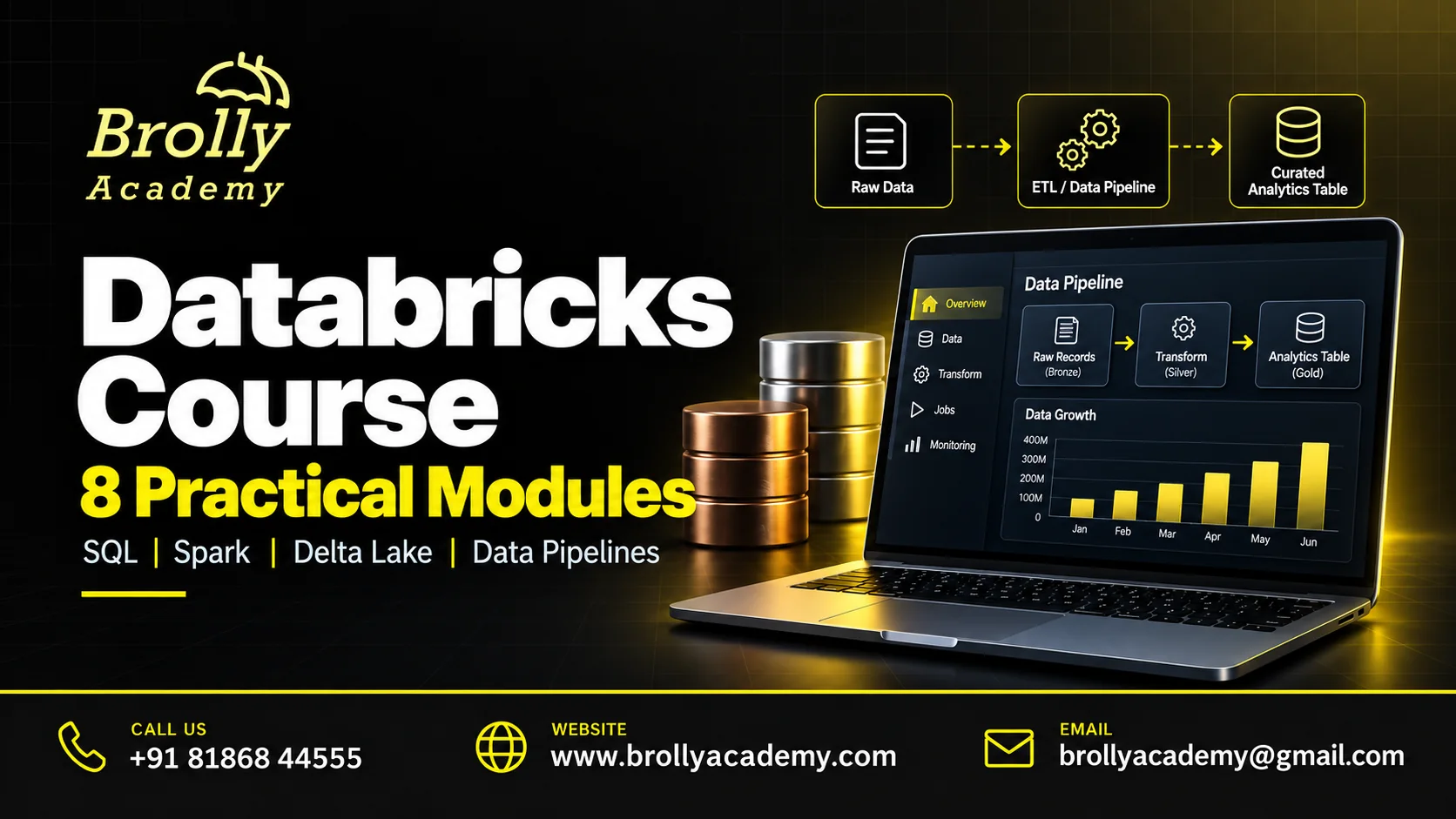
About the Databricks Course
Databricks provides a platform for data engineering, analytics and AI workloads. This course concentrates on data engineering: bringing data in, transforming it, making it reliable and delivering useful tables to other teams. You will trace where each output came from and explain how a job should behave when input data changes or processing fails.
This is a platform-focused data engineering course. It is not a complete Azure, AWS or machine-learning programme. PySpark Training develops Spark programming more deeply, while SQL fundamentals and cloud-account administration may need separate preparation. The cloud environment and available features must be confirmed for the batch.
For further background, read Databricks data engineering documentation. Use current guidance that matches your learning task and the tools in your batch.
What Is Databricks and Why Does It Matter?
Databricks is a platform for working with data and AI. In this course the focus is data engineering: using SQL and PySpark, building reliable Delta-based tables, running pipelines and controlling access. The aim is data that other people can use and trust.
Bring a pipeline togetherConnect ingestion, transformation and serving rather than treating every notebook as an isolated script.
Protect data qualityMake keys, schemas, reconciliation and safe reruns part of the pipeline design.
Make operations visibleUnderstand permissions, dependencies, execution evidence and costs when a scheduled workload fails.
Benefits of Learning Databricks
Build data pipelines you can explain, rerun and investigate when something goes wrong. The emphasis is reliable data engineering rather than collecting notebooks.
Make repeatable pipelinesSeparate ingestion, transformation and serving. Explain how reruns avoid duplicate or inconsistent business records.
Improve data trustAdd schema, null, duplicate and reconciliation checks. Keep evidence that the output matches a defined business rule.
Understand operating costsRead execution evidence before changing compute size. Relate performance choices to workload and budget.
Who Should Join?
You should understand SQL queries, joins and basic Python functions and collections. Familiarity with tables, files and data types is expected. If these are new, build the foundations before combining them with distributed processing and platform administration.
Data analysts moving into engineeringTurn query skills into reliable ingestion and transformation workflows.
ETL and database professionalsApply existing data knowledge to lakehouse tables and scheduled pipelines.
Python and Spark learnersDevelop a platform workflow around code, governance and operational evidence.
For complementary learning, explore SQL Course. Build query, join and aggregation skills before working with larger analytical pipelines.
Databricks Prerequisites and Readiness Checklist
You should understand SQL queries, joins and basic Python functions and collections. Familiarity with tables, files and data types is expected. If these are new, build the foundations before combining them with distributed processing and platform administration.
SQL foundationsWrite joins, aggregations and filters and understand nulls. Practise these first if query results still feel unpredictable.
Python basicsUse variables, collections, functions and exceptions. You do not need advanced machine learning to start this engineering path.
Platform accessConfirm a permitted workspace, cloud environment and data permissions. Never use employer data without approval.
Databricks Course Syllabus: 8 Practical Modules
Each module connects a concept to an exercise and an output you can explain. Work through the foundations before attempting the integrated project.
1. Workspace and lakehouse foundations
Identify workspaces, compute, notebooks, tables and storage responsibilities. Run a small SQL and Python exercise with approved access. Record runtime and environment details so another learner can reproduce the result.
2. SQL and PySpark transformations
Read a small dataset, define types and apply filters, joins and aggregations. Compare equivalent SQL and DataFrame operations. Inspect duplicate keys and null handling rather than assuming a successful job produced correct business data.
3. Delta Lake and table reliability
Create Delta tables and explore transactional changes, schema enforcement and version history. Design an update or merge exercise with a defined key. Explain retention and maintenance implications before treating table history as a permanent backup.
4. Ingestion and incremental processing
Ingest fictional source files and track what has already been processed. Consider late data, duplicate delivery and schema changes. Build a replay test demonstrating whether rerunning a task changes the result unexpectedly.
5. Layered pipelines and data quality
Separate raw, cleaned and business-ready data. Add explicit quality rules and quarantine or flag invalid rows. Use supported Lakeflow pipeline features where the lab permits, documenting the actual runtime and configuration.
6. Orchestration and recovery
Organise dependent tasks with parameters, schedules and failure handling. Simulate a failed transformation and practise a controlled rerun. Keep a runbook describing inputs, outputs, ownership and the checks required before a retry.
7. Unity Catalog and performance awareness
Review catalog, schema and object permissions using least privilege. Trace lineage where available. Inspect execution behaviour and compare a small optimisation with a baseline, recording compute and cost implications instead of claiming universal speed gains.
8. Capstone pipeline and handover
Package a small source-to-analytics pipeline with versioned code, quality checks and operational notes. Demonstrate the happy path, duplicate input and recovery after failure. Present a useful final table and its limitations.
Discuss Your Learning Goals
Tell the team about your experience and preferred schedule. Book a free demo to discuss the course, lab access and the practical work expected from you.
Practical Skills You Will Develop
Use the exercises to build an explanation as well as a result. You should be able to show what you did, how you checked it and where the limits are.
Data transformationWrite and check SQL and PySpark operations.
Incremental designHandle duplicates, updates and late-arriving data deliberately.
Pipeline qualityDefine rules and make rejected records visible.
GovernanceApply and explain appropriate data access boundaries.
Operational recoveryInvestigate failed jobs and perform controlled reruns.
Performance evidenceCompare changes using measured runtime and resource use.
Tools and Lab Requirements
Use an authorised Databricks workspace with a defined spending limit and synthetic data. Confirm the cloud, compute, runtime and feature access before enrolling. Store secrets in approved facilities, not notebooks or Git, and shut down chargeable resources when appropriate.
Databricks workspaceAn authorised workspace and suitable compute; cloud platform and entitlements are confirmed per batch.
SQL, Python and GitUse reproducible code and datasets with clear dependencies.
Delta Lake and Unity CatalogExplore reliable tables and governed access using supported lab features.
Consult Databricks training and certification for current guidance. Confirm the software, account permissions and costs needed for your exercises.
Set Up Your Databricks Practice Environment
Use an authorised Databricks workspace with a defined spending limit and synthetic data. Confirm the cloud, compute, runtime and feature access before enrolling. Store secrets in approved facilities, not notebooks or Git, and shut down chargeable resources when appropriate.
Workspace and storageUse the agreed Databricks environment and a small synthetic dataset. Identify where data is stored and who can read or change it.
Reproducible notebooksKeep parameters, dependencies and setup instructions clear. Do not save tokens, passwords or cloud keys in notebooks or exports.
Cost controlsUse approved compute settings, stop idle resources and check usage. Free learning environments may not expose every production feature.
Databricks Learning Roadmap: Foundations to Portfolio
Build confidence in stages. Practice time and your starting knowledge matter as much as the number of scheduled sessions.
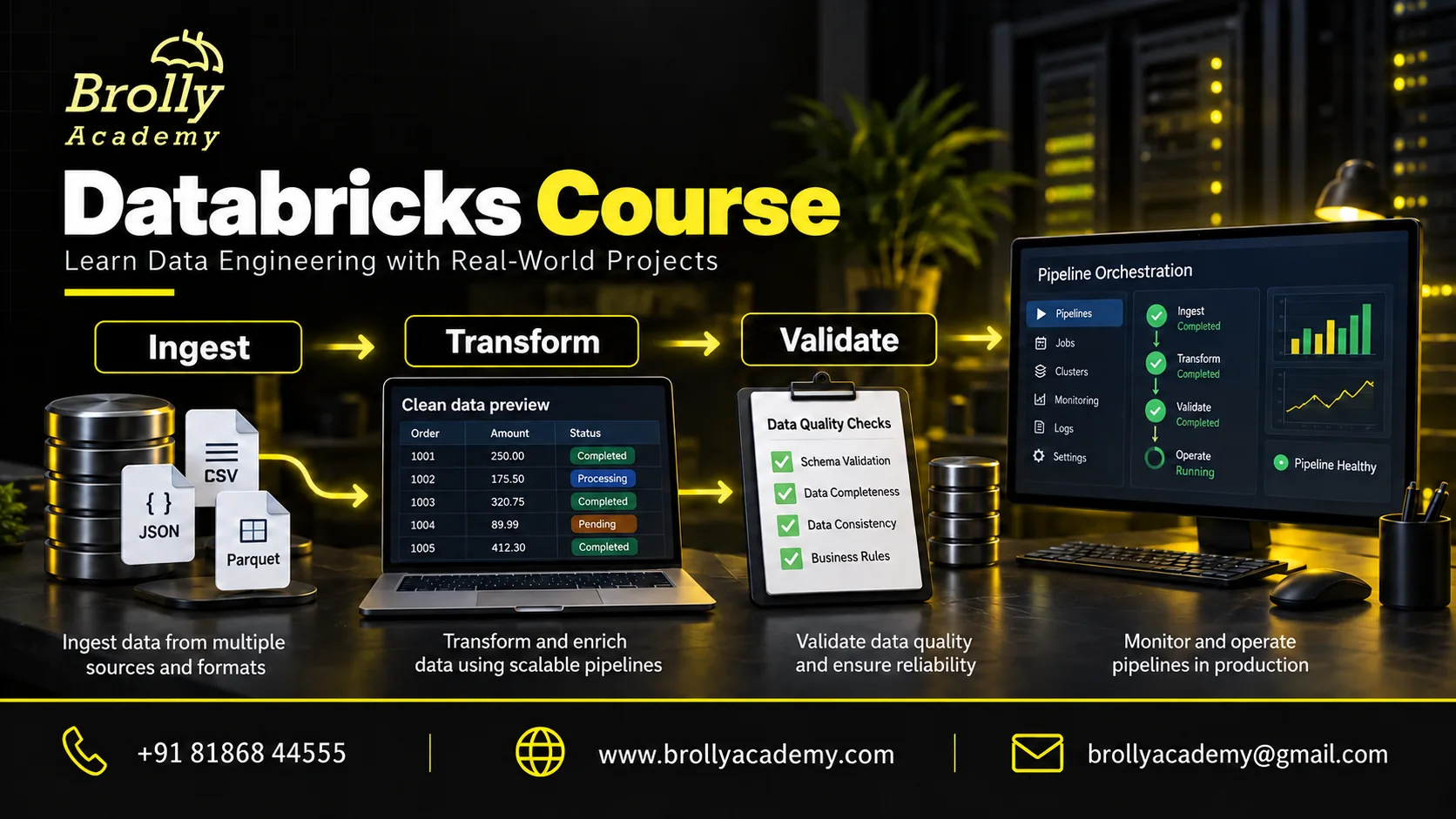
Illustrative learning workflow. Screens, figures and scenarios are examples, not student results or live product screenshots.
Stage 1: Build the foundationPrepare the workspace, practise SQL and PySpark, and build transformations with explicit schemas and quality checks.
Stage 2: Apply and validateCreate Delta-based layers, handle changes and duplicates, and demonstrate a safe rerun with reconciled outputs.
Stage 3: Present your workDeliver the pipeline, test evidence and runbook. Reproduce one failure and show a recovery that preserves data correctness.
Databricks: 8-Week Study Plan
Use these milestones to organise practice around the eight modules. Move on when you can explain and demonstrate the output, not just when you have watched a lesson. This suggested pace is separate from your batch timetable.
Weeks 1-2: Query and transformPrepare the workspace, practise SQL and PySpark, and build transformations with explicit schemas and quality checks.
Weeks 3-4: Reliable tablesCreate Delta-based layers, handle changes and duplicates, and demonstrate a safe rerun with reconciled outputs.
Weeks 5-6: Operate and governOrchestrate dependencies, investigate failures, review access and examine performance evidence before tuning.
Weeks 7-8: Capstone and handoverDeliver the pipeline, test evidence and runbook. Reproduce one failure and show a recovery that preserves data correctness.
3 Practical Project Scenarios
These are teaching scenarios using approved lab systems and synthetic data. They are not claims about live client work or previous student results.
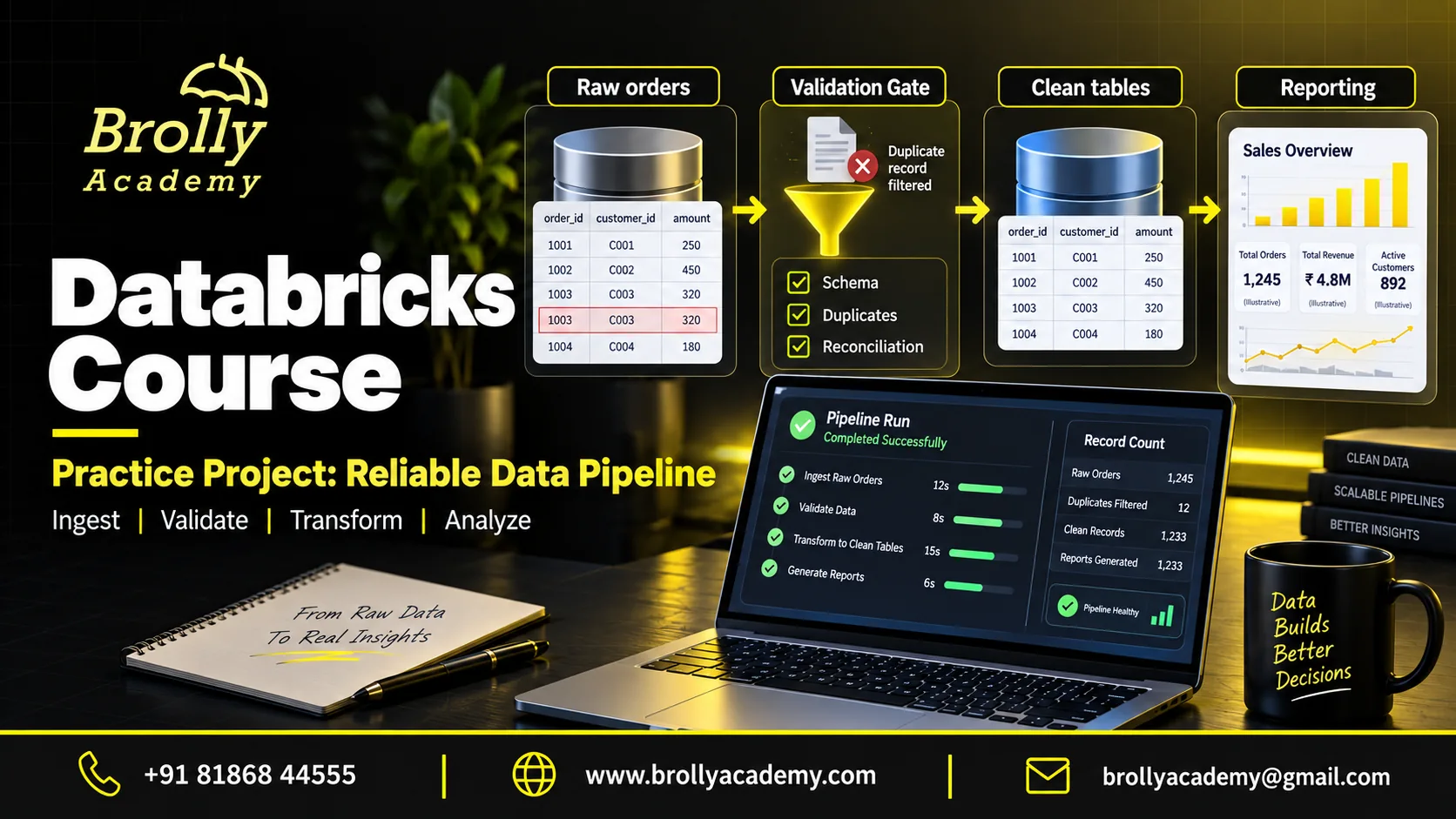
Illustrative practice project. Screens, figures and scenarios are examples, not student results or live product screenshots.
Retail orders pipelineTransform fictional order and return files into daily sales tables. Check duplicate orders, invalid totals and reprocessing.
Service-events pipelineProcess synthetic event data with late arrivals and missing fields. Document quality rules and recovery behaviour.
Governed reporting datasetBuild a curated table, define reader and editor access, and show the lineage and handover checks available in the lab.
How the Skills Work in Practice
A fictional retailer resends yesterday's orders after fixing several records. Appending the file again would double count sales. Choose a stable business key, define update behaviour and preserve enough information to explain the change.
Run the same delivery twice and compare the final totals. Then introduce a malformed row and check how the pipeline reports it. This exercise connects data correctness, replay behaviour and operational visibility rather than celebrating a green job status alone.
Try a Databricks Exercise: Reconcile a Small Orders Dataset
Start with four synthetic records containing order_id and amount: A100 with 100, A101 with 50, a second identical A101 with 50, and one record with no order_id and amount 25. Define the duplicate and missing-key rules before writing transformations. Keep the raw input unchanged.
1. Record the input checksCount four input rows and an input amount total of 225. Mark the missing-key row for separate review. Treat the repeated A101 as a duplicate only because this exercise defines order_id as a unique order and the records are identical.
2. Apply explicit quality rulesRetain one A101, keep A100 and quarantine the record without an identifier. Do not silently discard records. Save a reason for each duplicate or rejected record so a reviewer can trace the difference between raw and clean data.
3. Test the output and rerunExpect two clean rows totalling 150, one duplicate totalling 50 and one quarantined row totalling 25. The amounts reconcile to 225. Rerun the same batch and check that the destination does not gain another copy of the accepted orders.
What to keep: Keep a small notebook or SQL script, the input and output counts, a reject-reason table and a repeat-run check. In real datasets, agree business keys and update rules before removing duplicates; not every repeated value is an error.
Continue with the Databricks guidance on Delta table merges.
How Your Databricks Project Can Be Reviewed
Demonstrate correct source-to-target totals, a duplicate-input replay, a failed-run recovery and a permission boundary. Deliver versioned code, a data dictionary, quality results and an operational runbook. Report only performance improvements you actually measured.
Common Databricks Mistakes and How to Avoid Them
Use this checklist when reviewing your practice work. Correct the cause of an issue and keep a short explanation of what changed.
Removing duplicates without a business ruleChoose the key and decide how to handle conflicting versions before deduplicating. An order update may be legitimate, not a row to delete.
Checking only whether the job completedA successful run can still produce wrong totals. Check schema, row counts, rejected records and a meaningful reconciliation.
Ignoring repeat runs and operating costsTest what happens when input arrives twice. Review the selected compute setup and stop unused resources according to your lab rules.
What Your Databricks Portfolio Should Show
A strong data-engineering project can be run again by someone else and explains what happens when inputs are late, invalid or repeated.
Data contractDocument input schema, business keys, expected volumes and rules. Include intentionally bad records to demonstrate handling.
Pipeline evidenceShow layer outputs, reconciliation checks, rerun behaviour and a controlled failure. Keep sensitive values out of logs and screenshots.
Operational runbookDocument parameters, permissions, dependency order, recovery and cost considerations. Explain limitations of the learning environment.
Why Learn with Brolly Academy?
Choose a course that connects the subject to work you can actually demonstrate. Use a demo to discuss the learning path and decide whether it fits your starting point.
A connected learning pathThe eight-module outline moves from foundations to an integrated task. Each module identifies an output rather than leaving practice as a vague promise.
Discuss your own learning goalShare your experience and preferred format with the course team. Use a demo to assess whether the technical depth, pace and project expectations fit your needs.
Clear course boundariesThe page explains prerequisites, product scope and the difference between training completion and independent certification. You can compare the offer with your actual requirements.
Compare Brolly Academy with Other Training Institutes
Compare the same evidence from each provider: the tasks you will complete, the feedback you will receive and the services the fee includes. Request a demo and a written outline before deciding.
What to discuss with Brolly AcademyReview these eight modules and the three project scenarios.
Ask for the assigned trainer profile.
Check the lab version and access period.
Review the fee, schedule and certificate terms.
Use the demo to assess the teaching approach.
What to check with any instituteRequest a detailed outline, not just product names.
Verify the trainer information supplied.
Separate demonstrations from your own lab work.
Check licences, exam costs and refund conditions.
Compare the total commitment, not only the advertised price.
Databricks vs PySpark vs a Cloud Data-Engineering Course
Databricks is a platform; PySpark is a programming interface used for distributed processing. A wider cloud course covers additional services and architecture.
Databricks CourseChoose this for a platform workflow covering notebooks, Delta tables, jobs, governance and operational data pipelines.
PySpark TrainingChoose deeper Spark programming when transformations, execution plans and distributed-processing behaviour are your main gap.
Cloud data engineeringChoose a broader path when your goal includes cloud storage, identity, networking and several integration services beyond Databricks.
Classroom, Online and Corporate Learning
Discuss the currently available delivery format with the academy before booking. Batch availability and session timings should be agreed in writing.
Classroom learning enquiryConfirm the venue, next available batch and computer requirements before arranging travel.
Live online enquiryCheck the session time zone, remote lab access and arrangements for asking questions or catching up on a missed session.
Corporate team enquiryShare your team size, current tools and learning objectives. Agree a scoped program without sharing confidential business data.
For a team program, explore Brolly Academy corporate training.
Upcoming Batch: Monday, 2 November 2026
The upcoming Databricks Course batch starts on Monday, 2 November 2026. Contact the course team for class timings and total live teaching hours. The suggested study plan above organises your practice; it is separate from the class timetable.
Brolly Academy lists weekday morning, weekday evening and weekend learning options. Share your preferred format when enquiring. See the academy course schedule and ask about availability for your selected course.
Check Batch TimingsHow Your Databricks Learning Sessions Work
Connect every topic to a task and a piece of evidence. Use this learning cycle with the modules, practice scenarios and review checklist on this page.
1. Understand the taskStart with the problem, the expected output and the reason the concept matters. Write a SQL aggregation and a simple Python transformation on synthetic data, then describe the expected output and checks.
2. Practise and investigateComplete a small exercise in the agreed learning environment. Keep parameters, dependencies and setup instructions clear. Do not save tokens, passwords or cloud keys in notebooks or exports.
3. Review and improveCompare your work with the project checklist, record one weakness and revise it. Explain schema decisions, duplicate handling and reconciliation against source records.
How to Join the Databricks Course
Choose a learning format that fits your starting skills and practice time. A course enquiry does not commit you to a payment.
1. Share your goalTell us your present role, prior knowledge and the kind of work you want to do. Use the demo form or WhatsApp so the team can suggest the appropriate starting point.
2. Attend a demoAsk to see a small pipeline rerun safely, including how duplicate records and a failed step are handled.
3. Review your course offerCheck the fee, final taxes, learning scope, assigned mentor, batch timings, venue or online access, practice resources and support arrangements in writing.
4. Start with a baseline taskWrite a SQL aggregation and a simple Python transformation on synthetic data, then describe the expected output and checks.
Databricks Course Fee, Duration and Course Offerings
Databricks Course training fee: INR 22,999. The fee covers the course learning path and practical exercises described here. Ask for the final payable amount and the batch timetable before payment; any applicable taxes and optional third-party charges must be itemised in your enrolment quotation.
Training fee: INR 22,999Eight learning modules, structured practice and project preparation. Build a body of work that you can revise, explain and demonstrate. Corporate or individually customised training is quoted separately.
8-week learning planBuild SQL and PySpark foundations first, then add Delta tables, pipeline orchestration, governance and a reproducible capstone. This is a suggested study plan, not a published batch calendar. Teaching dates, live hours and classroom availability are agreed at enrolment.
Understand the complete costCloud compute, storage, premium platform features and external certification exams can cost extra. Confirm the practice workspace and spending limits before creating paid resources. External examinations, paid software and optional subscriptions are not included unless your written quotation lists them. Review payment and refund terms before enrolling.
What the Learning Package Covers
Eight-module syllabusA connected sequence of foundations, applied work and project preparation. The complete outline is visible above and available as an editable download.
Course-specific practiceUse the agreed Databricks environment and a small synthetic dataset. Identify where data is stored and who can read or change it.
Three project scenariosChoose an integrated task from the three scenarios on this page and retain evidence of your decisions and checks.
Portfolio and interview preparationExplain schema decisions, duplicate handling and reconciliation against source records.
Editable learning resourcesUse the syllabus checklist to track modules and the project-review sheet to record completed work and open questions.
Completion and next stepsComplete the agreed coursework and assessment, then document the skills and project evidence that support your course completion.
Databricks Course Completion Certificate and Assessment
After completing the coursework and assessment agreed for your batch, you receive a Brolly Academy Databricks course completion certificate. Keep your project evidence alongside it so you can explain the skills you practised. Attendance and submission requirements are provided in your course offer.
Academy course completionSubmit a reproducible SQL or PySpark pipeline, quality-check results, a safe-rerun demonstration and an operations runbook.
Know which credential you receiveDatabricks Certified Data Engineer Associate is a separate vendor credential. Review its current exam guide and requirements with Databricks; course completion alone does not award that certification.
1. Complete the learning workWork through the agreed modules and practical assignments. Keep a record of completed tasks and questions needing review.
2. Present and revise your projectSubmit a reproducible SQL or PySpark pipeline, quality-check results, a safe-rerun demonstration and an operations runbook. Explain what you personally completed and address the assessment feedback.
3. Record your completionConfirm the name and course title for your certificate with the academy. Keep your own project link, completion record and certificate together for future applications.
For a separate vendor credential, consult Databricks Data Engineer Associate exam information. Exam registration and charges are separate unless expressly listed in your course offer.
Career Roles and Skill Applications
Match the learning path to a role, then compare its requirements with your existing experience. The course can support skill development; it does not guarantee employment.
Data engineerBuild and maintain ingestion and transformation pipelines.
Analytics engineerCreate tested, documented datasets for analytical use.
Data platform contributorSupport governed access, repeatable jobs and operational troubleshooting.
You can also explore MLOps Training. Extend a working prototype into a monitored, repeatable deployment workflow.
Evidence to Prepare for Your Target Role
A correct pipelineExplain schema decisions, duplicate handling and reconciliation against source records.
A failure investigationShow how you distinguish code, data, permission and resource failures.
A reproducible handoverProvide setup instructions, parameters, validation checks and recovery steps another person can follow.
Databricks Industry Applications and Changing Skills
Databricks skills are relevant to analytical platforms, batch and streaming data workflows and shared data products. Actual roles require a mix of SQL, programming, cloud knowledge and business understanding. A platform certificate alone does not establish production experience.
Retail and operationsCombine orders and reference data into consistent reporting tables. Check changing records and late-arriving events.
Analytics platformsPrepare trusted datasets for analysts with defined access and lineage. A dashboard is only as dependable as its source tables.
AI data preparationApply cleaning, governance and traceability before downstream AI use. Data engineering is distinct from training a model.
Databricks Market Trends and Current Learning Priorities
Modern Databricks work combines transformation with governance and operational reliability. Unity Catalog documentation describes access control, lineage and auditing, which explain why the syllabus includes more than notebooks. Further reading: Databricks Unity Catalog documentation.
Governance alongside engineeringPractise least-privilege access and understand how a catalog organises governed data assets.
Lineage and accountabilityTrace how an input becomes a reporting table so a change can be investigated before downstream users rely on it.
Reliable data for AIPrepare quality-controlled datasets and clear access boundaries before reusing data in analytics or AI workflows.
Databricks Placement Preparation and Career Support
Build a job-search package around work you can demonstrate. The preparation below covers your resume, profile, project explanation and interview practice. Confirm which guided sessions are included in your batch; this is placement preparation, not a guaranteed job or employer referral.
Explain a projectDescribe the requirement, your decisions, the result and one limitation. Be ready to answer what you would change for a real deployment.
Show useful evidenceKeep approved files, test results and a concise README or runbook. Remove secrets and private information before sharing a portfolio.
Discuss support servicesAsk the academy which resume, mock-interview or job-search services are included in your batch. Placement assistance is not a job or salary guarantee.
Data correctnessExplain deduplication, merge assumptions and what happens when a business key is missing.
Performance diagnosisDescribe what you inspect before adding more compute: plan, joins, partitions, data volume and skew.
Recovery and operationsWalk through a failed pipeline and show how you resume without duplicating output or hiding bad records.
Use your completed project to write an honest resume entry: problem, your contribution, tools, checks and what changed after feedback. Label practice projects as learning work. Course completion and interview preparation do not guarantee a job, a salary increase or interviews with named employers.
Resume preparationTurn your course project into a clear entry: the problem, your contribution, tools, validation and limitation. Label it as training work rather than paid employment.
LinkedIn and portfolio profileUse a role-focused headline, concise skills and links to permitted work. Describe what you can demonstrate instead of adding unsupported experience.
Technical or case interviewExplain deduplication, merge assumptions and what happens when a business key is missing.
Mock presentation and HR practiceRehearse a short introduction, a project walkthrough and a specific example of responding to feedback. Ask for feedback on clarity as well as subject knowledge.
Application planningChoose vacancies that match your current experience, note their requirements and track applications and follow-ups. A course name alone is not a role match.
Skill-gap follow-throughUse interview feedback to plan the next exercise. Revisit weak foundations rather than repeatedly memorising a model answer.
Databricks Career and Salary Benchmarks
Salary depends on the role, prior experience, location and the employer. A tool course alone does not establish a salary band. Compare recent job descriptions, required experience and responsibilities rather than relying on a headline income promise.
Databricks is commonly a skill within data-engineer and analytics-engineer roles, not a single uniform job title. Compare openings by SQL/Python expectations, cloud stack, responsibility and experience. A certificate or platform name alone does not determine compensation.
Data Engineer: broader roleINR 9,65,396 per yearReported average base salary in India. This is market context, not take-home pay or a course outcome.
Source and dateIndeed: Data Engineer. approximately 1,100 reported salaries; source updated 20 September 2026. Checked 4 October 2026.
How to interpret this figureAn India-wide Data Engineer average, not a Databricks-only or fresher-only figure. Cloud, SQL, Python and operating responsibilities affect individual offers. Compare like-for-like responsibilities, location and experience; averages cannot predict your individual offer.
Meet Ravi, Your Databricks Trainer
Learn Databricks with Ravi. Use a free demo to discuss your starting skills, the practical work in the syllabus and how your assignments will be reviewed. Bring a question from the course outline so the discussion is relevant to your goal.
Pipeline reasoningDiscuss what the mentor would check when a rerun doubles row counts or a join unexpectedly increases records.
Debugging walkthroughAsk to inspect a failed job and distinguish input, code, permission and resource problems before changing the configuration.
Project feedbackAgree how notebook quality, data correctness and runbook clarity will be assessed, and request the assigned trainer profile.
Read about Brolly Academy instructors and request the profile of the trainer assigned to your batch.
Get Trainer ProfileBrolly Academy Learner Feedback
Read available academy feedback and ask whether a review relates to this particular course, trainer and delivery format. General academy reviews should not be mistaken for verified results from this new course.
These excerpts come from the academy's published Data Science testimonials, not reviews of this new Databricks course. Read the full context on the Brolly Academy reviews page.
Aditya - Data Science"a clear and practical understanding of data science concepts"
Kavita Singh - Data Science"The hands-on projects helped me apply the concepts effectively."
Keep Learning with the Brolly Academy Community
Follow the Brolly Academy WhatsApp channel for public academy updates. Ask which batch discussion or mentor-support options are available for this course. When requesting help, share a small permitted example, the result you expected and the specific problem you found. Remove private data, credentials and employer material.
Pipeline peer reviewExchange a small synthetic dataset and compare output checks. Investigate any difference before assuming either result is correct.
Runbook rehearsalHave a peer follow your setup and recovery instructions, then improve the steps they could not reproduce.
Download Your Practice Checklists
Download an eight-module syllabus checklist and a project-review sheet. Both are editable CSV files with usable content, so you can track practice and discuss your questions during a demo.
Download Syllabus (CSV) Project Checklist (CSV)Official Documentation for Further Reading
These original sources support further learning. Their availability does not imply that Brolly Academy is endorsed, accredited or authorised by the organisations that publish them.
Databricks data engineering documentation
Databricks training and certification
Delta Lake documentation
Related Courses at Brolly Academy
Choose complementary learning based on your current skill gaps. These are separate courses, not automatically included in this program.
SQL CourseBuild query, join and aggregation skills before working with larger analytical pipelines.
View SQL Course
PySpark TrainingStudy Spark programming in greater depth alongside the Databricks platform workflow.
View PySpark Training
MLOps TrainingExtend a working prototype into a monitored, repeatable deployment workflow.
View MLOps Training
Visit Brolly Academy or Enquire Online
Call +91 81868 44555 or send a course enquiry to discuss the syllabus and current batch options. For a classroom visit, confirm the venue and appointment with Brolly Academy before travelling.
Main office near JNTU MetroMetro Pillar No. A689, 3rd Floor, Dr Atmaram Estates, beside Sri Bhramaramba Theatre, Hyder Nagar, Vasantha Nagar, Hyderabad, Telangana 500072. Confirm your classroom venue and appointment before travel.
Directions and course enquiryGet directions to Brolly Academy. Call +91 81868 44555 to discuss your course and a suitable visit time.
Online learning enquirySend your preferred time zone and learning goal to brollyacademy@gmail.com. Discuss current online batches, lab access and the device you plan to use.
Read our contact details for the academy location and enquiry options. Online delivery, session time zones and tool access should be confirmed for your batch.
Call +91 81868 44555 Get DirectionsDatabricks Course FAQs
Do I need SQL and Python first?
Yes, working knowledge is recommended. The course applies queries and Python to data workflows rather than teaching complete programming foundations from the beginning.
Is Databricks the same as Apache Spark?
No. Spark is a processing engine. Databricks provides a managed platform and surrounding capabilities for collaboration, data engineering and governance. The exact services depend on the environment.
Will the course use Azure or AWS?
Confirm the batch environment before enrolling. The core data-engineering concepts transfer, but identity, networking, storage setup and some platform features differ between cloud deployments.
Are cloud charges included?
Do not assume they are. Ask which workspace, compute and storage will be used, who pays for them and what spending limits apply. Stop unused resources according to the lab instructions.
Does this cover machine learning?
The primary scope is data engineering. Preparing useful data may support later ML work, but model development and MLOps need their own deeper learning paths.
What are bronze, silver and gold layers?
They are a common way to separate raw, refined and business-ready data. The names do not automatically ensure quality; each layer still needs clear contracts, checks and ownership.
Will I become Databricks certified after this course?
Training completion is not a Databricks credential. Check the current official exam guide, prerequisites, registration process and fees for the certification you intend to pursue.
What makes a useful Databricks portfolio project?
Show source data, transformations, quality tests, rerun behaviour, permissions and a readable handover. A notebook screenshot alone does not prove the pipeline is reliable.
What are the course fee and duration?
The training fee is INR 22,999. The page includes a suggested 8-week learning plan. Confirm the actual class calendar, live hours and final payable amount before payment. Paid third-party tools and external exam fees are separate unless listed in the enrolment quotation.
Can I attend online or in a classroom?
Contact the course team to check current online and classroom availability. Confirm the session time zone, venue, equipment and missed-session arrangements before you enrol.
Does training include an external certification?
Course completion and an external vendor or professional certification are different. Ask for Brolly Academy completion requirements. External exam registration, eligibility, fees and vouchers must be confirmed separately with the issuing body.
How can I check whether this course suits me?
Book a free demo or send your background and learning goal on WhatsApp. Request the assigned trainer profile, sample exercise, confirmed syllabus and complete enrolment terms before making a decision.
Should I learn SQL before Databricks?
Yes. Joins, aggregations, null handling and data modelling make platform exercises easier to understand. Strengthen these before complex pipelines.
Does this include Azure and AWS administration?
The core is Databricks data-engineering practice. Broader cloud networking, identity and infrastructure administration are separate subjects; confirm the cloud used by your batch.
Will every lab work in a free account?
Not necessarily. Feature availability and usage limits depend on the environment. Confirm the lab plan before paying for resources or assuming production features are free.
Will I get a job guarantee?
No job or salary guarantee is included. The course develops skills and project evidence. Hiring depends on your preparation, wider experience, interview performance and employer requirements. Discuss the career-support services included in your batch.
What happens if I miss a class?
Ask the team for the catch-up arrangement for your selected batch before enrolling. Recording access, repeat sessions and individual reviews depend on the written course offer; do not assume unlimited access or lifetime support.
How can I get a free demo and the syllabus?
Use Book Free Demo to open the enquiry form, or WhatsApp Us to message the course team. The syllabus and project-review checklist are available in the downloads section on this page.
When does the next Databricks Course batch start?
The upcoming batch starts on Monday, 2 November 2026. Use Check Batch Timings or call +91 81868 44555 for the class timetable and total live teaching hours. Ask about alternative weekday or weekend options if this date does not suit you.
Got Questions About the Databricks Course?
Talk to our team about your starting skills, learning goal and current batch availability. Request a demo, ask for the assigned trainer profile and review the complete fee and course terms before enrolling.