LLM WORKFLOWS · LANGGRAPH · API INTEGRATION · HUMAN APPROVAL
AI Orchestration Course in Hyderabad
Build connected AI workflows with models, APIs, retrieval and human approvals. This one-month AI Orchestration course at Brolly Academy focuses on Python, LangGraph, workflow automation, evaluation and a practical capstone. Learn online, offline in Hyderabad or in a hybrid format with Madhu Mitha.
One month · 16 focused modules · Practical workflow projects · Free demo
Trainer: Madhu Mitha · Online ₹10,000 · Offline ₹15,000 · Hybrid ₹13,000
TrainerMadhu Mitha
Duration1 month
Online fee₹10,000
Learning modesOnline · Offline · Hybrid
AI Orchestration Training at Brolly Academy
Brolly Academy's AI Orchestration Course in Hyderabad is a one-month, hands-on program taught by Madhu Mitha. Learn Python-based workflows, APIs, LangGraph, retrieval, human approval, evaluation and deployment through guided exercises and a capstone. Choose online training at INR 10,000, offline classroom training at INR 15,000 or hybrid training at INR 13,000. The course includes a completion certificate, placement assistance, lifetime video access and EMI with no additional charges.
Start with a clear user task, build the smallest useful workflow, then add retrieval, routing, state and safeguards. The course moves beyond a single prompt to the engineering decisions behind useful AI applications: validated inputs, predictable handoffs, recovery from failure and evidence that a change actually helped.
Why choose Brolly Academy for AI Orchestration training?
Training and support✓ Trainer-led learning with Madhu Mitha
✓ Hands-on Python, APIs, LangGraph and n8n practice
✓ RAG, routing, approvals and failure-recovery workflows
✓ Guided exercises and a practical capstone project
✓ Workflow documentation and evaluation evidence
✓ Resume support and career preparation
✓ Mock interviews and technical interview preparation
✓ Placement assistance
Flexibility and value✓ Online, offline and hybrid learning options
✓ Weekday and weekend batches
✓ Focused one-month course
✓ Free demo before enrolment
✓ EMI with no additional charges
✓ Lifetime access to course video recordings
✓ Lifelong course-related doubt support
✓ Brolly Academy course-completion certificate
AI Orchestration Course Syllabus: 16 Focused Modules
The one-month curriculum combines concise concept sessions with connected practice. Python readiness matters: complete foundation work before the batch if you are new to programming. Confirm teaching hours, lab time and the final calendar in your course offer.
Module 1: Workflow Thinking and Use-Case Scoping
Identify the user, task, source data and measurable acceptance criteria. Decide which steps should use ordinary code and where a model may help. Practice: write a workflow brief with an explicit stop condition and a manual fallback.
Module 2: Python, JSON and API Readiness
Use functions, dictionaries, exceptions, virtual environments and environment variables. Read JSON responses and handle missing fields. Practice: call a sample API, validate its response and keep credentials outside source code.
Module 3: Model Calls and Structured Outputs
Separate system instructions, user inputs and retrieved content. Define a schema for classification or extraction and validate returned fields. Practice: turn a support request into a typed record without treating generated text as trusted code.
Module 4: Tool Contracts and Permission Boundaries
Describe tool inputs, outputs, allowed actions and failure responses. Distinguish read-only lookups from actions that change external systems. Practice: build a restricted lookup tool and reject invalid or unauthorized arguments.
Module 5: Sequential Workflows and Prompt Chains
Break a task into small steps with inspectable intermediate outputs. Pass only the context the next step needs. Practice: extract facts, draft a response and check it against a rubric, with a clear error path at every stage.
Module 6: Routing, Branching and Parallel Steps
Choose routes using rules or a validated model decision. Combine independent results and define what happens when one branch fails. Practice: route incoming requests to a knowledge lookup, an account query or a human queue.
Module 7: LangGraph State and Execution
Represent a workflow using state, nodes and edges. Make state changes explicit and inspect the route taken by a request. Practice: implement a small stateful workflow and compare its behavior with a simpler Python baseline.
Module 8: Retrieval as a Workflow Component
Prepare permitted documents, retrieve relevant passages and carry source references into the answer. Add an insufficient-evidence route. Practice: answer a question with citations or explain why the available documents cannot support an answer.
Module 9: Human Approval and Escalation
Pause before sensitive actions and show the reviewer the proposed action and supporting context. Handle rejection, changed inputs and expired approvals. Practice: review an outbound response before a mock send step is allowed.
Module 10: Persistence, Retries and Recovery
Distinguish transient failures from invalid requests. Set retry limits, timeouts and idempotency keys for side effects; understand checkpoint recovery. Practice: resume an interrupted run without creating a duplicate action.
Module 11: n8n and Business-System Integration
Connect triggers, webhooks, data transformations and an AI step in a visual workflow. Keep credentials scoped and test integrations using sample data. Practice: send a structured result to a test destination with an approval branch.
Module 12: Bounded Agents and Multi-Agent Patterns
Compare a fixed workflow, a single tool-using agent and a multi-agent arrangement. Use a handoff only when responsibilities are genuinely different. Practice: add a specialist review step with a task boundary, iteration limit and final owner.
Module 13: Evaluation and Failure-Case Testing
Create a small evaluation set covering normal inputs, ambiguity, missing data, tool failures and adversarial text. Compare task completion, factual support and unauthorized-action attempts. Practice: keep a before-and-after test report.
Module 14: Tracing, Cost and Latency
Inspect model calls, tool calls and state transitions. Redact sensitive data in traces and identify repeated work. Practice: measure run time and token usage, then reduce unnecessary calls without weakening the acceptance checks.
Module 15: Deployment and Operational Controls
Package the application with configuration, access controls, health checks and usage limits. Separate development and production credentials. Practice: demonstrate a controlled deployment and write a rollback and resource-cleanup checklist.
Module 16: Capstone, Documentation and Handover
Bring the workflow together in one scoped project. Submit the architecture, reproducible setup, evaluation evidence and known limitations. Practice: demonstrate a successful run, a failed run and the recovery path in a short technical presentation.
Get the AI Orchestration syllabus and batch details
Discuss your Python experience, preferred learning mode and project goal. Our team can share the batch calendar and written course offer before you decide.
AI Orchestration Learning Roadmap: One Month
Move from a small working flow to a tested, documented application. The roadmap shows the learning sequence; the sample screens and dashboard figures are illustrative, not student results.
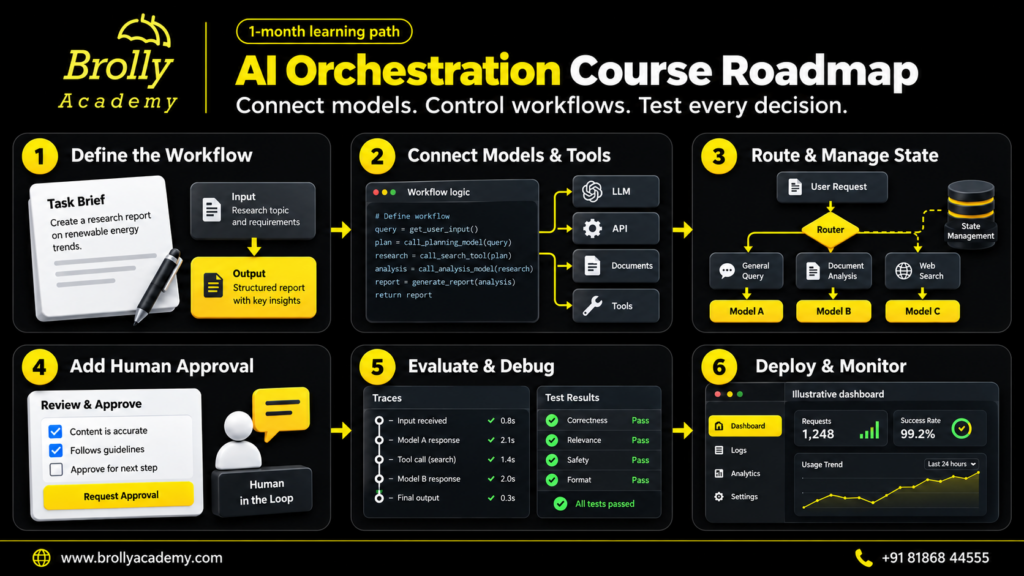
Week 1: Define and connectScope a useful task, prepare Python and API access, validate structured outputs and connect a restricted tool. Deliverable: a working baseline with a written input/output contract.
Week 2: Route and retrieveBuild branches, pass state between steps and add document retrieval where the task needs evidence. Deliverable: a traceable workflow with an insufficient-evidence path.
Week 3: Control and testAdd human approval, bounded retries and failure-case tests. Compare a deterministic flow with an agentic step. Deliverable: an evaluation set and a recovery demonstration.
Week 4: Deploy and explainComplete a scoped capstone, measure usage and latency, and document setup, limits and handover. Deliverable: a portfolio-ready demonstration with reproducible evidence.
What Is AI Orchestration?
AI orchestration is the coordination layer around an AI application. It controls how information moves between model calls, retrieval, software tools and people, including the rules for routing, approval, failure handling and completion.
ModelThe model interprets or generates content. Its response is an input to your application, not automatic permission to perform an action.
WorkflowA sequence or graph defines the path through the task. Use fixed rules where the next step must be predictable.
Tools and APIsTools connect the workflow to a capability, such as a document lookup. Their contracts define valid inputs and permitted operations.
StateState carries the information needed across steps. Store only what the task requires and keep unrelated users and runs separated.
RetrievalRetrieval supplies relevant evidence from permitted sources. The workflow must handle missing, conflicting or outdated evidence.
RoutingRouting selects a path for the request. Validate model-generated route names before dispatching to the next step.
Human approvalA reviewer can approve, change or reject a proposed action. Sensitive writes should not proceed merely because a model recommended them.
EvaluationTest a workflow against representative cases and compare it with a baseline. A fluent answer is not enough to prove task completion.
OperationsMonitor latency, errors and usage after deployment. Make ownership, recovery and rollback understandable to the next engineer.
Benefits of the AI Orchestration Course in Hyderabad
The learning outcome is a small, explainable AI application with controlled behavior. You should be able to show how the workflow works, what can fail and how your tests support the design.
01Turn a process into a workflowMap inputs, decisions, tools and outputs before choosing a framework.
02Connect software and AIPass validated data between a model, an API and an application step.
03Make decisions inspectableRecord why a request took a route and which evidence informed the answer.
04Handle uncertaintyAsk for missing information or escalate when the system cannot safely finish.
05Protect sensitive actionsSeparate drafting from sending, proposing from approving and reading from writing.
06Recover from interruptionUse timeouts, bounded retries and duplicate-action protection in practice.
07Evaluate changesRun the same test cases before and after a change instead of judging a single impressive demo.
08Understand operating costTrack usage and latency, set limits and identify avoidable model calls.
09Explain the finished systemPresent a workflow diagram, test report, setup guide and known limitations.
Thinking of AI Orchestration Training in Hyderabad?
Compare self-directed study with a structured, trainer-led course. Both can support learning; the right choice depends on how much guidance, practical feedback and career support you need.
Self-directed learning• Choose your own resources and pace
• Assemble a learning sequence independently
• Set up your own API and workflow exercises
• Arrange project feedback separately
• Investigate errors using documentation and forums
• Build your own evaluation and revision plan
• Organise resume and interview preparation separately
• Check each resource's access and support terms
Brolly Academy training✓ One-month structured plan with Madhu Mitha
✓ Connected Python, API and LangGraph practice
✓ Guided workflow exercises and a capstone
✓ Routing, retrieval and human-approval controls
✓ Evaluation and failure-case testing
✓ Resume support, mock interviews and placement assistance
✓ Lifetime video access and lifelong course-related doubt support
✓ Online, offline or hybrid learning with no-extra-charge EMI
Meet Your AI Orchestration Trainer
AI ORCHESTRATION COURSE TRAINER
Madhu Mitha
One-month program · Online, offline and hybrid learning
Madhu Mitha is the trainer for Brolly Academy's AI Orchestration course. The course connects workflow design with practical model calls, tool integration, retrieval and human approval. Sessions move from a worked example to learner practice, failure-case testing and a clear explanation of the result. Use the free demo to discuss your starting level, review the lab approach and confirm the feedback arrangements for your batch.
AI Orchestration Tools and Skills You Will Practice
Python and JSONFunctions, exceptions, typed records and validation for reliable data exchange.
Model APIsPrompt structure, structured output, tool calls and safe credential handling.
LangChain componentsModel and tool integrations that support a small application workflow.
LangGraphExplicit state, nodes, edges and controlled transitions between steps.
Retrieval workflowsDocument preparation, source references and insufficient-evidence handling.
n8n integrationTriggers, webhooks and practical handoffs between a visual workflow and APIs.
Human-in-the-loop controlsReview checkpoints, rejection paths and escalation before sensitive actions.
Testing and tracingRepresentative cases, run histories and investigation of failed outputs.
Deployment fundamentalsConfiguration, access boundaries, usage limits, monitoring and a handover guide.
Practical AI Orchestration Projects
Use these six practice scenarios to apply the modules. Complete guided exercises and select one scoped capstone for a deeper build. Examples use synthetic or permitted data; they are learning projects, not claims of paid client delivery.
Project 1Support Request TriageInput: sample support tickets.
Workflow: validate, classify, retrieve a relevant guide and draft a reply.
Control: route sensitive or unclear requests to a person.
Evidence: routing tests and an approval log.
Project 2Document Intake and ValidationInput: synthetic application documents.
Workflow: extract fields, validate their format and identify omissions.
Control: reject unsupported values rather than invent them.
Evidence: an exception report and extraction test cases.
Project 3Knowledge Assistant with SourcesInput: permitted product or policy documents.
Workflow: retrieve passages, draft a grounded answer and attach sources.
Control: abstain when evidence is missing.
Evidence: citation checks and a retrieval evaluation set.
Project 4Research Brief with ReviewInput: a topic and a defined source list.
Workflow: collect evidence, summarize findings and compare claims.
Control: keep sources attached and require editorial review.
Evidence: a source-backed brief and contradiction log.
Project 5Approval-Based Operations FlowInput: a mock internal service request.
Workflow: validate, perform a read-only lookup and prepare an action.
Control: approve before a test-system write; prevent duplicates.
Evidence: rejected-action and recovery demonstrations.
Project 6AI Workflow Evaluation HarnessInput: saved sample requests and expected outcomes.
Workflow: run cases, collect traces and compare versions.
Control: cap retries, redact sensitive fields and flag regressions.
Evidence: a repeatable quality, cost and latency report.
Your capstone handover: a clear problem statement, workflow diagram, repository or workflow export, setup instructions, test cases, observed results and known limitations. Explain both a successful run and a case the system should refuse or escalate.
How Practical AI Orchestration Training Works
Each exercise connects a concept to a complete task. Start with a small working version, investigate a failed case, then demonstrate what changed and why. The emphasis is on understandable decisions and repeatable evidence.
01. Understand the requirementIdentify the user, input data and useful output. Write acceptance criteria and decide which actions need approval before selecting a framework.
02. Follow a worked exampleInspect a small workflow with Madhu Mitha. Trace the model call, tool input, state change and final result so each step has a clear purpose.
03. Build your own versionModify the input, route or integration using synthetic or permitted data. Keep a baseline that you can run again after every change.
04. Test the failure pathsTry missing fields, unsupported questions, denied tool access and timeouts. Record expected behavior instead of testing only the successful path.
05. Review and improveUse test results and feedback to revise the workflow. Compare task quality, latency and usage without hiding cases that still fail.
06. Demonstrate and hand overPresent the capstone, explain its limitations and provide setup instructions. Show the reviewer how to reproduce a run and recover from interruption.
Practice beyond the live class: revisit class video recordings with lifetime access, continue the exercises between sessions and bring course-related questions to the lifelong doubt-support channel shared at enrolment.
AI Orchestration Course Fees and Learning Options
Choose the format that fits your schedule. All three options are for the one-month AI Orchestration course with trainer Madhu Mitha. Confirm batch dates, session hours and the final written offer before payment.
Online Training₹10,000✓ One-month live online course
✓ Trainer: Madhu Mitha
✓ Weekday or weekend batch options
✓ Guided workflow exercises and one capstone
✓ Lifetime course video access
✓ Course-completion certificate
✓ Resume support, mock interviews and placement assistance
✓ Lifelong course-related doubt support
✓ EMI with no additional charges
Offline Classroom Training₹15,000✓ One-month classroom course near JNTU Metro
✓ Trainer: Madhu Mitha
✓ Weekday or weekend batch options
✓ Guided workflow exercises and one capstone
✓ Lifetime course video access
✓ Course-completion certificate
✓ Resume support, mock interviews and placement assistance
✓ Lifelong course-related doubt support
✓ EMI with no additional charges
Hybrid Training₹13,000✓ One-month online and classroom learning plan
✓ Trainer: Madhu Mitha
✓ Weekday or weekend batch options
✓ Guided workflow exercises and one capstone
✓ Lifetime course video access
✓ Course-completion certificate
✓ Resume support, mock interviews and placement assistance
✓ Lifelong course-related doubt support
✓ EMI with no additional charges
Free demo and written fee clarity: discuss the syllabus, trainer approach and course fit before enrolling. EMI options are available with no additional EMI charges. Confirm the instalment schedule, GST, model/API usage, cloud credits, software subscriptions and any assessment charges in the written offer. Read our refund policy and terms and conditions before payment.
Flexible Batches, Recordings and Lifelong Doubt Support
A focused one-month course should fit around your existing responsibilities. Choose a weekday or weekend batch and confirm the session calendar for your online, offline or hybrid format.
Weekday and weekend batchesChoose a suitable schedule with the admissions team. Review live class timings and practice expectations before joining; availability depends on the batch calendar.
Lifetime video accessGet lifetime access to your course video recordings. Revisit class demonstrations, workflow explanations and practical sessions whenever you need a refresher, including after course completion.
Lifelong course-related doubt supportContinue asking questions about the concepts covered in your course. The support channel and response arrangements will be shared at enrolment; this is doubt clarification, not unlimited project delivery.
EMI with no additional charges: pay your course fee in instalments without extra EMI charges. Confirm the instalment schedule with admissions before payment. Course tuition remains INR 10,000 online, INR 15,000 offline and INR 13,000 hybrid.
Corporate AI Orchestration Training
Build a team learning plan around the workflows your organisation needs to understand. Discuss the starting skills, approved systems and delivery format before defining the training scope.
Start with a business processChoose a focused scenario such as support triage, document intake or an internal knowledge assistant. Define the learning outcome and the decisions that must remain with a person.
Customise the learning planAlign demonstrations and exercises with your team's Python, API, cloud and automation experience. Agree online, classroom or hybrid delivery and a weekday or weekend schedule in the proposal.
Review practical evidencePlan workflow demonstrations, failure-case checks and a documented handover. Use synthetic or explicitly permitted data; do not upload confidential company information to an unapproved tool.
Request a team proposal: share the team size, preferred dates and use case. Course video recordings include lifetime access. Scope, trainer availability, pricing and support arrangements are agreed in writing. Explore Brolly Academy corporate training.
Placement Assistance and Interview Preparation
Brolly Academy provides resume support, mock interviews and placement assistance for the AI Orchestration course. Prepare to explain the work you built, the decisions you made and the evidence behind the result. Employer selection, interview performance and prior experience determine hiring outcomes; placement assistance is not a job or salary guarantee.
Resume supportPresent your Python, API and workflow skills clearly. Describe the capstone as a training project and identify your own contribution, tools and measurable test results.
Mock interviewsPractise explaining routing, state, retrieval and human approval. Work through follow-up questions about a failed run, a design trade-off and the changes you would make.
Technical interview preparationRevisit data validation, API failures, retries, permissions and evaluation. Connect each answer to a concrete example from your project instead of memorising tool definitions.
Portfolio evidencePrepare a problem statement, workflow diagram, reproducible setup and test report. Make it possible for an interviewer to understand and inspect what you built.
Project presentationDemonstrate a normal run, an ambiguous request and a recovery path. Explain what the application deliberately refuses or escalates to a person.
Architecture discussionShow where ordinary code is sufficient and where a model adds value. Explain tool boundaries, state transitions and the checks around external actions.
Debugging practiceTrace a bad result back to data, retrieval, routing or a tool response. Use run evidence to separate a model problem from an integration problem.
Placement assistanceDiscuss suitable role requirements and application readiness with the placement team. Available opportunities and employer eligibility criteria vary; confirm the assistance process for your batch.
Career transition planningConnect the new workflow skills to your existing development, automation, cloud or QA experience. Choose roles that match your current level and the evidence in your portfolio.
AI Orchestration Learner Reviews
AI Orchestration course feedback“AI Orchestration was a new topic for me when I joined Brolly Academy. I found the examples on AI workflow automation helpful because I could follow each step and try it myself. It took some practice, but things gradually started to make sense.”Rahul Sharma
AI Orchestration course feedback“What I liked most about learning AI Orchestration at Brolly Academy was getting time to practise. I was interested in AI agent development, and working through the exercises helped me understand it better. Asking questions along the way also made a difference.”Priya Reddy
AI Orchestration course feedback“I joined Brolly Academy mainly to understand multi-agent systems. The AI Orchestration lessons gave me a clearer picture of how different agents work together. A few topics were challenging at first, but the examples helped me work through them.”Arjun Kumar
AI Orchestration course feedback“I was a little unsure before starting AI Orchestration at Brolly Academy because I had very little experience. The AI automation training was easy to follow, and I felt more comfortable as the sessions went on. I particularly enjoyed completing the exercises on my own.”Sneha Patel
AI Orchestration course feedback“The sessions on LLM integration were the most useful part of AI Orchestration at Brolly Academy for me. I had read about the topic before, but seeing examples helped it click. I came away with a better understanding and a few things I wanted to try.”Sai Kiran
AI Orchestration course feedback“Learning AI Orchestration at Brolly Academy gave me some useful ideas for my work. I enjoyed the discussions about business process automation because I could relate them to tasks I do regularly. That made the lessons feel practical and kept me interested.”Divya Rao
Student Community and Learning Support
Workflow discussionsDiscuss the routing, retrieval, approval and evaluation choices in your course exercises. Explain what worked, investigate failed cases and document what you would improve.
Resources and lifetime video accessRevisit class video recordings during and after your course with lifetime access. Use the exercises and workflow diagrams to reinforce concepts at your own pace.
Trainer-led practiceBring questions from the exercises to Madhu Mitha. Review workflow choices and failed cases through the batch feedback arrangements.
Team trainingFor an organisation-specific workflow, ask about a scoped corporate training plan, permitted datasets and suitable review checkpoints.
Lifelong doubt supportGet ongoing clarification on the course concepts after completion. Confirm the contact channel and response arrangements at enrolment; support does not include unlimited implementation work.
AI Orchestration Course Eligibility and Prerequisites
This course is best suited to learners who can read and modify basic Python and are ready to debug an application. A particular degree is not a universal requirement, but practical programming readiness is important for the one-month pace.
Python fundamentalsBe comfortable with functions, lists, dictionaries, exceptions and installing packages.
API and JSON basicsUnderstand requests, responses, authentication concepts and common error codes.
Application thinkingBe willing to break a user task into inputs, rules, decisions and measurable outputs.
Laptop and connectivityUse a supported development environment, editor, browser and reliable internet connection.
Permitted tool accessConfirm model/API accounts, software access and usage charges before practical sessions. Never use employer data without permission.
Time for practicePlan for hands-on work between classes. New programmers may need a foundation course before joining this focused program.
Who Should Join AI Orchestration Training?
Software developersAdd model calls, retrieval and controlled tools to applications you already know how to build and debug.
Automation and integration professionalsExtend existing API or workflow skills with structured AI steps, approvals and reliable error paths.
Data and cloud professionalsConnect data access and operational knowledge with evidence-based AI application behavior.
QA and test engineersLearn how routing, tool use and state introduce new failure modes, then design meaningful test cases.
Students and graduates with Python basicsBuild a scoped portfolio project and practice explaining the engineering choices behind it.
Technical founders and consultantsPrototype a narrow business workflow, estimate its operating needs and identify where human responsibility must remain.
Career Opportunities Related to AI Orchestration
AI Application DeveloperIntegrate models, tools and retrieval into a maintainable application with ordinary software controls.
Workflow Automation DeveloperConnect APIs, triggers and business rules, using AI only where interpretation or generation helps.
LLM Application EngineerWork on structured outputs, context handling, evaluation and the application layer around models.
AI Integration EngineerConnect approved systems with clearly defined data contracts and permission boundaries.
RAG Application DeveloperBuild source-grounded workflows and investigate retrieval misses or unsupported answers.
Agent Workflow DeveloperDefine state, tool contracts, handoffs and stopping conditions for a bounded agentic system.
AI Quality EngineerTest task completion, routing, unsafe tool use and quality regressions using representative cases.
Platform or MLOps ContributorApply existing cloud and engineering experience to deployment, observability and operating controls.
Technical ConsultantTranslate a customer process into a scoped solution and explain its costs, risks and limits. Senior responsibility requires experience beyond one course.
AI-Related Salary Benchmarks: India and Hyderabad
Fresher context: INR 7-8.5 LPA
TeamLease Digital reported this starting range for AI and Cloud freshers in its FY2025-26 primer. It is a historical India-wide benchmark, not an AI Orchestration graduate salary.
Read the TeamLease source
Hyderabad AI/ML average: INR 9,44,246 per year
Indeed reports this average base salary from 6 salaries, updated 30 April 2026. The small sample covers AI/ML engineers, not a specific experience level or this course.
View the Indeed dataset
Experienced applicants: compare the actual role
Existing software delivery, cloud, security and stakeholder experience affect eligibility and pay. Compare fixed pay, variable pay and equity separately. These related-role benchmarks are not placement outcomes or salary promises. Sources checked 11 October 2026.
AI Orchestration Course Completion and Certification
Receive a Brolly Academy course-completion certificate after meeting the course requirements. Support it with a working workflow, source code or workflow export, test cases and a clear handover. The academy certificate records completion of this training; it is not a Microsoft, OpenAI, LangChain or other vendor certification. Review the completion and assessment criteria with admissions before enrolment.
AI Orchestration Market Trends and Learning Priorities
Workflows before autonomyStart with defined steps and routing. Add agent decisions only where the task benefits from them. Read the LangGraph workflow and agent guide.
State and recoveryTrack what has happened, what can be retried and what must not execute twice. Explore LangGraph orchestration.
Human approvalSeparate a model suggestion from an authorized action. Pause sensitive writes for review and record the decision. See human-in-the-loop patterns.
Connected business systemsUse webhooks and APIs with validated inputs, restricted permissions and clear failure paths. Explore n8n AI workflows.
Evaluation that changes decisionsCompare outputs against representative cases, including missing fields, retrieval misses, tool errors and unauthorized requests. Keep the test evidence alongside the workflow.
Cost and operational visibilityMeasure calls, latency and errors. Set retry limits, protect credentials and document deployment, rollback and resource cleanup.
Companies and Roles to Explore for AI Orchestration Careers
AI orchestration skills can be relevant to software, integration, automation and AI application roles. The employers below are career-research examples, not claimed Brolly Academy placement partners. Vacancies, locations and eligibility change; check the official listing before applying.
Official Career Links and Application Checks
AccentureExplore AI and data-science roles involving applications, cloud services and delivery. Match your background to the stated experience and education requirements.
Accenture AI and data-science careers
MicrosoftBrowse India engineering roles and look for work involving AI applications, cloud platforms, evaluation and reliable software. Senior roles require experience beyond a short course.
Microsoft India careers
AmazonUse the official careers search to investigate software engineering, AI and cloud-related opportunities. Check the actual responsibilities rather than relying on AI in the title.
Explore Amazon India opportunities
Search related role titlesTry AI Application Engineer, LLM Engineer, Automation Developer and AI Integration Engineer. AI Orchestration is a skill area and is not always the advertised job title.
Read the full requirementsCompare required programming skills, years of experience, education, work location and system ownership. Separate essential requirements from desirable framework familiarity.
Match evidence to the roleUse your capstone to show API integration, controlled tool use and repeatable tests. Add relevant earlier work experience and explain which responsibilities you can already handle independently.
AI Orchestration Training Near JNTU, Hyderabad
Join online, offline or hybrid training with Brolly Academy. Visit Metro Pillar A689, JNTU Metro Station, 3rd Floor, Dr Atmaram Estates, beside Sri Bhramaramba Theatre, Hyder Nagar, Vasantha Nagar, Hyderabad, Telangana 500072. Confirm the classroom batch schedule before visiting.
Related AI Courses at Brolly Academy
Generative AI TrainingBuild broader foundations in models, prompts and AI applications.
Explore Generative AI Training
Agentic AI CourseExplore agent systems, tool use and controlled decision-making.
Explore Agentic AI Training
LangChain CourseFocus on framework-based LLM application development.
Explore the LangChain Course
Pydantic AI CourseStudy typed inputs, structured outputs and Python agent applications.
Explore Pydantic AI Training
Azure AI CourseConnect AI application skills with Azure services and deployment.
Explore Azure AI Training
Forward Deployed Engineer CourseConnect customer discovery, implementation, evaluation and handover.
Explore the FDE Course
AI Orchestration Course FAQs
1. What is AI orchestration?
AI orchestration coordinates model calls, tools, data and application steps into a controlled workflow. It decides what runs next, carries state between steps and handles approvals, errors and retries. The aim is a useful application process, not just a single prompt.
2. What will I learn in this course?
You will study workflow design, Python and API readiness, structured outputs, tool contracts, routing, LangGraph state, retrieval, human review, recovery, n8n integrations, evaluation and deployment. The 16 modules connect through exercises and one scoped capstone.
3. How is this different from a Generative AI course?
Generative AI training covers broader model and application foundations. This course focuses on coordinating the steps around a model: data retrieval, tool calls, branching, approvals, failure handling and operational checks. Choose it when you want to build and evaluate connected workflows.
4. How is a workflow different from an AI agent?
A workflow follows a defined path or set of branches. An agent can choose actions or tools dynamically within its instructions and permissions. You will learn when predictable orchestration is enough and when a bounded agent decision is useful.
5. Is this course suitable for beginners?
It suits learners who can work with basic Python and are ready to practise between sessions. You should be comfortable with functions, dictionaries, JSON and simple API requests. Use the free demo to identify any foundation work needed before joining.
6. Do I need Python, or can I learn only no-code tools?
The course includes Python-based workflow practice alongside n8n integration patterns. No-code tools can connect systems, but they do not remove the need to understand data, permissions and failures. This is not positioned as a no-coding-only course.
7. Which tools and frameworks are covered?
The learning plan includes Python, JSON, HTTP APIs, LangGraph, retrieval patterns and n8n. Frameworks support the workflow concepts; exact versions and any paid services used in your batch should be confirmed in the written syllabus.
8. Will I build real projects?
You will work with practical scenarios such as support triage, document intake, knowledge retrieval and approval-based operations, then develop one scoped capstone. Exercises use synthetic or permitted data. Training projects are not presented as paid customer deployments.
9. How long is the AI Orchestration Course?
The confirmed course duration is one month. Ask admissions for the batch calendar, class hours, practice expectations and review schedule; one month does not imply a particular number of teaching hours.
10. Who is the trainer?
Madhu Mitha is the AI Orchestration course trainer. Meet the trainer through a free demo to discuss your starting point, the first workflow exercise and how project questions and feedback are handled.
11. What are the course fees?
Tuition is INR 10,000 online, INR 15,000 offline and INR 13,000 hybrid. EMI or instalment options are available with no additional EMI charges. Confirm the written payment schedule and applicable taxes before enrolment.
12. Are API credits, cloud charges and software subscriptions included?
Do not assume that model API credits, cloud usage or paid tool subscriptions are included in tuition. Ask which services your batch uses, whether a free or mock alternative is available and who pays for usage. Keep credentials private and set usage limits.
13. Are weekday, weekend and recorded learning options available?
Yes. You can choose online, offline or hybrid training, with weekday and weekend batch options. You receive lifetime access to course video recordings and lifelong course-related doubt support. Confirm the batch timetable, support channel and response arrangements with admissions.
14. Will I receive a certificate or a job guarantee?
Brolly Academy provides a course-completion certificate after you meet the training requirements. Resume support, mock interviews and placement assistance are also included. These services do not guarantee a job, a particular salary or a vendor credential. The academy certificate is separate from any external certification.
15. Can my company arrange a customized batch?
Discuss your team size, starting skills, use case and preferred schedule with Brolly Academy. A corporate proposal can define scope, delivery mode, assessments and support in writing. Explore corporate training.
Build Your First Controlled AI Workflow
Start with a free demo. Discuss your goals with Madhu Mitha, review the one-month syllabus and choose online, offline or hybrid training.
Next Step: AI Testing Training
Once you can build an AI workflow, deepen the way you test it. Explore evaluation datasets, grounded answers, prompt-injection cases, tool permissions and regression checks through Brolly Academy's AI Testing Training. It is a separate course, not an extra module or fee included in this one-month program.