Practical cybersecurity learning | Hyderabad and online enquiries
Incident Response Training in Hyderabad
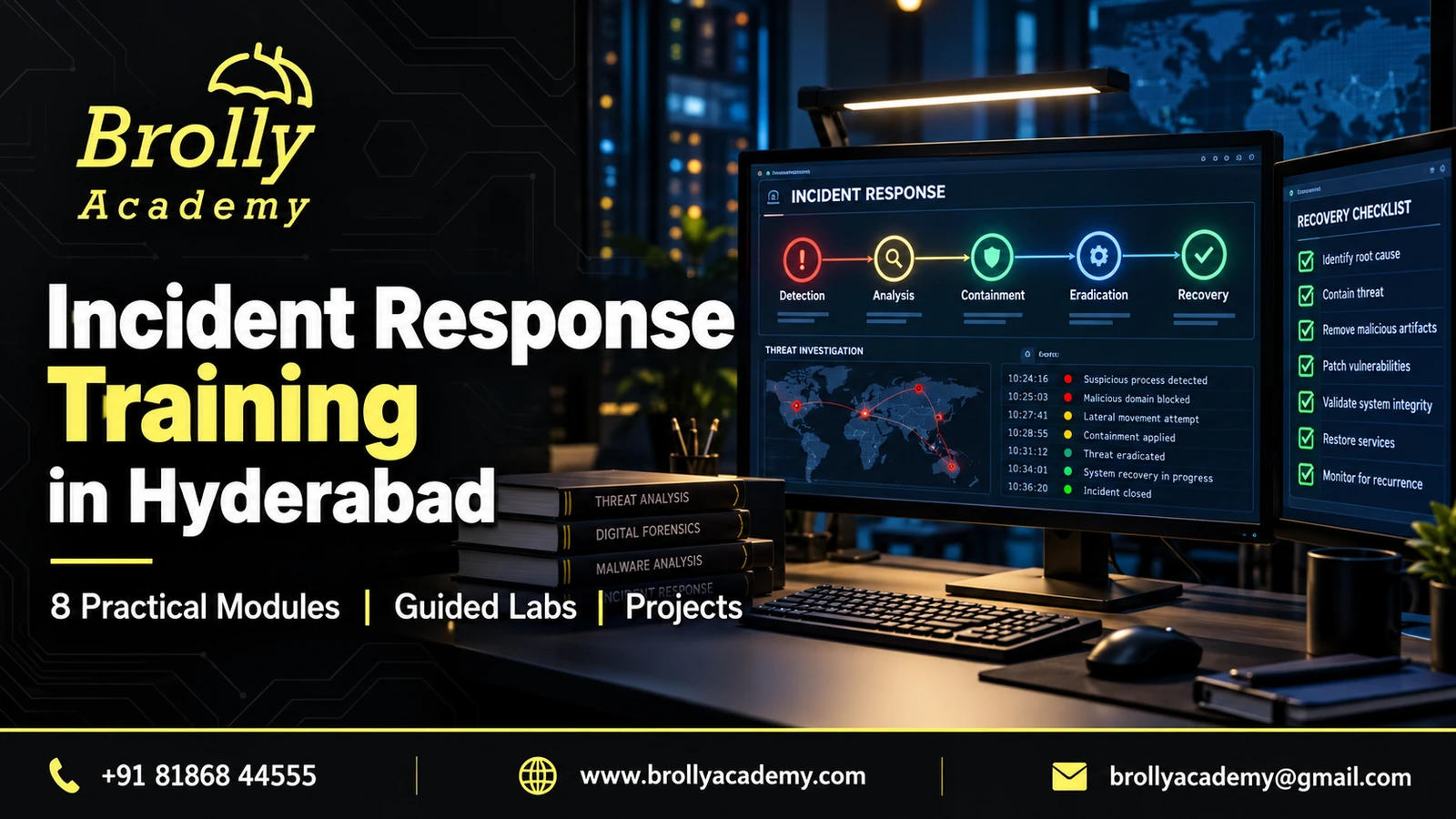
Learn how to assess security incidents, preserve useful evidence and coordinate recovery with Incident Response Training in Hyderabad. The eight-module course connects preparation, triage, containment decisions, recovery checks and lessons learned through realistic but synthetic scenarios.
★ 4+ Google rating from 100+ reviews · 9,000+ students trained · 523+ batches completed · Teaching since 2021
Next batch: Monday, 2 November 2026
Course outline8 modules
Practice3 project scenarios
DurationAsk for batch schedule
Course feeRequest current fee
About Incident Response Training
Incident response is the organized work of understanding and handling a security incident. An alert alone does not reveal the full situation. Responders need to establish what is known, what may be affected, who can approve action and how to restore service without losing important evidence.
SOC monitoring finds and escalates suspicious events; incident response coordinates the deeper investigation and recovery. Digital forensics provides specialized evidence analysis. These disciplines work together, but none should be confused with an automatic response button.
Use NIST incident response guidance, SP 800-61 Revision 3 alongside the relevant modules. The practice examples on this page are original teaching scenarios, not claims of vendor approval or live client work.
Who Should Join?
Networking, operating-system logs and basic security concepts are useful. SOC analysts, administrators and IT support professionals can build on their operational knowledge. Beginners should prepare with the foundation security modules first.
Learners building a specialismNetworking, operating-system logs and basic security concepts are useful. SOC analysts, administrators and IT support professionals can build on their operational knowledge. Beginners should prepare with the foundation security modules first.
IT and security professionalsUse the module outputs to compare this course with the tasks in your current or target role.
Teams planning practical learningDiscuss a lab-led program using approved systems, synthetic records and clear learning goals.
For complementary learning, explore SOC Analyst Course. Connect technical findings with monitoring, escalation and analyst workflows.
Prerequisites and Readiness Checklist
Use these practical checks to decide whether you are ready for Incident Response. Any foundation gaps can guide your preparation before a batch starts.
Systems and networkingUnderstand basic accounts, services, traffic and system logs.
Analyst reasoningBe able to explain what an alert proves and what remains to be checked.
CommunicationWrite short time-stamped notes and know when a decision requires authorization.
A repeatable study setupKeep a notebook, a place for sanitized lab files and time to repeat an exercise. Confirm the lab requirements and access arrangements for your chosen batch.
Incident Response Syllabus: 8 Practical Modules
Each module connects a concept to an exercise and an output you can explain. Work through the foundations before attempting the integrated project.
1. Readiness, roles and response planning
Define the incident team, asset owners and decision authority in a fictional organization. Prepare contact paths, evidence access and recovery dependencies. Use current NIST incident-response guidance as a reference for connecting response with broader risk management.
2. Alert triage and incident assessment
Review synthetic alerts and supporting logs. Separate suspicious activity from a confirmed incident and record the confidence level. Write a concise initial assessment including affected assets, uncertainty and the next safe question to investigate.
3. Evidence collection and timeline
Identify useful endpoint, identity, email and network records within the approved scope. Preserve source context and timestamps. Build an evidence-linked timeline and record gaps instead of filling missing events with assumptions.
4. Containment decisions and trade-offs
Compare possible containment actions in a tabletop exercise. Consider service impact, evidence loss and attacker access. Document who must approve the action and how it can be reversed; do not apply live isolation based solely on a training alert.
5. Investigation and cause analysis
Correlate available evidence to identify likely entry conditions, affected resources and contributing control gaps. Distinguish root cause from a visible symptom. State alternative explanations and the additional evidence needed to increase confidence.
6. Eradication and recovery planning
Prepare an owner-approved plan to remove the cause and restore trusted service. Consider credentials, configuration, patches and backups as relevant to the scenario. Define validation steps before returning a system to normal operation.
7. Communication and escalation
Create short status updates for technical teams and business stakeholders. Separate confirmed facts, current actions and next decisions. Discuss notification obligations with the responsible legal or compliance function rather than inventing a universal deadline.
8. Post-incident review and improvement
Write a review that identifies what worked, what slowed response and which actions need owners. Update the playbook and practise a related scenario. Measure improvement using clear definitions, not an unsupported claim that every incident was prevented.
Discuss Your Learning Goals
Tell the team about your experience and preferred schedule. Book a free demo to discuss the course, lab access and the practical work expected from you.
Practical Skills You Will Develop
Use the exercises to build an explanation as well as a result. You should be able to show what you did, how you checked it and where the limits are.
Evidence collection and timelineIdentify useful endpoint, identity, email and network records within the approved scope.
Containment decisions and trade-offsCompare possible containment actions in a tabletop exercise.
Investigation and cause analysisCorrelate available evidence to identify likely entry conditions, affected resources and contributing control gaps.
Eradication and recovery planningPrepare an owner-approved plan to remove the cause and restore trusted service.
Tools and Lab Requirements
Practice only on systems you own or have explicit permission to use. The course outline uses isolated labs and synthetic data. Agree the software versions, access period, hardware requirements and any licence or cloud charges before enrolling. Never upload employer logs, credentials or personal evidence to a public tool.
Log and case toolsUse synthetic SIEM exports and a case register to organize evidence and decisions.
Endpoint and network recordsInspect provided event logs and packet captures without touching production systems.
Response playbooksMaintain decision points, approval contacts, containment options and recovery checks.
Keep NIST forensic techniques guidance available when checking an exercise. Use the instructions for your installed version and authorized access level.
Your Learning Roadmap
Build confidence in stages. Practice time and your starting knowledge matter as much as the number of scheduled sessions.
1. Set up and understandCheck the prerequisites and lab access. Complete the first two modules and explain the basic workflow in your own words.
2. Build and investigateWork through the middle modules. Keep notes of errors, what you tried and the evidence that supported a fix.
3. Test and presentComplete the final modules and an integrated scenario. Present your output, validation and a short handover guide.
Your four-stage practice roadmap
Use these checkpoints alongside the eight-module curriculum. Move to the next stage when you can explain the output; they are learning milestones, not a promised course duration.
1. Prepare the playbookDefine roles, contacts, evidence sources and escalation conditions.
Module focus: Readiness, roles and response planning; Alert triage and incident assessment.
2. Triage the scenarioBuild an initial timeline and assess the scope using synthetic records.
Module focus: Evidence collection and timeline; Containment decisions and trade-offs.
3. Evaluate response choicesCompare containment options and document who can approve changes.
Module focus: Investigation and cause analysis; Eradication and recovery planning.
4. Recover and learnCheck the recovery evidence, unresolved risks and improvements to the playbook.
Module focus: Communication and escalation; Post-incident review and improvement.
3 Practical Project Scenarios
These are teaching scenarios using approved lab systems and synthetic data. They are not claims about live client work or previous student results.
Account-compromise tabletopTriage a fictional identity alert and prepare an evidence plan with approval-based containment options.
Ransomware-readiness scenarioReview a simulated disruption and build a recovery checklist using offline training records, not live malware.
Post-incident reviewDeliver a timeline, decision log, root-cause assessment and owner-assigned improvement plan.
How the Skills Work in Practice
A synthetic account alert shows an unfamiliar sign-in and a later data-access event. Begin by checking context and the reliability of the logs; do not label the account compromised from a location change alone.
If the evidence supports escalation, record the containment options and the approval needed. A strong handover explains both the security risk and the effect a response action may have on the user or service.
Why Learn with Brolly Academy?
Choose a course that connects the subject to work you can actually demonstrate. Use a demo to discuss the learning path and decide whether it fits your starting point.
A connected learning pathThe eight-module outline moves from foundations to an integrated task. Each module identifies an output rather than leaving practice as a vague promise.
A practical local conversationSpeak to the Hyderabad team about your goals, availability and lab needs. Ask questions before committing to a course or a particular schedule.
Clear course boundariesThe page explains prerequisites, product scope and the difference between training completion and independent certification. You can compare the offer with your actual requirements.
Benefits of Learning Incident Response
The value of this learning path is the work you can explain and demonstrate. Connect each module to a concrete output, then use the projects to practise those decisions.
Make decisions with evidenceDistinguish an unconfirmed alert from an incident that requires escalation.
Coordinate a responseRecord responsibilities, decisions and communication so teams do not lose context during an event.
Support safer recoveryCheck restoration and lessons learned rather than treating containment as the end of the incident.
Build a portfolio you can explainUse the course project scenarios to show decisions, evidence and a limitation. A clear training portfolio is more useful than a collection of tool screenshots.
Connect learning to a roleCompare the course outputs with a relevant job description. Keep a separate list of any additional scripting, system or communication skills that role needs.
Practise responsible security workUse approved labs, protect sensitive material and document the boundary of each exercise. These habits matter throughout security work.
Compare Brolly Academy with Other Training Institutes
Use the same questions when comparing providers. This course outline gives you specific learning outputs to discuss; confirm each institute's actual delivery and terms before deciding.
What to discuss with Brolly AcademyReview these eight modules and the three project scenarios.
Ask for the assigned trainer profile.
Check the lab version and access period.
Review the fee, schedule and certificate terms.
Use the demo to assess the teaching approach.
What to check with any instituteRequest a detailed outline, not just product names.
Verify the trainer information supplied.
Separate demonstrations from your own lab work.
Check licences, exam costs and refund conditions.
Compare the total commitment, not only the advertised price.
Classroom, Online and Corporate Learning
Discuss the currently available delivery format with the academy before booking. Batch availability and session timings should be agreed in writing.
Hyderabad classroom enquiryAsk about the next classroom batch, venue, system requirements and whether you should bring a laptop.
Live online enquiryCheck the session time zone, remote lab access and arrangements for asking questions or catching up on a missed session.
Corporate team enquiryShare your team size, current tools and learning objectives. Agree a scoped program without sharing confidential business data.
For a team program, explore Brolly Academy corporate training.
Incident Response Course Fee and Duration
Contact Brolly Academy for the current fee and timetable for Incident Response Training. Review the complete learning commitment and inclusions before you enrol.
Request the current course feeAsk for a written quotation showing the total payable, taxes and payment terms. Confirm whether lab licences, cloud usage or external examination fees are separate.
Confirm the batch timetableDiscuss the instructor-led hours, expected practice time, session dates and access period. The eight-module outline describes the learning sequence, not a fixed completion promise.
Before you enrolCheck lab access, materials, project feedback, missed-session arrangements, refund terms and any additional charges. Keep a copy of the agreed offer.
Course Completion and Certification Guidance
Brolly Academy course completion recognizes the training and assessment work agreed for your batch. It is separate from a credential awarded by a software vendor or another certification body.
Brolly Academy course completionAsk for the attendance, assignment and assessment requirements, the certificate wording and how completion will be verified.
Independent certificationUse official vendor information to check whether a relevant credential is currently offered and what preparation it requires. No vendor authorization, exam voucher or pass guarantee is implied.
Career Roles and Skill Applications
Match the learning path to a role, then compare its requirements with your existing experience. The course can support skill development; it does not guarantee employment.
Incident response analystAssess incidents and coordinate technical investigation.
SOC escalation analystHand over evidence with clear confidence and impact.
Infrastructure response coordinatorConnect recovery actions with service owners and validation.
You can also explore Cyber Security Course. Build a broader foundation in security concepts and the responsibilities of a security team.
Where These Skills Are Used
These skills support incident response analyst, soc escalation analyst, infrastructure response coordinator. Employers combine technical knowledge with careful documentation, communication and responsible access. Your lab portfolio should show decisions, evidence and limitations, not claim that a training exercise was a live client engagement.
Industry Skills and Evolving Practice
For Incident Response, these areas connect the course topics to practical security work. They describe skills to investigate, not a forecast of job growth or guaranteed demand.
Response as risk managementPreparation, detection, response and recovery should connect to organizational priorities rather than isolated emergency actions.
Cloud and identity contextAccount activity and cloud service records can be important alongside endpoint and network evidence.
Lessons that become changesA post-incident review should produce clear owners and follow-up checks, not only a narrative.
Interview and Portfolio Preparation
Prepare evidence you can discuss clearly. Label practice work as training work and do not present a teaching scenario as paid client experience.
Explain a projectDescribe the requirement, your decisions, the result and one limitation. Be ready to answer what you would change for a real deployment.
Show useful evidenceKeep approved files, test results and a concise README or runbook. Remove secrets and private information before sharing a portfolio.
Discuss support servicesAsk the academy which resume, mock-interview or job-search services are included in your batch. Placement assistance is not a job or salary guarantee.
Career Planning and Salary Expectations
Salary depends on the role, prior experience, location and the employer. A tool course alone does not establish a salary band. Compare recent job descriptions, required experience and responsibilities rather than relying on a headline income promise.
Compare roles before comparing pay
For Hyderabad opportunities, look at the actual responsibilities and eligibility in each vacancy. Similar job titles can describe very different levels of work.
Entry-level or junior rolesCheck whether the vacancy accepts training projects, which foundations it tests and whether it requires prior production experience. A course certificate by itself does not establish eligibility.
Experienced specialist rolesLook for the required depth of investigation, system ownership, scripting and communication. Prior responsibilities and relevant project evidence may matter more than the course title.
Read the compensation termsSeparate fixed annual pay, variable pay and one-time benefits. Check location, shift expectations, contract type and any conditions in the written offer.
Use current, matching evidenceCompare recent openings with the same role, experience range and location. A salary figure from another course, city or seniority level is not a reliable promise for this program.
Where to Look for Relevant Roles
Search for incident response analyst, DFIR analyst or security operations incident handler. Use the following official career portals to research requirements and filter by Hyderabad or your preferred location. These links do not imply a hiring partnership, an available vacancy or placement through this course.
Accenture careersExplore Accenture India careers
Read the role description, experience requirements and location on the employer website before applying.
TCS careersExplore TCS India careers
Check the relevant hiring category and current eligibility directly with the employer.
Compare tasks and skillsExplore the NIST NICE Framework
Use the framework to understand cybersecurity work, then compare it with a real vacancy. It is not a local salary or vacancy source.
Meet the Trainer Through a Demo
Discuss the assigned trainer's relevant experience during a free demo. Ask how they would explain a practical incident response problem and review your lab evidence.
Relevant experienceAsk for examples of work with Incident Response that can be discussed without revealing confidential client information.
Practical explanationAsk the trainer to explain a failure scenario and how a learner would investigate it, rather than only showing a finished result.
Feedback and supportDiscuss how assignments are reviewed, how questions are handled and the support period included in the course.
A useful question for your trainer demo
Ask how the team would balance containment, evidence preservation and operational impact in a fictional account-compromise incident.
Ask the assigned trainer to walk through a sanitized example, explain the limits of the evidence and show how a learner would receive feedback. Review Brolly Academy instructor information and confirm who will teach your batch with the academy. No named trainer or individual credential is implied here.
Brolly Academy Learner Reviews
Read available academy feedback and ask whether a review relates to this particular course, trainer and delivery format. General academy reviews should not be mistaken for verified results from this new course.
Read Academy ReviewsPublished feedback about the broader Cyber Security course
The following summaries refer to reviews published on Brolly Academy's reviews page. They are not reviews of this specialist course, and they are not a placement or outcome guarantee.
Rohit Verma - Cyber SecurityHis published review highlights the combination of security concepts, practical exercises and case-based learning. Read the academy review
Priya Sharma - Cyber SecurityHer published review discusses the trainers and coverage of network security, cryptography and ethical hacking. Read the academy review
Student Community and Collaborative Learning
A study group can help you explain your work, compare reasoning and stay consistent. Use the activities below with your classmates or study partners; ask the academy which group channels and facilitated sessions are available for your batch.
Peer practiceRun a tabletop discussion with analyst, incident lead and business-owner roles using synthetic facts.
A useful question logRecord the task, expected result, actual result and what you have already checked. This makes a question easier for a trainer or study partner to answer.
Portfolio walkthroughsTake turns explaining a training project in five minutes. Let another learner challenge assumptions and point out missing evidence.
Safe resource sharingShare official documentation, original notes and sanitized examples. Do not share credentials, private case material or employer data in a learning group.
Download Your Practice Checklists
Use these editable CSV files to organize your learning. They open in common spreadsheet tools and contain real module and project-checklist content.
Download Syllabus Checklist (CSV) Download Project Review Sheet (CSV)Official Documentation for Further Reading
Use the documentation that matches your product version and environment. These sources support technical learning; linking to them does not imply endorsement of Brolly Academy.
NIST incident response guidance, SP 800-61 Revision 3
NIST forensic techniques guidance
CISA ransomware guidance
Related Courses at Brolly Academy
Choose complementary learning based on your current skill gaps. These are separate courses, not automatically included in this program.
SOC Analyst CourseConnect technical findings with monitoring, escalation and analyst workflows.
View SOC Analyst Course
Splunk TrainingTake a separate product-focused path when you need deeper Splunk skills.
View Splunk Training
Cyber Security CourseBuild a broader foundation in security concepts and the responsibilities of a security team.
View Cyber Security Course
For a complementary learning path, also explore SIEM training and Digital Forensics training. These are separate programs; choose the one that fits your role and prerequisites.
Incident Response Training Enquiries in Hyderabad
Speak to Brolly Academy near JNTU Metro Station. The centre address is Metro Pillar No. A689, Dr Atmaram Estates, 3rd Floor, Nizampet X Roads, Hyderabad 500072. Confirm the batch venue before travelling.
Learners from Kukatpally, KPHB, Nizampet, Miyapur and other parts of Hyderabad can contact the academy to discuss classroom or online availability.
Call +91 81868 44555Incident Response Training FAQs
Is incident response the same as SIEM monitoring?
No. SIEM monitoring supports detection and investigation. Incident response also includes decision authority, containment, communication, recovery and improvement.
Will I handle live malware?
The planned scenarios use synthetic evidence and safe exercises. Live malware is not required for the listed learning outcomes.
Should a responder isolate every suspicious device?
Not automatically. Consider evidence, impact, authority and the response plan. Containment decisions need to fit the situation.
Does the course cover NIST guidance?
Yes, the outline references NIST SP 800-61 Revision 3 and connects response activity with preparation and risk management. It does not claim NIST accreditation.
Will I learn reporting deadlines?
The course discusses escalation awareness. Actual obligations depend on the organization and applicable rules and must be confirmed by the responsible professionals.
What will my project demonstrate?
Your evidence handling, triage reasoning, decision log, recovery checks and ability to explain uncertainty to another responder.
What are the course fee and duration?
Contact Brolly Academy for the current batch quotation and timetable. Confirm instructor-led hours, practice time, lab access, taxes and any separate licence or exam charges in writing.
What certificate will I receive?
Ask for the Brolly Academy completion requirements and certificate wording for your batch. Course completion is separate from an independent vendor examination; no external credential or exam voucher is implied.
Request a Free Demo
Share your contact details and the team can discuss course availability, prerequisites and the next suitable session.
Your details are used to respond to this enquiry. Read our Privacy Policy.