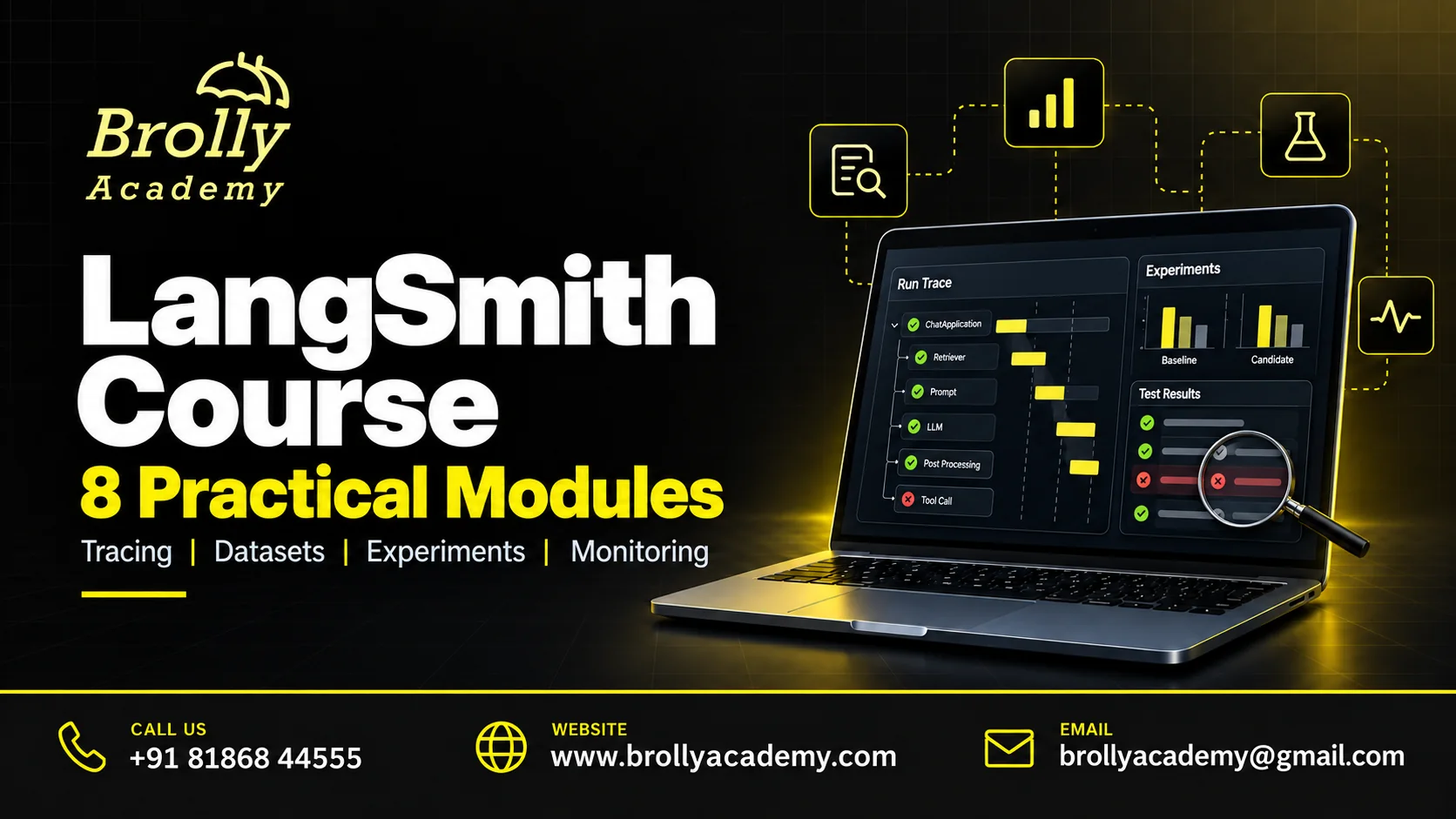
TRACING / EVALUATION DATASETS / EXPERIMENTS / MONITORING
LangSmith Course
Understand why an AI application produced a result and whether a change actually improved it. This LangSmith Course centres on tracing, evaluation datasets, experiments and feedback, with practical attention to sensitive data and misleading quality scores.
★ 4+ Google rating from 100+ reviews · 9,000+ students trained · 523+ batches completed · Teaching since 2021
Next batch: Monday, 2 November 2026
Course outline8 modules
Practice3 project scenarios
Duration2 months
Course feeOnline ₹20,000
Classroom ₹25,000
About the LangSmith Course
LangSmith supports observing and evaluating LLM applications. A trace records the steps of an execution; an evaluation examines an output against a defined criterion. These are related but different jobs. You learn to investigate individual failures and compare changes across a representative dataset rather than judging an application from one successful chat.
This course is the measurement and debugging specialisation. It does not repeat the broad Generative AI curriculum or promise to teach every model framework. LangChain and LangGraph applications can provide examples, but the main outputs are traces, datasets, evaluators, experiment comparisons and operational review procedures.
For product-specific terminology and behaviour, use LangSmith observability. Match the documentation to the environment used in your exercises.
Benefits of Learning LangSmith
Turn the syllabus into practical advantages you can demonstrate in your own work. These outcomes come from building, checking and explaining the exercises.
Find the expensive or failed stepUse traces to distinguish model time, retrieval time and tool execution.
Replace anecdotal testingCompare versions with the same dataset instead of relying on one impressive response.
Choose meaningful evaluatorsDefine the quality criterion before choosing a score or automated judge.
Review scoring limitationsCheck disagreements between automated scores and human review.
Protect sensitive observationsPlan redaction and retention before collecting application inputs and outputs.
Support release decisionsPresent experiment results and failure examples that explain whether a change should be accepted.
Who Should Join?
Bring basic Python and a small model-backed application you understand. You should be able to describe an expected result and read a tool call. Some QA or development experience helps when defining reliable test cases.
LLM application developersTrace execution and compare changes using consistent evidence.
QA and AI evaluatorsCreate datasets and review automated scoring limits.
AI platform teamsMonitor quality, latency and usage while protecting sensitive information.
For complementary learning, explore Generative AI Training. Choose the broader program if you need an introduction to AI models, prompting and the wider application landscape before specialising.
LangSmith Prerequisites and Readiness Checklist
Use these three checks to decide whether you are ready to start or need a short foundation step first. Bring any gaps to your demo discussion.
A small AI applicationBring a model-backed workflow you can explain, including its inputs, tools and expected outputs.
Basic test designWrite examples of an acceptable answer and a technically successful but incorrect answer.
Tracing permissionsCheck which data may be recorded in the evaluation workspace. Remove private content and credentials from sample traces.
LangSmith Course Syllabus: 8 Practical Modules
Each module connects a concept to an exercise and an output you can explain. Work through the foundations before attempting the integrated project.
1. Observability and evaluation basics
Separate execution records from quality judgements. Define what a trace should capture and what it should omit. Create a small application map and list the failures that would matter to its users.
2. Tracing application steps
Instrument model calls, retrieval and tool execution using supported integrations. Inspect parent and child runs, inputs, outputs and timing. Trace a deliberate tool failure and distinguish it from an incorrect but technically successful model response.
3. Datasets and reference examples
Build a small dataset with normal, ambiguous and missing-answer cases. Add reference outputs only where justified. Record dataset versions and avoid mixing tuning examples with an untouched final evaluation set.
4. Evaluators and review criteria
Implement deterministic checks for structure and required fields. Add human or model-based review for criteria that need judgement. Define a rubric, calibrate it against examples and document where an automated judge disagrees with reviewers.
5. Experiments and comparisons
Run two application configurations against the same dataset. Compare quality with latency and usage rather than selecting a winner from one score. Inspect regressions at example level and report uncertainty when the dataset is small.
6. Feedback and annotation
Collect structured feedback and separate user dissatisfaction from a verified factual error. Create review queues and label examples consistently. Use the results to improve a dataset without hiding difficult cases.
7. Monitoring and privacy
Choose operational checks and escalation criteria. Redact sensitive inputs, restrict access and discuss retention before enabling traces on real traffic. Keep monitoring costs and sampling decisions visible to the application owner.
8. Evaluation capstone and release note
Deliver a versioned evaluation dataset, rubric, comparison report and release recommendation. Include at least one regression and one evaluator limitation. Explain what the evidence supports and what remains untested.
Discuss Your Learning Goals
Tell the team about your experience and preferred schedule. Book a free demo to discuss the course, lab access and the practical work expected from you.
Practical Skills You Will Develop
Use the exercises to build an explanation as well as a result. You should be able to show what you did, how you checked it and where the limits are.
Trace investigationFollow a request through retrieval, tools and model responses.
Dataset qualityCreate representative cases with defensible reference information.
Evaluator designMatch a checking method to the property being tested.
Experiment analysisCompare configurations without hiding case-level regressions.
Feedback workflowsTurn reviewed failures into useful test examples.
Privacy-aware monitoringAvoid collecting unnecessary private content in traces.
Tools and Lab Requirements
Use a personal practice environment with synthetic or openly licensed data. Keep credentials outside notebooks and source control. Confirm software access, hardware and any paid API usage with the course team before enrolling.
LangSmith workspaceA permitted account with plan limits confirmed before the lab.
Instrumented applicationA small Python app or supported integration using synthetic inputs.
Evaluation recordsVersioned examples, rubrics and comparison notes for repeatable review.
Consult LangSmith evaluation during practice. Use documentation matching the installed version and check applicable permissions and service costs.
Your Learning Roadmap
Build confidence in stages. Practice time and your starting knowledge matter as much as the number of scheduled sessions.
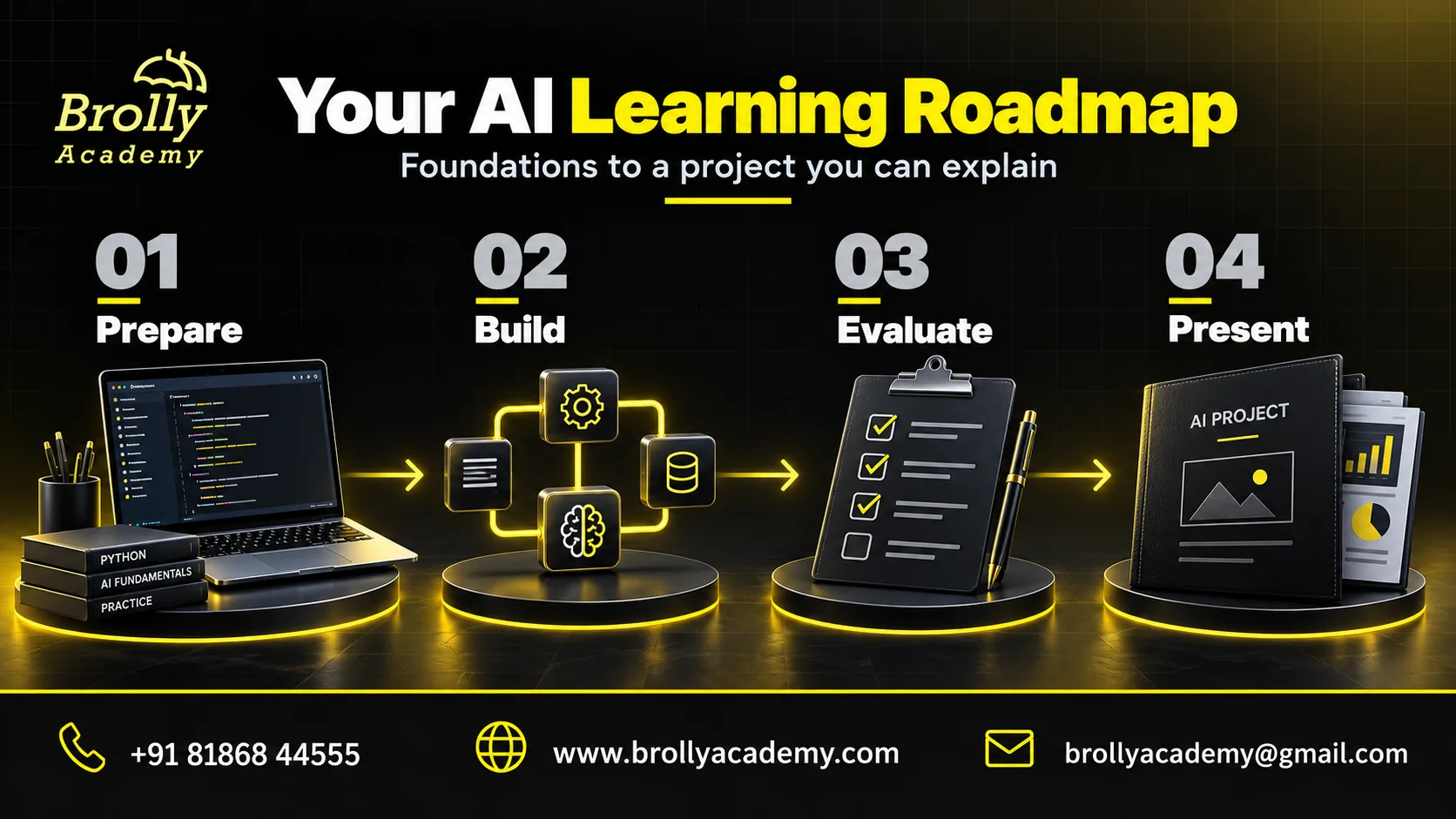
1. Set up and understandCheck the prerequisites and lab access. Complete the first two modules and explain the basic workflow in your own words.
2. Build and investigateWork through the middle modules. Keep notes of errors, what you tried and the evidence that supported a fix.
3. Test and presentComplete the final modules and an integrated scenario. Present your output, validation and a short handover guide.
Your LangSmith project milestone: Include a sanitised trace, versioned evaluation set, evaluator rubric, experiment comparison and scoring disagreement review. Use the existing syllabus checklist to track progress; follow the stages during the 2-month course and confirm assignment dates with your trainer.
3 Practical Project Scenarios
These are teaching scenarios using approved lab systems and synthetic data. They are not claims about live client work or previous student results.
RAG evaluation dashboardTrace a fictional document assistant and identify whether bad answers follow failed retrieval or poor use of correct evidence.
Prompt-change experimentCompare two prompt configurations on a fixed dataset. Report improved cases, regressions, latency and usage.
Tool-use review workflowEvaluate whether an assistant calls the right mock tool with permitted arguments. Include cases where no tool should be called.
How the Skills Work in Practice
A prompt change improves the average score but makes the application invent answers for questions outside its knowledge base. Inspect those individual examples rather than approving the change from the summary chart.
Add an explicit missing-answer criterion and ask a reviewer to check the automated scores. Your release note should identify the regression, describe the affected cases and explain whether the change is ready to ship. A dashboard is useful only when its measurements support a decision.
Why Learn with Brolly Academy?
Choose a course that connects the subject to work you can actually demonstrate. Use a demo to discuss the learning path and decide whether it fits your starting point.
A connected learning pathThe eight-module outline moves from foundations to an integrated task. Each module identifies an output rather than leaving practice as a vague promise.
Discuss your own learning goalShare your experience and preferred format with the course team. Use a demo to assess whether the technical depth, pace and project expectations fit your needs.
Clear course boundariesThe page explains prerequisites, product scope and the difference between training completion and independent certification. You can compare the offer with your actual requirements.
Compare Brolly Academy with Other Training Institutes
Compare the same evidence from each provider: what you will build, what you will test and which services the fee includes. Ask for specific examples rather than relying on broad claims about advanced AI.
What to discuss with Brolly AcademyReview these eight modules and the three project scenarios.
Ask for the assigned trainer profile.
Check the lab version and access period.
Review the fee, schedule and certificate terms.
Use the demo to assess the teaching approach.
What to check with any instituteRequest a detailed outline, not just product names.
Verify the trainer information supplied.
Separate demonstrations from your own lab work.
Check licences, exam costs and refund conditions.
Compare the total commitment, not only the advertised price.
Classroom, Online and Corporate Learning
Discuss the currently available delivery format with the academy before booking. Batch availability and session timings should be agreed in writing.
Classroom learning enquiryConfirm the venue, next available batch and computer requirements before arranging travel.
Live online enquiryCheck the session time zone, remote lab access and arrangements for asking questions or catching up on a missed session.
Corporate team enquiryShare your team size, current tools and learning objectives. Agree a scoped program without sharing confidential business data.
For a team program, explore Brolly Academy corporate training.
LangSmith Course Fee and Duration
The LangSmith Course runs for 2 months. The fee is ₹20,000 for online training or ₹25,000 for classroom (offline) training. Ask for a written quotation confirming taxes, payment and refund terms, lab access and any separate software or API charges.
Classroom training: ₹25,000Learn in the classroom over 2 months. Confirm the venue, batch start date and session timings with the academy before arranging travel.
Online training: ₹20,000Choose online learning over 2 months. Confirm the session time zone, lab access and arrangements for questions or missed sessions before enrolling.
Duration: 2 monthsPlan time for lessons, independent practice and the course project. Ask for the batch calendar, instructor-led hours, assignment deadlines and support period.
Course Completion and Certification Guidance
Brolly Academy course completion recognizes the training and assessment work agreed for your batch. It is separate from a credential awarded by a software vendor or another certification body.
Brolly Academy course completionAsk for the attendance, assignment and assessment requirements, the certificate wording and how completion will be verified.
Independent certificationUse official vendor information to check whether a relevant credential is currently offered and what preparation it requires. No vendor authorization, exam voucher or pass guarantee is implied.
Career Roles and Skill Applications
Match the learning path to a role, then compare its requirements with your existing experience. The course can support skill development; it does not guarantee employment.
AI evaluation engineerDesign experiments and assess model-backed application changes.
LLM QA practitionerInvestigate regressions and maintain representative tests.
AI observability engineerMonitor application behaviour and support failure diagnosis.
You can also explore MLOps Training. Extend a working prototype into a monitored, repeatable deployment workflow.
Where These Skills Are Used
Evaluation and observability are useful wherever a model-backed application changes over time. They help development and QA teams inspect failures, but a score is not an objective truth by itself. The criteria, examples, reviewers and operating context determine what the result means.
Interview and Portfolio Preparation
Prepare evidence you can discuss clearly. Label practice work as training work and do not present a teaching scenario as paid client experience.
Explain a projectDescribe the requirement, your decisions, the result and one limitation. Be ready to answer what you would change for a real deployment.
Show useful evidenceKeep approved files, test results and a concise README or runbook. Remove secrets and private information before sharing a portfolio.
Discuss support servicesAsk the academy which resume, mock-interview or job-search services are included in your batch. Placement assistance is not a job or salary guarantee.
Placement Preparation and Career Support
Use this checklist during your demo to agree the career-support services included with your batch. The preparation below builds on your course project; recruitment and interview outcomes remain with the employer.
Choose a target roleStart with the responsibilities of a AI evaluation engineer. Compare several relevant job descriptions and note the skills you can already prove.
Prepare a project evidence packInclude a sanitised trace, versioned evaluation set, evaluator rubric, experiment comparison and scoring disagreement review.
Practise a technical discussionWhat would you do if the average evaluation score improved but failures increased for one important user group? Explain your decision with a test or project example.
Write an honest resume entryState the project goal, your contribution and the checks you ran. Label it as a learning project and report only results you actually measured.
Request focused feedbackAsk whether the batch includes a resume review, portfolio review or mock interview. Agree the format, number of reviews and support period before enrolling.
Plan applications and follow-upKeep a record of role requirements, applications and feedback. Use the next practice session to address a specific gap rather than adding unsupported claims to your profile.
Career Planning and Salary Expectations
Salary depends on the role, prior experience, location and the employer. A tool course alone does not establish a salary band. Compare recent job descriptions, required experience and responsibilities rather than relying on a headline income promise.
Meet Your Trainer: Dinesh
Dinesh is the trainer for the LangSmith Course. Use a demo to discuss your learning goals, ask about a practical LangSmith scenario and understand how project feedback is provided.
Relevant experienceAsk for examples of work with LangSmith that can be discussed without revealing confidential client information.
Practical explanationAsk the trainer to explain a failure scenario and how a learner would investigate it, rather than only showing a finished result.
Feedback and supportDiscuss how assignments are reviewed, how questions are handled and the support period included in the course.
Brolly Academy Learner Feedback
Read available academy feedback and ask whether a review relates to this particular course, trainer and delivery format. General academy reviews should not be mistaken for verified results from this new course.
The excerpts below are published on Brolly Academy's academy reviews page. They describe Data Science and Machine Learning courses, not this new LangSmith course.
Aditya - Data Science"The instructors provided a clear and practical understanding of data science concepts."
Read the original academy testimonial
Kavita Singh - Data Science"The hands-on projects helped me apply the concepts effectively."
Read the original academy testimonial
Rahul Desai - Machine Learning"The trainers were experienced professionals who explained complex algorithms with ease."
Read the original academy testimonial
Student Community and Continued Learning
Keep learning visible: ask precise questions, share permitted examples and record what changed after feedback. Check with the course team about any batch-specific discussion group or mentor access.
Academy updatesFollow the Brolly Academy WhatsApp channel for public academy updates. A public channel is separate from individual technical support.
LangSmith peer-practice ideaScore the same permitted outputs independently and discuss where the rubric needs clearer definitions.
Share safely and ask clearlyInclude the tool version, a small permitted example, the expected result and what happened. Remove API keys, employer documents and personal data before asking for help.
For continued technical learning, use LangSmith observability. Recheck examples against the version you are using.
Download Your Practice Checklists
Use these editable CSV files to organize your learning. They open in common spreadsheet tools and contain real module and project-checklist content.
Download Syllabus (CSV) Project Checklist (CSV)Official Documentation for Further Reading
Use the documentation that matches your product version and environment. These sources support technical learning; linking to them does not imply endorsement of Brolly Academy.
LangSmith observability
LangSmith evaluation
LangSmith documentation
Related Courses at Brolly Academy
Choose complementary learning based on your current skill gaps. These are separate courses, not automatically included in this program.
Generative AI TrainingChoose the broader program if you need an introduction to AI models, prompting and the wider application landscape before specialising.
View Generative AI Training
AI Testing TrainingDevelop a deeper QA practice for AI answers, tool behaviour and release decisions.
View AI Testing Training
MLOps TrainingExtend a working prototype into a monitored, repeatable deployment workflow.
View MLOps Training
To build the model-and-tool application you will later trace and evaluate, start with the LangChain Course.
For applications with branching, persistent state and human review, pair your evaluation practice with the LangGraph Course.
To understand the retrieval and citation problems your evaluation should detect, explore RAG Training.
Talk to the LangSmith Course Team
Call +91 81868 44555 or send a course enquiry to discuss the syllabus and current batch options. For a classroom visit, confirm the venue and appointment with Brolly Academy before travelling.
Read our contact details for the academy location and enquiry options. Online delivery, session time zones and tool access should be confirmed for your batch.
Call +91 81868 44555LangSmith Course FAQs
Do I need LangChain to use LangSmith?
Not necessarily. LangSmith supports multiple integrations and direct instrumentation. This course uses a small application so you can understand the recorded steps regardless of the framework.
Does a trace tell me whether an answer is correct?
Not by itself. It shows what happened during execution. Correctness needs a separate criterion and suitable evidence, such as a source passage, deterministic check or qualified review.
Can an LLM judge replace human review?
Not reliably for every task. A model-based judge can help scale a defined rubric, but it needs calibration and can make mistakes. Important or ambiguous cases still need appropriate human review.
How many examples do I need?
There is no universal number. The set should cover the important task types and failure risks. A small teaching dataset demonstrates the method but does not establish production reliability.
Can I trace customer data?
Only within your organisation's permissions and data-handling rules. Configure redaction, access and retention before using real traffic. The labs use synthetic inputs.
Is this the same as AI Testing Training?
No. AI Testing is the broader QA discipline. This course concentrates on implementing tracing, datasets, experiments and feedback using LangSmith.
How much does the LangSmith Course cost?
The LangSmith Course fee is ₹20,000 for online training and ₹25,000 for classroom (offline) training. Confirm taxes, payment and refund terms, lab access and any separate software, API or examination costs in your written quotation.
What is the course duration and batch schedule?
The course duration is 2 months for both online and classroom training. Contact Brolly Academy for the next batch start date, session timings, instructor-led hours and independent practice expectations.
Can I attend a free demo before enrolling?
Use Book Free Demo to open the enquiry form, or contact the team on WhatsApp. Share your experience and learning goal so the counsellor can discuss a suitable session and current availability.
What certificate will I receive?
Discuss the Brolly Academy course-completion requirements for your batch, including attendance, assignments and project assessment. Course completion is separate from any credential issued by a software vendor or independent examination body.
Does the course guarantee a job or salary?
No. The learning path is designed to build demonstrable skills. Ask which portfolio, resume or interview-support services are included. Hiring decisions depend on your wider experience, preparation, location and employer requirements.
How should I compare this course with another institute?
Compare the actual syllabus, your own lab work, trainer experience, project feedback, tool costs and written terms. Ask each provider the same questions and use a demo to assess the teaching style before committing.
Got More Questions About LangSmith?
Talk to the Brolly Academy team about your starting skills, learning goal and available batch options. Request a free demo before choosing your course.