
Corporate Training Institute · Hyderabad
Corporate Training in Hyderabad
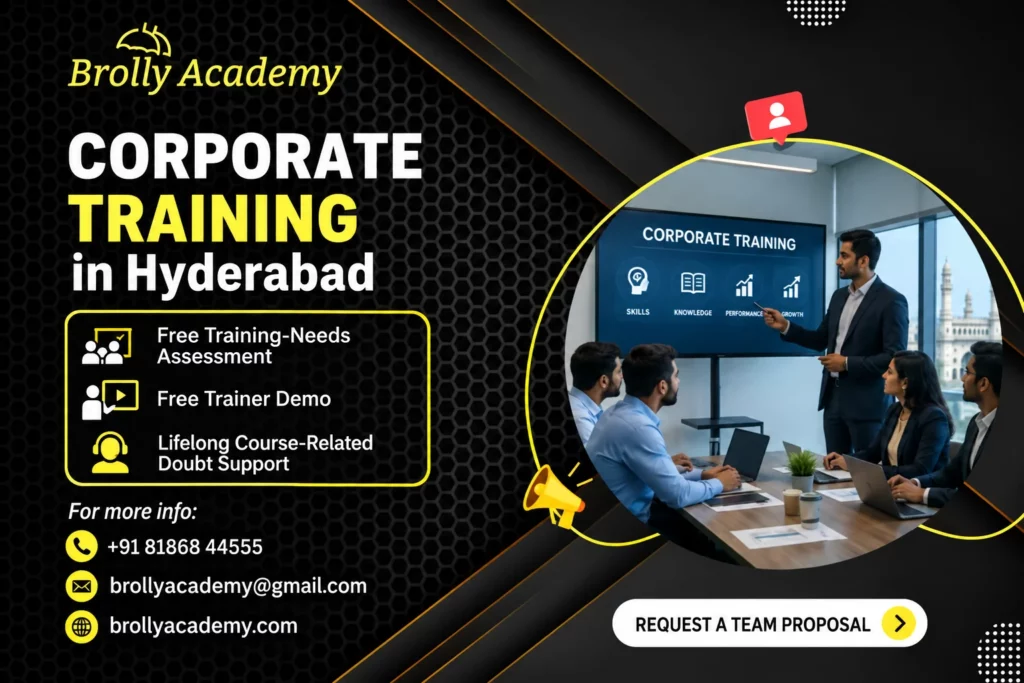
Brolly Academy is a corporate training institute in Hyderabad for software, cloud, data, AI and workplace skills. Build the skills your team needs for its next project, technology rollout or operational challenge through customised offline sessions at your office or live online training for distributed teams.
Start with a free training-needs assessment and trainer demo. Choose weekday or weekend sessions and customise the syllabus, exercises and timetable around your team. Batch size is as per requirement, with lifelong course-related doubt clarification after training.
Request a training proposal
Request your free training-needs assessment or trainer demo. Share the topic, team size and target dates so we can discuss a suitable programme.
We use your details to respond to this enquiry. Read our Privacy Policy. Do not include confidential company or customer data.
200+
Courses across software, AI, data & marketing
Online
Live sessions for distributed teams
Custom
A syllabus shaped around your requirements
Practical
Exercises, assessment and learner feedback
At a glance
Corporate training is an employer-sponsored learning programme built around the skills employees need at work. Unlike an open-enrolment course for individual learners, a corporate programme needs a shared business objective, a suitable cohort, an agreed schedule and evidence that learners can perform the target tasks.
At Brolly Academy, the discussion starts with your requirement: introduce a new technology, improve an existing workflow, onboard a team or develop communication and leadership skills. Choose onsite training in Hyderabad or live online delivery, with the precise curriculum, trainer, practical work and support scope agreed for your engagement.
For individual course enquiries: explore our course catalogue. For employee upskilling, use the training proposal form on this page.
01 Benefits
What should corporate training help your team do?
A useful training objective describes something employees should be able to do, not just a list of topics they should have heard about. The examples below help HR, L&D and team leaders turn a broad request into an assessable learning goal.
Skills
Close a specific skill gap
Identify where employees get stuck: writing SQL queries, debugging an API, preparing a dashboard or managing a customer conversation. Build practice around that task and check it again after training.
Output
Improve a real workflow
Choose a repeatable workflow such as a monthly report or a test run. Compare accuracy, manual steps and completion time on equivalent exercises before claiming an improvement.
Retention
Prepare people for new responsibilities
Give new hires, individual contributors and first-time managers the practice their next role requires. Training can support development; retention and promotion also depend on workplace conditions.
Consistency
Build consistent working practices
Use a shared checklist for code reviews, data validation, documentation or escalation. Assess whether employees can follow the same quality standard on a new example.
Cost
Develop capability within your team
Map the skills you already have against the work ahead. Decide which gaps can be addressed through training and which require additional experience, hiring or specialist support.
Future
Use AI with practical safeguards
For AI programmes, practise a defined use case, check outputs and recognise failure cases. Include data permissions, human review and usage costs instead of treating every task as suitable for automation.
02 Types
Corporate training programmes built around team outcomes
Start with the work your team needs to do. The six sample programme outlines below show a possible audience, entry level, learning sequence and practical deliverable. They are planning examples, not completed client engagements or fixed packages. We tailor the final syllabus, contact hours, trainer and assessment to your requirement.
AI & productivity
Generative AI for workplace tasks
For: Operations, HR, support and business teams. No coding assumed; participants need familiarity with their own workflow.
Sample sequence: Task selection, clear prompts, output checks, data boundaries and human approval.
Practical output: An approved-data workflow, prompt set and quality checklist for a task such as drafting a support response.
Assessment: Review accuracy, unsupported statements and handling of sensitive inputs on fresh scenarios.
Data & reporting
Power BI for business reporting
For: Analysts, finance and operations teams comfortable with spreadsheets and basic business metrics.
Sample sequence: Data cleaning, relationships, measures, report design and validation.
Practical output: A dashboard built on synthetic data, with reconciled totals and a short handover note.
Assessment: Check calculations, filter behaviour, readability and the learner’s explanation of one decision.
Programming
Python automation for teams
For: Technical analysts and operations staff. A prerequisite check determines whether Python foundations are needed first.
Sample sequence: Files and data structures, APIs, validation, exceptions and basic tests.
Practical output: A repeatable script that validates sample records and produces a report without changing production data.
Assessment: Run missing-input, invalid-data and service-failure cases; review tests and the README.
Cloud & delivery
Cloud & DevOps delivery practices
For: Developers and IT operations teams with basic command-line and version-control skills.
Sample sequence: Environments, CI checks, deployment, secrets handling, monitoring and rollback.
Practical output: A sandbox deployment pipeline and runbook for a small application on the agreed platform.
Assessment: Diagnose a failed build, demonstrate rollback and explain access and cloud-cost controls.
QA & automation
Software testing & quality engineering
For: QA teams and developers. Manual-testing foundations or basic coding are scoped to the chosen track.
Sample sequence: Risk-based test design, API checks, automation, failure investigation and CI reporting.
Practical output: A maintainable test suite with test data and a defect report for a sample application.
Assessment: Check meaningful assertions, negative cases, repeatability and diagnosis of a failing test.
People & performance
Workplace communication & leadership
For: New hires, customer-facing teams and first-time managers; scenarios are adapted to each role.
Sample sequence: Clear updates, listening, handovers, feedback, delegation and escalation.
Practical output: A concise project update, a role-play and a next-step action plan.
Assessment: Use a behaviour-based rubric for clarity, listening, ownership and handling of a difficult conversation.
03 What we train
Corporate IT training courses and workplace skills
Use the catalogue below to shortlist corporate IT training courses in programming, testing, cloud, data and AI. Software corporate training should match the technology your team uses and the tasks employees need to complete. Agree the starting level, tool versions, practical assignment and review criteria before choosing modules.
For business training in Hyderabad, explore workplace communication and leadership development. A professional development programme might focus on presenting a recommendation, handling a difficult conversation or giving useful feedback. Use role-play and an agreed review checklist to assess those skills. The examples are starting points for a customised syllabus, not fixed packages.
Example programme directions: Generative AI training for evaluating a bounded business workflow; Power BI training for reporting and data validation; DevOps training for delivery and operational practices; and soft skills training for workplace communication. Confirm the actual learning outputs, trainer and format for your preferred dates in the proposal.
Data Science & AI37
- AI Digital Marketing
- Apache Spark
- Clinical SAS
- Data Analytics
- Data Science
- Data Science With R
- Data Science With SAS
- Generative AI
- Hadoop
- IoT
- Machine Learning
- Machine Learning Using R
- Matlab
- Prompt Engineering
- Pyspark
- Python With Machine Learning
- R Programming
- Agentic AI
- Amazon Bedrock
- Azure AI
- ChatGPT
- Claude AI
- CrewAI
- LangChain
- LangGraph
- LangSmith
- LlamaIndex
- LLM
- Pydantic AI
- Quantum AI
- Gemini AI
- Microsoft Copilot
- RAG
- Computer Vision
- Hugging Face
- MLOps
- NLP
Cloud & DevOps23
Programming & Full Stack31
- .NET
- Ajax
- Angular
- Bootstrap
- C / C++
- Core Java
- Front END Developer
- Full Stack Developer
- GoLang
- HTML AND CSS
- Hibernate
- J2EE
- Javascript
- Jquery
- MEAN Stack
- MERN Stack
- MVC
- Node JS
- Node JS Full Stack
- PHP
- Perl Scripting
- Python Full Stack
- React
- Ruby ON Rails
- Spring
- Struts
- Vue JS
- WordPress
- Spring Boot
- Vibe Coding
- Forward Deployed Engineer
Software Testing18
Database & BI54
- Biztalk
- Business Objects
- Cognos
- DB2 DBA UDB
- DBA
- Datastage
- IBM Cognos Tm1
- IICS
- Informatica
- Informix
- Looker
- Microstrategy
- MongoDB
- OBIEE
- Oracle 12 Certification
- Oracle Admin
- Oracle Apex
- Oracle Apps DBA
- Oracle Apps Finance
- Oracle Apps HRM
- Oracle Apps SCM
- Oracle Apps Technical
- Oracle DBA
- Oracle Dataguard
- Oracle Developer
- Oracle Forms AND Reporting
- Oracle Fusion Financial
- Oracle Fusion HCM
- Oracle Goldengate
- Oracle Peoplesoft Finance
- Oracle Peoplesoft HCM
- Oracle Performance Tuning
- Oracle RAC
- Oracle SOA
- Oracle SQL AND Plsql
- Oracle Solaris
- Pentaho
- Power BI
- Qlikview
- SQL
- Snaplogic
- Snowflake
- Sybase
- Tableau
- Teradata
- Teradata DBA
- Tibco Spotfire
- Wherescape RED
- dbt
- Databricks
- PostgreSQL DBA
- Jaspersoft
- Microsoft Fabric
- Apache Cassandra
RPA & Automation9
Networking, Security & Servers35
- CCNA
- CCNP
- Citrix Server
- CompTIA
- Cyber Security
- Cyberark
- EMC Storage
- Ethical Hacking
- Hardware AND Networking
- IBM AIX
- Linux System Administrator
- Mainframe Administrator
- Mainframe Developer
- NetApp Storage
- SCCM
- Sailpoint
- Unix Administrator
- Unix Shell Scripting
- Windows Powershell
- Windows Server Administration
- Bug Bounty
- Cloud Security
- Cyber Crime Investigation
- Digital Forensics
- Fortinet
- Incident Response
- Linux Security
- Network Security
- Red Team
- SIEM
- SOC Analyst
- VAPT
- Vulnerability Assessment
- Web Application Security
- Oracle Identity Manager
Microsoft, ERP & Enterprise18
Design, Animation & Media19
Mobile Apps7
Digital Marketing12
Business, Soft Skills & Other29
- Blockchain
- Business Analyst
- Embedded Systems
- French Language
- GST
- German
- ITIL
- Japanese Language
- PMP Certification
- PRINCE2
- Salesforce
- Salesforce Lightning
- Salesforce Vlocity
- Scrum Master
- ServiceNow
- Softskills
- Spanish Language
- Spoken English
- Stock Market
- Tally
- Accounting & Taxation
- AML (Anti-Money Laundering)
- AI Product Management
- Change Management
- Jira
- Lean Six Sigma Black Belt
- Primavera P6
- Product Management
- Medical Coding
04 Delivery
Our Training Delivery Methods
Offline or online, weekdays or weekends: choose the delivery mode and customise the schedule around your team’s availability. Plan the session length, frequency and practice time around working hours, shifts and project deadlines. Confirm the cohort size, total contact hours, trainer availability, tools and practical-work arrangements before the programme starts.
1
Onsite at your office
Offline, face-to-face corporate training at your Hyderabad office, scheduled on weekdays or weekends to suit your team. Agree the dates, venue, trainer travel, seating, display equipment, internet and laptop or lab requirements before the first session.
2
Live online
Live instruction for teams in different locations. Plan time zones, a meeting platform, screen-sharing permissions and how learners will receive feedback on practical work.
3
Self-paced LMS
Ask which recorded resources are available for your selected topic. Confirm access duration, learner licences and whether doubt-clearing or assessments are included; availability is not identical across courses.
4
Hybrid
Combine agreed live sessions with independent practice or available learning resources. Specify what learners complete between sessions and how that work will be reviewed.
05 How it works
From a training requirement to an agreed programme
01
Understand the team and the task
Begin with a free training-needs assessment. Share the business objective, employee roles, team size, current skills and target tools. Identify prerequisites and decide whether separate learning groups are needed.
Decision: the target capability, starting level and success criteria.
02
Agree the syllabus and delivery plan
Use the free trainer demo to discuss the learning approach and practical work. Review the module sequence, proposed trainer, assignments, contact hours and delivery mode. Identify required accounts, software licences and lab access. Confirm the commercial scope before dates are committed.
Decision: a programme plan with responsibilities and inclusions.
03
Practise, assess and give feedback
Connect explanations to demonstrations and learner exercises. Review the work, record recurring difficulties and use checks matched to the original learning objectives. Use synthetic or approved data rather than production access by default.
Evidence: assignments, assessment results and specific feedback.
04
Review outcomes and the next steps
Compare the agreed baseline and final tasks. Discuss remaining skill gaps with the programme owner and clarify next steps. Lifelong course-related doubt clarification supports continued learning; agree the contact channel and course-specific arrangements in the proposal.
Evidence: a learning review and an agreed follow-up plan.
06 Outcomes
Corporate training results you can measure
Attendance is useful operational information, but it does not establish competence. Define the assessment task, scoring criteria and reporting format before training starts.
Example measurement plan: for a Power BI programme, give learners an approved sample dataset and ask them to clean it, create a report and explain their calculations. Review data accuracy, modelling choices and interpretation against the same rubric at the end, using a comparable task rather than an identical answer.
Agree who receives individual or cohort-level results. A better assessment score is evidence of learning, not proof of revenue growth, cost savings or production readiness. Business impact needs follow-up measurement in the workplace.
- Baseline assessment: identify prerequisite skills and the tasks learners can already complete.
- Progress review: agree individual or cohort reporting, recipients and review frequency.
- Practical evidence: review assignments against an agreed task and quality rubric.
- Completion criteria: distinguish attendance, assessment and certificate requirements.
- Learner feedback: record clarity, pace and obstacles without treating satisfaction as competence.
- Next steps: document remaining gaps and agree any workplace follow-up measurement.
SAMPLE DELIVERABLES
Preview a training plan, assessment and manager report
Illustrative example, not a client case study. This Power BI example shows the documents and evidence a team can use to plan training. The final deliverables and reporting frequency are agreed for each engagement.
Sample training plan
- Baseline: Check spreadsheet familiarity, business-metric definitions and a short data-validation task. Record any foundation work needed.
- Guided practice: Clean synthetic sales data, create relationships and calculate agreed measures. Review the work before introducing more complex reporting.
- Independent assignment: Build a dashboard from a different dataset, reconcile totals and explain the business question it answers.
- Review and handover: Demonstrate the report, document assumptions and identify the next practice task. Agree live hours and assessment dates during scoping.
Sample assessment rubric
| Criterion | Evidence to review |
|---|---|
| Data accuracy | Missing values, duplicate handling and reconciliation to the source. |
| Model and measures | Appropriate relationships, correct calculations and tested filters. |
| Usability | Readable labels, useful comparisons and accessible presentation. |
| Explanation | A clear account of assumptions, limitations and a proposed next step. |
Example scale: 0 = not demonstrated; 1 = completed with substantial help; 2 = completed with minor help; 3 = completed independently. Agree the pass criteria before the assessment. No learner scores or improvement percentages are claimed here.
Sample manager-report structure
- Programme: Topic, cohort, dates, objectives and completed modules.
- Participation: Attendance and assignment-submission counts.
- Learning evidence: Comparable baseline and final tasks, scores against the same rubric and links to permitted work samples.
- Remaining gaps: Specific tasks requiring practice, with a recommended follow-up action.
- Ownership: Report recipient, review date and the manager or learner responsible for the next step.
Use learner IDs and access-controlled reporting where appropriate. An assessment improvement demonstrates learning; business impact needs separate workplace measurement.
OUR CORPORATE CLIENTS
Organisations we have trained


AF
Allumulla Finance




Client names identify organisations served by Brolly Academy. Logos remain the property of their respective owners; their display does not imply accreditation or endorsement of every course.
Planning training for your team? Start with a free training-needs assessment and a free trainer demo. Discuss your corporate requirement.
07
COST & SCOPE
Corporate training packages, inclusions and pricing
Start with a free training-needs assessment and free trainer demo. We scope the programme around your team’s roles, starting skills and business objectives, with batch size arranged as per your requirement.
Brolly Academy provides lifelong course-related doubt clarification after training. The support channel, recording access and other course-specific terms are documented in the programme proposal.
Enquiry response: immediate initial assistance. A customised proposal follows the requirements discussion and confirmation of the trainer, schedule and scope.
Pricing depends on the subject, starting level, trainer preparation, live contact hours, learner count, delivery format and assessment requirements. Share the target outcome and budget range, if available, so the proposal can separate essential learning work from optional extras.
| Item | Brolly Academy offering | Programme-specific detail |
|---|---|---|
| Before the programme | Free training-needs assessment and free trainer demo. | Arrange the discussion and demo around your team requirement and trainer schedule. |
| Batch size | As per your requirement. | Learner count, starting level and cohort grouping. |
| Syllabus and delivery | Customised programme; onsite Hyderabad or live online delivery. | Modules, prerequisites, live hours, dates and trainer availability. |
| Post-training support | Lifelong course-related doubt clarification. | Course-specific scope, contact channel and arrangements documented in the proposal. |
| Practice and assessment | Exercises and assessment matched to the learning objectives. | Assignments, scoring rubric, report format and review schedule. |
| Recordings and LMS | Course-dependent; included access must be stated in the package. | Recording consent, resource availability, access period and learner licences. |
| Labs and software | Defined for the selected technology and practical tasks. | Who provides accounts, software licences and cloud credits; usage limits and extra costs. |
| Completion and certificates | Course-specific completion requirements. | Attendance or assessment criteria and issuing organisation. Vendor examinations are a separate item unless quoted. |
| Commercial scope | Itemised programme quotation. | Fees, applicable taxes, travel, payment milestones, rescheduling and any optional services. |
GSTIN: 36AAGCR5543J2Z2
The approved proposal states what is included, optional or excluded. Lifelong support covers course-related doubt clarification. New courses, lab credits, vendor examinations and production implementation require their own stated scope.
08 Who we train
Who plans and benefits from corporate training?
HR and L&D managers, engineering leaders, business owners and procurement teams typically plan corporate training for employee onboarding, technical upskilling or professional development. Learners need suitable prerequisites, practical exercises and feedback. The programme owner needs an agreed scope, weekday or weekend timings that fit the team’s work, and evidence of progress. Align the learner’s starting level, the business objective and the delivery calendar before selecting modules.
Startups & SMEs
HR and L&D managers
Translate a skills request into a cohort plan. Establish the baseline, attendance expectations, assessment method and progress-report recipients before the programme starts.
IT & software
Engineering and functional leaders
Identify the tools, workflows and quality standards employees need. Help select realistic exercises and decide what successful independent work should look like.
Enterprises
Business and procurement teams
Review trainer suitability, delivery capacity, programme costs and procurement requirements. For multiple teams, agree cohort grouping rather than placing every skill level in one batch.
09 Why us
Choosing a corporate training institute in Hyderabad
Brolly Academy was founded in 2021. As a corporate training and development institute, we connect technical and workplace learning to the tasks your employees need to perform.
Comparing corporate training companies in Hyderabad? Give each provider the same brief: employee roles, starting level, target skills, team size and preferred schedule. Compare the proposed trainer’s relevant experience, live contact hours, practical exercises, assessment evidence and total programme cost. A longer course list alone does not establish a better fit.
With Brolly Academy, start with a free needs assessment and trainer demo. Review a sample exercise and confirm your customised syllabus, offline or online delivery, weekday or weekend timings, and lifelong course-related doubt clarification in the proposal. Read academy reviews with their course and date in mind; general learner feedback is not proof of a particular corporate engagement. Learn more about Brolly Academy.
- Requirement-led planning: define the workplace task before selecting modules.
- A broad topic catalogue: shortlist related software, cloud, data, AI and business skills.
- Trainer fit: review the proposed trainer against the technology and learner level.
- Practical learning: connect explanations to exercises using approved tools and data.
- Delivery choice: discuss onsite Hyderabad, live online and suitable blended options.
- Assessment clarity: agree the baseline, final task and reporting expectations.
- Completion clarity: separate academy course completion from external vendor credentials.
- Written scope: confirm hours, resources, support and commercial terms before approval.
10
YOUR TRAINING BRIEF
What to include in your training brief
Team size
Roles and locations
Starting level
Skills and experience
Business goal
The task to improve
Topics & tools
Platforms and versions
Delivery mode
Onsite, online or hybrid
Target dates
Hours and time zone
11 FAQ
Corporate training questions
What is corporate training?
Corporate training is a structured learning programme for employees, sponsored by their organisation. It can address technical skills, workplace communication, leadership, onboarding or a tool rollout. The corporate format differs from an individual course because the objectives, learner group, schedule and reporting are agreed with the organisation.
Can freshers and experienced employees train together?
Corporate training for freshers and new hires starts with the skills required for their first workplace tasks. Assess prerequisites before grouping them with experienced employees. A shared introduction may work, followed by separate exercises or cohorts where skill levels differ. For example, new software hires may need guided tool setup and debugging practice, while experienced developers work on a more complex integration task. Agree foundation work, practical checks and the learning pace before the timetable is finalised. This is employer-sponsored onboarding and upskilling, not a recruitment or job-placement guarantee.
How much does corporate training cost in Hyderabad?
There is no single published fee that fits every corporate engagement. The quotation depends on the topics, learner count, trainer requirements, contact hours, delivery format and custom preparation. Ask for an itemised scope covering taxes, travel, lab or cloud costs, assessments, learning-resource access and support. Compare the total programme cost, not just a headline rate.
Can the syllabus use our tools and business scenarios?
Yes, the programme can be shaped around an agreed business requirement and technology stack. Share the workflow and expected outcomes without sending confidential records through the enquiry form. Confirm prerequisites, tool versions and access arrangements; use synthetic or approved examples for practice. Production implementation is a separate scope unless explicitly agreed.
How do we evaluate the trainer before confirming?
Brolly Academy offers a free training-needs assessment and a free trainer demo before you decide on the programme. Share your team’s roles, current skills and intended outcomes so the discussion and demo address the actual requirement. Ask for the proposed trainer’s profile, relevant experience and a walkthrough of a practical exercise. Verify any claimed certification with its issuing organisation. The demo timing and trainer assignment are arranged for your engagement.
Do you train at our office or online?
Yes. Choose offline, instructor-led training at your office in Hyderabad or live online sessions for a distributed team. Weekday and weekend schedules can be customised around employee availability, with the dates and trainer confirmed in the proposal. A hybrid plan can combine agreed live sessions and independent practice. Confirm the venue, time zone, internet, equipment and learner accounts in advance. Recorded or self-paced resources depend on the topic and agreed access terms.
How long does a corporate training program take?
Duration depends on the starting level, learning objectives and time available for practice. Weekday sessions, weekend sessions or a customised mix can be arranged around your team’s work schedule, subject to an agreed calendar and trainer availability. Discuss total contact hours as well as calendar duration: a programme spread over several weeks may include fewer live hours than an intensive workshop. Agree the session frequency, assessment deadlines and any prerequisites after scoping.
What certificate and post-training support are included?
Brolly Academy provides lifelong course-related doubt clarification after training. The support channel and course-specific arrangements are stated in the programme proposal. Course completion has its own attendance or assessment requirements. An academy completion certificate is not a Microsoft, AWS or other vendor certification; vendor exams and fees are separate unless explicitly included in the quotation.
How are company data, recordings and learning materials handled?
Agree confidentiality, permitted datasets, access controls, recording consent, resource ownership and retention arrangements before training. Do not upload customer records, passwords or sensitive company files in an enquiry. Use synthetic or approved training data and a sandbox wherever possible. Any NDA, internal-system access or special security requirement must be reviewed and agreed for the engagement.
Get a free training proposal
Tell us the team size, roles, training topic, starting level, preferred delivery mode and target dates. We will discuss the requirement and outline the next steps for scope, availability and a quotation. Please do not include confidential company information.
Or call +91 81868 44555
Discuss your corporate training requirement
Share your team size, learning goals and preferred schedule with Brolly Academy.