PROCESS DISCOVERY | WORKFLOWS | RELIABLE AUTOMATION
Robotic Process Automation Training in Hyderabad
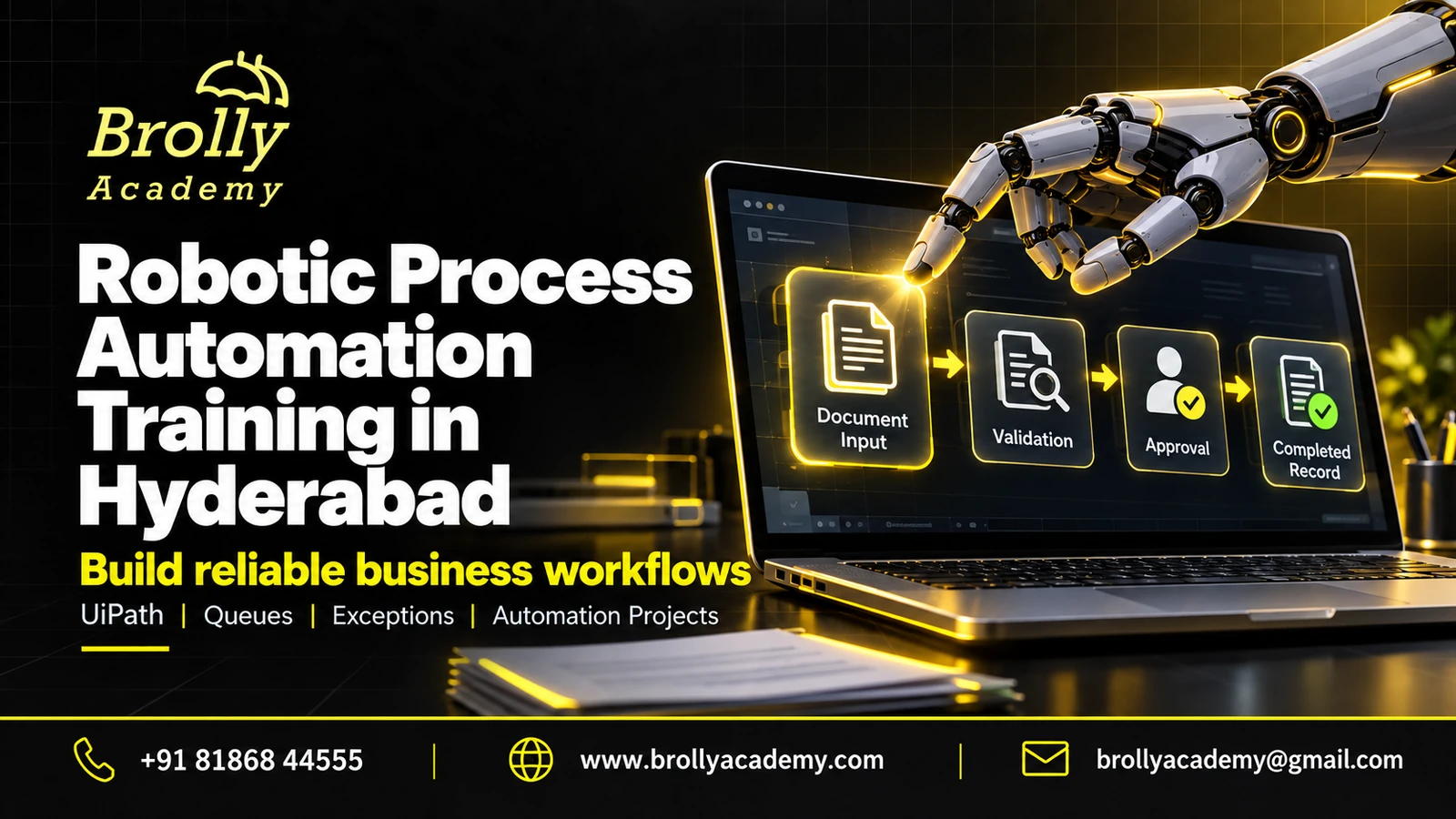
Learn to automate repeatable business work without losing control of errors, access or approvals. Move from a process map to a tested bot, with practical exercises in data handling, queues, exception management and operational handover.
★ 4+ Google rating from 100+ reviews · 9,000+ students trained · 523+ batches completed · Teaching since 2021
Next batch: Monday, 2 November 2026
Course outline8 modules
Practice3 project scenarios
Duration2 months
Course feeINR 20,000
About Robotic Process Automation Training
Robotic process automation, or RPA, uses software to carry out defined steps across applications. Examples include reading an approved spreadsheet, checking required fields, entering records and reporting the result. A reliable bot must also know what to do when information is missing or an application stops responding.
This is the broader RPA learning path, with UiPath-led exercises and an overview of other platforms. It is not a promise of advanced mastery of every vendor. Brolly Academy also has dedicated UiPath, Automation Anywhere and Blue Prism courses for learners who need a specific tool.
For product-specific terminology and behaviour, use UiPath queues and transactions. Match the documentation to the environment used in your exercises.
Who Should Join?
Computer skills, spreadsheet familiarity and logical thinking are useful starting points. You should be able to describe a process step by step. Some advanced tasks require expressions, APIs or programming; they are not simply drag-and-drop exercises.
Business and operations teamsIdentify repetitive, rules-based work and describe exceptions before deciding to automate it.
Testers and support professionalsUse your experience with checks, failures and application behaviour to build more dependable automations.
Developers and beginnersStart with variables and workflow logic, then progress into queues and reusable components. Basic programming helps with more complex integrations.
For complementary learning, explore UiPath training. Choose deeper practice in the UiPath platform.
Robotic Process Automation Syllabus: 8 Practical Modules
Each module connects a concept to an exercise and an output you can explain. Work through the foundations before attempting the integrated project.
1. RPA fundamentals and process selection
Identify stable, repetitive work with clear rules. Compare UI automation with an API integration and explain when manual judgement is still needed. Estimate volumes and exception rates before proposing a bot. Output: a process-selection note and a simple current-state map.
2. Workflow design and data handling
Practise variables, arguments, conditions, loops and reusable workflows. Validate values instead of assuming every file has the expected columns. Separate configuration from business logic. Output: a small workflow that handles correct, missing and invalid input deliberately.
3. Reliable application interaction
Explore selectors, waits, application states and appropriate interaction methods. Avoid relying only on screen coordinates or fixed delays. Test a changed window title and a slow response. Output: a workflow that can explain and record why an interaction failed.
4. Files, spreadsheets, email and documents
Read approved files, transform records and generate a result summary. Treat scanned documents differently from machine-readable text and review uncertain extracted values. Use synthetic personal data during practice. Output: an auditable record-processing exercise with a separate exception report.
5. Orchestration, queues and credentials
Understand publishing, jobs, schedules, assets and transaction queues. Keep credentials out of workflow text and source control. Explore unique references to reduce duplicate processing. Output: a queue-based design showing how each work item moves from pending to a recorded result.
6. Exceptions, retries and recovery
Distinguish invalid business data from temporary application failure. Retry only when it is safe, use limits and route unresolved items for review. Consider what happens if a process restarts after saving a record. Output: a failure-and-recovery test plan that checks for duplicate side effects.
7. Testing, logging and release controls
Test happy paths, edge cases and interrupted runs. Record useful identifiers without exposing passwords or sensitive data. Separate development from production configuration and plan rollback. Output: a release checklist with acceptance criteria, monitoring and a named operational owner.
8. Capstone and platform comparison
Deliver a small end-to-end business workflow and demonstrate its exceptions. Compare the roles of UiPath, Automation Anywhere, Blue Prism and Power Automate at a decision-making level. Output: workflow files, test evidence, a support runbook and a clear statement of the platform actually used.
Discuss Your Learning Goals
Tell the team about your experience and preferred schedule. Book a free demo to discuss the course, lab access and the practical work expected from you.
Practical Skills You Will Develop
Use the exercises to build an explanation as well as a result. You should be able to show what you did, how you checked it and where the limits are.
Select suitable workCheck rules, stability, access and business value before building.
Handle exceptionsDesign deliberate retry, stop and human-review paths.
Protect informationUse controlled credentials and avoid sensitive data in logs.
Support a bot after releaseExplain monitoring, ownership, recovery and maintenance needs.
Tools and Lab Requirements
UiPath access and platform features depend on the account and licence. Confirm the lab arrangement before joining. Exercises should use test applications and synthetic data, never shared production credentials or private customer records.
UiPath StudioBuild workflows, manage data and debug controlled automation exercises.
UiPath OrchestratorUnderstand jobs, queues, assets and deployment responsibilities.
Business applicationsUse spreadsheets, files and test applications to practise repeatable work safely.
Keep UiPath queue configuration available when checking an exercise. Use the instructions for your installed version and authorized access level.
Your Learning Roadmap
Build confidence in stages. Practice time and your starting knowledge matter as much as the number of scheduled sessions.
1. Set up and understandCheck the prerequisites and lab access. Complete the first two modules and explain the basic workflow in your own words.
2. Build and investigateWork through the middle modules. Keep notes of errors, what you tried and the evidence that supported a fix.
3. Test and presentComplete the final modules and an integrated scenario. Present your output, validation and a short handover guide.
3 Practical Project Scenarios
These are teaching scenarios using approved lab systems and synthetic data. They are not claims about live client work or previous student results.
Invoice intake and validationCheck a folder of teaching invoices, identify missing details and produce separate accepted and exception outputs. Do not automatically approve payments.
Service-request queueProcess request records with unique identifiers, bounded retries and an escalation path. Demonstrate what happens when the target application is unavailable.
Spreadsheet reconciliationCompare two teaching datasets, classify differences and create a review report. Keep source data intact and document matching rules.
How the Skills Work in Practice
A bot enters an invoice and then loses its connection before marking the queue item complete. Simply rerunning it could create a second invoice. The design needs a way to check whether that transaction already exists.
Use a stable business reference, validate the existing record and choose an appropriate recovery path. This small example explains why reliable RPA needs testing and process knowledge, not only fast clicking.
Why Learn with Brolly Academy?
Choose a course that connects the subject to work you can actually demonstrate. Use a demo to discuss the learning path and decide whether it fits your starting point.
A connected learning pathThe eight-module outline moves from foundations to an integrated task. Each module identifies an output rather than leaving practice as a vague promise.
A practical local conversationSpeak to the Hyderabad team about your goals, availability and lab needs. Ask questions before committing to a course or a particular schedule.
Clear course boundariesThe page explains prerequisites, product scope and the difference between training completion and independent certification. You can compare the offer with your actual requirements.
Brolly Academy and Other Institutes: Compare the Details
Compare the same evidence from every provider. A long syllabus or a low headline fee does not by itself show how much practical work you will complete.
What to discuss with Brolly AcademyReview these eight modules and the three project scenarios.
Ask for the assigned trainer profile.
Check the lab version and access period.
Review the fee, schedule and certificate terms.
Use the demo to assess the teaching approach.
What to check with any instituteRequest a detailed outline, not just product names.
Verify the trainer information supplied.
Separate demonstrations from your own lab work.
Check licences, exam costs and refund conditions.
Compare the total commitment, not only the advertised price.
Classroom, Online and Corporate Learning
Discuss the currently available delivery format with the academy before booking. Batch availability and session timings should be agreed in writing.
Hyderabad classroom enquiryAsk about the next classroom batch, venue, system requirements and whether you should bring a laptop.
Live online enquiryCheck the session time zone, remote lab access and arrangements for asking questions or catching up on a missed session.
Corporate team enquiryShare your team size, current tools and learning objectives. Agree a scoped program without sharing confidential business data.
For a team program, explore Brolly Academy corporate training.
Robotic Process Automation Course Fee and Duration
Review the course fee and planned learning duration below. Contact the academy to agree the batch dates and receive the complete enrolment terms.
Course fee: INR 20,000Ask for the written quotation showing applicable taxes, payment terms and the full amount payable. Do not assume an external exam or commercial software subscription is included.
Duration: 2 monthsConfirm the session timetable, the split between guided learning and practice, and the expected work outside scheduled sessions.
Before you enrolCheck lab access, materials, project feedback, missed-session arrangements, refund terms and any additional charges. Keep a copy of the agreed offer.
Course Completion and Certification Guidance
Brolly Academy course completion recognizes the training and assessment work agreed for your batch. It is separate from a credential awarded by a software vendor or another certification body.
Brolly Academy course completionAsk for the attendance, assignment and assessment requirements, the certificate wording and how completion will be verified.
Independent certificationUse official vendor information to check whether a relevant credential is currently offered and what preparation it requires. No vendor authorization, exam voucher or pass guarantee is implied.
Career Roles and Skill Applications
Match the learning path to a role, then compare its requirements with your existing experience. The course can support skill development; it does not guarantee employment.
RPA developerBuild and maintain workflows with tests and exception handling.
Automation analystEvaluate processes and translate business rules into automation requirements.
RPA support engineerMonitor jobs, investigate failed transactions and coordinate safe recovery.
You can also explore Blue Prism training. Compare a dedicated Blue Prism learning path.
Where These Skills Are Used
Finance operations, shared services, HR administration and support teams can benefit from controlled automation. Highly variable, sensitive or approval-heavy work may require redesign and human oversight before a bot is appropriate.
Interview and Portfolio Preparation
Prepare evidence you can discuss clearly. Label practice work as training work and do not present a teaching scenario as paid client experience.
Explain a projectDescribe the requirement, your decisions, the result and one limitation. Be ready to answer what you would change for a real deployment.
Show useful evidenceKeep approved files, test results and a concise README or runbook. Remove secrets and private information before sharing a portfolio.
Discuss support servicesAsk the academy which resume, mock-interview or job-search services are included in your batch. Placement assistance is not a job or salary guarantee.
Salary and Hiring Expectations
Salary depends on the role, prior experience, location and the employer. A tool course alone does not establish a salary band. Compare recent job descriptions, required experience and responsibilities rather than relying on a headline income promise.
Meet the Trainer Through a Demo
Request the assigned trainer profile and discuss the experience most relevant to your goals. We recommend using the demo to evaluate how clearly the trainer explains a practical problem.
Relevant experienceAsk for examples of work with Robotic Process Automation that can be discussed without revealing confidential client information.
Practical explanationAsk the trainer to explain a failure scenario and how a learner would investigate it, rather than only showing a finished result.
Feedback and supportDiscuss how assignments are reviewed, how questions are handled and the support period included in the course.
Explore Learner Feedback
Read available academy feedback and ask whether a review relates to this particular course, trainer and delivery format. General academy reviews should not be mistaken for verified results from this new course.
Read Academy ReviewsDownload Your Practice Checklists
Use these editable CSV files to organize your learning. They open in common spreadsheet tools and contain real module and project-checklist content.
Download Syllabus Checklist (CSV) Download Project Review Sheet (CSV)Official Documentation for Further Reading
Use the documentation that matches your product version and environment. These sources support technical learning; linking to them does not imply endorsement of Brolly Academy.
Related Courses at Brolly Academy
Choose complementary learning based on your current skill gaps. These are separate courses, not automatically included in this program.
UiPath trainingChoose deeper practice in the UiPath platform.
View UiPath training
Automation Anywhere trainingExplore the existing Automation Anywhere-focused course.
View Automation Anywhere training
Blue Prism trainingCompare a dedicated Blue Prism learning path.
View Blue Prism training
For a complementary learning path, also explore Jira training and Jaspersoft training. These are separate programs; choose the one that fits your role and prerequisites.
Robotic Process Automation Training Enquiries in Hyderabad
Speak to Brolly Academy near JNTU Metro Station. The centre address is Metro Pillar No. A689, Dr Atmaram Estates, 3rd Floor, Nizampet X Roads, Hyderabad 500072. Confirm the batch venue before travelling.
Learners from Kukatpally, KPHB, Nizampet, Miyapur and other parts of Hyderabad can contact the academy to discuss classroom or online availability.
Call +91 81868 44555Robotic Process Automation Training FAQs
Is RPA the same as artificial intelligence?
No. RPA commonly follows explicit workflow rules, while AI can classify, predict or generate information. They can be combined, but an AI response still needs validation before it triggers a consequential business action.
Which RPA tool is used for practice?
This outline uses UiPath-led practice and compares the main alternatives. Ask for the batch tool and licence details. Dedicated vendor courses are available separately on the Brolly Academy website.
Can a non-IT learner study RPA?
Yes, a learner with process knowledge can begin with workflow fundamentals. Advanced integrations may require coding and technical troubleshooting, so discuss your starting skills before choosing a batch.
Why are queues important?
Queues separate incoming work from the bot that processes it. They help track each item, distribute workloads and record failures. Their configuration still needs careful retry and duplicate-handling rules.
Does a bot remove every manual step?
No. Exceptions, approvals and uncertain information often need a person. A useful automation reduces repetitive effort while preserving necessary controls and accountability.
Will a course certificate equal a UiPath certification?
No. A Brolly Academy completion certificate records training completion. UiPath credentials have their own assessments and terms, which must be checked directly with the issuer.
Request a Free Demo
Share your contact details and the team can discuss course availability, prerequisites and the next suitable session.
Your details are used to respond to this enquiry. Read our Privacy Policy.