AGENTS / TASKS / CREWS / CONTROLLED FLOWS
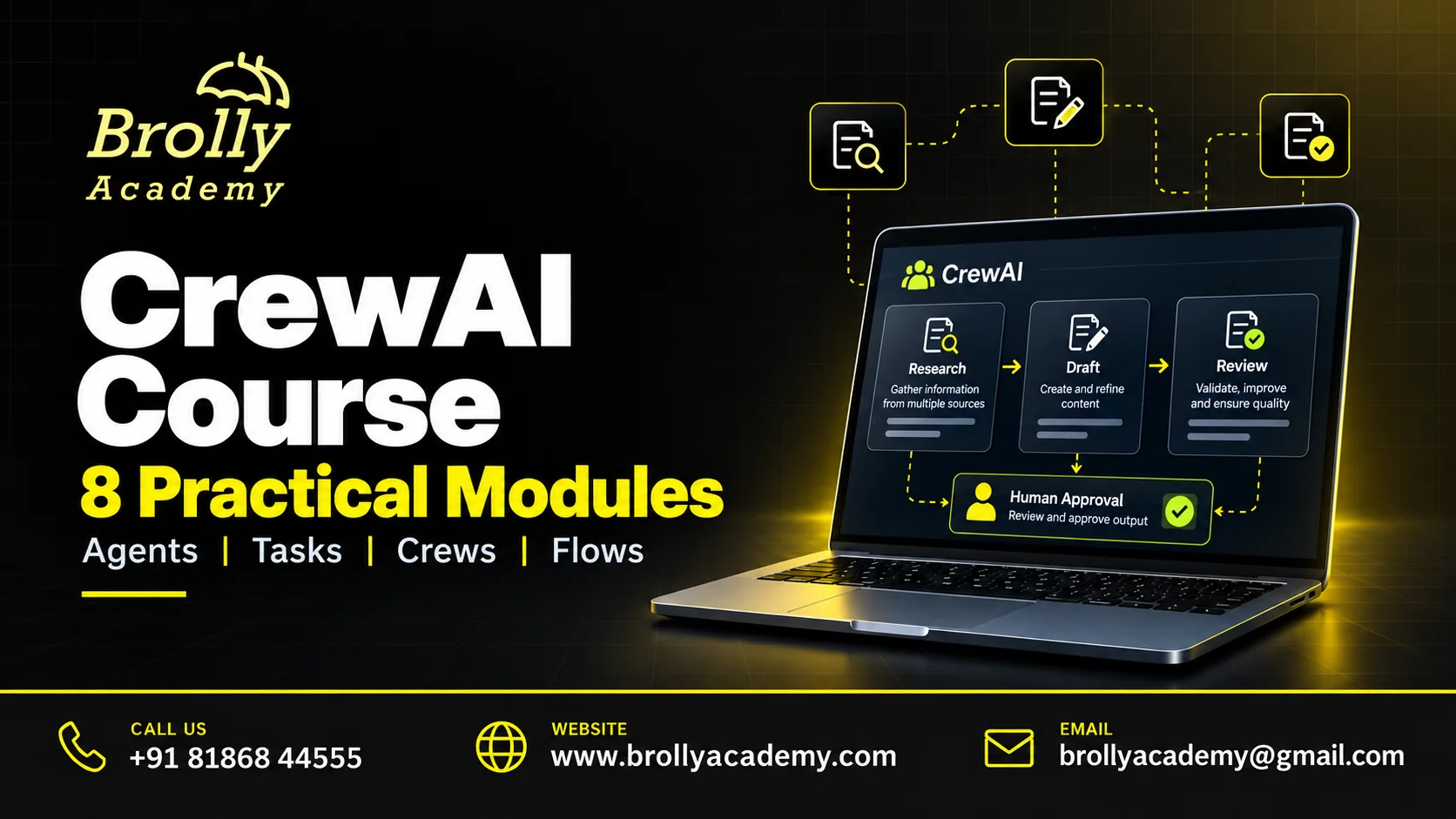
CrewAI Course
Learn to organise a small team of AI agents around clear tasks and reviewable outputs. This CrewAI Course covers roles, tools, task dependencies and flows, with practical checks for unnecessary delegation, repeated work and unsupported conclusions.
★ 4+ Google rating from 100+ reviews · 9,000+ students trained · 523+ batches completed · Teaching since 2021
Next batch: Monday, 2 November 2026
Course outline8 modules
Practice3 project scenarios
Duration2 months
Course feeOnline ₹20,000
Classroom ₹25,000
About the CrewAI Course
CrewAI offers abstractions for agents, tasks and collaborative execution, together with flows for orchestrating work. The useful question is not how many agents a project can contain. It is whether each role has a clear responsibility and whether the combined result is better than a simpler baseline. You compare both designs using the same task and evaluation criteria.
This is a CrewAI implementation course. It does not repeat the full Generative AI foundation program or claim that multi-agent systems always outperform a single agent. LangGraph specialises in explicit graph control; this outline concentrates on agent responsibilities, crew collaboration, flow boundaries and task-quality checks.
For product-specific terminology and behaviour, use CrewAI documentation. Match the documentation to the environment used in your exercises.
Benefits of Learning CrewAI
Turn the syllabus into practical advantages you can demonstrate in your own work. These outcomes come from building, checking and explaining the exercises.
Give every agent a purposeDefine distinct responsibilities instead of creating several agents with the same broad goal.
Make handoffs testableSpecify what each task must produce before another role can use it.
Spot unnecessary collaborationCompare a crew with a simpler baseline and identify duplicated work or avoidable cost.
Protect external actionsSeparate a proposed send or update from the approval that allows it to happen.
Review claims against sourcesCheck whether the final output has evidence rather than treating agreement between agents as proof.
Explain the trade-offsPresent quality, latency and usage alongside the reasons for keeping each agent.
Who Should Join?
You should know Python functions, basic classes, JSON and API credentials. Experience calling a language model is useful. Business learners without coding experience may prefer the n8n automation pathway before this Python-focused course.
Python developersBuild and test role-based AI workflows.
Automation engineersSeparate agent tasks from deterministic business rules.
Agent practitionersEvaluate whether delegation improves a real task.
For complementary learning, explore Generative AI Training. Choose the broader program if you need an introduction to AI models, prompting and the wider application landscape before specialising.
CrewAI Prerequisites and Readiness Checklist
Use these three checks to decide whether you are ready to start or need a short foundation step first. Bring any gaps to your demo discussion.
Python and configurationRead basic classes, call functions and work with JSON. Keep model credentials outside shared code.
A task worth delegatingDescribe a small task with measurable acceptance criteria and a simpler single-agent baseline.
Controlled toolsPrepare read-only sources and mock actions. Give each role only the access needed for its task.
CrewAI Course Syllabus: 8 Practical Modules
Each module connects a concept to an exercise and an output you can explain. Work through the foundations before attempting the integrated project.
1. Task design and baseline
Define a narrow task with checkable acceptance criteria. Complete it with a deterministic process or single model call first. Record quality, latency and cost so a later multi-agent design has something meaningful to beat.
2. Agent roles and responsibilities
Define agents with limited goals, context and tools. Avoid giving every agent the same broad responsibility. Write a responsibility map that explains what each agent may decide and what must be passed to another role or a human.
3. Tasks and output contracts
Break the goal into tasks with clear inputs and expected outputs. Validate structured results and preserve evidence references. Test incomplete task output and show how downstream steps respond instead of silently accepting missing information.
4. Crews and collaboration
Assemble a crew with deliberate task dependencies. Compare sequential work with a more coordinated arrangement where appropriate. Inspect duplicate tool calls and repeated conclusions, and simplify the design if collaboration adds cost without useful improvement.
5. Tools and permissions
Connect read-only tools to approved sources. Validate arguments and constrain access. Use mock write actions for practice, requiring application-level approval before execution and logging the final action separately from an agent proposal.
6. Flows and state
Use flows to define events, state changes and routing around agent work. Keep repeatable business rules deterministic. Demonstrate a success path, a rejected result and a recovery path after an external dependency is unavailable.
7. Evaluation and operational limits
Evaluate task outputs and the final combined result. Set execution and spending boundaries, inspect traces and test conflicting agent conclusions. Account for model uncertainty rather than treating agreement between agents as independent proof.
8. Multi-agent capstone
Deliver a bounded crew workflow with a baseline comparison, task contracts and failure tests. Present why each agent is necessary. Include an approval record for mock side effects and a runbook for configuration, recovery and review.
Discuss Your Learning Goals
Tell the team about your experience and preferred schedule. Book a free demo to discuss the course, lab access and the practical work expected from you.
Practical Skills You Will Develop
Use the exercises to build an explanation as well as a result. You should be able to show what you did, how you checked it and where the limits are.
Role designGive agents specific responsibilities rather than overlapping job titles.
Task contractsDefine useful inputs, outputs and evidence requirements.
Workflow boundariesKeep approvals and fixed rules outside agent discretion.
Collaboration analysisRecognise repeated work, conflicting conclusions and excess handoffs.
Cost-aware evaluationCompare multi-agent execution with a simpler baseline.
Operational handoverDocument tools, limits, errors and human ownership.
Tools and Lab Requirements
Use a personal practice environment with synthetic or openly licensed data. Keep credentials outside notebooks and source control. Confirm software access, hardware and any paid API usage with the course team before enrolling.
CrewAI and PythonA pinned installation with documentation for the chosen version.
Permitted model endpointModel access with explicit lab usage limits and no production secrets.
Synthetic tools and dataMock actions, source records and a result-review sheet.
Consult CrewAI flows during practice. Use documentation matching the installed version and check applicable permissions and service costs.
Your Learning Roadmap
Build confidence in stages. Practice time and your starting knowledge matter as much as the number of scheduled sessions.
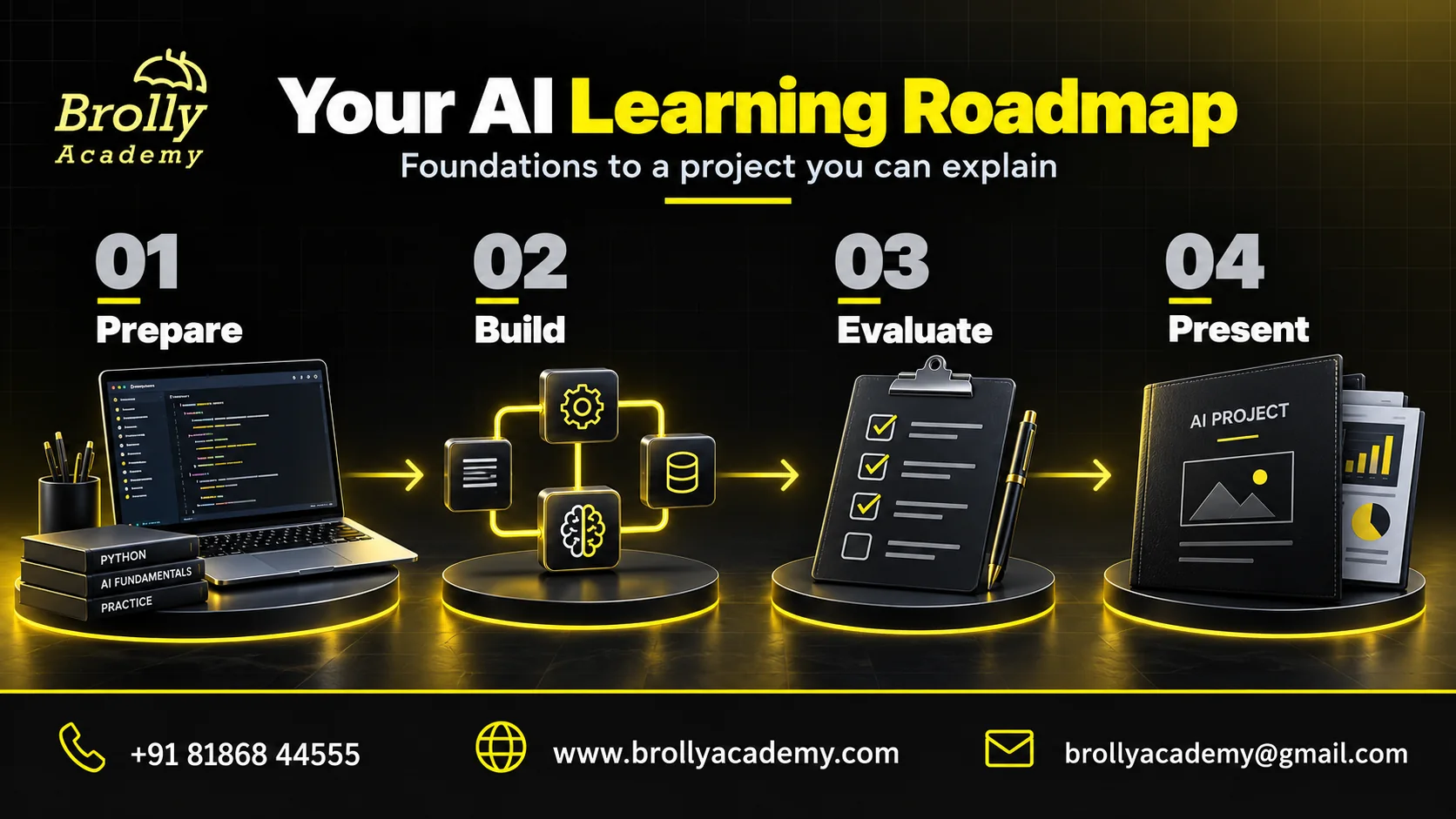
1. Set up and understandCheck the prerequisites and lab access. Complete the first two modules and explain the basic workflow in your own words.
2. Build and investigateWork through the middle modules. Keep notes of errors, what you tried and the evidence that supported a fix.
3. Test and presentComplete the final modules and an integrated scenario. Present your output, validation and a short handover guide.
Your CrewAI project milestone: Include the role map, task contracts, baseline comparison, evidence checks and mock-action approval record. Use the existing syllabus checklist to track progress; follow the stages during the 2-month course and confirm assignment dates with your trainer.
3 Practical Project Scenarios
These are teaching scenarios using approved lab systems and synthetic data. They are not claims about live client work or previous student results.
Research and review crewUse a supplied set of public documents. Separate evidence collection, drafting and verification, and retain references for claims in the final brief.
Product information workflowTurn a fictional catalogue into draft descriptions. A reviewer checks that no agent invents specifications, discounts or availability.
Support triage crewClassify synthetic tickets, gather permitted context and prepare a response for approval. Escalate cases where the sources do not support an answer.
How the Skills Work in Practice
A fictional catalogue says a device has two ports. A drafting agent writes that it has four. The reviewer must compare the claim with the source record, not just assess whether the sentence sounds professional. A second agent repeating the same claim does not make it correct.
Evaluate this workflow against a single-agent version. If the crew costs more without catching more errors, simplify it. Your project presentation should explain the measured trade-off rather than assuming that extra agents make a system advanced.
Why Learn with Brolly Academy?
Choose a course that connects the subject to work you can actually demonstrate. Use a demo to discuss the learning path and decide whether it fits your starting point.
A connected learning pathThe eight-module outline moves from foundations to an integrated task. Each module identifies an output rather than leaving practice as a vague promise.
Discuss your own learning goalShare your experience and preferred format with the course team. Use a demo to assess whether the technical depth, pace and project expectations fit your needs.
Clear course boundariesThe page explains prerequisites, product scope and the difference between training completion and independent certification. You can compare the offer with your actual requirements.
Compare Brolly Academy with Other Training Institutes
Compare the same evidence from each provider: what you will build, what you will test and which services the fee includes. Ask for specific examples rather than relying on broad claims about advanced AI.
What to discuss with Brolly AcademyReview these eight modules and the three project scenarios.
Ask for the assigned trainer profile.
Check the lab version and access period.
Review the fee, schedule and certificate terms.
Use the demo to assess the teaching approach.
What to check with any instituteRequest a detailed outline, not just product names.
Verify the trainer information supplied.
Separate demonstrations from your own lab work.
Check licences, exam costs and refund conditions.
Compare the total commitment, not only the advertised price.
Classroom, Online and Corporate Learning
Discuss the currently available delivery format with the academy before booking. Batch availability and session timings should be agreed in writing.
Classroom learning enquiryConfirm the venue, next available batch and computer requirements before arranging travel.
Live online enquiryCheck the session time zone, remote lab access and arrangements for asking questions or catching up on a missed session.
Corporate team enquiryShare your team size, current tools and learning objectives. Agree a scoped program without sharing confidential business data.
For a team program, explore Brolly Academy corporate training.
CrewAI Course Fee and Duration
The CrewAI Course runs for 2 months. The fee is ₹20,000 for online training or ₹25,000 for classroom (offline) training. Ask for a written quotation confirming taxes, payment and refund terms, lab access and any separate software or API charges.
Classroom training: ₹25,000Learn in the classroom over 2 months. Confirm the venue, batch start date and session timings with the academy before arranging travel.
Online training: ₹20,000Choose online learning over 2 months. Confirm the session time zone, lab access and arrangements for questions or missed sessions before enrolling.
Duration: 2 monthsPlan time for lessons, independent practice and the course project. Ask for the batch calendar, instructor-led hours, assignment deadlines and support period.
Course Completion and Certification Guidance
Brolly Academy course completion recognizes the training and assessment work agreed for your batch. It is separate from a credential awarded by a software vendor or another certification body.
Brolly Academy course completionAsk for the attendance, assignment and assessment requirements, the certificate wording and how completion will be verified.
Independent certificationUse official vendor information to check whether a relevant credential is currently offered and what preparation it requires. No vendor authorization, exam voucher or pass guarantee is implied.
Career Roles and Skill Applications
Match the learning path to a role, then compare its requirements with your existing experience. The course can support skill development; it does not guarantee employment.
Multi-agent application developerBuild bounded collaborative workflows.
AI automation engineerIntegrate agents with approved tools and business processes.
Agent evaluation practitionerAssess task-level and end-to-end quality.
You can also explore AI Testing Training. Develop a deeper QA practice for AI answers, tool behaviour and release decisions.
Where These Skills Are Used
Role-based workflows can help with research preparation, content review and structured support work. Their value depends on clear evidence and task boundaries. Production adoption also requires permissions, spend limits and an owner who reviews failures.
Interview and Portfolio Preparation
Prepare evidence you can discuss clearly. Label practice work as training work and do not present a teaching scenario as paid client experience.
Explain a projectDescribe the requirement, your decisions, the result and one limitation. Be ready to answer what you would change for a real deployment.
Show useful evidenceKeep approved files, test results and a concise README or runbook. Remove secrets and private information before sharing a portfolio.
Discuss support servicesAsk the academy which resume, mock-interview or job-search services are included in your batch. Placement assistance is not a job or salary guarantee.
Placement Preparation and Career Support
Use this checklist during your demo to agree the career-support services included with your batch. The preparation below builds on your course project; recruitment and interview outcomes remain with the employer.
Choose a target roleStart with the responsibilities of a Multi-agent application developer. Compare several relevant job descriptions and note the skills you can already prove.
Prepare a project evidence packInclude the role map, task contracts, baseline comparison, evidence checks and mock-action approval record.
Practise a technical discussionHow would you decide whether adding a reviewer agent improves quality enough to justify its cost? Explain your decision with a test or project example.
Write an honest resume entryState the project goal, your contribution and the checks you ran. Label it as a learning project and report only results you actually measured.
Request focused feedbackAsk whether the batch includes a resume review, portfolio review or mock interview. Agree the format, number of reviews and support period before enrolling.
Plan applications and follow-upKeep a record of role requirements, applications and feedback. Use the next practice session to address a specific gap rather than adding unsupported claims to your profile.
Career Planning and Salary Expectations
Salary depends on the role, prior experience, location and the employer. A tool course alone does not establish a salary band. Compare recent job descriptions, required experience and responsibilities rather than relying on a headline income promise.
Meet Your Trainer: Dinesh
Dinesh is the trainer for the CrewAI Course. Use a demo to discuss your learning goals, ask about a practical CrewAI scenario and understand how project feedback is provided.
Relevant experienceAsk for examples of work with CrewAI that can be discussed without revealing confidential client information.
Practical explanationAsk the trainer to explain a failure scenario and how a learner would investigate it, rather than only showing a finished result.
Feedback and supportDiscuss how assignments are reviewed, how questions are handled and the support period included in the course.
Brolly Academy Learner Feedback
Read available academy feedback and ask whether a review relates to this particular course, trainer and delivery format. General academy reviews should not be mistaken for verified results from this new course.
The excerpts below are published on Brolly Academy's academy reviews page. They describe Data Science and Machine Learning courses, not this new CrewAI course.
Aditya - Data Science"The instructors provided a clear and practical understanding of data science concepts."
Read the original academy testimonial
Kavita Singh - Data Science"The hands-on projects helped me apply the concepts effectively."
Read the original academy testimonial
Rahul Desai - Machine Learning"The trainers were experienced professionals who explained complex algorithms with ease."
Read the original academy testimonial
Student Community and Continued Learning
Keep learning visible: ask precise questions, share permitted examples and record what changed after feedback. Check with the course team about any batch-specific discussion group or mentor access.
Academy updatesFollow the Brolly Academy WhatsApp channel for public academy updates. A public channel is separate from individual technical support.
CrewAI peer-practice ideaReview another learner's role map and identify an overlapping responsibility or an unchecked handoff.
Share safely and ask clearlyInclude the tool version, a small permitted example, the expected result and what happened. Remove API keys, employer documents and personal data before asking for help.
For continued technical learning, use CrewAI documentation. Recheck examples against the version you are using.
Download Your Practice Checklists
Use these editable CSV files to organize your learning. They open in common spreadsheet tools and contain real module and project-checklist content.
Download Syllabus (CSV) Project Checklist (CSV)Official Documentation for Further Reading
Use the documentation that matches your product version and environment. These sources support technical learning; linking to them does not imply endorsement of Brolly Academy.
Related Courses at Brolly Academy
Choose complementary learning based on your current skill gaps. These are separate courses, not automatically included in this program.
Generative AI TrainingChoose the broader program if you need an introduction to AI models, prompting and the wider application landscape before specialising.
View Generative AI Training
Agentic AI CourseExplore agent architecture and decision-making across a broader range of tools.
View Agentic AI Course
AI Testing TrainingDevelop a deeper QA practice for AI answers, tool behaviour and release decisions.
View AI Testing Training
For explicit control over workflow state, branching and approval steps, compare the LangGraph Course.
To connect AI steps with business applications, triggers and low-code workflows, explore the n8n AI Automation Course.
For Python agents with typed outputs and validation-focused application design, see the Pydantic AI Course.
Talk to the CrewAI Course Team
Call +91 81868 44555 or send a course enquiry to discuss the syllabus and current batch options. For a classroom visit, confirm the venue and appointment with Brolly Academy before travelling.
Read our contact details for the academy location and enquiry options. Online delivery, session time zones and tool access should be confirmed for your batch.
Call +91 81868 44555CrewAI Course FAQs
Is CrewAI a no-code tool?
This course uses its Python framework. Some related interfaces may reduce coding, but the syllabus expects you to read configuration, implement tools and test workflow behaviour.
Are more agents always better?
No. They can add latency, cost and coordination errors. You compare a crew with a simpler baseline and keep extra roles only when they serve a measurable purpose.
What is the difference between a crew and a flow?
A crew organises agents around tasks. A flow controls a broader execution process through state and events. They can work together, but they solve different parts of the design.
Can agents approve their own external actions?
Not in the core lab design. Consequential mock actions require a separate approval step. Production access must be controlled by the application, not only by a sentence in a prompt.
How is this different from Agentic AI training?
Agentic AI is the broader architectural topic. This course specialises in implementing and evaluating workflows with CrewAI components.
Will I build a real business automation?
You will build original teaching scenarios with synthetic data and mock side effects. Adapting a project to a live business requires its own permissions, security review and operational agreement.
How much does the CrewAI Course cost?
The CrewAI Course fee is ₹20,000 for online training and ₹25,000 for classroom (offline) training. Confirm taxes, payment and refund terms, lab access and any separate software, API or examination costs in your written quotation.
What is the course duration and batch schedule?
The course duration is 2 months for both online and classroom training. Contact Brolly Academy for the next batch start date, session timings, instructor-led hours and independent practice expectations.
Can I attend a free demo before enrolling?
Use Book Free Demo to open the enquiry form, or contact the team on WhatsApp. Share your experience and learning goal so the counsellor can discuss a suitable session and current availability.
What certificate will I receive?
Discuss the Brolly Academy course-completion requirements for your batch, including attendance, assignments and project assessment. Course completion is separate from any credential issued by a software vendor or independent examination body.
Does the course guarantee a job or salary?
No. The learning path is designed to build demonstrable skills. Ask which portfolio, resume or interview-support services are included. Hiring decisions depend on your wider experience, preparation, location and employer requirements.
How should I compare this course with another institute?
Compare the actual syllabus, your own lab work, trainer experience, project feedback, tool costs and written terms. Ask each provider the same questions and use a demo to assess the teaching style before committing.
Got More Questions About CrewAI?
Talk to the Brolly Academy team about your starting skills, learning goal and available batch options. Request a free demo before choosing your course.