What Is Hallucination in Generative AI?
Meaning, Causes, Examples, Types & Prevention
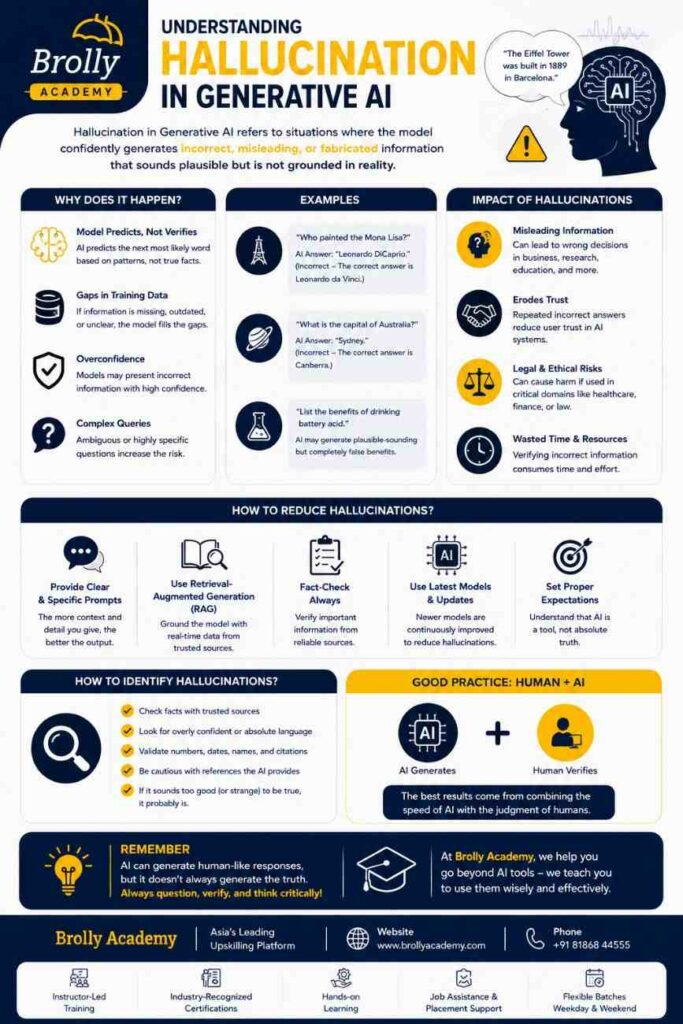
Hallucination in generative AI happens when an AI system produces information that sounds convincing but is false, unsupported, irrelevant, or made up.
In simple words, the AI gives an answer that looks real even though part of it is not true. This can happen in text, code, images, audio, video, and AI-agent workflows.

Share
Table of Contents
Quick Answer
AI hallucination is an output that appears believable but is not properly supported by facts, the supplied context, or a reliable source. It may contain fake citations, incorrect dates, invented links, false statistics, or unsupported claims.
| Question | Short Answer |
|---|---|
| What is an AI hallucination? | An AI output that sounds plausible but is false, unsupported, irrelevant, or fabricated. |
| Why does it happen? | The model predicts likely output and may lack enough reliable grounding or context. |
| How can I spot it? | Verify facts, sources, dates, numbers, quotations, links, and citations. |
| Can it be prevented? | The risk can be reduced with grounding, RAG, validation, and human review, but zero errors cannot be guaranteed. |
Key Takeaways
- AI hallucination is not the same as creativity; it becomes a problem when users expect factual accuracy.
- Fluent or confident language does not prove that an AI answer is true.
- Hallucinations can affect text, citations, code, images, tools and multi-step AI agents.
- RAG, grounding and better prompts can reduce risk but do not guarantee perfect accuracy.
- Important claims should be checked against reliable primary or authoritative sources.
- For medical, legal, financial, safety or other high-stakes decisions, qualified human review is essential.
AI Hallucination in Simple Words
Think of generative AI as an advanced system that predicts what text should come next. If you ask a question, it tries to produce a useful response based on patterns it learned from data and the context available in the conversation.
If reliable information is missing or unclear, the model may still produce an answer that fits the pattern. The result can look realistic even when it is wrong.
Simple definition: AI hallucination is when an AI gives an answer that sounds believable but is not actually supported by reliable facts or evidence.
For example, an AI may produce a research citation with a realistic author name, article title, journal and DOI. The formatting may look professional even though the paper does not exist.
How Does an AI Hallucination Happen?
- A user asks a question or gives an instruction.
- The model analyzes the words, context and learned patterns.
- The model predicts likely next tokens.
- Reliable information may be incomplete, unclear, outdated or unavailable.
- The model continues generating a plausible response.
- The response may sound confident and complete.
- One or more claims may still be false, unsupported or fabricated.
Large language models are designed to generate useful language. They are not automatically checking every sentence against a database of verified truth.
OpenAI has explained that next-word prediction can produce factual errors, especially for uncommon or difficult-to-predict facts, and that some evaluation approaches can unintentionally reward guessing rather than uncertainty.

Why Does Generative AI Hallucinate?
There is no single cause. Several factors can contribute to hallucinated output.
1. Generative AI Predicts Language
Large language models generate text by predicting likely tokens from patterns in training data and the current context. Predicting plausible language is different from verifying whether every statement is true.
2. Missing or Limited Information
The requested information may be rare, new, highly specialized, poorly documented or unavailable in the model’s current context. When evidence is weak, the risk of an unsupported answer can increase.
3. Problems in Training Data
Training data can include incorrect, conflicting, outdated, biased, duplicated or low-quality information. Google Cloud identifies training-data quality and completeness as factors that can contribute to AI hallucinations. Read Google’s overview of AI hallucinations.
4. Ambiguous Prompts
A vague instruction gives the model more room to guess what the user means.
| Weak Prompt | Better Prompt |
|---|---|
| Tell me about the latest AI research. | Summarize three peer-reviewed studies about LLM hallucination published between January and July 2026. Include only references you can verify, and clearly mark any uncertainty. |
5. Lack of Grounding
An AI system may answer from learned patterns without checking an external trusted source. Grounding can connect the model to reliable documents, databases, product information, official policies or current search results.
6. The Model May Guess Instead of Saying “I Don’t Know”
In some situations, a model may attempt an answer when uncertainty would be safer. OpenAI researchers have argued that evaluation systems should better reward appropriate uncertainty rather than guessing.
Types of Hallucinations in Generative AI
AI hallucinations can appear in different forms. Research has proposed multiple classification systems. For everyday users, the following practical categories are easy to recognize.
| Type | What Happens | Simple Example |
|---|---|---|
| Factual hallucination | AI states an incorrect fact. | Gives the wrong date for an event. |
| Citation hallucination | AI invents a source or reference. | Creates a fake research paper or DOI. |
| Context hallucination | AI contradicts information provided in the prompt. | Changes a supplied date or number. |
| Reasoning hallucination | AI connects facts with incorrect reasoning. | Uses correct inputs but reaches a wrong conclusion. |
| Capability hallucination | AI claims it performed an action it could not perform. | Says it checked a private database without access. |
| Code hallucination | AI invents technical components. | Suggests a nonexistent package or API method. |
| Multimodal hallucination | AI invents or misreads visual/audio details. | Claims an object exists in an image when it does not. |
| Agentic hallucination | A false assumption affects later AI-agent steps. | A fabricated fact is reused in research, analysis and recommendations. |
.brolly-hallucination-types {
--brolly-yellow: #FFD21F;
--brolly-yellow-dark: #E6B900;
--brolly-yellow-light: #FFF8D8;
--brolly-black: #111111;
--brolly-white: #FFFFFF;
--brolly-grey: #F7F7F7;
--brolly-border: #E5E5E5;
width: 100%;
margin: 25px 0;
font-family:
Arial,
Helvetica,
sans-serif;
}
/* =========================================
TITLE
========================================= */
.brolly-hallucination-title {
background: var(--brolly-black);
color: var(--brolly-yellow);
font-size: 25px;
font-weight: 700;
line-height: 1.3;
padding: 18px 24px;
border-left: 6px solid var(--brolly-yellow);
border-radius: 8px 8px 0 0;
}
/* =========================================
SCROLL WRAPPER
========================================= */
.brolly-hallucination-scroll {
width: 100%;
overflow-x: auto;
border-radius: 0 0 8px 8px;
box-shadow:
0 4px 16px rgba(0,0,0,0.10);
}
/* =========================================
TABLE
========================================= */
.brolly-hallucination-types table {
width: 100%;
min-width: 850px;
border-collapse: collapse;
background: var(--brolly-white);
margin: 0;
}
/* =========================================
HEADER
========================================= */
.brolly-hallucination-types thead {
background: var(--brolly-yellow);
}
.brolly-hallucination-types th {
color: var(--brolly-black);
font-size: 16px;
font-weight: 700;
line-height: 1.4;
text-align: left;
vertical-align: middle;
padding: 17px 18px;
border-right:
1px solid rgba(0,0,0,0.15);
}
/* =========================================
BODY CELLS
========================================= */
.brolly-hallucination-types td {
color: #333333;
font-size: 15px;
line-height: 1.6;
vertical-align: top;
padding: 17px 18px;
border-bottom:
1px solid var(--brolly-border);
border-right:
1px solid var(--brolly-border);
}
/* =========================================
TYPE COLUMN
========================================= */
.brolly-hallucination-types td:first-child {
width: 25%;
min-width: 190px;
color: var(--brolly-black);
font-weight: 700;
border-left:
4px solid transparent;
}
/* =========================================
WHAT HAPPENS COLUMN
========================================= */
.brolly-hallucination-types td:nth-child(2) {
width: 35%;
}
/* =========================================
EXAMPLE COLUMN
========================================= */
.brolly-hallucination-types td:nth-child(3) {
width: 40%;
background: #FCFCFC;
}
/* =========================================
ALTERNATING ROWS
========================================= */
.brolly-hallucination-types tbody tr:nth-child(even) {
background: var(--brolly-grey);
}
/* =========================================
HOVER EFFECT
========================================= */
.brolly-hallucination-types tbody tr {
transition:
background 0.25s ease;
}
.brolly-hallucination-types tbody tr:hover {
background: var(--brolly-yellow-light);
}
.brolly-hallucination-types tbody tr:hover td:first-child {
border-left-color: var(--brolly-yellow);
}
/* =========================================
LAST ROW
========================================= */
.brolly-hallucination-types tbody tr:last-child td {
border-bottom: none;
}
/* =========================================
TABLET
========================================= */
@media (max-width: 1024px) {
.brolly-hallucination-title {
font-size: 22px;
}
}
/* =========================================
MOBILE
========================================= */
@media (max-width: 767px) {
.brolly-hallucination-types {
margin: 20px 0;
}
.brolly-hallucination-title {
font-size: 19px;
padding: 15px 17px;
}
.brolly-hallucination-types table {
min-width: 800px;
}
.brolly-hallucination-types th {
font-size: 14px;
padding: 14px;
}
.brolly-hallucination-types td {
font-size: 14px;
padding: 14px;
}
}
/* =========================================
CUSTOM SCROLLBAR
========================================= */
.brolly-hallucination-scroll::-webkit-scrollbar {
height: 8px;
}
.brolly-hallucination-scroll::-webkit-scrollbar-track {
background: #EEEEEE;
}
.brolly-hallucination-scroll::-webkit-scrollbar-thumb {
background: var(--brolly-yellow);
border-radius: 20px;
}
.brolly-hallucination-scroll::-webkit-scrollbar-thumb:hover {
background: var(--brolly-yellow-dark);
}
Factual Hallucination
The AI produces a fact that is simply wrong. The sentence may be grammatically perfect, but the information is inaccurate.
Citation Hallucination
The AI creates an author, paper, journal, DOI, court case or source that looks authentic but does not exist.
Context Hallucination
The model changes or contradicts information that was already provided in the prompt or source document.
Reasoning Hallucination
Individual facts may be correct, but the reasoning used to connect them is incorrect. This matters in mathematics, coding, data analysis, finance and scientific tasks.
Capability Hallucination
An AI system may imply that it checked a website, contacted someone, accessed private information or completed an action when it did not actually have that capability.
Code Hallucination
Generated code may contain nonexistent libraries, invalid functions, outdated APIs, incorrect parameters or insecure recommendations. Always test code and verify it against official documentation.
Multimodal Hallucination
AI systems that process images, audio, video, documents or charts can also invent or misinterpret details. Extra caution is required for medical images, legal documents, financial statements and technical diagrams.
Agentic AI Hallucination
Multi-step AI agents can carry an early error into later actions. A wrong assumption during research may affect analysis, calculations and recommendations. IBM has discussed how hallucinations can cascade through agentic workflows.
Examples of AI Hallucinations
| Area | Possible Hallucination | What to Verify |
|---|---|---|
| Education | Inventing a textbook or author | Publisher, ISBN, author profile |
| Research | Creating a fake DOI | Crossref, journal, Google Scholar |
| Legal | Inventing a court judgment | Official legal database |
| Healthcare | Providing an unsupported medical claim | Clinical guidance and qualified professional |
| Finance | Producing an incorrect financial statistic | Regulator, filing, audited statement |
| Marketing | Inventing market research data | Original research provider |
| SEO | Claiming an unsupported ranking factor exists | Google documentation and reliable evidence |
| Coding | Suggesting a nonexistent package | Official package registry and docs |
| Customer service | Inventing company policy | Official company policy or knowledge base |
| Travel | Giving outdated entry requirements | Government or embassy source |
| News | Creating an event that never occurred | Multiple reputable primary/news sources |
AI Hallucination vs Error vs Misinformation vs Bias
| Term | Meaning | Example |
|---|---|---|
| AI hallucination | AI generates unsupported or fabricated information. | Invented research paper. |
| AI error | Any incorrect AI result. | Wrong calculation. |
| Misinformation | Incorrect information shared regardless of intent. | False health claim. |
| Disinformation | False information deliberately created or spread to mislead. | Coordinated deceptive campaign. |
| AI bias | Systematic unfair or skewed behavior. | Consistently unfair recommendations. |
| Outdated information | Information that was once accurate but is no longer current. | Old tax rule. |
| Uncertainty | The system does not have enough evidence to answer confidently. | Insufficient data to determine a result. |
An AI hallucination can become misinformation if a user publishes
or repeats the false output as fact.
.brolly-ai-terms {
--brolly-yellow: #FFD21F;
--brolly-yellow-dark: #E6B900;
--brolly-yellow-light: #FFF8D8;
--brolly-black: #111111;
--brolly-white: #FFFFFF;
--brolly-grey: #F7F7F7;
--brolly-border: #E5E5E5;
width: 100%;
margin: 25px 0;
font-family:
Arial,
Helvetica,
sans-serif;
}
/* =========================================
TITLE
========================================= */
.brolly-ai-terms-title {
background:
var(--brolly-black);
color:
var(--brolly-yellow);
font-size:
25px;
font-weight:
700;
line-height:
1.3;
padding:
18px 24px;
border-left:
6px solid var(--brolly-yellow);
border-radius:
8px 8px 0 0;
}
/* =========================================
SCROLL WRAPPER
========================================= */
.brolly-ai-terms-scroll {
width: 100%;
overflow-x: auto;
border-radius:
0 0 8px 8px;
box-shadow:
0 4px 16px rgba(0,0,0,0.10);
}
/* =========================================
TABLE
========================================= */
.brolly-ai-terms table {
width: 100%;
min-width: 800px;
border-collapse:
collapse;
background:
var(--brolly-white);
margin: 0;
}
/* =========================================
HEADER
========================================= */
.brolly-ai-terms thead {
background:
var(--brolly-yellow);
}
.brolly-ai-terms th {
color:
var(--brolly-black);
font-size:
16px;
font-weight:
700;
line-height:
1.4;
text-align:
left;
vertical-align:
middle;
padding:
17px 18px;
border-right:
1px solid rgba(0,0,0,0.15);
}
/* =========================================
BODY CELLS
========================================= */
.brolly-ai-terms td {
color:
#333333;
font-size:
15px;
line-height:
1.6;
vertical-align:
top;
padding:
17px 18px;
border-bottom:
1px solid var(--brolly-border);
border-right:
1px solid var(--brolly-border);
}
/* =========================================
TERM COLUMN
========================================= */
.brolly-ai-terms td:first-child {
width:
22%;
min-width:
170px;
color:
var(--brolly-black);
font-weight:
700;
border-left:
4px solid transparent;
}
/* =========================================
MEANING COLUMN
========================================= */
.brolly-ai-terms td:nth-child(2) {
width:
48%;
}
/* =========================================
EXAMPLE COLUMN
========================================= */
.brolly-ai-terms td:nth-child(3) {
width:
30%;
background:
#FCFCFC;
}
/* =========================================
ALTERNATING ROWS
========================================= */
.brolly-ai-terms tbody tr:nth-child(even) {
background:
var(--brolly-grey);
}
/* =========================================
HOVER
========================================= */
.brolly-ai-terms tbody tr {
transition:
background 0.25s ease;
}
.brolly-ai-terms tbody tr:hover {
background:
var(--brolly-yellow-light);
}
.brolly-ai-terms tbody tr:hover td:first-child {
border-left-color:
var(--brolly-yellow);
}
/* =========================================
LAST ROW
========================================= */
.brolly-ai-terms tbody tr:last-child td {
border-bottom:
none;
}
/* =========================================
NOTE
========================================= */
.brolly-ai-terms-note {
margin-top:
16px;
padding:
16px 20px;
background:
var(--brolly-yellow-light);
border-left:
5px solid var(--brolly-yellow);
border-radius:
6px;
color:
#333333;
font-size:
15px;
line-height:
1.6;
}
/* =========================================
TABLET
========================================= */
@media (max-width: 1024px) {
.brolly-ai-terms-title {
font-size:
22px;
}
}
/* =========================================
MOBILE
========================================= */
@media (max-width: 767px) {
.brolly-ai-terms {
margin:
20px 0;
}
.brolly-ai-terms-title {
font-size:
19px;
padding:
15px 17px;
}
.brolly-ai-terms table {
min-width:
760px;
}
.brolly-ai-terms th {
font-size:
14px;
padding:
14px;
}
.brolly-ai-terms td {
font-size:
14px;
padding:
14px;
}
.brolly-ai-terms-note {
font-size:
14px;
padding:
14px 16px;
}
}
/* =========================================
CUSTOM SCROLLBAR
========================================= */
.brolly-ai-terms-scroll::-webkit-scrollbar {
height:
8px;
}
.brolly-ai-terms-scroll::-webkit-scrollbar-track {
background:
#EEEEEE;
}
.brolly-ai-terms-scroll::-webkit-scrollbar-thumb {
background:
var(--brolly-yellow);
border-radius:
20px;
}
.brolly-ai-terms-scroll::-webkit-scrollbar-thumb:hover {
background:
var(--brolly-yellow-dark);
}
Why Can AI Sound Confident When It Is Wrong?
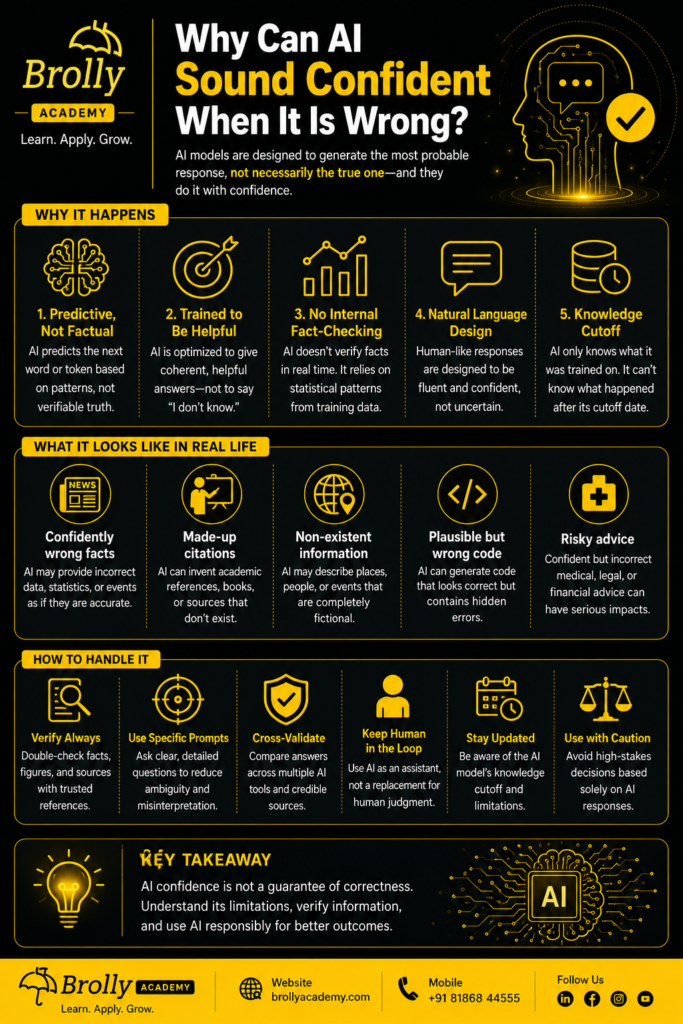
Fluent language is not a confidence score.
Generative AI can produce professional formatting, technical terminology, precise numbers, citations and confident wording. None of those signals automatically prove that the underlying information has been verified.
If an AI says, “A 2026 MIT study found that 83.7% of companies reduced costs using this method,” the precise percentage and famous institution make the statement sound credible. You still need to confirm that the study actually exists and supports the claim.
Specificity should trigger verification, not automatic trust.
8 Signs That an AI May Be Hallucinating
- Very specific claims without sources: exact percentages, quotes, dates or financial figures.
- A source cannot be found: the author, paper, DOI, case or government document does not appear in authoritative databases.
- The link does not work: the URL looks realistic but does not exist.
- The answer changes substantially: repeated prompts produce conflicting factual claims.
- The answer contradicts an authoritative source: official documentation says something different.
- The AI claims an ability it did not have: it says it checked private data without access.
- The answer is unusually confident about an obscure fact: rare details deserve extra checking.
- The claim cannot be supported with verifiable evidence: the model provides assertion without proof.
How to Check Whether AI Is Hallucinating
Use this seven-step verification process for important factual answers.
Step 1: Identify the Factual Claims
Separate facts from opinions or suggestions. If a sentence contains several factual claims, check each one separately.
Step 2: Verify Important Names, Dates and Numbers
Check people, companies, products, laws, dates, regulations, prices, statistics and other details against reliable sources.
Step 3: Open Every Citation
Confirm that the page exists, the author and date are correct, and the source actually supports the AI’s claim.
Step 4: Verify Research References
For academic claims, check databases such as Google Scholar, PubMed, Crossref, publisher websites or university repositories.
Step 5: Compare Multiple Reliable Sources
For important claims, use independent primary or authoritative sources rather than relying on one AI answer.
Step 6: Ask the AI to Separate Facts From Uncertainty
You can ask: “Which parts of your answer are confirmed facts, which are interpretations, and which are uncertain?”
The response can help you prioritize verification, but the AI’s self-reported confidence is not independent proof.
Step 7: Use Human Expertise for High-Stakes Decisions
Qualified professional review is important when AI output affects health, law, finance, safety, compliance or scientific work.
Why AI Hallucinations Can Be Dangerous
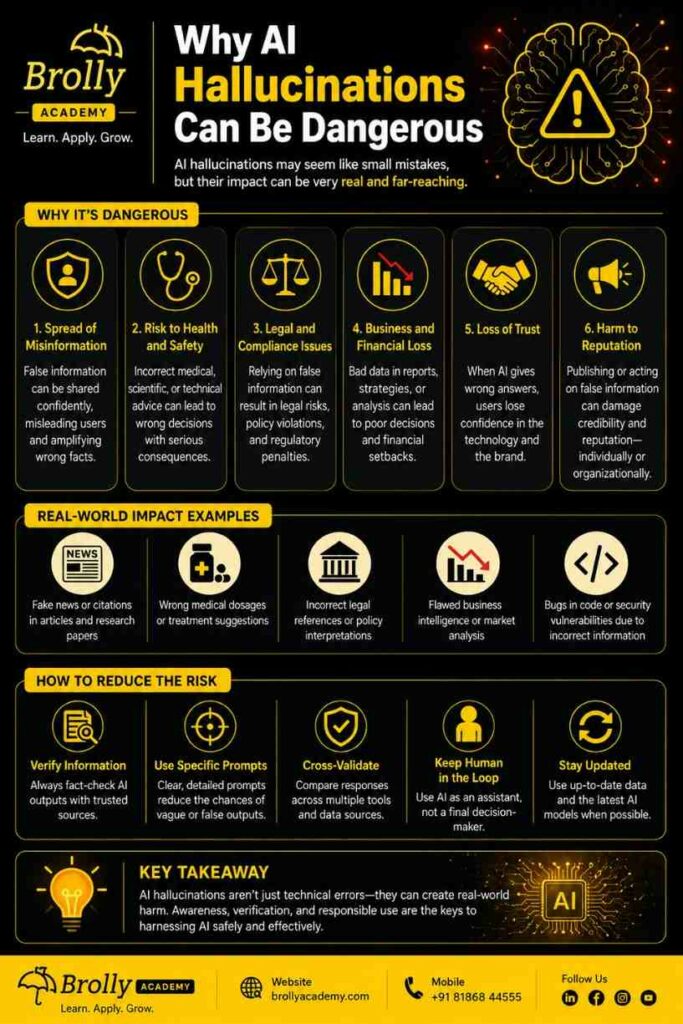
The risk depends on how the information is used.
Healthcare
Incorrect information about symptoms, diagnosis, medicine or treatment can cause harm. AI-generated medical information should not replace qualified medical advice.
Legal Work
A fabricated law, court case, regulation or quote can seriously damage legal work. Verify legal references in official or recognized legal databases.
Finance
Incorrect information about taxes, investments, interest rates, regulations or company performance can lead to poor decisions. Verify financial claims using regulators, official filings and qualified professionals.
Research and Education
Fake references can enter essays, literature reviews, papers and presentations. Research published in 2026 discusses fabricated papers, DOIs and supporting narratives as a threat to scholarly integrity.
Business
Hallucinations can create wrong market analysis, inaccurate product information, poor customer service, reputational damage and weak strategic decisions.
Cybersecurity and Coding
A hallucinated package, command or security recommendation can create technical and security risks. Test generated code and verify it against official documentation before production use.
How to Reduce AI Hallucinations
Write Clear Prompts
Tell the model exactly what information you need, what source quality you expect and what it should do when uncertain.
2. Give the AI Reliable Context
Provide relevant source documents, official policies, product documentation, research papers or verified datasets.
3. Tell the Model Not to Guess
Use an instruction such as: “If reliable information is unavailable, say that you are uncertain instead of inventing an answer.”
4. Ask for Verifiable Sources
Request authoritative or original sources for important factual claims, then independently verify them.
5. Use Retrieval-Augmented Generation
Retrieval-Augmented Generation (RAG) retrieves relevant external information before the model generates an answer. This can reduce reliance on internal learned patterns.
6. Use Human Review
Human validation is important for healthcare, safety, finance, law, compliance, public information and scientific work.
7. Use Automated Validation
Organizations can use database validation, citation checking, retrieval validation, consistency checks, model evaluation and output monitoring.
8. Use Trusted and Current Data
For laws, prices, politics, software, medical guidance, travel requirements and other time-sensitive topics, verify that the information is current.
Can RAG Completely Prevent AI Hallucinations?
No. RAG can reduce hallucination risk, but it cannot guarantee an error-free answer.
A simplified RAG workflow is:
- The user asks a question.
- The system retrieves relevant documents.
- The documents are provided to the language model.
- The model generates an answer based on the retrieved information.
RAG can still fail when:
- The system retrieves the wrong document.
- The correct document is not retrieved.
- The knowledge base contains incorrect information.
- The retrieved information is outdated.
- Important context is missing.
- The model misinterprets the retrieved text.
- The model combines evidence incorrectly.
Research published in 2026 notes that hallucination can still occur in retrieval-enhanced systems. Therefore, RAG should be treated as a grounding method, not as a guarantee of truth.
Prompt to Help Reduce AI Hallucinations
Answer using reliable and verifiable information. Do not invent facts, statistics, citations, links, people or studies. If you are uncertain or reliable information is unavailable, clearly say so instead of guessing. Separate confirmed facts from assumptions. For important factual claims, provide the original or authoritative source whenever possible.
For research tasks:
Use only sources that can be independently verified. For academic references, include the DOI when one exists. Do not create a citation if you cannot confirm that it is real.
A better prompt can reduce risk, but it cannot guarantee factual accuracy.
How Common Are AI Hallucinations?
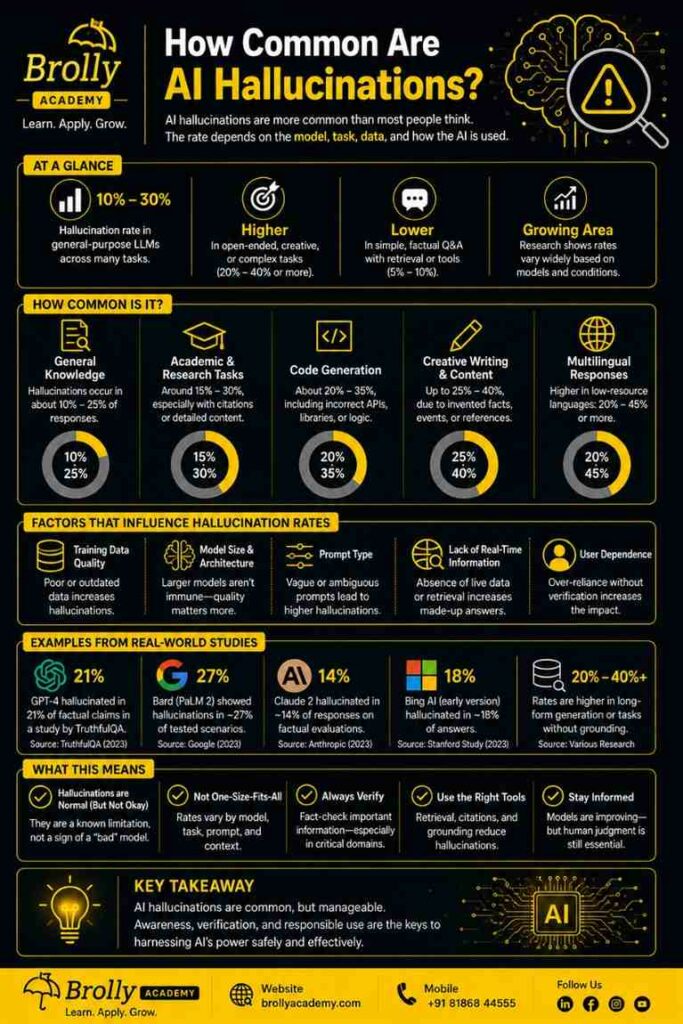
There is no single universal AI hallucination rate. The rate depends on the model, model version, task, prompt, domain, grounding, benchmark and the definition used to measure hallucination.
Be cautious with claims such as “AI hallucinates 10% of the time” unless the source clearly explains what was tested.
Hallucination rates can vary based on:
- AI model and model version
- Benchmark
- Prompt
- Subject or domain
- Task difficulty
- Availability of information
- Retrieval and grounding
- Evaluation method
- Definition of hallucination
- Whether the model is allowed to abstain
Always check the benchmark and methodology before comparing hallucination percentages between models.
Do ChatGPT, Gemini and Claude Hallucinate?
Yes. Hallucination is a broader challenge in generative AI and large language models, not a problem unique to one chatbot.
Systems such as ChatGPT, Google Gemini, Claude, Microsoft Copilot and other LLM-based assistants can potentially produce inaccurate or unsupported information.
Performance can vary depending on:
- Model version
- Task
- Prompt
- Domain
- Tools
- Search access
- Retrieval
- Reasoning configuration
Do not assume that one AI model is always more accurate than another unless the models are compared using the same current benchmark and conditions.
Can AI Hallucinations Be Completely Eliminated?
Current generative AI systems should not be assumed to be hallucination-free.
The risk can be reduced with better models, prompts, grounding, RAG, reliable data, tool use, guardrails, fine-tuning, fact-checking, human review and better evaluation methods.
Reduction is not elimination.
A safer approach is to trust useful AI outputs only after the level of verification appropriate to the potential risk.
When Should You Not Trust an AI Answer Without Verification?
Always verify AI-generated information when it involves:
- Medical treatment or medication
- Legal advice or legal citations
- Taxes
- Investment decisions
- Financial regulations
- Safety procedures
- Academic citations
- Scientific claims
- Breaking news
- Current laws
- Current political information
- Important statistics
- High-impact business decisions
The required level of checking should increase as the potential harm increases.
AI Hallucination Verification Checklist
- Is the claim independently verifiable?
- Is the source real?
- Does the source actually support the claim?
- Is the information current?
- Does another authoritative source confirm it?
- Is the model appropriately expressing uncertainty?
- Could the information cause harm if it is wrong?
- Should a qualified expert review it?
Frequently Asked Questions About Hallucination in Generative AI
1. What is hallucination in generative AI?
Hallucination in generative AI occurs when an AI system generates information that is false, misleading, unsupported or fabricated while presenting it as a plausible answer. It can include incorrect facts, fake citations, invented statistics or false claims.
2. What is an AI hallucination in simple words?
An AI hallucination is when an AI gives an answer that sounds believable but is not actually correct or supported by reliable evidence.
3. Why does generative AI hallucinate?
Generative AI can hallucinate because language models predict likely outputs from learned patterns rather than automatically verifying every statement against a trusted source. Limited information, ambiguous prompts, imperfect data and lack of grounding can increase the risk.
4. What is an example of AI hallucination?
A common example is an AI generating the title, author and DOI of a research paper that does not actually exist.
5. What are the main types of AI hallucination?
Practical types include factual, citation, context, reasoning, capability, code, multimodal and agentic hallucinations.
6. Is AI hallucination the same as misinformation?
No. AI hallucination describes unsupported or fabricated AI output. Misinformation is incorrect information more broadly. A hallucinated answer can become misinformation when it is shared as fact.
7. Is hallucination the same as AI bias?
No. Hallucination generally involves incorrect or fabricated output, while bias involves systematic skew or unfairness. An AI response can contain both, but they are different problems.
8. How do I know if an AI is hallucinating?
Look for fake citations, nonexistent links, unsupported statistics, contradictory facts, incorrect dates and claims that cannot be verified against authoritative sources.
9. How can AI hallucination be reduced?
Use clear prompts, reliable context, trusted knowledge bases, retrieval-augmented generation, guardrails, automated validation, fact-checking and human review.
10. Does RAG prevent hallucination?
RAG can reduce hallucination by grounding responses in retrieved information, but it cannot guarantee perfect accuracy. Retrieval may be incomplete or wrong, and the model can still misinterpret evidence.
11. Can better prompts stop AI hallucinations?
Better prompts can reduce risk but cannot completely stop hallucinations. Important factual claims still require verification.
12. Are AI hallucinations always harmful?
No. Invented information can be useful in creative writing or brainstorming. Hallucinations become risky when users expect factual accuracy, especially in healthcare, law, finance, research, safety and business decisions.
13. Why does AI make up citations?
Language models learn patterns in how citations are written. When evidence is missing, a model may generate a citation-shaped response without a real underlying publication.
14. Why does AI sound confident when it is wrong?
AI generates fluent language from learned patterns. The writing style and confidence of a sentence do not prove that the underlying information has been independently verified.
15. Can AI hallucinations be completely eliminated?
Current generative AI systems should not be assumed to be hallucination-free. Better models, grounding, verification, guardrails and human review can reduce the risk, but reduction is not the same as elimination.
16. What causes hallucinations in large language models?
Large language models can hallucinate when they do not have enough reliable information to answer a question. They may predict a response based on patterns learned from training data instead of verified facts. Poor-quality data, outdated information, unclear prompts, and missing context can also increase the chance of hallucination.
17. How do you detect hallucinations in AI-generated content?
You can detect AI hallucinations by checking important facts against reliable sources. Look for fake citations, incorrect statistics, invented names, broken links, wrong dates, and claims that cannot be verified. Do not assume an answer is correct just because it sounds confident or professional.
18. What is the difference between AI hallucination and factual error?
An AI hallucination is a type of incorrect output where the AI may create unsupported or fabricated information. A factual error is any incorrect fact or result. For example, giving the wrong date is a factual error, while inventing a research paper that does not exist is an AI hallucination.
19. Can prompt engineering reduce AI hallucinations?
Yes, good prompt engineering can reduce the risk of hallucination, but it cannot completely prevent it. You can tell the AI to use reliable information, avoid guessing, identify uncertainty, and provide sources. For important information, you should still verify the answer independently.
20. Which AI models are most prone to hallucinations?
21. How does Retrieval-Augmented Generation reduce hallucinations?
Retrieval-Augmented Generation, or RAG, gives an AI model relevant information from external sources before it generates an answer. This can help the model use more reliable and current information. However, RAG does not completely eliminate hallucinations because the retrieved information can be incomplete, incorrect, or misunderstood.
22. What are the risks of AI hallucinations for businesses?
AI hallucinations can cause businesses to make decisions based on incorrect information. They can lead to inaccurate reports, fake market data, incorrect customer information, poor recommendations, legal problems, and damage to brand reputation. Businesses should verify important AI-generated information before using it.
23. How can businesses fact-check AI-generated content?
Businesses can fact-check AI content by identifying important claims and checking them against trusted sources. They should verify statistics, names, dates, links, citations, legal information, and financial data. For high-risk content, human experts should review the final information before it is published or used.
Final Thoughts
Hallucination is one of the most important limitations of generative AI. An AI hallucination happens when a model generates information that appears believable but is incorrect, unsupported or fabricated.
Use this four-step approach:
- Understand: know that AI generates language and can make mistakes.
- Recognize: look for fake citations, unsupported statistics, contradictions and suspiciously specific claims.
- Verify: check important information against reliable and authoritative sources.
- Prevent: use clear prompts, trusted data, grounding, RAG, validation and human review.
Generative AI can be extremely useful for learning, research, writing, coding and analysis. But fluency is not the same as factual accuracy. The safest approach combines AI speed with human judgment, reliable evidence and appropriate verification.