How Does Generative AI Work?
A Step-by-Step Guide
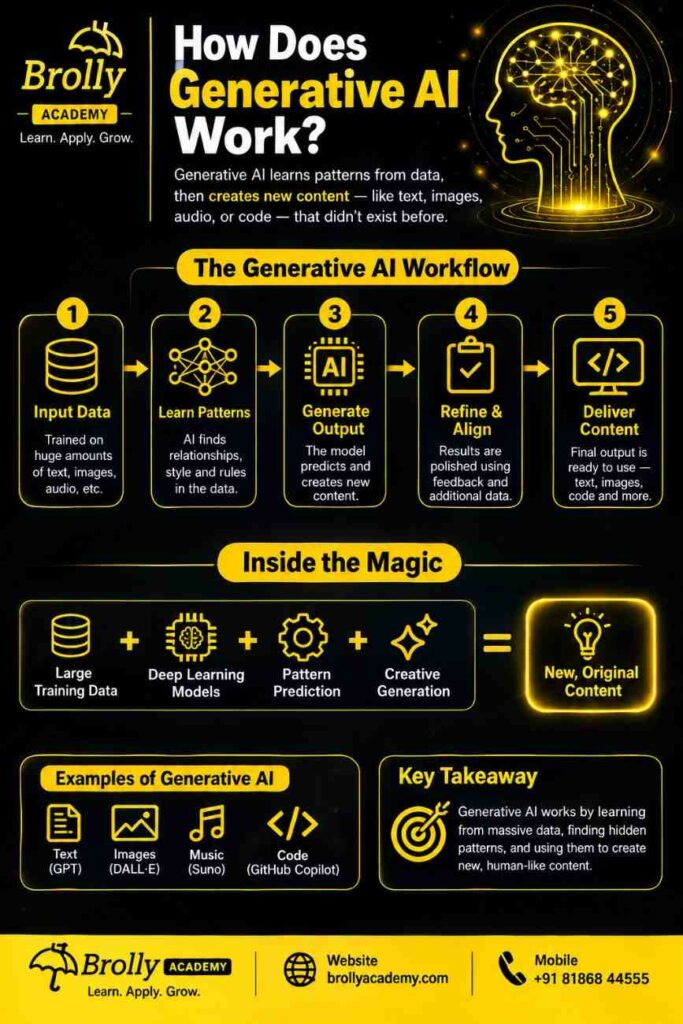
How does generative AI work? Generative AI works by learning patterns from data during training and using a trained model, a user’s input, and available context to generate new content during inference.
For many modern language-generation systems, the process can be simplified further:
However, generative AI is broader than language models. Different systems can use different architectures and generation methods for text, images, audio, video, code, and other types of content.

Share
Table of Contents
Quick Answer:
Generative AI generally works in two major stages:
- Training — the model learns patterns from training data by adjusting its numerical parameters.
- Inference — the trained model processes a new input and generates an output using its learned parameters and available context.
Then, when someone uses the system:
For a language model, the process can include tokenization, numerical representations, context processing, next-token prediction, and repeated generation until the response is complete.
The exact process depends on the type of generative AI model and the application built around it.
How Does Generative AI Work at a High Level?
You can understand generative AI through six basic stages:
| Stage | What happens |
|---|---|
| 1. Data | Relevant data is collected and prepared for training. |
| 2. Training | The model learns patterns according to its training objective. |
| 3. Model | Learned parameters represent patterns acquired during training. |
| 4. Prompt | A user or application provides an input. |
| 5. Inference | The trained model processes the input and available context. |
| 6. Output | The system generates and returns new content. |
This is a simplified framework. Different generative AI systems can have different training objectives, architectures, and generation processes.
What Is Generative AI?
Generative AI is a category of artificial intelligence that can generate new content based on patterns learned from data.
Depending on the system, it can generate or transform:
- Text
- Images
- Code
- Audio
- Music
- Video
- 3D content
- Other digital content
For example, a user might ask an AI system to write an explanation, generate code, create an image, summarize information, or transform existing content.
Training teaches the model patterns. Inference uses the trained model to generate an output.
How Is Generative AI Trained?
Before a generative AI model can be used, it generally needs to be trained.
1. Training Data Is Collected
Generative AI models require data relevant to their intended tasks.
| Model type | Possible training data |
|---|---|
| Language model | Text and code |
| Image model | Images and associated information |
| Audio model | Speech, music, and sounds |
| Video model | Video and related information |
| Multimodal model | Multiple types of data |
The quality, quantity, preparation, and composition of training data can influence model performance.
2. Training Data Is Prepared
Raw data generally needs to be processed before it can be used effectively.
- Cleaning
- Filtering
- Deduplication
- Formatting
- Normalization
- Tokenization
- Other transformations
For language models, tokenization converts text into units that the model can process.
A token can represent a complete word, part of a word, punctuation, a symbol, or another text unit depending on the tokenizer.
3. The Model Learns Patterns
During training, a model processes examples and makes predictions according to its training objective.
If the model’s prediction differs from the expected training target, a loss value can be calculated.
An optimization process then adjusts the model’s parameters. This happens repeatedly across large amounts of training data.
4. Model Parameters Are Optimized
Generative AI models contain learned numerical parameters. These parameters influence how the model processes inputs and produces outputs.
- Loss functions
- Gradient descent
- Backpropagation
- Optimization
- Parameter updates
Training adjusts model parameters so the model becomes better at its intended task.
What Happens After Training?
Training is not necessarily the final step before an AI system is deployed.
- Fine-tuning
- Alignment
- Evaluation
- Safety testing
- Deployment
- Monitoring
Fine-Tuning
Fine-tuning can adapt a pretrained model for a particular task, domain, behavior, or application.
Alignment
Alignment techniques can help make model behavior better suited to intended instructions, preferences, safety requirements, or application goals.
Evaluation
Models can be evaluated for factors such as:
- Accuracy
- Relevance
- Factuality
- Safety
- Robustness
- Instruction following
- Task performance
What Is a Foundation Model?
A foundation model is a broadly trained AI model that can serve as a base for multiple applications or tasks.
A foundation model can be adapted using approaches such as:
- Prompting
- Fine-tuning
- Other model-adaptation techniques
An application can also extend a model with:
- Retrieval
- External data
- Tools
- APIs
- Databases
What Happens When You Enter a Prompt?
Once a model has been trained and deployed, an AI application can receive a user’s prompt.
1. The User Provides a Prompt
A prompt is an instruction, question, request, or other input provided to an AI system.
Example: Explain digital marketing to a beginner.
A prompt can contain:
- Instructions
- Questions
- Context
- Examples
- Constraints
- Desired output format
2. The Prompt Is Tokenized
For many language models, text is divided into tokens.
A token may represent:
- A complete word
- Part of a word
- Punctuation
- A symbol
- Another text unit
The exact tokenization depends on the model and tokenizer.
For a detailed explanation, see What Is a Token in Generative AI?
3. Tokens Are Represented Numerically
Neural networks operate on numerical representations. The tokenized input is therefore converted into numerical representations that the model can process.
One important concept is embeddings.
Embeddings represent information as numerical vectors that allow neural networks to work with patterns and relationships in the input.
What Happens Inside a Generative AI Model?
After the input has been represented numerically, it is processed through neural-network layers.
Modern language models commonly use Transformer-based architectures.
Within a Transformer, attention mechanisms help the model process relationships between different parts of the available context.
The model then calculates probabilities for possible outputs according to its architecture and generation method.
What Is a Transformer?
A Transformer is a neural-network architecture that uses attention mechanisms to process relationships between parts of an input.
Transformers are widely used in modern language models and are also used in various multimodal and other AI systems.
The important idea is that Transformer-based models can process relationships between different parts of the available context.
The surrounding context can help a model process relationships between different parts of an input.
How Does Generative AI Generate Text?
Many modern language models generate text through next-token prediction.
Suppose the input is:
Digital marketing helps businesses
The model processes the available context and calculates probabilities for possible next tokens.
A token is then selected according to the model’s generation process. That token becomes part of the sequence, and the model predicts the next token.
This process continues until a stopping condition is reached.
The exact generation behavior depends on the model and generation settings.
AI Model vs AI Application: What Is the Difference?
An AI model and the application built around it are not necessarily the same thing.
| AI Model | AI Application |
|---|---|
| Contains learned parameters | Uses one or more models |
| Performs model computations | Provides a user-facing workflow |
| Processes inputs | Can add search, RAG, tools, databases, or APIs |
| Generates or transforms content | Can manage prompts and context |
| Is one component | Can contain multiple components |
An AI application can connect a language model to a company’s internal knowledge base.
The model generates the response, while the application can manage retrieval, documents, authentication, tools, APIs, user interface, and permissions.
Where Does Generative AI Get Its Information?
| Information source | When it can be used |
|---|---|
| Training data | During model training |
| User prompt | During an interaction |
| Conversation context | During the current interaction |
| Uploaded documents | When provided to the application |
| Retrieved information | When the application uses retrieval |
| Web search | When search capabilities are connected |
| APIs and tools | When the application connects to external systems |
Information learned during training is different from information supplied to the model during inference.
Does Generative AI Search the Internet?
Not necessarily.
A generative AI model can generate content using its learned parameters and the context provided to it.
However, an AI application can be connected to external systems such as:
- Search engines
- Websites
- Databases
- APIs
- Company knowledge bases
- Uploaded documents
When external information is retrieved, the application can provide that information to the model as additional context.
What Is Retrieval-Augmented Generation (RAG)?
Retrieval-Augmented Generation (RAG) combines information retrieval with generative AI.
For example, a company can connect an AI assistant to its internal documents.
- The system receives the query.
- Relevant information is retrieved.
- The retrieved information is provided as context.
- The AI model generates a response using that context.
Retrieving new information does not mean the base model is retrained every time a query is made.
RAG is generally an application technique that supplies additional context to a generative model.
How Does Generative AI Generate Different Types of Content?
Generative AI is not limited to text. Different systems can generate different types of content using different architectures and generation methods.
Text
Many language models generate text through next-token prediction.
Images
Many modern image-generation systems use diffusion-based approaches or other generation methods.
Code
Code-generation systems can process natural-language instructions and generate programming code based on learned patterns.
- Code generation
- Code explanation
- Debugging
- Refactoring
- Documentation
- Test generation
Audio and Video
Generative AI systems can generate or transform audio and video. These systems can use different architectures and generation methods depending on the model.
Multimodal Content
Multimodal AI can work with multiple types of information, including text, images, audio, video, and code.
Learn more about the broader category: Types of Generative AI
Brolly Academy Generative AI Experiment
One practical way to understand part of the generative AI pipeline is to examine how text is represented before a language model processes it.
Consider:
Generative AI helps marketers create content.
The exact token count depends on the tokenizer and model.
A practical experiment can compare the same idea in:
- English
- Hindi
- Telugu
| Comparison | What to observe |
|---|---|
| Language | How the same idea changes across languages |
| Characters | Differences in text length |
| Words | Differences in word segmentation |
| Tokens | Differences in tokenizer output |
| Token IDs | Numerical representation |
| Model | How different tokenizers or models process the text |
Token count is not the same as word count.
For accurate results, token counts should be generated using the specific tokenizer and model being tested rather than estimated manually.
Generative AI vs LLM: What Is the Difference?
| Feature | Generative AI | LLM |
|---|---|---|
| Meaning | Broad category of AI systems that generate content | Language-focused AI model |
| Can generate | Text, images, audio, video, code, and more | Mainly text and code |
| Scope | Broad | More specialized |
| Architectures | Multiple architectures | Often Transformer-based |
| Relationship | Broad category | One important type of generative AI |
An LLM is one type of generative AI model. Generative AI is the broader category.
This page focuses on how generative AI works, while dedicated pages can explain specific generative AI concepts in greater detail.
Why Can Generative AI Give Wrong Answers?
Generative AI can sometimes produce incorrect, incomplete, or unsupported information.
Possible reasons include:
- Insufficient context
- Ambiguous prompts
- Model limitations
- Incorrect learned patterns
- Outdated information
- Probabilistic generation
- Lack of external verification
These unsupported or fabricated outputs are commonly called AI hallucinations .
Fluent output does not automatically mean factual output.
For important information, AI-generated content should be checked against reliable sources.
Where Is Generative AI Used?
Marketing
- Content ideation
- Content drafting
- Advertising concepts
- Personalization
- Campaign assistance
Software Development
- Code generation
- Debugging
- Documentation
- Testing
- Code explanation
Education
- Explanations
- Study materials
- Question generation
- Learning assistance
Design and Media
- Image generation
- Creative concepts
- Audio generation
- Video generation
Customer Service
- AI assistants
- Response drafting
- Knowledge assistance
- Support automation
Limitations of Generative AI
| Limitation | Why it matters |
|---|---|
| Hallucinations | AI can generate unsupported or incorrect information. |
| Bias | Training data can contain biases. |
| Privacy | Sensitive information requires careful handling. |
| Copyright | AI-generated content can raise legal and ownership questions. |
| Accuracy | Important information should be verified. |
| Security | AI-generated code and content can introduce risks. |
| Cost | Large models can require significant computing resources. |
| Human judgment | AI does not remove human responsibility. |
Generative AI is therefore best viewed as a tool that can assist people rather than automatically replacing human judgment in every situation.
Frequently Asked Questions About How Generative AI Works
How does generative AI work?
Generative AI learns patterns from data during training and uses a trained model, input, and available context to generate content during inference.
How is generative AI trained?
Generative AI models are trained using data and optimization techniques that adjust model parameters so the model becomes better at its intended task.
What happens when you enter a prompt into generative AI?
The application processes the prompt, represents the input in a form the model can use, provides relevant context when available, and uses the trained model to generate an output.
What is inference in generative AI?
Inference is the process of using a trained AI model to process a new input and generate an output.
What are tokens in generative AI?
Tokens are units of information that language models process. Depending on the tokenizer, a token can represent a word, part of a word, punctuation, a symbol, or another text unit.
What is a Transformer?
A Transformer is a neural-network architecture that uses attention mechanisms to process relationships between parts of an input.
What is attention in generative AI?
Attention is a mechanism used by Transformer-based models to process relationships between different parts of the available context.
How does generative AI generate text?
Many language models generate text through next-token prediction. The model predicts possible next tokens based on the available context and generates the response progressively.
Does generative AI search the internet?
Not automatically. An AI application can be connected to search engines, databases, APIs, documents, and other external sources.
What is RAG in generative AI?
RAG stands for Retrieval-Augmented Generation. It retrieves relevant external information and provides that information to a generative AI model as context before generating a response.
What is a foundation model?
A foundation model is a broadly trained AI model that can serve as a base for multiple tasks and applications.
What is the difference between generative AI and an LLM?
Generative AI is the broader category. An LLM is a language-focused model and is one type of generative AI model.
How does generative AI generate images?
Many image-generation systems use diffusion-based approaches or other generation methods to transform prompts or conditioning information into images.
Can generative AI create code?
Yes. Generative AI can generate, explain, modify, and assist with debugging code. Generated code should be reviewed and tested.
Can generative AI generate video?
Yes. Generative AI systems can generate or transform video, although the exact process varies between models.
What is multimodal generative AI?
Multimodal generative AI can process or generate multiple types of information, such as text, images, audio, video, and code, depending on the model.
Why does generative AI hallucinate?
Generative AI can produce unsupported or incorrect information because it generates outputs from learned patterns and available context and does not automatically verify every statement against a trusted source.
Does generative AI think like humans?
No. Generative AI processes information using mathematical computations, learned parameters, and available context rather than a human brain or human consciousness.
Key Takeaways
Generative AI works through a combination of training, learned model parameters, input processing, inference, and content generation.
For many Transformer-based language models, the process can be simplified to:
The most important distinction is:
Inference → The model generates
Generative AI is broader than language models. Different systems can use different architectures and generation methods for text, images, audio, video, code, and multimodal content.
An AI application can also extend a model with RAG, search, databases, APIs, documents, and external tools.
Therefore, understanding how generative AI works means understanding both the trained model and the application components that provide input, context, retrieval, tools, and output handling.
In one sentence
Generative AI learns patterns from data during training and uses a trained model, input, and available context during inference to generate new content.
If you want a guided, hands-on path from beginner to builder, we are here to help. Brolly Academy offers practical Generative AI training in Hyderabad with real projects, certification guidance, and 100% Placement Assistance.
Talk to our team today. Call: +91 81868 44555 Email: brollyacademy@gmail.com Web: brollyacademy.com Visit: Metro Pillar No. A689, JNTU Metro Station, 3rd Floor, Hyderabad 500072