What Is a Token in Generative AI?
Meaning, Examples & How Tokens Work
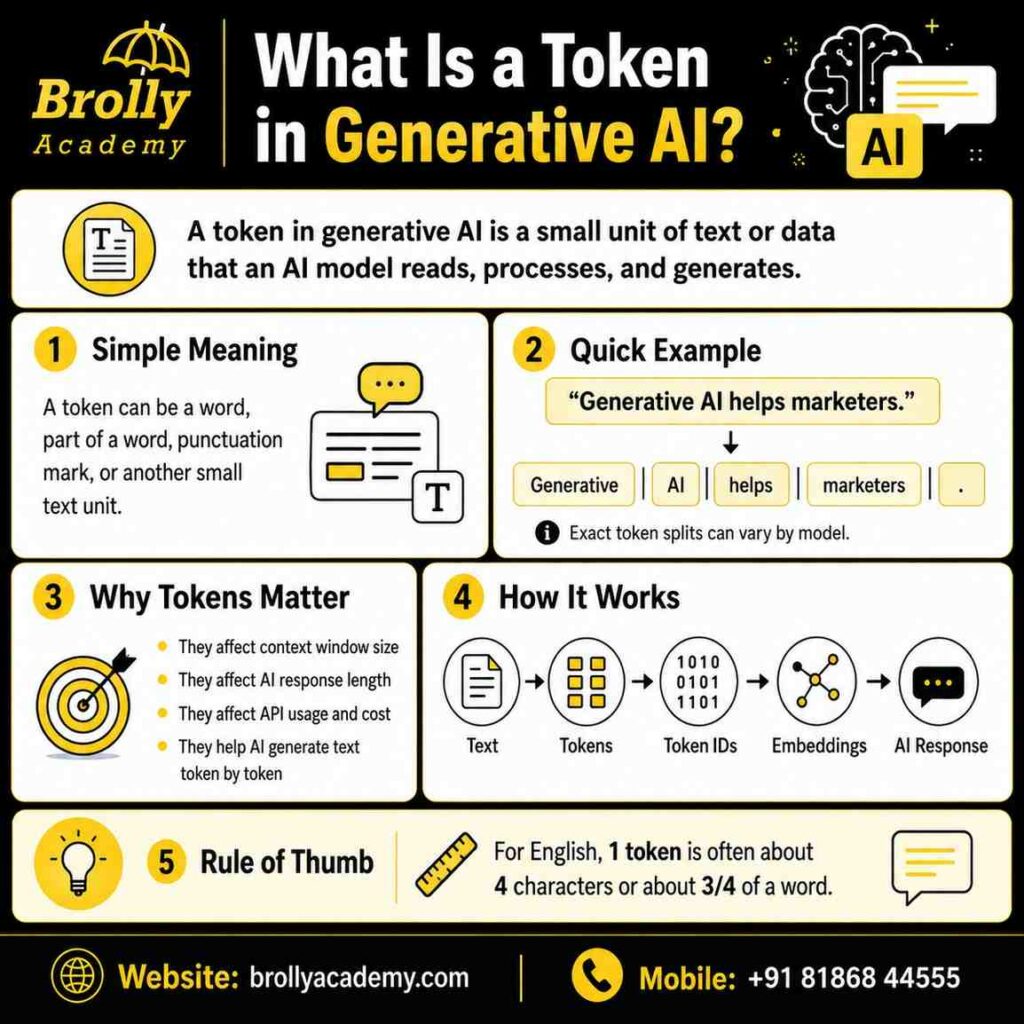
What is a token in generative AI? A token is a small unit of data that a generative AI model processes. In text-based large language models, a token can be a whole word, part of a word, punctuation, or another tokenizer-defined text unit. The model converts tokens into numerical IDs, processes them, and generates a response token by token.

Share
Table of Contents
Quick answer
A token is the basic unit an AI language model reads and generates. It is not always equal to one word. A common word may be one token, while a longer or unusual word may be split into several subword tokens. Punctuation, spaces, numbers, code, and language can also change the token count.
What Is a Token in Generative AI With an Example?
A simple way to understand an AI token is to think of it as a small text piece selected from a model’s vocabulary. People read sentences as words and meaning. An LLM first converts the text into model-readable units.
Imagine the sentence:
A tokenizer does not have to treat every visible word as exactly one token. Depending on the model, a word such as marketers could remain one token or be divided into smaller subword units.
Token vs Word vs Character vs Subword
These terms are related, but they are not interchangeable. This distinction is important when you calculate context size, API usage, or AI model costs.
| Concept | Meaning | Simple example |
|---|---|---|
| Character | One written symbol | A, 7, ? |
| Word | A human-readable language unit | marketing |
| Subword | A smaller reusable part of a word | market + ing |
| Token | A tokenizer-defined unit processed by a model | May be a word, subword, punctuation, or another unit |
| Token ID | A numeric index assigned to a token | An integer used internally |
| Embedding | A learned numerical vector used by the neural network | A list of numerical values |
Is one token equal to one word? No. Sometimes one word is one token. Sometimes one word becomes several tokens. In some tokenizers, punctuation or spacing also changes the token sequence.
How Do AI Tokens Work?
In a text-based large language model, tokens sit between human language and the numerical processing performed by the neural network. The implementation differs by model, but the high-level process is similar.
The prompt is tokenized
A tokenizer splits the prompt into units from its vocabulary. Those units may represent words, subwords, characters, bytes, punctuation, or combinations.
Tokens are mapped to IDs
Each token is mapped to a numeric token ID. The ID is an index used by the model; it is not the semantic meaning of the word.
IDs become embeddings
The model converts token IDs into learned vectors called embeddings and combines them with information about sequence position.
Attention processes context
Transformer attention helps the model identify relationships among tokens and use relevant parts of the available context.
The model predicts the next token
The model calculates probabilities for possible next tokens and selects one based on its learned patterns and decoding settings.
Generation repeats
The new token is added to the sequence. The next-token prediction process repeats until the response is complete or a limit is reached.
This repeated process is called autoregressive generation. It is one of the core ideas behind how many modern LLMs generate text.
What Is Tokenization in AI?
Tokenization in generative AI is the process of converting raw text or other input into smaller model-readable units. In natural language processing, tokenizers can use words, subwords, characters, bytes, or a combination of these approaches.
Subword tokenization is widely used because it gives a useful balance. Common text can remain compact, while rare or new words can be represented using smaller known pieces.
Byte Pair Encoding (BPE)
BPE begins with small units and repeatedly merges useful or frequent pairs. This creates a vocabulary that can represent common patterns efficiently while still handling unfamiliar words through smaller pieces.
WordPiece
WordPiece is another subword method. It is strongly associated with BERT-family models. It builds useful subword units using a scoring approach rather than simply choosing the most frequent pair at every step.
Unigram
Unigram begins with a relatively large set of possible pieces and removes less useful items until it reaches a target vocabulary. It can evaluate multiple possible segmentations and select a likely one.
SentencePiece
SentencePiece is a tokenization framework that can apply methods such as BPE or Unigram directly to raw text. It does not depend on spaces being perfect word boundaries, which makes it useful in multilingual workflows.
| Method | Basic idea | Useful association |
|---|---|---|
| BPE | Repeatedly merges useful or frequent symbol pairs. | Many modern transformer tokenizers use BPE or variants. |
| WordPiece | Builds subword units using a likelihood-oriented scoring rule. | BERT-family models. |
| Unigram | Starts with many candidate pieces and removes less useful ones. | Often used with SentencePiece. |
| SentencePiece | Tokenizes raw text and can use BPE or Unigram. | Multilingual and whitespace-independent workflows. |
What Are the Main Types of AI Tokens?
The word token can describe both text pieces and usage categories. Provider terminology varies, but these concepts are common across generative AI systems.
| Token type | What it means | Why it matters |
|---|---|---|
| Input tokens | Tokens sent in prompts, instructions, history, or retrieved content. | They consume context and often affect API cost. |
| Output tokens | Tokens generated by the model. | They affect response length and often cost. |
| Cached tokens | Previously processed input that a provider can reuse. | They can reduce repeated computation and may have different pricing. |
| Reasoning or thinking tokens | Internal computation units reported or counted by some reasoning-capable APIs. | They may contribute to usage even when not shown as visible output. |
| Special tokens | Structural or control markers used by a model or tokenizer. | They can mark roles, boundaries, padding, or end-of-text. |
| Subword tokens | Pieces smaller than a full word. | They help represent rare or complex words efficiently. |
| Multimodal tokens | Model-specific units for images, audio, video, or other modalities. | They can affect context size and usage in multimodal AI. |
How Many Words or Characters Are in One Token?
There is no universal conversion between tokens, words, and characters. However, for common English text, providers often use a rough planning estimate of around four characters per token.
- 1 token ≈ 4 English characters as a rough estimate.
- 1 token ≈ ¾ of an English word as a rough estimate.
- 100 tokens ≈ 75 English words as a rough planning rule.
These are not billing rules. Code, numbers, punctuation, emojis, whitespace, capitalization, names, and non-English scripts can change the count.
What Is a Context Window and Token Limit?
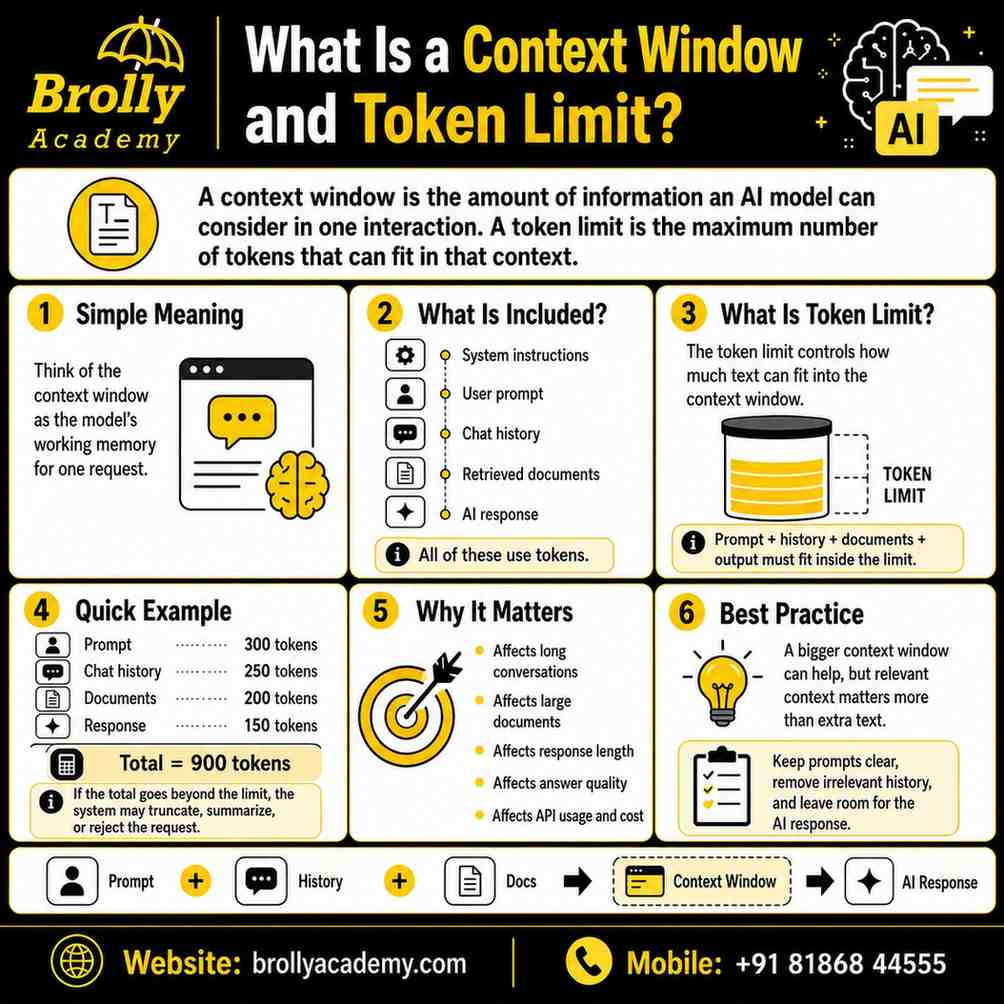
A context window is the amount of information a model can consider during an interaction or request. Depending on the system, the context can include system instructions, the user’s prompt, conversation history, retrieved documents, tool results, and generated output.
A token limit is the model or product constraint that controls how many tokens can fit into that process. Exact limits vary by model and can change over time.
Why context windows matter
- A longer prompt uses more input tokens.
- Long conversation history can consume available context.
- Uploaded or retrieved documents may add thousands of tokens.
- The model still needs enough space to generate a useful answer.
- If the request is too large, a product may reject it, truncate content, summarize earlier information, or require the task to be split.
A larger context window does not automatically produce a better answer. Relevant, well-organized context is usually more useful than unnecessary volume.
How Do Tokens Affect AI API Costs?
Many generative AI APIs use token counts as part of their pricing. Providers can charge different rates for input tokens, output tokens, cached input, reasoning, long-context use, or multimodal processing.
Because models and prices change frequently, do not use an old blog post as the final source for production estimates. Check the provider’s current pricing and usage documentation before calculating costs.
Ways to reduce token usage without reducing quality
- Write clear instructions once instead of repeating the same rule.
- Remove irrelevant conversation history.
- Retrieve only useful passages in a RAG workflow.
- Summarize long documents when full text is unnecessary.
- Set sensible output-length limits.
- Use caching where the provider supports it and the workflow benefits.
- Measure real token usage rather than optimizing only from word count.
Do ChatGPT, Claude and Gemini Count Tokens Differently?
Yes. Different models can use different tokenizers, vocabularies, special tokens, chat formats, and multimodal representations. That means the same sentence does not have to produce the same token count in GPT, Claude, Gemini, or another LLM.
The surrounding application can also add structured information such as system instructions, role labels, tools, files, cached context, or other metadata.
Do Hindi, Telugu and Other Languages Use Different Token Counts?
They can. Token efficiency differs across languages because the tokenizer’s vocabulary, training data, script coverage, and segmentation rules determine how text is split.
For Indian-language content such as Hindi or Telugu, do not apply an English rule such as “about four characters per token” as if it were exact. Test the actual text with the target model’s tokenizer or token-count API.
A simple multilingual token test
- Write the same idea naturally in English, Hindi, and Telugu.
- Keep the meaning similar instead of forcing a word-for-word translation.
- Run each version through the same model’s official token counter.
- Record the number of characters, words, and tokens.
- Repeat the test with another model if you want to compare tokenizer efficiency.
This produces evidence for your real use case instead of relying on a universal claim about all languages.
Do Images, Audio and Video Use Tokens?
In multimodal generative AI, token-like model units are not limited to written text. Systems can represent images, audio, video, PDFs, and other inputs using provider- and model-specific numerical units.
The method is not the same as splitting an English sentence into subwords. An image may be represented through patches, learned features, or other internal structures. Audio and video can also be transformed into model-specific sequences.
For that reason, do not assume one image token is equivalent to one text token. Use the provider’s documentation when estimating multimodal context or cost.
AI Token vs Crypto Token vs Authentication Token
The word token has several meanings in technology. They are separate concepts.
| Term | Meaning | Example context |
|---|---|---|
| Generative AI token | A model-processing unit used in input or output. | LLM tokenization, context windows, API usage. |
| Cryptocurrency token | A digital asset represented on a blockchain. | DeFi, NFTs, utility or governance. |
| Authentication or access token | A credential used by software to prove authorization. | OAuth, API access, sessions. |
How to Count AI Tokens Accurately
The most reliable approach is to use the official tool or API for the exact model.
- OpenAI models
- Use OpenAI-compatible tokenization tools and API usage metadata for the target model.
- Gemini models
- Use Google’s token-count method or response usage metadata for the specific Gemini model.
- Claude models
- Use Anthropic’s official token-count method or usage metadata for the target Claude model.
- Planning only
- Word-to-token estimates are useful for rough planning, but they are not exact for billing or hard context checks.
Common Mistakes About AI Tokens
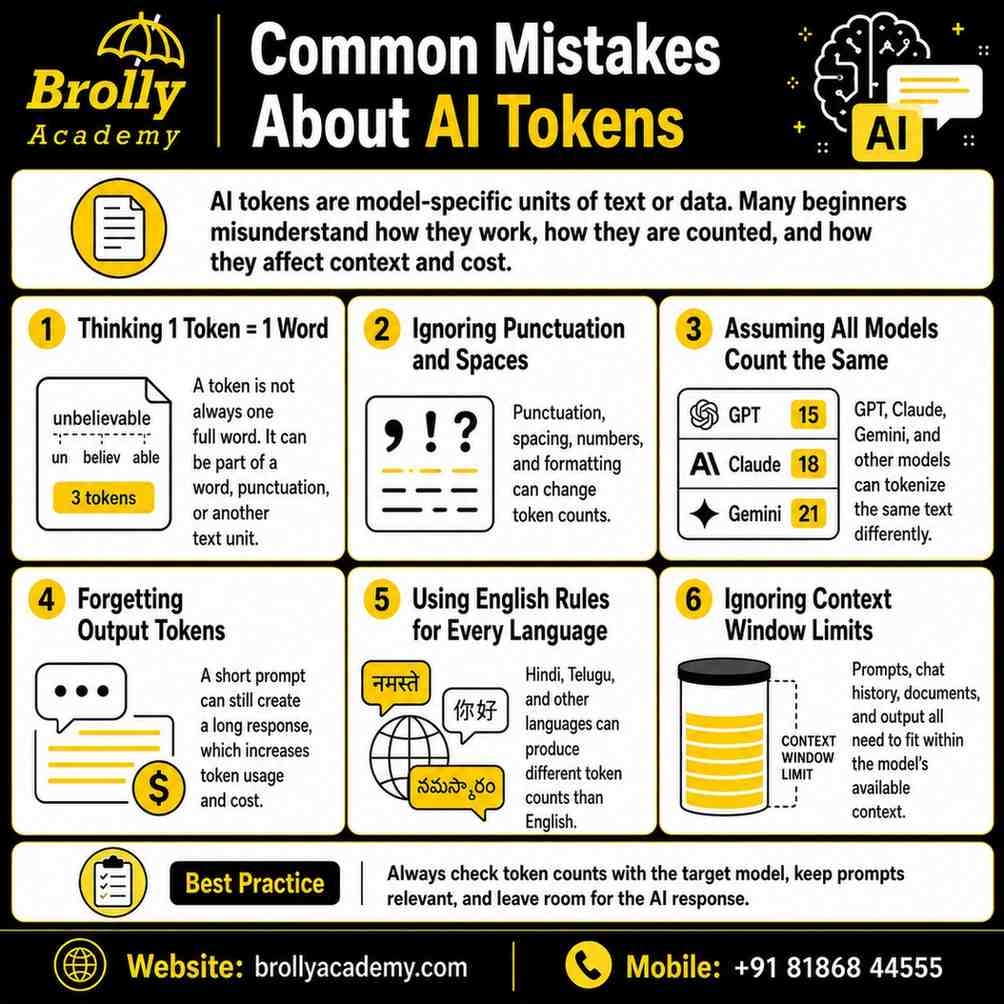
- Thinking one token always equals one word. A word can be one token or several tokens.
- Assuming every model tokenizes text the same way. Tokenizers and vocabularies differ.
- Using English averages for every language. Multilingual token efficiency varies.
- Ignoring output tokens. A short prompt can still produce a long response.
- Treating token limits as only a developer issue. Long chats and uploaded documents can consume context for everyday users too.
- Confusing AI tokens with crypto or authentication tokens. They are different concepts.
- Quoting model prices or token limits without checking the date. Providers update models, limits, and pricing.
Frequently Asked Questions
What is a token in generative AI?
A token in generative AI is a small unit that a model processes. In a language model, a token can be a whole word, part of a word, punctuation, or another text unit defined by the tokenizer.
What does token mean in an LLM?
In a large language model, a token is one unit in the sequence the model reads or predicts. Text is tokenized, mapped to token IDs, converted to numerical representations, and processed by the model.
Is one token equal to one word?
No. One word may be one token or several subword tokens. Punctuation, spacing, code, numbers, and language can also affect tokenization.
How many characters are in one token?
For common English text, about four characters per token is a useful rough estimate. The exact count depends on the tokenizer, model, language, punctuation, and formatting.
What is a token limit in AI?
A token limit is a model or product constraint on how many tokens can be handled in a request or context window, including prompts, chat history, documents, and generated output.
What happens when an AI reaches its token limit?
The application may reject the request, stop generation, truncate content, summarize earlier context, or ask you to split the task. Exact behavior varies by product.
Why do AI companies charge by tokens?
Tokens provide a practical way to measure how much model input and output is processed. Many API providers therefore use token usage as part of pricing.
What are cached tokens?
Cached tokens are previously processed input that a provider can reuse in supported caching workflows. They can reduce repeated computation and may be priced differently.
What are reasoning tokens?
Some reasoning-capable models count or report internal computation units used before producing visible output. Terminology and billing treatment differ by provider.
Do ChatGPT, Claude and Gemini count tokens differently?
They can. Different models may use different tokenizers, vocabularies, message formats, special tokens, and multimodal representations.
Do spaces and punctuation count as tokens?
They can affect tokenization. Punctuation may be a separate token, while spaces may be represented through token boundaries or token patterns. Exact behavior is model-specific.
Do images use tokens in generative AI?
Multimodal models can represent and count images using model-specific tokens or equivalent units. The exact method and token cost depend on the provider and model.
Key Takeaways
- A token is a basic unit a language model processes and generates.
- A token is not the same as a word. It may be a word, subword, punctuation mark, character, or another tokenizer-defined unit.
- The basic text flow is text → tokens → token IDs → embeddings → transformer processing → next-token prediction.
- BPE, WordPiece, Unigram, and SentencePiece are important tokenization approaches or frameworks.
- Token counts affect context windows, API usage, output length, and cost.
- Different models and languages can produce different token counts for similar text.
- For Hindi, Telugu, and other non-English content, measure real text with the target model rather than relying on English averages.
- Model limits and prices can change, so current provider documentation should be the source of truth.
If you want a guided, hands-on path from beginner to builder, we are here to help. Brolly Academy offers practical Generative AI training in Hyderabad with real projects, certification guidance, and 100% Placement Assistance.
Talk to our team today. Call: +91 81868 44555 Email: brollyacademy@gmail.com Web: brollyacademy.com Visit: Metro Pillar No. A689, JNTU Metro Station, 3rd Floor, Hyderabad 500072