Types of Generative AI: Models, Examples and How They Work
Generative AI Guide · Beginner Friendly
Types of generative AI can be understood in two useful ways: by the model architecture that creates content and by the type of content produced. This guide explains the main generative AI models, how they work, real examples, strengths, limitations and how to choose the right type for a task.

Share
Table of Contents
Quick answer
What are the main types of generative AI?
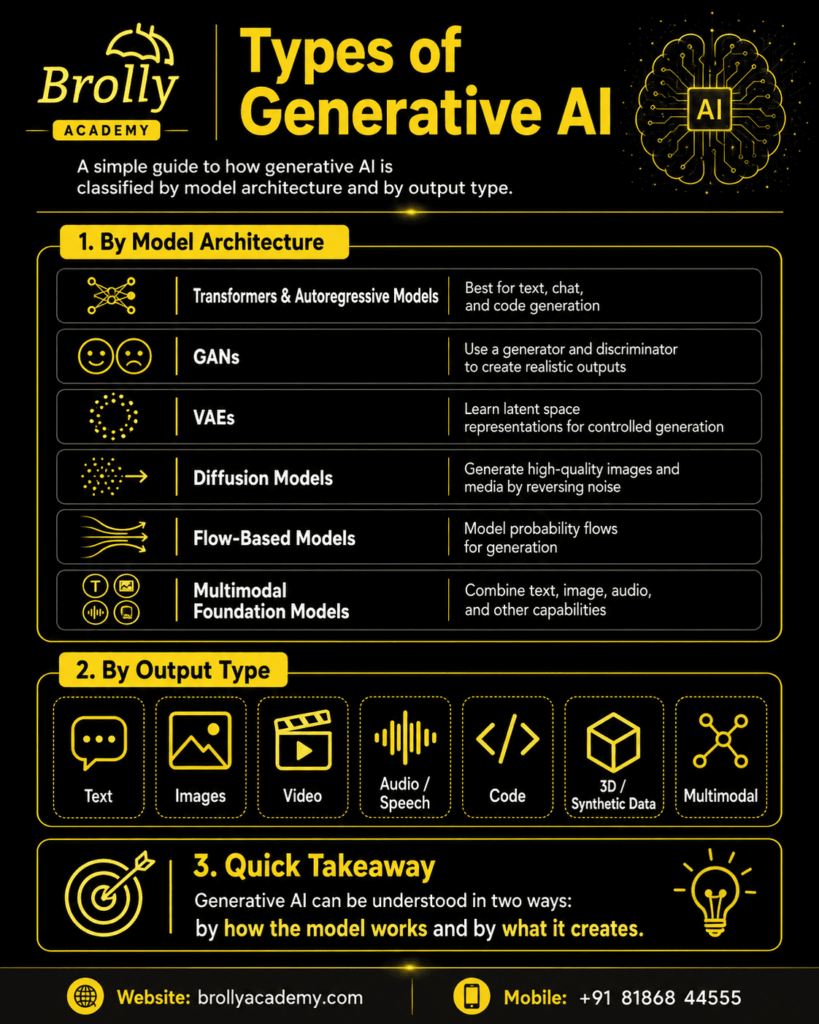
There is no single fixed number of generative AI types. A practical classification is to group them by architecture and by output. Common generative model architectures include transformer and autoregressive models, Generative Adversarial Networks (GANs), Variational Autoencoders (VAEs), diffusion models and flow-based or flow-matching models. Generative AI can also be grouped by what it creates: text, images, video, audio, code, 3D content, synthetic data and multimodal outputs.
Key takeaways
- “Types of generative AI” can mean model architectures or content/output types.
- Transformers and autoregressive models are widely used for language, code and many multimodal tasks.
- GANs train a generator and discriminator through competition.
- VAEs learn a structured latent space that can be sampled to generate new data.
- Diffusion models learn to generate data by reversing a gradual noising process.
- Flow-based and flow-matching methods learn transformations between probability distributions.
- Modern systems can combine several techniques, so categories often overlap.
- The best model depends on task, quality, speed, cost, control, data and risk level.
What Is Generative AI?
Generative artificial intelligence is a branch of AI that creates new content from patterns learned during training. The output can be text, images, code, audio, video, 3D assets, structured data or a combination of several modalities.
Traditional predictive or discriminative AI often focuses on classifying, scoring or predicting an outcome. Generative AI focuses on producing new data or content that resembles patterns in its training data. In real applications, predictive and generative components can work together.
A generative model is the statistical or machine learning model underneath the generation process. A generative AI system is broader. It can include a model, prompt handling, retrieval, tools, safety filters, databases, APIs and a user interface.
What Are the Main Types of Generative AI?
The main types of generative AI are easiest to understand through two classifications. First, classify the system by its model architecture, such as transformers, GANs, VAEs, diffusion models or flow-based models. Second, classify it by the content it generates, such as text, images, video, audio, code or multimodal content.
This approach is more accurate than saying there are exactly four, five or six types. Different sources use different taxonomies. Some list model families, others list output formats, and some mix both.
Two Ways to Classify Generative AI
The same generative AI system can belong to more than one category because architecture and output describe different things.
| Classification | What it answers | Examples | Why it matters |
|---|---|---|---|
| Architecture | How does the model generate? | Transformers, GANs, VAEs, diffusion, flow models | Helps compare technical model families |
| Output modality | What content does it create? | Text, images, video, audio, code, 3D, multimodal | Helps match the system to user intent |
For example, an image generator may use a diffusion or transformer-based architecture. A text assistant may use an autoregressive transformer. A multimodal system may combine language, vision and media-generation components.
How Does Generative AI Work?
Different generative AI models work in different ways, but most follow the same high-level idea:
learn patterns from data, then use those learned patterns to create a new output.
1. Training data is prepared
The model learns from relevant text, images, code, audio or multimodal data. Data quality, coverage, licensing and representation can affect what it learns.
2. The model learns a representation or probability pattern
This can involve token probabilities, latent variables, adversarial learning, denoising, vector fields or other generative methods.
3. A prompt or condition is provided
At inference time, a user or application supplies text, an image, audio, code context or another condition.
4. The model generates an output
An autoregressive model may predict the next token, a diffusion model may refine noise, and a VAE may sample a latent representation and decode it.
5. The application can add grounding and controls
Production systems can add retrieval, tools, safety rules, output validation, fine-tuning and human review.
Types of Generative AI Models by Architecture
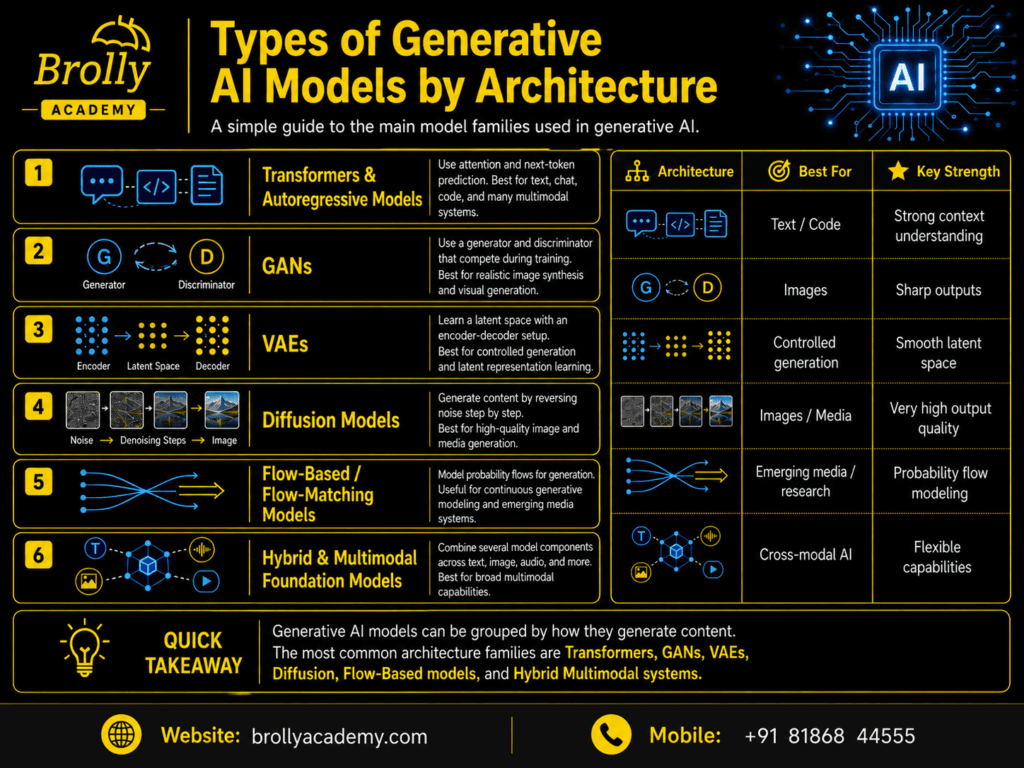
These generative AI model types explain the technical foundations behind modern content generation. They are not the only possible categories, and modern systems can combine them.
1. Transformer-Based and Autoregressive Models
Transformer models use attention mechanisms to learn relationships between parts of a sequence. The Transformer architecture was introduced in the 2017 paper “Attention Is All You Need.” Self-attention lets a model weigh relevant relationships between tokens or representations.
Many large language models are autoregressive. They generate a sequence by predicting the next token from previous context. Tokenization converts text or code into units that a model can process, while embeddings represent those units numerically.
Transformers are not limited to text. Modern transformer-based systems can work with images, audio, video and multimodal data.
Best for: text generation, conversational AI, code generation, summarization, question answering, translation and multimodal reasoning.
Strengths
- Strong context modeling
- Highly scalable
- Flexible pre-training and fine-tuning
- Useful for foundation and multimodal models
Limitations
- Can require significant compute
- Can hallucinate
- Long context does not guarantee correct reasoning
- Quality depends on data and system design
Examples include GPT-family models, many LLMs, code models and transformer components inside multimodal foundation models. Product ecosystems such as ChatGPT, Google Gemini, Anthropic Claude and Microsoft Copilot use generative language capabilities, while product architectures and features continue to evolve.
2. Generative Adversarial Networks (GANs)
Generative Adversarial Networks, or GANs, use two neural networks that learn through competition. The generator creates synthetic samples. The discriminator tries to distinguish generated samples from real training examples.
As training continues, the generator tries to create outputs that are harder for the discriminator to detect. GANs became an important family of deep generative models after the foundational 2014 work by Ian Goodfellow and colleagues.
Best for: image synthesis, image-to-image transformation, super-resolution, synthetic data and visual generation tasks.
Strengths
- Can generate visually sharp outputs
- Fast generation after training
- Useful for specialized synthetic-data and image tasks
Limitations
- Training can be unstable
- Mode collapse can reduce diversity
- Generator/discriminator balance matters
- Evaluation can be difficult
3. Variational Autoencoders (VAEs)
Variational Autoencoders, or VAEs, are probabilistic generative models built around an encoder, a latent representation and a decoder. The encoder maps data into a probability distribution in latent space. The decoder samples from that space and reconstructs or generates data.
The foundational VAE approach is associated with the work of Diederik Kingma and Max Welling. VAEs are useful when a structured, continuous latent space is valuable.
Best for: representation learning, controlled generation, reconstruction, anomaly-related workflows and synthetic-data research.
Strengths
- Smooth latent space
- Supports sampling and interpolation
- Clear probabilistic foundation
- Useful for representation learning
Limitations
- Some outputs can look softer
- Latent quality depends on design and training
- Reconstruction and regularization involve trade-offs
4. Diffusion Models
Diffusion models learn a generative process related to adding and reversing noise. During a forward process, data is gradually corrupted with noise. The model learns a reverse denoising process that can turn noise into a structured output.
Denoising diffusion probabilistic models became especially influential for high-quality image generation. Diffusion techniques now appear across images, audio, video and other media.
Best for: high-quality image generation, editing, inpainting, video, audio and conditional generation.
Strengths
- Strong media quality and diversity
- Flexible text/image conditioning
- Stable training compared with some adversarial approaches
Limitations
- Iterative sampling can add latency
- Quality depends on model scale and conditioning
- Media generation can raise rights and provenance concerns
Stable Diffusion is a well-known example from the diffusion ecosystem. DALL-E and Midjourney are well-known AI image-generation products, although commercial product techniques can change over time.
5. Flow-Based and Flow-Matching Models
Flow-based generative models learn transformations between probability distributions. Traditional normalizing flows use invertible transformations so data can be mapped between a simple distribution and a more complex one.
Flow matching is a newer framework for training continuous normalizing flows by learning a vector field that moves samples along probability paths. It provides another way to model generation and can use diffusion-style or other probability paths.
Best for: continuous generative modeling, research on efficient generation and tasks where probability paths or sampling efficiency matter.
Strengths
- Strong connection to continuous probability flows
- Can offer efficient probability paths
- Increasingly relevant in current generative-model research
Limitations
- More technical for beginners
- Performance depends heavily on design choices
- Terminology and implementations are evolving quickly
6. Hybrid and Multimodal Foundation Models
Modern generative AI systems often combine several techniques rather than fitting neatly into one historical family. A multimodal foundation model can use transformers for language and reasoning, vision encoders for images, diffusion or transformer-based decoders for media, retrieval systems for external knowledge and tools for actions.
Foundation models are broadly pre-trained models that can be adapted across many downstream tasks. Large language models are one important type of foundation model, but foundation models can also be vision, audio or multimodal.
Multimodal AI can process more than one modality. Multimodal generative AI goes further by generating new content or responses from one or more modalities.
Where Do Neural Radiance Fields (NeRFs) Fit?
Neural Radiance Fields, or NeRFs, are neural representations used to model 3D scenes from collections of images. They are important in neural rendering and view synthesis. They are sometimes included in lists of generative AI techniques, but they are more specialized than broad model families such as transformers, GANs, VAEs or diffusion models.
A clearer taxonomy presents NeRFs as a specialized generative or neural-rendering technique related to 3D scene generation rather than one member of a universally fixed list of “main types.”
Generative AI Model Comparison
| Model Family | Core Idea | Common Strengths | Common Limitations | Typical Uses |
|---|---|---|---|---|
| Transformer / Autoregressive | Predicts sequence elements from context using attention-based representations. | Scalable, contextual, flexible. | Compute needs, hallucinations, grounding limits. | Text, code, language and multimodal systems. |
| GANs | Generator competes with a discriminator. | Sharp outputs; fast generation after training. | Training instability; mode collapse. | Images, synthetic data, visual transformation. |
| VAEs | Encoder learns a probabilistic latent space; decoder reconstructs or generates. | Structured latent space, sampling, interpolation. | Can produce softer outputs; reconstruction trade-offs. | Representation learning, controlled generation, synthetic data. |
| Diffusion | Learns to reverse a gradual noising process. | High media quality, diversity, flexible conditioning. | Iterative sampling can add cost and latency. | Images, video, audio, editing. |
| Flow / Flow Matching | Learns transformations or vector fields between probability distributions. | Flexible probability paths, strong mathematical structure. | More technical; rapidly evolving. | Continuous generative modeling, research, media. |
| Hybrid / Multimodal Foundation | Combines model families, encoders, retrieval and tools. | Broad capabilities across tasks and modalities. | System complexity, cost, evaluation and governance. | Multimodal assistants, document and media workflows. |
GAN vs VAE vs Diffusion vs Transformer Models
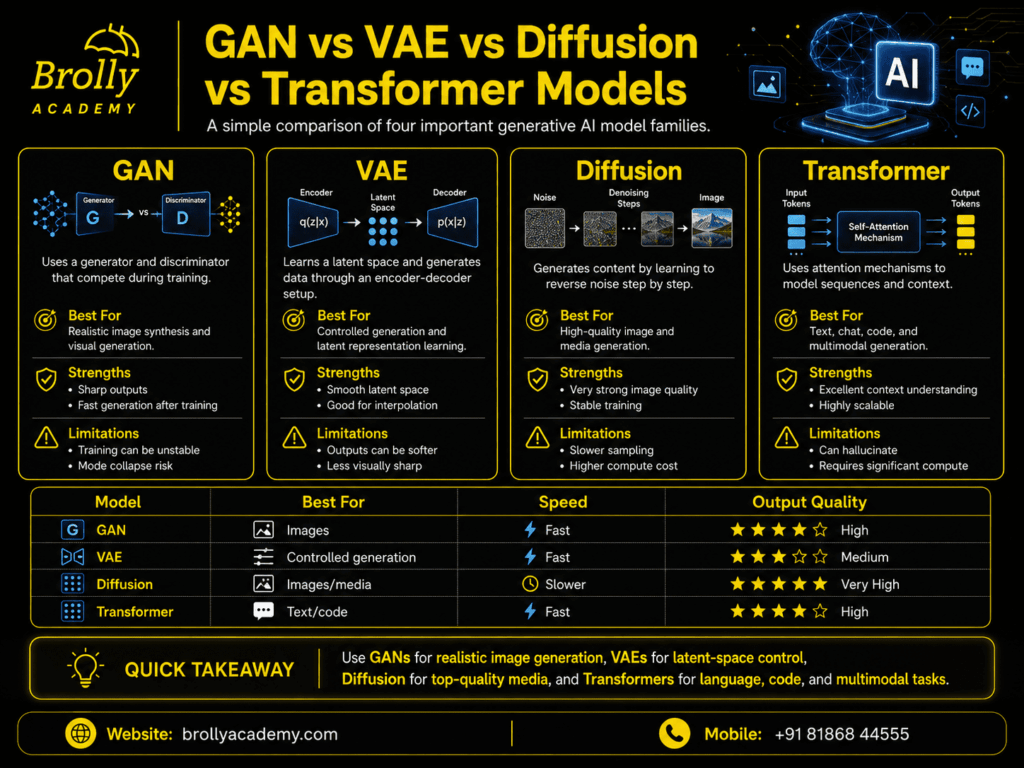
GANs, VAEs, diffusion models and transformers solve generation in different ways. GANs learn through competition between a generator and discriminator. VAEs learn a probabilistic latent space and reconstruct samples through a decoder. Diffusion models learn to reverse a noising process. Autoregressive transformers commonly generate sequences by predicting the next token or element from context.
For image generation, diffusion and transformer-based media systems are prominent, while GANs remain useful in specific visual and synthetic-data tasks. VAEs remain valuable for latent representations and as components inside larger systems. For text and code, autoregressive transformer models are widely used.
There is no universal “best” architecture. The right choice depends on output quality, controllability, speed, data, training cost, inference cost and evaluation requirements.
Types of Generative AI by Content or Output
Another useful way to describe generative AI types is by the content they create. This classification answers a different question from model architecture.
1. Text generation
Creates answers, summaries, drafts, explanations and translations. Common in chatbots, document assistance and research support.
2. Image generation
Creates or edits images from text, references or other conditions. Techniques can include diffusion, transformers, GANs and VAEs.
3. Video generation
Creates moving visual content from text, images or video references while modeling appearance, motion and time.
4. Audio, speech and music
Creates synthetic speech, music, sound effects or other audio from text, reference audio or additional conditions.
5. Code generation
Generates, completes, explains, refactors or tests software code. Generated code should always be reviewed and tested.
6. 3D and synthetic data
Creates 3D assets, scene representations, simulations or artificial samples for prototyping, augmentation and research.
7. Multimodal generation
Works across more than one data type, such as text, images, audio, video, code and documents in one workflow.
Generative AI Architecture vs Output Type
Architecture explains how the model is built or how it learns to generate. Output type explains what the user receives. They are related, but they are not the same.
- Transformer = architecture.
- Large language model = model category, commonly transformer-based.
- Text generation = output modality.
- ChatGPT = generative AI application/product.
- Diffusion model = generative model family.
- AI image generation = output/application category.
- Multimodal AI = capability across multiple data types.
A single application can therefore combine several generative AI model types and several output types.
Generative AI vs Generative Models
Generative AI is the broader application concept. A generative model is the underlying model that learns a distribution or representation and creates new samples.
For example, a business chatbot can be a generative AI system. Underneath it may be a large language model based on transformer architecture. The application can also add retrieval, company data, tools and safety rules.
| Output Type | What It Creates | Common Model Families | Example Uses |
|---|---|---|---|
| Text | Answers, summaries, drafts and translations. | Transformer / autoregressive models. | Chatbots, writing and document assistance. |
| Image | New or edited images. | Diffusion, transformers, GANs and VAEs. | Creative concepts, design and image editing. |
| Video | Moving visual content. | Diffusion, transformers and hybrid models. | Storyboards, creative video and education. |
| Audio / Speech | Voice, music and sound. | Transformers, diffusion, autoregressive and hybrid models. | Speech, music and sound effects. |
| Code | Software code and tests. | Transformer / autoregressive models. | Code completion, debugging and documentation. |
| 3D / Synthetic Data | 3D assets, scenes and artificial samples. | NeRFs, diffusion, GANs, VAEs and hybrid models. | Simulation, prototyping and data augmentation. |
| Multimodal | Content or responses across several data types. | Multimodal foundation and hybrid models. | Document Q&A, visual reasoning and mixed-media workflows. |
Examples of Generative AI Systems and Tools
Generative AI model examples and product examples should be separated. Product features change frequently, and one product may use several models or architectures.
- OpenAI / ChatGPT / GPT: well-known language and multimodal generative AI ecosystem.
- Google Gemini: generative and multimodal model ecosystem from Google.
- Anthropic Claude: language-centered generative AI model and assistant ecosystem with multimodal capabilities in supported versions.
- Microsoft Copilot: generative AI assistant experiences across Microsoft products and services.
- DALL-E: OpenAI image-generation model/product family.
- Midjourney: generative image platform.
- Stable Diffusion: diffusion-based open generative image ecosystem.
These names are useful entities for understanding the market, but they should not replace the technical taxonomy. The most famous tool is not automatically the best tool for every task.
Common Generative AI Use Cases
Content creation and marketing
- Campaign ideas and copy
- Creative concepts and image variations
- Customer-research summaries
- SEO research and content planning
- Repurposing one source into several formats
AI-generated content should be reviewed for originality, accuracy, brand voice, rights and real user value. Publishing large amounts of generic content only to target search traffic can create poor user experience and weak differentiation.
Software development
- Code completion
- Documentation
- Test generation
- Debugging assistance
- Code explanation
- Prototype generation
Developers should verify security, dependencies, logic and licensing implications instead of treating generated code as automatically correct.
Education
- Explanations at different difficulty levels
- Study questions
- Practice examples
- Summaries
- Feedback drafts
- Multimodal learning support
Teachers and learners should verify important facts and preserve academic integrity.
Business operations and customer service
- Drafting responses
- Summarizing tickets or calls
- Extracting information from documents
- Creating internal knowledge answers
- Generating reports and templates
- Multilingual communication
Grounding with approved company sources can improve usefulness, but retrieved information and generated answers still need evaluation.
Design and media
- Image concepts
- Storyboards
- Video concepts
- Audio generation
- 3D assets
- Creative iteration
Teams should consider copyright, licensing, likeness, disclosure and provenance requirements.
Healthcare, finance, legal and other high-stakes domains
Generative AI can assist with summarization, information retrieval, drafting and research workflows. However, model output can be incomplete or wrong. It should not replace qualified professional judgment, approved data governance, privacy controls or required regulatory processes.
How to Choose the Right Type of Generative AI
Do not choose a model only because it is popular. Start with the real task.
1. Define the output
Do you need text, code, images, video, audio, 3D content, synthetic data or several modalities?
2. Define the quality requirement
A brainstorming assistant has different requirements from a customer-facing or safety-critical system.
3. Decide how much control you need
Consider format, style, factual grounding, reproducibility, editing and structured output.
4. Measure speed and cost
Compare latency, throughput, inference cost, storage and engineering complexity.
5. Evaluate data and privacy
Check what data is required, where it is processed, how it is retained and whether sensitive information is involved.
6. Test reliability
Use a representative evaluation set with normal cases, difficult cases, missing information and edge cases.
7. Match the architecture to the task
Use technical fit, not hype, to select candidate model families.
Practical starting points:
- Text or code: transformer/autoregressive models.
- High-quality media: diffusion, transformer-based media or hybrid systems.
- Structured latent representations: VAEs.
- Specialized fast synthetic-image workflows: GANs.
- Continuous generative modeling: flow-based or flow-matching approaches.
- Mixed text, image, audio or document workflows: multimodal foundation models.
Benefits of Generative AI
Faster content generation
Produce first drafts, prototypes and variations quickly, while humans review the result.
Flexible personalization
Adapt tone, language, format, examples and output structure to context.
Access to complex information
Summarize, transform or explain complex material in simpler forms.
Rapid experimentation
Explore more concepts before investing in full production.
Synthetic data and simulation
Create artificial examples for testing, augmentation and research—subject to quality and bias checks.
Limitations, Risks and Responsible Use
Bias and representation
Training data can contain social, cultural or sampling biases. Generated output can reproduce or amplify those patterns.
Copyright, licensing and provenance
Training data and generated media can raise questions about copyright, permissions, ownership, likeness and source provenance. Requirements vary by jurisdiction and use case.
Privacy and confidential data
Prompts, uploaded files and retrieved sources can contain personal or confidential information. Organizations should understand data handling, retention and access controls.
Security
Generative systems can introduce risks such as prompt injection, unsafe tool use, data leakage, insecure generated code and malicious content. Application-level security is as important as model quality.
Cost and environmental resources
Large-model training and high-volume inference can require significant computing resources. Efficient model selection, caching, smaller models and careful workload design can reduce unnecessary cost.
Evaluation is task-specific
One benchmark does not tell you whether a model is good for your users. Evaluate the complete system on the real task, including retrieval, prompts, tools, interfaces and human workflows.
Frequently Asked Questions
1. What are the types of generative AI?
Generative AI can be classified by model architecture and by output type. Important model families include transformer and autoregressive models, GANs, VAEs, diffusion models and flow-based or flow-matching models. Output categories include text, images, video, audio, code, 3D content, synthetic data and multimodal content.
2. What are the main types of generative AI?
By architecture, common types include transformers/autoregressive models, GANs, VAEs, diffusion models and flow-based models. By output, common types include text, image, video, audio, code and multimodal generation.
3. How many types of generative AI are there?
There is no universally fixed number. Different sources group generative AI by architecture, data type, output modality or use case. A clear classification should explain the method instead of claiming one number is always correct.
4. What are the types of generative AI models?
Common generative AI models include autoregressive transformer models, Generative Adversarial Networks, Variational Autoencoders, diffusion models and flow-based models. Specialized and hybrid approaches also exist.
5. What are examples of generative AI?
Examples include language assistants, image generators, AI video tools, speech and music generators, code assistants, 3D generators and multimodal systems. Well-known ecosystems include ChatGPT, Gemini, Claude, Microsoft Copilot, DALL-E, Midjourney and Stable Diffusion.
6. How does generative AI work?
Generative AI learns patterns or probability relationships from training data. At inference time, it uses a prompt or condition to generate a new output. The exact process can involve next-token prediction, adversarial training, latent-space sampling, denoising or probability-flow methods.
7. Are LLMs a type of generative AI?
Yes. A large language model can be a generative model when it generates language or code. Many modern LLMs use transformer architecture and autoregressive generation, but generative AI is broader than LLMs.
8. What type of generative AI is ChatGPT?
ChatGPT is a generative AI application centered on GPT-family language models and supporting systems. GPT models are transformer-based, while the application can also include tools and multimodal capabilities depending on the version.
9. Which generative AI model is used for images?
Image generation can use diffusion models, transformer-based image models, GANs, VAEs and hybrid approaches. Diffusion models became especially influential for high-quality text-to-image generation.
10. What is the difference between GANs and VAEs?
GANs train a generator against a discriminator. VAEs learn a probabilistic latent space through an encoder and decoder. GANs are known for adversarial training and strong visual synthesis, while VAEs often provide smoother latent representations.
11.What is the difference between GANs and diffusion models?
GANs use a generator-discriminator competition. Diffusion models learn to reverse a gradual noising process. GAN inference can be fast once trained, while diffusion sampling is often iterative.
12. What is multimodal generative AI?
Multimodal generative AI can understand or combine more than one data type and generate new content or responses. It may work with text, images, audio, video, code or documents in the same workflow.
13. Which type of generative AI should a business use?
Choose based on the business task rather than popularity. Define the required inputs and outputs, quality level, factual grounding, speed, cost, privacy, security and human-review needs, then test candidates on real examples.
Conclusion
The phrase “types of generative AI” has more than one correct interpretation. The clearest approach is to separate model architecture from output modality.
By architecture, important types include transformer and autoregressive models, GANs, VAEs, diffusion models and flow-based or flow-matching models. Modern foundation models can combine these techniques with multimodal encoders, retrieval and tools.
By output, generative AI can create text, images, video, audio, code, 3D content, synthetic data and multimodal results.
The best system is not simply the biggest or newest model. It is the system that produces useful, reliable output for the real task at an acceptable cost and risk level. For high-stakes decisions, generated content should support—not replace—qualified human judgment and authoritative evidence.