
Brolly Academy | PMP
PMP Syllabus
The New Exam Content Outline, Domains and Tasks (2026)
The complete PMP syllabus for 2026 in plain English: PMI's new July 2026 Exam Content Outline, the three domains and their weights, every task explained, how predictive, agile and hybrid questions are spread, where the PMBOK Guide fits, and a 12-week module-by-module study plan.
PMP syllabus 2026 explained: the new exam content outline, the People, Process and Business Environment domains, their tasks, weights and a study plan.
By Brolly Academy Team · Brolly Academy · Updated 22 October 2026
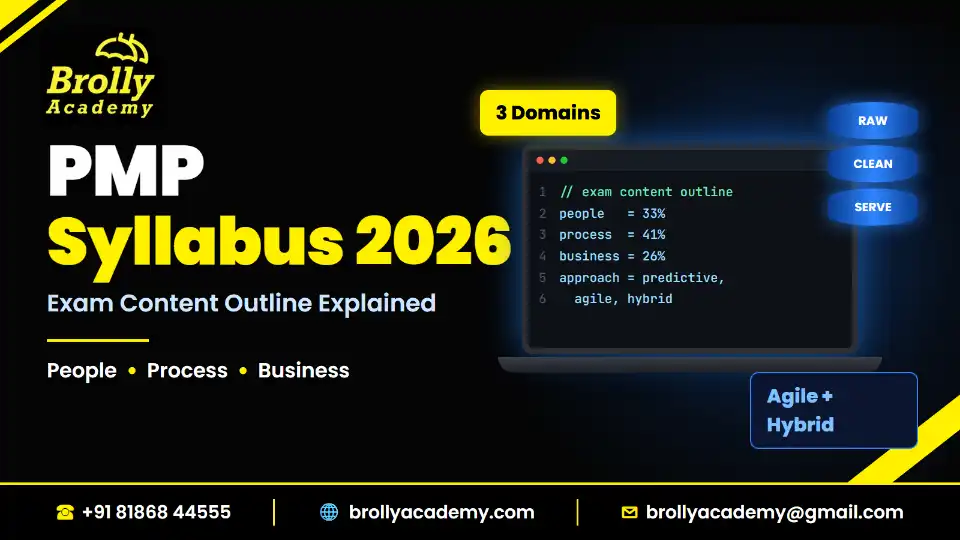
Table of Contents
2. What changed in the July 2026 PMP syllabus?
3. PMP syllabus at a glance: domains, weights and tasks
6. Domain III: Business Environment (26%)
7. Predictive, agile and hybrid approaches in the syllabus
8. How the syllabus shows up in the exam
9. The role of the PMBOK Guide (Eighth Edition)
10. Module-by-module PMP study plan (12 weeks)
11. Official PMP syllabus resources
12. PMP syllabus vs CAPM syllabus
Quick answer
The PMP syllabus is PMI's PMP Examination Content Outline (ECO), and the current version, dated July 2026, has three domains: People (33%), Process (41%) and Business Environment (26%), with 26 tasks in total. PMI (Project Management Institute) builds every PMP (Project Management Professional) exam from this outline, not from any single book. About 40% of questions use predictive approaches and the other 60% are split between agile and hybrid approaches. The July 2026 update adds AI, sustainability and stakeholder engagement, and gives much more weight to business value and governance.
- People (33%): vision, conflict, team leadership, stakeholders, communication, knowledge transfer
- Process (41%): planning, scope, value, resources, procurement, finance, quality, schedule, status, closure
- Business Environment (26%): governance, compliance, change, impediments, risk, improvement, organisational and external change
- Approaches: about 40% predictive, about 60% agile and hybrid
- Main reference: the PMBOK Guide, Eighth Edition, plus PMI's own ECO PDF
Key takeaways
- The official PMP syllabus is the PMP Examination Content Outline, July 2026, published by PMI as a free PDF.
- Domain weights changed in July 2026: People went from 42% to 33%, Process from 50% to 41%, and Business Environment from 8% to 26% (PMI, October 2026).
- The outline has 8 People tasks, 10 Process tasks and 8 Business Environment tasks. PMI says every exam covers all tasks in each domain.
- The PMBOK Guide, Eighth Edition (November 2025) is the main companion book, but PMI says the exam is not written from any single text.
- Plan for about 12 weeks of steady study if you work full time, and spend the most time on Process and on the newly expanded Business Environment domain.
1. What is the PMP syllabus?
Short answer: The PMP syllabus is the PMP Examination Content Outline (ECO). It lists the domains, tasks and example activities that PMI tests in the PMP exam.
Many people search for a "PMP syllabus" and expect a list of chapters, like a university course. PMI does not publish it that way. Instead, it publishes an Exam Content Outline. The current one is titled "Project Management Professional (PMP) Examination Content Outline - July 2026", and you can read it free as a PDF on PMI's website (PMI, July 2026, checked October 2026).
The outline is built in three layers:
PMI built the outline from a job task analysis. In simple words, it surveyed and studied what working project managers actually do, then turned that into tasks. That is why the exam feels practical. You are asked what a project manager should do in a situation, not to recite definitions.
One more point matters. PMI says in the ECO that there are "noticeable differences" between the outline and the PMBOK Guide. The guide gives you knowledge. The exam tests whether you can apply that knowledge with judgement. So treat the ECO as your syllabus and the PMBOK Guide as one of your textbooks.
If you first want to understand what PMP is and who can take it, read our guide on how to get PMP certification.
2. What changed in the July 2026 PMP syllabus?
Short answer: PMI updated the PMP exam in July 2026. It added AI, sustainability and stakeholder engagement to project scenarios, moved the focus to outcomes and business value, and changed the domain weights sharply in favour of Business Environment.
According to PMI's new exam page (October 2026), the update made four main changes:
- It adds AI, sustainability and stakeholder engagement in project-based scenarios.
- It shifts focus to outcomes, value and business impact.
- It changes the domain weights.
- It expands eligibility to include apprenticeships and training, with a 10-year window for experience.
Here is how the weights moved:
Source: PMI new PMP exam page, October 2026, and the July 2026 ECO.
The biggest change is Business Environment. It used to be a small slice. Now about one question in four comes from it. That domain now holds governance, compliance, change control, issues, risk, continuous improvement, organisational change and the external business environment. If you studied with older material, this is where you need fresh effort.
The ECO itself explains why. PMI says trends such as AI and sustainability were not covered in the earlier exam, so it tested them in the new job task analysis. It also says success is now seen as more than schedule, budget and scope. A project succeeds when it delivers value worth the effort and cost.
Good news if you already started: PMI says on its new exam page, "If you're already studying older materials, keep going. Core principles and approaches of the PMP exam remain the same." Keep your notes. Add the new topics on top of them.
People also search "when is the PMP syllabus changing". The answer for 2026 is simple: it already changed. PMI says the new exam arrived in July 2026, so any exam you book now follows the July 2026 outline.
3. PMP syllabus at a glance: domains, weights and tasks
Short answer: The syllabus has three domains and 26 tasks. Process is the largest domain at 41%, People is 33%, and Business Environment is 26%.
The PMP exam has 180 questions. Of these, 170 are scored and 10 are unscored pretest questions that PMI uses to try out new items (PMI ECO, July 2026). If you apply the domain weights to the 170 scored questions, you get a rough idea of how many questions each domain carries. These are our own estimates from the weights, because PMI says the exact number can vary by exam form.
PMI also says each exam includes questions that address all tasks in a domain. So you cannot skip a task and hope it does not appear. Every task is fair game.
The next three sections walk through every task. We have paraphrased PMI's wording into plain English and added what it means for you on the job and in the exam.
4. Domain I: People (33%)
Short answer: The People domain tests how you lead a team and work with stakeholders. It has 8 tasks covering vision, conflict, team leadership, stakeholder engagement, expectations, knowledge transfer and communication.
In the July 2026 outline, communication moved into People as its own task. Stakeholder work is also stronger, with three separate stakeholder tasks. This matches PMI's statement that the update adds stakeholder engagement to project scenarios.
Source: PMI PMP ECO, July 2026.
What to study for People:
- Leadership styles, such as servant leadership and situational leadership, and when each fits
- Conflict resolution approaches and why collaborating on the root cause usually beats forcing or avoiding
- Team charters and ground rules
- Stakeholder identification, analysis grids and engagement levels
- Communication planning, feedback loops and reporting for sponsors
- Knowledge management and lessons learned
- Emotional intelligence, coaching and mentoring
How People questions feel: Most are situations. A team member keeps missing stand-ups. Two senior engineers disagree about a design. A sponsor is unhappy with a report. The best answer usually involves talking to the person directly, understanding the cause and acting within agreed rules, before you escalate.
5. Domain II: Process (41%)
Short answer: The Process domain is the largest part of the syllabus. Its 10 tasks cover planning, scope, value delivery, resources, procurement, finance, quality, schedule, project status and closure.
This is the most "technical" part of the PMP syllabus. It covers the tools and methods that keep a project on track, across predictive, agile and hybrid ways of working.
Source: PMI PMP ECO, July 2026.
Notice what is new or stronger here. "Plan and manage finance" is a full task with seven activities, from contingency to managing reserves. "Help ensure value-based delivery" puts business value at the centre of delivery. "Evaluate project status" now talks about artifacts and their accessibility, which reflects how teams use digital tools today.
What to study for Process:
- Project integration: charter, integrated plan, tailoring the approach
- Scope: requirements, work breakdown structure (WBS), product backlog, definition of done
- Schedule: critical path, dependencies, schedule compression, story points, velocity, release planning
- Finance: budgeting, reserves, earned value management (EVM) basics such as cost and schedule variance
- Quality: quality planning, cost of quality, reviews, continuous improvement
- Resources and procurement: resource planning, contract types, vendor management
- Measuring progress: burndown and burnup charts, dashboards, status reports
- Closure: handover, final lessons learned, retrospectives
How Process questions feel: You will see schedules, budgets and charts. With the new graphic-based question type, you may need to read a chart before you answer. Practise reading burndown charts, network diagrams and simple EVM tables.
6. Domain III: Business Environment (26%)
Short answer: Business Environment is the domain that grew the most in 2026. Its 8 tasks cover governance, compliance, change control, impediments and issues, risk, continuous improvement, organisational change and changes in the outside world.
This domain connects your project to the organisation and the wider market. In the old outline it was only 8% of the exam. Now it is 26%. Several topics that used to sit under Process, such as risk and change control, now live here.
Source: PMI PMP ECO, July 2026.
What to study for Business Environment:
- Governance: PMOs, steering committees, escalation paths, approval thresholds
- Compliance: data security, health and safety, sustainability and regulatory requirements
- Integrated change control in predictive projects and backlog re-prioritisation in agile projects
- Risk: identification, qualitative and quantitative analysis, risk responses, risk register, risk owners
- Issue logs and how a risk becomes an issue
- Organisational change management and culture
- External scanning: new laws, new technology (including AI) and market shifts
Why this matters in India: Many Indian project managers work in IT services and global capability centres that serve clients in other countries. Data security, regulatory compliance and client governance are everyday concerns there. The new syllabus tests exactly this kind of thinking.
7. Predictive, agile and hybrid approaches in the syllabus
Short answer: About 40% of PMP questions use predictive (plan-based) approaches and the remaining 60% are split between agile and hybrid. These approaches appear across all three domains, not in a separate section.
The ECO is clear on this. Predictive, adaptive (agile) and hybrid approaches "will be found throughout the three domain areas" and are "not isolated to any particular domain or task" (PMI ECO, July 2026). So a People question may be set in a Scrum team, and a Business Environment question may be set in a construction project.
What to learn for agile and hybrid:
- Scrum roles, events and artifacts, plus Kanban basics
- User stories, backlog refinement, story points and velocity
- Servant leadership and self-organising teams
- How to choose an approach based on uncertainty, complexity and stakeholder needs (Process task 1)
- How change, risk and governance work in an agile or hybrid setting
If you come from a Scrum background and want to see how the roles differ, our post on Scrum Master vs Project Manager explains it.
8. How the syllabus shows up in the exam
Short answer: The exam has 180 questions in 240 minutes with two 10-minute breaks. It uses scenario, graphic-based, multiple-choice and other question types to test each task.
Here is the format, from the PMI ECO, July 2026:
- Questions: 180 in total (170 scored, 10 unscored pretest)
- Time: 240 minutes (4 hours)
- Breaks: two 10-minute breaks. The first comes after the case-study section, the second about halfway through the independent questions. You cannot return to a section after you start a break.
- Delivery: in person at a Pearson VUE test centre or online proctored through OnVue
The question types are:
The two new types change how you should study. Case questions reward people who can hold a whole project situation in mind. Graphic questions reward people who can read a burndown chart or a schedule quickly. So do not just memorise terms. Practise with charts and long scenarios.
For scheduling, retakes and exam-day rules, see our full guide to the PMP exam. For practice, try our PMP exam questions, which are grouped by the same three domains.
9. The role of the PMBOK Guide (Eighth Edition)
Short answer: The PMBOK Guide is the main reference book for the PMP syllabus, and the current edition is the Eighth Edition, published in November 2025. But the exam follows the ECO, not the book.
According to PMI's PMBOK Guide page (October 2026), the current edition is "PMBOK Guide, Eighth Edition, with The Standard for Project Management". Key facts:
- Published November 2025, 408 pages, errata last updated April 2026
- Built from input from thousands of practitioners and more than 48,000 data points
- Keeps the principles and performance-domain structure of the Seventh Edition, but simplified
- Six core principles: adopt a holistic view, focus on value, embed quality, lead accountably, integrate sustainability and build empowered teams
- Seven performance domains: governance, scope, schedule, finance, stakeholders, resources and risk
- Expanded coverage of AI, PMOs and procurement, and process guidance "reintroduced" in a non-prescriptive way
- Free in digital form for PMI members
You can see how closely the book and the 2026 outline match. Governance, finance, stakeholders, risk, sustainability and value appear in both. That is why people search for the "PMP 8th edition syllabus". The Eighth Edition is the natural textbook for the July 2026 exam.
Still, keep this in mind. PMI says in the ECO that the exam "is not written according to any single text". The questions test judgement in real situations. Reading the PMBOK Guide cover to cover will not be enough on its own. Use it to understand concepts, then use the ECO tasks to check your coverage and practice questions to build judgement.
Practical tip: Map each PMBOK Guide performance domain to the ECO tasks before you start. For example, the "risk" performance domain feeds Business Environment task 5, and the "finance" performance domain feeds Process task 6. This stops you from studying the book in a vacuum.
10. Module-by-module PMP study plan (12 weeks)
Short answer: If you work full time, plan for about 12 weeks: two weeks on foundations and approaches, eight weeks across the three domains, and two weeks of full mock exams and revision.
This plan is our suggestion, not a PMI rule. Adjust it to your own pace and experience. It assumes about 8 to 10 hours a week, with more on weekends.
How to study each module:
- Read the ECO task list for that module first, so you know what PMI expects.
- Read the matching PMBOK Guide content and your course notes.
- Make a one-page summary in your own words.
- Do 30 to 50 practice questions on the topic.
- For every wrong answer, write down which task it tests and why the right answer is better.
Where to put extra time: Business Environment deserves more time than its old 8% weight suggested, because it is now 26%. Process is still the largest domain. And because 60% of questions are agile or hybrid, do not treat agile as a side topic.
Before you start the 12 weeks, check that you meet the eligibility rules and have a plan for your 35 hours of training. Our guide to PMP certification eligibility covers this in detail.
11. Official PMP syllabus resources
Short answer: The essential official resources are the PMP Examination Content Outline PDF, the PMI Certification Handbook, the PMBOK Guide Eighth Edition and Pearson VUE's PMI pages for exam delivery.
The syllabus PDF question: Many people search for a "PMP syllabus 2026 PDF" or a "PMP syllabus PDF free download". The official PDF is PMI's ECO, linked above. It is free and you do not need to log in. Be careful with third-party PDFs that claim to be the syllabus. Some still show the old weights of 42%, 50% and 8%.
About training hours: The 35 hours of training you need must be aligned to the topics in the ECO, and the ECO says books and practice exams alone do not count. PMI's PMP page (October 2026) also says that from 1 December 2026, live classes count only if delivered by a PMI Authorized Training Partner, a China Registered Education Provider or an eligible accredited higher-education programme, while self-paced courses from any organisation still count. Training taken before 1 December 2026 stays eligible under the current rules (PMI new exam page, October 2026).
12. PMP syllabus vs CAPM syllabus
Short answer: The PMP syllabus tests experienced project leaders across People, Process and Business Environment. The CAPM syllabus tests entry-level knowledge across fundamentals, predictive methods, agile and business analysis.
According to PMI's CAPM page (October 2026), the CAPM (Certified Associate in Project Management) exam has 150 questions in 180 minutes, and its content is split like this: Project Management Fundamentals and Core Concepts 36%, Predictive Plan-Based Methodologies 17%, Agile Frameworks and Methodologies 20%, and Business Analysis Frameworks 27%. It needs no project experience.
If you hold an active CAPM, PMI gives you a 35-hour credit toward PMP training.
13. Common mistakes when studying the PMP syllabus
Short answer: The most common mistakes are studying from old outlines, treating the PMBOK Guide as the whole syllabus, ignoring Business Environment, and memorising terms instead of practising judgement.
- Using the old weights. Material showing People 42%, Process 50%, Business Environment 8% is pre-July 2026. Keep the concepts, rebalance your time.
- Reading only the PMBOK Guide. The ECO is the syllabus. The book is a reference.
- Skipping agile. About 60% of questions are agile or hybrid.
- Ignoring the new themes. AI, sustainability and stakeholder engagement now appear in scenarios.
- Never practising with charts or full mocks. Graphic questions are new, and four hours is long. Build both skills and stamina.
- Not mapping mistakes to tasks. For every wrong answer, find the ECO task it tests. That shows your real gaps.
14. How Brolly Academy helps
Short answer: Brolly Academy's PMP course in Hyderabad covers predictive, agile, hybrid and AI topics in 13 modules, with exam preparation, a 15+ year PMP trainer, and classroom, online and recorded options.
Brolly Academy runs a PMP certification course in Hyderabad built around the topics in this syllabus. Here is what the course page lists (Brolly Academy, October 2026):
- Duration: 35 contact hours of instructor-led training over 4 weeks
- 13 modules: Project Management Fundamentals; Predictive Project Management; Agile and Scrum Methodologies; Hybrid Project Management; AI in Project Management (Gen AI); Leadership and Business Environment; Risk, Quality and Resource Management; PMP Exam Preparation; Project Resource Management; Project Communications Management; Project Risk Management; Project Procurement Management; Project Stakeholder Management
- Trainer: Mr. Raju, a PMP trainer with 15+ years of experience
- Modes: classroom and online, with weekday and weekend batches; online has flexible timings
- Fees: from ₹10,999 for the Video Recording Plan; Online Course ₹30,000; Classroom Training ₹40,000; EMI available
- Next batch: Monday, 2 November 2026
- Location: Nizampet X Roads, near JNTU Metro Station, Hyderabad
How the modules map to the syllabus: the leadership, communications and stakeholder modules support the People domain. The predictive, agile, hybrid, resource and procurement modules support Process. The leadership and business environment, risk and AI modules support Business Environment and the new 2026 themes. The exam preparation module helps you practise scenario questions.
Please note: Brolly Academy offers PMP exam preparation and project management skills training. Brolly's course page does not state that Brolly is a PMI Authorized Training Partner. From 1 December 2026, PMI counts live-class hours toward the 35-hour requirement only from Authorized Training Partners and certain accredited programmes, so check PMI's current rules before you apply and plan your qualifying hours separately if needed.
Cover the full 2026 PMP syllabus with a mentor in Hyderabad
Brolly Academy's PMP course takes you through predictive, agile, hybrid and AI topics in 13 modules, with scenario-based exam practice and a trainer with 15+ years of experience. Choose classroom, online or recorded learning, with weekday and weekend batches. The next batch starts on Monday, 2 November 2026. Call +91 81868 44555 or visit our Nizampet campus near JNTU Metro Station to reserve your seat.
Frequently asked questions
What is the PMP syllabus?
The PMP syllabus is PMI's PMP Examination Content Outline, known as the ECO. It lists the domains, tasks and example activities that every PMP exam tests. The current version is dated July 2026 and has three domains: People at 33%, Process at 41% and Business Environment at 26%. Together these domains hold 26 tasks. PMI builds each exam from this outline rather than from any single textbook.
What is the PMP syllabus for 2026?
The PMP syllabus for 2026 is the Examination Content Outline that PMI dated July 2026. It has 8 People tasks, 10 Process tasks and 8 Business Environment tasks. It adds AI, sustainability and stakeholder engagement to project scenarios and shifts the focus to outcomes and business value. About 40% of questions use predictive approaches and about 60% use agile or hybrid approaches.
Has the PMP syllabus changed?
Yes, the PMP syllabus changed when PMI updated the exam in July 2026. People dropped from 42% to 33%, Process dropped from 50% to 41%, and Business Environment rose from 8% to 26%. New themes such as AI, sustainability and stakeholder engagement now appear in scenarios. PMI says the core principles and approaches remain the same, so older study notes are still useful.
When did the PMP syllabus change?
The PMP syllabus changed in July 2026, when PMI launched its updated PMP exam. Any exam you book now follows the July 2026 Examination Content Outline. If you are searching for when the syllabus will change, the answer is that it already has. Use the new domain weights and task list when you plan your study, and rebalance older material accordingly.
What are the three domains of the PMP exam?
The three domains are People, Process and Business Environment. People, at 33%, covers leadership, conflict, stakeholders and communication. Process, at 41%, covers planning, scope, value, resources, procurement, finance, quality, schedule, status and closure. Business Environment, at 26%, covers governance, compliance, change control, issues, risk, continuous improvement and organisational and external change.
How many tasks are in the PMP syllabus?
The July 2026 PMP Examination Content Outline has 26 tasks in total. The People domain has 8 tasks, the Process domain has 10 tasks and the Business Environment domain has 8 tasks. PMI says every exam includes questions that address all tasks in each domain, so you should study every task rather than skipping any of them.
How much of the PMP exam is agile?
About 60% of PMP exam questions are split between agile and hybrid approaches, and about 40% represent predictive approaches. PMI does not put agile in a separate section. Agile, hybrid and predictive scenarios appear across all three domains. That means you need to understand Scrum, Kanban, backlogs, story points and servant leadership as well as traditional planning and control.
Is the PMBOK Guide the PMP syllabus?
No, the PMBOK Guide is not the syllabus. The official syllabus is PMI's Examination Content Outline. The PMBOK Guide is the main reference book that supports it, but PMI says the exam is not written according to any single text. Use the outline to know what is tested, the guide to learn concepts and practice questions to build judgement.
Which PMBOK Guide edition should I read for the PMP exam?
Read the PMBOK Guide, Eighth Edition, which PMI published in November 2025. It keeps the principles and performance-domain structure of the Seventh Edition in a simpler form. It has six core principles and seven performance domains, including governance, finance and risk, and adds more on AI, PMOs and procurement. PMI members can read the digital edition free.
Can I still study with older PMP materials?
Yes, you can. PMI says that if you are already studying older materials you should keep going, because the core principles and approaches of the exam remain the same. However, older material uses old domain weights. Add more time for Business Environment, which is now 26%, and add the new themes of AI, sustainability, governance and value-based delivery.
Where can I download the PMP syllabus PDF?
You can download the official PMP syllabus as a free PDF from PMI's website. It is titled the Project Management Professional Examination Content Outline, July 2026. It contains the domains, tasks, enablers, question types and exam format. Avoid third-party PDFs that claim to be the syllabus, because some still show the old weights of 42%, 50% and 8%.
What topics are in the People domain?
The People domain covers eight tasks: develop a common vision, manage conflicts, lead the project team, engage stakeholders, align stakeholder expectations, manage stakeholder expectations, help ensure knowledge transfer, and plan and manage communication. It is worth 33% of the exam. Study leadership styles, conflict resolution, team charters, stakeholder analysis, communication plans and knowledge management.
What topics are in the Process domain?
The Process domain covers ten tasks: the integrated plan and delivery approach, scope, value-based delivery, resources, procurement, finance, quality, schedule, project status and closure. It is worth 41% of the exam, the largest share. Study the WBS, backlogs, critical path, story points, earned value basics, reserves, cost of quality, contracts, burndown charts and closure.
What is the Business Environment domain in PMP?
Business Environment is the domain that links your project to the organisation and the outside world. It covers governance, compliance, change control, impediments and issues, risk, continuous improvement, organisational change and external business changes. It grew from 8% to 26% of the exam in July 2026, so it now needs far more study time than before.
Does the new PMP syllabus include AI?
Yes. PMI says the July 2026 update adds AI, along with sustainability and stakeholder engagement, to project-based scenarios. You will not be tested on coding, but you should understand how AI affects project work, risks, compliance and the external environment. The PMBOK Guide, Eighth Edition, also expands its coverage of AI, which helps you prepare.
Is sustainability part of the PMP syllabus?
Yes. Sustainability appears in several places in the July 2026 outline. It is named as critical planning information in Process, as part of cost of quality, as a compliance requirement in Business Environment and as a type of risk to manage. Integrating sustainability is also one of the six core principles in the PMBOK Guide, Eighth Edition.
How many questions are in the PMP exam?
The PMP exam has 180 questions. Of these, 170 are scored and 10 are unscored pretest questions that PMI uses to test future items. You get 240 minutes, which is four hours, with two 10-minute breaks. The first break comes after the case-study section and the second comes about halfway through the independent questions.
What question types are on the new PMP exam?
The new PMP exam adds two question types: case or scenario questions and graphic-based questions, both available in every mode. It also uses multiple-choice single response and multiple response questions. At a test centre on computer, you may also see matching, enhanced matching, point and click and pull-down list questions. Practise with charts and long scenarios.
How long does it take to cover the PMP syllabus?
Most working professionals can cover the PMP syllabus in about 12 weeks at 8 to 10 hours a week. A sensible plan spends two weeks on foundations and approaches, eight weeks across the three domains and two weeks on full mock exams and revision. This is a suggested plan, not a PMI rule, so adjust it to your experience.
What should I study first for the PMP exam?
Start by reading PMI's Examination Content Outline end to end, so you know exactly what is tested. Then learn the PMBOK Guide principles and the differences between predictive, agile and hybrid approaches. After that, move through People, Process and Business Environment one task at a time, with practice questions after each module.
Is the new PMP exam harder?
It is fairer to say the new exam is different rather than simply harder, and difficulty depends on your preparation. It now gives much more weight to Business Environment, adds AI and sustainability, and introduces case and graphic-based questions. If you prepare with the new outline and practise long scenarios and charts, you can handle the changes.
Is the PMP syllabus the same as the CAPM syllabus?
No. The PMP syllabus has three domains and 26 tasks aimed at experienced project leaders. The CAPM content covers Project Management Fundamentals and Core Concepts at 36%, Predictive Plan-Based Methodologies at 17%, Agile Frameworks at 20% and Business Analysis Frameworks at 27%. CAPM needs no project experience and has 150 questions in 180 minutes.
Does my 35 hours of PMP training need to follow the syllabus?
Yes. PMI says your 35 hours of training must be aligned to the topics in the Examination Content Outline, and books and practice exams alone do not count. From 1 December 2026, live classes count only if delivered by a PMI Authorized Training Partner or an eligible accredited programme. Self-paced courses from any organisation still count, and an active CAPM gives a 35-hour credit.
Does Brolly Academy's PMP course cover the new 2026 syllabus?
Brolly Academy's PMP course covers predictive, agile, hybrid and AI in project management across 13 modules, including leadership and business environment, risk, procurement and stakeholder management, plus exam preparation. It is exam preparation and skills training. Brolly does not state that it is a PMI Authorized Training Partner, so check PMI's current training-hour rules separately.
Can I prepare for the PMP syllabus online from Hyderabad?
Yes. You can study the full syllabus online using PMI's free outline, the PMBOK Guide and practice questions. If you want guided preparation, Brolly Academy in Hyderabad offers classroom, online and recorded options with weekday and weekend batches, and the next batch starts on Monday, 2 November 2026. Online classes have flexible timings for working professionals.
Learn with Brolly Academy
Review the syllabus, practical projects and batch timings, and book a free demo before you enrol.
Related Articles
Continue Your Learning
PMP Certification Course in Hyderabad
35 contact hours of instructor-led PMP exam preparation over 4 weeks: predictive, agile, hybrid, AI in project management and full exam practice.
View CourseScrum Master Training in Hyderabad
Scrum Guide 2020, Scrum events and artifacts, Jira, metrics, role plays and CSM, PSM I and SAFe exam preparation.
View CourseBusiness Analyst Course in Hyderabad
Requirements, BRD and user stories, UML, Agile, Jira, SQL, Excel and Power BI with capstone projects and placement support.
View Course