
Brolly Academy | PMP
PMP Exam
Pattern, Domains, Question Types, Scoring and Study Plan (2026)
Everything you need to know about the PMP exam in 2026: the new July 2026 pattern, domains and weights, question types, how scoring works, online vs test centre, scheduling and retake rules, exam-day rules, and an 8 to 10 week study plan you can actually follow.
PMP exam 2026 guide: 180 questions in 240 minutes, the new People, Process and Business Environment weights, question types, scoring and a study plan.
By Brolly Academy Team · Brolly Academy · Updated 22 October 2026
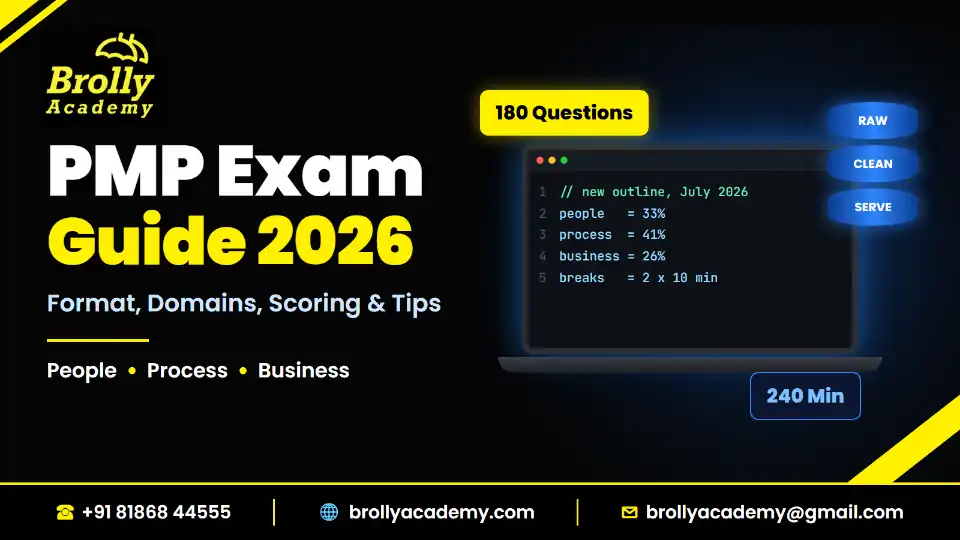
Table of Contents
2. PMP exam pattern at a glance
3. What changed in the July 2026 PMP exam
4. PMP exam domains and weights
5. Predictive, agile and hybrid: how the questions split
8. Online vs test centre: which should you choose?
9. Eligibility and exam fee in brief
10. Applying, scheduling, rescheduling and retakes
12. An 8 to 10 week PMP exam study plan
Quick answer
The PMP exam has 180 questions that you answer in 240 minutes (4 hours), with two 10-minute breaks, and it tests three domains: People 33%, Process 41% and Business Environment 26% (PMI, October 2026). PMI (Project Management Institute) updated the exam in July 2026. Of the 180 questions, 170 are scored and 10 are unscored pretest questions. About 40% of questions reflect predictive approaches and the other 60% are split between agile and hybrid. You can take the exam online or at a Pearson VUE test centre.
- Questions and time: 180 questions, 240 minutes, two 10-minute breaks
- Domains: People 33%, Process 41%, Business Environment 26%
- Approaches: about 40% predictive, about 60% agile and hybrid combined
- Delivery: Pearson VUE test centre or online proctored (OnVUE)
- Attempts: up to three attempts within your 1-year eligibility period
Key takeaways
- The PMP exam changed in July 2026. Business Environment jumped from 8% to 26% of the exam, and new case-study and graphic-based questions were added.
- Only 170 of the 180 questions count toward your result, but you cannot tell which 10 are unscored, so treat every question as real.
- PMI does not print a fixed pass percentage. Its handbook says the passing score is set by psychometric analysis against the standard of a qualified project manager.
- Rescheduling inside 30 days of your exam costs US$70 plus taxes, and inside 48 hours you cannot reschedule at all.
- An 8 to 10 week plan with steady practice tests is enough for most working professionals who already meet the eligibility rules.
1. What is the PMP exam?
Short answer: The PMP exam is the test you must pass to earn the Project Management Professional (PMP) certification from PMI (Project Management Institute). It checks whether you can lead projects well using predictive, agile and hybrid ways of working.
PMI is a global, not-for-profit professional body for project management. It runs several certifications, and PMP is its best known. PMI's PMP page says 1.7 million PMP holders make it "the world's most widely held project certification" (PMI, October 2026).
The exam is not a memory test of definitions. Most questions describe a short situation at work and ask what a project manager should do next. You need to understand why a choice is right, not just what a term means.
The exam is aimed at people who already lead projects. That is why you need project experience and 35 hours of training before PMI lets you book it. If you are new to the field, read our guide to PMP certification eligibility first to check whether you qualify today.
2. PMP exam pattern at a glance
Short answer: The PMP exam pattern in 2026 is 180 questions (170 scored, 10 unscored) in 240 minutes, with two 10-minute breaks, across three domains, using several question types including case studies.
All the numbers below come from PMI's PMP Examination Content Outline, July 2026 and PMI's PMP certification page (both checked in October 2026).
A quick bit of maths helps you plan. 240 minutes for 180 questions gives you about 80 seconds per question. Case-study questions take longer to read, so you need to move faster on the simple ones.
PMI lists 15 exam languages on its PMP page, from English and Arabic to Spanish and Turkish (PMI, October 2026). Most Indian candidates take the exam in English.
3. What changed in the July 2026 PMP exam
Short answer: PMI updated the PMP exam in July 2026. It added AI, sustainability and stakeholder engagement to scenarios, shifted focus to outcomes and business value, rebalanced the domain weights, and widened eligibility with a 10-year window for experience.
According to PMI's new exam page (PMI, October 2026), these are the main changes:
- New topics in scenarios: AI, sustainability and stakeholder engagement now appear in project-based questions.
- Focus on value: the exam shifts from "did you follow the process" toward outcomes, value and business impact.
- New weights: Business Environment grows sharply, as the table below shows.
- Eligibility: PMI expanded eligibility to apprenticeships and training, with a 10-year window for experience.
- New question formats: the July 2026 content outline lists case or scenario questions and graphic-based questions as new.
The biggest change for you is Business Environment. It used to be a small slice that many candidates skimmed. Now it is more than a quarter of the exam, so governance, compliance and the link between your project and the wider organisation need real study time.
If you have already started with older study material, PMI's advice is reassuring. Its new exam page says: "If you're already studying older materials, keep going. Core principles and approaches of the PMP exam remain the same." Just add the new topics and practise the new question formats.
PMI's current standard is the PMBOK Guide, Eighth Edition, published in November 2025 (PMI, October 2026). It is a useful reference, but the exam is built on the content outline, not on one book. Our PMP syllabus guide walks through every domain and task in detail.
4. PMP exam domains and weights
Short answer: The PMP exam covers three domains: People (33%), Process (41%) and Business Environment (26%). With 170 scored questions, that is roughly 56, 70 and 44 scored questions in each domain.
Here is what each domain covers, using sample tasks from PMI's July 2026 content outline, paraphrased.
The question counts in the table are our own estimate from the weights. PMI publishes the percentages, not exact counts per domain.
People (33%)
This domain is about leading humans. PMI's outline starts with tasks such as developing a common vision, managing conflicts, leading the project team and engaging stakeholders. Expect questions on servant leadership, coaching, team charters, motivation, negotiation and handling a difficult stakeholder.
A typical People question gives you a team in conflict or a stakeholder who is unhappy. The best answer usually involves talking to the people involved, understanding the root cause and working together, not escalating straight away.
Process (41%)
This is the biggest domain. It covers the technical side of running a project. PMI's outline starts with developing an integrated project management plan and planning delivery, and it includes helping to ensure value-based delivery.
Expect questions on scope, schedule, budget, quality, risk, resources, procurement, communications, change control and closing. You will also see agile practices such as backlogs, iterations, retrospectives and incremental delivery.
Business Environment (26%)
This domain links your project to the wider organisation. PMI's outline starts with defining and establishing project governance and planning and managing project compliance. Compliance examples in the outline include security, health and safety, sustainability and regulatory needs.
Expect questions on how a project is governed, how it stays compliant, and how it delivers value and business impact for the organisation, which is the new focus PMI describes for the 2026 exam. Because this domain grew from 8% to 26%, it deserves far more study time than older prep books gave it.
5. Predictive, agile and hybrid: how the questions split
Short answer: About 40% of PMP exam questions reflect predictive (plan-based) approaches. The remaining 60% are split between adaptive or agile approaches and hybrid approaches (PMI content outline, July 2026).
This split matters because the "right" answer often depends on the approach in the question.
- Predictive (about 40%): the scope is defined up front, you follow a baseline, and changes go through formal change control.
- Agile: work is delivered in short iterations, the product owner prioritises the backlog, and the team self-organises.
- Hybrid: a mix, for example a predictive plan for hardware and agile sprints for software on the same programme.
Read each question carefully for clues. Words like "sprint", "backlog" or "product owner" point to an agile context. Words like "baseline", "change control board" or "work breakdown structure" point to a predictive one. A good answer in one context can be wrong in the other.
6. PMP exam question types
Short answer: The PMP exam uses case or scenario questions (new), graphic-based questions (new), multiple-choice single response and multiple response. Test centre candidates may also see enhanced matching, hotspot, matching and pull-down list questions.
PMI's July 2026 content outline lists these types:
A few practical notes:
- Case questions come first. The outline says the first break comes after the case-study section, so you will start with longer reading.
- Multiple response questions need more than one answer. Read the instruction on every question carefully.
- Graphic-based questions often show a burndown chart, a schedule, a risk matrix or a simple dashboard. Practise reading these quickly.
- "Best" answers: often two options look correct. Pick the one a good project manager would do first, in that context.
For realistic practice in each format, see our set of PMP exam questions with answers and explanations.
7. How PMP exam scoring works
Short answer: You get a pass or fail result plus feedback on each domain. PMI does not publish a fixed pass percentage. Its handbook says the passing score is set by psychometric analysis, and only the 170 scored questions count.
Here is what PMI's Certification Handbook, revised June 2026, says about results:
- Criteria-based exam: PMI calls its exams "criteria-based". You pass if you meet the standard of a qualified person in the role, which for the PMP means an experienced project manager.
- Scored and unscored items: you are judged on the scored questions only. The 10 pretest questions do not count, but they look the same as the others.
- Score report: after a computer-based exam you receive a report with your overall pass or fail status and diagnostic feedback for each domain.
- Preliminary result: for the PMP, the result you see at the end of the session is preliminary until PMI confirms it is official. Your exam report is available online no later than 10 business days after your exam date, and PMI emails you when it is ready.
Because there is no published pass mark, ignore any "magic percentage" you see on forums. Aim to be comfortably strong in all three domains. In practice tests, look at your weakest domain, not just your total.
8. Online vs test centre: which should you choose?
Short answer: You can take the PMP exam at a Pearson VUE test centre or online with OnVUE remote proctoring. PMI calls the test centre option "recommended". The test centre also offers a few extra question formats that online candidates do not see.
Pearson VUE's PMI test-taker page (last updated September 2026) lets you find a test centre and check seat availability. It notes that "not all PMI exams are administered in every testing center", so check your chosen city early. For online testing, it describes taking the exam from home while "being monitored by an offsite proctor".
A few points to weigh:
- Home setup: online testing needs a quiet, private room, a reliable internet connection and a computer that passes Pearson VUE's checks. Power cuts and noisy homes are real risks in many Indian cities.
- Accommodations: PMI's handbook says that if you need an exam accommodation, you may not be eligible for the online option.
- Switching: you can switch between online and test centre by cancelling your appointment and picking the new delivery type when you reschedule. Normal reschedule fees and deadlines still apply.
9. Eligibility and exam fee in brief
Short answer: You need a degree or diploma plus years of experience leading projects within the last 10 years, and 35 hours of project management training. The exam fee shown to India visitors is ₹27,406 for PMI members and ₹55,488 for non-members (PMI, October 2026).
PMI's PMP page lists four education and experience paths (PMI, October 2026):
Experience must not double-count overlapping projects. This replaces the older 36 and 60 month rule. You also need 35 hours of training aligned to the content outline, or an active CAPM certification. Books and practice exams alone do not count.
One important date: from 1 December 2026, live classes (in person or online) count toward the 35 hours only if they are delivered by a PMI Authorized Training Partner, a China Registered Education Provider or an eligible accredited higher-education programme. Self-paced online courses from any organisation still count, and training finished before 1 December 2026 stays eligible under the current rules (PMI, October 2026).
On fees, PMI's page shows a member price of ₹27,406 and a full price of ₹55,488 to visitors from India, and you pay only after your application is accepted (PMI, October 2026). PMI's handbook adds that membership rates apply only if you become a member before you pay. For the full breakdown, including membership and renewal, read our guide to PMP certification cost in India.
10. Applying, scheduling, rescheduling and retakes
Short answer: Apply on pmi.org, pass the audit if selected, pay the fee, then book through Pearson VUE using your PMI Eligibility ID. You have 1 year and up to three attempts. Rescheduling inside 30 days costs US$70 plus taxes, and inside 48 hours it is not allowed.
From application to booking
- Apply online on pmi.org with your education, project experience and training details.
- Audit (if selected): PMI audits a random percentage of applications. You are told by email before you pay. You then have 90 days to send documents such as your degree, supervisor signatures for your experience and training certificates. The audit takes about 5 to 7 business days once submitted.
- Pay the exam fee once your application is accepted.
- Get your PMI Eligibility ID by email after payment. You need this number to book.
- Book your slot through Pearson VUE, online or at a centre. Pearson VUE's PMI page notes that exam eligibility can take up to 24 hours to process before you can book.
All of these steps come from PMI's Certification Handbook (revised June 2026). Your 1-year eligibility period starts after payment, or on the day you are told you passed the audit if you were audited. PMI's new exam page also says that after applying "You'll have a year to schedule and study for your exam."
Rescheduling and cancelling
PMI's handbook sets clear rules, and they cost money if you ignore them:
The rupee figure is an estimate at about ₹94.75 per US dollar (Wise mid-market rate, 22 October 2026), and your card may show a slightly different amount. The 30-day count does not include the exam day itself. For genuine emergencies, PMI may review a late change case by case under its extenuating circumstances policy.
Retakes
You can take the exam up to three times within your 1-year eligibility period (PMI content outline, July 2026). PMI's handbook says repayment of fees applies to the second and third attempts. The re-exam amount was not stated on the pages we checked, so confirm it in your PMI account.
If you fail three times, you must wait 1 year from your last exam before you can apply for the PMP again. You can apply for other PMI certifications in the meantime. If your 1-year period simply runs out without a pass, you can reapply with no waiting period.
11. PMP exam-day rules
Short answer: Check in 30 minutes early with a valid, non-expired, government-issued photo ID that matches your booking name exactly. Late arrivals are not allowed to test. Personal items go in a locker, and you cannot return to a finished section after a break.
These rules come from PMI's Certification Handbook (revised June 2026).
Before you start
- ID: bring a valid, current, government-issued ID with English (Roman) characters or an official English translation, a clear photo and your signature. The name must match your scheduling notification exactly. A damaged ID can be refused.
- Timing: check in online or at the centre 30 minutes before your appointment. If you arrive late, you will not be allowed to take the test.
- Check-in at a centre: you sign in, show your ID and PMI Eligibility ID, have your photo taken and give a signature. Staff may scan you with a metal detector and ask you to empty your pockets.
- Belongings: everything goes in a locker. Only your ID and locker key stay with you.
During the exam
- Tutorial: after you confirm your name and exam, a tutorial of up to 15 minutes begins, and then the exam starts.
- Notes: at a centre you get either scratch paper and pencils or erasable boards. You cannot choose which.
- Calculator: one is built into the exam, and you can ask for a handheld calculator at a centre.
- Breaks: you get two 10-minute breaks. The first comes after the case-study section and the second about midway through the independent questions. Once you start a break, you cannot go back to the earlier section.
- Security: all sessions are recorded on audio and video. Eating or drinking in the testing room, using notes or talking about the test can get you dismissed.
For online exams, PMI points you to Pearson VUE's OnVUE online proctored page for system checks and room rules. Run the system test on the same computer and network you will use on exam day, well in advance.
12. An 8 to 10 week PMP exam study plan
Short answer: Spend weeks 1 to 2 on foundations and People, weeks 3 to 5 on Process with predictive and agile practice, weeks 6 to 7 on Business Environment and hybrid, and weeks 8 to 10 on full mock exams and revision. Plan for about 10 to 12 hours a week.
This plan suits a working professional who already meets eligibility and has finished or is finishing the 35 hours of training. The hours are a suggestion, not a PMI rule. Adjust them to your background.
If you only have 8 weeks, merge weeks 6 and 7 and drop week 10. If you are new to agile, stretch week 5 into two weeks.
How to study each week
- Read, then practise the same day. Reading alone gives false confidence. Answer questions on the topic you just studied.
- Review every wrong answer. Write one line on why the right answer is better. This builds the "PMI mindset".
- Time yourself. From week 4, do practice sets at about 80 seconds per question.
- Use official material first. The content outline tells you exactly what PMI tests. The PMBOK Guide, Eighth Edition, is a helpful reference, and PMI members get the digital version free.
13. Tips to pass the PMP exam
Short answer: Know the content outline, think like a servant leader, read for the approach (predictive, agile or hybrid), choose the action a project manager should take first, manage your time in three blocks and practise full-length mocks.
- Study from the July 2026 outline. Older material is fine for core ideas, but the new weights and question types come only from the 2026 outline.
- Give Business Environment real time. At 26%, it can no longer be skipped.
- Spot the approach first. Before you read the options, ask yourself: is this predictive, agile or hybrid?
- Pick the first right step. Many options are good actions. The best one is usually to understand the situation, talk to the right people and act within your authority, before escalating.
- Lead, do not command. The exam rewards servant leadership, collaboration and empowering the team.
- Think value, not just process. The 2026 exam focuses on outcomes and business impact. Ask which option delivers value to the customer or organisation.
- Split your time into blocks. The two breaks divide the exam into three parts. Check your pace at each break.
- Flag and move on. If a question stalls you, mark it, make your best guess and come back if time allows, within the same section.
14. Common PMP exam mistakes to avoid
Short answer: The most common mistakes are ignoring Business Environment, answering from office habits, picking "escalate" too quickly, poor time management, skipping full mocks and rescheduling too late.
- Answering from your own company's habits. Your office may escalate everything to the manager. The exam expects the PMI way: solve problems at the right level first.
- Ignoring the approach. Choosing a change control board answer in an agile scenario, or a backlog answer in a predictive one.
- Rushing multiple response questions. Read the instruction fully before you choose your answers.
- Spending too long on case studies. They come first and can eat your time. Keep an eye on the clock.
- No full-length mocks. Four hours is long. If you never practise at full length, fatigue will hurt you on exam day.
- Rescheduling too late. Inside 30 days it costs US$70 plus taxes, and inside 48 hours you lose the fee if you do not appear.
- Leaving the audit to chance. Keep your degree, supervisor contacts and training certificate ready before you apply.
15. How Brolly Academy helps
Short answer: Brolly Academy offers PMP exam preparation and project management skills training in Hyderabad and online, with 35 contact hours of instructor-led training over 4 weeks, a trainer with 15+ years of experience, and modules that cover predictive, agile, hybrid and AI topics.
Here is what the Brolly Academy PMP course page lists (October 2026):
- Duration: 35 contact hours of instructor-led training over 4 weeks
- Modes: classroom in Hyderabad and online, with weekday and weekend batches; online has flexible timings
- Next batch: Monday, 2 November 2026
- Trainer: Mr. Raju, a PMP trainer with 15+ years of experience
- Syllabus: 13 modules, including Predictive Project Management, Agile and Scrum, Hybrid Project Management, AI in Project Management (Gen AI), Leadership and Business Environment, and PMP Exam Preparation
- Fees: from ₹10,999 (Video Recording Plan ₹10,999; Online Course ₹30,000; Classroom Training ₹40,000), with EMI available
The modules line up well with the July 2026 exam: Hybrid, AI and Leadership and Business Environment map to the new focus areas, and the exam preparation module covers practice and strategy.
Please note one important point. Brolly Academy provides exam preparation and skills training. From 1 December 2026, PMI counts live-class hours toward the 35-hour requirement only from PMI Authorized Training Partners or accredited programmes. Check PMI's current rules for how you will meet the training requirement before you apply.
Prepare for the new 2026 PMP exam with a clear plan
The July 2026 PMP exam gives more weight to Business Environment, adds case-study and graphic-based questions, and tests AI and sustainability in real scenarios. Brolly Academy's PMP exam preparation covers predictive, agile and hybrid approaches, AI in project management and exam strategy, in classroom batches in Hyderabad or online. The next batch starts on Monday, 2 November 2026. Call +91 81868 44555 to ask about batch timings.
Frequently asked questions
What is the PMP exam?
The PMP exam is the test you pass to earn PMI's Project Management Professional certification. It checks whether you can lead projects using predictive, agile and hybrid approaches. Most questions describe a work situation and ask what a project manager should do next. It is meant for people who already lead projects, so you need project experience and 35 hours of training before you can book it.
What is the PMP exam pattern in 2026?
The PMP exam pattern in 2026 is 180 questions in 240 minutes with two 10-minute breaks. Of the 180 questions, 170 are scored and 10 are unscored pretest questions. The exam covers People at 33%, Process at 41% and Business Environment at 26%. About 40% of questions are predictive and the remaining 60% are split between agile and hybrid approaches.
How many questions are in the PMP exam?
The PMP exam has 180 questions. Only 170 of them are scored. The other 10 are unscored pretest questions. You cannot tell which questions are unscored because they look exactly like the others, so you should answer every question with full care and never skip one on purpose.
What is the PMP exam duration?
The PMP exam lasts 240 minutes, which is 4 hours. You also get two 10-minute breaks. That works out to about 80 seconds per question on average. Before the exam starts there is a tutorial of up to 15 minutes. Plan to spend more time on case-study questions and less on short single-answer questions to finish comfortably.
What are the PMP exam domains and weights?
The PMP exam has three domains under PMI's July 2026 content outline. People is 33%, Process is 41% and Business Environment is 26%. People covers leadership, conflict and stakeholders. Process covers planning, delivery and value. Business Environment covers governance, compliance and the link between the project and the wider organisation.
When did the PMP exam change?
PMI updated the PMP exam in July 2026. The new exam adds AI, sustainability and stakeholder engagement to scenarios and shifts focus to outcomes, value and business impact. Domain weights changed, with Business Environment rising from 8% to 26%. New case-study and graphic-based question types were also added, and eligibility now uses a 10-year window for experience.
Is the PMP exam hard?
The PMP exam is challenging because most questions are scenarios with two or more reasonable answers, and you must pick the best one. It also lasts four hours, so focus and pacing matter. It becomes manageable when you study from the July 2026 content outline, practise many scenario questions and take full-length timed mock exams before your real attempt.
What is the passing score for the PMP exam?
PMI does not publish a fixed passing percentage for the PMP exam. Its certification handbook says the passing score is set by psychometric analysis and that the exam is criteria-based, meaning you must meet the standard of an experienced project manager. You are judged only on the 170 scored questions, so aim to be strong in all three domains.
How do I get my PMP exam result?
You receive a score report after a computer-based exam, showing pass or fail and feedback for each domain. For the PMP, this result is preliminary until PMI confirms it is official. Your exam report is available online no later than 10 business days after your exam date, and PMI sends you an email when it is ready.
What question types are on the PMP exam?
The PMP exam includes case or scenario questions and graphic-based questions, both new in July 2026. It also has multiple-choice single response and multiple response questions. Candidates at a test centre may see enhanced matching, hotspot, matching and pull-down list questions as well. Case-study questions come first, before the first break.
How much of the PMP exam is agile?
About 60% of PMP exam questions are split between agile and hybrid approaches, and about 40% reflect predictive approaches, according to PMI's July 2026 content outline. PMI does not give a separate figure for agile alone. In practice you must understand backlogs, iterations and team roles, and also know when a hybrid mix is the better choice.
Can I take the PMP exam online from home?
Yes, you can take the PMP exam online through Pearson VUE's OnVUE service, monitored by an offsite proctor. You need a quiet private room, a stable internet connection and a computer that passes Pearson VUE's system checks. PMI calls the test centre option recommended, and candidates who need an exam accommodation may not be eligible for the online option.
Online or test centre: which is better for the PMP exam?
A Pearson VUE test centre is better if you want a quiet, controlled room and no worries about power or internet. PMI calls it the recommended option. Online testing suits you if you live far from a centre and have a reliable private space. Test centre candidates may also see a few extra question formats that online candidates do not.
How do I schedule the PMP exam?
You schedule the PMP exam after PMI accepts your application and you pay the fee. PMI then emails your PMI Eligibility ID, which you use to book a slot with Pearson VUE online or at a test centre. Eligibility can take up to 24 hours to process. You have 1 year from payment, or from passing the audit, to take the exam.
Can I reschedule my PMP exam?
Yes, you can reschedule your PMP exam. It is free more than 30 days before your appointment. Within 30 days it costs US$70 plus taxes, which is about ₹6,633 at October 2026 rates. Within 48 hours of the exam you cannot reschedule or cancel at all, and if you do not show up you lose the entire exam fee.
How many attempts do I get for the PMP exam?
You get up to three attempts within your 1-year eligibility period. You pay again for the second and third attempts. If you fail three times, you must wait 1 year from your last exam before applying for the PMP again. If your eligibility year ends without a pass, you can reapply with no waiting period.
What is the PMP exam fee in India?
PMI's PMP page shows India visitors a member price of ₹27,406 and a full non-member price of ₹55,488, as checked in October 2026. You pay the exam fee only after your application is accepted and you are ready to schedule. Membership rates apply only if you hold PMI membership before you pay.
Who is eligible to take the PMP exam?
You are eligible if you meet one of PMI's education and experience paths and have 35 hours of training. For example, a bachelor's degree needs 3 years of experience leading projects in the last 10 years, while a high school diploma needs 5 years. An active CAPM can replace the 35 hours. Overlapping projects cannot be counted twice.
What ID do I need for the PMP exam?
You need a valid, current, government-issued ID with a clear photograph, your signature and English characters or an official English translation. The name on it must exactly match the name on your scheduling notification. A damaged ID can be refused. If your ID does not meet these rules, you will not be allowed to take the exam that day.
What happens during the PMP exam breaks?
You get two 10-minute breaks. The first comes after the case-study section and the second about midway through the independent questions. Once you start a break, you cannot return to the questions before it, so review your flagged questions first. At a test centre you sign out and back in with your ID each time.
Can I use a calculator in the PMP exam?
Yes. A calculator is built into the computer-based PMP exam, and at a test centre you may raise your hand and ask for a handheld calculator. You also get scratch paper or erasable marker boards at the centre. Practise basic calculations such as earned value so you can answer these questions quickly.
How long should I study for the PMP exam?
Most working professionals can prepare in 8 to 10 weeks with about 10 to 12 hours of study a week. A good plan covers foundations and People first, then Process, then Business Environment and hybrid topics, and ends with two or more full-length timed mock exams. Stretch the plan if agile or Business Environment is new to you.
Is the PMBOK Guide enough to pass the PMP exam?
The PMBOK Guide alone is usually not enough. PMI builds the exam on its July 2026 content outline, not on one book. The PMBOK Guide, Eighth Edition, published in November 2025, is a useful reference for principles and performance domains. Combine it with the content outline, agile and hybrid material, and plenty of scenario practice questions.
Does Brolly Academy help with PMP exam preparation?
Yes. Brolly Academy offers PMP exam preparation in Hyderabad and online, with 35 contact hours of instructor-led training over 4 weeks and 13 modules covering predictive, agile, hybrid and AI topics. Brolly provides exam preparation and skills training. From 1 December 2026, check PMI's rules on which live training counts toward the 35-hour requirement.
When is the next Brolly Academy PMP batch?
The next Brolly Academy PMP batch starts on Monday, 2 November 2026. Batches run in classroom mode in Hyderabad and online, with weekday and weekend options. Fees start from ₹10,999 for the Video Recording Plan, with the Online Course at ₹30,000 and Classroom Training at ₹40,000. EMI is available. You can call +91 81868 44555 for details.
Learn with Brolly Academy
Review the syllabus, practical projects and batch timings, and book a free demo before you enrol.
Related Articles
Continue Your Learning
PMP Certification Course in Hyderabad
35 contact hours of instructor-led PMP exam preparation over 4 weeks: predictive, agile, hybrid, AI in project management and full exam practice.
View CourseScrum Master Training in Hyderabad
Scrum Guide 2020, Scrum events and artifacts, Jira, metrics, role plays and CSM, PSM I and SAFe exam preparation.
View CourseBusiness Analyst Course in Hyderabad
Requirements, BRD and user stories, UML, Agile, Jira, SQL, Excel and Power BI with capstone projects and placement support.
View Course