
Brolly Academy | Embedded Systems
IoT vs Embedded Systems
Key Differences, How They Connect and Which to Learn First (2026)
A plain-English guide to the difference between IoT and embedded systems: what each one means, how they connect, a side-by-side comparison table, real examples, the protocols that link them, and which one you should learn first for a career in 2026.
IoT vs embedded systems explained: definitions, a differences table on connectivity, cloud, power and security, how IoT builds on embedded, what to learn.
By Brolly Academy Team · Brolly Academy · Updated 24 October 2026
Table of Contents
1. What is an embedded system?
2. What is IoT (Internet of Things)?
3. Is IoT an embedded system? How the two are related
4. Role of embedded systems in IoT
5. Difference between IoT and embedded systems: comparison table
6. How an IoT device is built on an embedded system
7. Protocols: inside the device vs between devices
8. Power and real-time differences
9. Challenges of embedded systems in IoT
10. Real examples side by side
11. Skills and tools: embedded engineer vs IoT engineer
12. Career angle: IoT vs embedded systems in India
Quick answer
An embedded system is a small computer built into a device to do one dedicated job, while IoT (Internet of Things) is a network of such devices that sense, connect and share data over the internet, so almost every IoT device is an embedded system, but not every embedded system is an IoT device. A microwave oven controller is embedded but not IoT, because it works alone. A smart energy meter that sends readings to the electricity board's servers is both, because it adds connectivity, a cloud back end and remote management on top of the embedded core.
- Embedded system: one device, one job, often works offline, runs firmware on a microcontroller
- IoT system: many devices plus a network, a cloud or server, and an app or dashboard
- Relationship: embedded is the foundation; IoT is embedded plus connectivity plus cloud
- Key extra skills for IoT: wireless links, protocols such as MQTT, cloud basics and device security
- Learn first: embedded basics (C, microcontrollers, peripherals), then add IoT on top
Key takeaways
- Embedded systems and IoT are not rivals. IoT is a layer built on top of embedded systems, so embedded skills come first.
- ITU-T Recommendation Y.2060, "Overview of the Internet of things", approved in June 2012 and still in force, is the international reference that sets out the concept, scope and reference model of IoT (ITU, October 2026).
- The biggest technical differences are connectivity, cloud dependency, power budget, security exposure and how the device gets updated in the field.
- MQTT is the classic IoT messaging protocol: OASIS describes MQTT 5.0 as a lightweight client-server publish/subscribe transport (OASIS, March 2019).
- If you are an ECE, EEE or CSE student, start with embedded C and one microcontroller board, then add Wi-Fi or Bluetooth, MQTT and a cloud dashboard as your second step.
1. What is an embedded system?
Short answer: An embedded system is a combination of hardware and software built into a larger product to perform one dedicated function, usually with a microcontroller running firmware and often with real-time timing limits.
Look around your home. The washing machine, the TV remote, the inverter, the digital weighing scale, the lift in your apartment and the ECU in a car all contain a small computer that you never "use" like a laptop. That hidden computer is an embedded system.
A few words you will see everywhere:
- Microcontroller (MCU): a single chip that holds a processor core, memory (flash and RAM) and peripherals such as timers and pins. It is the brain of most embedded systems.
- Firmware: the program stored in the microcontroller's flash memory. It runs from power-on until power-off.
- GPIO (General Purpose Input/Output): pins that the firmware can read (a button) or drive (an LED, a relay).
- ISR (Interrupt Service Routine): a short function that runs immediately when a hardware event happens, such as a byte arriving or a timer expiring.
- RTOS (Real-Time Operating System): a small operating system that runs several tasks and guarantees they meet their timing deadlines.
Most embedded systems run on low-power processor families built for this job. Arm, for example, says its M-profile architecture "targets deeply embedded systems" with low-latency, highly deterministic operation, and that Cortex-M cores are optimised for cost and energy-efficient microcontrollers (Arm M-profile page, October 2026).
The key point for this comparison: an embedded system does not need the internet. A pacemaker, an anti-lock braking controller or a digital thermometer works perfectly without a network. Its job is local: sense, decide and act inside the product.
If you want the full basics, including types and components, read our pillar guide on what embedded systems are. We will not repeat the types here.
2. What is IoT (Internet of Things)?
Short answer: IoT is a system of physical things, such as sensors, machines, meters and appliances, that carry embedded electronics and connect over a network so they can send data, receive commands and be managed remotely.
In plain words, IoT means everyday objects that can talk. A soil-moisture sensor in a farm sends readings to a phone app. A smart plug lets you switch a geyser on from your office. A fleet tracker reports a truck's location every minute.
The international reference document for IoT is ITU-T Recommendation Y.2060, "Overview of the Internet of things". The ITU page shows it was approved on 15 June 2012, is in force, and was renumbered as Y.4000 in 2016 without further change. Its summary says it clarifies the concept and scope of IoT, identifies its fundamental characteristics and high-level requirements, and describes the IoT reference model (ITU-T Y.2060, ITU, October 2026).
A typical IoT solution has four parts working together:
- The device (the "thing"): an embedded system with sensors, actuators and a radio or wired network link.
- Connectivity: Wi-Fi, Bluetooth, cellular or a wired network, often through a gateway.
- The cloud or server: stores the data, runs rules and analytics, and sends commands back.
- The application: a mobile app or web dashboard where people see data and control devices.
So IoT is not a single box. It is a whole chain, and the device at the start of that chain is an embedded system.
3. Is IoT an embedded system? How the two are related
Short answer: IoT is not a type of embedded system, but IoT devices are built from embedded systems. Think of embedded systems as the foundation and IoT as embedded systems plus connectivity, cloud and apps.
- Embedded system alone: a standalone digital clock. It keeps time, shows the time and never talks to anything.
- Embedded system with a local link: a fitness band that sends steps to your phone over Bluetooth. It is connected, but only to a nearby device.
- Full IoT device: a smart energy meter that sends readings over a network to a utility's servers, receives tariff updates and can be read remotely. Here the embedded system is one part of a larger internet-connected system.
So the honest answer to "is IoT and embedded systems the same?" is no. The answer to "does IoT come under embedded systems?" is "partly". The device side of IoT is embedded engineering. The network, cloud, data and app sides of IoT are closer to networking, cloud and software engineering.
That is why many university syllabi in India combine them in one subject: you cannot build an IoT product without an embedded core, and an embedded engineer in 2026 is increasingly asked to add connectivity.
4. Role of embedded systems in IoT
Short answer: The embedded system is the part of an IoT product that touches the physical world. It senses, processes data locally, controls actuators, connects to the network, protects the device and manages power, so the cloud only ever sees what the embedded firmware chooses to send.
Every useful IoT reading starts at a small embedded board in the field. Here are the six jobs that board does.
A watchdog timer is a hardware counter that resets the microcontroller if the firmware stops responding. In an IoT device that sits on a pole or a farm, nobody can press a reset button, so the watchdog is what brings a hung device back.
Why the embedded part decides the quality of an IoT product
Think about a smart energy meter. The cloud can draw nice charts, but if the meter firmware samples current wrongly, misses readings during a network drop or drains its backup battery, the whole product fails. Good IoT teams therefore treat the embedded firmware as the foundation and design the cloud around what the device can reliably do.
The embedded system also decides how much data leaves the device. Sending every raw reading wastes battery and bandwidth. Processing on the device and sending only events or summaries is cheaper and keeps the system responsive even when the network is slow.
Edge processing is growing
More processing is now moving from the cloud onto the device itself, which is called edge computing. When the device runs a small machine learning model locally, people call it edge AI or TinyML. Chip makers are adding hardware for this. Arm, for example, says Armv8.1-M adds Helium, its M-Profile Vector Extension, for machine learning and DSP work on Cortex-M class microcontrollers (Arm M-profile page, October 2026). Practical uses include a motor sensor that spots unusual vibration on its own, a doorbell that recognises a person before it wakes the radio, and a voice gadget that listens for one wake word locally. We cover the challenges this brings later in this guide.
5. Difference between IoT and embedded systems: comparison table
Short answer: Embedded systems focus on a single device doing a dedicated job reliably, often offline; IoT focuses on many connected devices sharing data with a cloud or server, which adds networking, security and remote-update work.
Here is the side-by-side view most students need for exams and interviews.
Two rows cause most of the real-world difference in effort.
Security is the biggest jump
A standalone embedded device is hard to attack from far away. Once it is online, every firmware weakness is reachable from anywhere, so IoT engineers add secure boot, encryption, unique device credentials and safe updates. Arm lists TrustZone security as part of the Armv8-M architecture on its M-profile page (Arm, October 2026). The challenges section below goes deeper.
Updates change the whole design
Many classic embedded products ship once and are never touched again. IoT products are expected to receive over-the-air (OTA) updates, which means sending new firmware through the network and installing it safely. This needs a bootloader: a small program that runs first at power-on, checks whether a valid new firmware image exists, and then starts the right one. If an update fails halfway, a good bootloader rolls back so the device does not become a brick.
6. How an IoT device is built on an embedded system
Short answer: An IoT device is an embedded system with three extra layers: a radio or network interface, a communication stack and protocol such as MQTT, and cloud-side logic. The sensing, timing and control at its heart are pure embedded work.
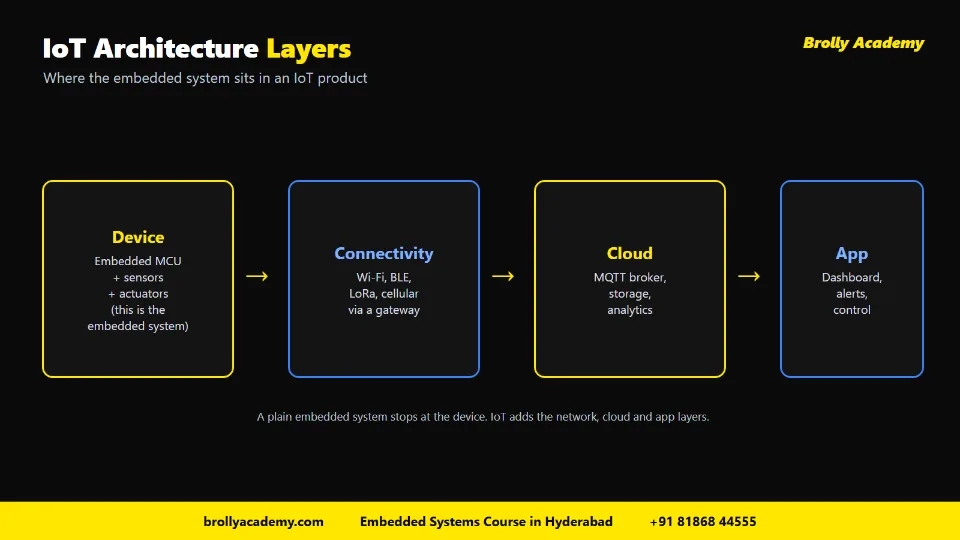
IoT architecture layers: the embedded device, connectivity, cloud and app. A plain embedded system stops at the device.
Let us walk through a simple real project: a temperature and humidity monitor for a cold storage room that sends alerts to a phone.
Layer 1: sensing and control (embedded)
A digital sensor connects to the microcontroller over I2C. The firmware reads it every few seconds, checks limits and turns on a buzzer through a GPIO pin if the temperature crosses a threshold. This part works even if the internet is down. It is 100 percent embedded engineering: drivers, timers, interrupts and careful C code.
Firmware engineers often use a HAL (Hardware Abstraction Layer), a vendor library that hides register details behind functions such as "read this pin" or "send these bytes", so the same code is easier to move between chips.
Layer 2: connectivity (embedded plus networking)
The microcontroller needs a way to reach the network. One common choice is a chip with the radio built in. Espressif describes the ESP32 as a feature-rich MCU with integrated Wi-Fi and Bluetooth connectivity (Espressif, October 2026). Raspberry Pi's Pico 2 W board, according to its March 2026 product brief, adds 2.4 GHz Wi-Fi and Bluetooth 5.2 to the RP2350 chip. Writing the code that joins a network, reconnects after a drop and saves power between transmissions is still embedded work, but it needs networking knowledge.
Layer 3: messaging protocol
The device now has to send data in a format the server understands. MQTT is the classic IoT choice. The OASIS MQTT Version 5.0 standard, published on 7 March 2019, describes MQTT as a client-server publish/subscribe messaging transport protocol that is lightweight and suited to machine-to-machine and IoT use (OASIS, March 2019). In practice, the device "publishes" a reading to a topic such as coldroom/1/temp, and any app "subscribed" to that topic receives it through a central server called a broker.
Layer 4: cloud and app (IoT side)
The broker passes data to a cloud service that stores readings, draws charts and sends a phone alert if the temperature stays high for ten minutes. This layer is mostly software, cloud and data engineering. An embedded engineer does not need to master it, but should understand how it works so the device side fits cleanly.
Where an RTOS fits
Once a device has to read sensors, run control logic, keep a network connection alive and handle updates at the same time, a simple loop becomes hard to manage. That is where an RTOS helps. FreeRTOS describes itself as a real-time operating system for microcontrollers and small microprocessors, maintained by AWS and released under the MIT licence (FreeRTOS website, October 2026). Zephyr describes its kernel as small-footprint and designed for resource-constrained and embedded systems (Zephyr Project documentation, October 2026). Both are widely used in connected devices. Our dedicated post on RTOS covers this in depth.
7. Protocols: inside the device vs between devices
Short answer: Embedded systems mainly use short-distance, on-board protocols such as UART, SPI, I2C and CAN to connect chips and modules; IoT adds network and messaging protocols such as Wi-Fi, Bluetooth LE and MQTT to connect devices to each other and to the cloud.
This is a very common interview and exam question, so here is a clear split.
On-board and in-vehicle protocols (embedded)
- UART (Universal Asynchronous Receiver-Transmitter): a simple two-wire serial link (transmit and receive) used for debug consoles, GPS modules and many radio modules.
- SPI (Serial Peripheral Interface): a fast, clocked bus used for displays, flash memory and some sensors.
- I2C (Inter-Integrated Circuit): a bus where a controller and several target devices share only two wires, a clock line (SCL) and a data line (SDA), as explained in TI's application note "Understanding the I2C Bus" (Texas Instruments, revised October 2026).
- CAN (Controller Area Network): developed by Bosch as a multi-master, message broadcast system and standardised as ISO 11898. It connects ECUs inside cars and machines. Newer generations include CAN FD and CAN XL (TI application note and Bosch CAN protocol page, October 2026).
Network and messaging protocols (IoT)
- Wi-Fi: connects a device directly to a home or office network and from there to the internet. Good range and speed, but it uses more power.
- Bluetooth LE (Low Energy): the Bluetooth SIG says Bluetooth LE is "designed for very low power operation" and supports point-to-point, broadcast and mesh topologies, as well as positioning (Bluetooth SIG technology overview, October 2026). It is common in wearables, beacons and phone-connected gadgets.
- MQTT: the lightweight publish/subscribe messaging protocol described in the device-building section above. It runs on top of a network connection and carries the actual data.
A real IoT device uses both groups. The cold storage monitor above reads its sensor over I2C, prints debug messages over UART, connects over Wi-Fi and sends readings with MQTT.
8. Power and real-time differences
Short answer: IoT devices usually face tighter power budgets than classic embedded devices because radios are power hungry and many IoT devices run on batteries for months or years; classic embedded systems more often face strict real-time limits.
Power
A washing machine controller runs on mains power, so energy is rarely the main worry. A battery-powered IoT sensor on a farm is different. Every time the radio switches on, battery drains fast. IoT firmware therefore spends most of its life in deep sleep, wakes up, takes a reading, sends it quickly and goes back to sleep. Designing this sleep-wake cycle well is a core embedded skill that IoT makes even more important.
Real-time behaviour
Many classic embedded systems are hard real time: an airbag controller or a motor drive must respond within a fixed time, every time. IoT devices can also have real-time parts on the device, but the cloud side is not real time. A dashboard that updates a few seconds late is fine. A brake controller that responds a few milliseconds late is not.
9. Challenges of embedded systems in IoT
Short answer: Connecting an embedded device to the internet brings six big challenges: security, interoperability, scalability, power, privacy and the new demands of edge AI. Most of them must be solved in the firmware, not in the cloud.
These are where IoT projects usually fail, and where skilled embedded engineers add the most value.
1. Security
Every connected device is a possible entry point for an attacker. Common weak spots are default passwords shared by every unit, firmware updates that are not signed, and debug ports left open on production boards. A hacked camera or router can be pulled into a network of hijacked devices that attacks other systems.
Engineers respond with unique credentials per device, secure boot, signed OTA updates, encrypted links and locked debug ports. The US standards body NIST has published a short guide, NIST IR 8259, "Foundational Cybersecurity Activities for IoT Device Manufacturers" (May 2020), that lists security activities makers should consider before their devices are sold (NIST, October 2026). It is a useful checklist even for student projects.
2. Interoperability
Interoperability means devices from different makers can work together. In practice, one sensor speaks Bluetooth LE, another uses Wi-Fi with its own app, and an old factory machine only talks Modbus over a serial line. Nothing connects without extra work.
The usual fix is a gateway: an embedded box that reads the older protocol on one side and publishes clean data over MQTT on the other. Choosing open, documented protocols from the start saves a lot of pain later.
3. Scalability
A demo with three devices on your desk behaves very differently from thousands of devices in the field. At scale you must give each device its own identity, roll out firmware updates in small batches so one bad build does not brick the whole fleet, and design MQTT topics and reconnect logic so that a network outage does not make every device reconnect at the same second.
4. Power
As the power section above explains, radios drain batteries fast. A soil sensor that needs a new battery every month is not a product. Engineers measure sleep current, keep the radio off as long as possible and pick low-power links such as Bluetooth LE where the range allows.
5. Privacy
IoT devices collect personal data quietly. A smart meter's usage pattern can show when a home is empty, and a wearable records health readings. Good design collects only the data the product needs, processes what it can on the device, encrypts data in transit and at rest, and lets users see and delete what is stored. Products sold in India must also respect the country's personal data protection rules, so privacy is a legal question as well as a technical one.
6. Edge AI
Running machine learning on the device reduces cloud traffic and helps privacy, because raw audio or images never leave the board. The challenge is fitting a model into a microcontroller with limited flash, RAM and battery. Engineers shrink models, use integer maths and pick cores with vector or DSP extensions such as Arm Helium. A predictive maintenance sensor that flags a failing motor bearing on its own is a typical example.
One more practical issue is lifecycle. Connected products can become unsupported or obsolete faster than standalone ones, adding to electronic waste, so plan how long you will ship security updates before you launch.
10. Real examples side by side
Short answer: The same product category can be purely embedded or IoT depending on whether it connects to a network and a remote service.
Notice the pattern. The left column already has a full embedded system. The right column keeps that same embedded core and adds a network link, a server and an app. For many more everyday cases, see our list of embedded systems examples, which groups them by home, automotive, medical, industrial and more.
11. Skills and tools: embedded engineer vs IoT engineer
Short answer: Embedded engineers go deep into C, microcontrollers, peripherals, interrupts, RTOS and debugging hardware; IoT engineers need a working version of those skills plus wireless connectivity, MQTT, cloud basics, security and data handling.
Tools you will meet
- For embedded work: an IDE such as Keil MDK (Arm says its Community Edition is free for non-commercial projects, Arm Keil, October 2026) or Arduino IDE 2, a debug probe, a logic analyser and an oscilloscope.
- For IoT work: everything above, plus an MQTT broker for testing, a serial terminal, a network analyser such as Wireshark and a cloud dashboard.
If you are new to the C side, our guide to embedded C programming explains bit manipulation, volatile, registers and interrupts with short code examples.
12. Career angle: IoT vs embedded systems in India
Short answer: Embedded engineering is the broader, deeper career base that IoT roles grow out of; IoT roles add connectivity and cloud and suit people who enjoy the full product chain. Both draw on the same core skills, so the choice is about direction, not about locking a door.
Typical job titles
- Embedded side: embedded software engineer, firmware engineer, device driver or BSP engineer, automotive embedded engineer, validation engineer.
- IoT side: IoT firmware engineer, IoT solutions engineer, connected device engineer, IoT application developer, IoT test engineer.
Many job posts in India use both terms together, such as "embedded and IoT engineer", because companies want firmware people who can also handle connectivity.
Why demand exists
India's electronics base is growing. A PIB-hosted note on the Electronics Component Manufacturing Scheme (February 2026) states that electronics production grew from 1.9 lakh crore rupees in 2014-15 to 11.3 lakh crore rupees in 2024-25, a six-fold increase, supporting around 25 lakh jobs. More devices made in India means more firmware, connectivity and testing work, which touches both embedded and IoT roles.
What about salary?
You will see many "IoT vs embedded salary" claims online. We have not verified a reliable, like-for-like salary comparison for October 2026, so we do not quote numbers here. In general, pay in both tracks depends far more on depth of skill, domain (automotive, medical, industrial, consumer) and your project proof than on whether the title says IoT or embedded. Our VLSI vs embedded systems comparison looks at the chip-design path if you are weighing that option too.
Which is better for you?
- Choose a deep embedded path if you enjoy hardware, timing, drivers, debugging with an oscilloscope and safety-critical domains such as automotive or medical.
- Choose an IoT direction if you enjoy seeing the whole product work end to end: the device, the network, the cloud and the app.
- Either way, the embedded core is the same, so you lose nothing by starting there.
13. Which should you learn first: IoT or embedded systems?
Short answer: Learn embedded systems first. IoT built on weak embedded basics breaks in the field, while strong embedded basics make IoT a natural, fast next step.
Many beginners jump straight to IoT kits, copy an online sketch, see data on a phone and think they have learnt IoT. The trouble starts when the device hangs, drains its battery in a day or loses data after a Wi-Fi drop. Fixing those problems needs embedded knowledge: interrupts, memory, timing, power modes and debugging.
Here is a practical order.
Stage 1: embedded foundations (about 8 to 10 weeks)
- C programming with a focus on pointers, bit operations and structures
- Digital electronics basics: logic levels, pull-ups, voltage dividers
- One microcontroller board: GPIO, timers, interrupts and ISRs
- UART, SPI and I2C with real sensors and displays
Stage 2: robust firmware (about 4 to 6 weeks)
- Reading datasheets and using a vendor HAL
- Debugging with a debug probe and a logic analyser
- An RTOS with two or three tasks and a queue between them
- Low-power modes and a simple bootloader concept
Stage 3: connectivity and IoT (about 6 to 8 weeks)
- A Wi-Fi or Bluetooth LE capable board such as ESP32 or Pico 2 W
- MQTT: publish sensor data, subscribe to commands
- A simple cloud dashboard and phone alert
- Basic IoT security: no hard-coded passwords, encrypted links, safe OTA updates
Stage 4: one end-to-end project
Build one complete product, for example the cold storage monitor or a smart water tank controller. Document it on GitHub with a block diagram, code, a short video and a list of problems you solved. This one project will speak louder in interviews than five copied demos.
These week counts are a study guide for a learner putting in steady daily effort, not a fixed rule. For a full step-by-step path, see our embedded systems roadmap.
14. How Brolly Academy helps
Short answer: Brolly Academy's Embedded Systems course teaches the embedded core first and then adds IoT, so you learn in the right order with hands-on hardware and projects.
Our Embedded Systems Course in Hyderabad runs for 3 months with 80+ hours of expert-led training, in classroom and online modes with weekday and weekend batches (course page, October 2026). The order matches the advice in this article:
- Month 1: microcontrollers and embedded C on ARM Cortex, STM32 and Arduino, with timers and interrupts
- Month 2: RTOS, IoT and the I2C, CAN, SPI and UART protocols
- Month 3: automotive embedded, VLSI basics and a capstone project, then career preparation
Projects on the page include an IoT automation system using I2C, SPI, UART and an RTOS, an embedded C sensor control project on STM32 or Arduino, and an embedded Linux device driver on ARM Cortex and Raspberry Pi. Tools listed include Keil µVision, Arduino IDE, PlatformIO, Zephyr OS and Wireshark.
Fees listed on the course page in October 2026 are ₹15,000 for Video Recording, ₹40,000 for the live Online Course and ₹45,000 for Classroom Training, with EMI available. You get a Brolly Academy course completion certificate, placement assistance, resume help and mock interviews. Free 3-day demo classes are available before you enrol, and the next batch starts on Monday, 2 November 2026.
If you want to go deeper into connected devices after the embedded foundation, Brolly also runs a separate IoT training in Hyderabad course.
Learn embedded first, then build real IoT projects
Brolly Academy's 3-month Embedded Systems course in Hyderabad takes you from embedded C and STM32 to RTOS, communication protocols and an IoT automation project, in classroom or online mode. Book a free 3-day demo class and see the labs before you decide.
Frequently asked questions
What is the difference between IoT and embedded systems?
An embedded system is a small computer built into a device to do one dedicated job, often without any network. IoT is a system of many such devices connected over a network to a cloud or server and an app, so they can share data and be controlled remotely. In short, embedded is the foundation, and IoT is embedded plus connectivity, cloud and apps.
Is IoT an embedded system?
IoT as a whole is not just an embedded system, but every IoT device has an embedded system inside it. The device side, with its microcontroller, sensors and firmware, is embedded engineering. The network, cloud and application sides of IoT are closer to networking and software engineering. So IoT is built on embedded systems rather than being the same thing.
Are IoT and embedded systems the same?
No, they are not the same. An embedded system can work completely alone, like a microwave oven controller or a digital thermometer. An IoT system needs a network link, a server or cloud and usually an app. They overlap heavily because every IoT device contains an embedded system, which is why many universities teach them together in one subject.
Does IoT come under embedded systems?
Partly. The device part of IoT comes under embedded systems, because it uses the same microcontrollers, firmware, interrupts and on-board protocols. The cloud storage, analytics and mobile app parts do not; they belong to software, cloud and data engineering. A good way to think of it is that IoT extends embedded systems outward to the network and the internet.
Can an embedded system work without the internet?
Yes, most embedded systems work without the internet. A pacemaker, an anti-lock braking controller, a calculator and a washing machine controller all do their job locally. They sense, decide and act inside the product. Connectivity is optional for an embedded system, while for an IoT device it is essential.
Which is better, IoT or embedded systems?
Neither is better in general, because IoT depends on embedded skills. Choose a deep embedded path if you enjoy hardware, timing, drivers and safety-critical domains like automotive or medical. Choose an IoT direction if you enjoy the whole chain from device to cloud to app. Either way, starting with embedded basics keeps both options open.
Should I learn IoT or embedded systems first?
Learn embedded systems first. IoT built on weak embedded basics fails in the field with hangs, battery drain and lost data, and fixing those needs knowledge of interrupts, memory, timing and power modes. A sensible order is C and one microcontroller, then peripherals and an RTOS, then Wi-Fi or Bluetooth LE, MQTT and a cloud dashboard.
What are examples of embedded systems that are not IoT?
Common examples are a microwave oven controller, a TV remote, a digital thermometer, a calculator, a standalone digital clock, an anti-lock braking unit and a pacemaker. Each one has a microcontroller running firmware for a dedicated job, but none of them needs to connect to a network or a cloud server to do that job.
What are examples of IoT devices built on embedded systems?
Examples include a smart energy meter that sends readings to the utility's servers, a smart plug you control from your phone, a fleet tracker that reports a truck's location, a connected farm sensor that sends soil moisture to an app, and a factory machine that sends vibration data for maintenance alerts. Each has an embedded system at its core.
What is an embedded system in IoT?
In IoT, the embedded system is the device itself: the microcontroller, sensors, actuators and firmware that read the physical world and act on it. It also runs the code that joins the network, sends data with a protocol such as MQTT and accepts commands or updates. Without it, there is nothing for the cloud to talk to.
Which protocols are used in embedded systems vs IoT?
Embedded systems mainly use on-board and in-vehicle protocols such as UART, SPI, I2C and CAN to connect chips, sensors and controllers. IoT devices use those too, and add network and messaging protocols such as Wi-Fi, Bluetooth LE and MQTT to connect devices to each other, to gateways and to the cloud.
What is MQTT and why is it used in IoT?
MQTT is a lightweight client-server publish/subscribe messaging protocol, defined in the OASIS MQTT 5.0 standard published in March 2019. A device publishes data to a topic, a central broker receives it, and any app subscribed to that topic gets the data. It suits IoT because it is light enough for small devices and handles many devices well.
What is the role of embedded systems in IoT?
The embedded system is the part of an IoT product that touches the physical world. It reads sensors, filters and processes data locally, drives relays and motors, runs the Wi-Fi or Bluetooth LE link and the messaging protocol, stores device keys and manages sleep modes and watchdog resets. The cloud only sees what the embedded firmware chooses to send, so the firmware decides the product's quality.
Why is security more important in IoT than in standalone embedded systems?
A standalone embedded device can usually be attacked only by someone with physical access. Once a device connects to the internet, any weakness in its firmware becomes reachable from anywhere. That is why IoT engineers add secure boot, encrypted communication, unique device credentials and safe update paths, and why some microcontroller cores include hardware security features such as Arm TrustZone.
What is an OTA update in IoT?
An OTA (over-the-air) update sends new firmware to a device through its network connection and installs it without anyone touching the device. It depends on a bootloader, a small program that runs first at power-on, checks for a valid new firmware image and starts the right one. A good bootloader rolls back if an update fails halfway.
Why do IoT devices care more about power than many embedded devices?
Radios use a lot of power, and many IoT devices run on batteries for long periods. So IoT firmware spends most of its time in deep sleep, wakes up, takes a reading, sends it quickly and sleeps again. A mains-powered embedded controller, such as one in a washing machine, rarely has to worry about energy in the same way.
Do IoT devices need an RTOS?
Not always, but an RTOS helps once a device must read sensors, run control logic, keep a network connection alive and handle updates at the same time. A simple loop becomes hard to manage at that point. FreeRTOS, maintained by AWS under the MIT licence, and Zephyr, built for resource-constrained systems, are both widely used in connected devices.
Which board is best to start learning IoT?
Start with a board that has Wi-Fi or Bluetooth built in, so you do not need extra modules. The ESP32 from Espressif is a microcontroller with integrated Wi-Fi and Bluetooth, and the Raspberry Pi Pico 2 W adds 2.4 GHz Wi-Fi and Bluetooth 5.2 to the RP2350 chip. Learn basic embedded skills first on any microcontroller, then move to one of these.
What skills does an IoT engineer need compared to an embedded engineer?
An embedded engineer goes deep into embedded C, microcontrollers, datasheets, interrupts, timers, drivers, RTOS and hardware debugging. An IoT engineer needs a working version of those skills plus wireless connectivity, MQTT, cloud basics, device security, OTA updates and some Python or JavaScript for scripts and dashboards. The embedded core is shared by both roles.
Is IoT a good career in India?
IoT can be a good career, especially if you enjoy building complete products from device to cloud. India's electronics production grew six-fold from 2014-15 to 2024-25 according to a February 2026 government note, and more devices made here means more firmware and connectivity work. Your growth will depend mostly on strong embedded basics and real project proof.
Is IoT or embedded systems better for ECE students?
Both suit ECE students well, because microcontrollers, communication and signals are core ECE topics. The smartest path is to build strong embedded skills first, since they are needed for both tracks, and then add IoT connectivity. This keeps doors open to firmware, automotive, industrial and connected-device roles instead of narrowing your options early.
What are the challenges of embedded systems in IoT?
The six main challenges are security, interoperability, scalability, power, privacy and edge AI. Devices can be attacked over the network, products from different makers often use different protocols, updates must work across large fleets, batteries drain fast when radios are on, personal data must be protected, and machine learning models must fit small microcontrollers. Most of these are solved in the firmware.
What is the salary difference between IoT and embedded engineers?
We have not found a reliable, like-for-like salary comparison for October 2026, so we do not quote numbers. In practice, pay in both tracks depends more on depth of skill, domain such as automotive, medical or industrial, and project proof than on whether the job title says IoT or embedded. Many companies hire for combined embedded and IoT roles.
Which Brolly Academy course should I choose for IoT and embedded systems?
Start with Brolly Academy's 3-month Embedded Systems course in Hyderabad, which covers embedded C and microcontrollers in month 1, then RTOS, IoT and the I2C, CAN, SPI and UART protocols in month 2, with an IoT automation project. Brolly also runs a separate IoT training course if you want to go deeper into connected devices afterwards.
What is edge AI in embedded IoT devices?
Edge AI means running a small machine learning model on the device itself instead of in the cloud, which is also called TinyML. It cuts cloud traffic and helps privacy because raw audio or images stay on the board. Examples include a motor sensor that spots unusual vibration and a doorbell that recognises a person. Arm's Helium extension in Armv8.1-M targets this kind of work.
Learn with Brolly Academy
Review the syllabus, practical projects and batch timings, and book a free demo before you enrol.
Related Articles
Continue Your Learning
Embedded Systems Course in Hyderabad
3 months and 80+ hours of hands-on training in embedded C, ARM Cortex, STM32, RTOS, communication protocols and IoT, with capstone projects.
View CourseIoT Training in Hyderabad
Build connected devices: sensors, microcontrollers, wireless protocols and cloud dashboards for real Internet of Things projects.
View CourseVLSI Training in Hyderabad
Learn digital design and chip design flows for VLSI careers, a natural next step for ECE students interested in hardware.
View Course