
Brolly Academy | Embedded Systems
Embedded Systems Examples
25 Real-World Examples by Industry, With Controller Type and Real-Time Needs (2026)
25 real embedded systems examples from your home, your car, hospitals, factories, telecom, aerospace and farms, with what each one does, the kind of controller inside it and whether it works in real time.
25 embedded systems examples from daily life: home, car, medical, industrial, consumer, telecom and farm devices, with controller type and real-time needs.
By Brolly Academy Team · Brolly Academy · Updated 24 October 2026
Table of Contents
1. What makes something an embedded system?
2. Types of embedded systems with examples
3. How an embedded system works: two examples as block diagrams
4. How to read the examples in this guide
5. Embedded systems examples at home
6. Embedded systems examples in cars
7. Medical embedded systems examples
8. Industrial embedded systems examples
9. Consumer electronics embedded systems examples
10. Telecom embedded systems examples
11. Aerospace and defence embedded systems examples
12. Agriculture embedded systems examples
13. Summary table of 25 embedded systems examples
14. Real time embedded systems examples: hard, firm and soft
15. Design challenges behind these examples
16. What all 25 examples have in common
17. Embedded systems examples vs IoT examples
18. Turn an example into your own project
Quick answer
An embedded system is a small computer built inside a larger product to do one dedicated job, and common examples include a washing machine, a microwave oven, a car's airbag controller, a pulse oximeter, a Wi-Fi router and a smartwatch. Each one has a processor, memory, input and output pins and software (called firmware) that runs only one set of tasks.
- At home: washing machine, microwave oven, inverter AC, smart plug, home inverter
- In your car: engine control unit, ABS, airbag controller, EV battery management system, infotainment
- In hospitals: pulse oximeter, pacemaker, patient monitor
- In industry and beyond: PLCs, servo drives, smart meters, routers, drones, irrigation controllers
- Real time ones: airbags, ABS, pacemakers and flight controllers must respond within a fixed deadline every time
Key takeaways
- A device is an embedded system when a computer inside it does one dedicated job as part of a bigger product, not when it is a general-purpose computer you install apps on.
- Most examples here run on a microcontroller, often a 32-bit Arm Cortex-M part, which Arm says is "optimized for cost and energy-efficient microcontrollers" (Arm, October 2026).
- Safety examples such as airbags, ABS, pacemakers and flight controls are hard real time: a late answer is a failure.
- Many everyday examples, such as smart plugs and fitness bands, are now connected, which is where embedded systems meet IoT.
- India's electronics production grew from ₹1.9 lakh crore in 2014-15 to ₹11.3 lakh crore in 2024-25 (PIB-hosted ECMS note, February 2026), so the products in this list are a growing part of India's economy.
1. What makes something an embedded system?
Short answer: A product is an embedded system when it contains a processor running fixed software that controls one specific function, usually with sensors for input, actuators or displays for output, and tight limits on cost, size and power.
An embedded system has three parts working together:
- Hardware: a processor (usually a microcontroller, or MCU), memory, a power supply, and pins that connect to sensors, buttons, motors and displays.
- Software: firmware, written mostly in C, that runs from the moment you switch on and does one job.
- A dedicated purpose: you cannot install new programs. A microwave only heats food. An airbag controller only decides when to fire the airbag.
Your laptop, by contrast, is general purpose: you can install any program on it. A washing machine controller cannot, and that focus is what makes it cheap, reliable and low power.
The next two sections show which type each example belongs to and how the parts work together inside two real products. After that, we spend the rest of the guide on the examples themselves.
2. Types of embedded systems with examples
Short answer: Embedded systems are usually grouped as stand-alone, real time, networked and mobile, and also as small, medium and sophisticated by how much computing they need. Most of our 25 examples fit more than one group.
Our pillar guide on what embedded systems are explains each type, its characteristics and its components in detail. Here we only map our examples to those types.
By scale, the same examples split like this:
The labels overlap: a drone flight controller is real time, mobile and medium scale at once.
3. How an embedded system works: two examples as block diagrams
Short answer: Every embedded system follows the same flow: sensors and buttons feed inputs to a microcontroller, firmware decides what to do, and actuators such as motors, valves or displays carry out the decision. The loop then repeats.
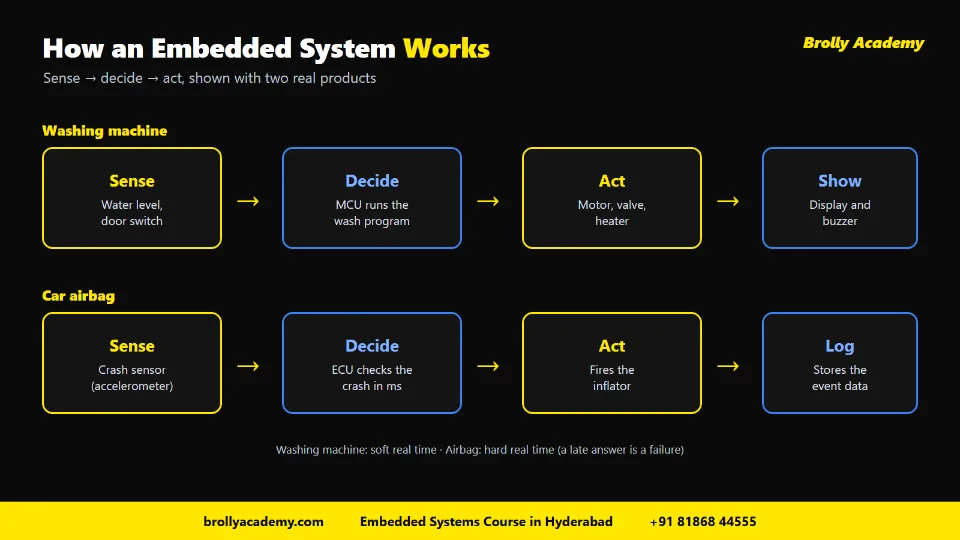
How an embedded system works: sense, decide and act, shown for a washing machine (soft real time) and a car airbag (hard real time).
Read each flow below as a block diagram from left to right: input, processing, output, then feedback.
Flow 1: Washing machine
- Inputs: the program knob or buttons, the water level sensor, the door lock switch and the drum speed sensor.
- Into the MCU: buttons and switches go to GPIO pins (general purpose input/output pins the firmware can read), while analog sensor signals go through the MCU's analog-to-digital converter (ADC), which turns a voltage into a number.
- Processing: the firmware checks that the door is locked, compares the water level with the target for the chosen program and decides the next step in the wash cycle.
- Outputs: the MCU opens the water inlet valve, runs the drum motor through a motor driver, starts the drain pump and updates the display.
- Feedback: it reads the sensors again and repeats the loop until the cycle ends, then beeps and unlocks the door.
Flow 2: Car airbag controller
- Inputs: accelerometers inside the control unit and crash sensors placed around the car, plus seat belt and seat occupancy signals.
- Into the MCU: a safety microcontroller samples these sensors all the time, not only when the car brakes.
- Processing: the firmware compares the pattern of forces with crash rules and runs cross-checks, so a pothole or a door slam does not count as a crash.
- Output: when a real crash is confirmed, the controller triggers the firing circuit that inflates the airbag, all within a tiny time window.
- Self-check and feedback: each time you start the car it tests its own circuits and turns on the airbag warning light if it finds a fault. It can also tell the car's other electronic control units (ECUs) about the crash over the CAN bus, the car's shared data network.
The washing machine is soft real time and forgives small delays. The airbag is hard real time, so its designers must prove the worst-case response time, not just the average.
4. How to read the examples in this guide
Short answer: For each example we tell you what it does, why it counts as embedded, the typical controller inside it, and whether it is hard, firm or soft real time, or not real time at all.
Key terms explained
- Microcontroller (MCU): a single chip that holds a processor, memory and input/output peripherals. It is the "brain" of most small embedded products.
- Firmware: the software stored permanently in the device's flash memory. It controls the hardware directly.
- GPIO (General Purpose Input/Output): chip pins the firmware can read (for a button) or drive high and low (for an LED or relay).
- UART, SPI and I2C: three common ways for chips to talk to each other; I2C lets many chips share just two wires.
- ISR (Interrupt Service Routine): a short function the processor jumps to the moment something urgent happens, such as a sensor signal or a timer tick.
- RTOS (Real-Time Operating System): a small operating system that runs several tasks and makes sure urgent ones meet their deadlines.
- Bootloader: a small program that runs first at power-on and can load or update the main firmware.
Controller types
- 8-bit MCU: simple, cheap chips for basic control. The classic 8051 family belongs here.
- 32-bit MCU: the most common choice today. Arm describes its Cortex-M profile as targeting "deeply embedded systems" with low-latency, deterministic operation (Arm, October 2026).
- Wireless MCU: a microcontroller with radio built in. Espressif describes its ESP32 as an MCU with integrated Wi-Fi and Bluetooth connectivity (Espressif, October 2026).
- DSP: a processor tuned for fast maths on signals such as audio and radio.
- Application processor or SoC: a more powerful chip, often running embedded Linux or Android, used where there is a big screen, a camera or networking.
Real time labels
- Hard real time: missing a deadline is a failure and can be dangerous.
- Firm real time: a late result is useless and thrown away, but one miss is not a disaster.
- Soft real time: a late result is still useful, but quality drops.
- Not real time: timing is relaxed, as long as the job gets done.
The controller types below are the typical choice for that product class. A particular brand or model may use a different chip.
5. Embedded systems examples at home
Short answer: Your home is full of embedded systems: the washing machine, microwave oven, inverter air conditioner, Wi-Fi smart plug and power backup inverter are five clear examples.
Example 1: Washing machine
Yes, a washing machine is an embedded system, and it is the textbook exam answer. Its controller reads the program you pick, checks the water level sensor and door lock, opens the water valves, runs the drum motor at different speeds and shows the time left. It is embedded because it runs fixed firmware for one job.
Controller: 8-bit or 32-bit MCU; inverter motor models need a 32-bit MCU. Real time: soft for the panel, tighter inside the motor control loop.
Example 2: Microwave oven
The microwave reads your keypad, counts down the timer, switches the heating power on and off to set the power level, checks that the door is closed and beeps when the food is ready. It is a timer and power controller hidden inside a kitchen appliance.
Controller: 8-bit MCU. Real time: soft; the door safety interlock is usually backed up by hardware switches.
Example 3: Inverter air conditioner
An inverter AC changes its compressor speed instead of switching it fully on and off. The controller reads temperature sensors and the infrared remote, then runs a motor control algorithm to set the compressor speed.
Controller: 32-bit MCU with motor control timers, often one each in the indoor and outdoor units. Real time: firm to hard in the motor drive, soft for the remote and display.
Example 4: Wi-Fi smart plug
A smart plug lets you switch a fan or geyser from your phone. A wireless MCU joins your home Wi-Fi, talks to a cloud service and drives a relay through a GPIO pin. It is a single-purpose controller with a radio, which also makes it an IoT device.
Controller: wireless MCU, such as an ESP32-class chip. Real time: not real time; a delay of a second does not matter.
Example 5: Home inverter and UPS
When the power goes off, your home inverter senses the failure, switches to battery and generates the switching signals that build the AC waveform. When power returns, it manages battery charging. This is power electronics controlled by dedicated firmware.
Controller: 8-bit or 32-bit MCU, or a digital signal controller in sine wave models. Real time: hard; late switching causes flicker or damage.
6. Embedded systems examples in cars
Short answer: A modern car has many embedded controllers called ECUs (Electronic Control Units). The engine controller, anti-lock brakes, airbag controller, EV battery management system and infotainment unit are five of the most important.
ECUs talk to each other over the CAN bus. Texas Instruments describes CAN as a "multi-master, message broadcast system" developed by Bosch and standardised as ISO 11898 (TI application note SLOA101B, revised May 2016). In simple words, any ECU can send a message and every other ECU on the bus can hear it.
Example 6: Engine control unit (ECU)
The engine ECU reads sensors for air flow, throttle position, engine speed, exhaust oxygen and temperature. It then decides how much fuel to inject and when to fire the spark, many times per second. It is a sealed controller that does only engine management.
Controller: 32-bit automotive-grade MCU. Real time: hard; fuel and spark timing are tied to the crankshaft position.
Example 7: Anti-lock braking system (ABS)
When you brake hard, ABS stops the wheels from locking so you can still steer. It reads a speed sensor on each wheel and, when one wheel slows too fast, quickly releases and reapplies brake pressure through valves.
Controller: 32-bit automotive MCU with safety features. Real time: hard; it must react within milliseconds.
Example 8: Airbag control unit
The airbag controller reads crash sensors (accelerometers) all the time. When it detects a real crash pattern, it fires the airbags within a very short window, and it must not fire on a pothole or a door slam. It has one life-critical job.
Controller: 32-bit automotive safety MCU. Real time: hard; a late airbag is a failed airbag.
Example 9: EV battery management system (BMS)
Electric scooters and cars carry packs made of many cells. The BMS measures cell voltages and temperatures, balances the cells, estimates the charge left and cuts off the pack if it gets too hot or too low.
Controller: 32-bit MCU working with battery monitoring chips. Real time: hard for protection cut-offs, soft for the range shown on your dashboard.
Example 10: Infotainment and digital instrument cluster
The touch screen with maps, music and phone apps is a bigger embedded system. It runs on a powerful SoC and talks to the rest of the car over CAN or automotive Ethernet. It is still embedded because the carmaker fixes its features, not you.
Controller: application processor running embedded Linux, Android or an RTOS. Real time: soft for media; warning lights in the cluster have stricter timing.
7. Medical embedded systems examples
Short answer: Medical devices such as pulse oximeters, pacemakers and patient monitors are embedded systems where accuracy and safety matter most.
Example 11: Pulse oximeter
The finger clip shines red and infrared light through your finger, measures how much passes through, and calculates your oxygen level and pulse rate. Sensing, signal processing and display all sit in one tiny battery-powered product.
Controller: low-power 32-bit MCU. Real time: soft; readings refresh about once a second.
Example 12: Pacemaker
A pacemaker sits inside the body and watches the heart's electrical signals. If the heart beats too slowly or misses a beat, it sends a small electrical pulse. It must run for years on one battery and has no user interface at all.
Controller: ultra-low-power custom chip or MCU. Real time: hard; pacing pulses must arrive on time, every time.
Example 13: Bedside patient monitor
An ICU monitor shows ECG, oxygen level, blood pressure and breathing rate on one screen and raises alarms when a value goes out of range. Sensor boards with their own MCUs collect the signals, and a main processor draws the waveforms and handles alarms.
Controller: 32-bit MCUs on sensor boards plus an application processor. Real time: hard for alarms and sampling, soft for the screen.
Other medical examples you may be asked about include infusion pumps, digital thermometers, glucometers, ECG machines and ventilators. Each reads signals from the body or delivers therapy under dedicated firmware.
8. Industrial embedded systems examples
Short answer: Factories and utilities run on embedded systems such as PLCs, servo drives for robots and machines, and smart energy meters.
Example 14: Programmable logic controller (PLC)
A PLC is a rugged controller that runs machines on a factory floor. It reads switches and sensors, runs its control program in a fixed cycle, and drives motors, valves and lights. Plants often pair PLCs with SCADA software that shows the whole process on a control room screen.
Controller: 32-bit processor, often with an RTOS. Real time: hard; the scan cycle has a fixed maximum time.
Example 15: Industrial robot and servo motor drive
Each joint of a robot arm, and each axis of a CNC machine, is moved by a servo motor. The servo drive reads the motor's position sensor and adjusts the current thousands of times per second to reach the exact position.
Controller: 32-bit MCU with motor control peripherals, or a DSP. Real time: hard; late updates make the arm shake or miss its target.
Example 16: Smart electricity meter
A smart meter measures how much power a home or shop uses, stores the readings and sends them to the electricity company over a mobile or radio network.
Controller: low-power 32-bit MCU with a metering front end and a communication module. Real time: soft for communication; sampling has strict timing.
Other industrial examples include variable frequency drives that control motor speed, and wireless sensor nodes that monitor temperature and vibration on machines.
9. Consumer electronics embedded systems examples
Short answer: Smartwatches, digital cameras and wireless earbuds are consumer products built around embedded systems that balance features with battery life.
Example 17: Smartwatch and fitness band
A fitness band counts steps with an accelerometer, reads heart rate with a light sensor, shows notifications and syncs with your phone over Bluetooth Low Energy. Simple bands run on an MCU with an RTOS; full smartwatches use a more powerful processor.
Controller: wireless 32-bit MCU for bands, application processor for full smartwatches. Real time: soft.
Example 18: Digital camera
When you press the shutter, the camera drives the focus motor, reads the image sensor, processes the image and saves it to a memory card.
Controller: SoC with an image signal processor, plus small MCUs for buttons and power. Real time: firm for video; a late frame is dropped.
Example 19: Wireless earbuds
Each earbud receives audio over Bluetooth, decodes it, may run noise cancellation, and plays it through a tiny speaker. The charging case often has its own small MCU for the battery and lid sensor.
Controller: Bluetooth audio SoC with a built-in DSP. Real time: firm; late audio packets cause clicks and gaps.
10. Telecom embedded systems examples
Short answer: The Wi-Fi router at home and the radio units on mobile towers are embedded systems that move data and voice for millions of users.
Example 20: Wi-Fi router
Your router takes your broadband connection, gives every device an address, forwards packets and runs the Wi-Fi radios. Most routers run embedded Linux on a network SoC, and you update them with a firmware file.
Controller: network SoC running embedded Linux. Real time: soft; small delays reduce speed but break nothing.
Example 21: Mobile base station (4G and 5G radio unit)
Radio units on mobile towers convert digital data into radio signals and back for many phones at once. They need very fast signal processing, plus control software that manages power and faults.
Controller: DSPs, FPGAs and multicore SoCs, often with an RTOS or embedded Linux. Real time: hard for radio timing slots, soft for management.
11. Aerospace and defence embedded systems examples
Short answer: Flight control computers and drone flight controllers are among the most demanding embedded systems, because a missed deadline can cause a crash.
Example 22: Aircraft flight control computer
In modern aircraft, the pilot's controls send signals to flight control computers instead of moving control surfaces directly. The computers read sensors, apply control laws and move the flaps, rudder and elevators. They run in redundant sets, and their software follows strict safety certification.
Controller: redundant processors running a safety-certified RTOS. Real time: hard.
The same field also includes autopilots, aircraft engine controllers, navigation systems, satellite on-board computers and missile guidance systems.
Example 23: Drone flight controller
A drone stays level because its flight controller reads a gyroscope and accelerometer hundreds of times per second and adjusts each motor's speed. It also reads GPS, a compass and your radio commands.
Controller: 32-bit Cortex-M class MCU, often with an RTOS. Real time: hard for the stabilisation loop.
12. Agriculture embedded systems examples
Short answer: Indian farms and dairies use embedded controllers too, such as smart drip irrigation controllers and the electronic milk analysers at collection centres.
Example 24: Smart drip irrigation controller
The controller reads soil moisture sensors, follows a schedule, and switches the pump or valves only when the soil is dry. Connected versions alert the farmer's phone over GSM or Wi-Fi, saving water and trips to the field.
Controller: 8-bit or 32-bit MCU, or a wireless MCU in connected models. Real time: not real time; watering a few seconds late does not matter.
Example 25: Milk analyser at dairy collection centres
At village milk collection centres, a sample goes into an electronic analyser that measures properties such as fat content, and the centre calculates the payment from the result. The analyser, weighing scale and printer are all embedded devices working together.
Controller: 32-bit MCU with sensor interfaces and a display or printer. Real time: soft.
Other farm examples include weather stations, greenhouse climate controllers and GPS guidance systems on tractors.
More everyday examples
You can add many more: ATMs, card swiping machines, lifts, traffic signal controllers, digital weighing scales, set-top boxes, printers, fire alarm panels and the fuel dispenser at your petrol pump. Take the ATM. Its controllers read your card, take your PIN on a secure keypad, count and dispense notes, print a receipt and talk to the bank's network. You cannot install your own programs on it, and it must work reliably all day.
13. Summary table of 25 embedded systems examples
Short answer: Use this table as a quick revision sheet for exams and interviews.
14. Real time embedded systems examples: hard, firm and soft
Short answer: Hard real time examples include airbags, ABS, pacemakers and flight controls; firm real time examples include video capture and wireless audio; soft real time examples include washing machine panels, routers and fitness bands.
A real time system is not just a fast system. It is a predictable one.
Many products mix levels. An EV battery pack's BMS is hard real time when it cuts off an overheating pack, but soft real time when it updates the range on your dashboard.
To juggle several tasks with deadlines, many of these products use an RTOS. FreeRTOS describes itself as a "real-time operating system for microcontrollers and small microprocessors", maintained by AWS and released under the MIT licence (FreeRTOS, October 2026). Other real time operating systems you will meet in industry include Zephyr, Eclipse ThreadX, VxWorks and QNX, while bigger devices such as routers and infotainment units run embedded Linux or Android. Simpler products, such as a microwave, skip the operating system and run a "superloop": one endless loop that checks inputs and updates outputs, with ISRs for urgent events. We explain schedulers and priorities in our guide to RTOS in embedded systems.
15. Design challenges behind these examples
Short answer: Engineers who build these products must solve the same hard problems again and again: security, safe firmware updates, battery life, long-term reliability, strict timing, safety rules and cost.
When you study or explain any example, ask which of these challenges shaped its design.
16. What all 25 examples have in common
Short answer: Every example has a dedicated function, fixed firmware, direct contact with the physical world through sensors and actuators, and tight limits on cost, power, size and reliability.
Use this checklist when someone asks "Why is this an embedded system?":
- Single, dedicated purpose. The microwave heats food; the BMS protects a battery.
- Firmware stored in the device. It starts at power-on, often through a bootloader that can also install updates.
- Sensors in, actuators out. It reads the real world and changes it through motors, valves, relays or displays.
- Resource limits. Memory, power and cost are tight.
- Reliability and often timing. It must work for years without a restart, and many must meet deadlines.
What is not an embedded system?
A desktop PC, a laptop and a general server are not embedded systems, because you choose what software runs on them. Still, a laptop contains small embedded controllers for jobs such as the keyboard, battery charging and the SSD. A smartphone is a grey area. As a whole it is a general-purpose computer, but it contains many embedded systems inside, such as the modem, the camera controller, the power management chip and the touch controller.
17. Embedded systems examples vs IoT examples
Short answer: Every IoT device contains an embedded system, but not every embedded system is an IoT device. A smart plug is both; a microwave oven is embedded but not IoT.
In this list, the smart plug, smart meter, connected irrigation controller and fitness band are IoT devices, because they send data over a network to an app or the cloud. The airbag controller and the pacemaker are embedded but not IoT in the usual sense: they do their job without the internet. We compare the two fields in our guide on IoT vs embedded systems.
18. Turn an example into your own project
Short answer: The best way to understand these examples is to build a small version of one on a development board, such as a mini irrigation controller or a smart plug.
Most examples above scale down into student projects: a smart plug with a wireless MCU and a relay, an irrigation controller with a soil moisture sensor and a pump, or a pulse rate monitor with an OLED display over I2C. Start with the not real time ones, then move to motor control and tighter timing. For 40 ideas by level, with components and skills for each, see our list of embedded systems projects.
19. Why these examples matter for your career
Short answer: Every product in this list is designed, coded and tested by embedded engineers, and India's electronics manufacturing is growing fast.
A note hosted by PIB on the Electronics Component Manufacturing Scheme says India's electronics production grew from ₹1.9 lakh crore in 2014-15 to ₹11.3 lakh crore in 2024-25, a six-fold rise, and that the sector supports around 25 lakh jobs (PIB-hosted ECMS note, February 2026).
The examples also point to specialisations: automotive values CAN and functional safety, IoT values wireless MCUs and low-power design, and routers value embedded Linux. In interviews, explaining three or four examples in depth is a strong answer.
20. How Brolly Academy helps
Short answer: Brolly Academy's 3-month Embedded Systems course in Hyderabad teaches you to build the kind of systems in this list, from embedded C and ARM microcontrollers to protocols, RTOS, IoT and automotive basics, with hands-on projects.
The Embedded Systems Course in Hyderabad runs as classroom and online batches, on weekdays and weekends. According to the course page (October 2026):
- Duration: 3 months with 80+ hours of expert-led training: microcontrollers and embedded C first, then RTOS, IoT and protocols (I2C, CAN, SPI, UART), then automotive embedded, VLSI basics and a capstone.
- Projects that match this list: sensor control on STM32 or Arduino, IoT automation with RTOS, an automotive embedded controller, an industrial PLC interface and a Linux device driver on Raspberry Pi.
- Fees: Video Recording ₹15,000, Online Course ₹40,000 and Classroom Training ₹45,000, with easy EMI available.
- Career support: placement assistance, resume and LinkedIn help, and mock interviews, with a trainer who has 15+ years in embedded systems.
- Who can join: EEE, ECE, CSE, Mechanical and related graduates. C is taught from the basics, so beginners can join.
The next batch starts on Monday, 2 November 2026, and you can attend free 3-day demo classes before you enrol.
Build the embedded systems you use every day
Learn embedded C, ARM and STM32 microcontrollers, I2C, SPI, UART and CAN, RTOS and IoT in 3 months, and build sensor, IoT, automotive and industrial projects you can show in interviews. Join a classroom batch in Hyderabad or a live online batch, with the next batch starting 2 November 2026. Book your free 3-day demo with Brolly Academy today.
Frequently asked questions
What is an embedded system with an example?
An embedded system is a small computer built inside a larger product to do one dedicated job. A washing machine is a good example. Its controller reads the program you select, checks the water level and door lock, runs the drum motor and shows the time left. It runs fixed firmware and you cannot install other programs on it, which is what makes it embedded rather than general purpose.
What are 10 examples of embedded systems in daily life?
Ten everyday examples are the washing machine, microwave oven, inverter air conditioner, Wi-Fi smart plug, home inverter, car airbag controller, pulse oximeter, smartwatch, Wi-Fi router and wireless earbuds. Each has a processor running fixed firmware for one job. You can add ATMs, lifts, traffic signals and digital weighing scales, because they also contain dedicated controllers hidden inside the product.
What are some examples of embedded systems at home?
Common examples at home include the washing machine, microwave oven, inverter AC, set-top box, printer, Wi-Fi router, smart plug and power backup inverter. Each one contains a microcontroller or processor that reads inputs such as buttons and sensors and controls outputs such as motors, relays and displays. Together, a typical home can contain dozens of embedded systems working quietly in the background.
Is a washing machine an example of an embedded system?
Yes, a washing machine is one of the most common examples of an embedded system. A microcontroller inside reads your wash program, monitors the water level sensor and door lock, controls the water valves and sets the drum motor speed. It runs only washing firmware, has tight cost limits, and must work reliably for years, which are all signs of an embedded system.
What are examples of embedded systems in cars?
Examples in cars include the engine control unit, anti-lock braking system, airbag control unit, EV battery management system, infotainment system and digital instrument cluster. These controllers are called ECUs and they share data over the CAN bus. Safety units such as airbags and ABS are hard real time systems because they must react within milliseconds to protect the people inside.
What are real time embedded systems examples?
Real time embedded systems must give the correct answer before a fixed deadline. Examples include car airbag controllers, anti-lock brakes, engine control units, pacemakers, aircraft flight control computers, drone flight controllers and industrial servo drives. Softer real time examples include wireless earbuds, digital cameras recording video, routers and fitness bands, where a late result reduces quality rather than causing failure.
What is the difference between hard and soft real time systems?
In a hard real time system, missing a deadline is a failure and can be dangerous, as with an airbag or pacemaker. In a soft real time system, a late result is still useful but quality drops, as with a slow display update on a washing machine. Firm real time sits between them: a late result, such as a dropped video frame, is discarded but the system continues.
What are hard real time embedded system examples?
Hard real time examples include the airbag control unit, anti-lock braking system, engine control unit, pacemaker, aircraft flight control computer, drone flight stabilisation, industrial servo drives, PLC scan cycles and the waveform generation in a home inverter. In each case, a late response can cause damage, injury or failure, so the design must guarantee the worst-case response time, not just the average.
What are soft real time embedded system examples?
Soft real time examples include the display and keypad of a washing machine or microwave, a pulse oximeter updating its reading, a Wi-Fi router forwarding packets, a smartwatch, a smart meter sending data and a car's infotainment screen. A small delay in these systems lowers quality or speed but does not cause harm, so their timing needs are more relaxed.
What are medical embedded systems examples?
Medical embedded systems include pulse oximeters, pacemakers, bedside patient monitors, infusion pumps, digital thermometers, glucometers, ECG machines and ventilators. They read signals from the body, process them and either display results or deliver therapy. Devices such as pacemakers and patient monitor alarms are hard real time and are designed for very high reliability and low power.
What are industrial embedded systems examples?
Industrial examples include programmable logic controllers that run machines, servo drives that move robot arms and CNC axes, smart electricity meters, variable frequency drives for motors, and sensor nodes that monitor temperature and vibration. Many industrial controllers are hard real time because a machine must respond within a fixed scan time to work safely and accurately.
Is a mobile phone an embedded system?
A smartphone as a whole is usually treated as a general-purpose computer, because you can install any app on it. However, it contains many embedded systems inside, including the cellular modem, camera controller, power management chip and touch controller. Each of these runs its own dedicated firmware, so a phone is best described as a general computer built from many embedded parts.
Is a laptop or computer an embedded system?
No, a laptop or desktop computer is not an embedded system, because it is general purpose. You decide which operating system and programs run on it. An embedded system is built for one dedicated job with fixed firmware. Laptops do contain small embedded controllers inside, for example for the keyboard, battery charging and the SSD, but the laptop itself is not embedded.
What are the main components of an embedded system?
The main components are a processor or microcontroller, memory for the program and data, input devices such as sensors and buttons, output devices such as motors, relays and displays, a power supply, and communication interfaces such as UART, SPI, I2C or CAN. The firmware ties these together. Our pillar guide on what embedded systems are explains each component in more detail.
Which microcontroller is used in most embedded systems?
Most modern embedded products use 32-bit microcontrollers, and many of these are based on Arm Cortex-M cores, which Arm describes as optimised for cost and energy-efficient microcontrollers. Simple appliances may still use 8-bit chips such as 8051-family parts. Connected devices often use wireless microcontrollers such as the ESP32, which has Wi-Fi and Bluetooth built in.
What is the difference between embedded systems and IoT examples?
Every IoT device contains an embedded system, but not every embedded system is IoT. A smart plug, smart meter or fitness band is IoT because it sends data over a network to an app or the cloud. A microwave oven, an airbag controller or a pacemaker is embedded but not IoT, because it does its job without needing an internet connection.
What are examples of embedded operating systems?
Examples of operating systems used in embedded products include FreeRTOS, Zephyr, Eclipse ThreadX, VxWorks and QNX for real time work, and embedded Linux and Android for bigger devices such as routers and car infotainment systems. Very simple products, such as a microwave, often use no operating system and run a single superloop with interrupts handling urgent events.
Why is an ATM an example of an embedded system?
An ATM is an embedded system because its controllers do dedicated jobs: reading your card, taking your PIN on a secure keypad, counting and dispensing notes, printing a receipt and talking to the bank's network. You cannot install your own programs on it. It contains several embedded controllers working together, each with fixed firmware and strict reliability needs.
What are the types of embedded systems with examples?
Embedded systems are commonly grouped into four types: stand-alone, real time, networked and mobile. A washing machine or microwave oven is stand-alone, an airbag controller or pacemaker is real time, a smart plug or Wi-Fi router is networked, and a smartwatch or wireless earbuds are mobile. By scale, a microwave is small scale, an EV battery management system is medium scale and a car infotainment unit is sophisticated. Many products fit more than one type.
How does an embedded system work with an example?
An embedded system works in a loop of input, processing and output. In a washing machine, the program buttons, door lock switch and water level sensor send signals to the microcontroller. The firmware checks that the door is locked, compares the water level with the target and decides the next step. It then drives the water valve, drum motor, drain pump and display, reads the sensors again and repeats until the cycle ends.
What are examples of embedded systems in agriculture?
Examples in agriculture include smart drip irrigation controllers that read soil moisture and switch pumps, electronic milk analysers at dairy collection centres, weather stations, greenhouse climate controllers and GPS guidance systems on tractors. Many run on solar or battery power, and connected versions send alerts to the farmer's phone, which also makes them IoT devices.
What makes a device an embedded system?
A device is an embedded system when it has a dedicated purpose, fixed firmware stored inside it, sensors and actuators that connect it to the physical world, tight limits on cost, size and power, and a need for long-term reliability. Many also have timing deadlines. If you can install any program you like on a device, it is general purpose rather than embedded.
What is an example of a small scale embedded system?
A small scale embedded system uses a simple 8-bit or small 32-bit microcontroller with little memory and basic peripherals. Good examples are a microwave oven controller, a digital weighing scale, a smart plug and a basic drip irrigation timer. They do one simple job, run from a small program, and often work without any operating system.
Can I build an embedded system example as a student project?
Yes, most examples in this list can be scaled down into student projects. You can build a smart plug with a wireless microcontroller and a relay, an irrigation controller with a soil moisture sensor and a pump, or a pulse rate monitor with an OLED display. Start with simple, not real time projects, then move to motor control and other projects with tighter timing.
Where can I learn to build embedded systems in Hyderabad?
Brolly Academy offers a 3-month Embedded Systems course in Hyderabad, in classroom and online modes. It covers embedded C, ARM Cortex and STM32 microcontrollers, I2C, SPI, UART and CAN, RTOS, IoT and automotive basics. Projects include sensor control, IoT automation, an automotive embedded controller and an industrial PLC interface, and you can attend free 3-day demo classes before you enrol.
Learn with Brolly Academy
Review the syllabus, practical projects and batch timings, and book a free demo before you enrol.
Related Articles
Continue Your Learning
Embedded Systems Course in Hyderabad
3 months and 80+ hours of hands-on training in embedded C, ARM Cortex, STM32, RTOS, communication protocols and IoT, with capstone projects.
View CourseIoT Training in Hyderabad
Build connected devices: sensors, microcontrollers, wireless protocols and cloud dashboards for real Internet of Things projects.
View CourseVLSI Training in Hyderabad
Learn digital design and chip design flows for VLSI careers, a natural next step for ECE students interested in hardware.
View Course