Pydantic AI vs LangChain vs LangGraph
7 Practical Checks for Choosing Your Agent Framework
Choosing between Pydantic AI, LangChain and LangGraph starts with the application you need to build. A typed Python assistant, an integration-heavy agent and a long-running workflow can have different priorities. There is no universal winner that makes every project simpler, cheaper and more reliable.
This comparison focuses on design choices: output contracts, tools, workflow control, testing and maintenance. It does not claim benchmark results that have not been measured. Features change, so check the current official documentation before committing to an implementation.
-
Nani
- No Comments
Share
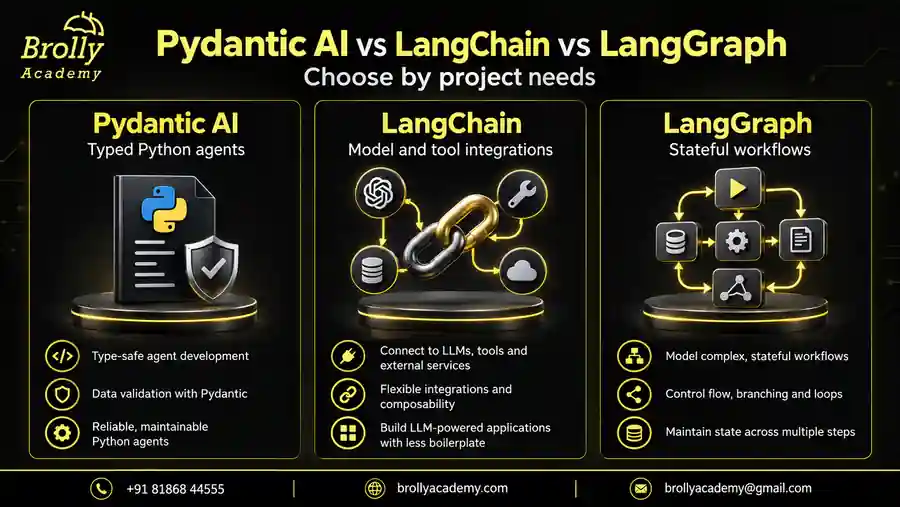
Table of Contents
Use a single running example as you read: an assistant receives a support request, looks up an authorised ticket and either returns a typed answer or requests review. Later, the team may add an approved ticket update. Following that progression makes the tradeoffs concrete. A framework suitable for the first endpoint may also support the later workflow, but the amount of configuration and application code can change.
Who is this comparison for?
This guide is for someone choosing how to build an AI application, not someone choosing a chat subscription. You might be a Python learner making a portfolio project, a backend developer adding a model to an API, or a team maintaining a workflow with several services. Your starting point changes what a useful comparison looks like. A student can reasonably prioritise an example they can understand. A production team must also account for existing tests, operational ownership and migration work.
By the end, you should be able to write a short decision for your own project. That decision should name the result the application must produce, the operations it may perform, the failures it must handle, and the evidence needed before release. You do not need to select a winner for every possible application. You need a candidate that meets your requirements and a clear explanation of why you chose it.
| Your situation | Start with | Useful outcome |
|---|---|---|
| New to Python AI development | The project definitions and typed support API scenario | One small application with a result you can validate |
| Already using LangChain | Integration checks and the migration section | A specific improvement to test before considering a rewrite |
| Building a review workflow | Approval, persistence and recovery | A demonstrated pause, restart and resume path |
| Comparing training options | The beginner learning sequence and project checklist | Questions to ask about exercises and feedback |
All scenarios below are learning examples. They are not customer case studies or measured claims about Brolly Academy systems. Where the article suggests a trial, record your own result. A blank result means the behaviour is untested, not that the framework passed.
The short answer
Consider Pydantic AI when a Python-first approach with explicit types and application contracts fits your team. Consider LangChain when its agent abstractions and integrations match the components you need. Consider LangGraph when explicit orchestration of stateful, long-running work is central to the application.
These descriptions are starting points, not hard boundaries. The frameworks have overlapping capabilities, and some can be used together. Do not compare them using old claims such as “only one supports structured output” without checking the versions under consideration.
Pydantic is not the same thing as Pydantic AI
Pydantic is a data-validation library. Pydantic AI is a separate AI application framework that uses typed Python interfaces. Seeing Pydantic in a LangChain example does not mean that example is running a Pydantic AI agent. This distinction matters when searching for installation problems: a compatibility issue involving a Pydantic model may concern validation or a connector, rather than the choice between agent frameworks.
Think about a result containing a route, a ticket identifier and a summary. A Pydantic model can describe those fields. An agent framework organises the model call and, where configured, tool use that leads to that result. The surrounding application authenticates the person, decides which records they can access and determines what happens next. These are related responsibilities, but they are not interchangeable.
For data types and coercion, use the Pydantic model documentation. For agent configuration, use the documentation for the agent framework you installed. When debugging, copy the package names and versions into your issue notes. Saying only that you have a Pydantic error leaves out the component that actually raised it.
| Term | Practical meaning here | Do not assume |
|---|---|---|
| Pydantic model | A declared data shape with validation behaviour | That its accepted values are factually true |
| Pydantic AI agent | A configured model interaction with optional tools and output contracts | That it automatically owns your business permissions |
| LangChain agent | A higher-level agent interface with configurable behaviour | That using it means avoiding Pydantic schemas |
| LangGraph workflow | Explicit progression through operations and state | That saving state makes every external action safe to repeat |
What is each project designed around?
Pydantic AI presents a typed Python approach to AI application development. Its agent interface brings model interaction, tools and output contracts into ordinary Python development. The wider ecosystem includes evaluation and graph-related components.
LangChain provides agent abstractions and model/tool integrations. Its agent implementation builds on LangGraph. That relationship matters: comparing LangChain and LangGraph as completely unrelated competing products misses how they fit together.
LangGraph focuses on orchestration for stateful agents and workflows. Its documentation highlights control over deterministic and model-driven steps, persistence and human involvement. You do not need to adopt every LangChain component to use LangGraph.
A practical comparison table
| Decision area | Pydantic AI | LangChain | LangGraph |
|---|---|---|---|
| Starting point | Typed Python agent and application contract | Agent abstractions and integrations | Explicit stateful orchestration |
| Useful first experiment | Typed classifier or tool-backed API | Agent using the required provider and tool integrations | Workflow with branching, pause and resume requirements |
| What to inspect | Types, dependencies, tools and validation behaviour | Integration fit, middleware and agent behaviour | State design, transitions and recovery behaviour |
| What still belongs to your app | Permissions, business rules and release evidence | Permissions, business rules and release evidence | Permissions, business rules and release evidence |
This table describes where to begin evaluating the tools. It is not a capability checklist claiming that one framework lacks everything listed under another.
Compare the abstraction before comparing syntax
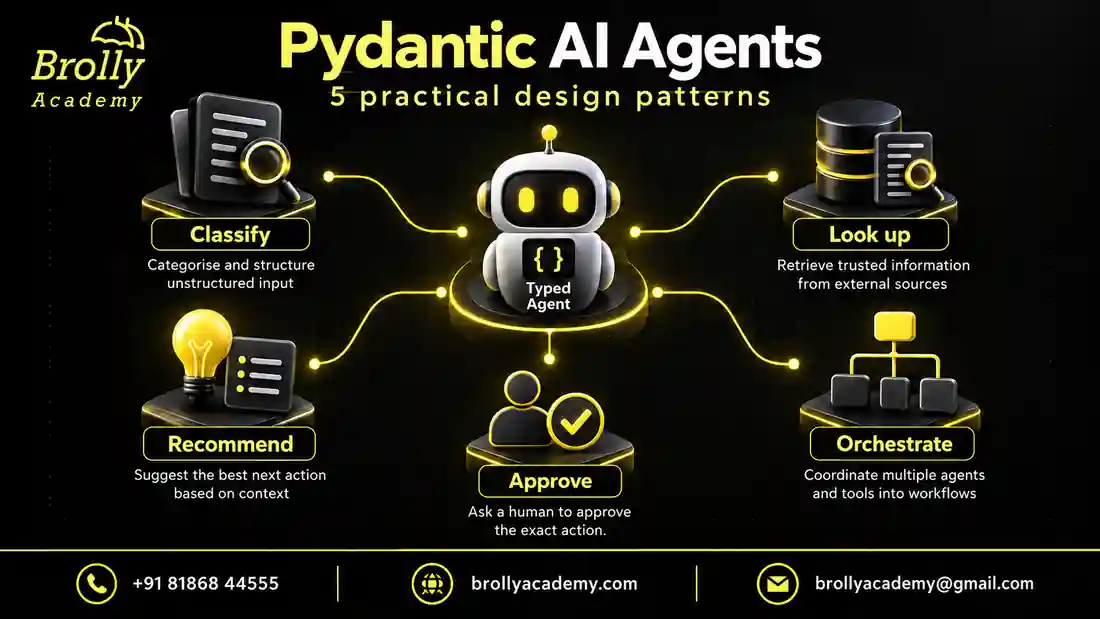
An agent is a configured interaction in which a model may choose tools before producing a result. A workflow specifies how work progresses across steps. A graph is one way to represent that progression using connected operations and shared state. These concepts overlap: an agent can be a workflow step, and a workflow can contain several agent runs.
For the support example, a single agent might choose whether to look up a ticket. The application then checks the result and returns it through an API. When review must happen tomorrow, the application also needs somewhere to store the proposed action and enough information to resume safely. Adding a graph or durable execution system changes those operating responsibilities; it does not make the identity check optional.
The practical question is where you want to express control. Some teams prefer ordinary Python functions around a typed agent. Others prefer an existing agent loop with middleware. Others want explicit nodes, transitions and persisted state. Read a small implementation with the colleague who will debug it, and ask them to locate the timeout, approval and error paths.
Put this into practice with guided training
Explore the Pydantic AI course for the syllabus, guided projects and training options.
Structured output: all three approaches need a contract
Pydantic AI accepts an output type through output_type; its output documentation explains tool-based, provider-native and prompted output approaches. The appropriate mode depends on model capabilities and the application’s requirements. Defining a Pydantic class is useful, but you must still test how the selected provider handles that schema.
LangChain’s structured-output documentation describes create_agent with response_format, including ProviderStrategy and ToolStrategy. Structured results appear under structured_response in the returned agent state. LangChain can also use Pydantic schemas, so typed output alone is not evidence that the frameworks solve different categories of problem.
When building directly with LangGraph, decide which node produces the structured result and how later nodes consume it. The Graph API guide explains state schemas, nodes, edges and reducers. A typed graph state describes workflow data; the model-producing node still needs an appropriate output contract and validation.
| Requirement | Pydantic AI starting point | LangChain starting point | Direct LangGraph design question |
|---|---|---|---|
| Return route and summary | Declare an output type | Configure a response format | Which node creates and validates these fields? |
| Handle invalid model output | Review output validation and retries | Review the selected strategy’s error handling | Where does the failure transition lead? |
| Expose the result to an API | Map the run output to the response | Map structured_response to the response | Map completed state to the response |
| Verify ticket ownership | Application service check | Application service check | Application service check |
A fair experiment supplies the same valid ticket, an unknown route, an absent identifier and a plausible but false status. Expected outcomes differ by failure type: shape errors are rejected, missing evidence causes review, and a false status fails the factual check. An implementation that accepts valid JSON has passed only the first part of the task.
Tools, dependencies and trusted user context
Pydantic AI’s dependency system lets application code pass run-specific services and context, accessed through RunContext. LangChain’s runtime documentation describes context_schema and invocation context for information supplied to a run. Both are relevant places to study how a trusted user identifier reaches a tool.
Do not put the burden of authentication on the model. A user saying “I am the administrator” is conversational content. An identity verified by the web application is trusted server context. The lookup service should combine that trusted identity with the requested ticket identifier and decide whether the record may be returned. This responsibility survives any framework migration.
| Information | Example | Design question to answer in every prototype |
|---|---|---|
| User input | Check ticket T-42 | How is an untrusted request validated? |
| Trusted context | Authenticated account identifier | How does server code supply it to the lookup? |
| Workflow state | Proposed update awaiting review | Where is it stored and who can read it? |
| Secret credential | Service access token | How is it kept outside model-visible content and logs? |
Test two users with distinct synthetic records. The expected outcome for a cross-account request is denial before protected content reaches the model. Inspect the tool response as well as the final answer. A polite refusal after the tool disclosed the record is still an access failure. Use the tools and dependencies exercise as a small application-level pattern to carry into each implementation.
Choose by requirements with this decision checklist
Write down what would make a prototype unacceptable before comparing attractive features. An application returning private ticket content to the wrong account fails even if it has excellent latency. A review process that loses pending work after a restart fails if recovery is required. Treat these as pass-or-fail requirements. Score convenience only after the mandatory behaviour has been demonstrated.
- Define the smallest useful result. For example, return a supported ticket status or a review response. Avoid beginning with a broad instruction to automate customer support.
- List the required services. Name the provider, database and external API you actually need. Check those integrations, not the size of a general integration catalogue.
- Decide who controls the next step. Is the model allowed to select a read-only tool, or must the application follow a fixed approval sequence?
- Specify lifetime and recovery. Does the work finish in one request, continue across a conversation, or remain pending after a process restart?
- Assign ownership. Name the team responsible for service failures, stored state, tracing and ordinary version upgrades.
| Requirement | Trial to run | Evidence to keep |
|---|---|---|
| Typed API response | Supply valid, incomplete and invalid result fixtures | Accepted response and rejected cases |
| Specific provider integration | Exercise the exact output and tool options needed | Configuration, versions and observed limitations |
| Human approval | Reject, approve and change a proposed action | Which action was executed and who approved it |
| Restart recovery | Stop the worker at a documented checkpoint | Recovered state and external-operation count |
| Maintainability | Have another developer change a review rule | Time spent and concepts they had to understand |
For a typed Python API, Pydantic AI is a sensible first candidate to evaluate. For an application already benefiting from LangChain integrations, extending the existing agent may be the smaller change. For an explicit branching workflow, a direct LangGraph prototype helps you inspect control and state. These are starting hypotheses. The checklist is how you test them rather than turning them into unsupported rankings.
Scenario 1: A typed support-classification API
A backend team needs a small endpoint that returns a category, a summary and a review flag. It already uses Python and Pydantic models. Pydantic AI is a reasonable option to prototype because the team can organise the result around a familiar data contract.
The deciding evidence should be practical: can the team validate the result, test failures and connect the necessary services without unnecessary complexity? Build a narrow prototype and review it with the developers who will maintain it.
A simple deterministic classifier may be sufficient for part of the work. Framework selection should not distract from the more basic question of whether a model adds useful value.
Build the first experiment in three steps. Define the category and review rules, return a controlled response through the endpoint, then connect the selected model in a separate evaluation. The expected offline outcome is that invalid categories never become accepted API results. The expected live outcome must be judged on labelled messages, including mixed and unclear requests.
Implement the same result contract in the alternative you are considering. Record how easy it is to substitute a model, inject a fake lookup and inspect a validation failure. Familiarity may make Pydantic AI convenient for this team; that observation does not prove that another team with established LangChain services would benefit from switching.
Scenario 2: An assistant using several existing integrations
Another team needs to connect a particular model provider, document source and tool service. An existing integration can reduce work, but only if its behaviour fits the application. LangChain may be worth evaluating when its available components align with that stack.
Check the integration’s current maintenance, supported options and failure handling. A connector existing in a catalogue does not guarantee that every feature of the underlying service is supported. Test the exact authentication and retrieval path your project needs.
Compare the total maintenance burden with a small direct integration. More reusable components are helpful only when they remove complexity that your team would otherwise have to own.
Choose one difficult path for the integration trial: an expired credential, a paginated source, a missing document or a rate-limited service. Confirm what error reaches the application and whether retries respect the task deadline. Also check that retrieved records retain the identifiers and metadata needed for citations and access filtering. A successful first search is insufficient evidence for that complete path.
Keep document selection equivalent when comparing answers. If one prototype sees newer documents or more useful chunks, its stronger answer may reflect retrieval quality. Separate retrieval, evidence checking and answer generation, then evaluate each part independently of the framework decision.
Scenario 3: A workflow that pauses for approval
A document workflow may gather evidence, wait for a reviewer, resume later and recover after interruption. In that case, workflow state and recovery are primary design concerns. LangGraph is a relevant candidate to evaluate for explicit orchestration.
Prototype a failure, not just the happy path. Stop the process after a completed step and check what happens on resume. Confirm whether an external action is repeated. Inspect where state is stored and who can access it.
Pydantic AI also has workflow-related options in its ecosystem, so do not assume that a feature name settles the decision. Compare the actual approach and integration effort for your application.
LangGraph’s persistence documentation distinguishes checkpointers for thread state from stores for information outside that state. In-memory examples are useful for learning, but state held only in process memory does not survive a restart. Select and operate a persistent backend when restart recovery is part of the requirement.
The interrupt documentation describes pausing and resuming work, including the fact that the interrupted node runs again on resume. External effects before an interrupt therefore need careful placement and duplicate prevention. An approval screen is only one part of a dependable approval workflow.
Pydantic AI’s durable execution overview documents integration with durable execution backends. Evaluate the backend and its operational requirements alongside the agent code. Neither an agent object nor the word durable establishes that every external service operation can be replayed without consequences.
| Event | Required observation | Why it affects selection |
|---|---|---|
| Reviewer has not responded | No consequential update occurs | Approval must be a real execution boundary |
| Process stops while waiting | Pending work remains recoverable | Tests persistence configuration |
| Reviewer changes the target | Changed action requires appropriate validation and approval | Tests the relationship between approval and action |
| Remote update succeeds before a timeout | Recovery recognises the operation instead of blindly repeating it | Tests duplicate prevention beyond graph state |
Estimate the operating burden honestly. Include database setup, backup, retention, identity checks on resume and handling of old workflow versions. A workflow framework may help express these requirements clearly, but someone still maintains the surrounding services. Prefer the design your team can explain and recover, using evidence from this specific exercise.
Where does CrewAI fit?
CrewAI’s documentation describes Flows for managing execution and Crews for coordinated agent work. It is another option when that organisation matches the task. It should not be reduced to “multiple agents are better than one.”
If your project has only one narrow responsibility, a team of agents may add overhead without a useful separation of work. When several responsibilities are justified, define the input, output and stopping conditions for each one.
Put this into practice with guided training
Explore the Pydantic AI course for the syllabus, guided projects and training options.
How to run a fair comparison
Use the same task, evidence set and model configuration where possible. Keep tool access and output requirements equivalent. Otherwise a result may reflect a different prompt or model rather than the framework.
Record implementation effort, task success, failure categories, total model calls, latency and operating requirements. Include the versions tested and the number of cases. Do not describe a local experiment as a universal performance benchmark.
A useful decision note says, for example, “This option required less custom code for our specific approval workflow, but our team needs more practice with its state model.” That is more informative than a star-rating table with no method behind it.
Agree on mandatory requirements before giving optional features a score. If the application must recover after restart, a prototype that cannot do so is incomplete regardless of its short code sample. Once every candidate meets those requirements, compare implementation effort, operational effort and the ease of making an ordinary change. Keep unsuccessful experiments in the decision record.
A step-by-step framework comparison exercise
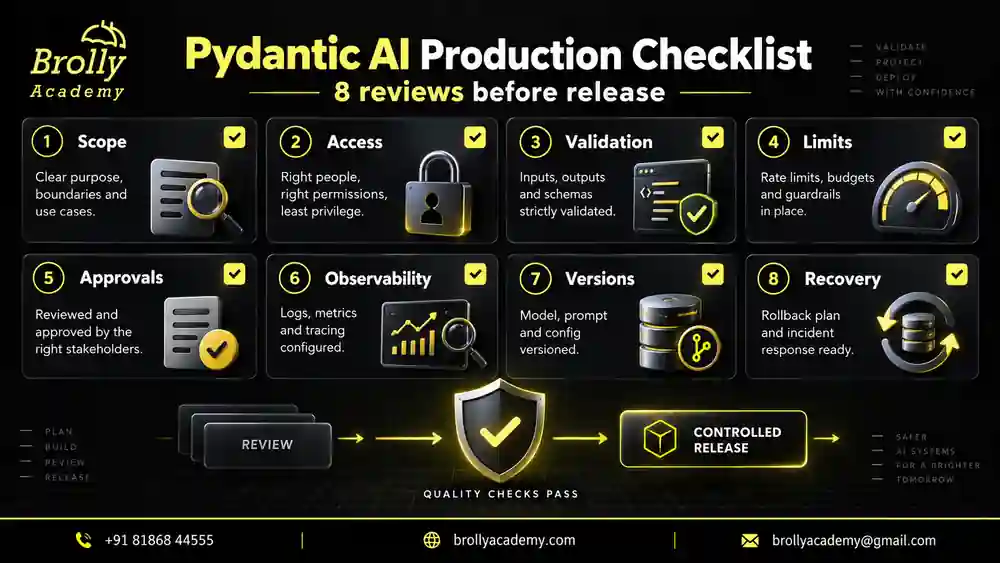
Use a read-only ticket assistant so the exercise cannot accidentally update a real system. Create synthetic tickets for two accounts, an unknown ticket identifier, and a ticket with incomplete status information. Keep the same records for every implementation. Do not include real customer conversations, credentials or private support history in a public repository or a training exercise.
Step 1: Write the contract. The application receives a ticket identifier and a user question. Trusted application context supplies the account identifier. The result contains a route, a short answer and a list of evidence identifiers. Allowed routes are answer and review. An answer must be supported by the accessible record. Missing or contradictory information should produce review rather than a guessed status.
Step 2: Build the service without an agent. Implement the lookup and the ownership check as ordinary application code. Test an allowed lookup, a denied lookup and a missing record. This establishes a reliable service boundary. If you cannot explain who may read the ticket without referring to a prompt, fix that design before comparing frameworks.
Step 3: Add one candidate. Connect the same service to the selected agent interface. Begin with controlled responses so you can test the handler without paying for model calls. Confirm that the application preserves evidence identifiers and rejects invalid routes. The Pydantic AI testing guide explains why these checks do not measure live-model accuracy.
Step 4: Build the alternative around the same contract. Keep the trusted identity outside user-controlled text. Do not silently give one candidate an extra document source, a longer time allowance or more retries. If a configuration cannot be made equivalent, record the difference and explain which requirement it affects. That difference can be useful evidence, but it should not be hidden inside a score.
Step 5: Test the unhappy paths. Make the lookup unavailable, return incomplete evidence, supply a cross-account identifier and interrupt a request. Record the result, number of service calls and time until the application stopped. A retry that repeats forever is not recovery. A confident answer after a failed lookup is not successful completion.
Step 6: Run a separate live-model evaluation. Only do this when you have an approved provider account, suitable data and a defined spending limit. Use the same labelled questions and supported configuration for each candidate. Save failures as well as successes. Report the model, prompt, evidence version and case count so someone else can understand what was compared.
Step 7: Review the decision with a maintainer. Ask them to find one failed lookup, explain the result contract and change a review rule. Include their feedback alongside the evaluation. Select the implementation that meets the requirements with an operating burden your team can handle. Keep a short note about what would cause you to reconsider the choice later.
| Field | What to record |
|---|---|
| Case and expected behaviour | Synthetic case identifier and the required answer or review route |
| Implementation | Framework, package versions, model and configuration |
| Observed result | Output, evidence references and failure category |
| Work performed | Model calls, service calls, retries and elapsed time |
| Decision | Pass, fail or not run, with a short explanation |
Testing and debugging: compare the evidence you can collect
Pydantic AI documents TestModel, FunctionModel and agent overrides for controlled tests. LangChain’s testing guide discusses unit tests, integration tests and trajectory evaluations. Trajectory means the sequence of steps and tool interactions, which can reveal errors that a final-answer check misses.
Run the same failure exercise in each prototype. Make the ticket service unavailable, observe the retry count and confirm that the final result does not invent a status. Then return a record the user cannot access. The expected evidence is a bounded failure in the first case and no disclosure in the second. Judge the implementation by those outcomes, not by whether its tracing screen looks more elaborate.
Choose tracing and evaluation services separately from the core library decision. Check which data they collect, who can access it, how long it remains and what optional services cost. You can compare local test reports before sending prompts or customer content to any hosted system. No live framework benchmark or paid model comparison is supplied by this article.
| Observation | Check before drawing a conclusion | Useful correction |
|---|---|---|
| One prototype gives better answers | Prompts, evidence and model settings differ | Align the task conditions and rerun the same cases |
| One prototype seems much slower | It performs more retrievals or retries | Report time by operation and include call counts |
| Only one accepts the schema | Output mode or provider capability differs | Test equivalent supported configurations |
| Resume duplicates an update | An external effect is replayed without operation tracking | Fix application recovery before scoring reliability |
| The smallest example wins the review | Error handling and operations were omitted | Compare complete task implementations |
Compare total cost, not the framework name
Record model calls, input and output tokens, retrieval work, tool requests, hosting and any optional tracing or hosted services. A framework choice does not by itself establish the bill. A design that repeats a long prompt or retries a failing tool can cost more even when its Python code is shorter.
| Keep constant | Measure | Report separately |
|---|---|---|
| Task and evaluation cases | Successful task completion | Unsupported answers and denied requests |
| Provider, model and settings | Latency, calls and token usage | Retries and failed runs |
| Tool access and documents | Integration effort and recovery behaviour | Framework support versus custom application code |
There are no measured framework speed or price claims in this comparison. Choose a small experiment around your actual constraints and keep the resulting evidence with your decision.
A simple cost model is useful even before a live trial: completed requests multiplied by attempts per request, with model usage and service charges recorded for each attempt. Add storage, tracing and staff time where relevant. Parallel calls may reduce elapsed time while increasing total consumption. A short response can also be expensive when it follows repeated retrievals and a long conversation history.
Decide whether to adopt, combine or migrate
For a new project, pick one candidate for the smallest complete task and set a review point after the failure exercises. For an existing project, identify the concrete limitation first. A difficult approval flow, an unsupported integration or a testing bottleneck gives a migration experiment a measurable purpose. A different import style does not by itself justify rewriting reliable business code.
Combining frameworks can be reasonable when one component has a clear responsibility, such as a typed agent inside a larger workflow. Define the boundary as ordinary input and output data. Decide which layer owns retries, tracing, cancellation and state. If both layers retry the same failure independently, the resulting call count can surprise you even though each configuration looks reasonable in isolation.
During migration, preserve the evaluation dataset and service-level access tests. Compare a read-only or isolated path first, and map old stored state to the new representation deliberately. Keep a way to return traffic to the earlier implementation. The testing and release evidence guide provides release questions that remain relevant whichever framework you select.
How do you make a decision when two options both work?
Ask each maintainer to make the same modest change: add a new review reason, connect a fake service failure and trace one failed request. Record which files and concepts they needed to understand. This reveals maintenance effort that a first demonstration may hide. Give existing team experience a place in the decision, while distinguishing familiarity from an inherent framework advantage.
Write a short decision with four elements: the task, the requirements that mattered most, the evidence observed and the remaining tradeoff. For example, a team might retain its current LangChain agent because it passes the required cases and its integrations are already maintained, while introducing a clearer typed result. Another team might choose Pydantic AI for the same task because its existing Python services make that implementation easier for them to own.
For a long-running review workflow, the decision might favour direct LangGraph orchestration after demonstrating restart recovery with the chosen persistent backend. That conclusion should include the cost of operating the backend and the need to prevent duplicated external actions. These are illustrative decisions, not measured findings about the three projects. Your own prototype determines which statement you can support.
Common comparison mistakes and better questions
A comparison can be technically detailed and still answer the wrong question. Counting import lines says little about a complete application. Comparing a current release with an old tutorial measures different generations of software. A successful response on one prompt says little about recovery, and a screenshot of a trace does not establish answer quality.
Another common mistake is assuming that a larger framework must always be slower. In many agent applications, network calls, model generation and retrieval dominate elapsed time. In others, orchestration overhead may matter. Measure the operations in your own request path before deciding which factor limits performance. The article supplies no universal framework-speed result because no equivalent benchmark has been run here.
| Weak claim | Better question |
|---|---|
| This framework prevents hallucinations | How does the application check that this answer follows from allowed evidence? |
| This framework has memory | Which information persists, for how long, and under whose access rules? |
| More agents means better results | Which distinct responsibility requires a separate agent? |
| Durable execution prevents duplicates | How does the external service recognise an operation already completed? |
| A hosted tracing product is mandatory | What observations do we need, and which supported backend meets that requirement? |
| The shortest demo is cheapest | What are the full request, infrastructure and maintenance costs? |
Be equally careful with community reports. A specific connector bug can be real without proving that every application using the framework is unreliable. Reproduce the relevant problem with your package versions and required feature. Keep the smallest failing case, check the project’s issue discussion, and test the proposed fix before changing a working stack.
What should a beginner learn first?
Learn Python, API basics, data validation and testing before collecting framework names. Build one small application well enough to explain what happens when a service fails or the model returns an unsuitable answer.
For a Python-first path, start with the Pydantic AI beginner tutorial. Then compare what changes when you build a second version using another framework. Transferable engineering skills matter more than memorising an import statement.
A useful learning sequence is to validate a result, add one read-only tool, test a failure, and only then introduce persistence or approval. At every stage, explain what new responsibility was added. You will be better prepared to compare frameworks after completing that small application than after copying several unrelated demonstrations with different models and tasks.
Put this into practice with guided training
Explore the Pydantic AI course for the syllabus, guided projects and training options.
Frequently asked questions
Is Pydantic AI always faster than LangChain?
No universal claim is justified here. Performance depends on model calls, tools, retrieval, workflow design and deployment. Measure the same task under comparable conditions.
Do I need LangChain to use LangGraph?
No. LangGraph’s documentation states that it can be used without LangChain, although the projects can work together.
Should I migrate a working application just to use a newer framework?
Only when a clear benefit outweighs migration cost and risk. Identify the problem, test a small replacement and preserve the existing evaluation set.
More questions before choosing a framework
Is LangChain the same as LangGraph?
No. LangChain offers a higher-level agent interface and integrations. LangGraph provides orchestration primitives for stateful execution. The current LangChain agent stack builds on LangGraph, so you may benefit from graph-based execution without designing a graph directly. Choose the level of control your application needs.
Can Pydantic AI be used inside a LangGraph workflow?
A graph node can call ordinary application code, including code that runs a Pydantic AI agent. The important design work is the boundary: convert the agent result into the graph’s expected state, pass trusted context deliberately, and choose one owner for retries and cancellation. Combining libraries is useful only when that boundary removes a real problem.
Which framework is best for a beginner?
Choose the smallest example that matches what you already know and what you want to build. A Python learner familiar with Pydantic may find a typed Pydantic AI exercise approachable. Someone joining an existing LangChain project may benefit more from learning its current conventions. Neither route removes the need to learn testing, API errors and data validation.
Which option should I choose for RAG?
Start with the document source, access rules, retrieval quality and evidence requirements. Then check whether the framework fits those services and makes the failure paths understandable. A framework name does not determine whether the correct passage is retrieved. Test retrieval separately from answer generation before comparing the final responses.
Does a typed result mean the answer is correct?
No. A result can contain all the expected fields and still state the wrong ticket status. Validation checks the declared contract; factual checking compares the answer with evidence. Your tests should include a structurally valid but unsupported result so that the difference remains visible.
Should I learn all three before building a project?
No. Finish one narrow project and understand its errors before rebuilding it with another framework. Reusing the same input contract, synthetic records and tests makes the second implementation a meaningful comparison. Moving between unrelated demos often hides which changes came from the framework and which came from the task.
Are the results in this article a performance benchmark?
No. The tables are decision aids and the scenarios are proposed exercises. There are no measured claims that one framework is faster, cheaper or more accurate than another. A credible benchmark would need published versions, equivalent configurations, a defined dataset and a reproducible measurement method.
Choose a course around your project
Compare the Pydantic AI course, LangChain course and LangGraph course by prerequisites and project outcomes. Choose the learning path that supports what you intend to build, not a claim that one framework wins every task.
Download the Pydantic AI practice pack
Get nine offline Python examples, a project-review checklist and an evaluation case sheet. The examples use simulated model responses and do not need an API key. Submit this form to open the ZIP download.
Brolly Academy will store your request and use your details to handle it. Course follow-up is optional; the checkbox is not selected automatically.
Read our Privacy Policy for information about handling your details.
Put this into practice with guided training
Explore the Pydantic AI course for the syllabus, guided projects and training options.

Brolly Academy Team
AI, Data Science & Software Training Experts | 20+ Years of Training Experience
Brolly Academy Team is a group of AI, Data Science, Cloud Computing, and Software Development professionals dedicated to helping learners gain practical skills and industry knowledge. Since 2015, Brolly Academy has supported thousands of students and professionals through technology training, certification guidance, and career-focused learning.