AI Testing Roadmap for Beginners
5 Best Steps for Freshers, Manual Testers & QA Learners
Start AI testing with QA fundamentals, then learn APIs, one automation tool, AI evaluation and a complete project. You do not need to learn every framework at once.
This five-stage roadmap gives beginners a sensible learning order and a practical checkpoint for each stage. It is a self-study guide, not a promise that everyone becomes job-ready in a fixed number of days.

Share
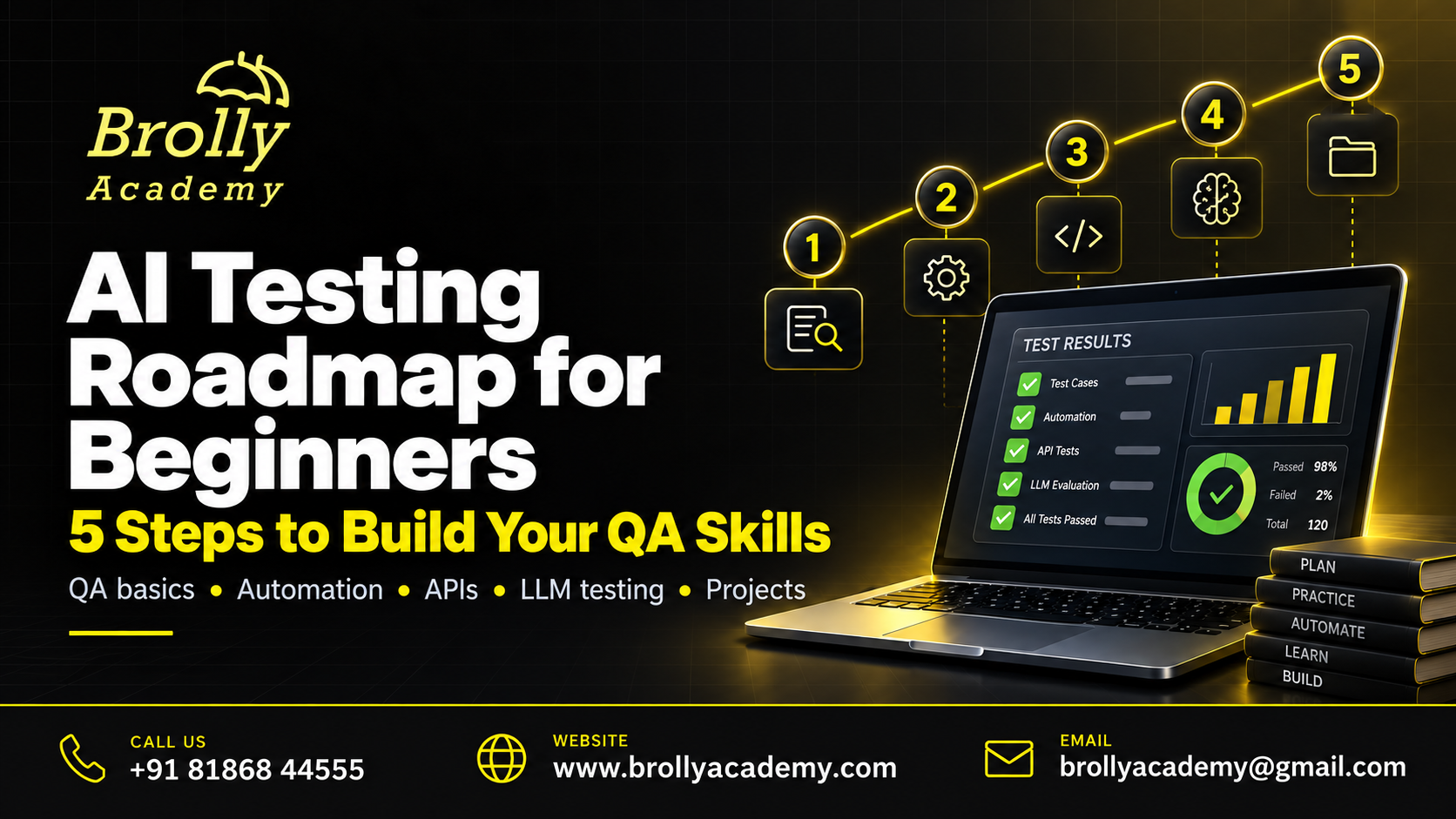
Table of Contents
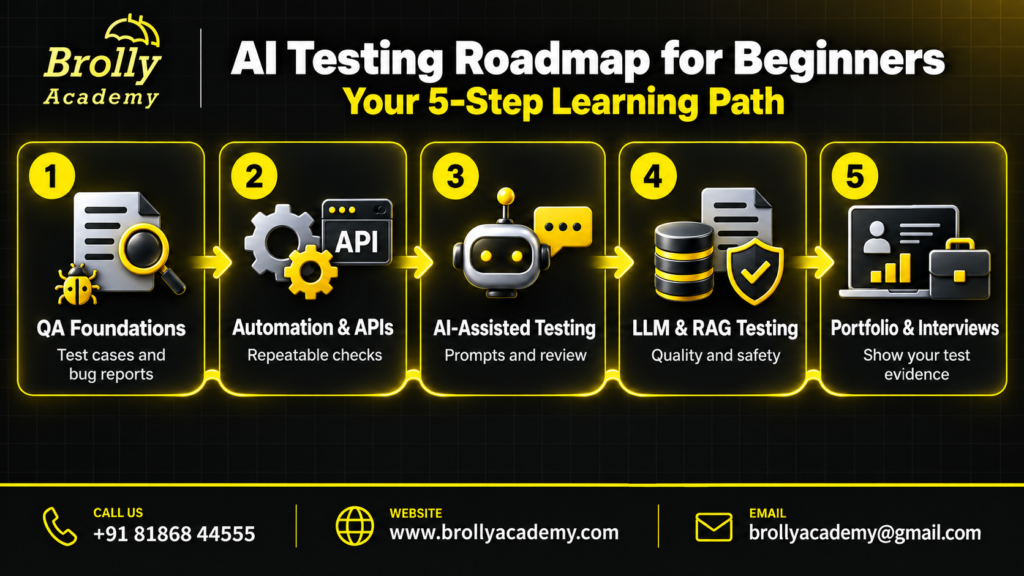
The 5-Step AI Testing Roadmap
| Stage | Learn | Evidence that you can move on |
|---|---|---|
| 1. QA foundations | Requirements, test design and defect reporting | A small test plan with useful negative cases |
| 2. APIs and data | HTTP, JSON, authentication and basic queries | An API test collection with clear assertions |
| 3. Automation | One language, one framework and version control | A repeatable suite with a readable failure report |
| 4. AI evaluation | LLMs, RAG, datasets and quality rubrics | A labelled evaluation set and reviewed results |
| 5. Portfolio and interviews | Integration, reporting and release decisions | A project another person can run and inspect |
Use the checkpoints as gates, not as a race. Someone with three years of automation experience may already meet the first three; a complete beginner may need several iterations. Repeating a weak area is productive when you can name the skill that is improving.
What AI Testing Means for a Beginner
AI testing checks whether an AI-enabled product behaves correctly and whether its outputs meet defined quality and safety expectations. That includes ordinary software behavior as well as problems such as unsupported answers, weak retrieval, inappropriate access and unstable results.
Using an AI assistant to draft test cases is a different activity. It may speed up preparation, but it does not prove that an AI product has been tested. Learn to explain both meanings, because job descriptions often use the same phrase for them.
A beginner does not need to train a large language model. Start by testing a small application and understanding its inputs, outputs, data sources and permissions. Later, deepen the areas required by your chosen role.
Choose Your Starting Point
If you are new to software, begin with requirements, test cases, basic browser behavior and clear defect reports. If you already work in manual QA, connect your existing test-design skills to APIs and automation rather than restarting from zero.
Automation testers should focus on how AI changes the expected result. They already know how to execute a check; the new challenge is defining acceptable meaning, useful evidence and justified thresholds. Data professionals may need the opposite emphasis: more application testing, user journeys and release discipline.
Choose one small product domain, such as a fictional help centre. Familiarity with the domain makes it easier to judge answers. Avoid practising with high-stakes medical, legal or financial decisions when you cannot review them competently.
Stage 1: Build QA Foundations
Read a requirement and turn it into observable behavior. For a login form, check valid access, invalid credentials, empty input, locked accounts and session expiry. Learn equivalence classes and boundary values so you can select useful cases without testing every possible string.
Write defects with steps, expected behavior, actual behavior, environment and impact. “It is not working” gives a developer little to investigate. “A signed-out user can open a private conversation link” identifies both a reproduction path and a meaningful risk.
Your checkpoint is a short test plan for an ordinary feature. Ask another person to execute it without your help. If they cannot tell what counts as a pass, improve the test before adding AI tools.
Stage 2: Understand APIs and Data
Learn requests, responses, headers, status codes and JSON. Test a small authorized API with valid input, missing fields, invalid types, expired authentication and unavailable resources. Check the response content as well as the status code.
Practise reading simple tables and queries so you can confirm whether an action changed the correct record. Use synthetic records. Do not practise by exporting customer databases or putting private information into a public AI assistant.
Finish this stage with a collection that demonstrates setup, an action, assertions and cleanup. Explain which checks belong at the API boundary and which require a browser. That explanation is more valuable than memorising every menu in a testing tool.
Stage 3: Automate a Small Reliable Suite
Choose a language that matches your target framework. TypeScript or JavaScript is a practical route for Playwright Test; Python is common in evaluation and data workflows. Learn variables, functions, collections, conditionals, exceptions and reading files before creating a large framework.
Automate a few stable journeys with controlled data. Use version control, meaningful test names and assertions that fail when the requirement is broken. Learn how to inspect a trace or report instead of adding longer waits to every failure.
The checkpoint is reproducibility: a second person should be able to follow your instructions and run the same suite. Our Playwright with AI Testing guide shows how fixed responses can separate interface defects from live-model variation.
Stage 4: Evaluate LLM and RAG Behavior
Learn the basic path from a user question to retrieved information, model response and displayed answer. In retrieval-augmented generation, or RAG, the application supplies relevant source material to the model. Retrieval quality and answer quality are related, but they are not the same measurement.
Build a small evaluation set with a question, reference evidence, required facts, unacceptable claims and expected fallback behavior. Include answerable questions, missing-information cases, conflicting sources and permission boundaries. Keep the dataset versioned so later results can be compared fairly.
Review answers against a rubric. For instance, ask whether the answer addresses the question, supports its claims and respects access rules. A model-generated score is useful evidence only after you check its agreement with competent human reviewers.
Stage 5: Build a Portfolio Project
Create a fictional support assistant with a small policy library. Add browser tests, API checks and an evaluation dataset. Include ordinary success cases and failures that matter: an inaccessible source, a wrong citation, a misleading number and a restricted document.
Your project should explain the system, the test boundaries, the source data, the results and the known limitations. Include at least one real defect found during your own work and show how you confirmed the fix. Do not manufacture a client story or pretend a classroom exercise was paid employment.
Prepare a short walkthrough that explains why you chose each check. Use the 170 AI Testing Interview Questions to practise, but connect answers to your actual project rather than memorising scripts.
Mistakes That Slow Beginners Down
Trying ten tools before completing one project creates the appearance of progress without much evidence. Learning only prompts leaves gaps in APIs, data and ordinary software behavior. Copying generated tests without running a deliberate failure makes it hard to know whether the assertions protect anything.
Another mistake is treating every numerical score as accuracy. A relevance score, retrieval metric, latency measurement and pass rate answer different questions. Always state the numerator, denominator and rule behind a reported result.
Avoid guaranteed-job claims and fixed salary promises when planning your learning. Skills, prior experience, role requirements and the hiring process all matter. A course certificate can document completion; it does not replace demonstrable work.
Use Milestones Instead of a Fixed Deadline
| Milestone | Ready when you can… | If you are stuck… |
|---|---|---|
| Test design | Explain valid, invalid and boundary cases | Rewrite vague requirements as observable behavior |
| API checks | Inspect request and response evidence | Practise one endpoint before a full workflow |
| Automation | Reproduce and debug a controlled failure | Reduce the test to the smallest failing action |
| Evaluation | Justify a score using source evidence | Improve the rubric and review disagreements |
| Portfolio | Explain limitations without overstating results | Add a clear README and a release summary |
Set a weekly study budget you can maintain and review progress against these outcomes. Time spent watching videos is not the same as time spent building and debugging. Keep short notes on what failed and what you changed; those notes become useful interview examples.
Free Official Learning References
Use the Playwright documentation when learning browser automation. For testing AI-based systems, consult the ISTQB CT-AI syllabus and certification information. Check current eligibility and exam arrangements directly with the official provider; this roadmap is not an accredited certification syllabus.
The OWASP LLM application risk list is a useful starting point for learning security vocabulary. Practise only in systems and environments you are authorized to test.
Do not read every reference from beginning to end before building something. Use a small question from your project to guide each reading session, then apply the idea and record what changed.
Choosing AI Testing Training in Hyderabad
Compare a course against your current skill gaps. Ask for the module list, the kind of projects reviewed, the tools used in the current batch and the support available when a test fails. Check whether both AI-assisted testing and testing AI systems are covered.
You can review Brolly Academy’s AI Testing Course Syllabus and discuss current arrangements through the AI Testing Training in Hyderabad page. Confirm fees, schedule, trainer information, software access and certification terms directly.
During a demo, ask the trainer to explain one failing test and one ambiguous AI answer. That reveals the teaching approach more clearly than a slide containing dozens of tool logos.
Frequently Asked Questions
Can a fresher learn AI testing?
Yes. Begin with QA fundamentals and a small application, then progress to APIs, automation and evaluation. Do not skip the ability to define a clear expected result.
Do I need advanced mathematics first?
Not for the first browser and API exercises. Basic statistics becomes useful when comparing evaluation results; specialist model-testing roles may require deeper mathematics.
Which language should I learn first?
Choose one that fits your immediate project. TypeScript is useful for Playwright Test, while Python is useful for many data and evaluation workflows. Learn one well before adding another.
Can a manual tester move into AI testing?
Yes. Test design, exploratory testing and defect communication transfer well. Add API, coding and AI-evaluation skills according to the roles you want.
How long will this roadmap take?
There is no single duration. Your starting knowledge and practice time affect progress. Use the stage checkpoints to decide when to move on.
Must I build an AI model from scratch?
No. Application-focused AI testing often uses an existing model. You still need to understand how prompts, retrieval, permissions and interfaces affect behavior.
Is prompt engineering enough for an AI QA job?
Usually it is only one part of the work. Requirements analysis, data handling, APIs, automation, evaluation and clear reporting may also be needed.
What is a good first project?
A fictional policy assistant is manageable: a small source library, clear questions, known evidence and a few permission rules make results easier to judge.
Do I need a paid model subscription?
Not for basic QA, browser automation or mocked API practice. Live model evaluation may involve provider charges, so set a budget before enabling it.
Which certificate guarantees a job?
No certificate guarantees employment. Check the official certification requirements, then support your learning with an honest portfolio and interview preparation.
How do I know my evaluation dataset is useful?
It covers important user tasks, failure categories and realistic edge cases, with clear evidence and labels. Review it for duplicates, ambiguity and missing high-risk situations.
When should I start applying for jobs?
Start when you can demonstrate the core skills in the role description and explain your project independently. Continue improving while applying; do not wait to know every tool.
Practice Tasks for Each Learning Stage
The tasks below turn the roadmap into evidence you can inspect. Complete them in a sandbox using fictional data. Keep the outputs small and understandable; a clear test case is more useful than a large collection of copied files.
Turn a Vague Requirement into a Test
Take “the assistant should be helpful” and rewrite it into specific checks. State which question it must answer, which source it may use and what it must do when evidence is absent. Ask a second person whether they could apply your pass rule consistently. If their interpretation differs, clarify the rule before generating more test cases.
Create Boundary Cases
Choose an input with a documented length limit. Test below the limit, at the limit and just above it, plus empty and whitespace-only input. Keep Unicode handling in mind rather than assuming characters and bytes are interchangeable. Your output is a short table showing input, expected behavior and actual behavior for each case.
Write a Reproducible Defect
Use a harmless practice bug and record the environment, preconditions, steps, expected result and actual result. Add evidence that helps investigation rather than a long screen recording with no explanation. Give severity a reason: a spelling mistake and unauthorized record access should not receive the same priority merely because both are easy to reproduce.
Read One JSON Response
Identify required fields, optional fields, arrays and nested objects in a sample response. Then create three altered fixtures: one missing a required field, one with the wrong type and one with an empty collection. Decide which should be rejected and which are valid. This exercise builds contract thinking without needing a large application.
Check an Authentication Boundary
Create two authorized synthetic accounts with different access. Describe what each may read and change. Test the service directly as well as through the interface. A hidden button is not proof of access control. Keep the exercise limited to your sandbox and save enough request information to show which account performed the action.
Learn One Useful Query
Use a tiny fictional table to select records, filter by a condition and count matching rows. Connect the query to a test: after one operation, did exactly the expected record change? Do not confuse knowing a query keyword with understanding the data. Explain the meaning of the result and why it supports your assertion.
Make a Test Fail on Purpose
Write a simple assertion, run it successfully, then change the expected value to something deliberately wrong. Confirm the failure message identifies the mismatch. Restore the correct expectation afterward. This habit helps detect empty assertions and tests that click around without protecting any requirement. Keep the deliberate failure out of the final passing baseline.
Replace a Fragile Selector
Find a test that depends on an element’s position or a long generated class name. Replace it with an appropriate role, label or stable test identifier. Explain why the new locator matches user intent or an agreed testing contract. Do not choose a broad selector that passes by clicking the wrong duplicate element.
Separate Test Data from Test Logic
Move fictional users, questions and source IDs into a small fixture file. Keep assertions in the test code. This makes the scenarios easier to review and update without hiding behavior in a large configuration system. Add a note explaining which values must remain stable for comparisons and which are generated per run.
Compare a Mock with a Live Response
Run one UI check with a fixed response and the equivalent integration case against your own service. List what each result proves. The mock can isolate rendering behavior; the live request can expose integration issues. Neither result alone establishes that all future model responses will be accurate or safe.
Create an Evidence-Based Answer Key
Write ten fictional policy questions and attach the relevant source passage to each answerable case. Include at least one question the documents cannot answer. A reference answer should explain the required facts, not force one preferred writing style. Label ambiguous questions for revision instead of quietly treating your first interpretation as certain.
Measure Unsupported Claims
Break a sample answer into factual claims and compare each with the allowed source. Count supported, unsupported and unclear claims using written rules. State the denominator when reporting a proportion. A fluent paragraph can contain one serious invented number, so also record impact rather than relying only on an average score.
Investigate Retrieval Separately
Give the assistant a relevant document and a distracting document. Check which source was retrieved before judging the generated answer. If the correct passage never reached the model, changing answer wording may not fix the root cause. Record document IDs and retrieval settings so another person can reproduce the experiment.
Review an Evaluator Disagreement
Ask two reviewers to score the same small answer set with your rubric. Discuss disagreements and refine unclear criteria. If using an automated judge, compare it with reviewed examples rather than accepting its score as truth. Keep a separate evaluation set for later checks so you do not tune everything to the same examples.
Test a Safe Uncertainty Response
Create a question with missing information, such as an unspecified policy date. Decide whether the system should ask a follow-up or state the limitation. Test that it does not invent the missing detail. This is a positive behavior to reward, not a failure simply because the assistant did not provide a confident direct answer.
Check a Multilingual Example
Choose a supported language you can review competently. Compare an English question with its natural equivalent, including local phrasing where relevant. Separate language quality from factual support. If you cannot verify the translation, label that limitation and seek a qualified reviewer instead of reporting an unsupported pass.
Record Latency and Cost Honestly
Measure the start and completion of a request and record the number of live calls. Keep latency separate from answer quality. A fast wrong answer is not a successful result. Explain whether your small sample is exploratory or representative, and avoid claiming production performance from a handful of laptop experiments.
Protect Portfolio Data
Replace real names, emails, documents and tokens with synthetic examples before publishing. Inspect screenshots, traces and logs as well as code. Removing a password from the latest file does not necessarily remove it from version history. When a real secret is exposed, follow the owner’s incident and rotation process rather than merely hiding the display.
Write a Readable Project README
Describe what the project tests, how to install it, what credentials are required and how to run the checks. Include a sample result and known limitations. A reviewer should not have to guess which test environment to use. State clearly that fictional data and classroom scenarios are not client work.
Practise a Five-Minute Walkthrough
Explain the user problem, one important risk, one test design choice, one defect and one limitation. Keep the explanation understandable to someone outside your tool stack. If you cannot explain why an assertion exists, revisit it. Strong project communication connects technical evidence with a user-facing consequence.
Map Skills to a Real Vacancy
Read a current employer job description and separate essential requirements from preferred skills. Match each essential skill to evidence you actually have, then choose one gap to work on. Do not add tools to your resume just because they appear in the vacancy. Use the exercise to focus learning, not to invent experience.
Complete a Final Readiness Review
Run the project from clean instructions, inspect its failure report and review your dataset labels. Confirm that no secrets or misleading claims are included. List remaining gaps and choose the next learning task. Readiness means you can explain and improve your work, not that you have memorised every interview answer or eliminated every possible software defect.