AI Testing Course Syllabus
8 Essential Modules, Practical Labs and Projects
Explore an AI Testing Course Syllabus covering QA foundations, Python, Playwright, LLM evaluation, RAG and agent safety. Follow eight practical modules with exercises, project ideas and free editable checklists.
A learning guide for freshers, manual testers and QA professionals. Ask our team for the confirmed batch syllabus and training details.

Share
Table of Contents
What should an AI testing course syllabus include?
An AI Testing Course Syllabus should cover software testing basics, Python and API testing, AI-assisted test design, browser automation, model evaluation, LLM and RAG testing, agent safety, and a practical project. A useful syllabus connects every topic to a task you can perform and evidence you can explain.
This guide groups those skills into eight practical modules. It is a learning and course-comparison guide, not a confirmed batch timetable or an official certification syllabus. Brolly Academy’s team can confirm the current teaching hours, trainer, fees, tool access and assessment arrangements before you join.
You do not need to begin by training a large model. Start by understanding a feature, deciding what a good result looks like, and checking whether the system meets that expectation. For example, a support assistant should quote the correct return policy, keep private records private, and admit when its sources do not contain an answer.
There are two related paths. AI-assisted testing uses AI to help write test ideas, data or automation. Testing AI systems checks the reliability of models, chatbots, retrieval systems and agents. Learning only the first does not prepare you for every task in the second. Our Gen AI Testing vs Automation Testing guide explains this distinction with examples.
AI testing syllabus at a glance
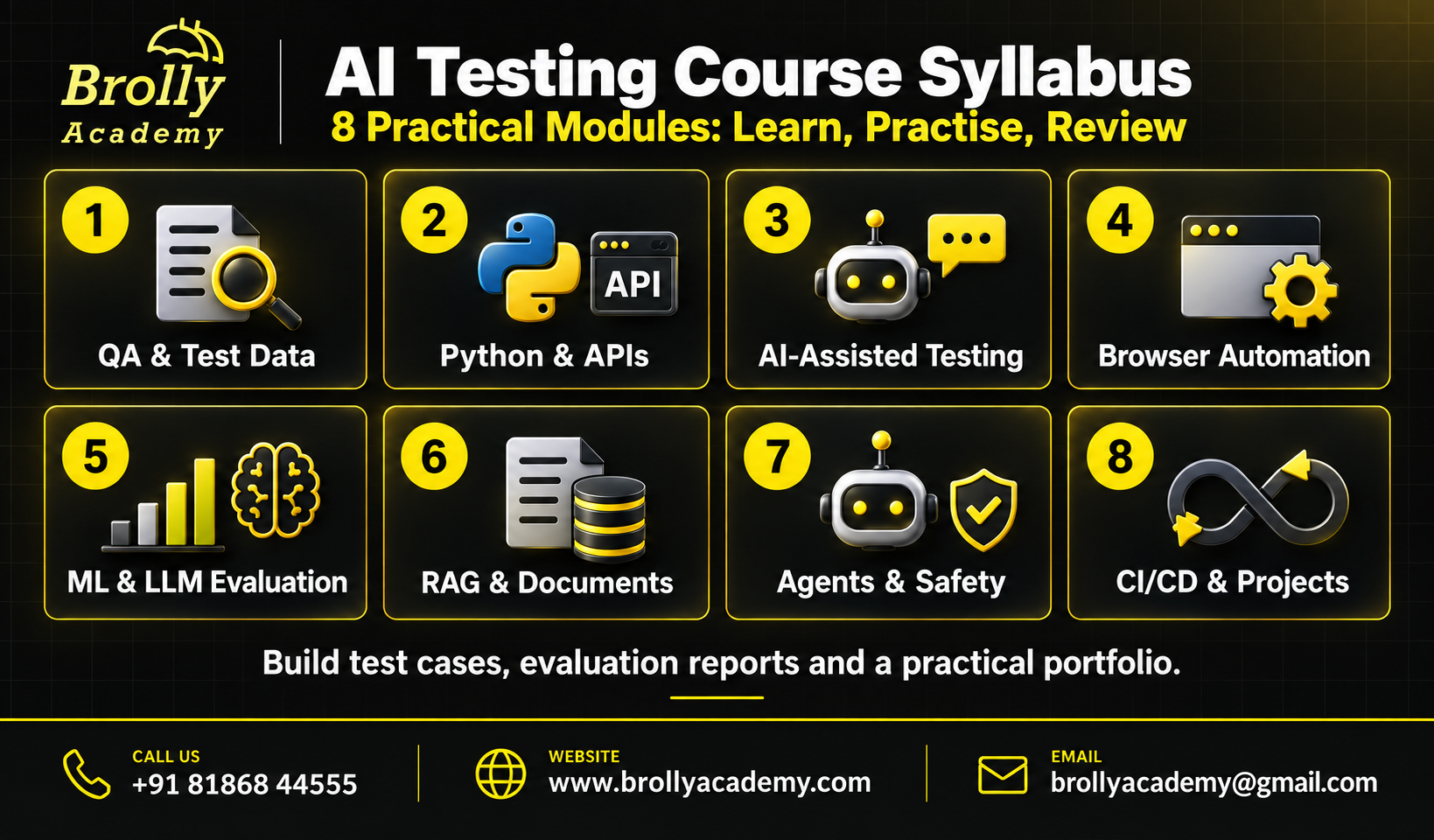
Use the output column to judge your progress. Knowing a tool name is not the same as being able to complete a testing task. Each module below produces a small piece of work that can become part of your final project.
| Module | Main skills | Practice output |
|---|---|---|
| 1. QA and data foundations | Requirements, risks, test cases, test data and defects | A risk-based test plan and reviewed dataset |
| 2. Python and API testing | JSON, functions, HTTP, authentication and assertions | A small API test suite with readable results |
| 3. AI-assisted test design | Prompting, requirement analysis and generated-test review | A human-reviewed test pack linked to requirements |
| 4. Browser automation | Playwright, locators, waiting, traces and accessibility checks | Stable tests for a chatbot user journey |
| 5. ML and LLM evaluation | Data splits, metrics, rubrics and answer-quality checks | An evaluation report with explained failures |
| 6. RAG and document testing | Retrieval, grounding, citations and access permissions | A source-backed knowledge-assistant test report |
| 7. Agents, safety and reliability | Tool use, approvals, privacy and failure recovery | A controlled agent test matrix and evidence log |
| 8. CI/CD and capstone | Regression, versioning, monitoring and project explanation | A repeatable project with a release recommendation |
The order matters. First learn how to define expected behaviour. Then automate checks that have a clear result. Introduce model-based evaluation only after you understand what the score means. Finally, join the checks into a repeatable workflow. This avoids collecting disconnected tools without knowing which problem each one solves.
Who can learn AI testing, and what should you know first?
Freshers can begin with software testing vocabulary, basic computer skills and simple written explanations. You should be able to describe a feature, follow a sequence of steps and compare an actual result with an expected result. A technical degree alone does not prove these skills, and not having one does not prevent you from learning them.
Manual testers already bring valuable experience in requirements, exploratory testing and defect reporting. Keep those strengths. Add Python, API testing and structured AI evaluation gradually. Do not replace careful investigation with a prompt that says, “Generate all test cases.”
Automation testers and SDETs can spend less time on basic scripting and more time on datasets, evaluation design, retrieval errors and model changes. Existing browser tests remain useful, but they cannot by themselves establish whether a generated answer is supported by evidence.
Developers and analysts may understand code or data well but still need to practise independent test design. A test should challenge an assumption, not simply repeat how the developer expects the feature to behave.
Before the coding modules, practise variables, lists, dictionaries, functions, conditions and reading a JSON file. Before the evaluation modules, understand percentages, averages and a simple confusion matrix. Advanced mathematics is not required to start this guide; deeper model-testing work may require additional statistics.
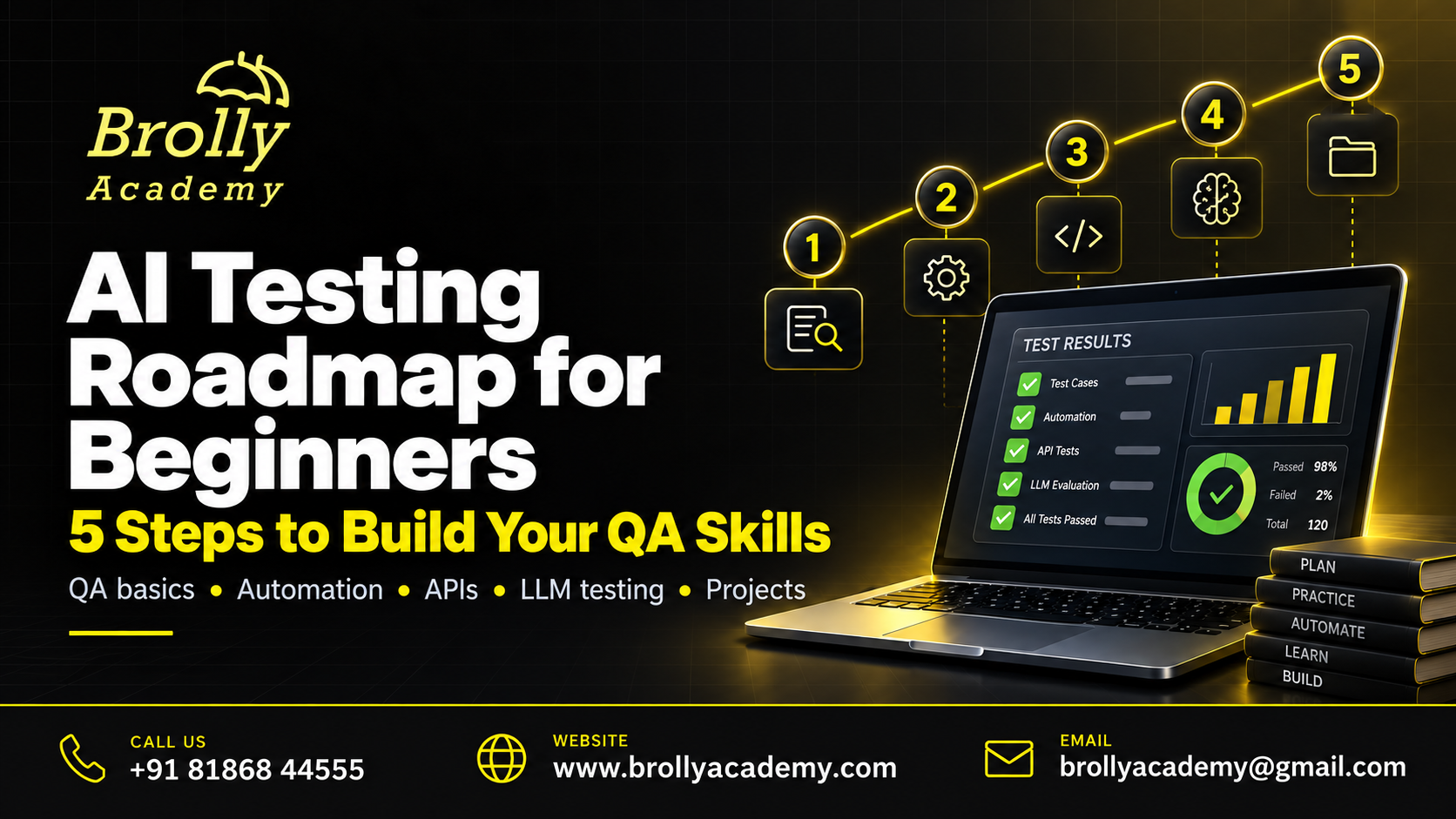
A laptop with a current browser, an editor and permission to install the chosen tools is a practical starting point. Check the actual tool requirements before buying hardware. Local models have different hardware needs from hosted APIs. API keys, trial credits and paid subscriptions are not automatically included in a training fee. Ask about them first. For a slower starting path, use the AI Testing Roadmap for Beginners.
Module 1: Software testing and test-data foundations
This module teaches you to turn a feature description into meaningful checks. Learn the software development life cycle, testing activities, acceptance criteria, test levels, functional testing, regression testing and exploratory testing. Understand severity as the impact of a defect and priority as how urgently the team decides to address it. Those decisions depend on context.
Practise equivalence partitioning, boundary values and decision tables. A return-policy assistant, for example, may handle a request differently depending on the purchase date, product condition and customer permissions. Listing these conditions is more useful than asking the same easy question in ten different ways.
Test data is part of the test, not an afterthought. Learn to identify missing fields, duplicate records, inconsistent labels, outdated documents and sensitive information. Use synthetic data or data you are authorised to use. A realistic-looking name in a spreadsheet does not make it safe to upload to an external AI service.
Build a small risk register. For each risk, record the affected user, the possible harm and the evidence needed to check it. A wrong product colour may be inconvenient; exposing another customer’s address is a different kind of failure. The register helps you decide what to test first when time is limited.
Practice lab: write a fictional shop policy and create cases for valid returns, late returns, missing receipts and questions the policy cannot answer. Add an expected result and a source reference to each case. Ask another learner to execute the cases without asking you what you meant.
Completion check: your test plan should make the scope, exclusions and important risks clear. Your defect report should contain reproducible steps, environment details, expected behaviour, actual behaviour and redacted evidence. “The AI is wrong” is not enough information for someone to investigate.
Module 2: Python, JSON and API testing
Python helps you run a collection of test inputs, inspect responses and produce a report. Begin with functions, loops, dictionaries, file handling, exceptions and virtual environments. Learn to keep configuration separate from code and to record dependency versions so another person can reproduce your setup.
An API is an interface through which software requests a result from another service. Study HTTP methods, headers, authentication, status codes, request bodies and JSON responses. Check response structure as well as meaning. A successful status code does not prove that an AI answer is correct, and a valid JSON object can still contain an invented fact.
Write assertions for required fields, supported values and error behaviour. Include missing input, invalid credentials, oversized input, timeouts and rate limits. Learn when retries are appropriate. Repeating a read-only request is different from repeating an action that creates an order or sends a message.
Keep API keys in an approved secret store or environment configuration, not in a public repository or screenshot. Limit permissions and use a test account. Redact logs before sharing them. Do not include real customer conversations in a portfolio to make it appear more realistic.
Practice lab: use a mock or authorised test API that returns a support response with a status, answer and reference identifier. Load inputs from a file, send each request, validate the response and write a result row. Start with fixed sample responses before using a paid model endpoint.
Completion check: someone else should be able to run your suite using the setup instructions. Failed assertions should explain what was expected and what arrived. Include a separate status for a service failure; do not count an unavailable endpoint as proof that the answer-quality requirement passed.
Use the official Python tutorial for language fundamentals and the pytest getting-started guide for basic test structure. You can learn one language well before adding another.
Module 3: AI-assisted test design and prompt review
In this module, AI is a helper for the tester. It can suggest questions about a requirement, draft test data, propose negative cases or explain a failing script. The tester remains responsible for checking whether the suggestion is relevant, permitted and correct.
A useful prompt includes the task, a clear requirement, relevant constraints and the desired output. For example, ask for test ideas for a fictional password-reset feature, specify the allowed reset-token lifetime, and request separate normal, boundary and misuse cases. Do not invent a requirement because the generated answer sounds confident.
Compare generated cases against a requirements checklist. Remove duplicates. Mark unsupported assumptions. Look for missing permissions, invalid inputs, recovery paths and accessibility needs. Ask whether the generated test can actually detect a failure, rather than merely execute a set of steps without assertions.
Learn the limits of AI-generated code. Review imports, package names, selectors and commands before execution. A generated script may use an obsolete API, reveal a key in a log or weaken an assertion to make a test pass. Self-healing suggestions also need review: changing a locator must not change the meaning of the test.
Practice lab: create your own cases for a small feature, then ask an approved AI assistant for additional ideas. Record which suggestions you accepted, changed or rejected and why. The comparison should show your judgement rather than simply reproduce the assistant’s response.
Completion check: every retained test should have a requirement or risk behind it. Keep a short review log and show one useful AI suggestion, one incorrect suggestion and one important case the assistant missed. This is stronger evidence than claiming that AI generated a large number of tests.
For additional practice in structuring instructions, explore Brolly Academy’s Prompt Engineering course. Prompting is one part of testing; it does not replace source verification, assertions or human review.
Module 4: Playwright and browser automation for AI features
Browser automation checks the experience a user sees. For a chatbot, this includes entering a question, submitting it once, showing progress, receiving a response and recovering when the service fails. The application can have a correct backend response and still present a broken or confusing interface.
Learn stable locators, test isolation, fixtures, setup data and assertions. Prefer locators based on accessible roles or explicit test identifiers where appropriate. Avoid fragile selectors tied to incidental layout. Understand that waiting for a UI condition is different from pausing for an arbitrary number of seconds.
For streaming responses, test the loading state, partial output, completion state and cancellation. A test that checks the first visible word may finish before the answer is complete. Also check double submission, lost connections, clear-chat behaviour and whether a failed request leaves controls permanently disabled.
Include keyboard operation and narrow-screen checks. A user should be able to reach the input, identify the send control and understand an error. Automated accessibility checks can catch some problems but do not replace keyboard testing and human review of the interaction.
Practice lab: automate one successful question, one invalid input and one controlled service error in a demo chat application. Capture a trace for a failing test and explain whether the failure came from the interface, the test or the service. Use mocked responses for predictable UI checks and a separate suite for real answer evaluation.
Completion check: the tests should run independently and fail for the intended reason when you introduce a known defect. A passing test that only checks whether text exists does not establish answer accuracy. Connect UI evidence to the API or evaluation result when the requirement crosses both layers.
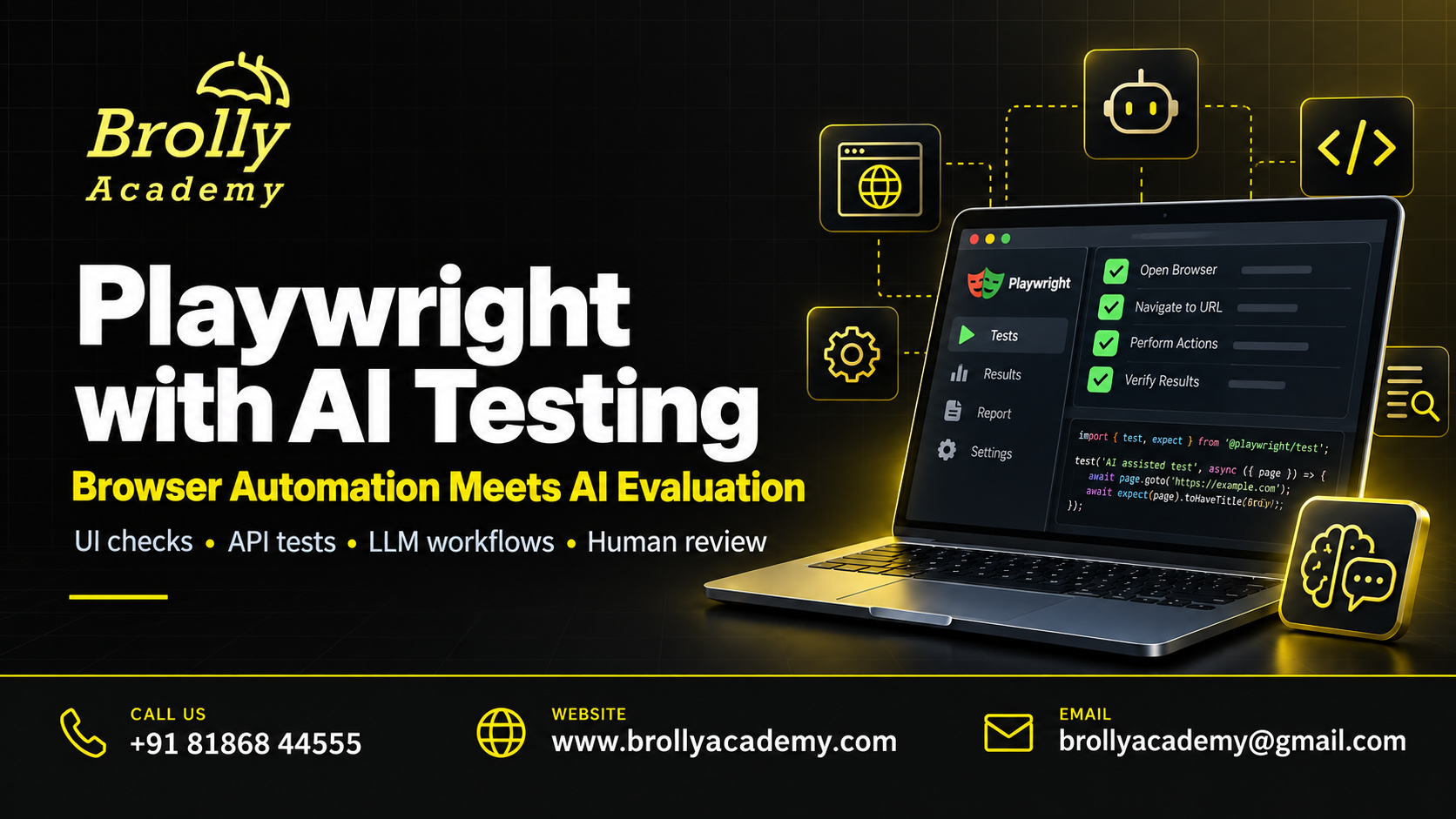
The official Playwright assertions documentation explains retrying web assertions. Our Playwright with AI Testing article connects browser checks with AI-quality checks.
Ready to build practical AI testing skills?
Brolly Academy offers AI Testing training. Ask about the current batch syllabus, hands-on labs and a free demo.
Module 5: Machine learning and LLM evaluation
Machine learning models and language models need different checks from ordinary form validation. Learn the difference between training, validation and test data, and why data leakage can make a result appear better than it really is. A test set should not quietly become the material used to tune every decision.
For a classifier, learn true positives, false positives, true negatives and false negatives. Study precision, recall and F1 alongside accuracy. The right metric depends on the failure you care about. A system that labels nearly everything as the majority class may show high accuracy while missing the rare cases that matter most.
For language-model output, separate factual correctness, relevance, completeness, groundedness and instruction following. An answer can be on topic but factually wrong. It can follow a source perfectly while the source itself is outdated. It can be correct but omit a condition the user needs to make a decision.
Build an evaluation rubric with concrete examples of acceptable and unacceptable output. Use exact assertions for fixed requirements such as a required field or forbidden disclosure. Use a reviewed rubric where several wordings are acceptable. Human reviewers may disagree, so record how disagreements are resolved.
LLM-as-a-judge means using a model to help score another response. It is a useful aid, not an unquestionable authority. Compare its decisions with a human-labelled sample, investigate disagreements and record the judge model and prompt version. A high average score should not hide a serious failure in a small but important group.
Practice lab: review a small set of fictional support answers containing a mixture of supported, incomplete and incorrect responses. Score each quality dimension separately. Repeat selected prompts to observe variability and report the number of runs. Do not turn one successful answer into a claim of guaranteed reliability.
Completion check: explain the metric, dataset, review rules and limitations behind each result. Use scikit-learn’s evaluation documentation for metric definitions. Read Hallucination in Generative AI for a beginner-friendly explanation of unsupported output.
Module 6: RAG, document and knowledge-assistant testing
Retrieval-augmented generation, or RAG, gives a language model relevant material before it answers. A typical flow takes a question, retrieves passages and uses those passages to produce a response. Testing needs to examine both the retrieved material and the final answer. Otherwise, you may blame the model for information the retriever never supplied.
Learn documents, chunks, embeddings, search results and source identifiers at a practical level. Check whether important content survives document extraction. Tables, headings, scanned pages and footnotes may be handled differently. A missing condition in an extracted policy can lead to a convincing but incomplete answer.
Test answerable questions, questions with no answer in the sources, conflicting documents, old versions and multi-document questions. A system should follow its defined rules for freshness and conflict handling. It should not silently combine incompatible policies just to produce a smooth response.
Inspect citations as evidence. A clickable link is not enough: the cited passage must support the associated claim. Also check that document permissions apply during retrieval. A response must not reveal a restricted document’s content, title or other protected metadata to an unauthorised user.
Practice lab: create three fictional policy documents, including one outdated version. Build a question set with source references and expected facts. For each failed answer, record whether the correct passage was retrieved, whether the passage was current, and whether the answer used it faithfully.
Completion check: separate retrieval failures from generation failures in your report. Include at least one missing-source case, one source-conflict case and one permission case. Use synthetic users and a controlled environment for access tests.
The official Ragas metrics catalogue includes retrieval and answer-quality measures. Their required inputs and interpretations differ. Choose a metric because it answers your evaluation question, not because its name appears in every course advertisement.
Module 7: AI agents, safety and failure recovery
An AI agent can use tools or take steps toward a goal. Testing therefore needs to examine actions and resulting state, not only the final message. An agent may say that it created a draft while actually sending a message, or report success after a tool failed.
Map the allowed tools, required permissions and approval boundaries. Check tool selection, argument validation, repeated calls, cancellation and recovery after a partial failure. A read-only request must not cause an unauthorised write. If a payment, email or record change requires approval, the test must verify that the action does not occur before approval.
Study prompt injection as a trust-boundary problem. Text in a retrieved document or tool result is data, not automatically an authorised instruction. Test whether untrusted content can redirect the workflow, expose protected information or trigger an unintended tool. Use an authorised sandbox and harmless fixtures; do not attack a third-party live service.
Privacy and fairness require defined expectations. Identify which data is sensitive and who may see it. For fairness checks, choose groups and scenarios relevant to the application with suitable expert review. A single generic score cannot certify that a system is fair, lawful or safe for every use.
Practice lab: test a fictional appointment assistant whose tool only creates draft requests. Try valid details, missing details, duplicate requests, an unavailable calendar and a document containing an instruction to bypass approval. Use mocked tools so the exercise cannot contact real people or change real bookings.
Completion check: the report should show requested actions, actual tool calls, approval state and final system state. Include how a failure is communicated to the user and whether repeating the request creates duplicate work.
Use the OWASP Top 10 for LLM Applications as a risk reference. It helps organise security questions, but a checklist alone is not proof that a system is secure.
Module 8: Regression, CI/CD, monitoring and a capstone
The final module brings the earlier work together. Continuous integration means running relevant checks as changes enter a project. For AI applications, changes may include code, model versions, prompts, source documents, retrieval settings and evaluation rules. Record these versions so you can explain why two runs differ.
Separate fast checks from expensive checks. A small smoke suite can catch basic failures early. A broader evaluation set can run before release or on an agreed schedule. Keep a protected evaluation set for meaningful comparisons instead of repeatedly adjusting the system to the same visible examples.
Define release decisions with the project team. Some failures may block release immediately, such as unauthorised disclosure or an action taken without required consent. Other dimensions may use agreed thresholds and review. There is no universal percentage that makes every AI product ready to launch.
Learn to measure latency, error rates and resource use. First-token time and full-response time answer different questions. Record whether results include retries and failed requests. Cost reporting should include relevant model and evaluator calls; an inexpensive generation can still lead to an expensive evaluation workflow.
Monitoring continues after release. Watch for changed input patterns, repeated user complaints and failures in important groups. Plan how to investigate, roll back or disable a risky feature. Alerts should lead to an owner and an action, not simply fill a dashboard.
Practice lab: assemble your dataset, API checks, browser checks and evaluation report into one project. Introduce a controlled regression, show which check catches it, then demonstrate the retest. Your final recommendation should state what is ready, what is blocked and what remains uncertain.
Completion check: provide a README, setup steps, safe sample data, version information, results and limitations. Prepare a short explanation of one difficult failure. Use the 170 AI Testing Interview Questions and Answers to practise explaining the decisions behind your project.
Discuss your learning path with Brolly Academy
Share your QA experience and coding level. Ask the team to confirm the modules, project feedback and batch options available.
Which tools belong in an AI testing syllabus?
Choose tools by the job they perform. You do not need five evaluation frameworks to learn one evaluation method. A small stack that you can explain and maintain is a better starting point than a long list of installations.
| Task | Example choice | What still needs human judgement |
|---|---|---|
| API checks and test orchestration | Python and pytest | Expected results, safe data and useful assertions |
| Browser journeys | Playwright | User experience and whether answers are meaningful |
| Prompt comparison | Promptfoo | Representative cases and appropriate assertions |
| LLM evaluation | DeepEval | Metric choice, judge calibration and failure review |
| RAG evaluation | Ragas | Source quality, reference data and permissions |
| Versioning and CI | Git and your team’s CI service | Release gates, approvals and operational ownership |
The Promptfoo documentation describes prompt and application evaluation workflows. The DeepEval quickstart provides a starting point for its evaluation framework. Follow the current documentation for the version you install; do not combine old tutorial code with new package behaviour without checking it.
Ask whether exercises use local sample responses, hosted APIs or a supplied lab. Open-source software can still call paid services. Check data-sharing settings, account requirements and spending limits before running a large evaluation. Save the configuration alongside the results so cost and behaviour are explainable.
Three portfolio projects that make the syllabus practical
Project 1: A source-backed support assistant
Create a small fictional policy collection and test an assistant against it. Cover supported questions, missing information, conflicting versions and misleading wording. Keep the sources under version control. Your deliverables are the test dataset, expected facts, source references, actual answers, failures and a short conclusion.
A strong demonstration traces one incorrect answer back to its cause. Was the policy missing? Was the wrong passage retrieved? Did the model ignore a condition? Explain the fix and retest the same case. Do not label a manually written report an automated test framework.
Project 2: An AI-assisted browser test pack
Choose a safe demo application with a few clear requirements. Ask an AI assistant to propose test cases and automation, then review the output before execution. Build stable Playwright tests for normal use, invalid input and a controlled failure. Include a trace and a clear bug report.
Your portfolio should show the review process: an incorrect selector you corrected, an assertion you strengthened and a generated case you rejected. Explain how you prevented a passing test from hiding a broken requirement. Credit tools honestly and distinguish your contribution from generated suggestions.
Project 3: An agent approval and recovery test
Use a mocked agent workflow that prepares a draft action. Test approval, rejection, cancellation, duplicate requests and tool failure. Keep every action inside a sandbox. The goal is to prove that the system respects its allowed actions and accurately reports what happened.
Include a workflow diagram, permissions table, test matrix and event log. A helpful conclusion might say that drafting works but cancellation after a tool timeout needs investigation. Honest limitations make a project more credible than an unsupported claim that every case passed.
All three projects can begin with small datasets. Expand them when you discover a new risk or failure pattern. A portfolio is not stronger simply because its spreadsheet contains many rows. It is stronger when the rows cover distinct risks and the results can be reproduced.
How should your practical work be assessed?
Assess the quality of the evidence, not only attendance or the number of scripts. Before starting a project, agree what the feature should do, what is out of scope and which failures matter most. This makes feedback specific and avoids moving the pass criteria after seeing the results.
| Area | Evidence to review | Warning sign |
|---|---|---|
| Coverage | Normal, boundary, missing-data and risk cases | Many rewordings of the same easy question |
| Expected behaviour | Requirements, sources or a clear review rubric | Only saying that output should be good |
| Reproducibility | Inputs, versions, configuration and run instructions | Screenshots without the conditions that produced them |
| Failure analysis | Cause investigation and a focused retest | Changing the test merely to make it pass |
| Communication | A clear conclusion with limits and next actions | Claiming certainty from a tiny sample |
For each criterion, use a simple practice scale: missing, partly demonstrated or clearly demonstrated. This is a learning aid, not an employer’s hiring standard. Ask a reviewer to explain the evidence behind their rating, and use that feedback to improve one specific part of the project.
Keep separate records for test failures and evaluation disagreements. A reviewer disagreeing with a model judge is not automatically a defect in the application. Investigate the rubric, reference answer and evidence before deciding which result is wrong.
A flexible eight-week study plan
The following is a suggested self-study sequence, not Brolly Academy’s confirmed course duration. Some learners need extra foundation time; experienced testers may move faster. Allocate time for practice and review, not just videos. Do not skip an unfinished lab simply because a calendar says to start the next topic.
- Week 1: study QA foundations and create a risk register with clear expected results.
- Week 2: practise Python and JSON, then run a small API test suite.
- Week 3: compare human-written and AI-generated test ideas and document your review.
- Week 4: automate a browser journey, a failure state and a keyboard interaction.
- Week 5: build a labelled evaluation set and explain why each metric is useful.
- Week 6: test a document assistant, including missing sources and incorrect citations.
- Week 7: test tool permissions, approval boundaries and controlled recovery cases.
- Week 8: assemble the capstone, run regression checks and present the findings.
At the end of a study session, record what you can now do without following a tutorial. If you cannot explain a failure, spend the next session investigating it. Passive familiarity can feel like progress, but an independent demonstration is a better checkpoint.
For working professionals, divide a module into reading, practice and review sessions. Freshers can add a foundation block before week one. Learners with automation experience can put more effort into evaluation datasets, retrieval debugging and release decisions instead of repeating basic syntax exercises.
Download the syllabus checklist and practice sheets
These free editable CSV resources support this learning guide. They open in spreadsheet tools and do not require a demo booking. They are practice resources, not an official batch syllabus, certification document or record of tests already completed.
Syllabus checklist: track the eight modules, their learning objectives and the evidence you have created. Add a review date and the next skill to practise.
Evaluation test-case sheet: record input, source, expected facts, actual output, status and evidence. The sample rows are fictional teaching examples. Replace them with authorised project data before use.
Course-comparison worksheet: record each provider’s confirmed answers about prerequisites, labs, costs, trainer, feedback and certification. Blank fields are questions to ask, not promises made by a provider.
Keep your completed sheets private if they contain personal or workplace information. Before sharing a portfolio, replace private data with synthetic examples and remove keys, internal URLs and confidential documents.
What should you confirm before joining a course?
Ask for the current batch syllabus, not only a list of popular tools. Find out which topics are demonstrated, which you practise yourself and which are optional introductions. Ask to see a sample exercise and understand how your work receives feedback.
Confirm instructor-led hours separately from suggested self-study time. Ask whether recordings, lab access, API credits, assessment, exam fees and support are included. Get fee and refund details directly from the provider before payment. This article does not quote an unverified price or promise a particular timetable.
A course-completion certificate and an independent professional certification are different. The official ISTQB AI Testing certification page is the place to check its current syllabus and eligibility. This eight-module guide does not claim to be an accredited ISTQB course or a complete exam-preparation programme.
For Hyderabad learners, confirm whether the selected batch is classroom, online or hybrid and whether the practical exercises are the same across those formats. Ask how missed sessions and project reviews are handled. Do not assume that a local address means every topic is taught in person.
Brolly Academy offers AI Testing Training in Hyderabad. Use the demo to discuss your starting level and compare the current batch content with this guide. Ask for confirmed details before making an enrolment decision.
For career planning, focus first on demonstrable QA, automation and evaluation skills. Job titles and pay vary by employer and experience. The AI Testing Jobs and Salary in Hyderabad article is a related starting point; verify any salary figure against its date and underlying evidence rather than treating it as an offer.
Frequently asked questions
1. What is the difference between an AI testing syllabus and a normal automation syllabus?
A normal automation syllabus focuses on repeatable software checks. An AI testing syllabus adds data quality, variable model output, evaluation rubrics, grounding, retrieval and safety. Browser and API automation remain useful, but they are only part of the work.
2. Can a fresher start without coding experience?
Yes, a fresher can start with requirements, manual cases and source-based answer review. Coding becomes important for repeatable API checks and evaluation runs. Learn the needed Python foundations before moving into the automation modules.
3. Should I learn Python or JavaScript first?
Choose the language used by your main learning path. Python fits many data and evaluation exercises. JavaScript or TypeScript fits the commonly used Playwright Test stack. Learn one well enough to debug it before adding the other.
4. Do I need to build a large language model?
No. You can learn application testing using a supplied model endpoint, a mock service or saved example responses. Understanding data, inputs, outputs and failure modes matters more at the start than training a large model.
5. Are Playwright and Selenium enough for AI testing?
They can cover important browser interactions. They do not, by themselves, establish factual correctness, retrieval quality or safe tool use. Add API checks and an evaluation method that matches the AI feature’s requirements.
6. What should a beginner learn about RAG?
Understand the question-to-retrieval-to-answer flow. Practise checking whether the right source was retrieved and whether the response is supported by it. Add missing-source, outdated-source and permission cases before exploring more complex retrieval methods.
7. Which evaluation framework is best?
There is no single best choice for every project. Compare the required inputs, supported checks, reporting, cost and maintenance effort. Start with a small, reviewed dataset and one framework that you can explain.
8. Can I practise without paying for an AI API?
Many foundations can be practised using mock responses, local fixtures and manual evaluation. Live model calls may require a paid account or limited trial access. Check current terms and set a budget before running them.
9. How long does it take to learn the syllabus?
Your starting skills and practice time determine the pace. The eight-week sequence above is a planning example, not a guaranteed completion time. Ask Brolly Academy for the current batch schedule and any foundation sessions you need.
10. Does this article provide an official syllabus PDF?
No. It provides a learning guide and editable practice downloads. Request the current official batch syllabus from the academy. Do not treat the practice checklist as a contractual statement of course delivery.
11. Will a course-completion certificate make me ISTQB certified?
No. These are separate credentials. Check the official certification body’s eligibility, examination and provider details. A training certificate should describe the training actually completed without implying an independent qualification you have not earned.
12. What should I show in an interview?
Show a test plan, a small dataset, working checks, a failure investigation and a retest. Explain your decisions and limitations. Use synthetic data and be clear about which parts you built, reviewed or generated with assistance.
Turn the syllabus into a practical learning plan
Choose the first module you cannot yet demonstrate and complete its practice output. Then work forward. Keep the eight-module checklist beside your project so every topic leads to something observable: a better test, clearer evidence or a more reliable decision.
For guided training, ask Brolly Academy about the current AI Testing batch and request a free demo. Share your testing experience, coding level and learning goal. That helps the team discuss a suitable starting point without assuming that every learner needs the same path.
Book a free AI Testing demo
Talk to the academy about course content, prerequisites and current availability before you enrol.