
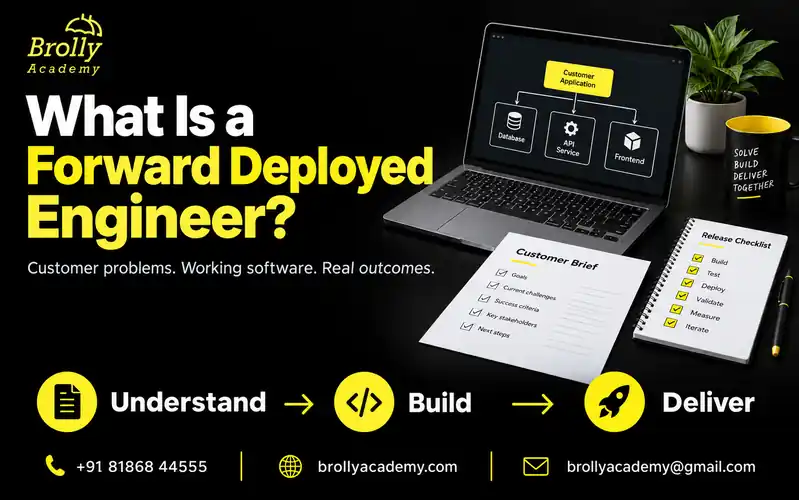
- FDE full form
- Forward Deployed Engineer
- Main responsibility
- Turn a customer problem into usable software
- Core combination
- Coding, discovery, integration and delivery
- AI required?
- For AI-focused roles, not every FDE role
Start with responsibilities, compare nearby roles, or use the starter exercise.
Understand the role, compare it with nearby careers, recognise useful technical skills and leave with a practical customer-project exercise you can explain.
What does forward deployed engineering mean?
In this context, forward deployed means bringing engineering work closer to the people using a product. Instead of receiving a fully defined feature request, an FDE may help discover what should be built, identify the constraints and then implement the solution. Some employers use the abbreviation FDE; others use titles such as deployment engineer, customer engineer or forward deployed AI engineer. Those titles are not automatically equivalent.
You may also see people search for forward deployment engineering. For career research, begin with the employer’s actual title, usually Forward Deployed Engineer, and read the responsibilities. A role involving deployment pipelines alone is different from one involving customer discovery, application development and adoption.
FDE work can include AI, but it does not have to. Data integration, operational applications and workflow improvements can be equally important. The test is whether you can connect a real need to software that people can safely use.
The term is not a new name invented for generative AI. Palantir described its forward deployed software engineers in 2019, distinguishing customer implementations from platform development. Current AI-focused employers use the model for a different technical setting. The underlying idea is still to work close enough to the user to discover what the software must actually accomplish.
Why do companies use forward deployed engineers?
A product can have strong capabilities and still be difficult to adopt inside a customer’s existing workflow. Identifiers may not match, the required data may be inaccessible, and the person requesting a feature may not be the person who uses it. An FDE investigates that gap and helps turn the capability into a working implementation.
- Discover the real constraint: an apparently weak answer may be caused by missing source data, not a weak model.
- Connect systems: an otherwise useful application may fail without identity, account mapping and error handling.
- Make adoption possible: users need clear decisions, permission boundaries and a route for correcting mistakes.
- Improve the product: repeated customer failures can reveal a platform capability worth building once.
For AI applications, a persuasive demonstration is only a starting point. The customer also needs confidence about task quality, operating cost and what happens when the model is wrong. Adding more autonomy without those controls can make an integration harder to operate.
What does an FDE actually do?
| Stage | Work the engineer does | Evidence produced |
|---|---|---|
| Discover | Observe the current process, interview users and locate the costly failure. | A problem statement, baseline and stakeholder map. |
| Scope | Decide the first useful release and what is deliberately excluded. | Acceptance criteria, risks and a short implementation plan. |
| Build | Integrate APIs, data, application logic and, where justified, a model. | A working vertical slice with tests. |
| Evaluate | Check normal cases, failures, permissions, quality and operational cost. | A reproducible test report, not just a successful demonstration. |
| Deploy | Release to a controlled environment, monitor behaviour and plan rollback. | A release record, monitoring and a recovery procedure. |
| Enable | Help users adopt the workflow and transfer operating knowledge. | Training notes, a runbook and an identified owner. |
These stages overlap. A failed data integration can change the scope. A user trying the first release may reveal that the original success measure was wrong. Strong FDE work makes those changes explicit rather than hiding them behind a polished demo.
A second part of the job is deciding what should become reusable. A useful field fix might remain a customer-specific adapter, become a documented implementation pattern, or be proposed to the product team. That decision needs review: copying one customer’s private data or configuration into a shared product is not reuse.
- 01 / UnderstandObserve a workflow and agree on the problem.
- 02 / ScopeChoose one outcome and set boundaries.
- 03 / ImplementConnect software, data and permissions.
- 04 / ProveTest quality, errors and unacceptable actions.
- 05 / ReleaseDeploy with monitoring and a recovery plan.
- 06 / ImproveSupport adoption and return product feedback.
What does a day in the life of an FDE look like?
There is no fixed percentage of coding versus meetings. Discovery-heavy work, a difficult integration and a production incident create very different days. The schedule below is an illustrative project day, not a reported employee timetable.
| Work block | Example activity | Useful output |
|---|---|---|
| Customer context | Watch a reviewer handle a ticket that was routed incorrectly. | A corrected requirement and a reproducible example. |
| Focused implementation | Fix the account mapping and add an integration test. | A reviewed change tied to the failure. |
| Technical coordination | Resolve a permission or API-contract issue with the customer’s engineering team. | A documented decision with an owner. |
| Evaluation and demo | Replay agreed cases and show a controlled failure, not only the happy path. | A test report and a go/no-go decision. |
| Handover and feedback | Update the runbook and identify a reusable product improvement. | A supportable release and actionable feedback. |
Protect uninterrupted implementation time while keeping decisions visible to the customer. A meeting is valuable when it resolves a requirement, risk or ownership question. Likewise, writing more code is not progress if the team is solving the wrong problem.
A worked example: a customer support triage workflow
Illustrative training scenario: a support team copies incoming requests into a spreadsheet, looks up the customer account and assigns a queue. Important messages sometimes wait because the subject line is misleading. The customer asks for an AI agent that handles every ticket.
1. Clarify the problem before choosing AI
Ask which tickets are delayed, who makes the final assignment, what data is available and how incorrect routing is corrected. Inspect a permitted sample. Separate the measurable problem, slow or incorrect routing, from the suggested solution, an autonomous agent. Do not upload real customer tickets to a model without approval.
2. Build the smallest useful workflow
Start with an intake API, validation and a routing rule for known categories. Show a reviewer the proposed queue and the reason. A model can help classify ambiguous text, but a low-confidence or unsupported case should remain reviewable. Keep account permissions outside the model prompt.
3. Test the uncomfortable cases
Include missing account IDs, duplicate submissions, hostile text, an unavailable CRM and a request containing confidential information. A correct demonstration on one ticket proves very little. A useful test set records the expected route, whether a reviewer is required and what the application must never do.
4. Release and learn
Pilot the workflow with a small permitted group. Measure routing accuracy on reviewed cases, time to a decision and the proportion sent for manual review. Compare with the same baseline process. These are proposed measurements, not Brolly Academy customer results or guaranteed improvements.
The portfolio story is now concrete: you identified a problem, made a scope decision, implemented a workflow and gathered evidence about its limitations. Saying only that you built an AI ticket agent would omit most of the engineering.
A tested example: input, decision and output
Here is the first working piece of the triage scenario: a small Python function that proposes a review queue. We ran the existing project-guide function locally on 9 October 2026 using Python 3.12.14, with eight synthetic test cases. No customer account, model API or external service was used.
Business rule: send a verified billing request to billing review, a verified technical request to support review, and an unknown category or unverified account to manual review. Missing required fields are rejected. Every proposed route still needs human approval.
Sample input
{
  "id": "T1",
  "category": "billing",
  "account_verified": true
}
In this local exercise, account_verified is a test fixture. In a real application, trusted server-side identity and account checks must supply it; a visitor must not be able to grant themselves access by submitting true.
Actual output from the local run
{
  "id": "T1",
  "queue": "billing-review",
  "requires_approval": true
}
The function returns a proposal, not a completed ticket assignment. It does not contact a customer, update a CRM or prove that an account is authorized. The next application component would display the proposal to an authorized reviewer.
Eight observed test results
| Case | Synthetic input | Observed result | Check |
|---|---|---|---|
| Known billing request | {"id":"T1","category":"billing","account_verified":true} | billing-review; approval required | Pass |
| Known technical request | {"id":"T2","category":"technical","account_verified":true} | support-review; approval required | Pass |
| Unknown category | {"id":"T3","category":"refund-status","account_verified":true} | manual-review; approval required | Pass |
| Account not verified | {"id":"T4","category":"billing","account_verified":false} | manual-review; approval required | Pass |
| Extra spaces and capitals | {"id":" T5 ","category":" Billing ","account_verified":true} | billing-review; approval required | Pass |
| Missing ticket ID | {"category":"billing","account_verified":true} | Rejected: id is required | Pass |
| Missing category | {"id":"T7","account_verified":true} | Rejected: category is required | Pass |
| Text instead of a boolean | {"id":"T8","category":"billing","account_verified":"yes"} | Rejected: account_verified must be a boolean | Pass |
Result: 8 of 8 specified checks passed. This is a functional test result, not a routing-accuracy benchmark or evidence of production performance. Notice how the unknown category remains reviewable, while an invalid field type is rejected before a route is proposed.
Reproduce and extend the example
- Open Project 1’s complete Python routing function and baseline checks. Run that example with Python 3; it needs no package installation or API key.
- Call
route_ticketwith the sample inputs above. For example,route_ticket({"id": "T1", "category": "billing", "account_verified": True})returns the billing-review proposal. - For a rejected input, catch
ValueErrorand compare its message with the table. Add one new test case before changing a rule. - Document the next production gap: authentication, duplicate-request handling, persistence, approval enforcement and monitoring are not implemented by this local function.
The FDE lesson: the valuable decision is not which model to call. It is agreeing on a useful first release, turning the agreement into observable rules, and showing exactly what works and what still needs engineering. Expand the brief with the customer-discovery guide and use the deployment and handover checklist before planning a real release.
How is FDE success measured?
Define success before the build. Agree with the customer on the intended outcome, unacceptable failures and the population being measured. Track both benefit and risk; a faster workflow that silently leaks information is not an improvement.
| Dimension | Measure in the triage example | Important limitation |
|---|---|---|
| Task quality | Correct proposed routes / reviewed eligible tickets | State the sample, labels and exclusions. |
| Human review | Tickets deliberately sent to a reviewer / eligible tickets | A high review rate may be the correct early safety choice. |
| Workflow speed | Time from valid intake to a confirmed assignment | Include waiting and review time, not only model latency. |
| Reliability | Failed integrations, recovery time and duplicate actions | Include the cases where an upstream service is unavailable. |
| Adoption | Eligible users who complete the workflow repeatedly | Logins and a single demo do not prove sustained use. |
| Operating cost | Total measured service usage / completed eligible tasks | Include retries and failed attempts; define what costs are excluded. |
Suppose a labelled test set contains 40 synthetic tickets. The workflow proposes 30 routes, 27 of which are correct, and sends 10 tickets directly for review. Route precision among proposed routes is 27 / 30 = 90%; review rate is 10 / 40 = 25%. Those figures do not mean 90% of every incoming ticket can be handled automatically.
If the rule-only baseline proposes 20 routes with 19 correct, it has higher proposed-route precision (95%) but lower coverage (50%, versus 75%). Which version is preferable depends on the cost of an incorrect route and the team’s review capacity. Use the same cases and constraints for the comparison.
Record the version, test date, denominator and reviewer rules. Small synthetic tests are learning evidence, not proof of production performance. An FDE must be able to explain what the evidence does not establish.
How is an FDE different from nearby roles?
| Role | Typical centre of responsibility | Question to ask in a job interview |
|---|---|---|
| Forward deployed engineer | A customer’s problem through implementation and adoption. | Who owns the production release and the solution after handover? |
| Product software engineer | Capabilities used across a product or platform. | How much direct customer discovery is part of the role? |
| Solutions engineer | Technical evaluation, architecture or pre-sales enablement; scope varies. | Does this team ship maintained production code or primarily demonstrations? |
| AI engineer | AI application or model-system behaviour. | Does the role include customer discovery and commercial delivery? |
| DevOps or platform engineer | Delivery systems, infrastructure and operational reliability. | Is the work platform-wide or tied to individual customer implementations? |
These are useful distinctions, not rigid job boundaries. A small team may combine several responsibilities. Palantir’s historical explanation of its Dev and Delta roles is a helpful example of platform-focused versus customer-problem-focused engineering, but it should not be treated as a universal definition for every company.
Is an FDE a consultant or a support engineer?
Consulting can include serious hands-on engineering, so the title alone is not a useful dividing line. Ask what the person owns: a recommendation, a demonstration, a maintained implementation, or an operating outcome. Support engineers may also debug difficult integrations; the difference to investigate is whether the role additionally owns discovery, solution design and delivery. Do not rank these careers as inherently higher or lower.
Which skills matter first?
Software fundamentals
Be able to write readable functions, handle errors, work with structured data and debug a failing request. Python is useful in many AI-oriented projects, but knowing one language well matters more than listing several without working examples. Practise HTTP, JSON, SQL, Git and automated tests.
Integration and data reasoning
Understand how two systems disagree: identifiers differ, fields are missing, permissions change and APIs return partial failures. Learn to validate inputs, map schemas and make retries safe. A model cannot repair an incorrectly defined source of truth.
Customer communication
Ask questions that change a decision. Summarise the need in language the user can correct. Explain why a feature is excluded, what evidence supports a release and what remains uncertain. Communication is part of engineering quality, not a replacement for coding.
AI application judgement
For AI-oriented roles, learn retrieval, model integration, evaluation and controlled tool use. Also learn when a deterministic rule or search interface is sufficient. An agent introduces additional failure modes and operational responsibility; it is not automatically the strongest solution.
Delivery discipline
Package a reproducible setup, document configuration, separate secrets from code, monitor failures and identify a maintainer. The application is not finished merely because it works on your laptop.
Which tools and technologies does an FDE use?
Choose tools from the problem and the employer’s stack. The following are examples for a learning project, not a mandatory certification list or a claim that every FDE uses the same products.
| Capability | Example tools | What you should demonstrate |
|---|---|---|
| Application programming | Python or TypeScript; FastAPI or Node.js | Build and debug a validated API, including error paths. |
| Data and integration | SQL, PostgreSQL, HTTP APIs, JSON | Explain identifiers, data ownership and partial failures. |
| Collaboration | Git, pull requests, issue tracking | Review a change and connect it to a requirement. |
| AI, where justified | A model API, retrieval and a suitable orchestration library | Compare output with a simpler baseline using agreed cases. |
| Delivery | Containers, CI checks and the selected cloud platform | Reproduce a release and restore a previous version. |
| Operations | Structured logs, traces and service metrics | Diagnose a failure without exposing sensitive content. |
For the support-triage example, begin with Python, a small API, a database and tests. Add a model only if ambiguous language is a demonstrated problem. A vector database, agent framework or Kubernetes cluster should answer a specific requirement, not make a portfolio look more advanced. Anthropic’s engineering guidance on effective agents also recommends starting with an appropriately simple approach.
Is this a realistic role for a fresher?
A fresher can prepare for FDE-style work, but that does not mean every FDE vacancy is entry level. The OpenAI Seattle role reviewed for this guide asks for substantial prior experience. Other employers may structure associate, graduate or customer engineering opportunities differently. Read each posting rather than assuming that a course overrides its requirements.
For an early-career candidate, a sensible first goal is evidence of software delivery: a small deployed application, a clear README, meaningful tests and a written explanation of customer trade-offs. Apply to suitable software engineering, implementation or customer engineering openings as well as explicitly junior FDE roles.
- If you cannot yet build an API: begin with programming, HTTP, validation and database practice.
- If you can build but have no customer experience: practise discovery interviews and write a scoped project brief.
- If you have consulting experience but little code ownership: demonstrate an implementation you can debug and maintain.
- If you already deploy applications: strengthen evaluation, stakeholder communication and handover evidence.
A degree, certificate or framework badge alone does not demonstrate all of these abilities. Equally, do not assume that every employer has the same degree policy.
Who is suited to FDE work, and what are the trade-offs?
The role can suit a developer who enjoys understanding how people work, making decisions with incomplete information and owning an implementation beyond the first demo. It can also suit an implementation engineer who wants deeper coding ownership. Interest alone does not replace the technical requirements of a vacancy.
| You may enjoy | The corresponding challenge | What to ask an employer |
|---|---|---|
| Direct customer feedback | Requirements can change after users try the solution. | How are scope changes agreed and prioritised? |
| Varied technical work | Frequent context changes can interrupt deep coding. | How many deployments does one engineer handle? |
| Visible ownership | A release may involve production support and escalation. | Who provides on-call coverage and approves go-live? |
| Learning different domains | Some roles involve travel or customer-site work. | What are the actual location and travel expectations? |
A product engineering role may fit better if you primarily want long-term depth in one platform component. Neither path is automatically superior. Compare the work you want to do, your current capabilities and the actual team’s operating model.
What a credible first portfolio project contains
Use synthetic or explicitly permitted data. Build one complete workflow rather than five disconnected demos. For the triage example, include the following evidence:
- A one-page brief describing the user, current process, problem and non-goals.
- A simple architecture diagram identifying the application, data source, model if used and permission boundary.
- A reproducible setup with sample configuration and no secrets.
- A test set including successful, invalid, duplicate and unavailable-service cases.
- A short demonstration showing both a successful task and a controlled failure.
- A release checklist, rollback note and runbook explaining how to diagnose a failure.
- A retrospective explaining what you would change with real customer access.
Label the project as a learning project. Do not describe a simulated customer as a paid client or invent adoption and cost-saving numbers. An interviewer can learn more from an honest limitation than from an unverifiable claim of a production transformation.
Turn these artifacts into a clear application using the FDE resume and portfolio guide. It explains how to connect a requirement to your own contribution, evidence and limitations.
Where can you find FDE roles, and what about salary?
Use employer pages to understand the work before interpreting job-board labels. These examples were reviewed on 9 October 2026; they are evidence of role descriptions, not Brolly Academy placement partners or a promise that an opening remains available.
- OpenAI, Seattle: the official FDE description asks for 5+ years of relevant experience, production application work and customer-facing delivery. It lists a hybrid arrangement and travel up to 50%. This is a specific US role, not an Indian fresher requirement.
- Supervity, Mumbai: its Forward Deployed AI Engineer description combines sales engineering, customer architecture and hands-on code. The listed location is on-site Mumbai. This illustrates why candidates should read the responsibilities beyond the title.
- Palantir: its 2019 Dev versus Delta article provides historical context for platform engineering and customer-focused implementations; it is not a current vacancy notice.
For a practical search process, use the FDE jobs guide to compare company requirements, location, experience and delivery responsibilities.
India salary snapshot: reported compensation, not a fresher promise
Levels.fyi’s India FDE compensation page, checked on 9 October 2026, shows these annual total-compensation figures. The source’s displayed update date is 7 October 2026.
| Reported measure | Annual total compensation | How to read it |
|---|---|---|
| Median | Approximately INR 17.70 lakh | The middle reported value, not a guaranteed offer or an arithmetic average. |
| 25th percentile | INR 16.20 lakh | A distribution point, not an entry-level or fresher salary band. |
| 75th percentile | INR 42.20 lakh | A distribution point, not a defined senior-engineer salary band. |
The visible source did not establish a sample count or a fresher-versus-experienced split. Total compensation can include base pay, stock and bonus; it is not monthly take-home pay. Read the FDE salary in India guide for the evidence limits and a worked offer comparison.
How to read an FDE vacancy without being misled
Highlight verbs before tools. Words such as discover, build, integrate, deploy, evaluate, support and influence tell you how ownership is distributed. Then map each requirement to evidence you can show.
Check location, travel, working hours, experience, security obligations and customer access. Ask whether the role is primarily pre-sales, post-sales delivery or long-term production ownership. Those differences affect daily work even if two advertisements use the same title.
A useful application note has three columns: requirement, evidence and gap. For example, API integration can map to your authenticated ticket workflow; customer discovery can map to a documented interview exercise; enterprise identity experience may remain a gap. Keep the gap visible and prepare a learning plan rather than renaming a tutorial as enterprise experience.
Practise explaining those decisions with the 30 FDE interview questions and practical answers. Use your actual project as the example instead of memorising a polished answer you cannot demonstrate.
Try a first FDE exercise
Start with the tested input/output example above, then change one requirement and record the effect.
Use this small exercise to test whether you enjoy the work. It is independent practice, not a hiring assessment or a promise of professional readiness.
- Write a brief: choose a synthetic support team, describe its routing problem and name the person who approves assignments.
- Make ten permitted examples: include clear categories, an unknown category, a missing account and a duplicate request. Do not use private employer tickets.
- Build a rule-only baseline: validate inputs and propose a queue. Keep uncertain requests in a review path.
- Show the evidence: record expected and actual outcomes. Demonstrate one successful case and one blocked or failed case.
- Explain the decision: write a short note on whether AI is needed, what you excluded and what would need to change before real deployment.
Readiness check: can another person run the example, understand the customer problem and see the limitations without you explaining every step? If not, improve the brief, tests or setup before adding a more complex framework.
For structured guidance, bring your brief to the FDE course free-demo discussion. Ask which foundation skills and project-review support fit your starting point.
Choose your next step
If the role fits your interests, move from definitions to a sequence of practical milestones. Study the FDE learning roadmap, then choose one of the portfolio project specifications. For a structured learning option, review Brolly Academy’s Forward Deployed Engineer Course and discuss your current programming ability in the free demo.
The course has a confirmed two-month duration, INR 20,000 online tuition or INR 25,000 classroom tuition, and Manish as the named trainer. Confirm batch hours, venue, support arrangements, taxes and any cloud usage costs before enrolling. Training is preparation, not a promise of a particular employer, salary or job.
Frequently Asked Questions
Is forward deployed engineering only about AI?
No. The role can involve data integration, operational applications and customer workflows without a model. AI-oriented vacancies add model, retrieval and evaluation responsibilities to the underlying software work.
Does an FDE write code?
Usually hands-on implementation is an important part of engineering-focused FDE roles. The balance between code, architecture, customer meetings and enablement varies by employer, so inspect the actual responsibilities.
Is forward deployment engineering the same as DevOps?
Not necessarily. FDE work usually centres on a customer problem; DevOps or platform work centres on the systems and practices used to deliver reliable software. A role can contain elements of both.
Can a two-month course make me job-ready?
It can provide a structured learning period, but readiness depends on your starting skills, practice, project evidence and the job requirements. Ask to review the syllabus and assessment approach before deciding.
What should I learn before an FDE course?
Start with basic programming, debugging, HTTP and JSON, Git and simple database queries. The strongest starting point is being able to build and explain a small application, even if it does not use AI.
What does FDE stand for in a technology job?
FDE commonly stands for Forward Deployed Engineer in this context. FDSE may mean Forward Deployed Software Engineer. Read the employer description because abbreviations and responsibilities are not standard across all organisations.
Do I need a computer-science degree to become an FDE?
There is no single degree policy across employers. Check each job specification for formal education and experience requirements. Whatever your background, expect to demonstrate programming, debugging, integration and communication rather than relying only on a certificate.
Can a non-technical professional become an FDE?
A transition is possible, but engineering-focused roles require hands-on software ability. Begin with programming, APIs and a tested application. Business knowledge and communication are useful strengths; they do not replace the ability to implement and debug the solution.
Does forward deployed mean that I must work at a customer site?
Not always. The phrase describes closeness to customer delivery, while location and travel are separate employer policies. Some roles are on-site or hybrid and require travel. Check the exact vacancy rather than assuming that the title means remote work.
Must every FDE know LangChain or an agent framework?
No single framework defines the role. Learn reliable application development, data integration, evaluation and tool permissions first. A particular employer may require a framework, but you should be able to explain the underlying workflow and when a simpler approach is enough.
Is an FDE course certificate an official professional licence?
No. A training completion certificate is evidence of completing that provider’s requirements, not a universal FDE licence or a guarantee of employer recognition. Ask what work is assessed and distinguish academy certificates from separate vendor certifications.
Sources and Further Reading
Official documentation and employer pages were checked on 9 October 2026. Job availability, compensation and product details can change. Teaching scenarios are illustrative unless explicitly identified otherwise.