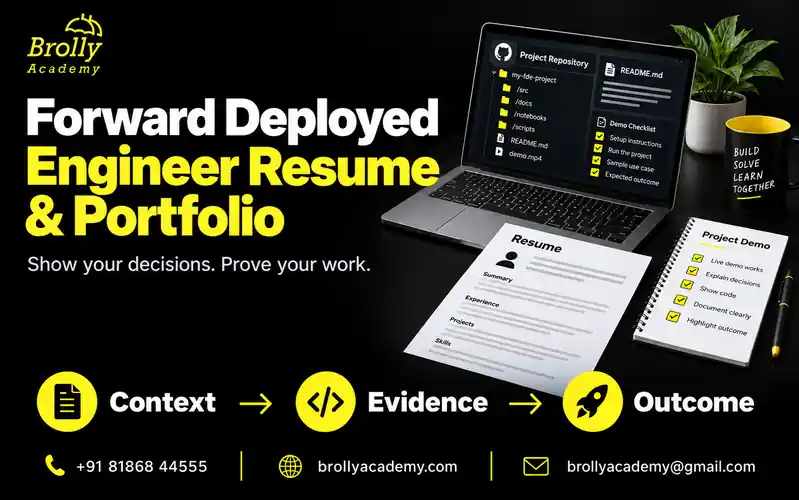
Include a relevant summary, skills you can demonstrate, accurate work history, one or two well-explained projects, education and accessible portfolio links. Show the user problem, your contribution, the engineering decision and the evidence. Use measured results when you have them; never invent numbers to make a bullet look stronger.
See the fresher example · See the experienced example · Build the portfolio case study
Draft a resume for your actual experience level, tailor it to a real vacancy, write defensible project bullets and assemble a portfolio with a clear problem, implementation, test evidence and limitations.
What an FDE reviewer needs to understand
A reviewer should quickly see your level, the kind of problems you can handle and the evidence behind your claims. For FDE work, make customer understanding, implementation and delivery visible. Do not bury your strongest example beneath every library you have tried.
Start from a real vacancy. Highlight its responsibilities and decide which two or three examples best match them. A resume for an AI-focused implementation role may emphasise evaluation and model integration; another may emphasise data pipelines or enterprise APIs. Use the employer’s wording where it accurately describes your experience, not as keyword stuffing.
Think of the resume and portfolio as two connected documents. The resume helps someone decide which experience to investigate. The portfolio makes that experience inspectable. A resume should not contain every architectural detail, and a portfolio should not force the reviewer to guess why the project exists.
| Question a reviewer may ask | Resume signal | Portfolio evidence |
|---|---|---|
| Can you understand an unclear need? | A specific problem, user and scope you helped define. | Problem brief, assumptions and acceptance criteria. |
| Can you implement the solution? | The component you built and the relevant technology. | Readable code, setup instructions and meaningful tests. |
| Can you handle real constraints? | A decision involving data, permissions, reliability or delivery. | A trade-off record and failure-case evidence. |
| Can you explain your contribution? | Accurate ownership verbs and a bounded outcome. | A walkthrough distinguishing your work from dependencies and teammates. |
| Can someone else use or maintain it? | Release, documentation or handover responsibility where true. | Deployment notes, runbook and known limitations. |
For the broader role definition, read what a forward deployed engineer does. This article focuses on presenting evidence, not replacing the engineering practice needed to produce it.
Translate a job description into evidence
Start with one actual vacancy rather than a generic FDE keyword list. Separate required responsibilities, technical requirements, experience level and working arrangements. Mark each item as demonstrated, adjacent experience or a genuine gap. A gap is a preparation decision, not permission to add an unsupported skill.
For example, OpenAI’s Seattle FDE description, reviewed on 9 October 2026, connects customer discovery and technical scoping with system design, implementation and production rollout. It also discusses reusable delivery patterns and customer feedback. This is one experienced-role example, not a universal requirement for freshers or an academy hiring partnership.
| Responsibility in a target vacancy | Question to ask about your experience | Evidence you could present if true |
|---|---|---|
| Customer discovery | Did I speak to users, or receive requirements second-hand? | A scoped problem statement or a documented change after user feedback. |
| API or data integration | Which boundary did I implement and validate? | An adapter, contract tests and handling of missing or inconsistent data. |
| Production delivery | Was this deployed for real users, a pilot or only a local exercise? | Accurate environment, release ownership and operating checks. |
| AI evaluation | Which cases and failure categories did I assess? | Versioned inputs, scoring rules, results and limits. |
| Customer communication | Which decision did my explanation help someone make? | A permitted decision summary, acceptance review or handover record. |
| Reusable engineering | Was the component actually used beyond one case? | Documented reuse, compatible interfaces and relevant tests. |
Use the employer’s terminology when it accurately describes your work. If the posting says API integration and that is what you did, write it plainly. Do not substitute the phrase for unrelated work merely to increase a match score.
A practical resume structure
| Section | What to include | What to avoid |
|---|---|---|
| Contact and links | Professional contact details and accessible portfolio links. | Unnecessary private identifiers or broken repositories. |
| Summary | Your actual level, relevant focus and one evidence-based strength. | Unverifiable expert or industry-leading claims. |
| Skills | A small grouped list supported by projects or work. | Framework names you cannot explain. |
| Experience | Responsibilities, decisions and verified outcomes. | Confidential customer information or invented impact. |
| Projects | Problem, implementation, tests, delivery and limitations. | Presenting a course exercise as paid employment. |
| Education and credentials | Accurate qualification names, issuer and status. | Planned exams presented as completed certifications. |
Use a readable format with consistent headings. Follow the employer’s file-format instructions. A visually elaborate document is not useful if its text, dates or links are difficult to inspect.
Choose the order that makes your strongest evidence easy to find
For an early-career candidate, a relevant project section can appear before limited unrelated work experience. For an experienced engineer, recent relevant employment usually deserves more space. Keep education and credentials accurate in either case. A short summary is useful when it explains the transition or focus; remove it if it only repeats vague adjectives.
A single page is a sensible starting point for a fresher with a small amount of relevant material. An experienced candidate may need a second page to preserve useful context. These are editorial choices, not universal screening rules. Do not force one page by making the type unreadable or expand a weak resume with unrelated tools.
Use your real employment titles. You may add a truthful scope description, such as Backend Engineer, customer integrations, without retroactively renaming every previous role Forward Deployed Engineer. Keep dates consistent across your resume, application and professional profile.
Write a summary that matches your real level
Early-career example
Illustrative wording, use only if true: Python developer building customer-workflow projects with API validation, SQL and automated tests. Created a synthetic support-triage application with reviewer approval and documented failure handling. Seeking an entry-level role combining implementation and user-focused problem solving.
Experienced developer example
Illustrative wording: Software engineer with experience integrating backend services and supporting releases. Interested in customer-facing delivery, with evidence in problem scoping, API integration and operational documentation. Replace this general statement with your actual domain and responsibilities.
A summary should orient the reader, not claim every FDE skill. Do not insert a number of years, employer, certificate or client outcome merely because it makes the wording sound stronger.
A useful summary has a focus and a reason to believe it
Compare “passionate AI professional with excellent communication” with “Python developer building tested API workflows; documented a synthetic support-triage project with validation, reviewer approval and recovery notes.” The second gives the reader something to investigate. It does not claim that a personal project is commercial experience.
For an experienced engineer, name the actual domain and ownership: integrations, internal platforms, customer implementation or another relevant area. Add a verified result only if it can be explained later. Delete expert, visionary or highly accomplished when the resume does not establish what those words mean.
Fresher forward deployed engineer resume example
Adaptable teaching example, not a real candidate: the following layout shows how an early-career applicant could present relevant learning work. Square-bracket fields must be replaced with accurate details. The project statements are illustrative; retain a statement only after doing the work and keeping evidence. This is an inline example, not an attached download.
Fresher resume text example
[Your name]
[City, country] | [Professional email] | [Phone]
[LinkedIn URL] | [Accessible GitHub or portfolio URL]

SUMMARY
Early-career Python developer interested in customer-facing engineering.
Built a synthetic support-triage workflow with input validation, a review queue
and documented failure handling. Seeking an entry-level role combining
implementation, problem clarification and practical software delivery.

TECHNICAL SKILLS
Programming: [Languages you can explain and use]
Data and APIs: [SQL database], [API framework], request/response validation
Engineering practice: Git, automated tests, debugging, documentation
AI application skills: [Only the retrieval or evaluation work you completed]

SELECTED PROJECT
Support-Triage Practice Application | Independent learning project | [Dates]
- Defined a synthetic support workflow, routing categories and reviewer-owned
  decisions in a problem brief with explicit non-goals.
- Implemented validated ticket intake and duplicate-event handling, with tests
  for malformed inputs and conflicting updates.
- Added a review path for uncertain cases and documented the limits of the
  synthetic test set instead of claiming production accuracy.
- Wrote setup instructions and a demonstration covering a normal case and a
  controlled downstream failure.

ADDITIONAL EXPERIENCE
[Internship, volunteering, part-time role or relevant activity] | [Dates]
- [Your actual responsibility, action and observable result.]

EDUCATION
[Actual qualification] | [Institution] | [Completion date or expected date]

CERTIFICATIONS OR TRAINING
[Earned credential, issuer and date, if relevant]
[Current study, clearly labelled in progress, if worth including]
Why this works as a structure: the project is labelled accurately, the bullets name implementation and verification, and the candidate’s level is clear. A reader can ask to inspect the validation code or the failure demo. There is no invented employer, number of customers or placement claim.
What to personalize: replace the sample workflow with your actual work, choose skills supported by that work and remove empty sections. If you have not implemented duplicate handling, do not leave that bullet in place because it sounds technical. Complete a smaller project and explain it honestly.
If your degree or previous experience is outside computer science, show the same engineering evidence and follow the vacancy’s qualification requirements. A resume format cannot waive an employer’s stated eligibility rules.
Experienced engineer resume example
Adaptable teaching example: this version is for a software engineer moving toward customer-facing delivery. It deliberately keeps the original job title and separates work history from personal practice. The bracketed fields and example bullets are not factual claims about any person.
Experienced resume text example
[Your name]
[City, country] | [Professional email] | [Phone]
[Professional profile] | [Permitted portfolio]

SUMMARY
Software engineer with experience in [actual domain and scope].
Interested in forward deployed engineering, with demonstrated work in
[integration or delivery responsibility] and [customer or stakeholder task].
Strongest evidence: [one concise, verified contribution].

CORE SKILLS
Languages and services: [Relevant, defensible skills]
Data and integration: [Databases, API contracts and data tools actually used]
Delivery: [Testing, deployment, monitoring and recovery responsibilities]
Collaboration: [Discovery, scope review or handover work actually owned]

EXPERIENCE
[Actual job title] | [Actual employer] | [Dates]
- Clarified [workflow constraint] with [permitted stakeholder description],
  turning the request into [agreed acceptance criteria or scoped release].
- Implemented [specific component] using [relevant technology], including
  [validation, permission or failure-handling decision].
- Investigated [real issue] using [evidence], then added [test or operating
  safeguard] to address the observed failure.
- Supported [actual release or handover scope]; measured [verified result
  with its baseline, window and limits], or describe an observable outcome.

[Earlier relevant job title] | [Employer] | [Dates]
- [One or two contributions relevant to this target vacancy.]

SELECTED PORTFOLIO CASE STUDY
[Project name] | [Independent, open-source or authorized professional work]
- [Your contribution, evidence link and known limitation.]
- [How this example supports a responsibility not obvious in your job title.]

EDUCATION AND CREDENTIALS
[Accurate qualification, issuer and status]
Do not upgrade participation into ownership. Contributed to an API integration and led the integration are different claims. A senior candidate should explain the decisions, coordination and consequences they actually owned, not add senior language to an individual task.
Where a result belongs to a team, acknowledge the team and specify your part. For example, “Implemented the retry and reconciliation component of the team’s migration” is more defensible than claiming the whole migration as your personal achievement. Keep confidential identities and measurements out unless disclosure is authorized.
Choose skills and keywords that your evidence supports
A forward deployed engineer resume can include technical and customer-delivery skills, but the right selection depends on the vacancy. Group the skills into a small number of readable categories. Do not use proficiency bars, percentage ratings or a catalogue of every framework you have opened.
| Skill area | Relevant terms when accurate | Evidence to prepare |
|---|---|---|
| Programming | Python, TypeScript, JavaScript or the required stack. | A component you can explain, modify and debug. |
| Data | SQL, data modelling, validation, ingestion, reconciliation. | A query, data contract and failed-record handling. |
| Integration | REST APIs, authentication, idempotency, error handling. | A boundary test and a repeated-request or timeout scenario. |
| AI applications | RAG, retrieval evaluation, structured outputs, tool use. | Separate checks for retrieval, answer quality and authorized actions. |
| Delivery | Deployment, observability, rollback, incident investigation. | A release record or clearly labelled practice runbook. |
| Customer work | Discovery, problem decomposition, scoping, acceptance review. | A decision changed by user needs or constraints. |
| Collaboration | Code review, documentation, stakeholder communication. | A concrete contribution rather than an unsupported soft-skill label. |
If you are still learning a tool, either leave it out or identify the limited context, such as used in an independent project. A basic exposure label is useful only if the skill matters to the role. The FDE roadmap can help turn a missing capability into a practice plan rather than another keyword.
Turn a weak bullet into an evidence-based bullet
Weak: Built an advanced AI agent using many tools.
Stronger, if accurate: Built a synthetic ticket-routing workflow with schema validation, a human-review queue and tests for duplicate submissions and unavailable account lookup.
The second statement identifies the workflow and specific engineering decisions. It does not need a fabricated percentage improvement. If you have a measured result, state the conditions: for example, correctly routed 18 of 20 labelled synthetic cases in a local evaluation. That is a result about those cases, not a universal accuracy claim.
| Weak wording | Better evidence to provide |
|---|---|
| Worked on RAG | Which documents, retrieval permissions, evaluation cases and unsupported-question behaviour? |
| Improved performance | What metric, baseline, workload and measurement method? |
| Handled customers | Which discovery, scope or communication responsibility did you own? |
| Deployed to cloud | Which release, configuration, monitoring and recovery tasks did you complete? |
| Production-ready | What operating evidence supports that claim, and what remains untested? |
MIT Career Advising’s guidance on writing about skills recommends connecting an action with its task and result. For FDE work, add enough user or delivery context to explain why the engineering mattered. The rewrites below are original examples, not verified candidate achievements.
| Weak bullet | More useful wording, only if true | Be ready to show |
|---|---|---|
| Built a chatbot. | Built a policy-answering practice app that cites approved documents and escalates unsupported questions. | Sources, retrieval behaviour and unsupported-case tests. |
| Used Python and SQL. | Implemented a ticket-status query that selects the highest revision within the authorized tenant context. | Query, tenant-scoped fixture and tie-handling rule. |
| Worked with customers. | Documented the account-review workflow with its owner and revised the first release after access constraints were identified. | Permitted notes and the resulting scope decision. |
| Improved reliability. | Added duplicate-operation checks and a reconciliation path for ambiguous API timeouts. | Failure tests and the operation-state design. |
| Created dashboards. | Defined the routing metric, exclusions and source reconciliation before presenting the review dashboard. | Metric definition and a traceable example record. |
| Managed deployment. | Prepared the release checklist, rollback verification and receiving-team runbook for the scoped pilot. | Your actual release role and evidence of verification. |
| Expert in agents. | Implemented a bounded tool workflow with argument validation and human approval before account changes. | Tool boundary and denied-action test. |
| Led the project. | Owned the integration component and coordinated its acceptance review with the workflow owner. | Ownership boundaries and acceptance criteria. |
A bullet does not always need a percentage. A verified engineering safeguard or completed handover can be valuable without an invented revenue figure. Avoid claiming an improvement when you only implemented a feature and never measured its effect.
Use metrics without overstating the result
Before including a number, record what was measured, the baseline, the sample, the environment, your contribution and the limitation. Distinguish business outcomes from test results. Passing a suite of unit tests is not the same as improving production success rates.
Illustrative arithmetic, not a Brolly learner result: suppose a prototype’s median response time on the same 100 synthetic cases fell from 800 ms to 500 ms under the same test conditions. The reduction is (800 – 500) / 800 = 37.5%. That describes this controlled comparison, not all traffic, user productivity or revenue.
| Claim | What must support it | Safer alternative when evidence is missing |
|---|---|---|
| Reduced response time by 37.5%. | Comparable workload, defined percentile, versions and measurement method. | Implemented caching and documented a reproducible latency comparison; state actual results only after testing. |
| Achieved 95% accuracy. | Task definition, labelled sample, denominator and error categories. | Correctly handled 19 of 20 labelled synthetic routing cases, if that is the observed result. |
| Saved 10 hours per week. | Observed baseline and new workflow, including review effort and volume. | Removed a repeated manual lookup step; operational time savings were not measured. |
| Served 1,000 users. | Actual usage definition and records, not capacity or account registrations alone. | Load-tested a stated synthetic workload; no claim of real-user adoption. |
| Built a production-ready service. | Operating context, controls, support, recovery and relevant validation. | Built a tested prototype with documented deployment limits. |
Keep a private claim record containing the calculation and permitted evidence. If you cannot explain where a figure came from, remove it until you can. If a result was negative, explain the limitation and improvement rather than rewriting the history.
Tailor one resume to a specific FDE vacancy
Tailoring means changing emphasis while keeping facts stable. Start with a master inventory of accurate work and choose the evidence relevant to the particular role. Do not create contradictory dates, titles or project outcomes in different versions.
Worked example: an integration-focused vacancy
Fictional vacancy: the team needs someone to investigate customer workflows, integrate APIs and SQL data, test failures and support a controlled release. The applicant has a backend integration project and a small independent AI demo.
- Prioritize the integration: move the backend project above the AI demo because its evidence matches the main responsibilities.
- Rewrite the summary: emphasize validated APIs and delivery work, not a generic ambition to work in AI.
- Choose three bullets: problem clarification, the implemented boundary and a tested failure or release decision.
- Keep gaps visible: if customer access was mediated by a product manager, describe that instead of claiming direct ownership.
- Check the portfolio landing page: make the relevant case study easy to find without requiring a tour of unrelated repositories.
For an AI-focused implementation vacancy, the same person might lead with retrieval permissions and evaluation evidence instead. That is a different selection of true experience, not a new fictional career.
Use a simple tracking note: vacancy URL, date checked, required capabilities, selected evidence and questions to clarify. The FDE job-search guide covers finding roles; this step connects those roles to your actual application materials.
ATS-friendly formatting and export checks
An applicant tracking system, or ATS, may parse a resume to populate candidate fields. Parsing is not the same as evaluating every skill or predicting a hiring decision. There is no universal keyword percentage or ATS score that guarantees selection.
Greenhouse’s resume-parsing documentation identifies possible problems with image-only resumes, elaborate graphics, columns, tables and contact details inside headers, footers or text boxes. These are product-specific parsing cautions, not proof that every ATS rejects every designed resume.
- Use a simple reading order and recognizable headings such as Experience, Projects, Skills and Education.
- Keep essential contact information in the document body and use real selectable text.
- Follow the application portal’s accepted format and file-size instructions.
- After export, copy the text into a plain-text view and inspect its order, dates and characters.
- Open the exported file and test each public link. Review fields populated by the application portal before submitting.
These checks reduce avoidable formatting errors; they do not certify compatibility with every hiring system. Avoid hidden keywords or white-on-white text. The right goal is an accurate, readable document whose content survives export.
For the resume itself, keep a clean document layout. The comparison tables in this article are explanatory aids, not a recommendation to place your whole CV inside a table. Use the inline sample’s text structure in the document format requested by the employer.
Career changes, gaps and limited customer experience
You do not need to disguise your starting point. Show relevant transferable work, identify what you have not yet done and choose a project that addresses the most important gap. An honest transition story is more coherent than a resume that implies you have already held every responsibility in the target vacancy.
| Starting point | Relevant evidence to surface | What not to imply |
|---|---|---|
| Backend or full-stack engineer | API contracts, debugging, release work and decisions changed by users. | That every internal feature was a customer deployment. |
| Data engineer or analyst | Source investigation, data quality, SQL and communicating a decision. | That reporting experience alone proves application or production ownership. |
| QA or automation engineer | Failure analysis, contract testing and release-risk judgement. | That testing a system means you designed all of it. |
| Consultant or solutions professional | Discovery, scope and stakeholder work, plus actual implementation. | That presentations replace hands-on coding evidence for a coding role. |
| Career break or non-technical background | Accurately dated recent work and demonstrable relevant practice. | Invented employment to hide a gap or an unsupported seniority level. |
Keep an employment-gap explanation concise and truthful. You do not need to disclose private medical or family details on a public resume. Where relevant, show current readiness through recent work, training or a project you can explain.
If you lack customer experience, try a permitted small workflow with a genuine user or clearly label a simulated brief. Record their problem, one change from feedback and the acceptance criteria. Do not assign enterprise scale to a student exercise.
Build the portfolio around one complete delivery story
A coherent project can show more than several disconnected demos. Choose a workflow with a user, a decision and an observable result. Use synthetic or explicitly permitted data. Keep the scope small enough that you can explain every important component.
- Problem brief: who needs the workflow, what fails today and what a useful change looks like.
- Architecture: components, data flow, trust boundaries and external dependencies.
- Implementation: code, configuration and a reproducible setup.
- Evaluation: labelled cases, test commands and results tied to a version.
- Delivery: deployment notes, monitoring and rollback.
- Handover: a runbook, user instructions and known limits.
For example, a grounded policy assistant should show more than a chat screenshot. Include the document version, permission filtering, source handling and what happens when the answer is not in the permitted evidence.
Select a project that exposes decisions, not only a polished interface
| Project type | What it can demonstrate | Evidence that makes it useful |
|---|---|---|
| Support-triage workflow | Validation, routing, review and exception handling. | Labelled synthetic cases, duplicate handling and reviewer decisions. |
| Permission-aware document assistant | Retrieval, evidence, authorization and abstention. | Versioned sources, cross-account tests and unsupported-question behaviour. |
| API synchronization service | Data contracts, retries, pagination and reconciliation. | Restart scenarios, conflicting updates and a runbook. |
| Deployment and monitoring exercise | Release ownership, diagnosis and recovery. | A controlled fault, observable signal and verified restoration steps. |
Choose one strong end-to-end example before creating several shallow variations. Add another project only when it demonstrates a meaningfully different capability. The FDE project build plans provide options, while the case study below shows how to present one without inventing customer impact.
Worked portfolio case study: support-ticket routing
Original teaching scenario: a small support team needs a way to route tickets to the right reviewer. This is a proposed portfolio presentation, not a claim that a real customer deployment or measured result exists.
1. State the user problem and first-release boundary
The user is a support coordinator who currently checks ticket text and account details before assigning a queue. The first release suggests a queue and explains the evidence used. A reviewer approves the assignment. Automatic account changes, unrestricted external actions and real customer data are excluded from the practice version.
Useful acceptance criteria include rejecting malformed requests, handling duplicate submissions consistently, routing unsupported categories for review and preventing one account’s records from being shown to another. Keep these separate from aspirational improvements in staff productivity.
2. Show a small, understandable architecture
Permitted ticket input
  -> identity and account checks
  -> schema and business validation
  -> deterministic routing baseline
  -> optional model suggestion, if justified
  -> reviewer queue
  -> recorded decision and safe diagnostic events
Explain why the deterministic baseline exists: it provides something measurable to compare against. If a model is added, it should solve a demonstrated limitation rather than merely make the project sound more current. Keep authorization and consequential actions in trusted application code.
3. Explain your contribution precisely
A candidate might own request validation, the routing adapter and tests while reusing a framework’s HTTP server. The case study should say that. If a teammate built the interface, credit them. If starter code was used, identify the source and describe the changes. This lets a reviewer ask focused questions about your actual work.
4. Present an evidence table before claiming a result
| Scenario | Expected behaviour | Artifact to retain |
|---|---|---|
| Missing account identifier | Reject or route for controlled correction according to the contract. | Validation test and safe error response. |
| Duplicate request with the same payload | Avoid creating a second assignment. | Operation-key test and stored outcome. |
| Same operation key, changed payload | Report a conflict rather than reuse an unrelated outcome. | Conflicting-payload regression test. |
| Unsupported routing category | Send to review with a clear reason. | Labelled evaluation case. |
| Denied account access | Return no protected account data. | Negative permission test. |
| Downstream timeout | Expose a controlled failure or uncertain outcome; do not silently claim success. | Failure simulation and recovery notes. |
The table specifies what to test. Add a separate Actual Result column only after running the implementation, with the tested version and date. Do not mark expected behaviour as Passed before it has been observed.
5. Record a real trade-off and limitation
For example, reviewer approval limits automation but keeps a person responsible for uncertain assignments. An in-memory prototype may demonstrate the interface but lose operation state on restart. Record that limitation and the durable-storage change needed before broader use. A local synthetic test cannot establish adoption, external-service reliability or performance on all ticket categories.
6. Convert the case study into resume evidence
Illustrative bullet, use only after implementing it: Built a synthetic support-routing application with validated intake, duplicate-operation checks and reviewer-owned assignment; documented failure scenarios and a reproducible local demonstration.
The detailed portfolio explains the architecture and tests. The resume carries the concise claim. This separation makes the application easier to scan while preserving depth for a technical interview.
A README structure a reviewer can actually use
# Project name

## Problem and intended user
## Scope and non-goals
## Architecture and trust boundaries
## Prerequisites and local setup
## Configuration (sample values only)
## Run the application
## Run the tests and evaluation
## Demonstration scenarios
## Results and measurement method
## Known limitations
## Deployment and rollback
## Operating runbook
## Attribution and license
Keep setup commands accurate and identify tested versions. Explain whether a paid model or cloud account is required before asking someone to run it. Supply a no-secret sample configuration and synthetic data. A reviewer should not have to contact you to discover the basic run command.
GitHub’s official profile guidance supports making relevant projects easy to find. Pin a small, strong selection and ensure the landing page explains their purpose. Do not publish a repository you have no right to disclose.
Make prerequisites and costs visible before the run command
State the supported runtime, how dependencies are installed, whether a cloud or model account is required, how configuration is provided and which data is safe to use. If a mock mode avoids paid calls, explain exactly what it replaces. Do not imply a mock demonstrates a live integration that it does not exercise.
Separate expected results from observed results
For each demonstration, describe the input and expected behaviour. Record observed results with the actual version and date only after running it. A README example should not say all tests pass simply because an AI tool generated a command. Verify the documented setup in a clean environment you control and note any step that still requires manual configuration.
Provide useful file organization
project/
  README.md
  src/                 application code
  tests/               checks you actually implemented
  data/synthetic/      clearly labelled practice inputs
  docs/problem.md      user, scope and acceptance criteria
  docs/decisions.md    important choices and alternatives
  docs/runbook.md      diagnosis, recovery and ownership
  docs/limitations.md  known gaps and untested assumptions
  .env.example         variable names and safe sample values
  LICENSE              appropriate license or rights notice
This is a suggested organization, not a repository we have created or a command sequence guaranteed to run. Use fewer files when that keeps a small project clearer. The important property is that evidence can be located and understood.
Arrange GitHub and portfolio links for a quick first review
Your public landing page should answer three questions quickly: what problem does this project address, what did you do and where can someone inspect the evidence? Put the most relevant project near the top. Do not make the reader navigate through unrelated experiments to reach it.
GitHub’s official job-search profile guide recommends making relevant projects prominent and providing understandable project documentation. Apply that principle to the actual vacancy rather than treating repository counts or contribution-calendar activity as a hiring score.
- Profile: use a concise factual bio and an accurate current focus.
- Project landing page: show problem, scope and your contribution before implementation detail.
- Evidence: make tests, decisions and limitations easy to reach.
- Accessibility: check the links without relying on your signed-in session.
- Maintenance: identify archived experiments and keep the application material aligned with the version being demonstrated.
A personal website is optional. A well-organized repository and a short case study can be enough to present work. Conversely, a beautiful portfolio homepage does not compensate for a broken setup or inaccessible code.
If public code is not permitted, use an approved anonymized case study or a separate synthetic project. Do not grant access to a private employer repository just to make an application convenient.
Show failure, not only the happy path
A useful demo starts with the user problem, runs a normal case and then shows one controlled failure. For a ticket application, submit an invalid request or simulate a downstream timeout. Explain the expected behaviour and point to the test covering it.
Record a short walkthrough only when the application is ready to demonstrate. Remove credentials, personal data and private browser tabs from the recording. Do not stage a successful output and imply that an unimplemented system produced it.
Use a small evidence table: scenario, expected result, actual result, version and limitation. If an evaluation is manual, say so. If a result cannot be reproduced, investigate before turning it into a resume claim.
A five-minute project walkthrough
| Suggested segment | What to show | What the viewer should learn |
|---|---|---|
| Opening | The intended user, problem and bounded scope. | Why this project exists. |
| Normal path | One small permitted input and its result. | What the application actually does. |
| Failure path | An invalid input, denied access or simulated dependency failure. | How the system behaves when assumptions fail. |
| Engineering decision | One component, test or trade-off you owned. | How you reason and verify. |
| Close | A limitation and the next useful improvement. | What the evidence does and does not establish. |
The duration is a practice suggestion, not an employer requirement. Rehearse a shorter explanation as well. A recording can help when a live service is unavailable, but label it as a recording and identify which version it shows. Never substitute a staged output for an unimplemented capability.
Protect confidential work and respect attribution
Employer repositories, customer tickets, production logs and internal architecture may not be yours to publish. Obtain permission or describe the work at an approved level of abstraction. For public practice, recreate the pattern with synthetic data rather than exporting private material.
If you adapt open-source code, inspect its license and preserve required notices. Link the original project and describe your changes. A fork can be useful learning evidence, but the contribution must be clear. Do not rename someone else’s repository and present its entire implementation as your original work.
Check more than source files before sharing: commit history, screenshots, logs, sample exports, notebook outputs and recorded browser tabs may contain private material. Removing a customer’s name does not necessarily make a detailed production example safe to disclose. Follow the authorization and confidentiality rules that apply to the work.
For a leaked credential, GitHub’s sensitive-data guidance says to revoke or rotate it first. Cleaning the latest file alone does not invalidate a secret already exposed. Follow the relevant incident process and coordinate history cleanup rather than presenting a clean screenshot as proof that the risk is gone.
For adapted code, inspect the license and required notices. GitHub’s licensing documentation distinguishes public visibility from an open-source license. Link the original and make your changes clear. Seek appropriate advice where rights or confidentiality obligations are uncertain; a portfolio deadline does not create permission to publish.
Present certifications and AI-assisted work honestly
List an earned credential with its actual name, issuer and status. Keep an exam you are preparing for separate from completed certifications. A course completion certificate and a vendor certification are not interchangeable, and a certificate alone does not establish production delivery experience.
When a credential is relevant, explain what work supports it. For example, a cloud credential can accompany a project that demonstrates configuration and recovery, but should not replace the project explanation. Do not place unrelated badges above stronger relevant evidence merely to make the resume look fuller.
Using AI to improve wording
AI can help organize accurate notes, identify unclear claims or propose concise wording. Give it a fact sheet you are permitted to share and require it to flag missing evidence. Do not upload confidential customer material or allow it to invent employers, metrics or responsibilities.
Useful editing prompt: “Rewrite these factual project notes into concise resume bullets. Preserve my actual role and environment. Do not invent metrics, customers or production use. Flag any claim that needs evidence instead of filling the gap.” Review every resulting line yourself.
For AI-assisted code, be able to explain, modify and test the implementation. Follow the employer’s assessment rules and any disclosure requirements. The fact that a tool generated part of the code does not remove your responsibility for the submitted claims.
Prepare to defend every line
For each resume bullet, prepare answers to: what did you personally do, why did you choose that approach, how did you test it, what failed and what would you improve? Open the relevant code or document while practising. If a bullet cannot survive a five-minute discussion, revise it or remove it.
Use the FDE interview questions to practise follow-ups. The goal is not a perfect speech; it is a truthful explanation that remains coherent when the scenario changes.
For a structured project path, review the Forward Deployed Engineer Course. Ask how your work will be reviewed and what evidence you will be expected to produce. A portfolio is valuable because of its contents, not because a course label appears above it.
Run a short evidence interview
- Choose the strongest bullet and explain the user problem in plain language.
- Open the exact component or document that supports your contribution.
- Explain one alternative you considered and why you did not choose it.
- Show a normal case and a meaningful failure case.
- State which result was measured and which benefit remains an assumption.
- Explain what would need to change for a larger or higher-risk deployment.
If you cannot do a step, improve the evidence or narrow the bullet. Do not memorize a story that hides the gap. Practise follow-ups using the 120 FDE interview questions and answers, especially the coding, delivery and customer-communication sections.
Review your resume and portfolio before applying
Use the checklist as a readiness review, not a numeric prediction of selection. Fix factual or access problems before polishing wording. A persuasive explanation is useful only if the supporting material is accurate and available.
| Review area | Pass condition | Fix before sending if… |
|---|---|---|
| Role relevance | The selected evidence matches the actual vacancy. | The resume is a generic tool list with no connection to responsibilities. |
| Identity and dates | Titles, employers, education and dates are accurate. | Different versions contradict one another. |
| Ownership | Your contribution is distinct from team and framework work. | You cannot explain what you personally implemented. |
| Metrics | Every number has a source, definition and scope. | A percentage was added because it sounded impressive. |
| Project context | Practice, pilot and production environments are labelled. | A course exercise is presented as paid customer work. |
| Links | Intended reviewers can open the selected public material. | The link requires an account or permission you did not anticipate. |
| Reproducibility | The documented setup and tests were actually checked. | Commands, dependencies or expected outputs are speculative. |
| Privacy and rights | Shared artifacts are permitted and secrets are absent. | Private customer data or unlicensed copied material remains. |
| Export | Text order, legibility, dates and links survive the required format. | The exported document is clipped, image-only or scrambled. |
| Interview readiness | You can explain one decision, failure and limitation. | The polished wording is more advanced than your understanding. |
Ask a peer to describe your main contribution after reading the first page. Then ask them to locate its evidence without help. Their difficulty is useful feedback about organization, not proof that you need more keywords.
A practical sequence to finish your application materials
Work in this order so writing does not outrun the evidence:
- Choose a vacancy: record the role requirements and the advertised level.
- Gather facts: inventory accurate responsibilities, artifacts and measured outcomes you may share.
- Select the strongest work: choose a coherent project or deployment rather than every experiment.
- Close evidence gaps: fix broken setup, missing tests or unclear contribution boundaries.
- Write the resume: use a relevant summary, concise bullets and accurate skill groups.
- Prepare the portfolio: add the problem brief, decision notes, demonstration and limitations.
- Verify the export: inspect text order, links, permissions and the application form’s extracted fields.
- Practise the explanation: rehearse the evidence interview and revise any unsupported wording.
If you need deeper project practice, review the Forward Deployed Engineer Course at Brolly Academy. The confirmed duration is two months, with INR 20,000 online or INR 25,000 classroom tuition and trainer Manish. Use the free demo to discuss your current skills and confirm the batch’s project review, support, hours, taxes and cloud costs. A course is a learning option, not a guarantee of a resume shortlist or job.
Frequently Asked Questions
What should a forward deployed engineer resume emphasize?
Connect customer understanding with hands-on implementation and delivery evidence. Show the problem, your contribution, a relevant engineering decision and an observable result or limitation. The exact emphasis should follow the vacancy.
Can a fresher apply with personal projects?
A fresher can present relevant personal, academic or volunteer work, clearly labelled. Whether that satisfies a role depends on its requirements. Do not describe practice projects as paid customer or production experience.
Should I change my previous job title to Forward Deployed Engineer?
No. Keep the accurate title and explain relevant responsibilities in the summary and bullets. A truthful scope description can help without inventing a past title.
How long should an FDE resume be?
Use enough space to present relevant evidence clearly. One page is a useful starting point for a fresher, while an experienced candidate may need two. Follow employer instructions and avoid tiny text or padding.
What technical skills belong on an FDE resume?
Include relevant languages, data and API skills, testing and delivery capabilities you can demonstrate. Add retrieval, agents or evaluation only when supported by your work and relevant to the role.
Is a GitHub portfolio mandatory?
Not for every role. Follow the employer requirements. A permitted case study can help when code is private, while an accessible repository is useful for work you have the right to share.
How many projects should I include?
Prioritize the strongest relevant examples instead of a fixed quota. One well-explained complete workflow can be more useful than several shallow demos. Add another when it demonstrates a distinct capability.
Can I include a course project?
Yes, in a clearly labelled Projects or Training section. Explain your actual contribution, reused components, tests and limitations. A course label does not convert the project into employment.
What if I have no numerical results?
Describe the verified implementation, safeguard or completed outcome. Do not invent percentages. Measure a relevant result later and record the method, baseline and limits before using it.
Can I use these resume examples exactly as written?
Use the structure, but replace bracketed fields with accurate details and keep only statements supported by your own work. The examples are teaching material, not real candidate histories or completed projects.
Should I submit PDF or Word?
Follow the portal requirements. Export real selectable text and inspect reading order, links and layout. No single format or template guarantees correct parsing in every system.
Does an ATS score guarantee an interview?
No. A score from a tool is not a hiring decision or universal standard. Focus on accurate role relevance, readable formatting and evidence rather than hidden keywords or repeated phrases.
How should I present NDA-restricted work?
Use only information you are authorized to disclose. An approved high-level case study or a separate synthetic project may help. Removing names alone does not establish that a detailed customer example is safe to publish.
Can I include an open-source fork?
Yes, where the relevant rights and conditions permit it, with clear attribution and an explanation of your own changes. Do not present the original author’s full implementation as your work.
Can AI help write my resume?
It can help edit accurate notes, but you must verify every claim and protect confidential information. Do not allow it to invent metrics, responsibilities or credentials, and follow assessment rules for AI-assisted work.
Will this resume structure guarantee an FDE job?
No. Hiring depends on the role, requirements, evidence and assessment. The guide helps make your work understandable and defensible; it cannot promise selection.
Sources and Further Reading
Official documentation and employer pages were checked on 9 October 2026. Job availability, compensation and product details can change. Teaching scenarios are illustrative unless explicitly identified otherwise.