
Brolly Academy | AML
AML Certification
CAMS, IIBF AML/KYC, NISM CALM, ICA and CFE Compared: Cost, Format and Who Each Suits (2026)
A plain-English guide to AML certification in India for 2026: what each major certificate is, who issues it, the exam format and official fee, which one fits your career stage, the free official resources you can study from, and how to show a certification on your resume so recruiters notice it.
Best AML certifications in 2026 compared: CAMS, IIBF AML/KYC, NISM CALM, ICA and CFE, with costs, exam formats, who each suits and how to choose in India.
By Brolly Academy Team · Brolly Academy · Updated 24 October 2026
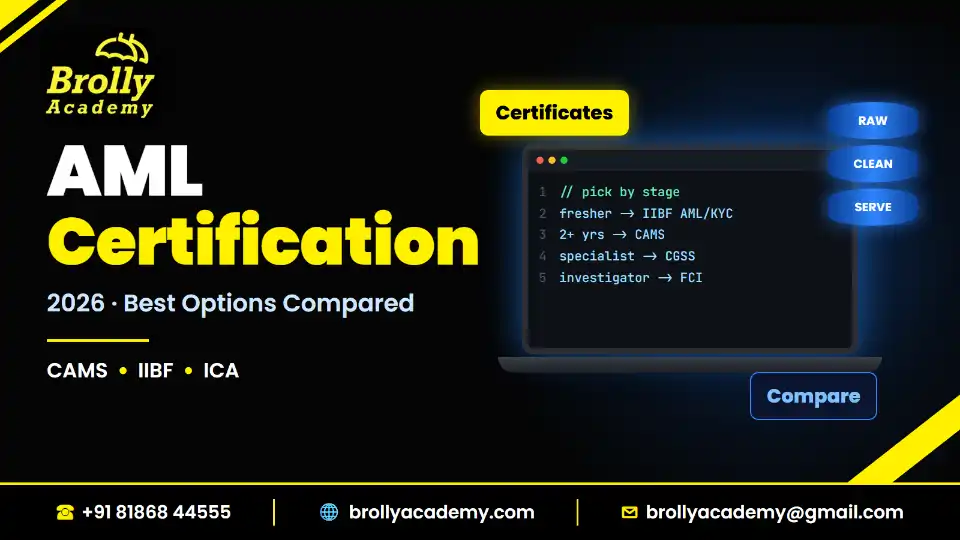
Table of Contents
1. AML certifications at a glance
2. What is an AML certification?
3. Why get an AML certification (and what it will not do)
4. ACAMS CAMS: the global benchmark
5. IIBF Certificate in AML and KYC: the affordable Indian start
6. NISM CALM and the NISM-IFSCA AML/CTF course
7. ICA certificates and diploma: a UK-recognised ladder
8. ACFE CFE: when your work is fraud, not only AML
9. Which AML certification should you take at your career stage?
10. Best AML certification in India: how to choose
11. AML certification cost in India: a budget view
12. Free AML learning resources (official only)
13. An 8-week study plan for a foundation AML exam
14. How to show an AML certification on your resume
Quick answer
The best AML certification depends on your stage: freshers in India usually start with the IIBF AML/KYC certificate or NISM's CALM course, while working analysts with a few years of experience aim for ACAMS CAMS or an ICA qualification. An AML certification is a credential from an independent body that tests your knowledge of anti-money laundering (AML) rules and practice. It does not replace job experience, and the listings we read in October 2026 call certifications "good to have", not mandatory. Pick one that matches your budget, your target employer and the work you want to do.
- Low-cost Indian start: IIBF AML/KYC exam, ₹1,100 (members) or ₹1,600 (non-members) per attempt, plus charges and taxes (IIBF rules, November 2024)
- Indian course plus exam: NISM CALM, listed at ₹9,000 with 60 hours of content (NISM, October 2026)
- Global benchmark: ACAMS CAMS, US$2,095 private sector or US$1,595 public sector package (ACAMS factsheet, 2026)
- UK-based ladder: ICA Certificate (Level 2) up to ICA Diploma (Level 6)
- Fraud focus: ACFE's Certified Fraud Examiner (CFE)
Key takeaways
- No AML certification is legally required for an entry-level analyst job in India, and the JDs we read list them as a plus, not a must.
- IIBF and NISM are the most affordable recognised options and are priced in rupees; CAMS and ICA are priced in US dollars, pounds or euros.
- CAMS needs active ACAMS membership and 40 eligibility credits before you can sit the exam, so it suits people with some experience (ACAMS factsheet, 2026).
- Free official sources, such as RBI's KYC Directions, FIU-IND's FAQs and the free NISM-IFSCA workbook, cover much of the study material.
- A certification helps most when you list it with the skills it proves, next to real KYC or alert work, on a one-page resume.
1. AML certifications at a glance
Short answer: Six options matter most for Indian learners: IIBF AML/KYC, NISM CALM, ACAMS CAMS, the ICA Certificate, the ICA Diploma and the ACFE CFE; they differ mainly in cost, depth and who recognises them.
Use this table as your first filter. Every fee is the issuer's own figure, in the currency the issuer uses, as of the date shown. We do not convert foreign fees into rupees because the rupee amount depends on the exchange rate on the day you pay.
Read the sections below for the exam format, eligibility and the honest pros and cons of each.
2. What is an AML certification?
Short answer: An AML certification is a credential awarded by an independent professional body after you pass its exam, showing that you understand how money laundering works and how banks and other firms detect, report and prevent it.
Money laundering is the process of making money from crime look like it came from a legal source. AML is the set of laws, controls and checks that stop it. If you are new to the field, read our guide on what anti-money laundering is first. It covers the stages, Indian law and the basic processes.
Three words get mixed up a lot, so here is the difference:
- Course: a programme of lessons. It may or may not end in an exam.
- Course completion certificate: proof that you finished a training programme. A training institute can issue this.
- Certification: a credential from an independent body, such as IIBF, NISM, ACAMS, ICA or ACFE, that you earn by passing its exam.
Employers value the third kind more, because an outside body tested you. When you search for an "AML course with certificate", check which of the three you are actually buying.
Every AML certification uses the same core vocabulary. Here are the terms you will meet in every syllabus:
- KYC (Know Your Customer): checking who a customer is before and during the relationship.
- CDD (Customer Due Diligence): identifying and verifying the customer and the beneficial owner from reliable, independent sources (RBI KYC Directions, 2025).
- EDD (Enhanced Due Diligence): extra checks for higher-risk customers, such as politically exposed persons.
- PEP (Politically Exposed Person): someone who holds or held a prominent public function, such as a senior politician or senior government official.
- STR (Suspicious Transaction Report): the report a bank files with FIU-IND when it suspects a transaction is linked to crime.
- CTR (Cash Transaction Report): a monthly report of large cash transactions.
- FIU-IND (Financial Intelligence Unit – India): the national agency that receives and analyses these reports.
- FATF (Financial Action Task Force): the inter-governmental body that sets global AML standards.
- Sanctions: official lists of people, entities and countries you may not deal with, such as UN Security Council lists.
- Typology: a known pattern or method of laundering, such as using mule accounts.
- Alert: a flag raised by monitoring software when a transaction matches a rule. A false positive is an alert that turns out to be harmless.
- L1, L2, L3: levels of review. L1 analysts clear or escalate alerts, L2 analysts investigate deeper, and L3 or senior staff make final calls and handle complex cases.
3. Why get an AML certification (and what it will not do)
Short answer: A certification proves structured knowledge, helps you pass resume screens and gives you a common language with compliance teams, but it will not replace practical experience, and the Indian listings we read call it a plus rather than a requirement.
Here are the real benefits:
- It proves knowledge a hiring manager can trust, because an outside body set and marked the exam.
- It fills gaps. If you come from a B.Com, BBA or BPO background, a syllabus makes you cover law, typologies, sanctions and reporting in order.
- It helps on resume screens. Some JDs name certifications directly. A State Street AML Senior Associate listing in Hyderabad said an ACAMS or ICA certificate is good to have (LinkedIn listing, read 24 October 2026). An Interactive Brokers AML Analyst I listing in Mumbai called ACAMS, CFE and CFCS a plus (LinkedIn listing, read 24 October 2026).
- It supports promotion. When you move from L1 alert review to investigations or team leadership, a deeper credential shows you are ready.
And here is what a certification will not do:
- It will not guarantee a job. Most operations listings we read asked for "any graduate" and 1 to 6 years of experience, with certifications as an extra.
- It will not replace hands-on skills. Employers test you on how you review a KYC file, investigate an alert and write a case narrative.
- It will not raise your salary on its own. We could not find a reliable Indian source that measures a pay premium for any AML certification, so treat salary claims tied to a certificate with caution.
Our honest view: if you are a fresher, spend most of your effort on skills and one affordable Indian certificate. Save the expensive global credential for when you have experience or an employer who pays for it.
4. ACAMS CAMS: the global benchmark
Short answer: CAMS (Certified Anti-Money Laundering Specialist) is ACAMS's flagship credential, trusted in more than 180 countries; you need active ACAMS membership and 40 eligibility credits, then you pass a 3.5-hour, 120-question exam.
According to the ACAMS CAMS factsheet (2026), these are the key facts:
- Eligibility: active ACAMS membership and 40 ACAMS eligibility credits, based on your education, experience, certifications and training. You can save your progress and apply once you are eligible.
- Exam: 3.5 hours, computer-based and proctored, with 120 multiple-choice questions that are knowledge-based and scenario-based. You can take it online or at an approved testing centre.
- Study material: four self-paced core courses (financial crime risks and methods; global anti-financial-crime frameworks and regulations; building a compliance programme; tools and technologies), plus two elective courses at no extra cost, an exam simulator with 1,000+ practice questions, flashcards and a study guide PDF.
- Price: the certification package costs US$2,095 for the private sector and US$1,595 for the public sector. The Virtual Classroom Series is an add-on at US$595.
- Languages: English, Arabic, French, German, Japanese, Korean, Portuguese, Russian, Spanish, and Simplified and Traditional Chinese.
- Upkeep: ACAMS says you maintain the certification through ongoing membership and education.
The factsheet lists job titles that suit CAMS, including KYC Analyst, Compliance Officer, Internal Auditor, Risk Manager and MLRO. ACAMS does not publish a rupee price in that factsheet, so your cost in India depends on the exchange rate on the day you pay. Membership is a separate requirement; check the current membership fee on ACAMS's own site before you budget.
ACAMS also offers other credentials, such as CGSS and CAMS-FCI. We have not verified their current fees or formats, so check ACAMS directly if they interest you.
For eligibility, registration steps and a study plan, read our full CAMS certification guide.
5. IIBF Certificate in AML and KYC: the affordable Indian start
Short answer: IIBF's Certificate Examination in Anti-Money Laundering and Know Your Customer is a 2-hour, 120-question online exam open to anyone who has passed Class 12, with a fee of ₹1,100 for members and ₹1,600 for non-members per attempt.
IIBF is the Indian Institute of Banking and Finance, an Indian professional body that runs banking exams. As per IIBF's rules and syllabus document (November 2024):
- Eligibility: IIBF members and non-members who have passed 12th standard in any discipline, or equivalent, or who have completed IIBF's BC/BF exam.
- Fee per attempt: ₹1,100 for members and ₹1,600 for non-members, plus convenience charges and taxes. You register separately for each attempt.
- Pattern: 120 objective multiple-choice questions for 100 marks, 2 hours, online and remote proctored only, in English only.
- Marking: no negative marking. You pass with at least 60 out of 100.
Why it suits freshers: it is cheap, it is in rupees, it needs no work experience, and it is built around Indian banking practice. It is also a sensible first step if you already work in a bank branch or a banking BPO and want to move into a KYC or AML team.
Limits: it is a foundation certificate. It shows you know the basics, not that you can lead investigations. IIBF may revise rules over time, so confirm the current version on IIBF's site before you register.
6. NISM CALM and the NISM-IFSCA AML/CTF course
Short answer: NISM's Certified Anti-Money Laundering Manager (CALM) is an online course with a remote proctored exam, listed at ₹9,000 with 60 hours of content and 6 months of access; a separate NISM-IFSCA course is mandatory for certain officers in GIFT City's regulated entities.
NISM is the National Institute of Securities Markets. Its CALM course page (October 2026) gives these details:
- Fee and access: ₹9,000, 60 hours of learning content, 6 months of access, English.
- Who it is for: compliance professionals in banks, securities market intermediaries and fintech, mid and senior managers in financial institutions, and students who want to learn AML risk and compliance.
- Modules: introduction to AML/CFT, legal and regulatory framework, core concepts, money laundering vulnerabilities, transaction monitoring and reporting, other international agencies, and risk and governance.
- Exam: remote proctored, held four times a year (March, June, September and December). It lasts 2 hours, uses multiple-choice questions, has no negative marking and needs 60% to pass.
- Attempts: a maximum of two exam attempts within the course validity, with no separate exam fee. You must finish all modules before you register for the exam. A one-time 3-month extension is available, but it adds no extra attempts.
Why it suits Indian learners: it is priced in rupees, it includes structured course content, and the exam timetable is clear. Its module on transaction monitoring and reporting maps well to day-to-day analyst work.
NISM-IFSCA-01 for GIFT City. The International Financial Services Centres Authority (IFSCA) announced the "NISM-IFSCA-01: Certification Course on Anti-Money Laundering and Counter-Terrorist Financing in the IFSC", developed with NISM. IFSCA's news release says that under Clause 8.4 of the IFSCA AML, CTF and KYC Guidelines, 2022, this certification is mandatory for Principal Officers and Designated Directors of all IFSCA-regulated entities, and other professionals can take it too (IFSCA news release, opened October 2026). The release also says a free workbook is available on the NISM website. This is education, not legal advice; if the rule applies to your role, check the current IFSCA guidelines or ask your compliance team.
7. ICA certificates and diploma: a UK-recognised ladder
Short answer: The International Compliance Association offers AML qualifications at several levels, from the introductory Level 2 ICA Certificate in Anti Money Laundering to the Level 6 ICA Diploma, all priced in pounds, euros or dollars plus ICA membership.
ICA groups its AML qualifications into four levels: Certificates for new entrants and operations staff, Advanced Certificates for analysts and managers, Specialist Certificates on topics such as trade-based money laundering, combating the financing of terrorism and correspondent banking, and Diplomas. ICA also lists an "ICA Certified Money Laundering Reporting Officer" qualification (ICA AML subject page, October 2026).
Two ICA options come up most often:
ICA Certificate in Anti Money Laundering. The ICA course page (October 2026) describes it as a Level 2 introductory qualification. You study online at your own pace with 2 months of access, then take a one-hour online multiple-choice exam. You earn the designation Cert(AML). It is awarded in association with Alliance Manchester Business School, University of Manchester. The fee is £765 / €860 / $1030, plus ICA membership of £195 / €220 / $260 for non-members, plus taxes. No rupee price is shown.
ICA Diploma in Anti Money Laundering. The ICA Diploma page (October 2026) describes a Level 6 qualification taken over 9 months part time. You complete three timed multiple-choice module assessments and two written assignments, and you earn the designation Dip.AML. Entry is by a degree or professional qualification, an ICA Advanced Certificate, or 3 years of relevant experience. The fee is £4500 / €5085 / $6075, plus membership of £195 / €220 / $260, plus taxes.
Who should consider ICA: people targeting UK or European banks and their Indian global capability centres (GCCs), and senior staff who want a diploma with written assessment. The Diploma is a serious investment, so it usually makes sense later in your career or with employer funding.
8. ACFE CFE: when your work is fraud, not only AML
Short answer: The Certified Fraud Examiner (CFE) credential from the Association of Certified Fraud Examiners covers fraud prevention, detection and investigation, so it suits people in fraud and investigations teams more than pure KYC roles.
Money laundering and fraud overlap. Fraud often produces the money that criminals later launder, and many banks combine the two in one financial crime team. ACFE describes the CFE as a credential covering fraud prevention, detection and investigation (ACFE CFE page, October 2026).
We did not find the CFE exam sections, eligibility points or fees on the ACFE page we checked, so we do not quote them here. If you are heading towards fraud investigations, forensic work or internal audit, compare the CFE with CAMS on ACFE's own site. For a KYC or transaction monitoring role, an AML-specific certificate is usually the more direct fit.
9. Which AML certification should you take at your career stage?
Short answer: Match the certification to where you are now: an Indian foundation certificate before your first job, a deeper Indian or global credential after one to three years, and CAMS or an ICA Diploma when you move into senior or specialist roles.
Two practical rules: do not buy an expensive global credential before your first job unless you have a clear target employer, and if your employer offers to pay, pick the credential your team already knows.
10. Best AML certification in India: how to choose
Short answer: Choose with six questions: what job you want, which employer type you target, your budget, your eligibility, how you learn best, and whether the body is independent and recognised.
Work through this checklist before you pay anything:
- What job do you want? KYC and onboarding roles reward a strong foundation in CDD and documents. Transaction monitoring roles reward knowledge of alerts, typologies and STR reporting. Fraud roles lean towards CFE.
- Who do you want to work for? IIBF is built around Indian banking. Some global-bank JDs we read in Hyderabad and Mumbai named ACAMS, ICA or CFE as a plus.
- What can you afford? IIBF and NISM fit a fresher's budget. CAMS and ICA cost much more and are priced in foreign currency.
- Are you eligible? CAMS needs 40 credits and active membership. The ICA Diploma needs a degree, an Advanced Certificate or 3 years of experience. IIBF needs Class 12.
- How do you learn? CALM and ICA include structured course content. IIBF is an exam with a published syllabus, so you need your own study plan or a course.
- Is it a real certification? Check that an independent body sets the exam. A course completion certificate from a training institute is useful, but it is not the same thing.
11. AML certification cost in India: a budget view
Short answer: Indian options cost from ₹1,100 per IIBF attempt to ₹9,000 for NISM CALM, while global options start in the hundreds of pounds or dollars and go into the thousands, before membership and taxes.
Sources: IIBF rules (November 2024), NISM CALM page, ICA course pages and the ACAMS factsheet, all as linked in the sections above.
Three ways to keep costs down: ask your employer whether it funds certifications before you pay yourself; take a mock test before booking IIBF, since it charges per attempt; and remember that for foreign-currency fees your bank sets the rupee amount on payment day, plus any foreign transaction charges.
12. Free AML learning resources (official only)
Short answer: There is no widely recognised free AML certification, but you can study most of the core content for free from official sources such as RBI, FIU-IND, UNODC and the free NISM-IFSCA workbook.
Be careful with "free AML certification" offers. The better plan is to learn for free from official sources and spend your money on one recognised exam.
Free official resources worth your time:
- RBI's KYC Directions. The Reserve Bank of India (Commercial Banks – Know Your Customer) Directions, 2025, dated 28 November 2025, are the current KYC rules for commercial banks; the page showed "Updated as on October 1, 2026" when we checked. They replaced the earlier 2016 KYC Master Direction for commercial banks. Read the chapters on CDD, risk categorisation and beneficial ownership.
- FIU-IND FAQs. FIU-IND's FAQ page explains reporting entities, records and reporting timelines in plain terms. For example, it says STRs must be filed not later than seven working days after the Principal Officer is satisfied a transaction is suspicious, and CTRs are due monthly by the 15th of the following month (FIU-IND FAQs, October 2026).
- FIU-IND Annual Report. Shows how many reports Indian entities file and the red flag indicators FIU-IND issues.
- UNODC's money laundering overview. UNODC explains the three stages of laundering (placement, layering and integration) in short, clear language.
- The NISM-IFSCA workbook. IFSCA's release says the workbook for the NISM-IFSCA-01 course is freely downloadable from NISM's website.
- Sanctions lists. The UN Security Council Consolidated List and the US Treasury's OFAC SDN list show what screening analysts check against.
Use these alongside a syllabus. Our AML course syllabus guide lays out the ten core modules most courses and certifications cover, so you can map free reading to each topic.
13. An 8-week study plan for a foundation AML exam
Short answer: For IIBF AML/KYC or NISM CALM, plan about eight weeks at 6 to 8 hours a week: four weeks of concepts, two weeks of Indian rules and reporting, and two weeks of practice and revision.
This plan is our suggestion, not an issuer's timetable. Adjust it to your pace.
- Week 1: Basics. What money laundering is, the three stages, predicate offences and common typologies.
- Week 2: KYC and CDD. Customer identification, beneficial ownership, risk categories, EDD and PEPs.
- Week 3: Monitoring. Transaction monitoring, alerts, false positives, L1 and L2 review, red flags.
- Week 4: Sanctions and global standards. FATF's role, UN sanctions lists, screening basics.
- Week 5: Indian law. PMLA basics, the role of FIU-IND, record keeping and reporting obligations.
- Week 6: Reporting. STRs, CTRs and how a case narrative is written.
- Week 7: Practice. Take mock tests and review every wrong answer.
- Week 8: Revision. Revise weak topics, re-read your notes and book the exam.
For CAMS, give yourself longer and use the study guide and exam simulator in the ACAMS package.
14. How to show an AML certification on your resume
Short answer: List the exact certification name, the issuing body and the month and year you earned it in a Certifications section, then back it up with skills and work bullets that show you can use what it tested.
Recruiters scan resumes quickly, and applicant tracking systems (ATS) search for exact words. Write the full name, the short form and the issuer.
Good formats:
- Certificate Examination in Anti-Money Laundering and Know Your Customer, IIBF, March 2026
- Certified Anti-Money Laundering Manager (CALM), NISM, June 2026
- Certified Anti-Money Laundering Specialist (CAMS), ACAMS, 2026
- ICA Certificate in Anti Money Laundering, Cert(AML), International Compliance Association, 2026
Weak formats to avoid:
- "AML certified" with no issuer
- "CAMS (pursuing)" with no exam date in sight
- A course completion certificate listed as if it were an independent certification
Tips that make the line count:
- Put it near the top if you are a fresher; experienced analysts can keep it below Experience.
- Repeat the keywords in Skills: KYC, CDD, EDD, transaction monitoring, sanctions screening, STR.
- Link it to work, for example: "Applied CDD and EDD concepts from the IIBF AML/KYC syllabus while reviewing customer files in a capstone project."
- Add it to LinkedIn under Licences and Certifications with the same name and issuer.
- Prepare to discuss it, with two examples ready, such as how you would handle a PEP or a structuring alert.
Our AML analyst resume guide has full sample resumes and 40 bullet examples.
15. Common mistakes when choosing an AML certification
Short answer: The most common mistakes are paying for an expensive credential too early, confusing a course certificate with a certification, ignoring eligibility rules, and expecting a certificate alone to get you hired.
Avoid these:
- Buying CAMS before you are eligible. Check your 40 credits and membership first.
- Trusting "guaranteed placement" claims. No certification guarantees a job. Be wary of anyone who asks you to pay for placement.
- Studying only for the exam. Interviewers test how you review a document, clear an alert or write an STR narrative.
- Not checking for updates. Confirm the current rules and exam pattern on the issuer's site before you register.
- Collecting certificates. One relevant certification plus real skills beats three certificates and no practical work.
If you are still deciding whether AML is the right field at all, our AML career guide walks through the paths, growth ladder and pros and cons.
16. How Brolly Academy helps
Short answer: Brolly Academy's 45-day AML course builds the practical KYC, CDD and monitoring skills that sit alongside a certification, and it prepares you to take external exams such as IIBF, NISM and CAMS, which those bodies run and charge for separately.
A certification tests what you know. A job asks what you can do. The Brolly Academy AML Course in India focuses on the practical side, as stated on the course page (Brolly Academy, October 2026):
- Duration and modes: 45 days, live online across India, classroom in Hyderabad, or a self-paced video recording plan. Weekday and weekend batches run, and a free demo class is offered before you enrol.
- Syllabus: 7 modules covering money laundering basics, AML risks and typologies, AML in specific sectors, the regulatory framework (FATF, RBI, SEBI, reporting and penalties), CDD and KYC including EDD, AML compliance programmes, and AML and technology.
- Tools: the course introduces tools such as NICE Actimize, SAS AML, Oracle Financial Services (OFSAA), World-Check, Excel and SQL.
- Projects: six capstone projects, including a KYC verification case study, transaction monitoring, risk assessment and an end-to-end AML case.
- Fees: Video Recording ₹6,999, Online Course ₹14,999 and Classroom Training ₹19,999.
- Certificate: a Brolly Academy AML course completion certificate. The page names IIBF's AML and KYC certificate, NISM AML certification and ACAMS CAMS as next steps, and says those are issued and examined by those bodies, not Brolly Academy, with separate fees.
- Career support: placement assistance with resume building, mock interviews and interview scheduling.
The next batch listed on the page starts on Monday, 2 November 2026.
Build the skills that make your AML certification count
A certificate opens the door, but interviews test whether you can review a KYC file, investigate an alert and write a clear case note. Brolly Academy's 45-day AML course covers KYC, CDD, EDD, typologies, monitoring and the regulatory framework, with six capstone projects and mock interviews, online or in our Hyderabad classroom. Join a free demo class first and see whether the pace suits you.
Frequently asked questions
What is an AML certification?
An AML certification is a credential from an independent body, such as IIBF, NISM, ACAMS, ICA or ACFE, that you earn by passing its exam on anti-money laundering rules and practice. It shows employers that an outside body tested your knowledge of KYC, due diligence, monitoring, sanctions and reporting. It is different from a training institute's course completion certificate.
Which AML certification is best in India?
There is no single best option; it depends on your stage. Freshers usually start with the IIBF AML/KYC certificate or NISM CALM because they are affordable and priced in rupees. Analysts with a few years of experience who work for global banks often move to ACAMS CAMS. Senior staff may take the ICA Diploma.
What is the best AML certification for freshers?
The IIBF Certificate Examination in AML and KYC is the most practical first choice for most freshers. It needs only a Class 12 pass, costs ₹1,100 for members or ₹1,600 for non-members per attempt plus charges and taxes, and is built around Indian banking. NISM CALM is a good alternative if you want structured course content.
How much does AML certification cost in India?
Indian options cost from ₹1,100 per IIBF attempt for members to ₹9,000 for NISM CALM. Global options cost far more: the CAMS package is US$2,095 for the private sector, the ICA Certificate is £765 plus membership for non-members, and the ICA Diploma is £4500 plus membership. Taxes and other charges are extra.
What is the CAMS certification cost in India?
ACAMS lists the CAMS package at US$2,095 for the private sector and US$1,595 for the public sector in its 2026 factsheet. It does not publish a rupee price there, so your cost in India depends on the exchange rate on the day you pay. You also need active ACAMS membership, which is a separate cost.
Is AML certification worth it?
It is worth it when it matches your stage and goal. A certification proves structured knowledge and helps on resume screens, and some JDs name ACAMS, ICA or CFE as a plus. It will not guarantee a job or replace practical skills, so pair an affordable certificate with real KYC and alert-review practice.
Is an AML certification mandatory to get a job?
No, not for most analyst roles. The Indian listings we read in October 2026 mostly asked for any graduate with 1 to 6 years of experience and called certifications good to have. One exception is GIFT City, where IFSCA made the NISM-IFSCA-01 course mandatory for Principal Officers and Designated Directors of regulated entities.
Is there a free AML certification?
There is no widely recognised free AML certification. You can, however, learn most of the content free from official sources: RBI's KYC Directions, FIU-IND's FAQs and Annual Report, UNODC's money laundering overview and the free NISM-IFSCA workbook. Then spend your money on one recognised exam such as IIBF or NISM.
What is the IIBF AML and KYC exam pattern?
As per IIBF's rules document of November 2024, the exam has 120 objective multiple-choice questions for 100 marks and lasts 2 hours. It is online and remote proctored only, in English only, with no negative marking. You need at least 60 out of 100 to pass, and you register separately for each attempt.
Who is eligible for the IIBF AML/KYC certificate?
Both IIBF members and non-members can take it. You need to have passed 12th standard in any discipline, or an equivalent, or completed IIBF's BC/BF exam. No work experience is required, which makes it one of the easiest recognised AML certificates for students, freshers and bank or BPO staff to start with.
What is NISM CALM?
CALM is the Certified Anti-Money Laundering Manager course from the National Institute of Securities Markets. It is listed at ₹9,000 with 60 hours of content and 6 months of access. Its seven modules cover AML/CFT basics, legal framework, core concepts, vulnerabilities, transaction monitoring and reporting, international agencies, and risk and governance, followed by a remote proctored exam.
How does the NISM CALM exam work?
The CALM exam is remote proctored and held four times a year, in March, June, September and December. It lasts 2 hours, uses multiple-choice questions, has no negative marking and needs 60% to pass. You get up to two attempts within the course validity at no separate exam fee, after finishing all modules.
What is the eligibility for CAMS?
According to the ACAMS factsheet for 2026, you need active ACAMS membership and 40 ACAMS eligibility credits. Credits are based on your education, experience, certifications and training. You can save your progress and apply once you reach the required credits, which is why CAMS usually suits people with some work experience.
What is the CAMS exam format?
The CAMS exam lasts 3.5 hours and has 120 multiple-choice questions, both knowledge-based and scenario-based. It is computer-based and proctored, and you can take it online or at an approved testing centre. The package includes four core courses, two electives, an exam simulator with 1,000+ practice questions, flashcards and a study guide.
Does an AML certification expire?
It depends on the issuer. ACAMS says you maintain CAMS through ongoing membership and education, so it is not a one-time credential. For other certificates, check the issuer's current rules. Always confirm the latest upkeep requirements on the issuing body's own website before you plan your budget.
How long does it take to get an AML certification?
A foundation exam such as IIBF AML/KYC or NISM CALM can be prepared for in about eight weeks at 6 to 8 hours a week. NISM CALM gives 6 months of course access. The ICA Certificate gives 2 months of access, and the ICA Diploma runs for 9 months part time. CAMS usually needs longer preparation.
What is the ICA Certificate in Anti Money Laundering?
It is a Level 2 introductory qualification from the International Compliance Association. You study online at your own pace with 2 months of access, then take a one-hour online multiple-choice exam and earn the designation Cert(AML). The fee is £765, €860 or $1030, plus ICA membership for non-members and taxes.
What is the ICA Diploma in Anti Money Laundering?
It is a Level 6 qualification taken over 9 months part time, with three timed multiple-choice module assessments and two written assignments, leading to the designation Dip.AML. Entry needs a degree or professional qualification, an ICA Advanced Certificate, or 3 years of relevant experience. The fee is £4500, €5085 or $6075, plus membership.
CAMS or IIBF: which should I choose?
Choose IIBF if you are a fresher or early in your career and want a low-cost, rupee-priced exam built around Indian banking. Choose CAMS once you have experience, meet the 40-credit rule and target global banks or GCCs. A sensible path is to take IIBF first and add CAMS later, ideally after asking whether your employer funds it.
Is CFE an AML certification?
Not exactly. The Certified Fraud Examiner credential from ACFE covers fraud prevention, detection and investigation. Fraud and money laundering overlap, so CFE suits people in fraud investigations, forensic or audit roles. For a KYC or transaction monitoring job, an AML-specific certificate such as IIBF, NISM CALM or CAMS is usually the more direct fit.
Which certification is best for AML and KYC roles?
For KYC and onboarding roles in India, the IIBF Certificate Examination in AML and KYC is the most direct match because its name and syllabus cover both. As you gain experience, NISM CALM, the ICA Certificate or CAMS add depth in monitoring, investigations and compliance programmes that KYC analysts need for promotion.
What is the difference between an AML course and an AML certification?
A course is a programme of lessons that may end with a training institute's completion certificate. A certification is a credential from an independent body, such as IIBF, NISM or ACAMS, that you earn by passing its exam. Employers usually value certifications more because an outside body tested you.
How should I list an AML certification on my resume?
Write the full name, the short form, the issuing body and the month and year, for example "Certified Anti-Money Laundering Manager (CALM), NISM, June 2026". Repeat key terms such as KYC, CDD and transaction monitoring in your Skills section, and add the same entry to LinkedIn under Licences and Certifications.
Can I get an AML certification without a finance degree?
Yes. IIBF's AML/KYC exam needs only a Class 12 pass in any discipline, and NISM's CALM is open to students who want to learn AML compliance. Most analyst listings we read asked for any graduate. A finance or commerce background helps but is not required for these foundation certificates.
Does Brolly Academy give an AML certification?
Brolly Academy gives a course completion certificate for its 45-day AML course, not an independent certification. Its course page names the IIBF AML and KYC certificate, NISM AML certification and ACAMS CAMS as next steps, and says those are issued and examined by those bodies, with separate fees.
Learn with Brolly Academy
Review the syllabus, practical projects and batch timings, and book a free demo before you enrol.
Related Articles
Continue Your Learning
AML Course in India
45-day programme in KYC, customer due diligence, transaction monitoring, AML regulations and compliance, with case studies, capstone projects and placement assistance.
View CourseBusiness Analyst Course in Hyderabad
Learn requirements, process mapping, documentation and stakeholder skills used by analysts in banks and financial services teams.
View CourseData Analytics Course in Hyderabad
Build Excel, SQL and dashboard skills that help in alert analysis, reporting and data-driven compliance roles.
View Course