CyberArk Career Opportunities
Jobs, Skills, Salary & Career Path
If you are searching for CyberArk career opportunities, you are probably trying to understand one thing: Is learning CyberArk a good way to build a career in cybersecurity?
The short answer is that CyberArk can be a valuable specialization for people interested in identity security and Privileged Access Management (PAM). Organizations need to protect administrator accounts, service accounts, credentials, applications, and other privileged identities, which creates demand for professionals who understand PAM technologies.
But learning CyberArk does not automatically mean you will get a CyberArk job. Your opportunities depend on your technical background, practical knowledge, experience, location, certifications, and the type of role you target.
This guide explains what you can realistically expect from a CyberArk career, including job roles, skills, opportunities for freshers and experienced professionals, salary factors, career growth, and how to start learning CyberArk.

Share
Table of Contents
Don’t have time to read? Listen to this quick audio summary to learn about CyberArk career opportunities, including popular CyberArk job roles, qualifications, certifications, required skills, salary expectations, career growth, and opportunities for both freshers and experienced IT professionals. Discover how CyberArk and Privileged Access Management (PAM) skills can help you build a career in cybersecurity, IAM, and identity security.
Popular CyberArk Career Opportunities
CyberArk Job Role | Salary in India* | What Does the Role Do? | Qualification / Background | CyberArk Certification / Learning | Key Skills Required | Freshers? | Experience |
|---|---|---|---|---|---|---|---|
CyberArk Administrator | ₹4–10.1 LPA base pay; ₹6 LPA average base pay | Manages privileged accounts, Safes, access, password policies, monitoring and day-to-day PAM operations. | B.Tech/B.E./BCA/MCA/B.Sc. CS/IT or relevant IT experience | PAM fundamentals + Defender-PAM preparation | CyberArk PAM, Windows, Linux, AD, networking, account onboarding, password management | Yes, with training | 0–3 years |
PAM Analyst | Use role-specific market data; varies by employer | Supports privileged-access requests, account management, monitoring and PAM operations. | IT, CS, Cybersecurity or related background | PAM fundamentals + CyberArk training | IAM, PAM, access control, security, troubleshooting | Yes | 0–3 years |
PAM Engineer | ₹4–20 LPA+ depending on experience/employer; current job postings show examples around ₹10–20 LPA for 4+ years | Implements, configures, maintains and troubleshoots enterprise PAM environments. | IT/CS/Cybersecurity or relevant experience | Defender-PAM + advanced PAM learning | CyberArk, PAM, AD, Windows/Linux, PSM, networking, integrations | Possible, but experience preferred | 1–5 years |
CyberArk Engineer | ₹5–10 LPA base pay; ₹6 LPA average base pay | Handles CyberArk implementation, configuration, onboarding, integrations, upgrades and troubleshooting. | IT/CS/Cybersecurity or equivalent experience | PAM administration + relevant current certification | CyberArk, PAM, AD, scripting, networking, troubleshooting | Possible | 1–5 years |
IAM Engineer | Varies by IAM/CyberArk experience and employer | Manages identity, authentication, authorization and access-management systems. | IT/CS/Cybersecurity or relevant experience | CyberArk IAM/PAM learning | IAM, AD, SSO, MFA, authentication, authorization, CyberArk | Possible | 1–5 years |
Identity Security Engineer | Varies by employer and specialization | Secures human, application and machine identities and their privileged access. | Cybersecurity/IT/CS or equivalent | CyberArk Identity + PAM learning | IAM, PAM, cloud, identity security, automation | Usually experience preferred | 2–5+ years |
CyberArk Consultant | ₹6.92–12 LPA total pay range; ₹8.5 LPA median | Designs, implements and supports CyberArk solutions and works with customers/stakeholders. | IT/CS/Cybersecurity + practical experience | Advanced PAM learning / certification aligned to role | CyberArk, implementation, PAM architecture, troubleshooting, communication | Usually no | 3–7+ years |
CyberArk Implementation Engineer | Varies by project and experience | Deploys and configures CyberArk and integrates it with enterprise systems. | IT/CS/Cybersecurity | PAM administration + implementation training | Installation, configuration, networking, AD, Linux/Windows, integrations | Rarely | 2–5+ years |
CyberArk Developer / Automation Engineer | Varies by development + CyberArk experience | Builds APIs, integrations and automation around CyberArk workflows. | CS/IT/Software Engineering or equivalent | CyberArk API/automation learning | Python, PowerShell, REST APIs, JSON, CyberArk, CI/CD | Possible | 1–5+ years |
Senior CyberArk Engineer | Role-specific; commonly higher with enterprise experience | Handles complex PAM environments, integrations, upgrades, troubleshooting and technical leadership. | IT/CS/Cybersecurity + strong PAM experience | Advanced CyberArk specialization | Advanced PAM, HA/DR, cloud, automation, architecture | No | 5+ years |
CyberArk Lead / PAM Lead | Varies significantly by company and leadership scope | Leads PAM teams, implementations, technical decisions and escalations. | Technical degree + substantial PAM experience | Advanced CyberArk learning/certification | PAM architecture, leadership, project management, security governance | No | 5–8+ years |
CyberArk Architect | Senior-level; highly dependent on experience and employer | Designs enterprise CyberArk architecture, integrations, scalability, HA/DR and security strategy. | IT/CS/Cybersecurity + extensive enterprise experience | Advanced PAM/Sentry-level learning | Enterprise architecture, PAM, IAM, cloud, HA/DR, integrations | No | 7+ years |
Identity Security Architect | Senior-level; varies by organization | Designs broader identity-security architecture across PAM, IAM, cloud and enterprise identities. | Cybersecurity/IT/CS + senior experience | Advanced CyberArk Identity/PAM learning | IAM, PAM, cloud security, Zero Trust, architecture, governance | No | 7+ years |
What Are CyberArk Career Opportunities?
CyberArk career opportunities refer to professional roles that focus on protecting privileged accounts, managing access to critical systems, and securing digital identities. These opportunities are mainly connected with Privileged Access Management (PAM), Identity and Access Management (IAM), cybersecurity, and identity security.
As organizations increasingly focus on controlling and monitoring privileged access, professionals with CyberArk and PAM knowledge can explore a range of technical and security-focused roles. The right position depends on your existing IT experience, technical skills, practical knowledge, and career goals.
Some of the common career options include:
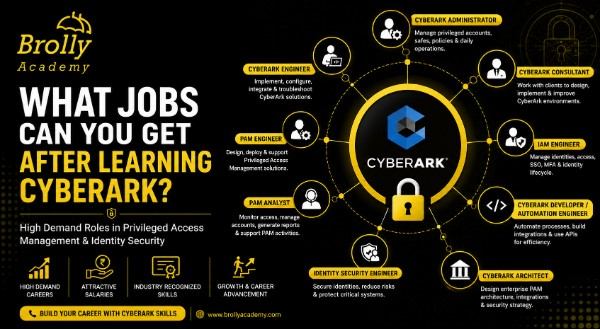
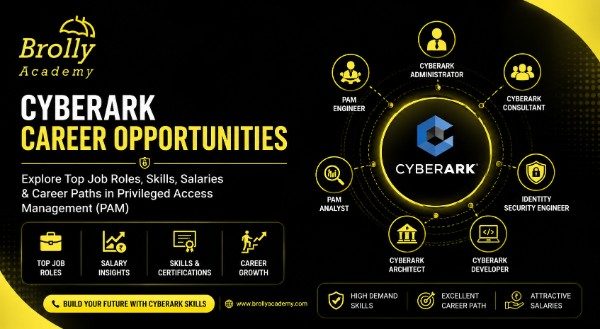
- CyberArk Administrator – Manages privileged accounts, Safes, access permissions, password policies, and routine PAM operations.
- CyberArk Engineer – Handles CyberArk configuration, implementation, integrations, maintenance, and technical troubleshooting.
- PAM Engineer – Designs, deploys, and supports privileged access management solutions in enterprise environments.
- CyberArk Consultant – Works with organizations to understand their security requirements and implement or improve CyberArk solutions.
- PAM Analyst – Supports privileged-access operations, account management, monitoring, reporting, and security processes.
- IAM Engineer – Works with identities, authentication, authorization, SSO, MFA, and access-management technologies.
- Identity Security Engineer – Helps protect user, privileged, application, and machine identities from unauthorized access.
- Cybersecurity Engineer – Applies broader security practices to protect systems, networks, identities, and sensitive resources.
- CyberArk Developer / Automation Engineer – Uses APIs, scripting, and automation to streamline PAM processes and integrations.
- CyberArk Architect – Designs large-scale PAM environments, integrations, security controls, and enterprise identity-security strategies.
A Practical Route into a CyberArk Role
Start by matching a role to its day-to-day work. An operations role may focus on onboarding accounts, investigating rotation failures and reviewing access. An implementation role may involve integrations, deployment design and controlled change. Job titles vary, so read the responsibilities carefully.
| Area | Practice evidence |
|---|---|
| Identity and access basics | Explain authentication, authorisation, least privilege and why shared administrator accounts create risk. |
| Account lifecycle | Document a lab-only account onboarding, access approval, credential rotation and removal process. |
| Troubleshooting | Write a fault report that separates network, permission, configuration and target-system causes. |
| Audit and operations | Explain what an audit record shows, who reviews it and how an exception is escalated. |
Use only an authorised lab or employer-approved environment. Do not put real passwords, private keys, client names or production screenshots in a public portfolio. A diagram, sanitised runbook and carefully described test case can demonstrate understanding without exposing credentials.
Read the official CyberArk documentation for the product and version you use. Self-hosted and cloud-delivered deployments differ; an installation procedure for one should not be applied blindly to the other. Verify current certification names, prerequisites and exam terms with the vendor before paying for an examination.
Interview example: when credential rotation fails, explain how you would check the approved logs, target connectivity, account permissions and policy configuration, then test a controlled correction. Avoid proposing that security controls should simply be disabled to make a job pass.
For learning support, review our CyberArk training syllabus and compare it with actual job requirements. Ask about practical access and trainer experience before enrolling. Course completion, a vendor credential and production experience are different forms of evidence; none guarantees a job or a stated salary.
Is CyberArk a Good Career?
This is one of the most common questions people ask before starting CyberArk training.
CyberArk can be a good career option if you enjoy working with cybersecurity, identities, access control, enterprise infrastructure, and problem-solving.
One reason is that identity has become an important part of modern cybersecurity. Companies need to know:
- Who has access?
- What systems can they access?
- Why do they need that access?
- How long should they have it?
- How are privileged credentials protected?
- What happens if a privileged account is compromised?
PAM technologies help organizations address these types of security requirements.
However, CyberArk is not necessarily the right career for everyone.
If you prefer application development, UI/UX, data science, or completely different technology areas, another specialization may be more suitable.
If you enjoy infrastructure and security, CyberArk can provide a focused path into identity and privileged access management.
What Jobs Can You Get After Learning CyberArk?
This is probably the most important question for someone considering CyberArk training.
After developing CyberArk knowledge and the supporting technical skills, you can target several types of roles.
CyberArk Administrator
A CyberArk Administrator generally handles the operational side of the PAM environment.
Typical responsibilities may include:
- Managing privileged accounts
- Account onboarding
- Safe administration
- Access management
- Password management
- Policy configuration
- Monitoring
- Troubleshooting
- Supporting users and administrators
This can be a suitable starting point for people with system administration or IAM experience.
PAM Engineer
A PAM Engineer typically works more deeply with implementation, configuration, integrations, maintenance, and troubleshooting.
A PAM Engineer may need knowledge of:
- CyberArk
- Windows
- Linux
- Active Directory
- Networking
- Authentication
- Authorization
- Enterprise infrastructure
This role is especially suitable for candidates who enjoy solving technical problems.
CyberArk Consultant
A CyberArk Consultant works with customers or internal teams to implement and improve privileged access management solutions.
The work may involve:
- Understanding requirements
- Designing the solution
- Configuring CyberArk
- Onboarding accounts
- Integrating systems
- Testing
- Troubleshooting
- Documentation
- Supporting production environments
Communication skills become increasingly important in consulting roles.
IAM Engineer
CyberArk skills can also lead into the wider Identity and Access Management (IAM) field.
IAM professionals may work with:
- Authentication
- Authorization
- User lifecycle
- Access management
- Single sign-on
- MFA
- Identity governance
- Privileged access
This gives you a broader career option instead of being dependent on one product.
Identity Security Engineer
Identity Security is another career direction.
Professionals in this area focus on protecting identities and controlling access to applications, systems, infrastructure, and sensitive resources.
CyberArk knowledge can complement skills in IAM, PAM, cloud security, and zero-trust security.
CyberArk Architect
Architect roles generally come later in the career.
A CyberArk Architect may work on:
- Enterprise architecture
- High availability
- Disaster recovery
- Integrations
- Security design
- Cloud environments
- Migration
- Scalability
- Technical standards
This is normally a senior-level position requiring significant hands-on experience.
Can Freshers Get CyberArk Jobs?
.ai-table{
width:100%;
min-width:1200px;
border-collapse:collapse;
font-family:'Poppins',sans-serif;
background:#fff;
}
.ai-table th{
background:#F5C518;
color:#111;
padding:18px;
text-align:left;
font-size:18px;
font-weight:700;
border:1px solid #ddd;
}
.ai-table td{
padding:18px;
border:1px solid #eee;
font-size:16px;
line-height:1.7;
vertical-align:top;
}
.ai-table tr:nth-child(even){
background:#fafafa;
}
.ai-table tr:hover{
background:#FFF8D6;
}
.ai-table td:first-child{
font-weight:700;
width:22%;
color:#111;
}
@media(max-width:768px){
.ai-table{
min-width:1200px;
}
.ai-table th,
.ai-table td{
padding:14px;
font-size:15px;
}
}
Yes, freshers can build a career in CyberArk, but expectations should be realistic.
CyberArk is an enterprise cybersecurity technology, and many employers prefer candidates who already understand basic IT infrastructure.
A fresher does not necessarily need years of CyberArk experience. However, having knowledge of the technologies around CyberArk can make your profile much stronger.
Start with:
Networking → Windows → Linux → Active Directory → Cybersecurity → IAM → PAM → CyberArk
Once you understand these concepts, CyberArk becomes easier to learn.
Freshers can look for roles such as:
- Junior Cybersecurity Analyst
- IAM Analyst
- PAM Support Engineer
- Junior CyberArk Engineer
- Security Support Engineer
- IAM Support Associate
The exact opportunities depend on the employer and current hiring requirements.
What Should Freshers Learn Before CyberArk?
If you are completely new to cybersecurity, don’t start by trying to memorize every CyberArk component.
Build the foundation first.
1. Networking
Understand:
- IP addresses
- TCP/IP
- DNS
- Ports
- Firewalls
- SSH
- HTTPS
- RDP
2. Windows
Learn:
- Windows Server basics
- Users
- Groups
- Services
- Permissions
- Authentication
3. Linux
Learn:
- Users and groups
- File permissions
- SSH
- Processes
- Services
- Basic shell commands
4. Active Directory
Understand:
- Domains
- Users
- Groups
- Domain controllers
- Group Policy
- Service accounts
5. Cybersecurity
Learn:
- Authentication
- Authorization
- Access control
- Privileged accounts
- Threats
- Vulnerabilities
- Security policies
6. IAM and PAM
Understand how organizations manage identities and privileged access.
Once these concepts are clear, you can move into CyberArk-specific learning.
Is CyberArk Good for Experienced IT Professionals?
Yes. In fact, CyberArk can be particularly relevant for professionals who already have experience in enterprise IT.
For example, consider a system administrator.
You may already know:
- Windows Server
- Active Directory
- Users and groups
- Permissions
- Enterprise troubleshooting
Adding CyberArk and PAM knowledge can help you move toward identity security.
Similarly:
Network Engineer → Cybersecurity/PAM
System Administrator → CyberArk Administrator/PAM Engineer
IAM Engineer → PAM Engineer
Cloud Engineer → Identity Security
Cybersecurity Analyst → PAM/Security Engineer
This means you don’t always have to start your career from zero.
Your existing experience can become the foundation for your CyberArk specialization.
What Skills Are Required for CyberArk Jobs?
If you search job descriptions for CyberArk and PAM roles, you will notice that employers often look beyond the CyberArk product itself.
Important skills include:
CyberArk
You should understand concepts related to:
- Privileged Access Management
- Account onboarding
- Credential management
- Password rotation
- Safes
- Access policies
- Session management
- Troubleshooting
- CyberArk architecture
Active Directory
Understand enterprise identity management and Windows authentication.
Windows and Linux
You should be comfortable working with common enterprise operating systems.
Networking
Networking fundamentals help when troubleshooting connectivity between CyberArk components and target systems.
Scripting
PowerShell and Python can help with automation and integrations.
APIs
Understanding REST APIs and JSON can be useful for integrations and automation.
Cloud
Knowledge of AWS, Azure, or other cloud environments can broaden your career options.
Do You Need Coding Skills for CyberArk?
Not every CyberArk job requires advanced programming.
If you are targeting an administrator or support-oriented role, strong administration and troubleshooting skills may be more important than advanced coding.
However, learning PowerShell, Python, REST APIs, and automation can become valuable as your career progresses.
For example, a senior engineer may need to automate repetitive tasks or integrate CyberArk with another enterprise application.
So you don’t need to become a software developer to work with CyberArk, but basic scripting can definitely strengthen your profile.
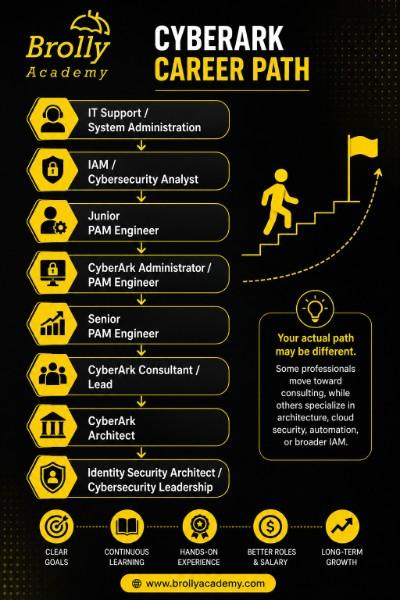
What Is the CyberArk Career Path?
A CyberArk career does not have to stop at administration.
A possible career path looks like this:
Frequently Asked Questions
1. Are CyberArk career opportunities good for complete freshers?
CyberArk isn’t typically the very first role in someone’s IT career, but it doesn’t require years of unrelated experience either. Candidates with foundational systems administration, networking, or general cybersecurity exposure — including through structured training — can transition into entry-level PAM roles relatively quickly.
2.Is CyberArk a good long-term career choice compared to other cybersecurity specializations?
CyberArk’s market leadership in PAM, combined with the persistent talent shortage and expanding regulatory requirements, makes it one of the more resilient specializations within cybersecurity. It also offers multiple career branches — engineering, consulting, security operations, and DevOps/cloud security — so you’re not locked into a single trajectory.
3. How long does it realistically take to become job-ready in CyberArk?
With structured, hands-on training that includes real lab practice, most learners can reach a genuinely job-ready level in roughly 2–4 months, particularly if they already have foundational IT experience.
4.Does a CyberArk career require strong coding skills?
No — basic scripting knowledge in PowerShell or Python is helpful, particularly for automation and custom integrations, but it’s not mandatory for most entry-level and mid-level roles. It becomes more relevant as you move toward DevOps-focused or highly customized implementation work.
5. What's the typical career progression timeline?
A common path looks like: 0–2 years as a PAM Engineer or Administrator, 2–5 years building deeper implementation and troubleshooting experience (often while pursuing Sentry certification), and 5+ years moving into Consultant or Architect roles, depending on how quickly you build both technical depth and client-facing skills.
6. Do I need a computer science degree to pursue a CyberArk career?
Not necessarily. Many successful PAM professionals come from systems administration, network engineering, or general IT support backgrounds without a formal computer science degree. What matters more is demonstrable hands-on skill, relevant certification, and practical troubleshooting ability.
7.Which city in India offers the best CyberArk career opportunities?
Bengaluru, Hyderabad, Pune, Chennai, Gurugram, and Mumbai all have strong concentrations of CyberArk roles, largely driven by the presence of global capability centers, IT services firms, and BFSI headquarters in those cities. Remote and hybrid roles have also become more common, widening access beyond these hubs.
Key Takeaways
- CyberArk skills are in high demand as organizations strengthen privileged access and identity security.
- CyberArk careers are not limited to one role; opportunities include CyberArk Administrator, PAM Engineer, CyberArk Consultant, IAM Engineer, Identity Security Engineer, and CyberArk Architect.
- Freshers can enter the field through IT support, system administration, IAM, cybersecurity, or PAM-focused roles.
- CyberArk certifications and hands-on projects can help candidates demonstrate practical knowledge to employers.
- Core skills include Privileged Access Management (PAM), CyberArk Vault, Safes, CPM, PSM, PVWA, authentication, access control, and troubleshooting.
- Experienced professionals can progress from Administrator or PAM Engineer to Consultant, Lead, Architect, and broader Identity Security roles.
- CyberArk professionals can find opportunities across IT services, consulting, banking, healthcare, telecom, and other security-focused industries.
- Practical experience matters—real-time projects, troubleshooting scenarios, automation, and knowledge of enterprise environments can strengthen your profile.
- The career path can expand beyond CyberArk, toward IAM, identity security, cloud security, cybersecurity architecture, and security leadership.
- Continuous learning is essential because PAM and identity security technologies are evolving rapidly.
Conclusion
CyberArk is no longer limited to traditional password management. As organizations strengthen Privileged Access Management (PAM), Identity Security, and Zero Trust, CyberArk skills are becoming valuable across cybersecurity teams. You do not need to start as a cybersecurity expert to build a career in this field. With the right fundamentals, hands-on practice, and real-world project experience, you can gradually move from entry-level IT or IAM roles into specialized CyberArk positions.
If you understand the CyberArk fundamentals covered in this guide, the next step is to build practical skills. Learn how the CyberArk Vault, PVWA, CPM, and PSM work, practice onboarding and managing privileged accounts, troubleshoot common PAM issues, and understand how CyberArk fits into an organization’s overall identity-security strategy.
The career path can grow from IT Support / System Administration → IAM or Cybersecurity Analyst → Junior PAM Engineer → CyberArk Administrator / PAM Engineer → Senior PAM Engineer → CyberArk Consultant / Lead → CyberArk Architect → Identity Security Architect or Cybersecurity Leadership.
If you want a guided, hands-on path from beginner to CyberArk professional, Brolly Academy can help. Our practical CyberArk training in Hyderabad focuses on real-time projects, hands-on learning, interview preparation, certification guidance, and 100% Placement Assistance.
Talk to our team today.
📞 Call: +91 81868 44555
📧 Email: brollyacademy@gmail.com
🌐 Web: brollyacademy.com
📍 Address: Metro Pillar No. A689, JNTU Metro Station, 3rd Floor, Hyderabad – 500072