
CyberArk Salary in India
What Is the CyberArk Salary in India?
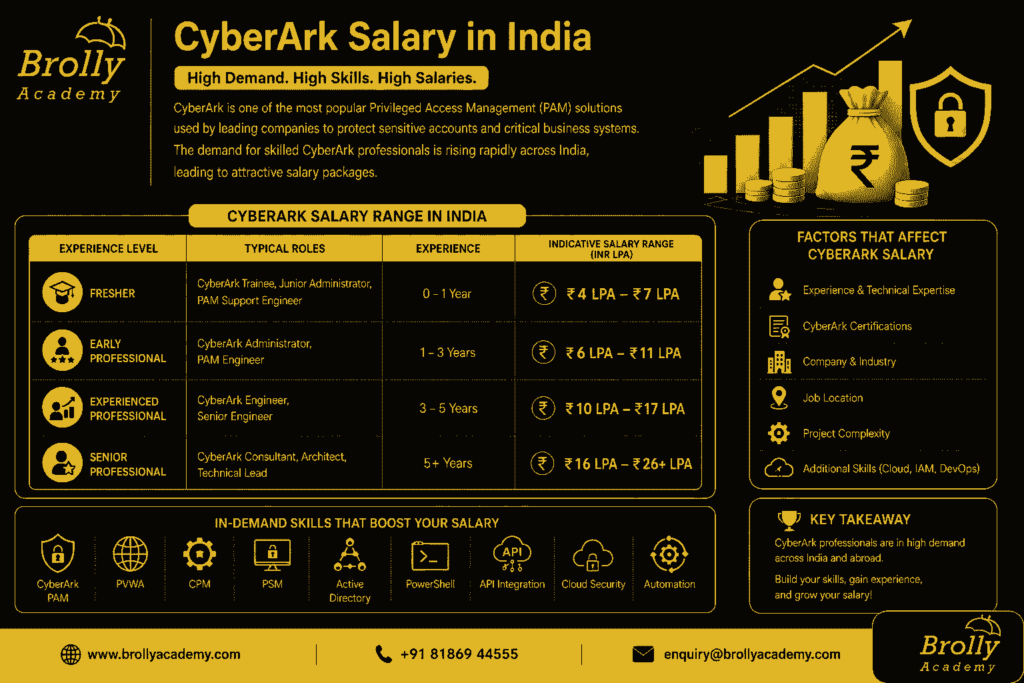
The CyberArk salary in India varies considerably depending on the professional’s experience and responsibilities.
For an easy reference, you can present the salary ranges as:
Experience | Indicative Salary Range |
Fresher / 0–1 Year | ₹4–8 LPA |
1–3 Years | ₹6–12 LPA |
3–5 Years | ₹8–18 LPA |
5–8 Years | ₹15–25 LPA |
8+ Years | ₹20–30+ LPA |

Share
Table of Contents
Listen to This Guide: CyberArk salary in India Chatbots
Don’t have time to read? Listen to this quick audio summary to learn about CyberArk salary in India, salary ranges by experience and job role, top CyberArk hiring locations, essential skills, certification, and career growth opportunities.
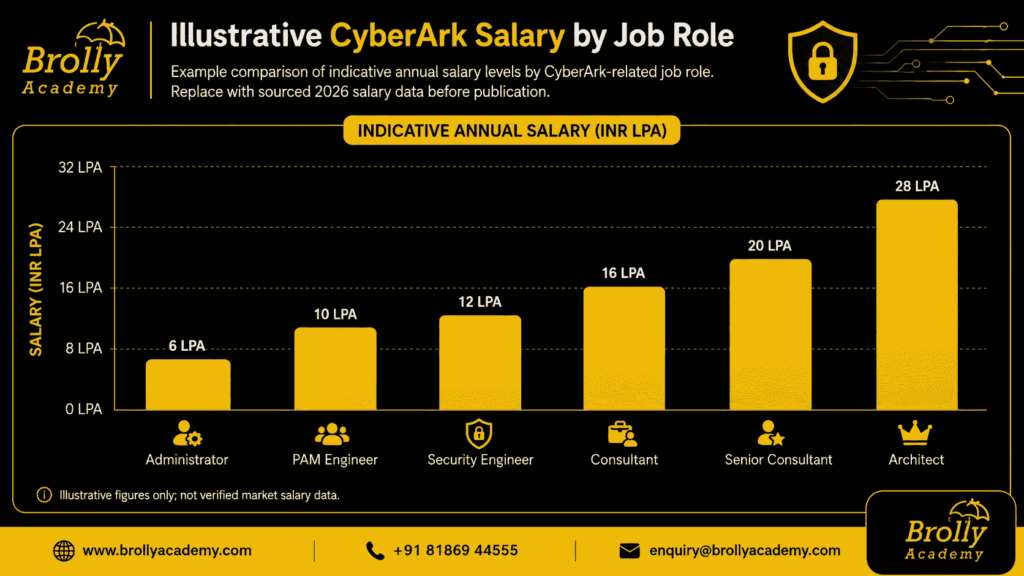
Illustrative CyberArk Salary by Job Role
What Does a CyberArk Professional Do?
.ai-chatbots-table{
width:100%;
min-width:1200px;
border-collapse:collapse;
font-family:'Poppins',sans-serif;
background:#fff;
}
.ai-chatbots-table th{
background:#F5C518;
color:#111;
padding:18px;
text-align:left;
font-size:18px;
font-weight:700;
white-space:nowrap;
}
.ai-chatbots-table td{
padding:18px;
border-bottom:1px solid #ececec;
font-size:16px;
line-height:1.7;
vertical-align:top;
}
.ai-chatbots-table tr:nth-child(even){
background:#fafafa;
}
.ai-chatbots-table tr:hover{
background:#fff8d7;
}
.ai-chatbots-table td:first-child{
font-weight:600;
color:#000;
}
@media(max-width:768px){
.ai-chatbots-table{
min-width:1100px;
}
.ai-chatbots-table th,
.ai-chatbots-table td{
font-size:15px;
padding:14px;
}
}
Before looking at salary, it helps to understand what CyberArk professionals actually do.
A CyberArk professional may be responsible for securing and managing privileged accounts and access within an organization’s IT environment.
Typical responsibilities can include:
- Managing privileged accounts
- Onboarding accounts into CyberArk
- Configuring and managing Safes
- Working with PVWA
- Managing CPM policies
- Supporting PSM sessions
- Monitoring privileged access
- Troubleshooting access-related issues
- Managing password rotation
- Integrating CyberArk with Active Directory
- Supporting audits and compliance requirements
- Working with automation and APIs
The exact responsibilities depend on whether you work as an Administrator, Engineer, Consultant, IAM Specialist, or Architect.
CyberArk Salary for Freshers in India
Starting a career in CyberArk doesn’t necessarily mean you need years of CyberArk experience.
Freshers and early-career professionals can build their profile by developing a foundation in:
- Cybersecurity
- PAM concepts
- Windows administration
- Linux
- Active Directory
- Networking
- CyberArk fundamentals
- PowerShell
- Basic scripting
Practical lab experience can also help candidates explain how they would handle real-world CyberArk tasks during interviews.
Entry-Level CyberArk Roles
You may find entry-level opportunities under titles such as:
- CyberArk Support Engineer
- PAM Support Engineer
- IAM Analyst
- Junior CyberArk Administrator
- PAM Engineer – Trainee
The salary for these roles depends heavily on the company, location, candidate background, and actual responsibilities.
Quick Salary Highlights
Experience | Average Salary | Expected Range |
Fresher (0–1 Year) | ₹5 LPA | ₹4–7 LPA |
1–3 Years | ₹8 LPA | ₹6–11 LPA |
3–5 Years | ₹13 LPA | ₹10–17 LPA |
5–8 Years | ₹18 LPA | ₹15–22 LPA |
8+ Years | ₹27 LPA | ₹20–35+ LPA |
Salary by Job Role :
Job Role | Average Salary |
CyberArk Administrator | ₹5–10 LPA |
CyberArk Engineer | ₹7–14 LPA |
PAM Engineer | ₹8–15 LPA |
IAM Engineer | ₹8–16 LPA |
CyberArk Consultant | ₹12–22 LPA |
CyberArk Architect | ₹22–35+ LPA |
Job Role | Career Focus |
CyberArk Administrator | Platform administration and support |
CyberArk Engineer | Implementation and technical operations |
PAM Engineer | Privileged access management |
IAM Engineer | Identity and access security |
CyberArk Consultant | Implementation and client solutions |
IAM/PAM Architect | Solution design and architecture |
Security Consultant | Broader security strategy |
Cybersecurity Manager | Leadership and security operations |
CyberArk Salary by City in India
Location can influence salary because cybersecurity hiring is concentrated in major technology and business hubs.
Major CyberArk Hiring Locations
Bengaluru
A major technology hub with opportunities across IT services, consulting, product companies, and cybersecurity teams.
Hyderabad
A strong market for enterprise IT, cloud, cybersecurity, and global capability centers.
Pune
A significant technology and financial-services hub with demand for IAM and security professionals.
Chennai
Offers opportunities across IT services, manufacturing, banking, and enterprise technology.
Mumbai
Strong opportunities across BFSI, consulting, technology, and large enterprises.
Gurugram and Noida
Important markets for consulting, enterprise technology, and cybersecurity roles.
City | Average Salary |
Hyderabad | ₹8–15 LPA |
Bengaluru | ₹9–16 LPA |
Pune | ₹8–15 LPA |
Chennai | ₹7–14 LPA |
Mumbai | ₹9–17 LPA |
What Skills Can Increase Your CyberArk Salary?
Learning CyberArk is the starting point. Building complementary skills can make your profile more useful for advanced roles.
1. CyberArk PAM
Understand privileged accounts, Safes, policies, credential management, and privileged access workflows.
2. PVWA
Learn how to manage users, Safes, accounts, permissions, and privileged access through the CyberArk web interface.
3. CPM
Understand password management, automatic rotation, verification, and policy-based credential management.
4. PSM
Learn privileged session management, monitoring, recording, and secure remote access.
5. Active Directory
AD knowledge is valuable because enterprise CyberArk environments often interact with directory services.
6. PowerShell
PowerShell can help automate repetitive administration and operational tasks in Windows environments.
7. REST APIs
API knowledge can help with integrations, automation, and connecting CyberArk with other enterprise applications.
8. Cloud Security
Understanding AWS, Azure, cloud IAM, secrets management, and cloud security can broaden your career options.
9. Linux and Windows
Strong operating-system knowledge helps with implementation, administration, and troubleshooting.
10. Automation
Automation can help CyberArk professionals move beyond routine administration toward more advanced engineering responsibilities.
Does CyberArk Certification Increase Salary?
.ai-table{
width:100%;
min-width:1200px;
border-collapse:collapse;
font-family:'Poppins',sans-serif;
background:#fff;
}
.ai-table th{
background:#F5C518;
color:#111;
padding:18px;
text-align:left;
font-size:18px;
font-weight:700;
border:1px solid #ddd;
}
.ai-table td{
padding:18px;
border:1px solid #eee;
font-size:16px;
line-height:1.7;
vertical-align:top;
}
.ai-table tr:nth-child(even){
background:#fafafa;
}
.ai-table tr:hover{
background:#FFF8D6;
}
.ai-table td:first-child{
font-weight:700;
width:22%;
color:#111;
}
@media(max-width:768px){
.ai-table{
min-width:1200px;
}
.ai-table th,
.ai-table td{
padding:14px;
font-size:15px;
}
}
Certification can strengthen your resume, but it shouldn’t be presented as an automatic salary guarantee.
A stronger formula is:
CyberArk Certification + Hands-on Experience + Projects + Technical Skills
Consider certifications as part of your professional development rather than the only route to a higher salary.
For your page, you can create a separate section explaining relevant CyberArk certification pathways and how they fit into different career stages.
CyberArk Salary vs Other IAM Technologies
A comparison section can help users who are deciding which identity-security specialization to pursue.
Technology / Role | Primary Focus |
CyberArk | Privileged Access Management |
SailPoint | Identity Governance |
Okta | Identity and Access Management |
Microsoft Entra ID | Cloud Identity |
BeyondTrust | Privileged Access Management |
Delinea | Privileged Access Management |
CyberArk Career Roadmap
A CyberArk career can develop gradually as you build technical knowledge and practical experience.
The skills required at each stage can change as your responsibilities increase. Focus on building practical experience first and then gradually add automation, cloud security, architecture, and leadership skills.

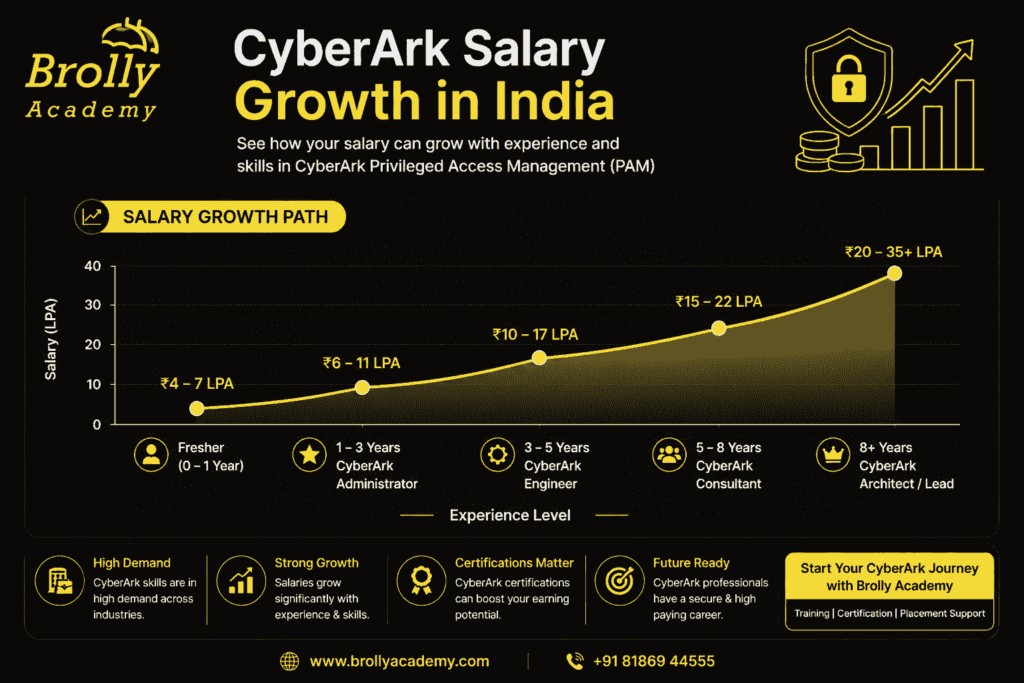
CyberArk Salary Growth:
One of the biggest advantages of building a career in CyberArk is the opportunity for steady salary growth as your skills and experience increase. Professionals who continuously improve their technical expertise, work on real-world projects, earn industry-recognized certifications, and gain hands-on experience with enterprise CyberArk implementations often progress to higher-paying roles.
In the early stages of your career, you may begin as a CyberArk Administrator or Support Engineer. As you gain practical experience with CyberArk components such as PVWA, CPM, PSM, Vault, automation, and cloud security, you can advance to roles like CyberArk Engineer, PAM Consultant, Identity Security Engineer, and eventually CyberArk Architect or Security Consultant. Each career step typically brings increased responsibilities, more complex projects, and improved earning potential.
The chart below illustrates an example of how salary can grow throughout a CyberArk career. It provides a general career progression based on increasing experience and responsibilities. Actual salary growth may vary depending on your technical skills, certifications, employer, job location, industry, and overall market demand.
Note: The salary growth chart is for illustrative purposes only. Actual salary progression depends on multiple factors, including individual performance, project experience, certifications, employer policies, and prevailing market conditions.
Recommended Salary Growth Chart | ||
Experience | Typical Career Stage | Illustrative Salary Range |
Fresher (0–1 Year) | CyberArk Support Engineer | ₹4–7 LPA |
1–3 Years | CyberArk Administrator | ₹6–11 LPA |
3–5 Years | CyberArk Engineer | ₹10–17 LPA |
5–8 Years | CyberArk Consultant | ₹15–22 LPA |
8+ Years | CyberArk Architect / Lead | ₹20–35+ LPA |
Is CyberArk a Good Career in India?
CyberArk can be a good career option for professionals interested in cybersecurity, identity security, and Privileged Access Management.
It can be especially relevant for people with backgrounds in:
- System Administration
- Windows Administration
- Linux
- IAM
- Networking
- Cybersecurity
- Cloud Administration
Instead of completely changing your career direction, you can build on your existing IT knowledge and specialize in PAM and identity security.
What Is the Future of CyberArk Careers?
.ai-table{
width:100%;
min-width:1000px;
border-collapse:collapse;
font-family:'Poppins',sans-serif;
background:#fff;
}
.ai-table th{
background:#F5C518;
color:#111;
padding:18px;
text-align:left;
font-size:18px;
font-weight:700;
}
.ai-table td{
padding:18px;
border-bottom:1px solid #ececec;
font-size:16px;
line-height:1.7;
vertical-align:top;
}
.ai-table tr:nth-child(even){
background:#fafafa;
}
.ai-table tr:hover{
background:#fff8d7;
}
.ai-table td:first-child{
font-weight:600;
width:22%;
color:#111;
}
@media(max-width:768px){
.ai-table{
min-width:900px;
}
.ai-table th,
.ai-table td{
font-size:15px;
padding:14px;
}
}
The future of CyberArk-related careers is connected to the wider growth of identity security, privileged access management, cloud adoption, automation, and Zero Trust security.
Professionals who combine CyberArk with cloud, automation, IAM, and broader cybersecurity knowledge can create more flexible career opportunities.
Rather than limiting yourself to one platform, focus on understanding the security problems CyberArk helps organizations solve.
Frequently Asked Questions
1. What is the average CyberArk salary in India?
The average CyberArk salary in India depends on experience, technical skills, certifications, job role, company, and location. Entry-level professionals generally earn competitive salaries, while experienced CyberArk Engineers, Consultants, and Architects receive significantly higher compensation. Professionals with expertise in Privileged Access Management (PAM), automation, cloud security, and enterprise implementations often have better earning potential.
2. What is the CyberArk salary for freshers in India?
Freshers who complete CyberArk training, gain hands-on experience through real-time projects, and develop strong technical skills can begin their careers with attractive salary packages. Employers often prefer candidates who understand CyberArk components, Windows and Linux administration, Active Directory, and cybersecurity fundamentals.
3. What factors affect CyberArk salary in India?
Several factors influence CyberArk salaries, including years of experience, technical expertise, certifications, company size, industry, city, project complexity, cloud security knowledge, scripting skills, interview performance, and communication abilities. Professionals who continuously upgrade their skills generally receive better salary packages.
4. Which CyberArk job role offers the highest salary?
Senior positions such as CyberArk Architect, CyberArk Consultant, Identity Security Engineer, and PAM Solution Architect are among the highest-paying roles. These positions require extensive experience, advanced technical knowledge, leadership skills, and enterprise implementation expertise.
5. Which cities offer the highest CyberArk salaries in India?
Major IT hubs such as Hyderabad, Bengaluru, Pune, Chennai, Mumbai, Noida, and Gurugram provide excellent career opportunities for CyberArk professionals. Salaries vary based on company, demand, cost of living, and the availability of cybersecurity projects.
6. Which companies hire CyberArk professionals in India?
Many leading organizations recruit CyberArk professionals, including global IT service providers, consulting firms, product companies, banks, healthcare organizations, and cloud service providers. Companies implementing Privileged Access Management solutions regularly hire CyberArk Administrators, Engineers, Consultants, and Architects.
7. Does CyberArk certification help increase salary?
Yes. CyberArk certifications demonstrate technical expertise and practical knowledge, making candidates more attractive to employers. Certified professionals often qualify for advanced roles and may receive better salary offers compared to non-certified candidates with similar experience.
8. What skills can help increase CyberArk salary?
Professionals who develop expertise in CyberArk PAM, PVWA, CPM, PSM, Vault Administration, PowerShell, REST APIs, Active Directory, Windows Server, Linux Administration, AWS, Azure, and Identity Security generally have stronger career prospects and higher earning potential.
9. Is CyberArk a good career in India?
Yes. CyberArk is one of the fastest-growing cybersecurity domains because organizations continue to invest in Identity Security and Privileged Access Management. As cyber threats evolve, skilled CyberArk professionals remain in high demand across multiple industries.
10. Is CyberArk in demand in India?
Yes. CyberArk professionals are increasingly sought after by organizations in banking, finance, healthcare, manufacturing, government, telecommunications, and IT services. Growing cybersecurity investments continue to create strong demand for experienced CyberArk specialists.
Key Takeaways
- CyberArk salary in India varies by experience, job role, skills, location, and employer, so there is no single salary figure for every CyberArk professional.
- Freshers and entry-level professionals can begin with CyberArk, PAM, or IAM roles, with salary depending on their technical foundation and practical exposure.
- Experience matters: professionals can progress from CyberArk Administrator and PAM Engineer roles to Senior Engineer, Consultant, Lead, and Architect positions.
- Hands-on CyberArk skills can improve career opportunities. Knowledge of PVWA, CPM, PSM, Vault, account onboarding, troubleshooting, and PAM administration is valuable for practical roles.
- Automation and integration skills add value. PowerShell, REST APIs, Python, Active Directory, and cloud security can help professionals move toward more advanced CyberArk positions.
- Location and employer can influence compensation. Major technology hubs such as Hyderabad, Bengaluru, Pune, Mumbai, Chennai, and NCR have significant cybersecurity and PAM opportunities.
- Certifications can strengthen your profile, but certification alone does not guarantee a higher salary. Practical experience and the ability to solve real-world CyberArk problems are equally important.
- Senior CyberArk professionals can move into consulting and architecture, where responsibilities include enterprise PAM implementation, solution design, integrations, security strategy, and technical leadership.
- Salary data should be treated as indicative rather than guaranteed. Public salary platforms use different job titles, sample sizes, and methodologies; for example, Glassdoor and Indeed report different figures for CyberArk-related roles.
- The best way to increase your earning potential is to build a complete skill profile: CyberArk + PAM + Automation + Cloud + IAM + Real-Time Experience.
Conclusion
A career in CyberArk and Privileged Access Management (PAM) can offer strong salary growth in India as organizations continue to strengthen their cybersecurity and identity security practices. Your earning potential depends on your experience, CyberArk skills, certifications, job role, location, and hands-on project experience. Freshers can start by building a strong foundation, while experienced professionals can move into roles such as CyberArk Engineer, PAM Consultant, Security Architect, or CyberArk Administrator.
If you want to build practical CyberArk skills and prepare for real-world job opportunities, Brolly Academy offers hands-on CyberArk training in Hyderabad with real-time projects, certification guidance, and placement assistance.
Take the next step toward your CyberArk career today.
📞 Call: +91 81868 44555
📧 Email: brollyacademy@gmail.com
🌐 Web: brollyacademy.com
📍 Metro Pillar No. A689, JNTU Metro Station, 3rd Floor, Hyderabad – 500072