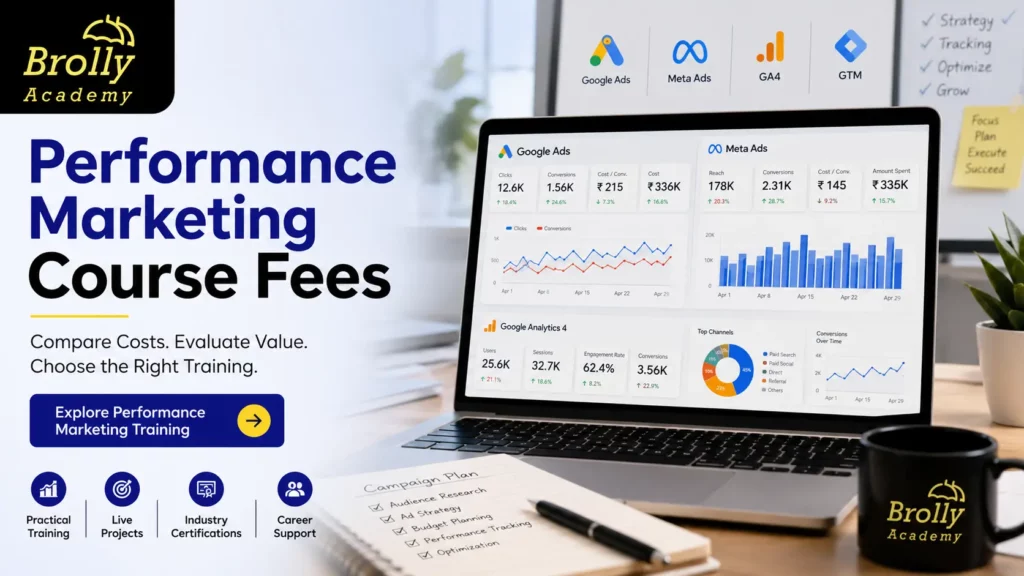
Performance Marketing Course Fees:
A Complete Guide to Cost, Value & Choosing the Right Training
Explore Performance Marketing Training Fees in Hyderabad, compare training costs, understand what is included in the fee, evaluate practical learning, certifications, career support, and choose the right performance marketing training program for long-term career growth.

Share
Table of Contents
Introduction
If you are searching for Performance Marketing Course Fees, you are probably asking one important question:
How much should you invest in a Performance Marketing course, and how do you know it’s worth it?
That is the right question to ask.
Today, there are hundreds of institutes offering performance marketing training, and the course fees can vary significantly. Some programs are available at a relatively low cost, while others charge a much higher fee for what may seem like similar content. This often leaves students, working professionals, business owners, and career switchers wondering what makes one program different from another.
The cost of a training program is only one part of the decision. The real value comes from the quality of learning, practical experience, and career support it provides. A course with a lower fee may seem like a smart choice initially, but if it doesn’t include hands-on training, current industry tools, experienced mentors, or career support, it may not equip you with the practical skills employers value. On the other hand, paying a higher fee does not automatically guarantee better learning or better career outcomes.
The real value of a performance marketing training program comes from what you receive in return for your investment.
A well-designed training program should help you build practical skills, work on real campaigns, understand industry tools, earn valuable certifications, and develop the confidence to manage advertising campaigns in real business environments.
Before enrolling in any program, it is important to understand what influences Performance Marketing Course Fees, what should be included in the fee you pay, and how to identify a training program that offers genuine value instead of attractive marketing promises.
In this guide, you’ll learn:
- The average cost of a performance marketing course
- Why course fees vary between training institutes
- The factors that influence pricing
- What should be included in a quality training program
- How to compare different training institutes
- How to make an informed investment based on your learning and career goals
Whether you are a beginner exploring digital marketing, a professional looking to upgrade your skills, a freelancer planning to expand your services, or a business owner wanting to run profitable advertising campaigns, this guide will help you understand how to choose a performance marketing training program that delivers real value for your investment.
What is the average fee for a Performance Marketing Course?
Before enrolling, many aspiring learners want a clear answer to one important question:
“What is the average fee for a Performance Marketing Course?”
While there is no single fixed fee, the cost usually depends on the quality of training, learning format, trainer experience, practical exposure, certifications, and career support offered by the institute.
Instead of focusing only on finding the lowest-priced option, it is more useful to understand what contributes to the overall value of the training.
Generally, performance marketing training programs fall into different pricing categories based on their depth and learning outcomes.
Entry-Level Training Programs
These programs are designed for beginners who want to understand the fundamentals of performance marketing.
They typically introduce concepts such as:
- Digital marketing basics
- Google Ads fundamentals
- Meta Ads basics
- Campaign structure
- Basic analytics
Although these programs help learners understand the basics, they often provide limited hands-on experience and fewer chances to apply their knowledge through real or simulated campaigns.
Intermediate Performance Marketing Training
Intermediate programs usually provide a more balanced learning experience.
Students often receive training in:
- Search advertising
- Display advertising
- Meta advertising
- Conversion tracking
- Google Analytics 4 (GA4)
- Google Tag Manager (GTM)
- Campaign optimization
Many institutes also include practical assignments and case studies that help learners understand how advertising campaigns perform in real business scenarios.
Advanced Performance Marketing Training
Advanced training programs are designed for learners who want to build job-ready skills.
These programs generally include:
- Advanced Google Ads strategies
- Performance Max campaigns
- Shopping campaigns
- Advanced audience targeting
- Attribution models
- Landing page optimization
- Budget optimization
- AI-powered marketing workflows
- Reporting dashboards
- Portfolio development
Many advanced programs also include live projects, interview preparation, and placement assistance, making them a better long-term investment for learners aiming to build a career in performance marketing.
What Influences the Overall Course Cost?
Rather than comparing fees alone, ask yourself:
- Does the program include practical training?
- Does the training include opportunities to gain hands-on experience by working on real or simulated advertising campaigns?
- Are industry-standard tools covered?
- Is certification included?
- Does the institute offer placement support?
- Will I receive mentorship from experienced trainers?
- Is the curriculum regularly updated?
The answers to these questions often provide a clearer picture of a program’s value than its fee alone.
A training program that helps you gain practical skills and prepares you for real industry challenges is usually a better investment than one that simply offers the lowest price.
Is an Expensive Course Always Better?
Not necessarily.
A higher course fee should reflect better learning outcomes rather than higher marketing costs.
The true value of a performance marketing training program lies in the learning experience it offers, including:
- An updated industry-focused syllabus
- Practical campaign experience
- Experienced trainers
- Hands-on learning
- Career guidance
- Portfolio development
- Placement assistance
- Access to relevant marketing tools
If these elements are missing, paying a higher fee may not provide better value.
Instead of asking,
“Which course is the cheapest?”
A better question is,
“How can I identify a performance marketing training program that offers the right balance of quality learning and career growth?”
That shift in perspective can help you make a smarter decision and achieve stronger long-term results.
Why Do Performance Marketing Course Fees Vary Between Training Institutes?
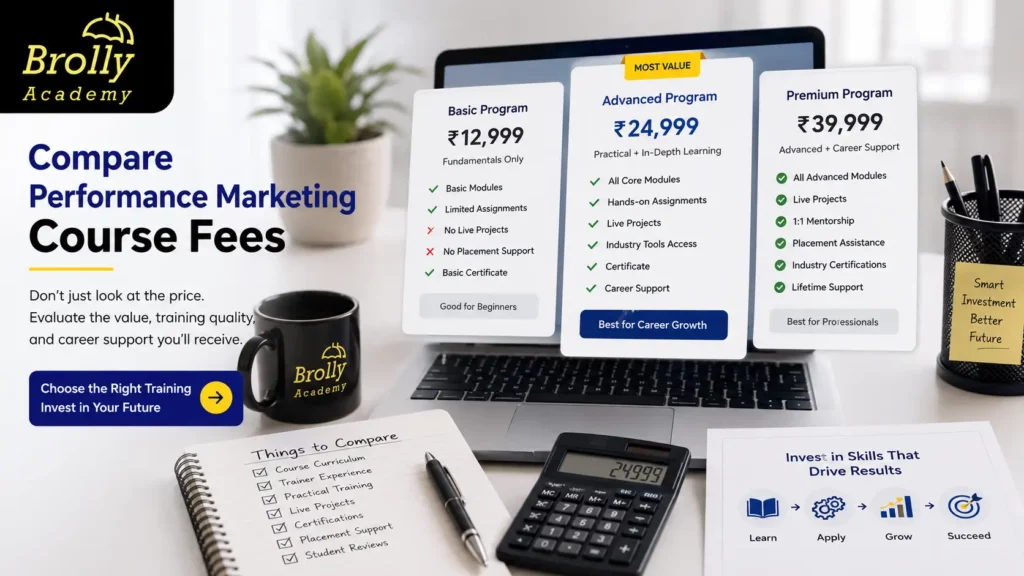
If you’ve compared multiple institutes, you’ve probably noticed that Performance Marketing Course Fees can vary considerably, even when the course titles appear similar.
This often creates confusion for prospective learners.
One institute may advertise a lower fee, while another charges significantly more for what seems to be the same training. However, once you look beyond the price, you’ll often find important differences in the quality of education, practical exposure, and career support.
Understanding these differences helps you evaluate the true value of a performance marketing training program rather than making a decision based only on cost.
Trainer Expertise
One of the biggest factors influencing course fees is the experience of the trainers.
Programs taught by professionals who actively manage advertising campaigns or have worked with businesses across different industries often provide more practical insights than programs focused only on theory.
Experienced trainers can share real campaign examples, explain common mistakes, and teach optimization techniques that are difficult to learn from recorded videos alone.
Course Duration
Training programs vary in both duration and depth.
Some courses focus only on basic concepts, while others provide comprehensive training that covers planning, execution, optimization, reporting, and campaign analysis.
Longer programs usually require more instructor involvement, additional learning resources, and more practical sessions, which naturally influences the course fee.
Practical Training
Performance marketing is a skill that develops through practice.
A quality training program should provide opportunities to:
- Create advertising campaigns
- Analyze campaign performance
- Optimize budgets
- Track conversions
- Interpret campaign reports
- Solve real marketing problems
Programs with extensive hands-on learning generally require more resources, making them different from courses that rely primarily on classroom lectures.
Live Projects
Working on live or simulated campaigns gives learners valuable practical experience.
Instead of only understanding advertising concepts, students learn how campaigns perform under real conditions.
This practical exposure helps bridge the gap between learning and professional work, making it an important factor when comparing performance marketing training programs.
Access to Industry Tools
Modern performance marketing relies on several professional tools.
A comprehensive training program may include exposure to tools such as:
- Google Ads
- Google Analytics 4
- Google Tag Manager
- Meta Ads Manager
- Keyword research platforms
- Landing page analysis tools
- Reporting dashboards
Providing access to these tools often adds value to the learning experience.
Certification
Many learners also consider certification when evaluating a course.
Some institutes prepare students for industry-recognized certifications, while others provide only internal completion certificates.
Although certification is valuable, it should complement practical learning rather than replace it.
Employers generally look for candidates who can demonstrate real skills alongside recognized credentials.
Placement Support
Career support is another important factor that influences course fees.
Some training institutes provide services such as:
- Resume building
- Interview preparation
- Mock interviews
- Portfolio guidance
- Job referrals
- Placement assistance
For learners planning to start a career in performance marketing, these services can significantly improve job readiness and long-term career growth.
The Right Question Is About Value, Not Just Price
When comparing different institutes, avoid making your decision based only on the course fee.
Instead, compare the complete learning experience.
Ask yourself:
- Does the syllabus match current industry requirements?
- Will I gain practical experience?
- Are live projects included?
- Do trainers have real industry expertise?
- Is career support available after training?
- Will the skills help me succeed in real performance marketing roles?
A training program that answers “yes” to most of these questions often provides greater long-term value than a cheaper program that focuses only on theory.
Choosing the right performance marketing training is not simply about spending less. It is about investing in skills, practical experience, and career opportunities that continue to deliver value long after the course is completed.
Factors That Influence Performance Marketing Course Fees
Not every performance marketing training program is designed the same way. Some focus only on teaching concepts, while others aim to prepare learners for real-world marketing roles through practical experience and career support.
The table below summarizes the major factors that commonly influence Performance Marketing Course Fees and explains why they matter when evaluating the overall value of a training program.
Factor | How It Influences the Course Fee |
Trainer Experience | Industry experts with practical campaign experience often provide deeper learning and mentorship. |
Course Duration | Comprehensive programs usually require more instructional time and practical sessions. |
Live Projects | Hands-on campaign experience adds significant learning value. |
Industry Tools | Access to platforms such as Google Ads, GA4, GTM, and Meta Ads enhances practical learning. |
Updated Syllabus | A curriculum aligned with current industry trends prepares learners for today’s marketing landscape. |
Certifications | Preparation for recognized certifications can increase the overall value of the program. |
Placement Assistance | Resume support, interview preparation, and hiring guidance contribute to career readiness. |
Batch Size | Smaller batches often provide better interaction, personalized feedback, and mentoring. |
Learning Resources | Templates, assignments, recordings, and additional study material improve the overall learning experience. |
While course fees are important, they should never be the only deciding factor. Looking at the complete learning experience helps you choose a performance marketing training program that offers meaningful value and supports your long-term career goals.
Does Performance Marketing Certification Add Value to the Course Fee?
When comparing Performance Marketing Course Fees, many learners ask an important question:
“Does certification really make a difference?”
The short answer is yes, but only when certification is supported by practical skills.
Today, employers are not simply looking for candidates who have completed a course. They seek professionals who can create effective campaigns, optimize advertising budgets, analyze campaign performance, and drive measurable business results.
A certificate can help validate your learning, but your ability to apply that knowledge is what creates real career opportunities.
If you’re investing in a performance marketing training program, certification should be viewed as an added advantage rather than the primary reason for enrolling.
Industry Certifications vs Institute Certifications
Not all certifications carry the same value.
Upon successfully completing the training, participants are awarded a certificate recognizing their course completion.
Some institutes also prepare students for globally recognized certifications offered by major advertising platforms.
Both have their own purpose.
An institute certificate reflects that you have completed structured training, while an industry-recognized certification demonstrates your understanding of platform-specific concepts and best practices.
Combining practical skills with recognized certifications creates a stronger professional profile.
Certification Supports Skill Validation
Recruiters receive numerous applications from candidates with similar academic backgrounds.
A certification can help your profile stand out, especially when combined with practical projects and campaign experience.
However, employers usually ask questions such as:
- Have you managed advertising campaigns?
- Can you optimize campaign performance?
- Do you understand conversion tracking?
- Can you explain campaign results using data?
Your answers to these questions matter more than simply showing a certificate.
Certification Should Reflect Current Industry Practices
The best training programs don’t separate certification from practical implementation.
Instead, they help learners:
- Understand advertising concepts
- Apply those concepts in projects
- Analyze campaign performance
- Build confidence using industry tools
- Prepare for interviews
This combination creates stronger job readiness than certification alone.
Certification Is More Valuable When Combined with Practical Learning
The best training programs don’t separate certification from practical implementation.
Instead, they help learners:
- Understand advertising concepts
- Apply those concepts in projects
- Analyze campaign performance
- Build confidence using industry tools
- Prepare for interviews
This combination creates stronger job readiness than certification alone.
Should Certification Influence Your Course Selection?
Certification is an important factor, but it should never be the only factor.
Before enrolling, ask questions such as:
- Is the certification supported by practical projects?
- Does the training include hands-on campaign experience?
- How will I build my portfolio during the course?
- Are trainers experienced in managing real advertising campaigns?
- Does the institute provide career guidance after certification?
When certification becomes part of a complete learning experience, it adds genuine value to your investment.
Does Placement Assistance Make a Higher Course Fee Worth It?
For many learners, the ultimate goal of joining a performance marketing training program is not simply earning a certificate.
It is building a successful career.
This is why placement assistance has become one of the biggest factors influencing Performance Marketing Course Fees.
Some institutes provide only classroom training, while others continue supporting learners even after the program is completed.
Understanding what placement support actually includes can help you decide whether paying a higher fee is justified.
Resume Building
Your resume is often the first thing recruiters evaluate before deciding whether to move your application to the next stage.
Good training institutes often guide learners on how to present:
- Skills
- Projects
- Certifications
- Internship experience
- Marketing tools
- Campaign achievements
A professionally crafted resume improves your chances of getting shortlisted by recruiters and landing interviews.
Interview Preparation
While many freshers have a good grasp of the concepts, they often struggle to explain how they would use those skills in practical business situations.
Interview preparation sessions often include:
- Technical interview questions
- Campaign-based discussions
- Practical scenarios
- Communication improvement
- Confidence building
These sessions help learners become interview-ready.
Mock Interviews
Mock interviews simulate actual hiring experiences.
They help learners:
- Improve communication
- Identify knowledge gaps
- Build confidence
- Practice answering technical questions
Receiving constructive feedback before attending real interviews often improves overall performance.
Portfolio Development
Employers increasingly value practical work over theoretical knowledge.
A strong portfolio may include:
- Campaign planning
- Keyword research
- Audience strategy
- Conversion tracking
- Campaign reports
- Performance optimization
A portfolio showcases your ability to apply the skills and knowledge you’ve learned.
Career Guidance
Career support should continue beyond the classroom.
Many quality institutes help learners understand:
- Different performance marketing roles
- Agency careers
- In-house marketing opportunities
- Freelancing
- Career progression
This guidance helps learners choose the path that best matches their interests and goals.
Does Placement Support Justify a Higher Fee?
The answer depends on the quality of support provided.
If placement assistance includes structured interview preparation, resume guidance, portfolio building, career mentoring, and employer connections, it can add significant value to your learning investment.
Instead of asking,
“Does the course provide placements?”
A better question is,
Will this training help me become job-ready?
There is an important difference.
Good placement support develops confidence, practical skills, and career readiness rather than simply promising job opportunities.
What Should You Look Beyond the Performance Marketing Course Fee?
Many learners compare only one number when selecting a training program.
The fee.
While pricing is important, it tells only a small part of the story.
Two institutes may charge similar fees, yet the learning experience can be completely different.
Looking beyond the advertised fee helps you identify the program that offers the greatest long-term value.
Trainer Experience
Experienced trainers bring practical knowledge from real advertising campaigns.
They explain not only how advertising platforms work but also why certain strategies succeed while others fail.
Learning from professionals who understand current industry practices often provides deeper insights than learning from theory alone.
Updated Curriculum
Performance marketing changes rapidly.
Training should cover the latest advertising features, campaign strategies, analytics tools, AI-powered workflows, and measurement techniques.
An outdated syllabus may leave learners with skills that no longer match industry expectations.
Practical Assignments
Reading about advertising is different from running campaigns. Assignments encourage learners to apply concepts, solve problems, analyze data, and improve campaign performance through continuous practice.
Industry Projects
Projects simulate real client situations.
They help learners understand:
- Business objectives
- Budget planning
- Audience targeting
- Campaign optimization
- Performance reporting
These experiences build confidence before entering professional roles.
Student Reviews
Reviews often provide valuable insights into:
- Teaching quality
- Trainer support
- Practical exposure
- Learning environment
- Career assistance
Instead of looking only at ratings, read detailed reviews that explain the overall learning experience.
Alumni Success
Former students often reflect the effectiveness of a training program.
Look for examples of learners who have successfully moved into agency roles, corporate marketing teams, freelancing, or entrepreneurship after completing their training.
Career Support
Learning does not end after the final class.
Strong institutes continue supporting learners through interview preparation, networking opportunities, career mentoring, and professional guidance.
These services often contribute more to long-term success than the initial course fee itself.
How Can the Right Performance Marketing Training Improve Your Career?
One of the biggest reasons people compare Performance Marketing Course Fees is because they want to understand the potential return on their investment.
The real value of training is measured by the opportunities it creates after learning.
A practical performance marketing training program can help learners develop skills that are valuable across multiple industries and business sizes.
Expanding Career Opportunities
Businesses of every size invest in digital advertising to reach customers and generate sales.
As a result, performance marketing professionals are needed across:
- Digital marketing agencies
- Startups
- E-commerce companies
- Software companies
- Educational institutions
- Healthcare organizations
- Retail businesses
This creates diverse career opportunities for trained professionals.
Building In-Demand Performance Marketing Skills
Employers increasingly look for candidates who understand both strategy and execution.
Key skills include:
- Campaign planning
- Google Ads
- Meta Ads
- Conversion tracking
- Analytics
- Budget optimization
- Audience targeting
- Performance reporting
Developing these skills improves employability and long-term career growth.
Performance Marketing Jobs
Depending on your experience and interests, you may explore roles such as:
- Performance Marketing Executive
- PPC Specialist
- Google Ads Specialist
- Paid Media Executive
- Digital Marketing Executive
- Media Buyer
- Campaign Manager
- Growth Marketing Associate
Different organizations may use different job titles, but the underlying skills remain similar.
Performance Marketing Salary Growth
Salary depends on multiple factors, including:
- Skills
- Practical experience
- Industry
- Location
- Portfolio
- Interview performance
Learners who continue improving their knowledge and gaining hands-on experience often create stronger opportunities for career progression over time.
Freelancing and Business Opportunities
Performance marketing skills are not limited to full-time employment.
Many professionals also choose to:
- Work as freelancers
- Manage advertising campaigns for small businesses
- Consult startups
- Build their own agencies
- Grow personal business ventures using paid advertising
This flexibility makes performance marketing a valuable long-term skill.
The Right Training Creates Long-Term Value
Choosing the right performance marketing training program is about more than completing a course.
It is about developing practical skills, building confidence, understanding industry tools, and preparing for real career opportunities.
When viewed from this perspective, your investment is not simply a course fee.
It is an investment in your future professional growth.
How to Compare Performance Marketing Course Fees Before Choosing a Training Institute
Choosing the right training institute becomes much easier when you compare more than just pricing.
Use the checklist below to evaluate the overall value of each training program before making your final decision.
Compare This | Why It Matters |
Updated Curriculum | Ensures you learn current industry practices and tools. |
Trainer Experience | Experienced mentors provide practical insights beyond theory. |
Hands-on Training | Practical implementation builds real confidence. |
Live Projects | Helps you apply concepts in realistic scenarios. |
Industry Tools | Prepares you for professional work environments. |
Certifications | Adds credibility to your learning journey. |
Portfolio Development | Demonstrates practical skills during interviews. |
Placement Assistance | Improves career readiness and interview opportunities. |
Student Reviews | Reflects the actual learning experience. |
Career Guidance | Supports long-term professional development. |
When you compare institutes using these factors instead of focusing only on fees, you are far more likely to choose a training program that delivers lasting value rather than short-term savings.
What Should You Expect from a Performance Marketing Training Program for the Fee You Pay?
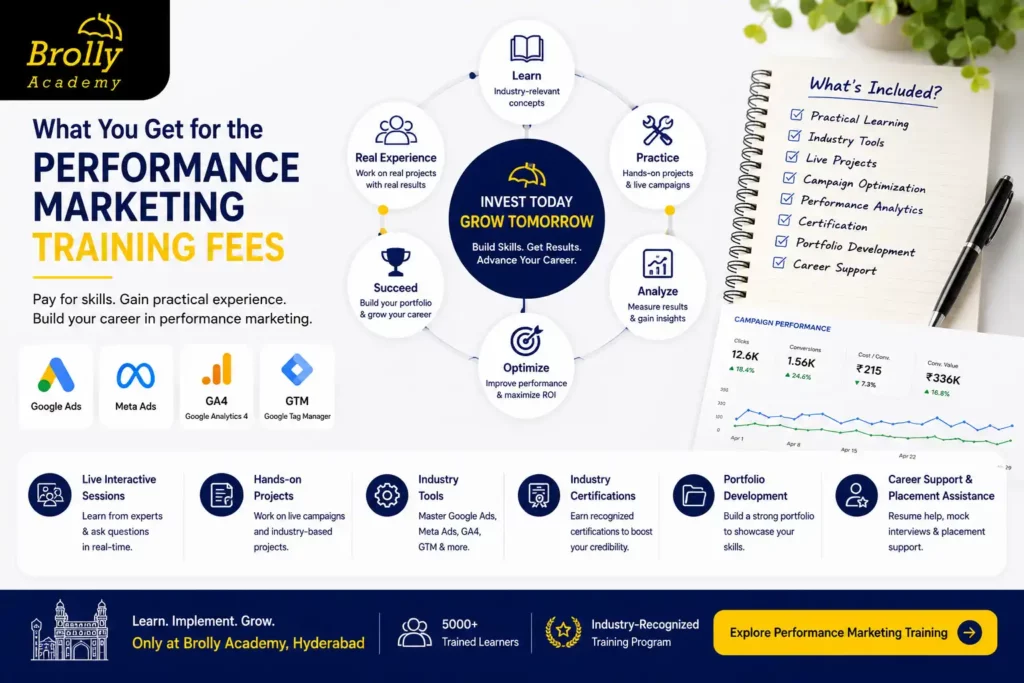
When comparing Performance Marketing Course Fees, one of the most important questions to ask is not “How much does the course cost?”, but “What should a performance marketing training program actually give you for the fee you pay?”
A well-structured Performance Marketing Training program should offer much more than classroom sessions or recorded videos. It should prepare you to plan, launch, optimize, and measure advertising campaigns using the same tools and strategies that businesses use every day.
The more practical value a training program offers, the better your chances of building job-ready skills.
Below are the key areas you should expect from a quality performance marketing training program.
Core Performance Marketing Modules
A comprehensive syllabus should cover the complete customer acquisition journey instead of focusing on a single advertising platform.
Look for modules that explain:
- Digital marketing fundamentals
- Customer journey
- Marketing funnels
- Audience research
- Campaign planning
- Budget allocation
- Performance measurement
These concepts provide the foundation before moving into advanced advertising platforms.
Google Ads Training
Google Ads remains one of the most valuable skills in performance marketing.
A practical training program should help you understand how to create campaigns that align with different business objectives rather than simply teaching where to click.
Topics should include:
- Search Campaigns
- Display Campaigns
- Video Campaigns
- Shopping Ads
- Performance Max Campaigns
- Keyword Research
- Bid Strategies
- Campaign Optimization
- Quality Score
- Conversion Tracking
Understanding why campaigns succeed or fail is far more valuable than memorizing platform features.
Meta Ads Training
Businesses use Meta advertising to connect with potential customers on Facebook and Instagram.
A quality training program should cover:
- Campaign objectives
- Audience targeting
- Custom audiences
- Lookalike audiences
- Creative testing
- Budget optimization
- Remarketing
- Performance analysis
Hands-on practice with campaign setup and optimization helps learners understand how real advertising decisions are made.
Google Analytics 4 (GA4)
Running advertisements is only one part of performance marketing.
Understanding user behavior is equally important.
Training should include:
- Website traffic analysis
- User engagement
- Event tracking
- Conversion reports
- Audience insights
- Marketing attribution
These skills help marketers make better decisions using data instead of assumptions.
Tracking campaign performance accurately is essential.
A comprehensive performance marketing training program should cover essential tracking concepts, including:
- Tag implementation
- Conversion tracking
- Event tracking
- Pixel installation
- Analytics integration
Without accurate tracking in place, even a well-performing campaign becomes hard to measure and improve.
AI Tools in Performance Marketing
Artificial intelligence is becoming an important part of digital advertising.
Modern performance marketing training should introduce learners to AI-powered workflows such as:
- Campaign planning
- Ad copy generation
- Audience research
- Keyword discovery
- Performance reporting
- Creative optimization
Learning how AI supports marketers helps students adapt to the evolving digital marketing landscape.
Live Campaign Experience
Theory alone cannot prepare someone for real client work.
The best training programs provide opportunities to:
- Build campaigns
- Launch advertisements
- Monitor campaign performance
- Optimize budgets
- Improve conversion rates
- Present campaign reports
Practical experience helps learners understand how different strategies perform under real business conditions.
What Should Be Included in Your Course Fee?
Course Feature | Key Benefits |
Updated Performance Marketing Syllabus | Keeps your skills aligned with what the industry expects today. |
Google Ads Training | Builds expertise in one of the most widely used advertising platforms. |
Meta Ads Training | Develops the skills needed to plan, launch, and optimize paid campaigns across Meta platforms. |
Enables data-driven campaign decisions. | |
Google Tag Manager (GTM) | Supports accurate tracking and measurement. |
Hands-on Projects | Builds practical problem-solving skills through project-based learning experiences. |
Portfolio Building | Demonstrates your skills during job interviews. |
Industry Certifications | Adds credibility alongside practical knowledge. |
Career Guidance | Guides you in preparing for professional opportunities through structured career support. |
When evaluating a performance marketing training program, remember that the value of your investment depends on the learning experience you receive, not just the topics listed in the brochure.
Online vs Offline Performance Marketing Training: Which Offers Better Value?
Choosing between online and offline learning is another important decision that can influence both your learning experience and the overall value of the course fee.
Neither format is universally better.
The right choice depends on your learning style, schedule, career goals, and the quality of training provided.
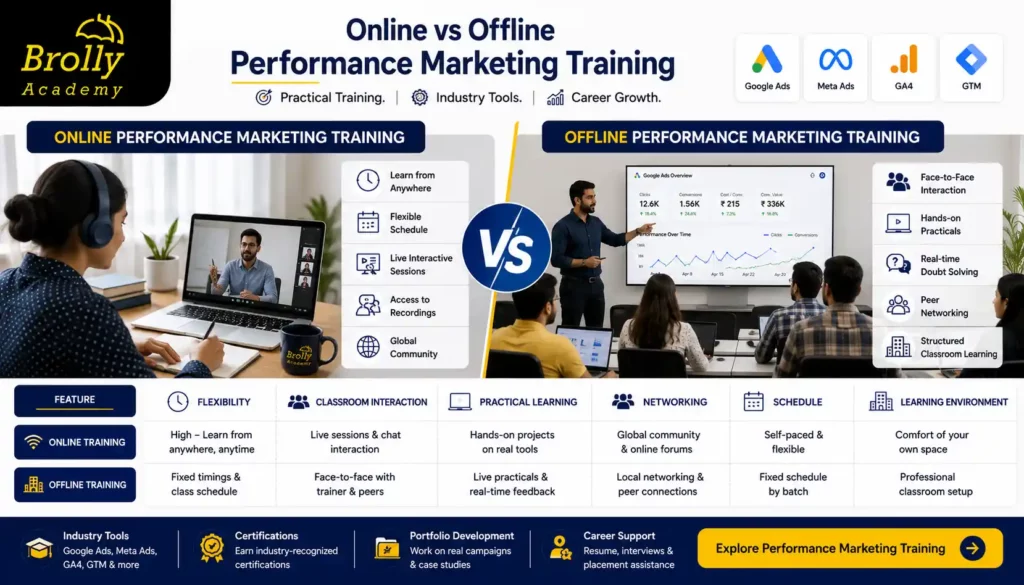
Online Performance Marketing Training
Online learning has become increasingly popular because it offers flexibility without requiring learners to relocate or commute.
It is often suitable for:
- Working professionals
- College students
- Freelancers
- Business owners
- Learners living outside major cities
Many online programs now include live instructor-led sessions, doubt-solving classes, assignments, and project work, making them much more interactive than self-paced recorded courses.
Advantages:
- Learn from anywhere
- Flexible schedules
- Saves travel time
- Easy access to recorded sessions
Suitable for working professionals
Offline Performance Marketing Training
Offline learning creates opportunities for face-to-face discussions, collaborative activities, and immediate guidance from instructors.
Many students prefer this format because it encourages discussions, collaborative learning, and immediate feedback.
Offline learning can also create stronger networking opportunities with trainers, peers, and industry professionals.
Advantages:
- Face-to-face mentoring
- Immediate doubt resolution
- Better classroom interaction
- Networking opportunities
- Structured learning environment
Online vs Offline Performance Marketing Training
Online Performance Marketing Training | Offline Performance Marketing Training |
Flexible learning schedule | Fixed classroom schedule |
Learn from any location | Requires physical attendance |
Suitable for working professionals | Suitable for full-time learners |
Saves commuting time | Better face-to-face interaction |
Access to recorded sessions | Classroom-based practical activities |
Convenient for remote learners | Better peer networking opportunities |
Instead of choosing a learning mode based only on convenience, evaluate how effectively the program delivers practical learning, trainer support, and career guidance.
Is a Higher Performance Marketing Training Fee Worth the Investment?
Many learners assume that a higher course fee automatically means better training.
That is not always true.
A higher fee is worthwhile only when it provides greater learning value and helps you build skills that improve your career opportunities.
The focus should always be on return on investment, not simply on the amount you pay.
Better Learning Experience
Higher-quality programs often invest more in curriculum development, experienced trainers, and practical learning.
Instead of relying only on presentations, learners actively participate in projects, assignments, campaign analysis, and optimization exercises.
Practical Training
Performance marketing is learned through implementation.
Training programs that provide opportunities to work on campaigns, analyze results, and solve business challenges often deliver better long-term outcomes than theory-focused courses.
Personalized Mentorship
Learning becomes easier when experienced trainers provide regular feedback and guidance.
Mentorship helps learners avoid common mistakes and understand how professionals approach campaign management.
Career Support
Some institutes continue supporting learners even after the training is completed.
Career services may include:
- Resume reviews
- Portfolio development
- Mock interviews
- Interview preparation
- Placement assistance
- Career mentoring
These services can significantly improve confidence during the job search process.
Long-Term Value
Instead of evaluating a course based on today’s fee, consider the long-term benefits.
Ask yourself:
- Will this training help me develop practical skills?
- Will I become confident in managing advertising campaigns?
- Will I build a strong portfolio?
- Will the learning remain useful as the industry evolves?
If the answer to these questions is yes, the investment is often more valuable than choosing a cheaper program that provides limited practical exposure.
Affordable vs Premium Performance Marketing Training: What's the Difference?
When comparing different institutes, you’ll often notice a wide variation in pricing.
This does not automatically mean one institute is better than another.
The real difference lies in what learners receive for the fee they pay.
The table below highlights some of the common differences learners may observe while comparing training programs.
Affordable Training | Premium Training |
Focuses mainly on fundamentals | Covers beginner to advanced concepts |
Limited practical assignments | Extensive hands-on projects |
Basic trainer interaction | Personalized mentoring and feedback |
Limited tool exposure | Access to multiple industry-standard tools |
Fewer career support services | Resume guidance, mock interviews, and placement support |
Suitable for basic learning | Designed for long-term career development |
A premium training program should not be judged by its fee alone. It should justify the investment through practical learning, updated content, experienced mentors, and meaningful career support.
When comparing institutes, always focus on value per rupee invested rather than selecting a program based solely on the lowest advertised price
Frequently Asked Questions About Performance Marketing Course Fees
- How do I know if a performance marketing course fee is worth paying?
Instead of comparing fees alone, evaluate what the training program offers. Look for an updated syllabus, practical assignments, live projects, experienced trainers, industry tools, certification, and career support. A course that helps you build job-ready skills usually provides better long-term value than one chosen only because it is less expensive.
- What should be included in a performance marketing training program before I enroll?
A quality training program should include hands-on learning, Google Ads, Meta Ads, Google Analytics 4 (GA4), Google Tag Manager (GTM), live projects, practical assignments, certification, and career guidance. These components help you gain practical experience that can be applied in real-world marketing roles.
- How can I compare performance marketing training institutes before making a decision?
Compare training institutes based on curriculum quality, trainer experience, practical learning opportunities, live projects, placement support, certifications, student reviews, and career guidance. Looking beyond the course fee helps you identify the program that offers the greatest overall value.
- Is performance marketing training suitable for beginners with no prior experience?
Yes. Many training programs are designed for beginners and start with fundamental concepts before moving to advanced topics. Choosing a program that combines theory with practical learning can make it easier to develop confidence and industry-ready skills.
- Does practical training make a difference when choosing a performance marketing course?
Yes. Practical training allows you to apply concepts through assignments, projects, and campaign-based exercises. It helps you understand how performance marketing works in real business situations rather than learning only theoretical concepts.
- What questions should I ask a training institute before paying the course fee?
Ask about the course syllabus, trainer experience, live projects, industry tools, certification, batch size, placement support, and career guidance. These questions help you understand whether the training program matches your learning and career goals.
- How important is trainer experience when selecting a performance marketing training program?
Trainer experience plays an important role in your learning journey. Trainers with real industry experience can share practical insights, campaign strategies, and problem-solving techniques that go beyond textbook concepts, helping you build skills that are relevant in the workplace.
- Can performance marketing training help me build a professional portfolio?
Yes. Many practical training programs include projects, campaign planning exercises, and performance analysis activities that can be added to your portfolio. A strong portfolio showcases your abilities during interviews and demonstrates your practical knowledge to potential employers.
- Should I choose a training program based only on the course fee?
No. The course fee is only one factor to consider. It is equally important to evaluate the quality of training, practical exposure, industry relevance, certifications, and career support. Choosing a program based on overall value often leads to better learning outcomes.
- How do I choose the right performance marketing training program for my career goals?
Start by identifying your objectives, whether you want to become a digital marketing professional, freelancer, entrepreneur, or career switcher. Then compare training programs based on practical learning, updated curriculum, trainer expertise, live projects, certification, and career support to find the one that aligns with your goals.