
Brolly Academy | SailPoint
SailPoint Career
Demand in India, SailPoint and IAM Roles, the Path From Fresher to Architect and Pay at Each Stage (2026)
An honest, evidence-based guide to building a SailPoint career in India in 2026: how strong demand really is, what each SailPoint and IAM role does, the path from fresher to architect, pay at each stage, the skills and certifications that matter, the pros and cons, and where identity governance is heading.
Is SailPoint a good career in 2026? Demand in India, SailPoint and IAM roles, the path from fresher to architect, salary by stage, skills, pros and cons.
By Brolly Academy Team · Brolly Academy · Updated 24 October 2026
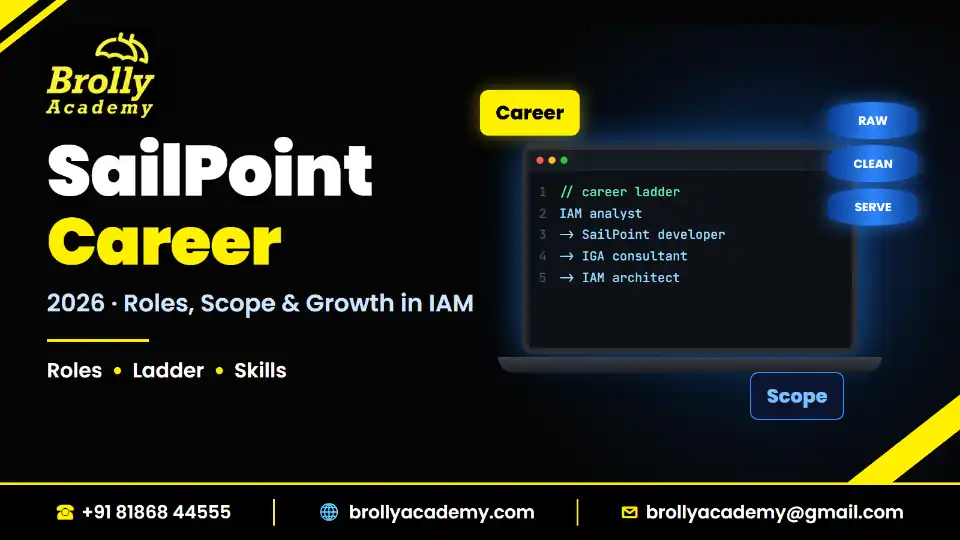
Table of Contents
1. SailPoint career at a glance
2. Is SailPoint a good career in 2026?
3. What a SailPoint career actually involves
4. SailPoint job roles and what each one does
5. SailPoint career path: from fresher to architect
6. Where you can work: four kinds of employers
7. SailPoint salary by career stage
8. Who a SailPoint career suits
9. Skills you need for a SailPoint career
10. Certifications that help your SailPoint career
11. Pros and cons of a SailPoint career
12. The future of SailPoint and identity governance
Quick answer
Yes, SailPoint can be a good career in India in 2026 if you are willing to start in IAM operations or support and build Java, Active Directory and identity governance skills for two to three years before you land a developer or engineer role. SailPoint is the identity governance software that large companies use to control who gets access to which systems, and every implementation needs analysts, developers, consultants and architects. On 24 October 2026, Naukri showed about 5,550 results for "sailpoint" across India, and AmbitionBox showed SailPoint developers with 3 to 6 years' experience earning about ₹8.4 to 9.2 lakh a year. The catch: almost every listing we read asked for 3 or more years of experience.
- Main roles: IAM operations analyst, IAM analyst, SailPoint developer (IdentityIQ), Identity Security Cloud engineer, consultant, architect, IAM manager
- Typical path: support or operations (0 to 2 years), developer or engineer (2 to 6 years), senior consultant or lead (5 to 9 years), architect or manager (8+ years)
- Who hires: IT services firms, Big Four consulting firms, global capability centres (GCCs) of banks and product companies, and SailPoint itself
- Pay ceiling: AmbitionBox showed identity and access management architects at about ₹36.1 to 41.2 lakh a year (8 to 18 years, small sample, October 2026)
- Biggest risk: it is a niche skill, so you must keep up as SailPoint moves its customers to the cloud and adds AI agent security
Key takeaways
- SailPoint demand in India is real but experience-heavy: job portals show thousands of keyword matches, yet genuine 0-year SailPoint developer roles were not found on 24 October 2026.
- The realistic entry door is IAM operations, access management or support work; development and consulting roles follow after 2 to 3 years.
- Java, BeanShell, Active Directory, SQL, connectors, roles and access certifications are the skills job descriptions repeat most.
- SailPoint certifications help you stand out, but the job descriptions we read listed them as "good to have", never as mandatory.
- The future looks strong for people who learn both IdentityIQ and the cloud product (Identity Security Cloud, now sold as SailPoint Human Fabric) and who understand machine and AI agent identities.
1. SailPoint career at a glance
Short answer: A SailPoint career is a career in identity governance: you set up and run the system that decides who joins, moves and leaves with the right access, and you grow from support work to development, consulting and architecture.
Use this table as a one-screen summary. Every figure is dated and sourced in the sections below.
2. Is SailPoint a good career in 2026?
Short answer: SailPoint is a good career for people who like security, systems and process, because large regulated companies keep needing identity governance; it is a weaker choice if you want a quick fresher job or a broad, general skill.
Let us look at the evidence first, then the honest caveats.
The demand evidence
Job portals are the best public signal of demand. We searched Naukri for "sailpoint" while logged out on 24 October 2026 and noted the "1 - 20 of N" figure. These are keyword-match counts. They include duplicates, recruiter re-posts and roles where SailPoint is one of many listed skills, so treat them as a demand signal, not a count of open SailPoint jobs.
On the same day, LinkedIn's public job search showed "4,000+" results for "SailPoint" in India, with the same Big Four postings repeated across several cities. For city-by-city job hunting and company lists, see our guide to SailPoint jobs in India.
A second signal is who the customers are. SailPoint's company page says it has 3,000+ customers in 60+ countries, including 53% of the Fortune 500, and that it passed $1B in annual recurring revenue in 2025 (SailPoint, October 2026). Every one of those customers needs people to implement, run and audit the platform, and the listings we read show Indian IT services firms, consulting firms and GCCs doing much of that work.
The honest caveats
- Freshers face a wall. On 24 October 2026, a Naukri search for "sailpoint fresher" showed 0 results, and we found no SailPoint developer listing on Naukri or LinkedIn that genuinely accepted 0 years' experience.
- It is a niche. SailPoint is one product in one area of security. If the market moved away from it, your skills would need to transfer to other identity tools.
- Shifts can be demanding. Some listings we read asked for US-shift work, rotational shifts or on-call support.
- The product is changing. SailPoint is pushing its cloud platform and AI agent security, so IdentityIQ-only skills will slowly lose value unless you add cloud skills.
Our verdict: it is a good career if you plan for a 2 to 3 year runway through IAM support or a related role, and if you keep learning as the product moves to the cloud.
3. What a SailPoint career actually involves
Short answer: You work on identity governance, which means making sure every employee, contractor and system account has exactly the access it needs, no more and no less, and proving that to auditors.
If you are new to the product itself, read our explainer on what SailPoint is first; here we only cover what the work looks like. SailPoint sells two main products. IdentityIQ is the self-managed product that companies install on their own servers or cloud. Identity Security Cloud (ISC, formerly IdentityNow, now sold as SailPoint Human Fabric within SailPoint Identity Security) is the SaaS product. SailPoint's Identity Security announcement of 4 August 2026 described Human Fabric as the evolution of Identity Security Cloud, sold alongside Agentic Fabric for AI agents. Job posts in India still say "IdentityIQ", "IIQ", "ISC" or "IdentityNow", so you will see all these names.
These are the words you will meet in your first week. Learn them now:
- IAM (identity and access management): the broad practice of managing digital identities and what each one can access
- IGA (identity governance and administration): the governance layer of IAM; it checks that access is appropriate, runs access reviews and supports audits. SailPoint is an IGA tool
- PAM (privileged access management): tools that protect powerful admin accounts; they work alongside IGA. CyberArk is the best-known PAM name, and on 24 October 2026 Naukri showed about 5,817 results for "cyberark", so PAM is a busy neighbouring career too
- SSO (single sign-on) and MFA (multi-factor authentication): log in once to many apps, and prove who you are with more than a password
- Provisioning and deprovisioning: creating, changing or removing a user's accounts and access in target systems
- Joiner-mover-leaver (JML): the three lifecycle events; a new hire joins, an employee changes role, an employee exits
- Aggregation: reading account and access data from a system (such as HR or Active Directory) into SailPoint
- Correlation: matching each account found to the right person
- Entitlement: the smallest unit of access, such as membership of one AD group
- Role: a bundle of entitlements given to people who do the same job
- Access certification: a periodic review where managers or app owners approve or revoke each person's access
- SoD (separation of duties): a rule that one person should not hold two conflicting powers, such as creating and approving a payment
- Connector: the integration that lets SailPoint read from and write to a system
- BeanShell: the Java-based scripting language used for custom rules in IdentityIQ
- Virtual appliance (VA): a small machine that connects the cloud product to on-premises systems without opening your firewall
On a normal day you might onboard a new application, fix a failed joiner workflow, write a correlation rule, prepare a quarterly access certification campaign, or answer an auditor's question about who approved someone's access. The idea behind all of it is least privilege, which NIST defines as giving users and processes only the access they need for their assigned work (NIST glossary, October 2026).
4. SailPoint job roles and what each one does
Short answer: SailPoint roles fall into two families: operations and support roles that run the platform day to day, and implementation roles that build and design it.
This split matters because the operations family is where most juniors get in. The table below is based on the job descriptions we read on 24 October 2026 at firms such as EY, Deloitte, PwC, Cognizant, UST, ICE and WSP.
A closer look at the main roles
IAM operations analyst. UST's "IAM Analyst - SailPoint IIQ" listing in Bengaluru described work such as orphan-account cleanup, manual account correlation, removing terminated users' access, entitlement-owner reviews and audit evidence. EY's managed services "GMS-Staff-UAR - IGA" role in Hyderabad covered lifecycle management, provisioning, reconciliation, certification and SoD support, with health checks, incidents and upgrades. This is the realistic first job.
SailPoint developer. EY's "SailPoint IIQ Senior" listing in Hyderabad asked candidates to build connectors, custom workflows, rules and APIs for provisioning, and to configure Lifecycle Manager and Compliance Manager, with at least 3 years of hands-on IdentityIQ development and 2+ years of Java. PwC's developer JD added unit and integration testing, UAT support, deployment and hypercare.
Identity Security Cloud engineer. Deloitte's "SailPoint ISC Consultant" JD asked for 3 to 6 years in SailPoint ISC, at least two full IAM implementations, and onboarding of AD, LDAP and Exchange with out-of-the-box connectors.
Architect. TCS listed a "Sailpoint Architect" role for 7 to 10 years in Hyderabad, Kolkata and Bengaluru, and Persistent Systems listed a SailPoint architect role in Pune (listings seen 24 October 2026).
5. SailPoint career path: from fresher to architect
Short answer: Most people move from IAM support (0 to 2 years) to SailPoint developer or engineer (2 to 6 years), then senior consultant or lead (5 to 9 years), and finally architect or manager (8+ years).
The years below are typical ranges based on the experience bands in listings we read on 24 October 2026. They are not fixed rules; strong performers move faster.
Here is the usual flow in one line per step:
- Start in IAM operations, access management or AD support and learn how access really works.
- Learn IdentityIQ hands-on and take on small rule and onboarding tasks.
- Move to a developer or engineer title, usually after 2 to 3 years of identity work.
- Add Identity Security Cloud skills and lead small projects.
- Take a senior consultant or lead role and own client delivery.
- Grow into architect (technical) or manager (people and delivery) roles.
The top of the ladder is real. On 24 October 2026 we saw listings such as LPL Financial GCC's "VP IAM Engineering - IGA" and Chubb's "IGA Engineering Lead" in Hyderabad, and Kroll's "Senior Manager - IGA Architect" in Bengaluru.
For the week-by-week learning sequence that gets you through stages 1 and 2, follow our SailPoint roadmap.
6. Where you can work: four kinds of employers
Short answer: SailPoint careers in India run through IT services firms, Big Four consulting firms, GCCs of banks and product companies, and SailPoint's own engineering teams.
Each employer type shapes your career differently.
A few notes. These names come from listings we saw on 24 October 2026; they are not hiring commitments. SailPoint itself had engineering and product listings in Pune in October 2026, such as "Senior Software Engineer" and "Staff Software Engineer - Java/Golang". Those roles build the product in Java or Go, which is a different career from implementing SailPoint for a customer. The official SailPoint careers site lists India among its job locations.
For juniors, GCC and managed services operations teams are often the easiest way in, while Big Four and IT services firms are where most developer and consultant growth happens.
7. SailPoint salary by career stage
Short answer: AmbitionBox showed SailPoint developers in India at about ₹5 to 5.6 lakh a year at 1 to 3 years and ₹8.4 to 9.2 lakh at 3 to 6 years in October 2026, with consultant and architect roles paying much more.
These are AmbitionBox "typical ranges" shown to logged-out users, read on 24 October 2026 from its SailPoint developer salary page (updated 18 October 2026). Read them as guides, not offers.
Pay grows as you move up the role ladder. On the same date, AmbitionBox showed SailPoint consultants at about ₹9.8 to 11.6 lakh a year (2 to 8 years, 162 salaries), IAM consultants at about ₹14.4 to 16.1 lakh (2 to 10 years, 456 salaries) and identity and access management architects at about ₹36.1 to 41.2 lakh (8 to 18 years, 84 salaries, a small sample). AmbitionBox showed no band for 0 to 1 year on any SailPoint or IAM page we read.
For city-wise, company-wise and role-wise pay, and tips to negotiate, see our full guide to SailPoint developer salary in India.
8. Who a SailPoint career suits
Short answer: SailPoint suits Java developers, Active Directory and service desk staff, support engineers, testers and determined freshers; each group starts from a different place and needs to add different skills.
Two examples show these paths are real. First Citizens India listed a "Principal Information Security Engineer - IAM (Quality Assurance/SailPoint Testing)" role in Bengaluru, which shows that testing experience has a place in IAM. Cognizant listed a "Returnship - IAM SailPoint Developer Engineer" role in Bengaluru for professionals returning after a break (listings seen 24 October 2026; the returnship asked for 6 to 8 years of hands-on SailPoint experience).
Can a non-coder build a SailPoint career?
Yes, up to a point. Operations, access management, IAM analyst and governance roles need less coding. ICE's "Analyst I, Identity and Access Management" listing in Hyderabad focused on provisioning, AD administration, certifications and access reviews using SailPoint, Active Directory and ServiceNow. But developer and engineer roles, which pay more, expect Java and BeanShell. If you want the full career ladder, plan to learn basic Java.
On education, the listings we read asked for "any graduate" (PwC on Naukri), any stream with IT knowledge (ICE), B.Tech, M.Tech, MS or MBA (Deloitte), or a CS/IT bachelor's degree or equivalent experience (WSP). A non-IT graduate can get in, but should first build basic IT, Active Directory and SQL skills.
9. Skills you need for a SailPoint career
Short answer: Job descriptions repeat the same core skills: IdentityIQ and Identity Security Cloud, Java and BeanShell, rules and workflows, connectors and application onboarding, Active Directory and LDAP, SQL, REST APIs, roles, SoD policies and access certifications.
This table is built from the common patterns across 11 job descriptions we read on 24 October 2026.
Soft skills count too. PwC's JD asked seniors to mentor "campus grads and juniors", and Deloitte's JD asked for full implementation experience, so communication, documentation and client handling matter as much as code.
Product skills that set you apart
On the IdentityIQ side, learn aggregation and correlation, the four role types, certification campaigns, policy types and Lifecycle Manager, all described in SailPoint's IdentityIQ documentation (October 2026). On the cloud side, learn sources, identity profiles, virtual appliances, transforms (JSON objects that change attribute values without code), access profiles, roles and workflows. SailPoint's developer portal also offers SDKs in Golang, PowerShell, Python, TypeScript and Angular, which helps developers who want to automate.
10. Certifications that help your SailPoint career
Short answer: SailPoint runs seven current credentials; the role-based Identity Security Engineer, Identity Security Administrator and IdentityIQ Engineer certifications carry the most weight, but job descriptions treat them as a bonus, not a requirement.
SailPoint's certification program page (last updated 23 September 2026) lists these credentials:
A few facts worth knowing. Role-based certifications are valid for two years; training-based credentials do not expire. Results are Pass/Fail only, with no published passing score. In February 2026, SailPoint said there were over 12,000 SailPoint certified professionals and launched a recertification program. Training-based exams are free with the matching training path or about $200 standalone (2 training units); the role-based exam price is shown on Identity University at checkout.
How much do certifications matter to employers? In the 11 JDs we read, EY listed the IdentityIQ Engineer certification as desirable and PwC called SailPoint certifications "good to have". None made them mandatory. Experience and hands-on skill come first; a certification helps you get shortlisted, especially when you switch from another field. For exam formats, domains and a study plan, read our guide to SailPoint certification.
11. Pros and cons of a SailPoint career
Short answer: The pros are steady enterprise demand, a clear ladder and strong senior pay; the cons are a hard fresher entry, niche risk, product change and some shift work.
On shifts, be specific when you apply. Deloitte's ISC consultant JD stated "11 AM to 8 PM" timings, a separate Deloitte posting was a "US Shift" role, ICE asked for flexibility in 17x5 rotational shifts, and EY's managed services role mentioned on-call support and occasional overtime. On work mode, Naukri's filters on the Hyderabad "sailpoint" page showed 837 of 934 results as work from office, 86 hybrid and 11 remote on 24 October 2026.
12. The future of SailPoint and identity governance
Short answer: The future looks positive: SailPoint is investing in its cloud platform, in AI agent and machine identity security, and in a modernised IdentityIQ, which together point to more, and more varied, identity work.
Here is what SailPoint has actually announced, and what each trend means for your career.
1. The move to a unified cloud platform
On 4 August 2026, SailPoint announced SailPoint Identity Security, a unified, cloud-native solution combining Human Fabric (the evolution of Identity Security Cloud) for people and Agentic Fabric for AI agents and non-human identities. Career impact: cloud skills (sources, transforms, workflows, APIs) will keep rising in value.
2. AI agents and machine identities
SailPoint's Agentic Fabric page describes three steps: discover AI agents, machine identities and the credentials they use; govern each agent's access and tie it to a human owner; and protect with behaviour monitoring and automated remediation, including a "kill switch" (SailPoint, October 2026). In June 2026 SailPoint also completed its acquisition of Entro Security, a non-human identity and secrets security company. Career impact: governing service accounts, bots and AI agents is a new skill area where few people have experience yet.
3. IdentityIQ is being modernised, not retired
On 6 October 2026, SailPoint announced IdentityIQ 9.0 as a modernisation path for hybrid and on-premises customers, with time-based access for roles and entitlements, a rebuilt technical foundation, a refreshed interface and an automated upgrade tool. It is aimed at customers with data residency, regulatory or heavy customisation needs. Career impact: IdentityIQ upgrade and migration projects should keep developers busy, and we found no statement that IdentityIQ is being discontinued.
4. AI inside the governance tools
SailPoint launched Harbor Pilot, a set of AI agents for identity teams, in March 2025 as part of Identity Security Cloud, and IdentityIQ offers AI-driven recommendations, auto-approval of low-risk items and role suggestions. Career impact: routine review work will get faster, so the value shifts to people who design roles, policies and integrations.
5. Zero trust and least privilege
NIST's Zero Trust Architecture (SP 800-207, final August 2020) moves security away from network perimeters and towards users, assets and resources, with no implicit trust. Identity governance is central to that model, which supports long-term demand.
Will AI replace SailPoint jobs?
AI will change the work more than remove it. AI features already suggest access and approve low-risk requests, so pure ticket-clearing roles may shrink. But someone still has to connect systems, design roles and SoD rules, govern AI agents themselves and answer auditors. People who keep learning will find more work, not less.
13. How to start your SailPoint career: a 6-step plan
Short answer: Learn IAM basics, build Java, SQL and AD skills, get hands-on with IdentityIQ, build one project, target IAM operations or junior IAM roles first, and move into development after you gain experience.
- Learn IAM fundamentals. Understand JML, provisioning, roles, certifications, SoD and least privilege.
- Build the technical base. Basic Java, SQL, XML, Active Directory and LDAP, and REST API basics.
- Get hands-on with IdentityIQ. Practise aggregation, correlation, roles, certifications and a simple BeanShell rule through official training or a legitimate course lab. Never use pirated software.
- Build a portfolio project. For example, a fictional "HR to Active Directory" joiner-mover-leaver flow with an access review, documented step by step.
- Target the right first job. Apply for IAM operations, access management, IAM analyst and support roles. Read the JD, not the experience tag: some listings tagged "0 years" ask for 3 years in the text.
- Grow into development. After 1 to 2 years, take on onboarding and rule tasks, add Identity Security Cloud, consider a role-based certification, and move to a developer or engineer title.
Prepare for interviews with our existing list of about 60 SailPoint interview questions and answers, and use the roadmap and jobs guides linked above for the learning sequence and the job search.
14. How Brolly Academy helps
Short answer: Brolly Academy's SailPoint Certification Training in Hyderabad is a 2-month, IdentityIQ-focused course, with an introduction to IdentityNow, that covers the skills SailPoint job descriptions ask for, plus capstone projects, mock interviews and placement assistance.
- Our SailPoint Certification Training runs for 2 months across 10 modules: IdentityIQ preview; architecture, installation and deployment; Identity Cube and key entities; application onboarding and correlation; connector provisioning (including Active Directory); policies; certifications; roles and rules; workflows; and debugging.
- You practise with Delimited, JDBC and Active Directory connectors, BeanShell, and see how SailPoint integrates with tools such as CyberArk, ServiceNow, Workday and SAP.
- You complete six capstone projects: IdentityIQ user onboarding, access review and certification campaigns, joiner-mover-leaver provisioning, role management and policies, workflow automation for access requests, and application integration.
- The lead instructor is Mrs. Divya, a SailPoint and IAM specialist with 8+ years in IAM and SailPoint.
- You get resume and interview support, mock interviews and placement assistance. Placement assistance is support with your search, not a job guarantee.
- The course page lists three plans in October 2026: Video Recording ₹9,999, Online Course ₹24,999 and Classroom Training in Hyderabad ₹29,999, with EMI on the online and classroom plans. The next batch listed is Monday, 2 November 2026, and you can attend a free demo class first.
SailPoint certification exams are issued and examined by SailPoint, not Brolly Academy, and exam fees are separate and paid to SailPoint.
Ready to start your SailPoint career with hands-on IdentityIQ skills?
Join Brolly Academy's 2-month SailPoint course to learn aggregation, correlation, connectors, roles, certifications, workflows and BeanShell rules, build six capstone projects and prepare with mock interviews and placement assistance. Book a free demo class online or at our Hyderabad centre and see if the course fits your goals.
Frequently asked questions
Is SailPoint a good career in 2026?
Yes, for people who are ready to build experience step by step. Large regulated companies need identity governance every year, and SailPoint is investing in its cloud platform, AI agent security and a modernised IdentityIQ. The main drawbacks are a hard fresher entry, since most listings ask for 3 or more years, and the need to keep learning as the product changes.
Is SailPoint in demand in India?
Yes, demand looks steady. On 24 October 2026, Naukri showed about 5,550 results for "sailpoint" across India and LinkedIn showed "4,000+" results. These are keyword matches that include duplicates and loosely related roles, so they are not vacancy counts, but they show consistent hiring interest led by Bengaluru, Hyderabad, Pune and Chennai.
What is the career path for a SailPoint developer?
Most people start in IAM operations or support for up to 2 years, become a SailPoint developer or engineer between about 2 and 6 years, move to senior consultant or technical lead around 5 to 9 years, and reach architect or manager roles after about 8 years. Strong performers can move faster, and the steps vary by employer.
What does a SailPoint developer do?
A SailPoint developer builds and maintains the identity governance platform. Daily work includes onboarding applications through connectors, writing BeanShell rules for correlation and provisioning, building joiner, mover and leaver workflows, configuring roles and access certifications, and testing and deploying changes. Senior developers also support UAT, hypercare after go-live and mentor juniors.
Can a fresher start a career in SailPoint?
Yes, but usually not directly as a SailPoint developer. On 24 October 2026 we found no genuine 0-year SailPoint developer listing, and a Naukri search for "sailpoint fresher" showed 0 results. Freshers usually start in IAM operations, access management or support roles, build skills for one to three years, then move into development or engineering roles.
Does SailPoint require coding?
It depends on the role. Developer and engineer roles expect Java and BeanShell, the Java-based scripting language used for IdentityIQ rules, plus SQL and REST basics. Operations, access management and IAM analyst roles need far less coding and focus on tickets, Active Directory, access reviews and audit evidence. To reach the higher-paying roles, plan to learn basic Java.
Can a non-IT person build a SailPoint career?
It is possible but harder. Listings we read asked for any graduate with IT knowledge, a B.Tech or similar degree, or a computer science or IT degree or equivalent experience. A non-IT graduate should first build basic IT, Active Directory and SQL skills, then target IAM operations or access management roles before moving towards SailPoint development.
What skills are needed for a SailPoint career?
Job descriptions repeat IdentityIQ and Identity Security Cloud, Java and BeanShell, rules and workflows, connectors and application onboarding for systems such as AD, LDAP, JDBC, SAP and Workday, roles, SoD policies and access certifications, SQL, REST APIs and ServiceNow. Communication, documentation and client handling matter too, especially in consulting roles.
What are the different SailPoint job roles?
Common roles are IAM operations or access management analyst, IAM analyst, SailPoint developer for IdentityIQ, Identity Security Cloud engineer, IAM tester, SailPoint consultant, IGA or IAM architect, and IAM manager. They fall into two families: operations roles that run the platform day to day, and implementation roles that build and design it.
How much can I earn in a SailPoint career?
AmbitionBox showed SailPoint developers in India at about ₹5 to 5.6 lakh a year at 1 to 3 years and ₹8.4 to 9.2 lakh at 3 to 6 years in October 2026. IAM consultants showed about ₹14.4 to 16.1 lakh, and identity and access management architects about ₹36.1 to 41.2 lakh, from a small sample. These are typical ranges, not offers.
What is the salary of a SailPoint fresher?
No reliable fresher figure exists. AmbitionBox showed no 0 to 1 year band on any SailPoint or IAM page we read in October 2026. Its lowest band, 1 to 3 years, was about ₹5 to 5.6 lakh a year for SailPoint developers in India. Treat this as a guide to early-career pay rather than a guaranteed starting salary.
Which companies hire SailPoint professionals in India?
In listings we saw on 24 October 2026, firms with SailPoint or IAM roles included EY, Deloitte, PwC, TCS, Cognizant, Wipro, Virtusa and Persistent Systems, plus GCCs and enterprises such as LPL Financial, Chubb, PepsiCo and ICE. SailPoint itself had engineering and product listings in Pune. These were listings on that date, not hiring commitments.
Is SailPoint certification required to get a job?
No. In the 11 job descriptions we read in October 2026, SailPoint certifications appeared only as desirable or good to have, for example at EY and PwC. Employers care most about hands-on experience with IdentityIQ or Identity Security Cloud. A certification still helps you get shortlisted, especially if you are switching from another field.
Which SailPoint certification is best for my career?
Choose by product and stage. IdentityIQ beginners can aim for the IdentityIQ Associate after the official courses, and IdentityIQ developers with 1 to 3 years of experience for the IdentityIQ Engineer. Identity Security Cloud professionals can choose the Identity Security Administrator or Identity Security Engineer. Role-based certifications are valid for two years.
Is SailPoint better than CyberArk for a career?
They solve different problems, so neither is simply better. SailPoint is an identity governance tool that controls who gets access and runs access reviews, while CyberArk is a privileged access management tool that protects powerful admin accounts. Both show steady demand in India: on 24 October 2026 Naukri showed about 5,550 results for "sailpoint" and 5,817 for "cyberark". The two kinds of tools often work side by side, so learning both widens your options.
Will AI replace SailPoint jobs?
AI will change SailPoint work more than replace it. AI features already recommend access, auto-approve low-risk requests and suggest roles, so routine ticket work may shrink. But people are still needed to connect systems, design roles and SoD rules, govern AI agents and machine identities, and answer auditors. Professionals who keep learning should find more work, not less.
What is the future scope of SailPoint?
The future scope looks positive. In 2026 SailPoint launched its unified SailPoint Identity Security platform with Human Fabric for people and Agentic Fabric for AI agents, completed its Entro Security acquisition for non-human identities, and announced IdentityIQ 9.0 to modernise its self-managed product. Cloud skills and machine identity governance are the growth areas to focus on.
Is IdentityIQ being discontinued?
No. We found no statement from SailPoint that IdentityIQ is being discontinued. In October 2026 SailPoint announced IdentityIQ 9.0 as a modernisation path for hybrid and on-premises customers, with time-based access, a rebuilt technical foundation, a refreshed interface and an automated upgrade tool. Learning IdentityIQ alongside Identity Security Cloud is still a sound plan.
Should I learn IdentityIQ or Identity Security Cloud first?
Most learners start with IdentityIQ because most Indian implementation and support work still runs on it, and it teaches the core concepts of aggregation, correlation, roles and certifications in depth. Then add Identity Security Cloud, the cloud product SailPoint is pushing, with its sources, transforms, access profiles and workflows. Knowing both makes you more employable.
Can a manual tester or support engineer switch to SailPoint?
Yes. Support engineers already troubleshoot and work with SLAs, so they need IAM concepts, IdentityIQ debugging and rules. Testers already know test cases and UAT, so they can add joiner, mover and leaver flows, certifications and provisioning testing. Listings such as First Citizens India's SailPoint testing role show that QA experience has a place in IAM.
Is a SailPoint career good for people returning after a career break?
It can be. Cognizant listed a "Returnship - IAM SailPoint Developer Engineer" role in Bengaluru in October 2026 for professionals returning after a break, though it asked for 6 to 8 years of hands-on SailPoint experience. If you had IT experience before your break, refreshing your IdentityIQ and cloud skills is the best way back.
Do SailPoint jobs involve night shifts?
Some do, but not all. Listings we read in October 2026 included Deloitte timings of 11 AM to 8 PM, a separate Deloitte US-shift role, ICE rotational shifts and EY managed services on-call support. Most Hyderabad results on Naukri were work from office. Always check the shift line in the job description before you apply.
Is it good to work at SailPoint the company?
Working at SailPoint itself is a different career from implementing it. SailPoint's Pune listings in October 2026 were for roles such as senior and staff software engineers in Java and Go, solution architects and product managers. These roles build the product. Most SailPoint careers in India are at IT services firms, consulting firms and GCCs that implement it.
How long does it take to build a SailPoint career?
Plan for about two to three years of identity work before you hold a SailPoint developer or engineer title, and around eight years or more to reach architect roles. Learning the basics takes a few months, but employers mostly ask for hands-on experience, so starting early in an IAM operations or support role saves time.
Does Brolly Academy help with a SailPoint career?
Brolly Academy's 2-month SailPoint course is IdentityIQ-focused, with an introduction to IdentityNow, and covers connectors, aggregation, correlation, roles, certifications, workflows and BeanShell rules. It includes six capstone projects, mock interviews, resume support and placement assistance. Placement assistance is help with your job search, not a job guarantee.
Learn with Brolly Academy
Review the syllabus, practical projects and batch timings, and book a free demo before you enrol.
Related Articles
Continue Your Learning
SailPoint Training in Hyderabad
2-month IdentityIQ-focused programme covering the Identity Cube, connectors, roles, certifications, workflows and BeanShell rules, with 6 capstone projects.
View CourseOracle Identity Manager Training
Learn another enterprise identity governance platform used in IAM teams, from provisioning and reconciliation to access policies.
View CourseCloud Security Training
Build cloud security skills that sit next to identity governance in modern IAM and security operations roles.
View Course