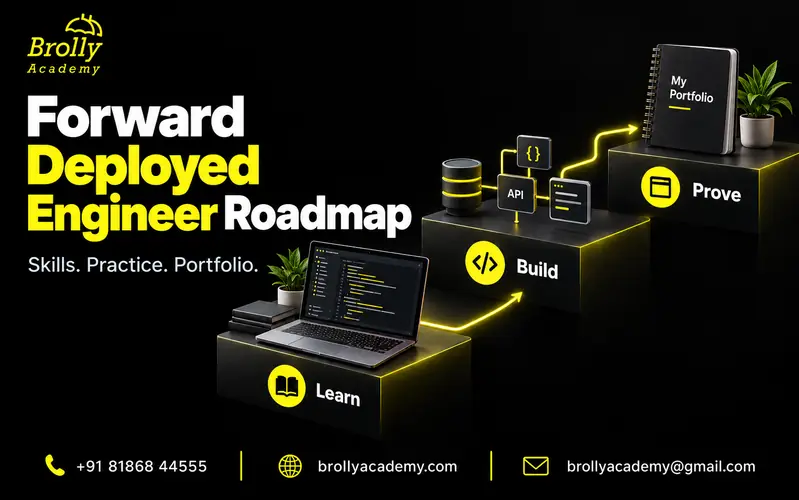
Build a small Python application before adding an agent. Then learn to clarify a customer need, connect an API and database, evaluate one useful AI capability, and deploy with a recovery plan. Finish by showing another person how to run and assess your work.
New to the role itself? Read what a forward deployed engineer does. This article focuses on the learning sequence; the FDE course page covers training, fees and enrolment.
Choose your starting stage, follow an eight-week practice plan where appropriate, use official learning resources and build one portfolio project with clear progress checks. You will also know which gaps to address before applying for a role.
Start with your current level
The same roadmap should not give a beginner and an experienced developer identical homework. A learner who cannot debug a Python function needs a foundation phase. An experienced API developer may need more practice with discovery, AI evaluation and communicating release risk.
| Your starting point | First priority | Evidence before advancing |
|---|---|---|
| New to programming | Functions, structured data, errors and debugging. | Read a CSV, validate records and explain a failing case. |
| Can script but not build services | HTTP, API design, database access and tests. | A documented API with validation and a test suite. |
| Software developer | Discovery, scoping, integration risks and evaluation. | A customer brief connected to measurable acceptance criteria. |
| Cloud or operations professional | Application logic and user-facing workflow ownership. | An end-to-end workflow, not only infrastructure configuration. |
| Consultant or analyst | Hands-on implementation and reproducibility. | Code you can run, modify, test and explain. |
These are readiness checks, not admission restrictions or a guarantee that an employer will accept a particular background.
How to adapt the path to your background
- Student or complete beginner: complete the programming and API checkpoints before starting an eight-week application plan. Add foundation time rather than compressing unfamiliar concepts.
- Backend or full-stack developer: demonstrate Stages 1 and 2 with existing code, then spend more time on discovery, evaluation and explaining trade-offs to a non-developer.
- QA or automation engineer: keep your testing strengths, but take ownership of an endpoint, persistence and a deployment. Testing someone else’s application is different from building and operating your own.
- Cloud or data professional: connect your infrastructure or pipeline work to a user-visible action. Practise validating requests and communicating what a failed workflow means to the customer.
- Consultant or business analyst: use your domain knowledge for discovery, but prove that you can implement and debug the proposed solution. No-code prototypes can explore a problem; they do not demonstrate all the coding requirements of an engineering role.
A practical readiness check before you start
Try these six tasks using a small synthetic ticket dataset. You may consult documentation, but record where you needed help. This is a self-assessment exercise, not an employer test or an admission score.
| Check | Task to attempt | Evidence that the foundation is usable |
|---|---|---|
| Python | Read records and separate valid tickets from records missing a required field. | A small function, clear errors and tests for valid and invalid inputs. |
| HTTP and JSON | Send a request to a local endpoint and inspect its response. | You can explain the method, payload, status code and response body. |
| SQL | Count tickets by category and join them to a synthetic customer table. | Correct results, including an explanation of missing or duplicate matches. |
| Git | Make a change on a branch and review the difference before committing. | A readable commit history and no credentials or private data in the repository. |
| Debugging | Reproduce a failed request and isolate the cause. | A failing test, a focused fix and a test that now passes for the right reason. |
| Communication | Explain the workflow and one limitation to a peer. | The peer can describe the user, expected result and what still needs human review. |
Choose your next step: if Python or debugging is a struggle, start at Stage 1. If local code works but APIs or SQL are unfamiliar, focus on Stage 2. If implementation is comfortable, bring that evidence forward and concentrate on customer discovery and end-to-end delivery. Do not use a total score to hide a serious gap in permissions or recovery.
The eight-stage FDE learning path
- Software foundations: programming, Git, debugging and structured data.
- Application integration: HTTP, APIs, SQL, validation and safe failure handling.
- Customer discovery: observe a workflow and turn an ambiguous request into a problem statement.
- Scope and architecture: choose a small useful release, data boundaries and acceptance criteria.
- AI application patterns: use models, retrieval or tools only where they solve the defined problem.
- Evaluation and security: test quality, permissions, failure paths and operational cost.
- Deployment and operations: release, monitor, roll back and recover.
- Portfolio and handover: document decisions, show evidence and transfer ownership.
Move forward when you can demonstrate the milestone. Completing a video playlist is an input to learning, not proof that the skill is usable.
Stage 1: make your software foundations dependable
Choose one implementation language. For the examples in this roadmap, Python is a practical choice. Learn functions, collections, exceptions, modules and virtual environments. Add a small amount of command-line and Git practice so another person can reproduce your work.
Exercise: validate a file of synthetic support tickets. Require an ID, category and timestamp; collect invalid records in an error report instead of silently dropping them. Write tests for missing fields, duplicate IDs and invalid dates. Explain why validation belongs at the boundary of your application.
Pass condition: a fresh checkout can run the validator and its tests using documented commands. You can change one validation rule without breaking unrelated behaviour. If you cannot explain a failing test, spend more time here before introducing agents.
Make the first exercise small enough to finish
- Create ten fictional records with a mix of complete and incomplete fields.
- Write the validation function separately from the file-reading code.
- Record each rejected row and its reason; do not silently discard it.
- Change one rule, rerun the tests and explain which cases should change.
Use the official Python tutorial for language practice and Pro Git for version-control basics. Keep a short error journal: symptom, cause, fix and prevention. That journal becomes useful material for later debugging discussions.
Stage 2: connect an application to data and APIs
Learn request methods, status codes, authentication concepts, pagination, timeouts and rate limits. Add SQL basics: filtering, joins, constraints and transactions. Practise separating external API responses from your internal data model so a supplier’s field change does not leak across the whole application.
Exercise: expose a ticket intake endpoint and a status lookup. Validate the payload, store the ticket and return a stable ID. Simulate an unavailable downstream service. Return an understandable error and avoid creating duplicate work if a caller retries.
Pass condition: you can explain the difference between invalid input, an unauthorized caller, a temporary upstream failure and an application bug. Your logs help identify the request without exposing credentials or sensitive payloads.
What to test at the API boundary
- A valid ticket is stored once and can be retrieved by its ID.
- An invalid payload produces a clear validation response.
- A repeated submission does not accidentally create a second business action.
- An authenticated user cannot read another customer’s ticket.
- A simulated dependency timeout leaves the request in an understandable state.
Use FastAPI testing guidance to learn request-level tests. Keep authentication and authorization as explicit application responsibilities. A local demo with mocked identity is useful practice, but it must be labelled as such rather than described as a secure production service.
Stage 3: learn discovery before solution selection
Choose a synthetic business scenario such as routing support requests or reconciling invoice records. Write down who performs the task, how it works today, what fails and which constraints cannot change. Interview a peer acting as the user, but label this as a simulation in the portfolio.
Replace vague objectives such as save time with an observable measure: time from a valid request arriving to a reviewer making a decision. Identify a baseline measurement process before promising an improvement. Ask which error would be unacceptable even if the average completion time improves.
Deliverable: a one-page brief with the user, problem, baseline, non-goals, data permissions and acceptance criteria. If the user cannot recognise their workflow in this brief, do not start a larger implementation yet.
Practise a discovery conversation
Ask a peer acting as a support lead: Which requests are hardest to route? What information is usually missing? Who may approve a routing change? Which mistake would be more expensive than a delay? What happens when the system is unavailable? Summarise the answers in a brief and ask the peer to correct it.
Keep a decision log linking each answer to a design choice. For example, if a supervisor must approve account-sensitive actions, the application needs an approval state, not just a warning in the prompt. Continue with the worked customer-discovery guide for the fuller brief and acceptance-criteria exercise.
Stage 4: build a narrow vertical slice
A vertical slice connects input, application logic, storage and a user-visible result for one useful scenario. It is different from building every backend component before anyone can try the workflow.
Draw the trust boundaries. Identify which component authenticates the user, which decides permission, where data is stored and which external service receives it. Choose the smallest architecture you can maintain. A queue, vector database or agent framework should solve a stated need, not decorate the diagram.
Exercise: process one permitted ticket type from submission to human-reviewed routing. Keep automatic account changes outside the first release. Record the limitations clearly. This gives you an end-to-end workflow against which to test later AI additions.
Use a simple system boundary
For the practice project, the flow is: intake form or API, server-side validation, permitted account lookup, routing proposal, reviewer decision and audit record. Build the first path without a model. Draw where identity is established and where permissions are checked. Do not accept a browser-supplied account flag as proof that the caller is authorized.
The role explainer and its tested routing example demonstrates a small decision function. It is a useful starting component, not the complete API, authentication system or deployment required by this roadmap.
Stage 5: add AI only where the workflow benefits
Compare three options: a deterministic rule, a retrieval interface and a model-assisted response. A rule may be enough for a known account tier. Retrieval may help find a policy. A model may help summarise ambiguous text. Each option has different costs and failure modes.
For a retrieval project, keep source identifiers, permission metadata and document versions. Test whether the right evidence is retrieved before judging the final answer. For a tool-using agent, specify the input schema and enforce authorization in application code. A prompt asking the model to be careful is not a permission system.
Deliverable: a short design decision comparing the chosen approach with at least one simpler alternative. Anthropic’s guidance on effective agents supports the general principle of choosing an appropriately simple architecture; your particular implementation still needs its own evidence.
Separate retrieval, generation and actions
If the new requirement is to find a policy, start with retrieval. If it is to produce a concise answer, add generation grounded in the retrieved text. If it is to change a ticket, introduce a separately authorized action with a reviewer where required. These are different capabilities with different tests.
Read Microsoft Learn on RAG for a concrete retrieval architecture. Azure is one implementation option, not a prerequisite for every FDE. Introduce an orchestration framework only when you can name the state, retry or integration problem it solves.
Stage 6: evaluate behaviour, not just fluency
Create a small, versioned evaluation set with representative cases and expected outcomes. Include absent information, conflicting documents, forbidden access, malformed inputs and service failures. Keep a development set for iteration and a separate held-out set for the final check.
| Dimension | Question | Example evidence |
|---|---|---|
| Functional correctness | Did the workflow do the intended task? | Expected versus actual route or extracted fields. |
| Grounding | Does the answer follow the permitted source? | Reviewer checks tied to source passages. |
| Authorization | Can a user obtain another account’s data? | Denied cross-account test cases. |
| Reliability | What happens when a dependency fails? | Timeout, retry and fallback tests. |
| Operations | Can the team afford and diagnose the workflow? | Latency, usage, errors and trace identifiers. |
Do not report an accuracy percentage without its denominator and evaluation rules. A result of 18 correct cases out of 20 is evidence about those cases, not a universal claim of 90% accuracy.
Keep an evaluation record someone else can inspect
For each case, record an ID, input, expected behaviour, actual result, pass/fail decision and a note explaining the judgment. Link the run to the code version, dataset and relevant configuration. When comparing two versions, use the same cases and explain any changed expectations.
Keep three questions separate: did retrieval find the right evidence, did the response follow it, and did the system respect permissions? A correct answer can still be an authorization failure. A short evaluation set can find regressions, but it cannot establish safety for every possible user or input.
Stage 7: deploy with a recovery plan
Separate local, test and production-like configuration. Keep credentials out of the repository. Document the minimum access required and how to remove access after the exercise. Use a small permitted pilot rather than exposing an unfinished application to real customer data.
Write a release checklist that identifies the version, test evidence, owner and rollback method. Add health checks and useful logs. Practise stopping a failing release, restoring the previous version and verifying that the workflow recovers.
Pass condition: another learner can follow the runbook to identify a simulated failure. If the only recovery instruction is call the author, the handover is incomplete.
Rehearse failure before claiming completion
Package the application and document its configuration. Use the Docker getting-started material if containers suit your chosen environment. Stop a dependency deliberately, observe the failure and follow your own recovery steps. Then ask a peer to repeat the exercise from the written instructions.
A cloud account is not needed for every early exercise. Local containers or a controlled test environment can teach packaging and failure handling. Before using a paid host, confirm usage limits and cleanup steps. Use the deployment and handover checklist when preparing the final release record.
Stage 8: turn implementation into a defensible portfolio
Package the story around decisions and evidence: problem, constraints, architecture, implementation, tests, results, limitations and next steps. Include setup instructions and a short demo that shows both success and controlled failure. Identify exactly what you built and what a framework or external API provided.
Use an honest resume statement such as built a synthetic ticket-routing application with schema validation, reviewer approval and duplicate-request tests. Replace that wording with your actual implementation. Do not claim a real client, production scale or measured savings that you do not have.
Practise explaining the project at three levels: a two-minute business summary, a ten-minute architecture walkthrough and a deeper debugging discussion. This is more useful than memorising a single polished speech.
Make the evidence easy to find
Put the problem statement, setup instructions, test command, sample run and known limitations near the top of the README. A recruiter should not need to search through unrelated notebooks to understand the project. The GitHub profile guide explains how to present relevant repositories; a polished profile still needs work behind it.
Use the FDE resume and portfolio guide to connect each claim to an artifact. Practise follow-up questions using the FDE interview questions, particularly what failed, why you chose the design and what you would change next.
An eight-week practice schedule
This is a suggested independent practice plan for learners with basic coding skills, not a confirmed Brolly Academy timetable. Use it to organize one small project. Beginners should complete foundation work first, and every learner should repeat a week when its checkpoint is not met.
A workable weekly study rhythm
As a planning example, reserve ten focused hours: two for documentation, five for building, two for testing and one for a demo or written review. Across eight weeks that is 80 planned hours, not a measured requirement for mastering FDE work. With five hours available, spread the same tasks across a longer calendar; do not remove testing to preserve an eight-week deadline.
| Week | Practice tasks | Keep this artifact | End-of-week checkpoint |
|---|---|---|---|
| 1: Foundations | Read synthetic tickets, validate required fields, handle errors and version the work. | Validator, sample records, tests and setup notes. | Run from a clean checkout and explain a rejected record. |
| 2: Integrations | Build intake and lookup endpoints, persist records and simulate a retry. | API contract, database schema and request-level tests. | Show valid input, rejected input and duplicate handling. |
| 3: Discovery | Interview a peer, map the current workflow and agree a small first release. | Problem brief, baseline plan, non-goals and permission boundaries. | Explain why this problem matters and what you are not building. |
| 4: Complete workflow | Connect intake, lookup, routing proposal and a reviewer decision. | A working vertical slice and a simple architecture diagram. | Demonstrate one task from beginning to end without manual hidden steps. |
| 5: One AI capability | Choose classification or retrieval, then compare it with a simpler baseline. | Design decision, model configuration and comparable examples. | Explain when AI helps, when it does not, and when review is needed. |
| 6: Evaluation | Run normal, unsupported, invalid, denied and failed-dependency cases. | Versioned evaluation record and a list of remaining failures. | Reproduce a regression and explain the release decision. |
| 7: Operations | Package a controlled deployment, observe a failure and rehearse recovery. | Deployment notes, health check, rollback steps and cleanup record. | A peer can follow the runbook without relying on your memory. |
| 8: Portfolio | Prepare the README, record or rehearse a demo and practise technical follow-ups. | Repository, evidence index and a short retrospective. | Explain the user problem, your contribution, a failure and the next improvement. |
When you fall behind: reduce the number of features, not the quality of the remaining workflow. Keep one ticket category, one data source and one reviewed action. Remove an optional agent or dashboard before removing access checks or recovery instructions.
For structured learning, compare this plan with the Forward Deployed Engineer Course syllabus. The confirmed course duration is two months, but class hours, independent practice and review arrangements must be confirmed separately.
One capstone project from first script to handover
Use a synthetic support-ticket routing assistant to connect the stages. The user is a support coordinator who needs a clear routing proposal and a review queue. Start with fictional records and a mock account service. This is an original practice specification, not a claimed customer deployment.
| Version | What changes | Evidence to retain |
|---|---|---|
| V0: Rules baseline | A Python function validates the record and proposes a queue for known categories. | Input/output examples, invalid-input tests and a list of unsupported categories. |
| V1: Application | An API stores the ticket and exposes its review status. | Endpoint tests, persistence checks and duplicate-request behaviour. |
| V2: Customer scope | Discovery clarifies which users can review tickets and which actions stay manual. | Revised brief, role permissions and a record of excluded features. |
| V3: AI assistance | One model-backed step proposes a category for ambiguous text, or retrieval finds a relevant policy. | Comparison against the rules or search baseline using the same cases. |
| V4: Release candidate | Evaluation, denied-access cases and dependency failures are made reproducible. | Failed-case log, versioned test results and a justified release decision. |
| V5: Handover | The application runs in a controlled environment and another person follows the runbook. | Setup record, demo, recovery rehearsal and remaining limitations. |
Write acceptance criteria before adding features
- A valid authorized request produces a traceable proposal rather than silently changing an external account.
- A malformed request is rejected clearly, without a partial business action.
- A retry does not create duplicate work for the reviewer.
- A user cannot view a ticket outside their permitted scope.
- A dependency failure produces an understandable status and a documented recovery route.
- An unsupported classification or answer goes to review instead of being presented as certain.
These are proposed checks for your implementation, not test results from a completed full-stack system. Retain actual outputs when you build them. For alternative use cases, choose from the five FDE project build plans while keeping the same discovery-to-handover structure.
Which tools should you learn, and which can wait?
Choose tools by the next deliverable. You do not need a large stack before you can produce useful engineering evidence. The following is a suggested practice stack, not a claim that all employers use the same technologies.
| Need | A reasonable starting choice | Add complexity only when |
|---|---|---|
| Application code | Python and one editor. | The project genuinely needs another language or runtime. |
| HTTP service | FastAPI or a framework you already understand. | A specific integration or deployment requirement calls for a change. |
| Structured data | JSON validation and a small SQL database. | The schema, concurrency or operational requirements justify a different store. |
| Version control | Git with clear commits and setup instructions. | Team collaboration calls for additional review or automation. |
| Model integration | One model endpoint with validated input/output. | Comparative evaluation supports another model or routing approach. |
| Retrieval | A small approved document set and a measurable search baseline. | The evidence shows a need for embeddings, hybrid search or a managed service. |
| Agent orchestration | Explicit application steps and clear state. | Dynamic tool selection or longer workflows justify a framework. |
| Deployment | A reproducible local setup, then one controlled hosting target. | The audience and operating requirements justify additional infrastructure. |
For this first learning project, Kubernetes, multiple cloud providers, fine-tuning and complex multi-agent coordination can usually wait. This is a scope recommendation, not a statement that those skills never matter. Learn them when a target role or a demonstrated project limitation gives you a reason.
Keep practice costs visible
Use synthetic data and mock services for early stages. Before calling a paid model, decide how many evaluation cases and repeats you will run. Estimate input and output usage using the provider’s current prices, then compare the estimate with the bill. Provider alerts may not stop spending automatically. Bound retries in your application, remove unused resources and never commit an API key.
Free learning resources matched to each milestone
These documentation resources can support self-study. The suggested exercises below are our own learning activities, not assignments or certifications issued by the linked organizations. A free documentation page does not mean every associated hosting or API service is free.
| Milestone | Resource | Use it to complete |
|---|---|---|
| Python foundations | Python tutorial | A validator you can modify and debug. The tutorial assumes some general programming familiarity. |
| Git workflow | Pro Git | A branch, reviewed diff and clear project history. |
| SQL practice | PostgreSQL tutorial | A small schema and queries over fictional tickets and customers. |
| API tests | FastAPI testing | Request/response assertions around your own endpoint. |
| Retrieval concepts | Microsoft Learn: RAG | An explanation of sources, retrieval and answer grounding. |
| Agent design judgment | Anthropic: Building effective agents | A written choice between a simple workflow and an agent. The article is architectural background; check current provider docs for implementation APIs. |
| Packaging | Docker getting started | A reproducible application package and startup instructions. |
| Portfolio presentation | GitHub profile and resume guidance | A relevant repository with an accessible README and evidence links. |
Pick the resource for your current gap, complete the exercise and return to your project. Opening eight tutorials at once is not the same as advancing through eight milestones.
Common roadmap mistakes and how to correct them
- Collecting frameworks before building a workflow: finish one input-to-result path and add a tool only when you can explain what it simplifies.
- Starting with an autonomous agent: keep the first version bounded and reviewable. Expand actions only after permissions, expected behaviour and failure handling are explicit.
- Copying a tutorial unchanged: change a requirement, add a failed case and explain the resulting code changes. Keep attribution and applicable licences.
- Skipping customer discovery: ask a peer to challenge the problem statement and non-goals before you build more features.
- Counting a successful demo as evaluation: retain invalid, denied and unavailable-service cases alongside the successful example.
- Calling mock data a client success story: label the scenario honestly. A well-explained simulation is useful evidence without an invented customer or savings figure.
- Rushing because the calendar says Week 8: repeat an unfinished checkpoint. The point of a roadmap is to reveal the next gap, not hide it behind a completion date.
When should you start applying for FDE roles?
Start researching vacancies while learning, but apply by demonstrated requirements rather than the word FDE alone. The OpenAI Paris FDE role checked for this guide asks for 5+ years of relevant experience. That is one employer’s role requirement, not a universal rule or an entry-level outcome of this plan.
A practical application-readiness checklist
- You can describe a user problem, a scope choice and an excluded feature.
- Your project runs from documented setup steps with synthetic or permitted data.
- You can modify the code and investigate a failure without merely replaying a tutorial.
- You have evidence for validation, permissions, duplicate handling and dependency failures.
- You can explain the AI component, its simpler alternative and your evaluation method.
- You can show deployment and recovery notes, plus an honest statement of what remains untested.
- You can connect your own contribution to the requirements of a specific vacancy.
A missing checkpoint identifies more practice; passing them is not a hiring guarantee. A fresher may first target junior software, implementation or applied-AI roles, while an experienced engineer can compare prior delivery ownership with the FDE requirements. Use the FDE jobs guide for role research and the interview guide to rehearse evidence-based answers.
Choose self-study or a structured FDE course
Self-study can work when you can debug independently, choose a manageable project and obtain useful feedback. A course is worth comparing when you need a consistent schedule, explanation of unfamiliar concepts and an agreed project-review process. Neither route removes the need to build and explain your own work.
Brolly Academy’s Forward Deployed Engineer Course has a confirmed two-month duration, Manish as the trainer, INR 20,000 online tuition and INR 25,000 classroom tuition. Use the free demo to show your readiness-check results and ask which gaps the batch will address.
Before enrolling, confirm teaching hours, the batch calendar, review arrangements, total costs and the work expected outside class. The practical question is not only how many tools are listed in the syllabus, but what you will personally build, test and be able to explain afterwards.
Frequently Asked Questions
Should I learn every agent framework?
No. Learn the underlying workflow, model interface, validation, tool permissions and evaluation first. Use one suitable framework when it reduces complexity, and be able to explain the parts it handles for you.
Is a cloud certification the first step?
Not for every learner. A beginner usually benefits first from programming and application practice. Certification study can support a particular cloud path, but it does not replace a deployed, tested workflow.
How long does this roadmap take?
The time depends on your starting skills and practice. The eight-week schedule is a suggested structure for prepared learners, not a promise of mastery or a job within eight weeks.
Can I practise without paid customer data?
Yes. Use synthetic or licensed public data, clearly label the scenario and keep provider usage within your budget. Do not upload employer data or personal information without authorization.
What proves that I am ready for interviews?
You can explain a customer problem, defend a scoped solution, debug your code, show tests and describe deployment and limitations. Match that evidence to the specific level and responsibilities of the role.
Can I follow an FDE roadmap without coding experience?
Yes, as a long-term learning direction, but start with programming and debugging before the application stages. The eight-week practice plan assumes basic coding readiness. Add the foundation time you need rather than treating eight weeks as a promise for every beginner.
How many hours should I study each week?
The example plan budgets ten focused hours per week across documentation, building, testing and review. This is a planning assumption, not an evidence-based minimum or confirmed class schedule. Adjust the calendar to your starting skills and repeat milestones that are not complete.
Do I need Python, JavaScript or both?
Choose one language you can use to build and debug the first application. This roadmap uses Python. JavaScript or TypeScript can be useful for a richer frontend or a specific employer stack, but learning a second language should not prevent you from finishing the first workflow.
Should I learn machine learning mathematics before RAG?
For this scoped application project, begin with software foundations, retrieval concepts, structured outputs and evaluation. You do not need to train a model from scratch first. Roles involving model development or research can require substantially deeper statistics, mathematics and machine-learning knowledge.
Do I need LangChain, LangGraph or another agent framework?
No single framework is a universal prerequisite. First understand model calls, state, validation, permissions and failure handling. Then use one framework where it reduces a problem you can identify, and learn enough of its behavior to debug your implementation.
Is a Palantir certificate required to become an FDE?
Do not treat one vendor credential as a universal requirement for the job title. Palantir-specific roles and other employers have their own requirements. Check the actual vacancy and demonstrate relevant implementation skills; this roadmap does not award or promise a vendor credential.
Can I complete the first project without paid cloud services?
Many foundation, API, database and failure-handling exercises can run locally with synthetic data and mock services. A live hosted deployment or paid model can introduce charges. Choose a controlled environment, check current provider terms and document which parts are simulated.
How many projects should I build before applying?
Start with one complete project whose code, tests, decisions and limitations you can explain. Add another project when it demonstrates a genuinely different requirement. A project count alone does not establish readiness for a particular employer or seniority level.
Sources and Further Reading
Official documentation and employer pages were checked on 9 October 2026. Job availability, compensation and product details can change. Teaching scenarios are illustrative unless explicitly identified otherwise.
- Anthropic: Building effective agents
- Microsoft Learn: Retrieval-augmented generation in Azure AI Search
- GitHub Docs: Using your GitHub profile to enhance your resume
- Python: official tutorial
- Git: Pro Git book
- PostgreSQL: tutorial
- FastAPI: testing
- Docker: getting started
- OpenAI: Forward Deployed Engineer, Paris