Forward Deployed Engineer Course

with
Practical AI Delivery & Customer-Facing Projects
Live Online | Classroom | 2 Months | 8 Modules | Free Demo

A useful AI demo is only the beginning. In this Forward Deployed Engineer Course, practise turning a customer problem into a scoped, tested application that someone else can use and maintain. Connect Python, APIs, RAG, controlled agents and deployment with discovery, stakeholder communication and handover. Study online for INR 20,000 or in the classroom for INR 25,000 over two months. Bring basic coding skills; start with a free demo to check your readiness.

Course Contents

Forward Deployed Engineer Course

Batch Details

Course detailConfirmed information
Duration2 months
Live online tuitionINR 20,000
Classroom tuitionINR 25,000
TrainerManish
Course structure8 practical modules; one scoped capstone chosen from 5 project scenarios
Next batch and teaching hoursContact the admissions team for the confirmed calendar
Starting levelBasic Python, JSON, API and debugging familiarity
Free demoDiscuss your goals, starting skills and learning format
Contact+91 81868 44555 | brollyacademy@gmail.com

Your Forward Deployed Engineering Learning Path

2 Months

Connected learning journey

8 Modules

Discovery through handover

Trainer

Manish

5 Scenarios

Choose one capstone

Online

INR 20,000 tuition

Classroom

INR 25,000 tuition

Practical Work

Code, tests and delivery evidence

Free Demo

Check the fit before joining

Why Choose Brolly Academy for the FDE Course?

Learn the Work Behind a Reliable Customer Deployment

Forward Deployed Engineer Course Curriculum

FDE Course Syllabus: 8 Practical Modules

Map a real workflow before choosing a model. Identify the user, current steps, failure costs, data owners and constraints. Separate a measurable business outcome from a feature request. Compare a rules-based baseline with an AI-assisted approach, then define a small first release, acceptance criteria and explicit exclusions.

  • Discovery interview and stakeholder map
  • Workflow baseline and success metric
  • Build-versus-buy and AI-versus-rules decisions
  • Scope, dependencies, assumptions and delivery risks

Practical deliverable: Write a one-page brief for a fictional support team. Define an acceptance test, a non-goal and the evidence needed before deployment.

Build the software boundary around an AI feature. Read and validate JSON, model request and response contracts, query a small database and handle authentication, pagination and timeouts. Keep secrets outside source code. Design retries around operation safety instead of repeating every failed request.

  • Python functions, types, exceptions and packages
  • SQL joins and application data models
  • REST APIs, authentication and webhooks
  • Validation, logging, retry limits and idempotency

Practical deliverable: Create a ticket lookup API with synthetic records. Test invalid IDs, denied access and a downstream timeout; show a useful error without leaking credentials.

Connect a model to a narrowly defined task. Version the prompt and model configuration, validate structured responses and distinguish model suggestions from application decisions. Compare a simple baseline with the model-backed version on the same examples. Record usage and failure behaviour rather than relying on an impressive demo.

  • Model selection by task, latency and cost
  • Prompt templates and versioned configuration
  • Structured output and schema validation
  • Fallbacks, bounded retries and failure reporting

Practical deliverable: Build a support-ticket classifier that returns a validated category and explanation. Reject invalid output and send uncertain cases to a review queue.

Prepare permitted source documents, retain version and source identifiers, and build retrieval before generation. Compare keyword and vector retrieval for a small question set. Inspect evidence separately from the final response. Enforce access rules before returning documents, and handle missing or conflicting information explicitly.

  • Document parsing, chunking and source metadata
  • Embeddings, vector search and retrieval comparison
  • Citations, answerability and document freshness
  • Access filtering and retrieval evaluation

Practical deliverable: Build a handbook assistant with source links. Evaluate answerable questions, unsupported requests, conflicting policies and documents restricted to another user.

Use an agent only when a workflow benefits from model-selected steps. Define narrow tool contracts, validate arguments and authorize actions in application code. Keep consequential writes behind approval. Introduce Model Context Protocol as an integration interface, not as a replacement for authentication or business rules.

  • Tool calling, state and workflow boundaries
  • Typed inputs and deterministic validation
  • MCP concepts and least-privilege access
  • Approval, duplicate actions and recovery paths

Practical deliverable: Build a simulated service-desk assistant that proposes a ticket update. Require approval and demonstrate invalid input, denied access and a duplicate request without touching real systems.

Connect the AI feature to a realistic business process. Map systems of record, document field ownership and design an integration that can be retried safely. Use a simple interface to expose status, review and recovery. Practise explaining scope changes and risks in terms the customer can act on.

  • CRM and help-desk integration patterns
  • Queues, webhooks and asynchronous status
  • Human review and audit records
  • Stakeholder demos, change requests and adoption

Practical deliverable: Connect a synthetic intake form to a review queue and mock CRM. Present a change request with its impact on scope, testing and delivery.

Create a repeatable evaluation set before comparing versions. Test task success, unsupported claims, access boundaries and tool failures. Track latency, cost and error rate with traces that avoid unnecessary personal data. Define release gates and explain which cases require manual judgement.

  • Task-specific rubrics and labelled test cases
  • Prompt injection and untrusted input boundaries
  • Latency, token usage, traces and regression tests
  • Release gates, fallback behaviour and incident review

Practical deliverable: Compare two application versions on the same reviewed cases. Record failures, investigate one regression and write a release recommendation supported by evidence.

Package one scoped application for a controlled deployment. Separate configuration from code, add health checks and document access and usage ownership. Prepare rollback and cleanup steps. Demonstrate both a normal path and a failure, then hand over a runbook another developer can follow.

  • Docker, environment configuration and cloud deployment
  • Health checks, monitoring and rollback
  • Acceptance demonstration and user handover
  • Portfolio README, architecture and delivery reflection

Practical deliverable: Deliver the capstone with setup instructions, test evidence, known limits, a cost note and an operator runbook. Explain your contribution and one trade-off you would revisit.

Forward Deployed Engineer Learning Roadmap

Use the two-month journey to connect the pieces of a delivery, not just collect tools. The sequence below is a suggested study plan; the admissions team will confirm actual class dates and teaching hours. Complete any missing Python foundations before the application labs.

By the end, aim to explain the customer need, demonstrate your application and show the evidence behind a release decision. Production responsibility at an employer also requires experience beyond a training project.

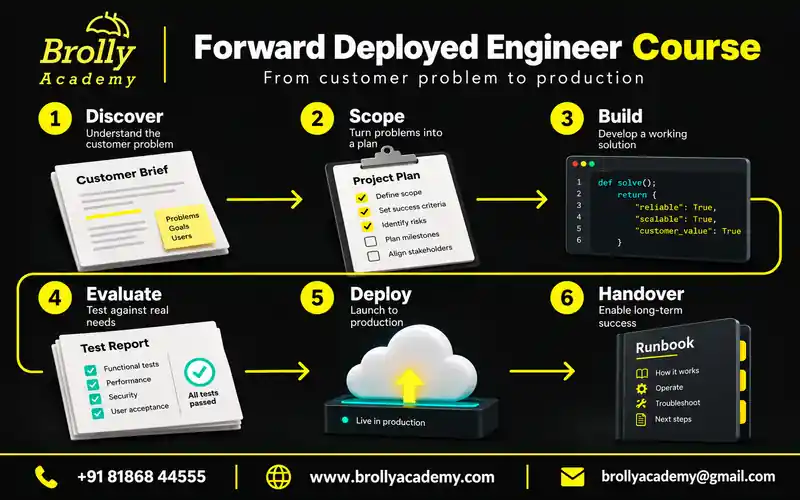
Brolly Academy FDE roadmap: discover the customer problem, scope, build, evaluate, deploy and hand over the application.
Brolly Academy FDE project roadmap: discover, scope, build, evaluate, deploy and hand over. Follow the eight-week learning sequence below.

01

Weeks 1-2: Discover, Scope and Connect

  • Interview a fictional stakeholder, map the workflow and write a small delivery brief with a success metric. Identify the data owner, access constraints and work that is out of scope.
  • Build a Python API integration using synthetic records. Demonstrate valid input, invalid input and a service failure before adding a model.

02

Weeks 3-5: Build, Retrieve and Integrate

  • Add a model-backed task and validate the response. Build retrieval with citations, then test missing evidence and access restrictions.
  • Connect a bounded agent or review workflow to a mock business system. Require approval for writes and practise a stakeholder demonstration.

03

Weeks 6-8: Evaluate, Deploy and Handover

  • Compare application versions on the same evaluation set. Investigate a regression, inspect traces and define release gates for quality, safety and cost.
  • Package and deploy the capstone in a controlled environment. Present the architecture, normal and failed runs, rollback plan and handover documentation.

What Is a Forward Deployed Engineer?

For example, a support team may need faster answers from an internal handbook. The FDE must clarify success, integrate authorized data, build retrieval, test incorrect answers and prepare a release and support plan. A chatbot screenshot alone does not show that work.OpenAI’s FDE role description illustrates this delivery scope and asks for 5+ years of relevant experience. It is a role reference, not an academy affiliation or a promised outcome.

How Practical FDE Training Works

Each practical task connects an engineering concept to a customer problem. The learning sequence below builds on the eight-module syllabus: understand the requirement, implement a small solution, test it and explain the result.
  1. Understand the Requirement

    Identify who will use the workflow, what happens today and what a useful improvement would look like. Write acceptance criteria before selecting a framework.
  2. Build a Small Working Version

    Connect Python, a validated input and an API or dataset. Demonstrate the ordinary software flow before introducing a model or agent.
  3. Investigate a Failed Case

    Test a missing field, denied action, unsupported question or service timeout. Record the expected behaviour, observed result and change needed.
  4. Explain and Improve

    Present the application and its limits in plain language. Use the same test cases to check the next version and record why the change helped.
The course combines module exercises with one scoped capstone. Confirm class hours, guided-review arrangements and the final calendar with admissions; the two-month duration alone does not specify weekly teaching hours.

Where Are Forward Deployed Engineering Skills Used?

Illustrative learning scenarios using synthetic or permitted data, not claims of client deployments.
Team or workflowProblem to solveEvidence of a useful solution
Customer supportFind reliable answers in approved product documentationSource-supported responses, escalation and reviewed failure cases
Internal operationsTurn repeated intake work into a traceable workflowValidated fields, approval records and recovery from duplicate requests
Sales operationsConnect a permitted intake process with CRM recordsData ownership, safe writes and an audit trail
IT service deskAssist ticket investigation without uncontrolled actionsScoped tools, authorization checks and human approval
Document-heavy teamsExtract information and route exceptionsField validation, a review queue and error examples
Software implementationAdapt a platform to customer constraintsIntegration tests, deployment configuration and a handover runbook
Brolly Academy FDE roadmap: discover the customer problem, scope, build, evaluate, deploy and hand over the application.
Brolly Academy FDE delivery workflow: connect the customer requirement to a working application, reviewed tests, deployment and handover.

What You Gain from the FDE Course

The goal is to become more capable at moving from an unclear request to a working, explainable solution. Practise the engineering decisions and communication that sit between a model demo and a dependable workflow. Your starting skills and independent practice will affect how far you progress in two months.

1. Clarify the Real Problem

Ask who uses the workflow, what goes wrong today and how improvement will be measured. This keeps the project useful even when the initial request is vague.

2. Scope a Deliverable

Break an ambitious idea into a small first release. Identify dependencies, exclusions and the checks that decide whether the work is ready.

3. Build Beyond a Notebook

Connect code, APIs and a simple interface so another person can use the application. Handle configuration and failures explicitly.

4. Explain Your Decisions

Describe why you chose a model, retrieval method or integration pattern. Explain alternatives and what would make you change the decision.

5. Create Portfolio Evidence

Prepare an architecture diagram, test record and runnable repository. An interviewer should be able to understand what you personally built.

6. Strengthen Python Integration

Use functions, validation and structured data around a real application flow. Practise debugging rather than copying a successful output.

7. Choose AI Deliberately

Compare a deterministic baseline with an AI-assisted option. Learn when an ordinary rule or search interface is the better solution.

8. Build Grounded Responses

Retain sources and test whether retrieved evidence supports an answer. Make missing information visible instead of filling it with confident text.

9. Work with Customer Data Safely

Use permitted or synthetic datasets, limit access and avoid sensitive information in logs. Treat external content as untrusted input.

10. Control Workflow Actions

Define tool contracts and approval boundaries. Make a failed or denied operation visible, and avoid unsafe duplicate writes.

11. Evaluate Changes Consistently

Compare versions against the same reviewed cases. Keep regression examples and use more than a single average score.

12. Understand Operational Cost

Track usage, response time and retry behaviour. Explain the cost and reliability trade-offs of a proposed release.

13. Practise Deployment and Handover

Package configuration, document health checks and rehearse rollback. A useful runbook helps someone else operate what you built.

14. Prepare for Customer Discussions

Present progress, raise blockers early and explain scope changes. Practise concise updates that help stakeholders make decisions.

15. Learn with Others

Share sanitized examples and compare approaches. Make each discussion specific enough for another learner to reproduce the problem.

16. Plan the Next Career Step

Compare your evidence with real vacancy requirements. A beginner may need a junior development role before taking full deployment ownership.

Compare Your FDE Learning Options

Forward Deployed Engineering at Brolly Academy

Your FDE Course Trainer

Manish is the trainer for the Forward Deployed Engineer Course at Brolly Academy. The course connects customer discovery with Python and API integration, AI application development, testing, deployment and handover. In the free demo, discuss your starting skills with Manish and review how these topics fit your chosen project.

TRAINER

Manish

Forward Deployed Engineering

Course duration: 2 months

Discuss the teaching approach in the free demo

Connect your technical learning with the delivery decisions an FDE makes. Your sessions with Manish follow the course syllabus, from understanding a customer workflow to building and testing a small application.

  • Technical focus: Python, APIs, structured data, retrieval and controlled AI workflows.
  • Project discussions: requirements, architecture choices, failed cases and practical trade-offs.
  • Portfolio preparation: explain your own code, evaluation results and handover documentation.
  • Before joining: use the free demo to meet Manish and discuss your readiness, class schedule and feedback arrangements.

Skills You Will Practise in FDE Training

From Technical Knowledge to Delivery Evidence

Forward Deployed Engineer Projects

Five Scenarios, One Capstone You Can Explain

Choose one main capstone and complete it end to end. The five scenarios below are options for practice, not five guaranteed production deployments. Use synthetic or explicitly permitted data, begin with a narrow scope and retain the failed cases you used to improve the application. Your final demonstration should answer: what problem did I solve, what evidence supports the result, and what happens when it fails?

Project Review and Assessment

A convincing capstone shows more than an attractive demo. Use the following review checklist to connect your application to the original requirement and make your own contribution clear. The trainer will confirm batch assessment and completion criteria.
Review areaEvidence to presentQuestion your project should answer
Problem and scopeDiscovery brief, user workflow and acceptance criteria.Who benefits, and what is deliberately outside the first release?
ImplementationRunnable repository, architecture and validated API contracts.Can another developer reproduce the application?
Quality and safetyReviewed tests, source checks, permissions and failed cases.What does the application do when the input or evidence is insufficient?
OperationsDeployment notes, usage observations, health checks and rollback.How would someone detect and recover from a problem?
CommunicationShort stakeholder demo, technical README and handover runbook.Can you explain the result, trade-offs and next useful improvement?

What Goes into Your FDE Portfolio?

  • A one-page problem statement and architecture diagram.
  • A repository with setup instructions and safe sample data.
  • Examples of successful, rejected and failed requests.
  • A concise evaluation report and documented limitations.
  • A recorded or live demonstration of your own work, when prepared.
  • A runbook covering operation, recovery and cleanup.
Label simulated work as a learning project. Do not describe a classroom capstone as a paid client deployment or claim business results you have not measured.

Customer Support Knowledge Assistant

Problem: support staff cannot find consistent answers. Build retrieval over a small approved handbook with source links and escalation. Test outdated passages, unanswered questions and access restrictions. Deliver a discovery brief, source map, application, reviewed question set and runbook. Compare answer quality with a search-only baseline.

Document Intake and Review Workflow

Problem: a team retypes information from documents. Extract selected fields from synthetic invoices or intake forms, validate required values and route inconsistent records for review. Test missing fields, duplicate documents and failed downstream writes. Deliver a field schema, review queue, test evidence and recovery instructions.

Service-Desk Agent with Approved Actions

Problem: staff repeat lookup and ticket-update steps. Build tools against a fictional ticket store, validate caller permissions and require approval before a write. Demonstrate a denied action, invalid argument, timeout and duplicate request. Deliver a tool contract, approval flow, audit record and failure demonstration.

Customer Onboarding Integration

Problem: onboarding information is scattered across forms and systems. Connect a synthetic intake process to a mock CRM and task queue. Separate data ownership from model suggestions. Test retries, partial failure and inconsistent records. Deliver an integration map, acceptance checklist, stakeholder demo and handover guide.

AI Evaluation and Release Console

Problem: a team cannot explain whether a new prompt or retrieval version is safer to release. Compare two versions on a fixed, reviewed dataset; display failed cases, latency and usage. Add a release checklist and rollback note. Deliver a reproducible evaluation run and a written recommendation that acknowledges limitations.

Tools and Technologies in the FDE Course

Use Tools to Serve the Workflow

Python

Application and integration code

SQL

Query and validate records

REST APIs

Connect business systems

Git

Review and version changes

FastAPI

Application endpoints

Pydantic

Validate structured data

LLM APIs

Task-specific model integration

RAG

Ground answers in sources

Agent Frameworks

Bounded tools and state

MCP Concepts

Tool integration boundaries

Docker

Package the application

Cloud & Observability

Deploy, trace and recover

Forward Deployed Engineer Course Fee

Course Fees & Learning Options

Free Demo

Explore the Course First

Classroom Training

INR 25,000

Live Online Course

INR 20,000

Confirmed tuition: INR 20,000 online or INR 25,000 classroom. Request a written quotation covering taxes, any model/API or cloud usage, support and completion requirements. External services and certification exams are not automatically included.EMI, video learning and corporate training: ask admissions for FDE-specific availability and written terms. A separate video-course fee or corporate package has not been confirmed. For a team programme, share the workflow, participants’ coding level, security constraints and preferred delivery format.Review the refund policy and terms and conditions before payment. An enquiry is not enrolment.

Video Course, Corporate Training and EMI Options

Choose a learning format that fits your schedule and the work you want to do. Live online and classroom tuition are confirmed above. Use the options below to request an FDE-specific proposal before selecting a video package, team programme or payment plan.

Video Course

Request FDE availability and access details

  • Ask for the module list and a sample lesson before choosing a recorded format.
  • Confirm video-access duration, exercise files and whether project review is included.
  • Check whether doubt support is live, scheduled or message-based.
  • Request the separate video-course fee; live-course tuition does not establish the video price.
Ask About Video Course

Corporate Training

Request a programme for your team

  • Share the business workflow, team size and current coding skills.
  • Discuss a scoped use case covering integration, evaluation, deployment and handover.
  • Agree permitted datasets, account access and confidentiality before practical work.
  • Request a written proposal for delivery mode, schedule, project scope and team pricing.
Request Team Proposal

EMI Payment Option

Request written FDE payment terms

  • Ask which installment arrangements are available for your selected training mode.
  • Confirm the deposit, payment dates and total payable amount.
  • Check any eligibility conditions, financing charges and late-payment terms.
  • Read cancellation and refund terms before accepting a payment plan.
Discuss EMI Options

The confirmed two-month tuition is INR 20,000 online or INR 25,000 classroom. FDE video access, corporate pricing and EMI terms require a separate written confirmation; no interest-free or guaranteed-finance offer is claimed.

FDE Interview and Career Preparation
Present Your Work with Evidence

Prepare for interviews by explaining work you actually completed. Practise discovering requirements, debugging unfamiliar failures, comparing designs and communicating a delivery plan. The checklist below shows preparation areas; confirm which guided sessions are included in your batch. Course completion does not guarantee a job, interview or salary.

Resume Building

Describe your contribution, scope and verified results without invented customer impact.

Role Research

Separate junior engineering opportunities from experienced FDE ownership roles.

Technical Interviews

Explain APIs, retrieval, tool boundaries, failures and deployment choices.

Project Practice

Build and debug one scoped application end to end.

Customer Demonstrations

Show a normal task, a failed case and the next useful improvement.

System Design

Discuss data flow, access, latency, cost and recovery trade-offs.

Application Planning

Compare your evidence with each vacancy rather than applying by title alone.

Mock Interview Preparation

Rehearse concise answers and technical follow-up questions.

Communication Skills

Translate technical risks into decisions a stakeholder can understand.

Delivery Problem Solving

Prioritize blockers and propose a testable next step.

Student Testimonials and Academy Reviews

Selected Reviews from Other Academy Courses

These reviews describe learners’ experiences on the academy courses named below. They are not testimonials for the new FDE course or for Manish. Read the linked source and course context when comparing your learning options.

Rakesh THR

Generative AI | Google Review

The trainers explain topics clearly and patiently, with hands-on exercises that make complex concepts easier to understand.

View Google Source

Pranav Pranav

Generative AI | Google Review

Sandeep sir made Generative AI concepts very easy. Real-time practice helped me a lot.

View Google Source

Sana Hari

Generative AI | Google Review

I Recently Completed the Generative AI Training at Brolly Academy and it was an excellent experience.

View Google Source

PAVAN

Generative AI | Google Review

Sandeep sir explains step by step in simple English. After modules, we worked on real-time projects.

View Google Source

Poojasri Baru

Online Classes | Google Review

I liked the online classes. Sandeep sir gives examples for every topic.

View Google Source

Roshan Mahapatra

Azure Data Factory | Google Review

Brolly Academy provides the best Azure Data Factory training program in Hyderabad.

View Google Source

FDE Learner Community

Make Practice More Useful Together

When a workflow fails, a precise question is more useful than a screenshot of an error. Share the expected result, a small safe example and the checks you tried. Compare approaches and explain what changed. Ask which batch groups and support channels are available, how they are moderated and how long access lasts. Keep credentials, customer records and private code out of shared discussions.

Use the Community to Improve Your Own Reasoning

Learning and Collaboration

Reproduce a small problem, compare approaches and explain why one change helped. Do not substitute another learner's finished project for your own work.

Resources and Tools

Use official documentation and permitted data. Record package versions and setup steps so others can reproduce the example.

Professional Connections

Exchange learning goals and project ideas respectfully. Community access is not a promise of recruiter referrals.

Useful Mentor Questions

Bring the specific failure, your hypothesis and the checks already attempted. Confirm the support format offered for your batch.

Career Development

Map project evidence to a real job requirement. Discuss skill gaps without sharing private employer or application information.

Forward Deployed Engineer Course Eligibility

Prerequisites & Readiness

You do not need to know every AI framework before joining, but you should be able to write and debug a small Python program. This is an applied engineering course, not a replacement for all software-development foundations. Course eligibility and employer hiring requirements are different: a learner can study the skills without yet meeting the experience required for a senior FDE position.

Practice Environment and Lab Setup

Start with a reproducible setup so that a working exercise is not dependent on one laptop or an undocumented account. The final batch stack and any paid services should be agreed before labs begin.
AreaWhat to prepareWhat to verify
Local developmentPython environment, editor, Git and the project’s dependency list.A second setup can run the documented example without hidden files.
Data and integrationsSynthetic records, JSON examples and a mock API or approved data source.No private employer or customer data is needed for the learning task.
Model servicesAn authorized model endpoint or the alternative specified for the lab.Access, usage limits, billing owner and service availability are known.
Application testingNormal, invalid and denied-input examples with expected results.Changes can be compared against the same cases.
DeploymentProject configuration, environment variables and a controlled deployment target.Secrets stay out of source code; rollback and resource cleanup are documented.

API credits, cloud usage and third-party subscriptions are not assumed to be included in tuition. Confirm the required accounts and expected costs before starting a paid service.

What You Need Before Joining

Who Should Join Forward Deployed Engineering Training?

Choose this path when you want to build software close to a customer’s operational problem. The emphasis is delivery across technical and stakeholder boundaries, not merely learning a model API. For a broad AI foundation, compare Generative AI Training; for a platform-specific route, see the Azure AI Course.

Forward Deployed Engineer Career Opportunities

Choose by Responsibilities, Not Only Job Titles

Forward Deployed Engineer Salary in India: Evidence by Experience

Employer-advertised examples checked on 8 October 2026. These are individual job postings, not a salary survey, placement record or guaranteed offer.
Experience and exampleAdvertised annual salaryRequirements to compareSource
Fresher / no professional experienceNo verified zero-experience FDE range in the examples reviewedBuild coding and portfolio evidence; compare junior software and applied-AI openingsDo not treat experienced-role figures as a fresher offer
1 year listed | Chat360, GurgaonINR 8-10 lakhCoding, communication and customer-facing AI solution buildingView employer job listing
2 years listed | TechUp Labs, India remoteINR 10-25 lakhPython, APIs, debugging and practical workflow integrationView employer job listing
6+ years | Alpha Nodus, BengaluruINR 20-40 lakhSenior engineering plus customer-facing delivery experienceView employer job listing

Location, prior delivery experience, technical depth and customer responsibilities affect compensation. Check whether an offer is fixed salary or total compensation and confirm the current vacancy details. A degree or certificate alone does not establish eligibility; each employer sets its own requirements.

Qualifications and Skills for Forward Deployed Engineer Jobs

Course admission and hiring eligibility are different. A learner can develop these skills before meeting the experience requirement of a particular FDE vacancy.

  • Software foundations: be ready to demonstrate Python, API integration, debugging and maintainable code.
  • Customer understanding: explain a business workflow, clarify requirements and communicate technical trade-offs.
  • Applied AI: show how models, structured data and retrieval fit into an application you can test.
  • Delivery evidence: present your repository, integration tests, deployment notes and project decisions.
  • Experience and education: check each employer’s stated requirements rather than treating one course certificate as universal eligibility.

For example, TechUp Labs’ employer-posted FDE vacancy lists two years of experience and emphasizes Python, APIs, debugging, AI integration and communication. This is a job-research reference, not a placement partnership. Requirements and vacancy availability can change.

Companies with Forward Deployed Engineering Roles

Explore the responsibilities behind the title. These links are research references, not claims of academy hiring partnerships, guaranteed interviews or ongoing vacancies.

FDE Course Learning Milestones

Show What You Can Do

Discovery Brief

Define a user, problem and measurable acceptance criteria

Working Integration

Connect validated inputs, APIs and application data

Evaluated Application

Retain reviewed successes, failures and revisions

Controlled Deployment

Document access, health checks and rollback

Customer Handover

Explain setup, operation, limits and next steps

FDE Course Completion and Certification Guidance

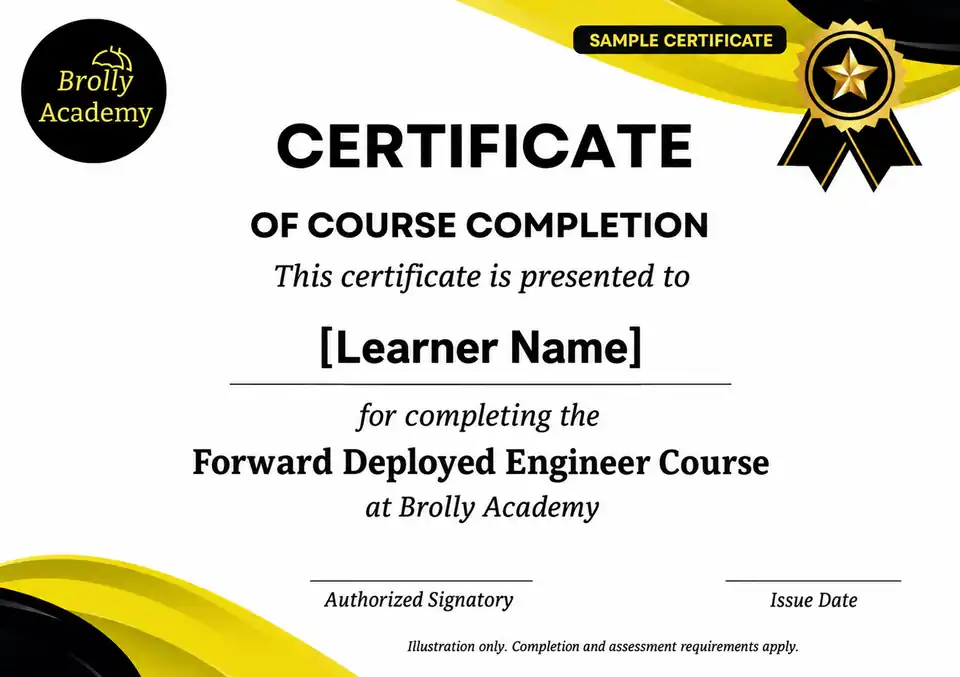
An academy completion certificate records the learning and assessment agreed for your batch. It is not a professional licence, an employer endorsement or a substitute for engineering experience. This course does not award a Palantir, OpenAI, Microsoft or other vendor credential. Confirm the academy completion requirements in writing before enrolling.

Brolly Academy sample certificate for completing the Forward Deployed Engineer Course.
Sample FDE course completion certificate. Batch assessment requirements apply.

Evidence to Prepare for Course Completion

There is no single certificate on this page that guarantees an FDE role. A stronger application connects demonstrable software skills with customer communication and delivery experience. The academy certificate illustration is not a vendor certification or a claim of authorization.

Forward Deployed Engineering: Market Signals and Learning Priorities

What the Role Descriptions Suggest

FDE vs AI Engineer vs Solutions Engineer: Which Path Fits?

Titles overlap. Compare responsibilities and experience requirements in the actual vacancy.
PathTypical emphasisUseful evidence
Forward Deployed EngineerCustomer-specific implementation and end-to-end deliveryDiscovery brief, working integration, deployment and handover
Applied AI EngineerModel-backed product or application featuresApplication code, evaluation results and operational behaviour
Solutions EngineerTechnical fit, demonstrations and customer discussions; scope variesRequirements analysis, solution design and a clear demo
ML EngineerModel and data pipelines or ML production systemsData handling, modelling/evaluation and production pipeline skills
Cloud / DevOps EngineerInfrastructure, release automation and operationsDeployment, monitoring, access and recovery evidence

A Generative AI course offers broader model concepts; this FDE path emphasizes customer delivery. Choose RAG Training for retrieval specialization, or the Azure AI Course for Azure-focused application development.

Forward Deployed Engineer Course FAQs

Your Questions, Answered

1. What is a Forward Deployed Engineer course?

It is an applied learning path for building software close to a customer’s problem. This course connects discovery, scoping, Python and API integration, AI application development, evaluation, deployment and handover. The goal is a small working system with evidence, not only a collection of model demos.

2. What does FDE stand for?

Here FDE means Forward Deployed Engineer. Some organizations use related titles or different expansions. Read the role description: customer delivery, coding responsibilities, travel and required experience matter more than the abbreviation alone.

3. Is this course only about generative AI?

No. AI integration is part of the curriculum, but the wider focus is delivering a useful application. You also practise requirements, APIs, data handling, tests, deployment, stakeholder communication and operational handover.

4. Who is this FDE course for?

It suits coding-ready developers, implementation or solutions engineers, cloud and data professionals, technical consultants and students with software foundations. A free demo can help determine whether you need Python or API preparation first.

5. Can freshers join?

Freshers with basic coding skills can study the course and build a portfolio. That does not make every FDE job an entry-level opportunity. Many employers ask for professional delivery experience, so junior software or applied-AI roles may be a more realistic first step.

6. Do I need a computer-science degree?

A particular degree is not stated as a universal course prerequisite. Practical readiness in Python, JSON, APIs and debugging matters for the labs. Employers may separately require a degree, equivalent experience or other qualifications; check each vacancy.

7. How much Python should I know?

Be able to write functions, use lists and dictionaries, handle exceptions, install packages and process JSON. You should be willing to debug a small program independently. If those tasks are unfamiliar, complete foundation practice before the application modules.

8. Do I need SQL, frontend or cloud experience?

Basic SQL and API knowledge help. Frontend and cloud familiarity are useful, but the course is not a complete replacement for full-stack or cloud engineering training. We use a scoped application so you can connect the parts and identify what to study next.

9. What is the course duration?

The confirmed duration is two months. The roadmap suggests a sequence across eight weeks, but actual start dates, class times and teaching hours must be confirmed with admissions. Allow additional time for independent practice and project work.

10. What is the Forward Deployed Engineer course fee?

The confirmed tuition is INR 20,000 for live online learning and INR 25,000 for classroom learning. Request written details covering taxes, lab or API usage, support and completion requirements before payment.

11. Can I attend online or in Hyderabad?

Both live online and classroom tuition have been confirmed. Contact the academy to confirm the classroom venue, next batch and available teaching times. For online learning, confirm the session time zone and equipment requirements.

12. Is there a free demo?

Yes. Use Book Free Demo to open the enquiry form, or contact the academy on WhatsApp. Use the discussion to review your starting skills, learning goals, curriculum, sessions with Manish and batch arrangements.

13. Who is the trainer?

Manish is the trainer for the Forward Deployed Engineer Course at Brolly Academy. Use the free demo to meet Manish, discuss the syllabus and your starting skills, and review the project and feedback arrangements.

14. Are EMI, recorded videos or corporate training available?

Ask admissions for FDE-specific availability and written terms. No separate video-course fee or corporate package is confirmed on this page. For EMI, review payment dates, eligibility and any charges before agreeing to a plan.

15. Are model APIs and cloud credits included?

Do not assume unlimited API usage, cloud credits or exam fees are included in tuition. Confirm which accounts and services are required, who owns them and who pays for usage. Use small experiments, bounded requests and appropriate cleanup.

16. Will I build five projects?

Five project scenarios are presented as choices. The main goal is one scoped capstone completed end to end, with smaller labs supporting the modules. Agree the expected deliverables for your batch rather than counting unfinished demonstrations as complete projects.

17. What should the capstone contain?

Include a problem brief, architecture, runnable code, safe sample data, tests, reviewed evaluation results and known limitations. Add deployment configuration, a cost note, rollback steps and a handover runbook. Explain what you personally contributed.

18. Does the course cover RAG?

Yes. The syllabus covers document preparation, retrieval, source tracking, citations, answerability and access controls. You will compare retrieved evidence with the final response and test unsupported questions rather than assuming a citation proves correctness.

19. Does it include AI agents and MCP?

The curriculum includes bounded tool workflows, validation, state and human approval, with MCP introduced as an integration concept. These interfaces do not replace authentication or business rules. The practical focus is a controlled workflow you can inspect and test.

20. Which frameworks will I use?

The course emphasizes transferable patterns using Python, APIs, validation, retrieval, Git, Docker and a cloud deployment workflow. Framework choices should suit the task and available services. Confirm the exact batch stack; no single framework is a requirement for every FDE role.

21. Is this an official Palantir or OpenAI course?

No. This is Brolly Academy training. Employer role descriptions are linked as research references, not affiliations, endorsements, recruitment partnerships or official courseware. The course does not award a vendor credential.

22. Will I receive a certificate?

Ask for the academy completion and assessment requirements agreed for your batch. An academy certificate records learning; it is not a licence, employer endorsement or guarantee of employment. Any external credential has separate provider requirements and fees.

23. Is placement guaranteed?

No. The course includes portfolio and interview-preparation topics, but completion does not guarantee a job, interview, placement or salary. Hiring depends on your skills, prior experience, vacancies and the employer’s selection process.

24. What salary can a fresher expect?

The salary section links individual employer advertisements and separates their experience requirements. No verified zero-experience FDE salary band is claimed. Do not apply a one-year or senior-role salary to a fresher; compare actual entry-level offers and their compensation structure.

25. How is FDE different from a solutions engineer?

The titles overlap. Many FDE roles emphasize hands-on implementation and production delivery, while some solutions-engineering roles emphasize technical fit and pre-sales demonstrations. Read the actual responsibilities to understand where ownership starts and ends.

26. How is this different from the Generative AI course?

The FDE course organizes learning around customer delivery from discovery to handover. A broader Generative AI course may be a better first step for model concepts and general foundations. Choose by your current skills and next work goal, not by collecting similar course titles.

27. Can I use my employer’s data in a project?

Only with explicit authorization and appropriate safeguards. Synthetic or permitted sample data is the default. Do not upload private documents, credentials or customer records to model services or learner groups without permission.

28. How are projects evaluated?

Use task-specific acceptance criteria and a reviewed set of normal and failed cases. Assess functionality, grounding, access controls, reliability and clarity of handover. A single automated score is not enough to establish that an application is safe or useful in every situation.

29. Will the course guarantee expertise in two months?

No. Two months provides a structured path for a scoped project, not a substitute for years of engineering experience. Progress depends on your starting point, practice and feedback. Use the capstone to identify the next skills you need.

30. How do I enrol or request the syllabus?

Request the syllabus through the form or book a free demo. Before payment, confirm the trainer, calendar, teaching hours, total costs, support and completion terms, and review the academy refund policy. Sending an enquiry does not enrol you or automatically subscribe you to marketing.
How to Join the Forward Deployed Engineer Course

  1. Discuss Your Starting Point

    Tell the team about your Python and API experience, the role you are targeting and your preferred learning format.

  2. Book a Free Demo

    Review a sample learning task, the eight-module plan and the project options. Ask which foundations you should complete first.

  3. Review Your Batch Details

    Get the assigned trainer, start date, teaching hours, support arrangements and total costs in writing. Confirm recordings, missed-session options and project-review access.

  4. Confirm Enrolment

    Read the terms and conditions and refund policy, then follow the academy’s official payment instructions. An enquiry alone does not enrol you.

Ask About the Next FDE Batch or call +91 81868 44555.

FDE Learning and Career Resources

Got more questions?

Talk to Our Team Directly

Contact our team for the FDE syllabus, batch schedule and free demo.

Request the FDE Syllabus and Project Checklist

Get the eight-module syllabus and a capstone acceptance checklist. Submit your name and email to request the original academy learning pack. It is not vendor courseware or a paid enrolment.

Your name and email are used to respond to this request. It does not automatically subscribe you to marketing. Read our Privacy Policy.

Enroll for Course Free Demo Class

Your name, email and mobile number help us respond to your demo enquiry. Read our Privacy Policy for details and privacy requests.