
Table of Contents
Table of Contents
TogglePurpose of artificial intelligence – Brolly Academy
1.Purpose of artificial intelligence - Core Goal of AI Systems
- The purpose of artificial intelligence is to create machines that can do tasks that usually need human thinking.
- These tasks include learning from data, solving problems, and making decisions.
- AI helps complete work faster and with fewer mistakes.
- It is used in many modern applications to make life easier and more efficient.
2.How AI Simulates Human Intelligence
- AI tries to copy how humans think and learn.
- It learns patterns from data and improves over time.
- AI can understand text, recognize images, and respond to questions.
- This is done using programs and algorithms designed by developers.
3.Role of Automation, Learning, and Decision-Making
- Learning: AI systems learn from past data and improve their performance.
- Automation: AI can do repetitive tasks without human help.
- Decision-making: AI uses data to make smart choices or predictions.
- These three parts are the main working process of AI systems.
4.Purpose of AI in Modern Applications
- AI is used in many areas like healthcare, banking, and online shopping.
- It helps doctors find diseases, banks detect fraud, and apps suggest products.
- AI is also used in daily tools like maps, search engines, and voice assistants.
- The main aim is to save time, reduce effort, and improve results.
purpose of artificial intelligence PDF
If you’re looking for a Purpose of Artificial Intelligence PDF, you can download it here

Core Purpose of Artificial Intelligence
Function | Description | Example |
Learning | Systems improve by using data | Recommendation engines |
Reasoning | Makes decisions based on information | Fraud detection |
Automation | Does tasks without human effort |
5.Types of Artificial Intelligence and Their Purpose
Type of AI | Capability | How It Works | Purpose | Real-World Examples | Current Status |
Narrow AI (Weak AI) | Focuses on one specific task | Uses data and algorithms to learn patterns for a single function | Automates tasks and improves efficiency | Voice assistants, recommendation systems, chatbots, fraud detection | Widely used today in many industries |
General AI (Strong AI) | Can perform multiple tasks like a human | Would combine learning, reasoning, and problem-solving across different areas | Solve complex problems similar to human thinking | Not fully developed yet (research stage) | Still under development and not available in real-world use |
Super AI | More intelligent than humans in all areas | Expected to think, learn, and make decisions beyond human ability | Drive future innovation and advanced decision-making | No real-world examples yet (theoretical concept) | Hypothetical, may develop in the future |
6. Applications of Artificial Intelligence Across Industries
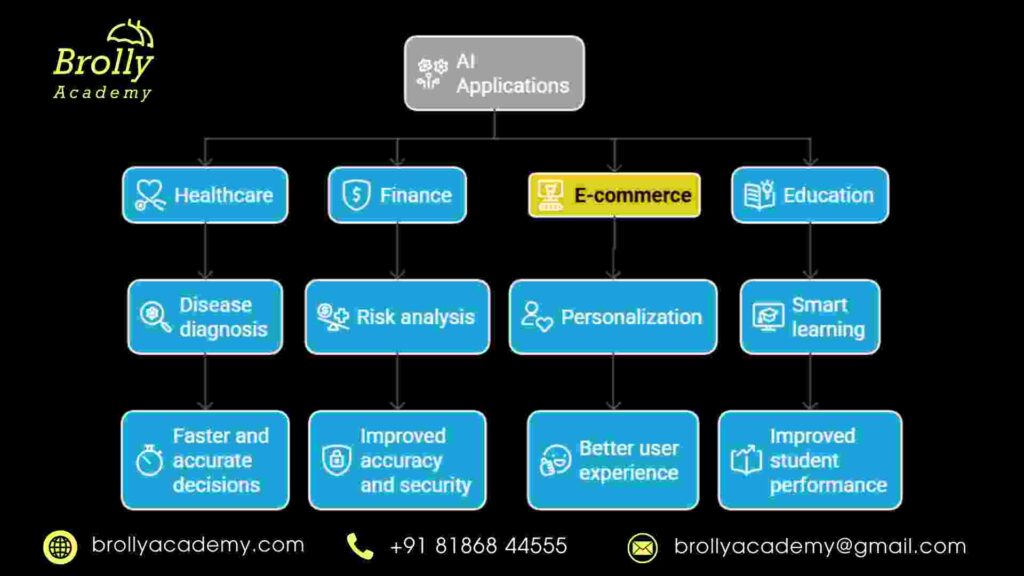
Artificial intelligence is used in many industries and also in daily life. It helps people and organizations work faster, make better decisions, and reduce manual effort. From business operations to healthcare and education, AI plays an important role in improving results and saving time
AI Applications Across Industries
Industry | Use Case | How AI Is Used | Impact |
Healthcare | Disease diagnosis | Analyzes medical data and images | Faster and accurate decisions |
Finance | Risk analysis | Detects fraud and evaluates risks | Improved accuracy and security |
Personalization | Recommends products based on user behavior | Better user experience | |
Education | Smart learning | Provides personalized lessons | Improved student performance |
Transportation | Route optimization | Predicts traffic and suggests best routes | Saves time and fuel |
Entertainment | Content recommendation | Suggests movies and music | More engaging experience |
7. Uses of Artificial Intelligence in Everyday Life
Artificial intelligence is part of daily life, even if people do not always notice it. It helps make tasks easier, faster, and more convenient.
10 Uses of Artificial Intelligence
- Voice Assistants
AI powers assistants like Siri or Google Assistant to answer questions and perform tasks using voice commands. - Search Engines
AI helps search engines understand queries and show the most relevant results. - Navigation and Maps
AI analyzes traffic data to suggest the fastest routes and avoid delays. - Social Media Feeds
AI decides what content appears based on user interests and activity. - Online Shopping Recommendations
E-commerce platforms suggest products based on browsing and purchase history. - Streaming Services
AI recommends movies, shows, and music based on user preferences. - Email Filtering
AI filters spam emails and organizes inbox messages automatically. - Smartphones Features
AI is used in face unlock, camera improvements, and predictive text typing. - Chatbots and Customer Support
AI chatbots provide instant replies to customer queries on websites. - Online Payments and Fraud Detection
AI monitors transactions to detect unusual activity and prevent fraud.
8. Advantages and Disadvantages of Artificial Intelligence
Aspect | Advantages (Benefits) | Disadvantages (Limitations) |
Work Process | Automation of repetitive tasks | Job loss risk due to automation |
Accuracy | High accuracy with fewer errors | Bias in data can affect results |
Efficiency | Faster performance and productivity | High cost of development and maintenance |
Availability | Works 24/7 without breaks | Dependency on technology |
Decision-Making | Quick data-based decisions | Lack of human judgment and emotions |
Data Handling | Can process large amounts of data | Privacy and security risks |
9. Key Characteristics of Artificial Intelligence
Artificial intelligence has certain characteristics that allow machines to perform intelligent tasks. These characteristics help AI systems learn from data, make decisions, and solve problems.
Artificial Intelligence Characteristics
- Learning
AI systems learn from data and improve their performance over time without being explicitly programmed for every task. - Reasoning
AI can analyze information and make logical decisions based on available data. - Perception
AI can understand inputs like images, speech, and text using sensors and algorithms.
Problem-Solving
AI can find solutions to complex problems by processing large amounts of data quickly.
AI vs Human Intelligence Comparison
Feature | Artificial Intelligence | Human Intelligence |
Learning | Learns from data and algorithms | Learns from experience and understanding |
Reasoning | Based on programmed logic and data | Based on logic, emotions, and experience |
Perception | Recognizes patterns in images and data | Uses senses and awareness |
Problem-Solving | Solves problems using data and calculations | Uses creativity and critical thinking |
Speed | Very fast processing | Slower compared to AI |
Adaptability | Limited to trained data | Highly adaptable to new situations |
10. How AI Technology Works
Artificial intelligence works by using data, algorithms, and computing power to learn patterns and make decisions. It follows a step-by-step process to perform tasks that normally require human intelligence.
How AI Works (Step-by-Step)
- Data Collection
AI systems need large amounts of data. This data can be text, images, videos, or numbers. - Data Processing
The collected data is cleaned and organized so the system can understand it. - Training the Model
AI uses machine learning algorithms to learn from the data. It finds patterns and relationships. - Making Predictions or Decisions
After training, the AI system can give outputs like predictions, recommendations, or answers.
Continuous Improvement
AI systems improve over time by learning from new data and feedback.
11. Future Purpose of Artificial Intelligence (2026 and Beyond)
Artificial intelligence is growing very fast and is becoming a key part of how businesses and daily life work. The future purpose of AI is not just automation, but also helping people make better decisions and solve complex problems.
Evolution of AI Technology
- AI has moved from simple rule-based systems to advanced learning systems.
- Modern AI can understand data, learn patterns, and improve over time.
- New technologies like machine learning and generative AI are making systems more powerful.
- In the coming years, AI will become more accurate and easier to use.
AI in Automation and Decision Intelligence
- AI is now used to automate not just basic tasks, but also complex processes.
- Businesses use AI to analyze large amounts of data quickly.
- AI helps in decision-making by giving insights and predictions.
- Many companies are using AI tools daily for Digital marketing, customer service, and planning.
Future Trends Shaping Industries
- Increase in AI Adoption
More companies are using AI tools in their daily operations than ever before. - Growth of Generative AI
Tools that create content (text, images, code) are becoming very popular. - Smarter Automation
AI systems are starting to handle complete workflows, not just small tasks. - Personalization at Scale
Apps and websites will become more customized for each user. - AI in Healthcare and Education
AI will support early diagnosis and personalized learning systems.
Human and AI Working Together
AI will assist humans instead of fully replacing them in most jobs.
12. Conclusion
Artificial intelligence is designed to help machines perform tasks that usually need human thinking. Its main purpose is to improve how work is done by making systems faster, more accurate, and more efficient. From learning and automation to decision-making, AI is changing the way people and businesses solve problems.
In modern society, AI has become an important part of daily life. It is used in industries like healthcare, education, finance, and business operations. It also plays a role in everyday tools such as smartphones, search engines, and online platforms. AI helps save time, reduce effort, and improve the quality of results.
As AI continues to grow, its adoption will increase across all sectors. It is important to use AI in a responsible way while understanding both its benefits and limitations. When used correctly, AI can support human work, improve productivity, and create new opportunities for the future.
FAQ
1. What is the purpose of artificial intelligence?
The purpose of artificial intelligence is to create systems that can perform tasks that normally require human intelligence, such as learning, problem-solving, and decision-making.
2. What is general purpose artificial intelligence?
General purpose artificial intelligence refers to AI that can perform many different tasks like a human, instead of being limited to one specific task. It is still under development.
3. What are the main uses of AI?
AI is used in healthcare, business, education, finance, and daily life applications like search engines, maps, and voice assistants.
4. What are the advantages and disadvantages of AI?
AI improves efficiency, accuracy, and automation, but it also has disadvantages like job loss risk, high cost, and data bias.
5. How is AI used in real life?
AI is used in smartphones, online shopping, navigation apps, social media, and customer support systems.
6. What is artificial intelligence in simple words?
Artificial intelligence means teaching machines to think and learn like humans.
7. What are the types of artificial intelligence?
The main types are narrow AI, general AI, and super AI.
8. What are examples of artificial intelligence?
Examples include voice assistants, recommendation systems, chatbots, and self-driving cars.
9. How does artificial intelligence work?
AI works by collecting data, learning patterns, and making decisions using algorithms.
10. Why is artificial intelligence important?
AI is important because it helps improve efficiency, reduce effort, and make better decisions.
11. What are the applications of artificial intelligence?
AI is used in healthcare, finance, education, transportation, and entertainment.
12. What is AI technology?
AI technology includes machine learning, deep learning, and natural language processing.
13. What are the benefits of artificial intelligence?
Benefits include faster work, better accuracy, automation, and improved user experience.
14. What are the risks of artificial intelligence?
Risks include job displacement, data privacy issues, and system bias.
15. Can AI replace humans?
AI can replace some repetitive jobs, but it cannot fully replace human creativity and emotions.
16. What is the future of artificial intelligence?
The future of AI includes smarter automation, better decision-making, and wider use across industries.
17. How is AI used in education?
AI is used for personalized learning, online tutoring, and automated grading.
18. How is AI used in healthcare?
AI helps in disease detection, medical analysis, and treatment planning.
19. What is machine learning in AI?
Machine learning is a part of AI that allows systems to learn from data without being programmed step by step.
20. What is the difference between AI and human intelligence?
AI works based on data and algorithms, while human intelligence includes emotions, creativity, and experience.
Related AI Blogs
Introduction to AI and Machine Learning

Related AI Courses
Agentic AI Course in Hyderabad