Introduction of Python Programming
Introduction of Python Programming – What Is Python?
Introduction of Python programming begins with a simple yet powerful idea: creating a language that anyone can read, understand, and write with ease. Python is a high-level, interpreted, general-purpose programming language designed to prioritize code readability and developer productivity.
Unlike many languages that rely on complex syntax rules, Python uses clean, English-like commands, making it the top choice for beginners and experienced developers alike. Whether you want to build websites, analyze data, create AI models, or automate everyday tasks, Python provides the tools to do it efficiently.
Today, Python consistently ranks as the world’s most popular programming language according to the TIOBE Index and Stack Overflow Developer Survey, and is widely used by global companies like Google, Netflix, Instagram, NASA, and Spotify.
What is Python in simple words?
Python is a programming language that tells computers what to do using simple, human-readable instructions. It can be used to build websites, work with data, create AI, and automate repetitive tasks.

Share
Table of Contents
ToggleIntroduction Of Python Programming – Brolly Academy
Table of Contents
History and Evolution of Python
Understanding the history of Python helps you appreciate why it is built the way it is. Python was created by Guido van Rossum, a Dutch programmer, while he was working at Centrum Wiskunde & Informatica (CWI) in the Netherlands. He began developing Python in the late 1980s as a side project during the Christmas holidays.
Year | Milestone | Significance |
1989 | Python development begins | Guido van Rossum starts writing Python as a hobby project |
1991 | Python 0.9.0 released | First public version — included classes, exception handling, and functions |
1994 | Python 1.0 released | Added lambda, map, filter, and reduce functions |
2000 | Python 2.0 released | Introduced list comprehensions and garbage collection |
2008 | Python 3.0 released | Major redesign — improved Unicode support and fixed design flaws |
2020 | Python 2 end of life | All support shifted to Python 3 |
2023–2026 | Python 3.11–3.13+ | Faster execution, improved error messages, JIT compilation research |
The name “Python” was inspired not by the snake but by the British comedy series Monty Python’s Flying Circus, which Guido van Rossum was a fan of. He wanted the language to feel fun and approachable — a philosophy that continues to define Python’s community today.
Key Features of Python Programming Language
One of the biggest reasons Python is recommended as the first programming language for beginners is its rich set of features that make coding easier, faster, and more enjoyable.
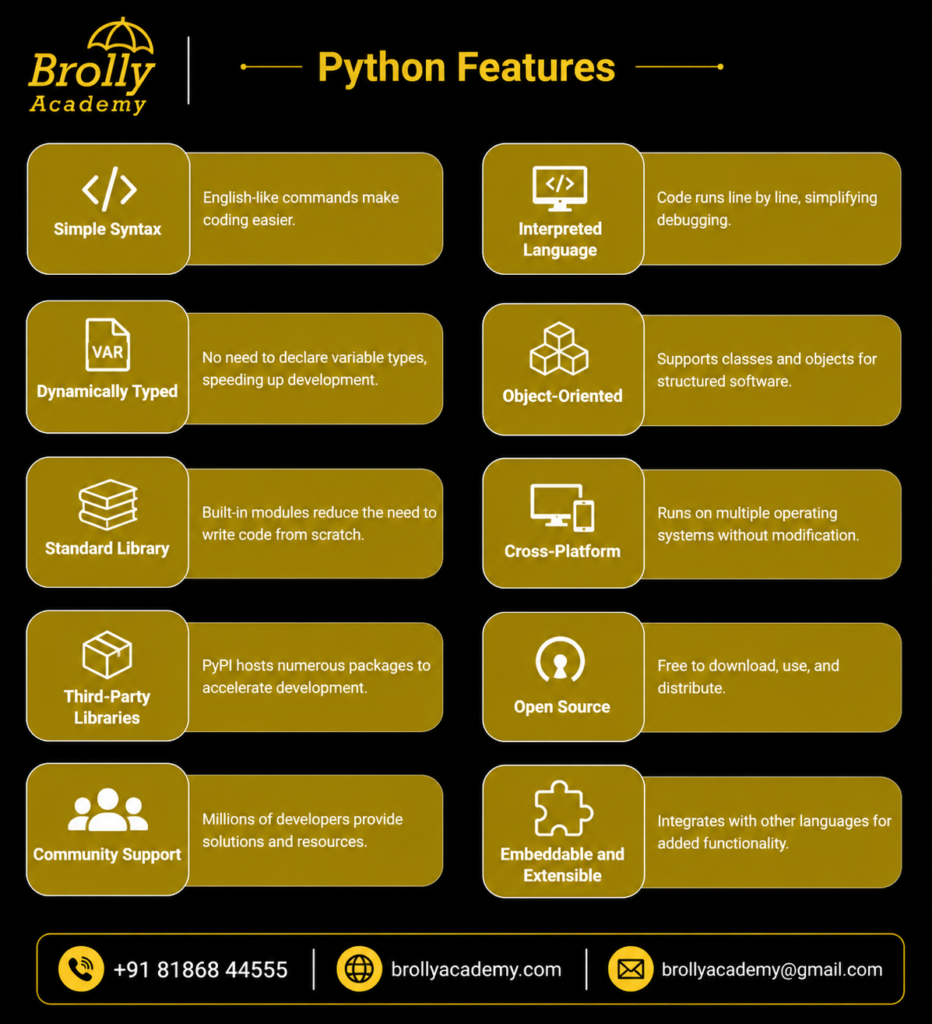
Feature | Description | Real-World Benefit |
Simple and Readable Syntax | Uses English-like commands with minimal symbols | Beginners write working code faster with fewer errors |
Interpreted Language | Code runs line by line without pre-compilation | Easier to test and debug programs instantly |
Dynamically Typed | No need to declare variable data types explicitly | Faster development and more flexible coding |
Object-Oriented | Supports classes, objects, inheritance, and polymorphism | Builds structured, reusable, and scalable software |
Large Standard Library | Built-in modules for file handling, networking, math, and more | Reduces need to write code from scratch |
Cross-Platform | Runs on Windows, macOS, Linux, and Raspberry Pi | Write once, run anywhere without modification |
Extensive Third-Party Libraries | PyPI hosts over 500,000 packages (NumPy, Pandas, TensorFlow, Django) | Accelerates development across all domains |
Open Source and Free | Python is free to download, use, and distribute | No licensing cost — ideal for students and startups |
Strong Community Support | Millions of developers, tutorials, and forums worldwide | Solutions and learning resources are always available |
Embeddable and Extensible | Can be integrated with C, C++, and Java | Adds scripting capability to existing applications |
Basic Python Syntax for Beginners
One of the most exciting parts of the introduction of Python programming is how clean and simple the syntax is. Even someone without a technical background can read a Python program and understand what it does.
Your First Python Program
print("Hello, World!")That single line is a complete Python program. No semicolons. No curly braces. No complex declarations.
Python Variables and Data Assignment
name = "Rahul"

age = 25

city = "Hyderabad"

is_student = True

print(name, "is", age, "years old and lives in", city)
Conditional Statements (if / else)
marks = 85

if marks >= 90:

    print("Grade: A+")

elif marks >= 75:

    print("Grade: A")

else:

    print("Grade: B")
Loops in Python
# For Loop

for i in range(1, 6):

    print("Python Step", i)

# While Loop

count = 1

while count <= 3:

    print("Count:", count)

    count += 1
Functions in Python
def greet(name):

    return f"Welcome to Brolly Academy, {name}!"

message = greet("Priya")

print(message)
Notice how Python uses indentation (spaces) instead of curly braces to define code blocks. This forces developers to write clean, consistently formatted code — one of Python’s defining characteristics.
Python Data Types and Variables
Python supports a wide range of built-in data types that allow you to work with numbers, text, collections, and more.
Data Type | Category | Example | Usage |
int | Numeric | age = 22 | Whole numbers and counters |
float | Numeric | price = 99.99 | Decimal values and measurements |
str | Text | name = “Python” | Text, names, messages |
bool | Boolean | is_active = True | True/False conditions |
list | Collection | skills = [“Python”, “SQL”, “ML”] | Ordered, changeable sequences |
tuple | Collection | coordinates = (17.3850, 78.4867) | Ordered, unchangeable data |
dict | Mapping | student = {“name”: “Arjun”, “age”: 21} | Key-value pairs |
set | Collection | unique_cities = {“Hyderabad”, “Pune”, “Bangalore”} | Unique, unordered items |
NoneType | Null | result = None | Represents absence of value |
Object-Oriented Programming in Python
Python fully supports Object-Oriented Programming (OOP), which allows developers to model real-world entities using classes and objects. OOP makes large codebases more organized, reusable, and easier to maintain.
Core OOP Concepts in Python
- Class:A blueprint that defines the structure and behavior of objects.
- Object:A specific instance created from a class.
- Inheritance:A child class inherits properties and methods from a parent class.
- Encapsulation:Bundling data and methods together and restricting direct access.
- Polymorphism:The ability of different classes to share the same method name with different behaviors.
class Student:

    def __init__(self, name, course):

        self.name = name

        self.course = course

    def introduce(self):

        return f"Hi, I am {self.name} and I am learning {self.course} at Brolly Academy."

student1 = Student("Ananya", "Python Full Stack")

print(student1.introduce())
Applications of Python Across Industries
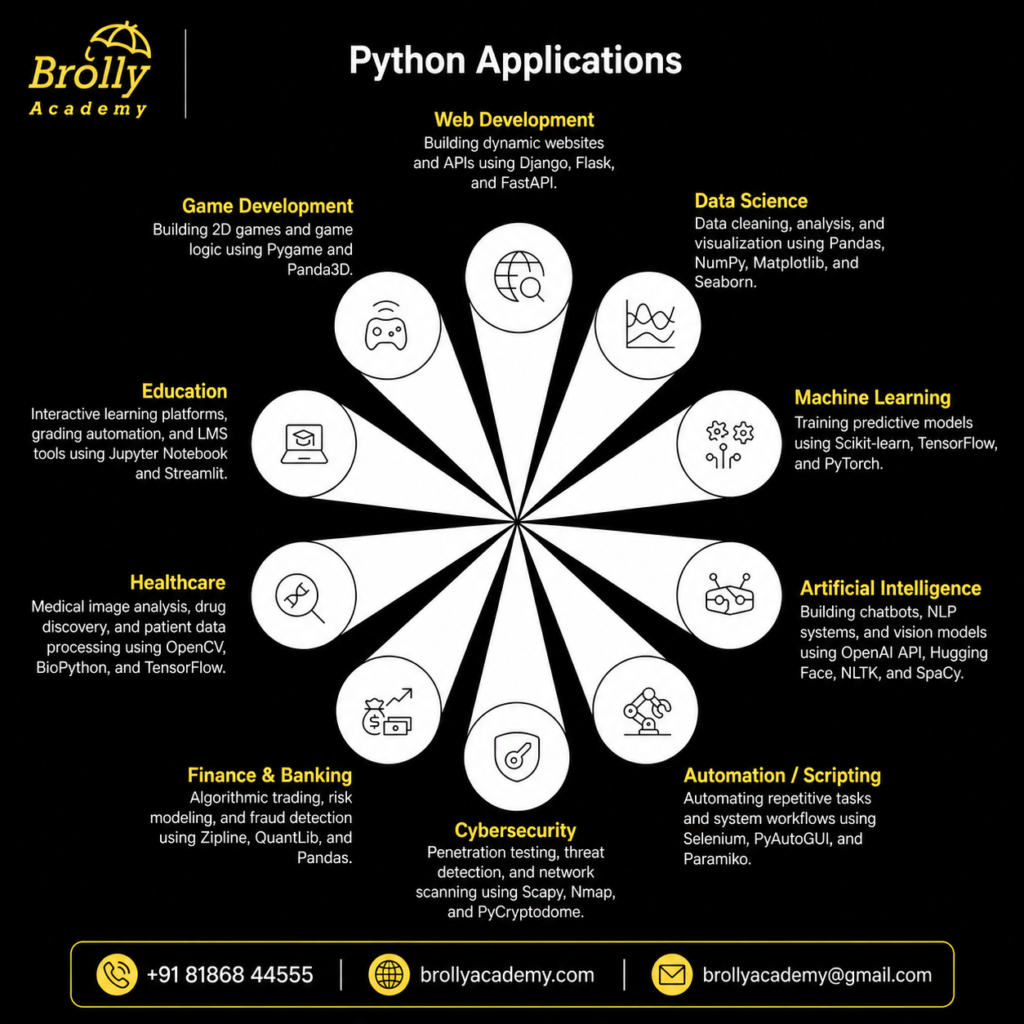
Python’s versatility is one of its greatest strengths. It is used in virtually every major industry around the world. Understanding these applications demonstrates the real-world value of learning Python.
Industry | Application | Python Tools Used | Impact |
Web Development | Building dynamic websites and APIs | Django, Flask, FastAPI | Faster development cycles and scalable backends |
Data Science | Data cleaning, analysis, and visualization | Pandas, NumPy, Matplotlib, Seaborn | Better business decisions through data insights |
Machine Learning | Training predictive models | Scikit-learn, TensorFlow, PyTorch | Automation of complex pattern recognition tasks |
Artificial Intelligence | Building chatbots, NLP systems, and vision models | OpenAI API, Hugging Face, NLTK, SpaCy | Intelligent automation and human-like interactions |
Automation / Scripting | Automating repetitive tasks and system workflows | Selenium, PyAutoGUI, Paramiko | Saves hours of manual work daily |
Cybersecurity | Penetration testing, threat detection, network scanning | Scapy, Nmap, PyCryptodome | Stronger security postures for organizations |
Finance & Banking | Algorithmic trading, risk modeling, fraud detection | Zipline, QuantLib, Pandas | More accurate and faster financial analysis |
Healthcare | Medical image analysis, drug discovery, patient data processing | OpenCV, BioPython, TensorFlow | Early disease detection and better patient outcomes |
Education | Interactive learning platforms, grading automation, LMS tools | Jupyter Notebook, Streamlit | Personalized and engaging learning experiences |
Game Development | Building 2D games and game logic | Pygame, Panda3D | Rapid game prototyping and simulation |
Advantages and Disadvantages of Python
Like every programming language, Python comes with its own set of strengths and limitations. Here is a balanced view to help you make an informed decision.
Aspect | Advantages | Disadvantages |
Speed of Development | Fast to write and prototype due to concise syntax | Slower execution speed compared to C or Java |
Readability | Clean, English-like syntax reduces cognitive load | Enforced indentation can confuse absolute beginners initially |
Versatility | Used in web, AI, data science, automation, and more | Not ideal for mobile app development (limited native frameworks) |
Community and Libraries | Massive ecosystem with 500,000+ packages on PyPI | Too many library choices can overwhelm newcomers |
Memory Management | Automatic garbage collection handles memory | High memory consumption for large applications |
Cross-Platform | Works on Windows, macOS, and Linux | Global Interpreter Lock (GIL) limits true multi-threading |
Career Opportunities | High demand across industries globally | Competitive job market requires strong portfolio and skills |
Learning Curve | Easiest language to learn for beginners | May create bad habits if learners skip concepts like memory management |
Python vs Other Programming Languages
When beginning the introduction of Python programming, many learners wonder how Python compares to other popular languages. Here is a clear comparison:
Feature | Python | Java | JavaScript | C++ |
Syntax Complexity | Very simple | Verbose | Moderate | Complex |
Execution Speed | Moderate | Fast | Fast (V8 engine) | Very fast |
Best Use Case | Data science, AI, automation | Enterprise apps, Android | Web front-end & back-end | System programming, games |
Learning Curve | Easiest | Moderate | Moderate | Difficult |
AI/ML Support | Excellent | Limited | Limited | Moderate |
Community Size | Very large | Large | Very large | Large |
Job Market (India) | Very high demand | High demand | High demand | Moderate demand |
How Python Works – Step by Step
Understanding how Python works internally helps you write better code and troubleshoot issues more effectively.
- Write the Code:The developer writes Python code in a .py file using a text editor or IDE like VS Code, PyCharm, or Jupyter Notebook.
- Source Code Compilation:Python’s interpreter compiles the source code into an intermediate format called bytecode (.pyc files stored in __pycache__).
- Python Virtual Machine (PVM):The bytecode is sent to the PVM, which is the runtime engine that executes instructions one by one.
- Execution:The PVM translates bytecode into machine-level instructions that the computer’s CPU can understand and execute.
- Output:The result — whether it is printed text, a saved file, a web page, or a trained model — is delivered to the user.
Key Insight: Python uses the CPython interpreter by default (written in C). Other implementations include PyPy (faster), Jython (runs on JVM), and IronPython (runs on .NET).
Popular Python IDEs and Development Tools
Tool | Type | Best For |
VS Code | Code Editor | General Python development with extensions |
PyCharm | Full IDE | Professional development and web projects |
Jupyter Notebook | Interactive Environment | Data science, machine learning, research |
Google Colab | Cloud IDE | Free GPU-powered ML experiments |
Spyder | Scientific IDE | Data analysis and scientific computing |
IDLE | Basic IDE | Beginners and simple scripting |
Career Scope of Python in 2026
The career opportunities for Python professionals in 2026 are broader than ever before. As AI, data science, and digital transformation accelerate across every industry, Python developers are among the most sought-after technology professionals worldwide.
Top Python Career Roles
Job Role | Primary Skills Required | Average Salary (India) |
Python Developer | Python, Django/Flask, REST APIs, SQL | ₹5 – ₹15 LPA |
Data Analyst | Python, Pandas, NumPy, Tableau, Excel | ₹4 – ₹12 LPA |
Data Scientist | Python, Machine Learning, Statistics, SQL | ₹8 – ₹25 LPA |
Machine Learning Engineer | Python, TensorFlow, PyTorch, Scikit-learn | ₹10 – ₹30 LPA |
AI Engineer | Python, Deep Learning, NLP, LLMs | ₹12 – ₹40 LPA |
Python Automation Engineer | Python, Selenium, PyAutoGUI, Scripting | ₹4 – ₹12 LPA |
Full Stack Python Developer | Python, Django, React/Angular, PostgreSQL | ₹6 – ₹18 LPA |
DevOps Engineer (Python) | Python, Ansible, Docker, CI/CD, Cloud | ₹8 – ₹22 LPA |
Future Trends Driving Python's Growth
- Generative AI Explosion:Building and fine-tuning LLMs (like GPT, Llama) is done almost entirely in Python.
- Data-Driven Enterprises:Every company is now investing in analytics — Python is the primary tool of choice for data teams.
- Cloud and DevOps:AWS, Azure, and Google Cloud all provide Python SDKs for infrastructure automation.
- Cybersecurity Growth:Python scripts power penetration testing tools and threat intelligence platforms.
- Faster Python (3.13+):Ongoing performance improvements are closing the speed gap with compiled languages.
Python Programming in Hyderabad
Hyderabad, often called “Cyberabad,” is one of India’s premier technology hubs and home to the operations of global tech leaders including Amazon, Microsoft, Google, Apple, Facebook, Infosys, TCS, Wipro, and Accenture. The city’s thriving IT ecosystem creates exceptional demand for Python-skilled professionals.
Why Learn Python in Hyderabad?
- Hyderabad’s IT corridor — HITEC City, Gachibowli, and Madhapur — hosts thousands of software companies actively hiring Python developers.
- The city’s startup ecosystem in areas like Banjara Hills and Jubilee Hills is growing rapidly, with many startups choosing Python as their primary development language.
- JNTU, Osmania University, and IIIT Hyderabad graduates are in high demand, and Python skills significantly enhance their employability.
- The Telangana government’s Digital Telangana initiative drives further demand for Python-skilled professionals in e-governance projects.
Python Job Market – Hyderabad at a Glance (2026)
Metric | Data |
Active Python Job Listings (Hyderabad) | 10,000+ roles on Naukri, LinkedIn, and Indeed |
Top Hiring Companies | Amazon, Microsoft, Google, Infosys, TCS, Cognizant, Capgemini |
Average Fresher Salary | ₹3.5 – ₹6 LPA |
Average Experienced Salary (3–5 yrs) | ₹10 – ₹22 LPA |
Growth Rate of Python Jobs (YoY) | ~28% increase |
Key IT Areas in Hyderabad | HITEC City, Gachibowli, Madhapur, Ameerpet, JNTU |
Learn Python in Hyderabad at Brolly Academy
Brolly Academy is located near JNTU Metro Station, Hyderabad (Metro Pillar No: A689). We offer comprehensive Python training covering basics to advanced — including Python Full Stack, Python with Machine Learning, and Python for Data Science. Our expert trainers, real-world projects, and placement support make us one of the most trusted Python training institutes in Hyderabad.
Conclusion
The introduction of Python programming reveals why this language has become the world’s most popular and versatile programming tool. From its clean, beginner-friendly syntax and powerful object-oriented capabilities to its unparalleled application in data science, machine learning, artificial intelligence, and web development — Python offers something valuable for every type of developer.
Python’s design philosophy centers on simplicity and readability, making it the ideal starting point for newcomers while remaining a professional-grade choice for experienced engineers. Whether you are a student in Hyderabad looking for your first tech job, a working professional seeking to switch careers into data science, or an entrepreneur building a tech product, Python is the skill that will open the most doors in 2026 and beyond.
At Brolly Academy, we are committed to delivering practical, industry-aligned Python training that prepares you for real-world challenges. Our curriculum covers everything from the fundamentals of Python programming to advanced concepts in full stack development and machine learning — with hands-on projects, expert mentorship, and dedicated placement support.
Start your Python journey today. The opportunities are limitless, and the best time to begin is now.
Frequently Asked Questions (FAQ)
1. What is the introduction of Python programming?
The introduction of Python programming refers to understanding Python as a high-level, interpreted, general-purpose programming language created by Guido van Rossum. It is known for its simple syntax, readability, and use across web development, data science, AI, and automation.
2. Why is Python the best language for beginners?
Python is the best language for beginners because it uses simple, English-like syntax with minimal special characters. Beginners can write working programs in minutes, and the large community ensures that help and learning resources are always available.
3. What are the main features of Python?
The main features of Python include simple and readable syntax, interpreted execution, dynamic typing, object-oriented programming support, a large standard library, cross-platform compatibility, an extensive ecosystem of third-party packages, and strong community backing.
4. What is Python used for in real life?
Python is used in web development (Django, Flask), data science (Pandas, NumPy), machine learning (TensorFlow, Scikit-learn), artificial intelligence, automation and scripting, cybersecurity, game development, finance, and scientific computing.
5. What is the salary of a Python developer in Hyderabad?
A fresher Python developer in Hyderabad earns between ₹3.5 – ₹6 LPA, while experienced professionals with 3–5 years of experience earn ₹10 – ₹22 LPA. Data scientists and AI engineers with Python skills can earn ₹25 LPA or more.
6. What is the difference between Python 2 and Python 3?
Python 2 was discontinued in 2020. Python 3, which is the current version, includes improved Unicode support, better syntax, enhanced security, and ongoing performance improvements. All new projects must use Python 3.
7. How long does it take to learn Python basics?
With consistent daily practice, most learners can grasp Python basics in 4–8 weeks. Mastering Python for a specific domain like data science or web development typically takes 3–6 months of focused study and project work.
8. What are the best Python libraries for beginners?
The best Python libraries for beginners are NumPy (numerical computing), Pandas (data manipulation), Matplotlib (data visualization), Requests (HTTP requests), and Flask (simple web applications).
9. Is Python good for data science?
Yes, Python is the industry standard for data science. Libraries like Pandas, NumPy, Matplotlib, Seaborn, Scikit-learn, TensorFlow, and PyTorch make Python the most powerful and popular language for data analysis and machine learning.
10. What is the scope of Python in 2026?
The scope of Python in 2026 is enormous. With the rise of AI, generative AI, data-driven decision making, and cloud computing, Python professionals are in high demand globally. Job listings for Python roles continue to grow at approximately 28% year-over-year in India.
11. Where can I learn Python in Hyderabad?
Brolly Academy, located near JNTU Metro Station in Hyderabad, offers comprehensive Python training — from basics to advanced Python full stack and machine learning. Expert trainers, real-world projects, and placement support are all part of the program.
12. Is Python useful for web development?
Yes, Python is widely used in web development. Frameworks like Django (for large applications) and Flask/FastAPI (for APIs and lightweight apps) allow developers to build robust, scalable web applications efficiently.
13. What is an interpreted language in Python?
Python is an interpreted language, meaning the code is executed line by line at runtime by an interpreter (CPython by default) rather than being compiled into machine code beforehand. This makes debugging easier and development faster.
14. What is object-oriented programming in Python?
Object-oriented programming (OOP) in Python is a programming approach that organizes code into classes and objects. Key OOP concepts in Python include encapsulation, inheritance, polymorphism, and abstraction.
15. Can Python be used for automation?
Yes, Python is one of the best languages for automation. Tools like Selenium (browser automation), PyAutoGUI (desktop automation), Paramiko (server automation), and Python’s built-in os and subprocess modules make automating repetitive tasks straightforward and efficient.
16. What is PyPI in Python?
PyPI (Python Package Index) is the official repository of third-party Python packages. With over 500,000 packages available, developers can install and use libraries for virtually any purpose using the pip command.
17. Is Python free to use?
Yes, Python is completely free and open source. It can be downloaded, used, and distributed at no cost. The Python Software Foundation (PSF) maintains the language and makes it freely available for personal, educational, and commercial use.
18. What are Python's limitations?
Python’s main limitations include slower execution speed compared to C or Java, high memory consumption for large applications, limited support for native mobile app development, and the Global Interpreter Lock (GIL) which restricts true multi-threading performance.
19. What is the best IDE for Python beginners?
For beginners, VS Code with Python extensions is highly recommended due to its simplicity and versatility. Jupyter Notebook is excellent for data science learners, while PyCharm is preferred for professional development projects.
20. How is Python used in artificial intelligence?
Python is the dominant language in artificial intelligence. Frameworks like TensorFlow, PyTorch, Keras, and Hugging Face Transformers allow developers to build, train, and deploy deep learning models, natural language processing systems, and generative AI applications.
Related Python Blogs
Related Python Courses