Brolly Academy | SailPoint
SailPoint IdentityIQ
IdentityIQ Architecture, Identity Cube, Roles, Certifications, BeanShell Rules and IIQ 9.0 Explained (2026)
A clear, technical guide to SailPoint IdentityIQ (IIQ) for 2026: what it is, how its architecture fits together, the modules and key objects you will work with every day, how aggregation, correlation, roles, certifications and lifecycle events work, what BeanShell rules are, what changed with IdentityIQ 9.0, and how IIQ compares with Identity Security Cloud.
SailPoint IdentityIQ explained simply: architecture, the Identity Cube, aggregation, roles, certifications, BeanShell rules, IdentityIQ 9.0 and IIQ vs ISC.
By Brolly Academy Team · Brolly Academy · Updated 24 October 2026
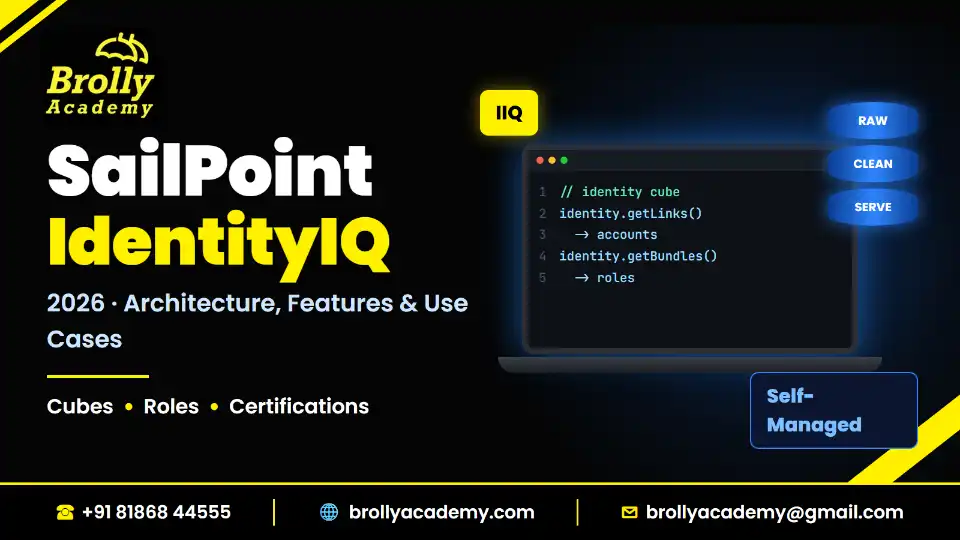
Table of Contents
1. SailPoint IdentityIQ at a glance
2. What is SailPoint IdentityIQ?
3. IdentityIQ architecture explained
4. IdentityIQ modules and features
5. Key IdentityIQ objects explained
6. Aggregation and correlation, step by step
7. Roles in IdentityIQ: business roles vs IT roles
8. Policies and separation of duties
9. Access certifications: a campaign walkthrough
10. Lifecycle events: a joiner, mover, leaver worked example
11. Rules, BeanShell and workflows in IdentityIQ
12. IdentityIQ versions and deployment in 2026
13. IdentityIQ vs Identity Security Cloud (IIQ vs ISC)
14. IdentityIQ use cases by industry
Quick answer
SailPoint IdentityIQ (IIQ) is SailPoint's self-managed identity governance product: you install and run it on your own servers or a hosting of your choice, and it controls who has access to which applications, why they have it, and whether they should keep it. It pulls accounts from HR systems, Active Directory, databases and business apps into one view of each person (the Identity Cube), automates joiner, mover and leaver changes, runs access reviews, and flags risky combinations of access. In October 2026 SailPoint announced IdentityIQ 9.0, a modernised version for on-premises and hybrid customers, so IIQ is very much alive alongside the cloud product.
- Type: identity governance and administration (IGA), self-managed (on-prem or customer-hosted)
- Core modules: Compliance Manager, Lifecycle Manager, Password Manager, File Access Manager
- Key idea: the Identity Cube, one record per person that links all their accounts and entitlements
- Customisation: BeanShell rules (Java-based scripting), workflows and connectors
- Latest version: IdentityIQ 9.0, announced 6 October 2026
Key takeaways
- IIQ stands for IdentityIQ. It is the self-managed member of the SailPoint family, while Identity Security Cloud is the SaaS member.
- Everything in IIQ starts with data: aggregation reads accounts in, correlation links them to the right person, and the Identity Cube holds the result.
- Roles, policies and certifications turn that data into governance: least-privilege access, separation of duties and regular reviews.
- Lifecycle Manager automates joiners, movers and leavers, and BeanShell rules let you add custom logic where the standard settings stop.
- Job descriptions we read in October 2026 asked for IIQ plus Java, BeanShell, connectors, workflows and SQL, usually with 3 or more years of experience.
1. SailPoint IdentityIQ at a glance
Short answer: IdentityIQ is an enterprise IGA platform you host yourself, built around the Identity Cube, extended with BeanShell rules, and sold with separately licensed modules.
Use this table as a quick reference before we go deeper.
The table draws on SailPoint's IdentityIQ product page and the IdentityIQ 9.0 announcement (SailPoint, October 2026).
2. What is SailPoint IdentityIQ?
Short answer: IdentityIQ is software that answers three audit questions for a company: who has access to what, how did they get it, and should they still have it.
If you are new to SailPoint the company and its full product family, read our guide on what SailPoint is first. Here we stay on IdentityIQ itself.
SailPoint describes IdentityIQ as enterprise identity governance that secures access at scale across on-premises, cloud, mainframe, database and legacy applications (SailPoint IdentityIQ product page, October 2026). In plain words, a large bank, insurer or manufacturer may run hundreds of applications. Each has its own user list. IIQ connects to them, builds one view per person, and then automates and checks access.
A few terms you will meet in every IIQ project:
- IAM (identity and access management): the broad discipline of managing digital identities and what they can access.
- IGA (identity governance and administration): the governance part of IAM. It covers who should have access, approvals, access reviews, provisioning and audit reports. IdentityIQ is an IGA tool.
- PAM (privileged access management): tools that protect powerful admin accounts. PAM works alongside IGA; it is not what IIQ does.
- SSO and MFA: single sign-on (one login for many apps) and multi-factor authentication (a second proof such as an OTP). These belong to access management tools, which IIQ governs but does not replace.
- Provisioning: creating, changing or removing an account or access on a target system. De-provisioning is the removal side.
- Entitlement: a single piece of access, such as an AD group, a database role or an SAP role.
- JML (joiner, mover, leaver): the three life events of an employee: joining, changing job, and leaving.
"Self-managed" is the key word. SailPoint's own pages position IdentityIQ as the option for on-premises and hybrid deployments, and the cloud-native product as Identity Security Cloud, now delivered as SailPoint Human Fabric (SailPoint, October 2026). With IIQ, your company or its IT partner installs, patches, upgrades and backs up the system. That gives more control and deeper customisation, and it also means more technical work, which is where IIQ developers and engineers come in.
3. IdentityIQ architecture explained
Short answer: IdentityIQ is a Java web application that runs on an application server, stores everything in a relational database, talks to target systems through connectors, and does heavy work through scheduled tasks.
Here is the architecture as a numbered flow. Read it top to bottom as the path data takes through the system.
- Authoritative source (usually HR): an HR system such as Workday or an HR database export is the "source of truth" for who works at the company.
- Connectors: IIQ reads from and writes to systems through connectors. SailPoint lists REST, SCIM, JDBC, CSV (delimited file) and LDAP connectors, and notes that only some connectors support provisioning (SailPoint IdentityIQ product page, October 2026).
- Tasks: scheduled jobs do the bulk work. Account Aggregation and Account Group Aggregation tasks read accounts and groups into IIQ; other tasks refresh identities and run reports.
- IdentityIQ server (application server): the IIQ web application runs inside a Java application server. Its rules are written in BeanShell, a Java-based scripting language, and Javadocs ship with every install (IdentityIQ rules documentation, October 2026).
- Database: a relational database stores identities, accounts, roles, policies, certifications, configuration and history.
- Governance engine: roles, policies, certifications and lifecycle workflows run on top of the stored data.
- User interface: administrators, managers and end users log in through the browser to request access, approve, review and report.
- Provisioning back out: approved changes go back through connectors (or as tickets, when a connector cannot provision) to the target systems.
What about the server stack? SailPoint says IdentityIQ 9.0 brings a rebuilt technical foundation on modern application servers (SailPoint, 6 October 2026). Exact supported Java, application server and database versions for 9.0 change by release, so always check the release notes for your version before you install or upgrade.
4. IdentityIQ modules and features
Short answer: IdentityIQ sits on a shared governance platform and adds four named modules: Compliance Manager for reviews and policies, Lifecycle Manager for requests and JML, Password Manager for self-service passwords, and File Access Manager for unstructured data.
SailPoint names these modules on its IdentityIQ product page (October 2026). Lifecycle Manager is separately licensed, according to SailPoint's IdentityIQ 9.0 documentation (October 2026), so not every customer has every module.
The AI-Driven Identity Security add-on for IdentityIQ is a SaaS data-analysis service, according to SailPoint's IdentityIQ 9.0 documentation (October 2026). That means an IIQ customer can keep the core system on-premises and still use cloud-based recommendations if they choose.
Lifecycle Manager also includes Rapid Setup, which has separate configuration areas for Joiner, Mover and Leaver events, and supports access requests with start and end dates (SailPoint IdentityIQ documentation, October 2026). We use it in the JML example in section 10.
5. Key IdentityIQ objects explained
Short answer: most IIQ work comes down to ten objects: identity, application, account, entitlement, role, policy, certification, workflow, rule and task.
When you read IIQ screens, XML exports or job descriptions, these words come up again and again. Learn them well.
The Identity Cube is the heart of this. SailPoint's documentation calls it a multi-dimensional data model that gives a single logical view of each managed user, holding attributes, entitlements, accounts, policy violations, risk scores, IdentityIQ capabilities and access history (IdentityIQ identity management documentation, October 2026). The same page describes the Identity Warehouse (the list of every identity), Identity Correlation (linking cubes to accounts on other applications) and the Identity Risk Model (how risk is scored).
6. Aggregation and correlation, step by step
Short answer: aggregation reads accounts into IIQ; correlation decides which person each account belongs to. Together they build the Identity Cubes.
Aggregation means reading data from a target system into IdentityIQ. It is done by the Account Aggregation and Account Group Aggregation tasks. When you aggregate an authoritative source such as HR, IIQ creates an Identity Cube for each account on that source (SailPoint IdentityIQ documentation, October 2026).
Correlation means matching aggregated accounts to existing identities. IIQ can correlate by direct attribute mapping, by conditions, or by custom rules. Accounts that do not match stay uncorrelated and can be linked manually, and those manual links survive later aggregations (SailPoint IdentityIQ documentation, October 2026).
Here is how it plays out on a real project:
- Onboard HR as the authoritative application. Define the HR application with a delimited file (CSV) or JDBC connector and map attributes such as employee ID, name, department, manager and status.
- Run HR aggregation. IIQ creates one Identity Cube per employee row.
- Onboard Active Directory. Define the AD application and its schema (account attributes and groups).
- Set correlation. For example, match the AD attribute that holds the employee number to the identity attribute "employee ID".
- Run AD account aggregation. Each AD account that matches is attached to the right cube. Group aggregation brings in AD groups as entitlements.
- Review uncorrelated accounts. Service accounts, test IDs and former staff often stay uncorrelated. Assign owners or link them manually.
- Repeat for each application. Databases, SAP and business apps follow the same pattern.
- Schedule the tasks. Run aggregations nightly or on a set schedule so the cubes stay current.
A common real-world problem: orphan accounts, which are accounts with no matching person. Operations job descriptions we read in October 2026 listed orphan-account clean-up and manual correlation in IIQ as daily work, so expect this in your first IAM role.
For a hands-on version of these steps with a practice application, follow our SailPoint tutorial.
7. Roles in IdentityIQ: business roles vs IT roles
Short answer: IIQ uses roles to group raw entitlements into units people understand; business roles describe job functions and IT roles hold the actual system access.
SailPoint's IdentityIQ documentation (October 2026) says IIQ ships with four role types:
- Organizational roles: used for structure and nesting, like folders for other roles.
- Business roles: group users by job function, for example "Accounts Payable Clerk".
- IT roles: bundles of real entitlements on systems, for example a set of AD groups and an SAP role.
- Entitlement roles: a legacy type kept for backward compatibility with old 5.x versions, and not recommended for new work.
Business roles connect to IT roles through two lists. Required IT roles are given automatically. Permitted IT roles may be requested but are not automatic.
A worked example for an Indian bank's finance team:
When a new clerk joins Finance-AP, IIQ assigns the business role, which brings the required IT roles, which provision the actual groups and roles. Reviewers later certify "Accounts Payable Clerk" instead of ten cryptic group names. That is why role design is such a valued skill.
8. Policies and separation of duties
Short answer: policies tell IIQ which access combinations are not allowed or are risky, and IIQ flags violations during requests, reviews and scans.
Separation of duties (SoD) means no single person should hold enough access to misuse a process alone. The classic case is that the person who creates a vendor payment should not also approve it.
IdentityIQ supports these policy types (SailPoint IdentityIQ documentation, October 2026):
- Role SoD: two roles that conflict
- Entitlement SoD: two entitlements that conflict
- Effective Entitlement SoD: conflicts through indirect access, such as nested AD groups
- Activity: risky activity on an application
- Account: a person with more than one account on the same application
- Risk: an identity whose risk score crosses a threshold
- Advanced: custom logic using match lists, filters, scripts, BeanShell rules or populations
Example: an Entitlement SoD policy says "SAP Vendor Create" and "SAP Payment Approve" must not sit on the same identity. If Priya requests the second while holding the first, IIQ shows the violation to the approver, who can deny it or approve it with a documented reason. Policy violations also appear on the Identity Cube and in certifications.
9. Access certifications: a campaign walkthrough
Short answer: an access certification is a review campaign in which managers or owners approve or revoke each person's access, and IIQ tracks every decision for auditors.
SailPoint's documentation says a certification contains access reviews assigned to reviewers, who can approve, revoke, forward or delegate each item (IdentityIQ certifications documentation, October 2026). The same page lists the certification types: Targeted, Manager, Application Owner, Entitlement Owner, Advanced, Account Group Membership, Account Group Permissions, Role Membership, Role Composition, Identity and Event-Based.
Each certification moves through phases: Staging (optional), Active, Challenge (optional), Revocation and End. Here is a typical quarterly manager review, step by step:
- Plan the scope. Choose a Manager certification for all Finance users and their access on SAP, AD and Oracle EBS.
- Stage it (optional). In Staging, the IAM team checks the generated reviews for wrong managers or missing data before anyone sees them.
- Activate. Each manager gets an access review with one line per entitlement or role for each team member.
- Decide. Managers approve, revoke, forward or delegate each item. Policy violations are highlighted.
- Challenge (optional). Users whose access was revoked can challenge the decision within a set window.
- Revocation. IIQ removes revoked access through connectors or raises tickets for manual removal.
- End and report. The campaign closes, and reports show who decided what and when. Auditors use these as evidence.
Event-Based certifications run when something changes, for example a mover review that asks the new manager to confirm the person's old access is still needed. Role Composition reviews ask role owners to confirm that each role still contains the right entitlements.
10. Lifecycle events: a joiner, mover, leaver worked example
Short answer: Lifecycle Manager watches HR changes and automatically gives, changes or removes access when people join, move or leave.
Follow one fictional employee through a year at a Hyderabad bank GCC.
Here is the joiner in more detail:
- HR aggregation picks up Priya's new record overnight.
- IIQ creates her Identity Cube and sets attributes such as manager and department.
- The joiner lifecycle event fires because a new identity appeared.
- Role assignment rules match "department = Finance-AP" and assign the business role.
- Required IT roles turn into a provisioning plan for AD, SAP and Oracle EBS.
- Connectors create the accounts; where a connector cannot provision, IIQ raises a ticket, often in ServiceNow.
- Priya's manager gets an email that her access is ready on day one.
Lifecycle Manager also supports access requests with start and end dates (SailPoint IdentityIQ documentation, October 2026). IdentityIQ 9.0 adds granular time-based access, with start and end times and time zones for roles and entitlements (SailPoint, 6 October 2026). That helps with contractors and temporary project access, which is common in Indian IT services teams.
11. Rules, BeanShell and workflows in IdentityIQ
Short answer: rules are small pieces of BeanShell code that add custom logic at set points in IIQ, and workflows are the step-by-step processes, such as access requests, that call those rules.
BeanShell is a Java-based scripting language. SailPoint's documentation says IIQ rules are written in BeanShell, can use all the Java classes available to IdentityIQ, can be created in the Rule Editor or imported as XML, and that scripts can also be embedded directly inside objects such as policies and workflows (IdentityIQ rules documentation, October 2026). So if you know core Java, you can read most IIQ rules.
Where rules are used:
- Correlation: custom logic to link accounts to identities when simple attribute matching is not enough
- Aggregation and connectors: cleaning or shaping data as it comes in (the docs name the Build Map rule as an example of a rule shared by applications)
- Provisioning: deciding how account attributes such as usernames are built
- Roles and certifications: assignment logic and certification behaviour
- Policies: the Advanced policy type can run BeanShell rules
- Workflows: steps that call rule libraries such as the Workflow Library, Approval Library and LCM Workflow Library
Rule libraries let you write a method once and reuse it. The simplified example below follows the structure shown in SailPoint's rules documentation: a rule that references a library, then calls a method defined there.
<Rule name="My Calling Rule">
<ReferencedRules>
<Reference class='Rule' name='My Library'/>
</ReferencedRules>
<Source>
doSomething();
</Source>
</Rule>
Here, "My Library" holds the method doSomething(), and any rule that references it can call it. One warning from the documentation: a faulty correlation rule can link accounts to the wrong people or leave them uncorrelated, so test rules on a small data set first.
Workflows in IIQ are business processes made of steps, variables, approvals and transitions. The standard access request flow, for example, collects the request, checks policies, routes approvals to the manager and application owner, provisions on approval and sends notifications. You customise workflows by changing steps, approvals and the rules they call.
12. IdentityIQ versions and deployment in 2026
Short answer: the latest IdentityIQ version is 9.0, announced on 6 October 2026, and the live IIQ help site now shows the 9.0 documentation, with 8.5 and 8.4 still in the version selector.
SailPoint announced IdentityIQ 9.0 at its Navigate event in Austin on 6 October 2026 and called it a "parallel modernization path" for hybrid and on-premises customers (SailPoint, October 2026). The announcement lists:
- Granular time-based access: start and end times, with time zones, for roles and entitlements
- Rebuilt technical foundation: IIQ moved onto modern application servers
- Refreshed UI: new screens for access reviews and application definition
- Automated upgrade tool: to make moving between versions easier
SailPoint positions 9.0 for customers with data residency, regulatory or heavy customisation needs. This matters for Indian learners: it shows SailPoint is still investing in IIQ, and companies with big IIQ estates will need people to plan and run 9.0 upgrades. SailPoint has not announced an end-of-life date for IdentityIQ.
A typical IIQ deployment has three environments: development, test (or UAT) and production. Developers build rules, roles and workflows in development, export them as XML, test them, and then promote them. Job descriptions we read in October 2026 mentioned CI/CD with GitHub and Jenkins for this.
13. IdentityIQ vs Identity Security Cloud (IIQ vs ISC)
Short answer: IdentityIQ is self-managed and highly customisable with BeanShell; Identity Security Cloud is SailPoint's SaaS product, run by SailPoint, customised mostly through configuration, transforms and APIs.
First, the naming. Identity Security Cloud (ISC, formerly IdentityNow, now sold as SailPoint Human Fabric within SailPoint Identity Security) is the cloud product. Exams, documentation titles and Indian job posts still widely say "Identity Security Cloud" or "ISC" in October 2026, so you will see all three names.
A virtual appliance is a small virtual machine the customer runs inside its network so the cloud tenant can reach on-prem systems such as AD. A transform in ISC is a JSON object that changes attribute values during aggregation or provisioning without code (SailPoint developer documentation, October 2026).
Which should you learn in 2026? The concepts are the same: identities, sources or applications, aggregation, correlation, roles, certifications and lifecycle. Many people learn IIQ first because it exposes how everything works underneath, then add ISC. Job descriptions we read in October 2026 often asked for IIQ and named IdentityNow or ISC as a plus, and some roles were ISC-only. Learning both is the safest plan, in the order shown in our SailPoint roadmap.
14. IdentityIQ use cases by industry
Short answer: IIQ suits large, regulated or heavily customised organisations that need tight control over access and strong audit evidence.
These are typical patterns, not a customer list:
In India, much of this work happens in the global capability centres (GCCs) of banks and insurers, and in the IAM practices of Big Four and IT services firms in Hyderabad, Bengaluru, Pune and Chennai. Those teams implement and run IIQ for clients worldwide.
15. Skills you need to work on IdentityIQ
Short answer: IIQ work needs IAM concepts, core Java and BeanShell, XML, SQL, directory knowledge (AD/LDAP) and comfort with connectors, workflows and troubleshooting.
We read 11 SailPoint and IAM job descriptions from Indian listings on 24 October 2026. Here is what they asked for most often:
Experience: almost every listing we read asked for 3 or more years, and we found no genuine 0-year SailPoint developer listing. Freshers usually start in IAM operations or support roles, such as access management analyst or IGA support, where tasks include access reviews, orphan accounts and ticket handling. From there, they move into IIQ development.
Certification: SailPoint's current credentials include the SailPoint Certified IdentityIQ Engineer (role-based) and the SailPoint Certified IdentityIQ Associate (training-based). The job descriptions we read listed SailPoint certification only as "good to have", never as a must. Results are pass/fail with no published passing score. See our SailPoint certification guide for exam details.
To prepare for interviews on these topics, our SailPoint interview questions page has about 60 questions on IIQ concepts.
16. How Brolly Academy helps
Short answer: Brolly Academy's SailPoint course is IdentityIQ-focused, with an introduction to IdentityNow, and covers the same modules and objects explained in this guide.
Our SailPoint Certification Training in Hyderabad is a 2-month program (course page, October 2026). The 10-module syllabus covers:
- IdentityIQ overview, architecture, installation and deployment
- Identity Cube and key entities, delimited connector onboarding, identity mappings and aggregation
- Application onboarding with the JDBC connector and account correlation
- Active Directory connector provisioning and de-provisioning
- Policies and policy violations
- Certifications, roles and rules (provisioning, certification and aggregation rules)
- Workflows (steps, variables, approvals, troubleshooting) and debugging real IdentityIQ issues
You build six capstone projects, including user onboarding, certification campaigns, joiner-mover-leaver provisioning, roles and policies, request workflows and application integration. Modes are classroom, online and hybrid, plus a self-paced video plan. Fees listed on the course page in October 2026: Video Recording ₹9,999, Online ₹24,999 and Classroom ₹29,999, with EMI on the Online and Classroom plans. SailPoint exam fees are separate and paid to SailPoint. The next batch listed starts on Monday, 2 November 2026, and you can attend a free demo class first.
Learn IdentityIQ the way projects use it
Want to onboard applications, write correlation rules, run certification campaigns and automate joiner-mover-leaver flows yourself? Join a free demo of Brolly Academy's IdentityIQ-focused SailPoint course in Hyderabad, available in classroom, online or hybrid mode, and see the labs and capstone projects before you enrol.
Frequently asked questions
What is SailPoint IdentityIQ?
SailPoint IdentityIQ is a self-managed identity governance and administration (IGA) product. It connects to HR, directories, databases and business applications, builds one Identity Cube per person, and then automates access requests, provisioning, joiner-mover-leaver changes, access certifications and separation of duties policies. Companies install and run it on their own servers or a hosting provider they choose, which gives them control and deep customisation.
What is the full form of IIQ in SailPoint?
IIQ is short for IdentityIQ, SailPoint's self-managed identity governance product. You will see IIQ in job titles, job descriptions and community posts, for example "SailPoint IIQ developer". Its cloud sibling is Identity Security Cloud, often shortened to ISC and formerly called IdentityNow, which is now sold as SailPoint Human Fabric within the SailPoint Identity Security platform.
What is SailPoint IIQ used for?
IIQ is used to control and prove who has access to what inside a company. It automates giving access to joiners, changing access for movers and removing access for leavers. It runs access reviews so managers confirm access is still needed, blocks risky combinations through separation of duties policies, handles self-service access requests and passwords, and produces audit evidence for regulators and auditors.
Is SailPoint IdentityIQ on-premises or SaaS?
IdentityIQ is self-managed, not SaaS. It runs on-premises or in a customer-hosted environment, including hybrid setups, and the customer or its IT partner handles installation, patching and upgrades. SailPoint's SaaS product is Identity Security Cloud, now sold as SailPoint Human Fabric. IIQ customers can still add the AI-Driven Identity Security add-on, which is a SaaS data-analysis service.
What is the latest version of SailPoint IdentityIQ?
The latest version is IdentityIQ 9.0, announced by SailPoint on 6 October 2026 at its Navigate event in Austin. The live IdentityIQ help site now shows the 9.0 documentation, while versions 8.5 and 8.4 remain in the version selector. Exact supported Java, application server and database versions are published per release, so check the release notes before installing.
What is new in IdentityIQ 9.0?
IdentityIQ 9.0 adds granular time-based access with start and end times and time zones for roles and entitlements, a rebuilt technical foundation on modern application servers, refreshed screens for access reviews and application definition, and an automated upgrade tool. SailPoint positions it for customers with data residency, regulatory or heavy customisation needs that want to stay on-premises or hybrid.
Is SailPoint IdentityIQ being discontinued?
No. SailPoint has not announced an end-of-life date for IdentityIQ. In October 2026 it announced IdentityIQ 9.0 as a parallel modernisation path for hybrid and on-premises customers, which shows continued investment. Companies with large IIQ estates will need people to run, customise and upgrade it, so IIQ skills remain useful alongside Identity Security Cloud skills.
What are the modules of SailPoint IdentityIQ?
IdentityIQ has four named modules on a shared governance platform. Compliance Manager handles access certifications, separation of duties and policies. Lifecycle Manager, which is separately licensed, handles access requests, approvals, provisioning and joiner-mover-leaver automation. Password Manager offers self-service password management, and File Access Manager governs access to unstructured data such as file shares.
What is the architecture of SailPoint IdentityIQ?
IdentityIQ is a Java web application running on an application server, with a relational database that stores identities, accounts, roles, policies and history. Connectors read from and write to target systems, scheduled tasks run aggregations and refreshes, a governance engine applies roles, policies and certifications, and users work through a browser interface. Approved changes flow back to systems through connectors or tickets.
What is the Identity Cube in IdentityIQ?
The Identity Cube is IdentityIQ's record for one person. SailPoint describes it as a multi-dimensional data model giving a single logical view of each managed user. It holds attributes, linked accounts, entitlements, policy violations, risk scores, IdentityIQ capabilities and the history of access and activity. All cubes together form the Identity Warehouse.
What is aggregation in SailPoint IIQ?
Aggregation is the process of reading accounts and groups from a target system into IdentityIQ. It runs through the Account Aggregation and Account Group Aggregation tasks, usually on a schedule. When you aggregate an authoritative source such as an HR system, IdentityIQ creates an Identity Cube for each account on that source, which is why HR is normally onboarded first.
What is correlation in SailPoint IIQ?
Correlation matches each aggregated account to the right identity. IdentityIQ can correlate by direct attribute mapping, such as employee ID, by conditions, or by custom BeanShell rules. Accounts that do not match stay uncorrelated and can be linked manually, and those manual links persist through later aggregations. Uncorrelated accounts are often service accounts or orphan accounts that need owners.
What are rules in SailPoint IIQ?
Rules are small pieces of custom logic that IdentityIQ runs at set points, such as correlation, aggregation, provisioning, role assignment, policies and workflows. They are written in BeanShell, can use the Java classes available to IdentityIQ, and are created in the Rule Editor or imported as XML. Rule libraries let you write a method once and reuse it.
What is BeanShell in SailPoint?
BeanShell is the Java-based scripting language IdentityIQ uses for rules and embedded scripts. If you know core Java syntax, you can read and write most IIQ rules. Job descriptions we read in October 2026 often listed BeanShell next to Java as a key skill for SailPoint developers, so learning core Java first makes IIQ development much easier.
What is a workflow in SailPoint IIQ?
A workflow is a step-by-step business process in IdentityIQ, such as an access request. It is made of steps, variables, approvals and transitions. The standard request flow collects the request, checks policies, routes approvals to the manager and owner, provisions on approval and sends notifications. Workflow steps can call rule libraries such as the Workflow Library and Approval Library.
What connectors does IdentityIQ support?
SailPoint lists REST, SCIM, JDBC, CSV (delimited file) and LDAP connectors for IdentityIQ, along with connectors for applications across on-premises, cloud, mainframe, database and legacy systems. Only some connectors support provisioning. Where a connector cannot provision, IIQ can raise a ticket, often in ServiceNow, so that a person makes the change manually.
What are business roles and IT roles in IdentityIQ?
Business roles group users by job function, such as "Accounts Payable Clerk". IT roles bundle the actual entitlements on systems, such as AD groups and SAP roles. A business role links to IT roles through a required list, which is assigned automatically, and a permitted list, which users may request. IIQ also has organizational roles and legacy entitlement roles.
What is an access certification in IdentityIQ?
An access certification is a review campaign in which reviewers approve, revoke, forward or delegate each person's access. IdentityIQ supports types such as Manager, Application Owner, Entitlement Owner, Targeted, Role Membership, Role Composition and Event-Based. Campaigns move through Staging (optional), Active, Challenge (optional), Revocation and End phases, and the decisions become audit evidence.
What types of policies does IdentityIQ support?
IdentityIQ supports Role SoD, Entitlement SoD and Effective Entitlement SoD policies for separation of duties, plus Activity, Account, Risk and Advanced policies. Account policies flag people with more than one account on one application, Risk policies flag high risk scores, and Advanced policies use match lists, filters, scripts, BeanShell rules or populations for custom checks.
How does IdentityIQ handle joiners, movers and leavers?
Lifecycle Manager watches HR changes picked up by aggregation. For a joiner, IIQ creates the Identity Cube, assigns roles and provisions accounts. For a mover, it adds new access, removes old access and can launch a review. For a leaver, it disables accounts and removes entitlements. Rapid Setup has separate Joiner, Mover and Leaver configuration areas.
What is the difference between IdentityIQ and Identity Security Cloud?
IdentityIQ is self-managed and deeply customisable with BeanShell rules and workflows. Identity Security Cloud is SailPoint's SaaS product, run by SailPoint, customised mainly through configuration, JSON transforms, workflows and APIs, and it reaches on-premises systems through a virtual appliance. IdentityIQ suits data residency or heavy customisation needs, while ISC suits companies wanting SaaS speed.
Should I learn IIQ or ISC in 2026?
Learn both if you can, starting with the shared concepts. Many people start with IdentityIQ because it shows how aggregation, correlation, roles and rules work underneath, then add Identity Security Cloud. Job descriptions we read in October 2026 often asked for IdentityIQ with IdentityNow or ISC as a plus, and some roles were ISC-only, so knowing both widens your options.
Does SailPoint IIQ require Java?
Yes, Java matters for IIQ work. IdentityIQ is a Java web application, its rules are written in Java-based BeanShell, and Javadocs ship with each install. You can configure many screens without code, but developer roles need core Java. Job descriptions we read in October 2026 commonly asked for Java and BeanShell alongside SQL, XML and REST basics.
Can a fresher get a job in SailPoint IdentityIQ?
It is possible, but usually not directly as an IIQ developer. On 24 October 2026 we found no genuine SailPoint developer listing that accepted 0 years of experience; most asked for 3 or more years. Freshers usually start in IAM operations or support roles handling access reviews, orphan accounts and tickets, then move into IIQ development after gaining hands-on experience.
Does Brolly Academy teach SailPoint IdentityIQ?
Yes. Brolly Academy's SailPoint course in Hyderabad is IdentityIQ-focused, with an introduction to IdentityNow. The 2-month program covers architecture, the Identity Cube, delimited and JDBC onboarding, correlation, Active Directory provisioning, policies, certifications, roles, rules, workflows and debugging, with six capstone projects. It runs in classroom, online and hybrid modes, and SailPoint exam fees are paid separately.
Learn with Brolly Academy
Review the syllabus, practical projects and batch timings, and book a free demo before you enrol.
Related Articles
Continue Your Learning
SailPoint Training in Hyderabad
2-month IdentityIQ-focused programme covering the Identity Cube, connectors, roles, certifications, workflows and BeanShell rules, with 6 capstone projects.
View CourseOracle Identity Manager Training
Learn another enterprise identity governance platform used in IAM teams, from provisioning and reconciliation to access policies.
View CourseCloud Security Training
Build cloud security skills that sit next to identity governance in modern IAM and security operations roles.
View Course