Brolly Academy | SailPoint
What Is SailPoint?
The Identity Security Company and Its Tools Explained: IAM vs IGA vs PAM, Products and How It Works (2026)
A plain-English guide to SailPoint for 2026: what the company and its tools do, the access problem they solve, how IAM, IGA and PAM differ, the full product family including IdentityIQ and Identity Security Cloud, how SailPoint works step by step, who uses it in India and whether it is worth learning.
What is SailPoint? A plain guide to this identity security tool: its uses, IAM vs IGA vs PAM, IdentityIQ vs Identity Security Cloud and how it all works.
By Brolly Academy Team · Brolly Academy · Updated 24 October 2026
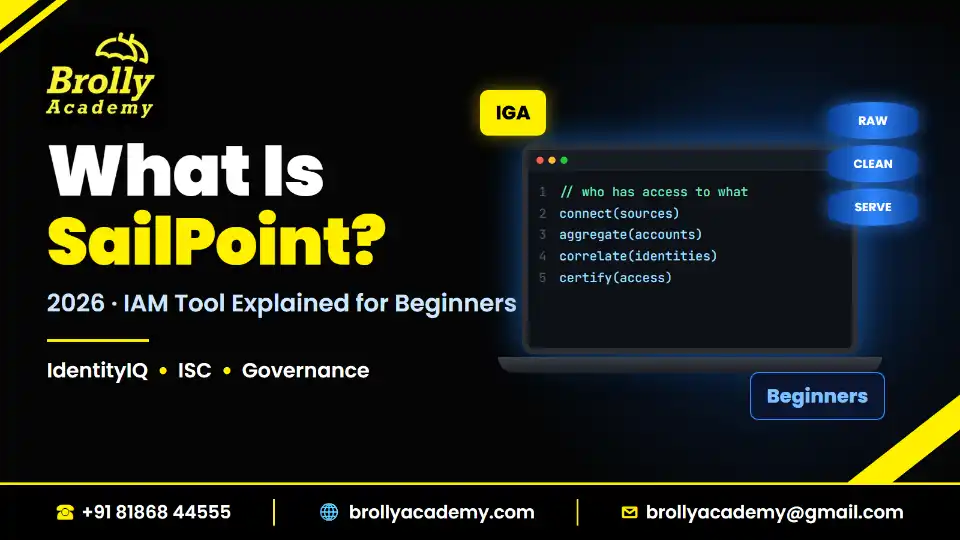
Table of Contents
2. What problem does SailPoint solve?
3. IAM vs IGA vs PAM vs access management
5. SailPoint products: the product family in 2026
6. SailPoint core capabilities explained simply
7. How SailPoint works in 6 steps
9. IdentityIQ vs Identity Security Cloud: the short version
10. What SailPoint is used for: 8 real use cases
Quick answer
SailPoint is an American identity security company, and also the name people use for its software, which decides and records who in an organisation gets access to which applications and data, keeps that access correct as people join, move and leave, and proves it to auditors. In technical terms, SailPoint is the best-known vendor of identity governance and administration (IGA) software. Its two main products are IdentityIQ, which a company installs and runs itself, and Identity Security Cloud (ISC, formerly IdentityNow), a software-as-a-service product that SailPoint now sells as SailPoint Human Fabric inside its SailPoint Identity Security platform.
- What it is used for: giving new employees the right access on day one, changing access when they move, removing it when they leave, running access reviews and blocking risky combinations of access
- Main products: IdentityIQ (self-managed), Identity Security Cloud / Human Fabric (cloud), Agentic Fabric (for AI agents and machine identities), all built on the SailPoint Atlas foundation
- Company: founded in 2005, based in Austin, Texas, and listed on Nasdaq under "SAIL" since February 2025
- Who uses it: large enterprises, especially banks, insurers, healthcare and global firms with thousands of users and hundreds of applications
- Is it an IdP or SSO tool? No. SailPoint governs access; login tools such as single sign-on platforms handle the sign-in itself
Key takeaways
- SailPoint answers one big question for a company: who has access to what, should they have it, and can we prove it?
- It is an IGA tool, which is one part of the wider IAM (identity and access management) field, not a login or password vault product.
- IdentityIQ is the self-managed product (version 9.0 was announced on 6 October 2026); Identity Security Cloud is the cloud product, now sold as Human Fabric.
- SailPoint works by connecting to source systems, reading accounts, linking them to people, applying rules, provisioning access and running reviews.
- In India, SailPoint skills are in demand at Big Four firms, IT services companies and global capability centres (GCCs), but most roles ask for some prior IAM experience.
1. SailPoint at a glance
Short answer: SailPoint is an identity governance company and product family that automates and audits user access across an organisation's applications.
Use this table as your one-screen summary. Every company fact here comes from SailPoint's official pages, checked in October 2026.
SailPoint meaning in one line: when someone in an IT job says "we use SailPoint", they usually mean "we use SailPoint software to manage and review employee access".
2. What problem does SailPoint solve?
Short answer: SailPoint fixes the messy, risky and slow way companies hand out and take back access, by automating it and keeping a full record for audits.
Think of a bank's India centre with 20,000 employees. Each person needs accounts in many systems: Active Directory (the Windows directory that controls logins and groups), email, the HR system, SAP, a ticketing tool, a core banking application and dozens of internal apps. Without a governance tool, access is handed out by email and tickets, one system at a time.
That creates four big problems:
- Slow onboarding: a new joiner waits days for basic access.
- Access creep: people who change teams keep their old access and pick up new access, so over the years they hold far more than they need.
- Orphan accounts: when someone leaves, a few of their accounts stay active because nobody remembered to remove them. An attacker or an angry ex-employee can misuse them.
- Painful audits: auditors and regulators ask "who can approve payments in this system, and who checked that this is correct?" and the team has no clean answer.
SailPoint is built to solve these. It follows the principle of least privilege, which means each person gets only the access needed for their job, and separation of duties (SoD), which means no single person holds two powers that together allow fraud, such as creating a vendor and approving payments to that vendor.
A plain example: Priya's first day, transfer and exit
Here is what SailPoint does across one employee's life at a company. This is the "joiner, mover, leaver" (JML) cycle you will hear about in every IAM job.
- Joiner: HR adds Priya to the HR system as a new analyst in the Payments team. SailPoint reads the new HR record, creates her identity and automatically creates her Active Directory account, email and the payments application access that every Payments analyst gets. This automatic day-one access is often called birthright access.
- Access request: in week two, Priya needs read access to a reporting tool. She asks for it in SailPoint's self-service portal. Her manager approves, and SailPoint provisions it (creates the access in the target system).
- Mover: a year later, Priya moves to the Treasury team. HR changes her department. SailPoint gives her Treasury access and starts removing her Payments access, so she does not keep both.
- Access review: every quarter, Priya's manager gets an access certification, a list of everything Priya can access, and must approve or revoke each item.
- Policy check: if someone tries to give Priya both "create payment" and "approve payment", SailPoint flags an SoD violation before or after it happens.
- Leaver: when Priya resigns, HR marks her last working day. SailPoint disables or removes her accounts across the connected systems and records exactly what was removed and when.
Every step leaves an audit trail. That record is what auditors and regulators want to see.
3. IAM vs IGA vs PAM vs access management
Short answer: IAM is the whole field of managing identities and access; IGA (where SailPoint sits) governs who should have what access; access management handles login and SSO; PAM protects powerful admin accounts.
Beginners often mix these up, and job titles use all of them. Here is the difference in simple terms.
So SailPoint is an IAM tool in the broad sense, but more precisely an IGA tool. It is not an identity provider (IdP), the system that actually signs users in. In a real company, these tools work together: an SSO platform signs Priya in, SailPoint decides and reviews what she should have, and a PAM tool controls the few administrator accounts. Our guide on SailPoint vs CyberArk compares IGA and PAM in detail.
Who are SailPoint's competitors? In IGA, the names you will most often see beside SailPoint in Indian job descriptions are Saviynt, Oracle Identity Manager and Microsoft Entra ID Governance. Okta and CyberArk overlap with SailPoint in parts of identity security but are mainly known for access management and PAM.
4. SailPoint company snapshot
Short answer: SailPoint was founded in 2005 in Austin, Texas, was taken private by Thoma Bravo in 2022 and returned to the stock market on Nasdaq in February 2025.
Here are the key company facts, all from SailPoint's own pages.
- Founding and leader: SailPoint was founded in 2005, and Mark McClain is listed as Chief Executive Officer and Founder (SailPoint company page, October 2026).
- Headquarters: SailPoint is an Austin, Texas-based company; its press releases carry an Austin dateline.
- Size: the company page says SailPoint has 3,000+ employees and 3,000+ customers, operates in 60+ countries, counts 53% of the Fortune 500 and 28% of the Forbes Global 2000 as customers, and passed $1 billion in annual recurring revenue (ARR) in 2025 (SailPoint, October 2026).
- Private equity years: private equity firm Thoma Bravo completed its all-cash acquisition of SailPoint on 16 August 2022, in a deal valued at about $6.9 billion; shareholders received $65.25 per share and the stock was delisted from the NYSE (SailPoint press release, August 2022).
- Back on the stock market: SailPoint priced its initial public offering at $23.00 per share on 12 February 2025 and began trading on the Nasdaq Global Select Market under "SAIL" on 13 February 2025. The company page calls this its second time in the public markets (SailPoint, October 2026).
- Recognition: SailPoint's company page cites KuppingerCole naming it an Overall Leader in its 2026 Leadership Compass (SailPoint, October 2026).
- India: SailPoint lists roles in India on its careers site. Do not confuse SailPoint the employer, which mostly hires product engineers, with the much larger number of companies in India that implement and run SailPoint for clients.
Who owns SailPoint? SailPoint is a public company listed on Nasdaq. Thoma Bravo took it private in 2022, and SailPoint returned to the public markets in 2025. For current shareholdings, check SailPoint's investor filings.
Is SailPoint a product-based company? Yes. SailPoint builds and sells its own software. Most SailPoint jobs in India, though, are at service firms, consultancies and GCCs that use the product.
5. SailPoint products: the product family in 2026
Short answer: SailPoint's main products are IdentityIQ (self-managed), Identity Security Cloud (cloud, now sold as Human Fabric), Agentic Fabric (for AI agents and machine identities) and add-ons, all on the Atlas foundation.
SailPoint renamed its cloud product twice, which confuses many beginners. IdentityNow, the original SaaS product, was folded into and renamed Identity Security Cloud by 2023. Then in August 2026 SailPoint described SailPoint Human Fabric as the evolution of Identity Security Cloud and began selling it only inside a unified offering called SailPoint Identity Security, which combines Human Fabric (for people) and Agentic Fabric (for AI agents and non-human identities); Agentic Fabric is also sold on its own (SailPoint, October 2026). Exams, documentation and most Indian job posts still say "Identity Security Cloud" or "ISC", so in this guide we use Identity Security Cloud (ISC).
SailPoint's products page lists all of these, along with Password Management and a Discovery Tool that finds unmanaged apps and "shadow AI" (SailPoint, October 2026). Quick notes on the add-ons:
- Non-Employee Risk Management (NERM): manages contractors, vendors and partners who are not on the HR system.
- Access Risk Management: finds and blocks SoD conflicts and sensitive access, mainly in SAP.
- Cloud Infrastructure Entitlement Management (CIEM): governs who can do what in AWS, Microsoft Azure and Google Cloud.
- Data Access Security and File Access Manager: govern access to unstructured data such as file shares and storage.
What is SailPoint ISC? ISC is short for Identity Security Cloud, SailPoint's SaaS identity governance product. It connects to applications through sources, and uses a small on-premises virtual appliance (VA) when it must reach systems inside a company network.
6. SailPoint core capabilities explained simply
Short answer: SailPoint's core features are lifecycle management, provisioning, access requests, access certifications, SoD and other policies, role management, connectors and AI-driven recommendations.
Here is what each one means, in plain words.
Lifecycle management (joiner, mover, leaver)
SailPoint watches an authoritative source, usually the HR system, and reacts when people join, change jobs or leave. The IdentityIQ product page lists joiner-mover-leaver automation, certification campaigns, SoD and policy controls, self-service access requests and password management as core features (SailPoint, October 2026).
Provisioning and deprovisioning
Provisioning means creating accounts or adding access in a target system. Deprovisioning means removing it. SailPoint can do this automatically through connectors, or create a ticket for a person to do it when a system cannot be connected directly.
Access requests
Users ask for access in a self-service portal, approvals route to managers or application owners, and SailPoint provisions the result. Each request records who asked, who approved and when.
Access certifications (access reviews)
An access certification is a periodic review where a manager or application owner checks each person's access and approves, revokes or delegates it. Regulators and auditors rely heavily on these reviews.
Policies and separation of duties (SoD)
Policies are rules that flag risky access, such as one person holding two conflicting roles, or someone having more than one account on the same application. SoD policies are the most common type.
Role management
An entitlement is one specific permission, such as membership of an AD group or a role inside SAP. A role bundles many entitlements into something a business person understands, such as "Payments Analyst". Roles make access easier to grant and easier to review.
Connectors and integrations
A connector is the piece of software that lets SailPoint talk to another system. IdentityIQ connects through REST, SCIM, JDBC, CSV and LDAP connectors, among others (SailPoint, October 2026). Only some connectors can write changes back (provision); others can only read data.
AI-driven recommendations
SailPoint groups its IdentityIQ AI features under "SailPoint Predictive Identity": access recommendations, peer group analysis (comparing a user with similar colleagues) and outlier detection (spotting users whose access looks unusual) (SailPoint, October 2026).
IdentityIQ modules
On the IdentityIQ product page, SailPoint names four modules: Compliance Manager (reviews and policies), Lifecycle Manager (requests and provisioning), Password Manager and File Access Manager (SailPoint, October 2026).
7. How SailPoint works in 6 steps
Short answer: SailPoint connects to source systems, aggregates accounts, correlates them to people, applies governance rules, provisions changes and certifies access on a schedule.
This is the simplified SailPoint architecture that every beginner should understand. The same idea applies to both IdentityIQ and Identity Security Cloud, though the screens and terms differ slightly.
- Connect sources. You set up each application in SailPoint (an "application" in IdentityIQ, a "source" in ISC) with a connector. One source, usually HR, is marked as authoritative, which means it decides who the real people are.
- Aggregate. SailPoint reads accounts and entitlements from each connected system. This read is called aggregation. Reading the authoritative HR source creates one identity per person.
- Correlate. SailPoint matches each account it reads to the right person, for example by matching the AD account's employee ID to the HR employee ID. This is called correlation. Accounts that match nobody show up as uncorrelated or orphan accounts for someone to check.
- Govern. SailPoint now has one view of each person with all their accounts and access. In IdentityIQ this view is called the Identity Cube: it holds the person's attributes, accounts, entitlements, roles, policy violations, risk scores and access history. Roles, policies and risk scores are applied on top of it.
- Provision. When something changes, such as a new joiner, an approved request or a leaver, SailPoint creates, changes or removes access in the target systems through connectors or tickets.
- Certify. On a schedule or after an event such as a transfer, SailPoint sends access reviews to managers and owners. Revoked items flow back into step 5 and get removed.
Then the loop repeats. Aggregation runs on a schedule, so SailPoint keeps seeing changes made outside it, such as an admin adding someone to a group directly, and can flag or reverse them.
In a typical IdentityIQ deployment, IdentityIQ is a Java web application that runs on an application server with a relational database behind it. In Identity Security Cloud, SailPoint runs the platform for you, and a virtual appliance inside your network handles connections to on-premises systems. Our SailPoint IdentityIQ guide explains the IdentityIQ architecture, objects and modules in depth.
8. Who uses SailPoint?
Short answer: SailPoint is used mainly by large enterprises in regulated industries, and inside those companies by IAM teams, managers, application owners, auditors and the help desk.
SailPoint says 53% of the Fortune 500 are customers (SailPoint, October 2026). The pattern is clear: the more users, applications and regulation a company has, the more it needs IGA.
Industries
- Banking, financial services and insurance (BFSI): strict audit and SoD needs, many legacy systems
- Healthcare and life sciences: patient data privacy and many clinical applications
- Government and public sector: compliance and large user bases
- Technology, manufacturing and retail: large workforces, contractors and many SaaS apps
Roles inside a company that touch SailPoint
Who uses SailPoint in India
In India, most SailPoint work happens in three kinds of places, based on the job listings we read on 24 October 2026:
- Big Four and consulting firms such as EY, Deloitte and PwC, which implement SailPoint for global clients.
- IT services companies such as Cognizant, TCS and Wipro, which build and support SailPoint for clients.
- Global capability centres (GCCs) of banks, insurers and product companies in Hyderabad, Bengaluru, Pune and Chennai, which run IGA for their parent company.
These are listings seen on that date, not hiring commitments.
9. IdentityIQ vs Identity Security Cloud: the short version
Short answer: IdentityIQ is installed and run by the customer for maximum control and customisation; Identity Security Cloud is SaaS run by SailPoint for faster rollout and less infrastructure work.
IdentityIQ is not going away. On 6 October 2026, SailPoint announced IdentityIQ 9.0 as a major update to its on-premises product, with time-based access for roles and entitlements, a rebuilt technical foundation, a refreshed user interface for access reviews and application setup, and an automated upgrade tool (SailPoint, October 2026). BeanShell, mentioned in the table, is a Java-like scripting language used to write custom rules in IdentityIQ.
For the full comparison, including architecture, objects and when to choose which, read our SailPoint IdentityIQ guide.
10. What SailPoint is used for: 8 real use cases
Short answer: companies use SailPoint to automate onboarding and offboarding, run access reviews, enforce SoD, govern contractors, clean up orphan accounts and pass audits.
- Day-one access for new joiners based on department, location and job title.
- Instant offboarding so leavers lose access across all connected systems on their last day.
- Quarterly or annual access reviews for managers and application owners, with revocations carried out automatically.
- SoD enforcement in finance and ERP systems such as SAP, so no one can both create and approve payments.
- Self-service access requests with approvals, replacing email and spreadsheet approvals.
- Orphan and dormant account clean-up by finding accounts that match no current employee.
- Contractor and vendor governance with start and end dates, so outside access does not stay open forever.
- Audit and compliance reporting that shows who had access, who approved it and who reviewed it.
Does SailPoint require coding? Basic administration does not. Implementation and development work often does: IdentityIQ developers write Java and BeanShell rules, and ISC engineers use JSON transforms, workflows and REST APIs. Our SailPoint tutorial walks through these hands-on, lesson by lesson.
11. Why learn SailPoint? Career snapshot
Short answer: SailPoint is worth learning if you want a stable, well-paid niche in cybersecurity; demand in India is real, but most roles expect a few years of IAM or IT experience first.
Reasons it is a good skill to build:
- It is a leading IGA vendor. SailPoint's customers include 53% of the Fortune 500, and KuppingerCole named it an Overall Leader in 2026 (SailPoint, October 2026). Learning a widely used tool gives you a wide choice of jobs.
- Every regulated company needs IGA. Banks, insurers and healthcare firms must review and prove access every year, whatever the economy is doing.
- Skills carry over. Concepts such as aggregation, correlation, roles, SoD and certifications apply to other IGA tools too.
- India is a delivery hub. Big Four firms, IT services companies and GCCs in Hyderabad, Bengaluru, Pune and Chennai deliver SailPoint projects for global clients.
Be realistic about the entry point:
- In the job descriptions we read on 24 October 2026, almost every SailPoint developer role asked for 3 or more years of experience, and we found no genuine SailPoint developer listing for 0 years.
- Freshers usually enter through IAM operations, access management or support roles, then move into SailPoint development after 1 to 3 years.
- SailPoint certifications appeared only as "good to have" in those job descriptions, never as mandatory.
Helpful backgrounds include Java development, Active Directory or service desk work, Linux and Windows support, SQL and testing. Our SailPoint career guide covers the full career path, roles, salaries and how to land your first IAM job.
12. How Brolly Academy helps
Short answer: Brolly Academy's 2-month SailPoint course in Hyderabad is IdentityIQ-focused, with an introduction to IdentityNow / Identity Security Cloud, and includes capstone projects and placement assistance.
- Our SailPoint Certification Training in Hyderabad runs for 2 months in classroom, online and hybrid modes, with weekday, weekend and fast-track batches, plus a self-paced video plan.
- The 10-module syllabus covers IdentityIQ architecture and installation, the Identity Cube, Delimited and JDBC connector onboarding, account correlation, the Active Directory connector with provisioning and deprovisioning, policies, certifications, roles and rules, workflows and debugging.
- The course builds your foundation in IdentityIQ and shows how the same governance ideas apply in IdentityNow, and shows how SailPoint integrates with tools such as Active Directory, ServiceNow, Workday and SAP.
- You work on six capstone projects, including user onboarding, access certification campaigns, joiner-mover-leaver provisioning, roles and policies, request workflows and application integration.
- The lead instructor, Mrs. Divya, has 8+ years in IAM and SailPoint.
- The course page lists three plans in October 2026: Video Recording ₹9,999, Online Course ₹24,999 and Classroom Training ₹29,999, with EMI on the online and classroom plans. You get resume and interview support, mock interviews and placement assistance. Placement assistance is support with your job search, not a job guarantee.
- No IAM background is required; SQL or Java knowledge helps but is not compulsory. The next batch listed is Monday, 2 November 2026, and you can attend a free demo class first.
SailPoint's own certification exams are issued and examined by SailPoint, not by Brolly Academy, and their fees are separate.
Want to go from "what is SailPoint" to working on it?
Join Brolly Academy's 2-month SailPoint IdentityIQ course in Hyderabad or online. Learn aggregation, correlation, connectors, roles, certifications and workflows on six capstone projects, then prepare for interviews with mock sessions and placement assistance. Book a free demo class and see if SailPoint is the right next step for you.
Frequently asked questions
What is SailPoint in simple words?
SailPoint is software that controls and records who in a company can access which applications and data. It gives new employees the right access, changes it when they move teams, removes it when they leave and lets managers review it regularly. SailPoint is also the name of the Austin, Texas company that makes this software, founded in 2005.
What is SailPoint used for?
SailPoint is used to automate joiner, mover and leaver access, handle self-service access requests, run access reviews, enforce separation of duties policies and produce audit reports. Companies use it to give people only the access they need, remove access quickly when people leave and prove to auditors and regulators that access is checked and approved.
What is SailPoint in cyber security?
In cyber security, SailPoint is an identity governance and administration tool. It reduces risk by removing unneeded access, closing orphan accounts left behind by leavers and blocking risky combinations of access. Because attackers often misuse valid accounts, keeping access correct and reviewed is an important defence, and SailPoint automates that work across many systems.
Is SailPoint an IAM tool or an IGA tool?
SailPoint is both, in a sense. IAM is the broad field of managing identities and access, and IGA is the governance part of it. SailPoint is an IGA tool, so it sits inside IAM. It focuses on who should have what access and on proving it, rather than on signing users in.
Is SailPoint an identity provider (IdP)?
No, SailPoint is not an identity provider. An identity provider signs users in and powers single sign-on and multi-factor authentication. SailPoint governs access instead: it decides what access people should have, provisions it, reviews it and records it. In most companies, SailPoint works alongside a separate single sign-on platform.
What does SailPoint software do step by step?
SailPoint connects to source systems, reads their accounts through aggregation, matches each account to the right person through correlation, applies roles and policies, provisions access changes and sends access reviews to managers. Revoked access is removed automatically, and the cycle repeats on a schedule so changes made outside SailPoint are also caught.
What are SailPoint's main products?
SailPoint's main products are IdentityIQ, which customers install and run themselves, and Identity Security Cloud, the SaaS product now sold as SailPoint Human Fabric. Agentic Fabric covers AI agents and machine identities, Atlas is the shared foundation, and add-ons include Non-Employee Risk Management, Access Risk Management, Data Access Security and File Access Manager.
What is SailPoint IdentityIQ?
IdentityIQ is SailPoint's self-managed identity governance product, installed on a company's own servers or hosting. It covers lifecycle management, access requests, certifications, policies and roles, with deep customisation through Java and BeanShell rules. SailPoint announced IdentityIQ 9.0 on 6 October 2026 as a major update to this on-premises product.
What is SailPoint ISC?
ISC stands for Identity Security Cloud, SailPoint's cloud-native identity governance product delivered as SaaS. It was formerly called IdentityNow. In August 2026 SailPoint described SailPoint Human Fabric as the evolution of Identity Security Cloud, sold inside the SailPoint Identity Security platform, but exams, documentation and job posts still widely say ISC.
Is IdentityNow the same as Identity Security Cloud?
Yes, broadly. IdentityNow was SailPoint's original SaaS product, and by 2023 it had been folded into and renamed Identity Security Cloud. In August 2026 SailPoint began calling the product SailPoint Human Fabric. Many job descriptions in India still write IdentityNow, IDN or ISC, and they mean the same cloud product family.
What is SailPoint Atlas?
SailPoint Atlas is the shared foundation of SailPoint's platform. It connects identity, entitlement and risk data and sits underneath Human Fabric and Agentic Fabric, providing common services. Most teams do not buy Atlas on its own; they use it as part of the SailPoint Identity Security platform.
What is SailPoint Agentic Fabric?
Agentic Fabric is SailPoint's identity security product for AI agents and other non-human identities. It finds agents and machine identities, ties each one to a responsible human owner and monitors and controls what they can do. SailPoint offers it inside the SailPoint Identity Security platform alongside Human Fabric, and also on its own.
Who owns SailPoint?
SailPoint is a public company listed on Nasdaq under the ticker SAIL since February 2025. Private equity firm Thoma Bravo took SailPoint private in August 2022 in a deal valued at about 6.9 billion dollars, and SailPoint returned to the stock market through its 2025 initial public offering, its second time as a public company.
When was SailPoint founded and where is it based?
SailPoint was founded in 2005 and is based in Austin, Texas, in the United States. Mark McClain is listed as its Chief Executive Officer and Founder. The company says it has more than 3,000 employees and more than 3,000 customers and operates in more than 60 countries.
How many companies use SailPoint?
SailPoint says it has more than 3,000 customers worldwide, including 53 percent of the Fortune 500 and 28 percent of the Forbes Global 2000. Its customers are mostly large enterprises in banking, insurance, healthcare, government and technology, where many users, many applications and strict audits make identity governance essential.
What is the difference between SailPoint and Okta?
SailPoint and Okta solve different problems. Okta is mainly an access management platform that signs users in through single sign-on and multi-factor authentication. SailPoint is an identity governance tool that decides who should have which access, provisions it and runs access reviews. Many companies use both together.
What is the difference between SailPoint and CyberArk?
SailPoint governs access for all users, while CyberArk focuses on privileged access management for powerful admin accounts. SailPoint handles joiners, movers, leavers, access requests and reviews; CyberArk controls and monitors privileged credentials and sessions. They complement each other, and large companies often run both side by side.
Who are SailPoint's competitors?
In identity governance, the names most often seen next to SailPoint in Indian job descriptions are Saviynt, Oracle Identity Manager and Microsoft Entra ID Governance. Okta and CyberArk overlap in parts of identity security but are best known for access management and privileged access management. The core IGA concepts carry over between these tools.
What is an identity cube in SailPoint?
The Identity Cube is IdentityIQ's single view of one person. It brings together their attributes from HR, all their accounts on connected systems, their entitlements and roles, policy violations, risk scores and access history. Managers, auditors and the IAM team use it to see everything about one identity in one place.
What is access certification in SailPoint?
An access certification is a periodic review where managers or application owners check each person's access and approve, revoke or delegate it. SailPoint creates these reviews, sends them to the right reviewers, records every decision and removes revoked access. Auditors and regulators rely on these reviews as proof that access is controlled.
What is SoD in SailPoint?
SoD means separation of duties. It is a rule that no single person should hold two powers that together allow fraud or serious error, such as creating a vendor and approving payments to that vendor. SailPoint uses SoD policies to flag or block these conflicting combinations during access requests and reviews.
Does SailPoint require coding?
Basic SailPoint administration does not require coding. Implementation and development roles usually do: IdentityIQ developers write Java and BeanShell rules and workflows, while Identity Security Cloud engineers work with JSON transforms, workflows and REST APIs. Java and SQL basics make learning SailPoint much easier.
Is SailPoint in demand in India?
Yes. In job listings we read in October 2026, Big Four firms, IT services companies and global capability centres in Hyderabad, Bengaluru, Pune and Chennai were looking for SailPoint skills. Most SailPoint developer roles asked for three or more years of experience, so freshers usually start in IAM operations or support roles.
Is SailPoint a good career for freshers?
SailPoint can be a good long-term career for freshers, but the first job is usually not a SailPoint developer role. Freshers typically start in IAM operations, access management or support, then move into SailPoint development after one to three years. Brolly Academy's IdentityIQ-focused course helps you build the core skills for that path.
How can I learn SailPoint?
Start with IAM basics such as joiner, mover and leaver, roles and access reviews, then learn Java, SQL, XML and Active Directory basics. Next, learn IdentityIQ concepts such as aggregation, correlation, connectors, certifications and workflows, and practise on projects. Brolly Academy's 2-month SailPoint course in Hyderabad covers this with capstone projects and placement assistance.
Learn with Brolly Academy
Review the syllabus, practical projects and batch timings, and book a free demo before you enrol.
Related Articles
Continue Your Learning
SailPoint Training in Hyderabad
2-month IdentityIQ-focused programme covering the Identity Cube, connectors, roles, certifications, workflows and BeanShell rules, with 6 capstone projects.
View CourseOracle Identity Manager Training
Learn another enterprise identity governance platform used in IAM teams, from provisioning and reconciliation to access policies.
View CourseCloud Security Training
Build cloud security skills that sit next to identity governance in modern IAM and security operations roles.
View Course