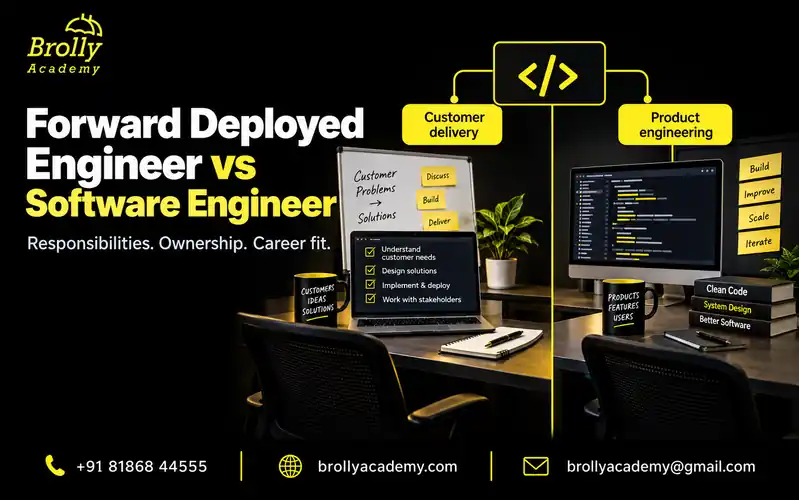
Choose the work, not the label. FDE work may fit you if you want to investigate customer problems, build integrations and stay close to rollout and adoption. Product software engineering may fit you if you want sustained ownership of shared services or features. Neither title guarantees more coding, higher pay or better career growth.
Compare the roles · See the worked project · Use the decision worksheet
Compare responsibilities and trade-offs, see how both roles handle the same project, check fresher and career-switching options, and leave with a role-fit worksheet backed by questions you can ask an employer.
The main difference is the centre of ownership
Software engineer is the broad category. Backend, frontend, platform, product and forward deployed engineers can all belong to it. In this comparison, SWE means product or platform software engineering, while FDE means a hands-on role close to customer implementation. FDSE or FDSWE may mean Forward Deployed Software Engineer; the employer’s description determines the actual scope.
An FDE often begins with a customer process that needs improvement, investigates its constraints and connects software capabilities into a useful solution. A product engineer often begins with a capability that must work consistently across a wider user base. This changes the decisions each person makes, not whether they are a real engineer.
Both can meet users, build reusable systems and handle incidents. The distinction becomes useful when you ask: whose problem drives the next engineering decision, and who owns the result after release? For the broader definition, read what a forward deployed engineer does.
Side-by-side comparison
This is a practical comparison framework, not a universal division of duties. Use it to investigate two actual vacancies at a similar level.
| Dimension | Forward deployed engineer | Product or platform software engineer |
|---|---|---|
| Starting point | A customer workflow, implementation obstacle or adoption problem. | A shared product need, service requirement or platform limitation. |
| Scope | Connect several capabilities into one usable customer outcome. | Develop a capability that remains useful across customers and use cases. |
| Requirements | May help discover the problem before a specification exists. | May shape requirements with product, design, users and other engineers. |
| Code ownership | Adapters, applications, integrations and reusable delivery components. | Services, libraries, product features, interfaces and shared infrastructure. |
| Customer contact | Often direct and frequent during discovery, rollout and feedback. | Varies by team; direct user research and customer debugging can also be central. |
| Technical depth | Can require deep integration, data, security and full-stack problem solving. | Can require deep expertise in a subsystem, architecture or distributed system. |
| Feedback loop | Observe whether the implemented workflow works for its users. | Observe whether the capability works across its intended user population. |
| Testing | Application tests plus customer-specific data, access and acceptance cases. | Application tests plus compatibility, performance and product-wide regression cases. |
| Release decisions | Coordinate customer readiness, permissions, dependencies and ownership. | Coordinate release safety, shared-service impact and compatibility. |
| Success measures | Agreed workflow outcomes, quality, adoption and supportability. | Product outcomes, reliability, usability and maintainable capabilities. |
| Change pressure | A newly discovered constraint can change the implementation scope. | A change must be balanced against shared architecture and roadmap priorities. |
| Travel and location | Customer-site work or travel may be required; inspect the posting. | Remote, hybrid, office and travel expectations also vary by employer. |
| After launch | May support, improve or hand over the deployment under an agreed model. | May operate the service and iterate on it over multiple releases. |
| Career evidence | Explain the customer problem, engineering decisions and delivered outcome. | Explain technical ownership, design decisions and product or system impact. |
The wrong conclusion: FDE equals meetings and SWE equals coding. The useful conclusion is that both require engineering, but their context and decision boundaries can differ.
What real employer descriptions show
These primary sources were reviewed on 9 October 2026. They illustrate role design, not a market-wide survey, academy hiring partnership or promise of an available job.
| Employer source | What the description establishes | What you should not infer |
|---|---|---|
| Palantir: Students and Early Talent | Distinguishes product development from customer technical and operational outcomes; interview processes vary by role. | Every company uses Palantir’s organisational structure or interview format. |
| OpenAI: FDE, Seattle | Covers discovery, scoping, system design, build and production rollout. Lists 5+ years of relevant experience and travel up to 50%. | This US experienced-role requirement applies to every Indian or graduate role. |
| OpenAI: Forward Deployed Software Engineer, SF | Explicitly includes customer-focused software development and reusable abstractions across engagements. | Forward-deployed engineers only configure tools or stop at a demo. |
| OpenAI: Software Engineer, API Frontiers | Includes backend APIs, distributed-system reliability, staged launches and production feedback. | Product engineers never hear from customers or take responsibility after release. |
| Supervity: Forward Deployed AI Engineer, India | Combines customer architecture, hands-on implementation and sales engineering. | Every FDE role is exclusively pre-sales or exclusively post-sales. |
Our interpretation: the titles overlap. Compare the work, team boundaries and level in the actual description. Do not average these few examples into a universal coding percentage, travel expectation or hiring standard.
What daily work can look like in each role
The following is an illustrative working week around a document-search application, not a reported schedule or an estimate of how employees divide their time. A release incident can replace the entire plan in either job.
| Work block | FDE perspective | Product SWE perspective |
|---|---|---|
| Understand the problem | Observe why reviewers cannot find the current approved policy. | Review search failures reported across product users and deployments. |
| Focused implementation | Build the customer document adapter and map approved access groups. | Improve the shared query interface or permission-filtering capability. |
| Engineering review | Check customer-specific assumptions, migration steps and failure handling. | Check compatibility, maintainability and effects on existing integrations. |
| Validation | Run acceptance cases with the people using the workflow. | Run regression, load and contract tests for the shared service. |
| Release and learning | Coordinate the pilot, user guidance and named support owner. | Roll out the feature, watch service behaviour and improve diagnostics. |
The FDE may spend a morning uncovering that a document has no approved owner, then spend the afternoon fixing an API adapter. The product engineer may spend the morning diagnosing a slow query, then meet a customer to understand a confusing API response. Neither example supports a rigid split between technical and non-technical work.
Ask a hiring manager for an anonymised recent week, the number of concurrent projects and how uninterrupted coding time is protected. That gives you more useful evidence than a job title or a claim that the team is fast-paced.
Coding depth, skills and tools: what actually changes?
FDE is not a shortcut around programming. A customer deadline does not remove the need for tests, readable code, authorization, error handling and review. Likewise, product engineering is not limited to implementing tickets someone else has fully understood.
| Capability | Shared foundation | Useful difference in emphasis |
|---|---|---|
| Programming and debugging | Functions, data structures, errors, tests, Git and code review. | FDE: debug across customer systems. SWE: debug shared components and their consumers. |
| APIs and data | HTTP, schemas, SQL, authentication, retries and source-of-truth decisions. | FDE: reconcile local identifiers and workflow constraints. SWE: keep contracts stable across integrations. |
| System design | Make trade-offs about state, consistency, failure, security and cost. | FDE: fit an existing customer environment. SWE: support multiple environments without excessive complexity. |
| Communication | Explain decisions and resolve disagreement clearly. | FDE: frequently translate between user workflows and engineering. SWE: frequently coordinate product and technical dependencies. |
| AI where relevant | Evaluate behaviour, ground outputs and control tool access. | FDE: prove usefulness in a particular workflow. SWE: make the capability reusable and operable. |
Learn technologies that let you demonstrate these abilities. Python or TypeScript, an API framework, SQL, Git and a repeatable deployment can support a useful learning project. They are examples, not a mandatory stack for every employer. A platform specialist can be an excellent SWE without an AI framework; an AI-focused FDE still needs dependable software fundamentals.
If you worry about losing technical depth, ask what code you will own, who reviews it, how it is tested and whether you maintain it after launch. A role containing only slides is different from one containing substantial implementation, regardless of its title.
One problem, two different engineering perspectives
Original teaching scenario: a fictional company wants employees to find approved policy documents. Some files are outdated, access groups differ between systems and a confident but unsupported answer could mislead a reviewer. No real customer data or measured business results are used here.
1. Establish what must be true
Before selecting a model, identify the document owner, current version, permitted audience and action the employee needs to take. The first release will search approved documents and show sources. It will not change HR records, make policy decisions or reveal documents outside the caller’s access. Those limits turn a vague AI request into a testable application.
2. The FDE builds the customer workflow
The FDE investigates the actual document approval process, maps the customer’s groups to application permissions, implements an ingestion adapter and presents a reviewable search result. They agree with the customer which cases must work before the pilot. If the source system does not reliably identify approved versions, they resolve that dependency instead of hiding it with a better prompt.
3. The product engineer builds the reusable capability
The product engineer works on the shared search contract, indexing behaviour, permission-filter interface and diagnostic signals. They consider how a new parameter affects existing clients, how a slow query is cancelled and how one tenant’s traffic affects another. They may expose a supported extension point so implementations do not depend on fragile internal behaviour.
4. Make the boundary explicit
| Decision or artifact | Customer implementation responsibility | Shared product responsibility |
|---|---|---|
| Approved source of truth | Confirm which policy version the customer authorizes. | Provide a reliable way to represent and query document versions. |
| Permission mapping | Map approved customer groups and verify access scenarios. | Define and enforce the supported filtering contract. |
| Bad answer investigation | Reproduce the user question against its permitted source set. | Investigate retrieval or service behaviour that affects multiple deployments. |
| Change request | Explain customer impact and propose a scoped requirement. | Assess reuse, compatibility, support cost and roadmap priority. |
| Operating handover | Identify who manages this integration and its customer dependencies. | Document service support boundaries, diagnostics and supported versions. |
This is a proposed division for the example, not a rule about every team. One small team could hold both responsibilities. What matters is that they are assigned and reviewed rather than assumed.
5. Compare evidence before calling the work finished
- Current policy: a permitted employee finds the approved version with a usable source link.
- Restricted document: a user outside the allowed group cannot retrieve the text or receive a revealing snippet.
- Conflicting versions: the workflow identifies the approved version or requests review instead of guessing.
- Unavailable source: the application gives a controlled failure and a useful diagnostic reference.
- Compatibility: the product change does not silently break another supported client.
Both engineers need a tested system. The FDE adds evidence that the customer’s workflow is useful and operable; the product engineer adds evidence that the shared capability remains dependable beyond that customer.
6. Turn a repeated need into a product improvement
If several deployments need the same version-mapping pattern, document the common requirement, separate customer-specific data and propose a supported abstraction. Do not copy private configuration into a shared repository. A well-scoped product change can reduce future delivery work; a poorly generalized workaround can spread one customer’s assumptions everywhere.
How success is measured without rewarding the wrong behaviour
Discuss performance expectations before joining. Measuring only meetings, lines of code, demonstrations or customer praise can encourage the wrong trade-offs. The table below gives suggested measures for the fictional search project, not reported employer scorecards.
| Question | Implementation-focused evidence | Product-focused evidence |
|---|---|---|
| Does it solve the problem? | Reviewers complete the agreed policy lookup with an approved source. | Users can complete the supported search task across relevant product scenarios. |
| Is it reliable? | Integration failure cases have a controlled response and recovery owner. | Service error and latency measures meet the team’s defined objectives. |
| Is it safe to use? | Customer-specific access checks pass for permitted and denied cases. | Permission behaviour stays correct across supported clients and changes. |
| Can it be maintained? | A new owner can reproduce setup and diagnose a failed synchronization. | A reviewed change includes compatibility coverage and useful documentation. |
Record the baseline, eligible cases and observation period before claiming improvement. A successful demo is not recurring adoption, and a low average response time does not excuse unauthorized access. The best comparison evaluates useful outcomes alongside quality and operating constraints.
FDE is not automatically pre-sales engineering
A solutions engineer may help a prospect evaluate a product through demonstrations, architecture advice and proof-of-concept work. Some solutions teams also own production implementation. An FDE role may include sales engineering, but other roles begin after a commercial decision and focus on delivery.
Ask what happens after a successful demo. Who implements authentication, writes integration tests, deploys the application and responds to failures? If the answer is a different team, understand what your responsibility actually includes. A job title should not lead you to claim production ownership you will not have.
The Supervity India role is one concrete example that combines sales-oriented and implementation responsibilities. It illustrates why reading the full posting matters.
Check adjacent titles by ownership
- Solutions engineer: ask whether the role primarily helps evaluation, writes a proof of concept or maintains the final implementation.
- Implementation engineer: ask how much independent discovery and coding the deployment requires.
- DevOps or platform engineer: ask whether ownership centres on delivery infrastructure or the customer’s business workflow.
- Consulting engineer: ask whether the engagement ends with advice, a working system or ongoing operations.
These can all be substantive technical careers. The point is to understand the responsibility you are accepting, not rank job labels as higher or lower.
FDE versus AI engineer
AI engineering describes a technical focus: building systems involving models, retrieval, data and evaluation. Forward deployment describes a relationship to customer problems and delivery. A person can therefore be both an AI engineer and an FDE.
An internal AI engineer might improve an evaluation pipeline for a product without working directly with external customers. An AI-oriented FDE might integrate that product into a customer’s workflow and discover that a human approval step matters more than a new model. The same technical components can appear in both jobs.
When choosing training, do not replace software fundamentals with an agent-framework list. Customer-facing AI delivery still requires data validation, authorization, failure handling, deployment and communication.
For career planning, treat customer ownership and technical specialization as separate dimensions. You could build an AI product without external customer delivery, deliver a customer integration without AI, or combine both. A framework course and a customer-delivery course may therefore address different gaps in the same person’s preparation.
Which role fits your working preferences?
- You enjoy unclear problems: FDE work may suit you if you like discovering the problem as well as implementing it.
- You prefer deep ownership of a shared subsystem: a product engineering role may offer more sustained focus, depending on the team.
- You enjoy explaining trade-offs to users: frequent customer interaction can be rewarding, but it also requires patience and boundary setting.
- You dislike travel or changing time zones: investigate the operating model before assuming an FDE role will fit.
- You want to improve a product used at scale: product engineering and some FDE teams both offer that path through different feedback loops.
These preferences are not a personality test. Try a small customer-discovery exercise and an implementation project. Notice which activities energise you and which require deliberate practice. Your preference can change as you gain experience.
Benefits and trade-offs to evaluate
FDE work can offer direct feedback, varied problems and visibility into whether software helps someone. The corresponding risks include context switching, changing requirements and unclear support boundaries. Look for a team that controls scope and provides engineering review.
Product SWE work can offer sustained technical ownership and opportunities to improve a reusable system across releases. The corresponding risks include distance from users, competing roadmap demands and long-lived maintenance obligations. Look for a team that connects technical work with real user needs.
These are evaluation questions, not promises about every employer. A well-run customer engineering team can protect focused work; a product team can be highly interrupt-driven. Assess the actual manager, project load and escalation model.
Which path is suitable for freshers and career changers?
Choose a role with an appropriate level and meaningful mentorship. A fresher should not infer that a new-sounding title is an entry-level opportunity. Some employers recruit graduates into forward-deployed roles; others expect substantial previous delivery experience. Palantir’s early-talent page discusses both engineering tracks, while the specific OpenAI FDE example above is an experienced role. Neither establishes a universal hiring policy.
If you cannot yet build and debug a small application, prioritize programming, APIs, data and testing before choosing a specialty. If you already have those foundations, compare who will review your code, how much independent customer responsibility you will hold and what happens when a project gets stuck.
- Recent graduate: look for internship, graduate or explicitly junior requirements and a named review structure.
- Backend or full-stack developer: add discovery, scope negotiation and operating handover to your existing delivery evidence.
- QA or cloud professional: use your testing or operations strengths, but demonstrate application implementation as well.
- Analyst or consultant: domain knowledge helps; build code you can modify and debug independently before claiming engineering readiness.
Read each vacancy’s education policy. There is no single degree or certificate requirement that applies to every FDE employer. A course can organize practice; it cannot substitute for mandatory experience in a specific advertisement.
Can a software engineer transition into FDE work?
Yes, relevant software experience can transfer, but the title change does not remove new responsibilities. Begin by identifying examples of integration, rollout, incident handling and user communication in your existing work.
- Choose a customer-like problem and write a brief before coding.
- Agree on a limited first release and explicit non-goals.
- Build the solution using technologies you can maintain.
- Test both application behaviour and the assumptions behind the workflow.
- Demonstrate it to someone acting as the user and capture feedback.
- Prepare a release checklist, runbook and handover discussion.
Use the FDE roadmap to organise gaps. If your existing work is confidential, practise with a separate synthetic scenario instead of exporting company data into a portfolio.
A focused transition exercise
Take an application you already understand. Write down the user problem without naming your preferred technology. Ask a peer to act as the customer and challenge the scope: what if the data is unavailable, the deadline changes or the first version needs manual review? Revise the brief before adding features.
Then implement one agreed change, add a failure test and explain what would be required for a real release. Your transition evidence should show that customer learning influenced an engineering decision. Do not simply rename your current developer role as FDE on your resume; describe the relevant work you actually did.
Can an FDE move back into product software engineering?
A transition is possible, but it depends on the engineering evidence you develop, the destination role and its hiring requirements. Being close to customers does not prevent product work. Equally, a title containing engineer does not prove you have the depth needed for a particular backend or platform position.
Preserve evidence of code review, tests, API design, migrations, performance work and maintainable abstractions. Explain how you separated a customer-specific adapter from a reusable component. If you want a distributed-systems role, build and demonstrate relevant depth rather than relying only on successful stakeholder communication.
Palantir’s infrastructure careers page includes an employee account of moving from an FDSE internship into a full-time software engineering role. That is an individual example, not a transfer policy or a probability of your own outcome.
- Keep a technically detailed account of a system you designed or improved.
- Practise coding and system-design topics required by the target team.
- Show what happened after the first delivery: maintenance, regression fixes and upgrades.
- Explain the reason for your move as a preference for a different ownership model, not a claim that the previous work was not engineering.
Does an FDE earn more than a software engineer?
There is no universal answer. A title-only comparison can mix different countries, levels, company types and compensation structures. Compare roles at a similar level and location, and separate fixed pay, bonus and equity.
A high overseas FDE range is not proof that every Indian FDE earns more than a local product engineer. Likewise, one low offer does not establish a market-wide rule. Use the India salary evidence and offer-comparison guide to interpret actual numbers and their limitations.
Compare two real offers on the same basis
First align country, city, seniority, employment arrangement and employer type. Then separate annual fixed cash, conditional bonus, equity and employer-cost components. Check travel, on-call, working-hour and support expectations alongside compensation. A larger headline number is not automatically a better fit.
This article does not claim a verified India-wide FDE-versus-SWE pay premium. The public role examples are not a matched salary dataset. Use the linked salary guide for its separately dated evidence, and use the written breakdown of an actual offer for your decision. Do not convert a US experienced-role band into a Hyderabad fresher expectation.
Interview preparation: common foundations, different emphasis
Both paths can require coding, debugging and design reasoning. The actual sequence varies by employer and level; Palantir explicitly notes role-dependent interview processes. Ask your recruiter for the format instead of treating online interview stories as a fixed examination syllabus.
These are original practice prompts, not leaked questions or claims about a company’s assessment.
| Practice area | FDE-oriented prompt | Product SWE-oriented prompt |
|---|---|---|
| Clarify the problem | A customer asks for an autonomous policy assistant. What must you learn before agreeing? | Several teams request different search options. Which underlying capability should the API expose? |
| Implement safely | Map inconsistent source records and reject invalid or unauthorized inputs. | Design a stable request schema and maintain compatibility as it evolves. |
| Debug a failure | The demo worked but the customer pilot cannot find approved documents. How do you isolate the cause? | A query change causes a latency regression for some tenants. How do you investigate? |
| Make a trade-off | The deadline is fixed but source approval is incomplete. What will you release or defer? | A special case helps one customer but complicates every client. How do you decide? |
| Communicate ownership | Explain the pilot risks and named handover responsibilities to a customer. | Explain migration, rollout and ongoing service ownership to dependent teams. |
A good answer makes assumptions explicit, identifies the affected user, considers simpler options and shows how the decision would be checked. An FDE answer without implementation detail can be too vague; a SWE answer without user context can optimize the wrong thing. Continue with the FDE interview questions and practice answers after deciding which gaps you need to strengthen.
A portfolio experiment that lets you try both roles
Use the document-search scenario to test your preference without pretending to have two professional jobs. Build a small application using synthetic documents and clearly label it as independent practice.
- Write the customer brief: describe the user, approved information, access boundary and first useful outcome.
- Build the integration: import the synthetic documents, validate metadata and return a traceable search result.
- Add the product perspective: define a stable interface that a second fictional customer could use with different configuration.
- Test both boundaries: check invalid input, denied access, unavailable sources and compatibility when configuration changes.
- Show a controlled failure: demonstrate what the user sees when the application cannot safely complete the task.
- Write two short retrospectives: one explaining the customer decision, the other explaining the reusable design and its limitations.
The practical test is not which version contains more code. Notice whether you most enjoyed clarifying the workflow, negotiating scope and showing it to a user, or improving the shared interface, tests and internal design. You may enjoy both; that is a useful result.
For a fuller specification, use the FDE project build plans. Present the outcome using the resume and portfolio evidence guide. Do not add client names, adoption figures or performance improvements you did not actually observe.
A role-fit worksheet you can actually use
Use this worksheet to compare two specific opportunities, not to generate a personality score. Record an answer and its evidence. An unknown remains unknown until you ask the team.
| Decision area | What to record for each role | Evidence to ask for |
|---|---|---|
| Ordinary work | Which activities you will own in a normal project phase. | An anonymised example of a recent project and working week. |
| Code and review | What you implement and who reviews the design and changes. | A description of the repository, review and release process. |
| Customer responsibility | Who handles discovery, scope changes and difficult conversations. | A concrete example of a requirement that changed after feedback. |
| Technical growth | Which capabilities you can deepen over several projects or releases. | Examples of feedback, mentoring and increasing responsibility. |
| Lifestyle constraints | Location, travel, time-zone overlap, on-call and predictability. | The actual policy and team practice, not the title alone. |
| Maintenance | Who owns the implementation after the initial handover. | The support model, escalation owner and documentation expectations. |
| Compensation and level | Comparable fixed, variable and equity components and defined level. | A written role description and offer breakdown. |
Worked interpretation: suppose Role A offers substantial customer delivery but leaves maintenance ownership unclear. Role B offers a narrower shared service with clear review and mentorship. If your priority is foundational engineering growth, B may be the better fit even if A has the more fashionable title. If A clarifies support, provides strong review and matches your preference for customer work, your conclusion may change.
List your non-negotiable constraints first. Do not let a good score on interesting technology cancel an unacceptable travel expectation or a lack of essential support. The worksheet supports a conversation; it does not predict career success.
Career growth, AI and common misconceptions
Think about the responsibility you want to grow into, not a title that is supposedly future-proof. An FDE might deepen technical delivery, lead implementations, improve reusable infrastructure or pursue product engineering. A product SWE might deepen a specialty, lead technical projects or move closer to customer delivery. These are possible directions to investigate, not guaranteed promotion ladders.
- “FDE is less technical.” Inspect code, design and operating ownership; the label alone cannot establish depth.
- “SWE never talks to customers.” Product engineering can include direct user feedback, developer support and integration debugging.
- “Every FDE is an AI engineer.” Customer deployment can involve data and software without a generative model.
- “FDE always pays more.” Comparable level, employer, location and compensation structure matter.
- “AI will replace one role but protect the other.” Neither title provides a reliable guarantee about future demand.
AI tools may change how a team writes code, but the career decision still needs evidence about problem understanding, verification, ownership and maintainability. Build those capabilities rather than choosing a path from a prediction that cannot be established.
A decision checklist before choosing a course or role
Lean toward FDE work when you want frequent customer context, enjoy resolving unclear requirements and are prepared to stay accountable through implementation and handover. Lean toward product SWE work when you want sustained ownership of reusable capabilities and their behaviour across releases. Then validate that preference against an actual team, because either title can cover a different operating model.
- Choose the kind of ordinary work you want, not only the job title.
- Check your current programming, integration and debugging evidence.
- Try the small portfolio experiment and identify one concrete skill gap.
- Use the employer worksheet to check mentorship, scope, support and practical constraints.
- Decide whether independent practice, a suitable entry-level role or structured training addresses that gap.
For structured customer-to-application practice, review Brolly Academy’s Forward Deployed Engineer Course. The confirmed duration is two months, with INR 20,000 online or INR 25,000 classroom tuition and Manish as trainer. Bring your project brief or a job description to the free demo and discuss what you need to practise.
Confirm teaching hours, review support, batch arrangements, taxes and any cloud charges before enrolling. Training prepares you to demonstrate skills; it does not guarantee a job, salary, employer selection or career transition. Continue with the practical FDE roadmap or the FDE job-search guide according to your next decision.
Frequently Asked Questions
What is the main difference between an FDE and a software engineer?
FDE is itself a software-engineering role. Compared with product or platform SWE work, its emphasis is usually closer ownership of a customer workflow, integration and rollout. Both can design, implement, test and operate production software.
Is Forward Deployed Software Engineer different from Forward Deployed Engineer?
FDSE, FDSWE and FDE can overlap, but employers may use them for different scopes. Read whether the role owns discovery, coding, architecture, deployment, adoption or some combination instead of deciding from the abbreviation.
Does an FDE write less code than a product software engineer?
There is no reliable universal percentage. The balance changes with employer and project phase. Ask what code you will own, who reviews it and whether you maintain it after deployment.
Is an FDE a real software engineer or mainly a salesperson?
Hands-on FDE roles can involve substantial software development. Some also include sales engineering. Establish whether the job owns maintained implementation or primarily evaluation and demonstrations; neither can be inferred from the title alone.
What is the Palantir Dev versus Delta distinction?
Palantir distinguishes product-development software engineers from forward-deployed engineers responsible for customer technical and operational outcomes. It is a useful company-specific example, not a universal organisational model.
Which role is better for freshers?
The better first role is one with suitable entry requirements, code review, mentorship and a manageable level of responsibility. Evaluate the actual graduate or junior opportunity rather than assuming one title is inherently better.
Can I become an FDE without strong coding skills?
Engineering-focused roles require the ability to implement and debug software. Domain knowledge and communication help, but they do not replace programming, APIs, data handling and testing. Start with those foundations if they are missing.
Can a software engineer switch to FDE work?
Relevant development experience can transfer. Add evidence of discovery, scope decisions, customer communication, integration and handover. Describe your actual responsibilities rather than changing the title of a previous job.
Can an FDE later move into product software engineering?
A move is possible when your technical evidence matches the destination role. Maintain depth in code, tests, design and operating systems over time; an FDE title alone neither prevents nor guarantees the transition.
Does an FDE earn more than a SWE in India?
This guide does not establish an India-wide pay premium for either title. Compare the same location, level and employer context, and separate fixed cash, conditional bonus, equity and other compensation components.
Do all FDE roles require travel?
No single travel policy applies. Some specific employer postings require substantial travel, while others use different arrangements. Confirm location, customer-site expectations and time-zone overlap before accepting.
Is FDE the same as DevOps or solutions engineering?
Not automatically. DevOps or platform work may centre on delivery infrastructure; solutions engineering may centre on technical evaluation or pre-sales. Some roles overlap, so compare coding, release and ongoing support ownership.
Are FDE interviews easier than SWE interviews?
Neither title establishes difficulty. Both may assess programming and technical reasoning, with additional emphasis varying by role. Confirm the actual interview format and practise explaining decisions rather than memorising a supposed fixed loop.
Will an FDE course guarantee that I can switch careers?
No course can guarantee employer selection or a career transition. Evaluate the syllabus, practical work and feedback against your current gaps and the requirements of the role you want.
Sources and Further Reading
Official documentation and employer pages were checked on 9 October 2026. Job availability, compensation and product details can change. Teaching scenarios are illustrative unless explicitly identified otherwise.
- Palantir: Students and Early Talent, role distinctions and interview guidance
- OpenAI: Forward Deployed Engineer, Seattle
- OpenAI: Forward Deployed Software Engineer, San Francisco
- OpenAI: Software Engineer, API Frontiers
- Supervity: Forward Deployed AI Engineer, India
- Palantir: Infrastructure careers and an individual transition account