
SOC Analyst Salary in India
Fresher to Senior Salary, Skills & Career Growth
Explore the latest SOC Analyst Salary in India (2026), including salary by experience, city, company type, skills, certifications, and career growth. Learn how to become a SOC Analyst and build a successful cybersecurity career.

Share
Table of Contents

- The demand for SOC (Security Operations Center) Analysts is growing rapidly in India. As cyber threats continue to increase, organizations need skilled professionals to monitor, detect, and respond to security incidents effectively.
- Today, companies across IT, banking, healthcare, telecom, e-commerce, and government sectors are actively hiring SOC Analysts. This has made cybersecurity one of the fastest-growing career fields in India.
- A career as a SOC Analyst offers competitive salaries, excellent job security, and clear career growth. Whether you’re a student, fresher, IT professional, or career switcher, this role provides exciting opportunities in the cybersecurity industry.
- In this comprehensive guide, Brolly Academy covers everything you need to know about SOC Analyst salaries in India, including salary by experience, city-wise salary trends, top-paying industries, essential skills, certifications, career growth, and future job opportunities.
SOC Analyst Salary in India Overview
Experience Level | Average Salary (LPA) | Monthly Salary | Typical Job Role |
Fresher (0–1 Year) | ₹3.5–6 LPA | ₹30K–50K | SOC Analyst L1 |
1–3 Years | ₹5–9 LPA | ₹42K–75K | SOC Analyst |
3–5 Years | ₹8–14 LPA | ₹67K–1.2L | SOC Analyst L2 |
5–8 Years | ₹12–22 LPA | ₹1–1.8L | Senior SOC Analyst |
8+ Years | ₹20–45+ LPA | ₹1.6L–3.7L | SOC Manager |
What Does a SOC Analyst Do?
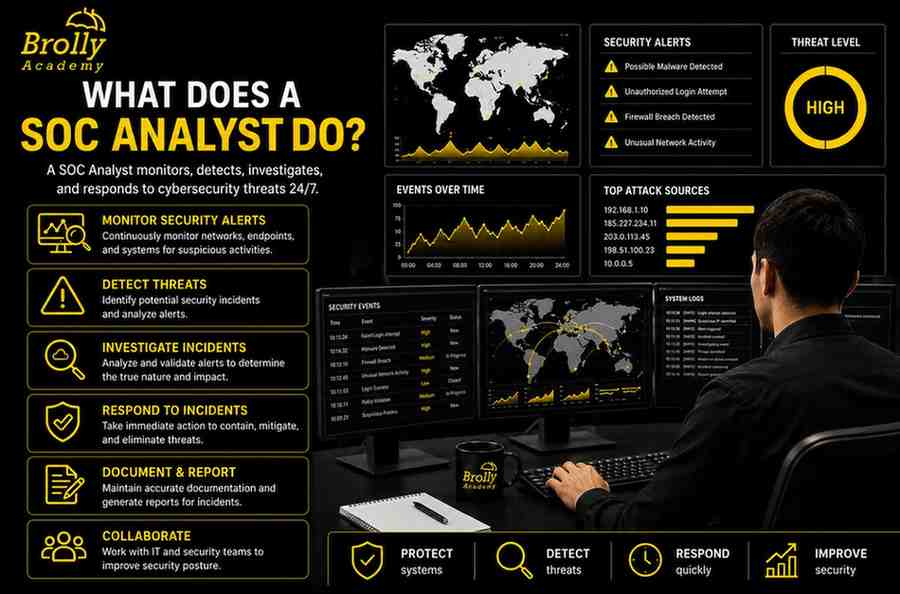
- A Security Operations Center (SOC) Analyst is a cybersecurity professional who helps protect an organization’s systems, networks, and sensitive data from cyber threats. They act as the first line of defense, monitoring security events and responding to potential attacks.
- SOC Analysts continuously monitor networks, servers, applications, endpoints, and security devices to identify unusual or suspicious activities. Their goal is to detect threats early and prevent them from causing damage.
- To perform these tasks, SOC Analysts use industry-standard security tools such as SIEM (Security Information and Event Management), EDR (Endpoint Detection and Response), threat intelligence platforms, and network monitoring tools. These tools help them identify, investigate, and respond to security incidents efficiently.
- The primary responsibility of a SOC Analyst is to reduce cybersecurity risks, protect sensitive business information, and ensure uninterrupted business operations. Their role is critical in helping organizations stay secure against evolving cyber threats.
SOC Analyst Salary Based on Experience
- One of the biggest factors that affects a SOC Analyst’s salary in India is professional experience. As you gain hands-on experience in cybersecurity, your skills become more valuable, leading to better job opportunities and higher salary packages.
Freshers usually start their careers as SOC Analyst L1, where they monitor security alerts, analyze logs, and report security incidents. This stage helps build a strong foundation in security operations and threat detection.
With experience, professionals move to SOC Analyst L2 and L3 roles. At these levels, they investigate complex cyber threats, perform threat hunting, analyze malware, and respond to security incidents more independently
Professionals who continuously upgrade their skills in cloud security, digital forensics, threat intelligence, and security orchestration are often rewarded with higher salaries and faster promotions.
SOC Analyst Salary by Experience
Experience Level | Average Salary (LPA) | Typical Job Role | Key Responsibilities | Skills Required |
0–1 Year (Fresher) | ₹3.5–6 LPA | SOC Analyst L1 | Monitor alerts, analyze logs, create incident tickets, escalate security events | Networking, Linux, Windows, Cybersecurity Fundamentals, SIEM Basics |
1–3 Years | ₹5–9 LPA | SOC Analyst L1/L2 | Investigate incidents, analyze malware alerts, respond to phishing attacks, manage SIEM alerts | Splunk, Microsoft Sentinel, EDR, Incident Response, Threat Analysis |
3–5 Years | ₹8–14 LPA | SOC Analyst L2 | Perform threat hunting, investigate advanced attacks, mentor junior analysts, improve detection rules | Threat Hunting, the MITRE ATT&CK Framework, Python Programming, Cloud Security, and Malware Analysis |
5–8 Years | ₹12–22 LPA | Senior SOC Analyst / L3 | Lead incident response, conduct digital forensics, automate security processes, coordinate with security teams | Digital Forensics, SOAR (Security Orchestration, Automation, and Response), Threat Intelligence, Security Automation, and Leadership Skills |
8–12 Years | ₹18–35 LPA | SOC Lead | Oversee SOC operations, lead incident response activities, optimize security monitoring processes, and develop effective SOC strategies. | Team Management, Risk Management, Compliance, Cloud Security, Security Architecture |
12+ Years | ₹25–45+ LPA | SOC Manager | Define security strategy, oversee SOC teams, ensure regulatory compliance, manage enterprise security operations | Leadership, Governance, Security Strategy, Budget Planning, Executive Communication |
SOC Analyst Salary by City in India
- The salary of a SOC Analyst in India varies from one city to another. Factors such as the number of IT companies, cybersecurity job opportunities, demand for skilled professionals, and the cost of living play a major role in determining salary packages.
- Cities with strong technology ecosystems and a high presence of multinational companies (MNCs) usually offer better salaries and faster career growth. These locations also provide more opportunities to work with advanced cybersecurity tools and global security teams.
City | Average Salary (LPA) | Top Hiring Industries | Career Growth |
Bangalore | ₹8–15 LPA | Product Companies, SaaS, Cloud Security, MNCs | Excellent |
Hyderabad | ₹7–14 LPA | IT Services, Cybersecurity Firms, Pharma, Cloud Companies | Excellent |
Pune | ₹6–13 LPA | Banking, IT Services, Automotive, FinTech | Very Good |
Mumbai | ₹7–15 LPA | Banking, Financial Services (BFSI), Telecom, Consulting | Very Good |
Delhi NCR | ₹7–14 LPA | Government, Consulting, IT Services, Telecom | Very Good |
Chennai | ₹6–12 LPA | Manufacturing, Healthcare, IT Services | Good |
Noida | ₹6–13 LPA | IT Services, SaaS, BPO, Cybersecurity Companies | Very Good |
Kolkata | ₹5–10 LPA | IT Services, Government, Banking | Good |
Ahmedabad | ₹5–9 LPA | IT Services, Manufacturing, Startups | Good |
Coimbatore | ₹4–8 LPA | IT Services, SMEs, Startups | Moderate |
Factors That Affect SOC Analyst Salary
- A SOC Analyst’s salary in India depends on more than just work experience. Several factors influence how much you can earn throughout your cybersecurity career.
- One of the most important factors is your technical skills. Professionals with expertise in SIEM tools, incident response, threat hunting, cloud security, endpoint security, and digital forensics are often offered higher salary packages.
- Hands-on experience also plays a key role in salary growth. Employers prefer candidates who can confidently detect, investigate, and respond to real-world cyber threats using industry-standard security tools.
- Other factors, including your job location, company type, industry, educational background, and communication skills, also influence salary. Professionals working in major IT hubs and multinational companies often receive better compensation and career growth opportunities.
- By continuously upgrading your skills, gaining practical experience, and staying updated with the latest cybersecurity technologies, you can increase your chances of securing higher-paying SOC Analyst roles.
Key Factors That Affect SOC Analyst Salary
Factor | Why It Matters |
Work Experience | Experience increases technical expertise, problem-solving ability, and responsibility, leading to better salary packages. |
Technical Skills | Skills in SIEM, EDR, threat hunting, malware analysis, cloud security, and incident response are highly valued by employers. |
Professional Certifications | Certifications such as CompTIA Security+, CEH, CySA+, Microsoft SC-200, Splunk, and CISSP validate expertise and improve employability. |
Company Type | Product companies, MNCs, and cloud security organizations generally offer higher salaries than service-based companies. |
Location (City) | Metro cities like Bangalore, Hyderabad, Mumbai, and Pune typically provide higher salaries due to greater demand and cost of living. |
Industry | Banking, fintech, healthcare, telecom, cloud, and e-commerce sectors invest heavily in cybersecurity and often pay higher salaries. |
Cloud Security Expertise | Experience with AWS, Microsoft Azure, and Google Cloud security is increasingly in demand across enterprises. |
Programming & Automation | Knowledge of Python, PowerShell, or Bash scripting helps automate security tasks and improves career opportunities. |
Communication & Reporting Skills | Strong communication helps in incident reporting, stakeholder coordination, and leadership roles. |
Educational Background | A degree in Computer Science, IT, or Cybersecurity can support career growth, though practical skills are often more important. |
SOC Analyst Salary by Company Type
- Product-based companies generally offer higher salary packages because they manage large-scale applications, cloud platforms, and sensitive customer data. These organizations invest heavily in cybersecurity and look for professionals with advanced technical skills.
- Service-based companies are an excellent choice for freshers and early-career professionals. They provide opportunities to work with multiple clients, security tools, and real-world cyber incidents, helping you build valuable hands-on experience.
- Choosing the right company depends on your career goals, learning opportunities, salary expectations, and long-term growth plans. Gaining experience in different work environments can help you build a successful career as a SOC Analyst.
Skills That Increase SOC Analyst Salary
- A SOC Analyst’s salary depends on more than just experience. Employers look for professionals who have the right mix of technical skills, practical knowledge, and problem-solving abilities.
- For beginners, learning the basics of networking, Linux, Windows administration, and cybersecurity fundamentals is essential. These core skills help you understand how systems work and how to identify potential security threats.
- As you gain experience, developing expertise in SIEM tools, Endpoint Detection and Response (EDR), threat hunting, cloud security, malware analysis, and incident response can significantly increase your earning potential.
- Hands-on experience with industry-standard security tools is equally important. Employers prefer candidates who can investigate security incidents, respond to cyber threats, and protect an organization’s critical systems.
- In addition to technical expertise, communication, analytical thinking, teamwork, and report-writing skills are highly valued. SOC Analysts regularly work with IT and security teams, making strong communication an important part of the role.
- Learning Python or PowerShell for security automation can also give you a competitive advantage. Automating repetitive tasks improves efficiency and makes you more valuable to employers.
- By continuously upgrading your skills and staying updated with the latest cybersecurity technologies, you can qualify for higher-paying SOC Analyst roles, faster promotions, and leadership positions such as Senior SOC Analyst, SOC Lead, or SOC Manager.
Best Certifications to Boost SOC Analyst Salary
Earning the right cybersecurity certifications is one of the most effective ways to increase your SOC Analyst salary in India. While practical experience is essential, industry-recognized certifications validate your technical knowledge, demonstrate your commitment to continuous learning, and make your resume stand out in a competitive job market. Many organizations prefer certified professionals because they can quickly adapt to real-world security operations and follow industry best practices.
In addition to improving technical skills, certifications can lead to better job opportunities, higher salary packages, faster promotions, and increased credibility among employers. Combining certifications with hands-on experience in SIEM tools, cloud security, threat hunting, and incident response can significantly boost your earning potential.
Best Certifications for SOC Analysts
Certification | Best For | Skills Covered | Career Level |
CompTIA Security+ | Beginners | Cybersecurity fundamentals, network security, risk management | Entry Level |
Microsoft SC-900 | Beginners | Microsoft security, compliance, identity concepts | Entry Level |
Microsoft SC-200 (Security Operations Analyst) | SOC Analysts | Microsoft Sentinel, Defender XDR, incident response | Intermediate |
Certified Ethical Hacker (CEH) | SOC Analysts & Security Professionals | Ethical hacking, vulnerability assessment, penetration testing | Intermediate |
CompTIA CySA+ | Threat detection, incident response, behavioral analytics | Intermediate | |
Splunk Core Certified User | SIEM Professionals | Log analysis, dashboards, security monitoring | Intermediate |
IBM QRadar SIEM Certification | SOC Analysts | SIEM monitoring, threat detection, event correlation | Intermediate |
AWS Certified Security – Specialty | Cloud Security Professionals | AWS cloud security, monitoring, compliance | Advanced |
GIAC Certified Incident Handler (GCIH) | Incident Response Specialists | Incident handling, malware attacks, attack techniques | Advanced |
Certified Information Systems Security Professional (CISSP) | Senior Professionals & Managers | Security architecture, governance, risk management | Expert |
SOC Analyst Career Path
A career as a Security Operations Center (SOC) Analyst offers excellent long-term growth opportunities in the cybersecurity industry. As cyber threats continue to increase across banking, healthcare, IT, cloud computing, manufacturing, and government sectors, organizations are investing heavily in skilled cybersecurity professionals. This has created a well-defined career path where professionals can progress from entry-level monitoring roles to senior leadership positions while significantly increasing their salary and technical expertise.
Skills Required at Each Career Stage
Career Level | Technical Skills | Leadership Skills |
L1 | Networking, Linux, Windows, SIEM Basics | Communication, Attention to Detail |
L2 | Incident Response, EDR/XDR, Threat Analysis | Problem Solving, Collaboration |
L3 | Threat Hunting, Malware Analysis, Cloud Security | Mentoring, Decision Making |
Senior Analyst | Digital Forensics, SOAR, Automation | Project Coordination |
SOC Lead | Security Operations, Compliance | Team Management |
SOC Manager | Security Strategy, Governance | Leadership, Budget Planning |
CISO | Enterprise Security, Risk Management | Executive Leadership, Business Strategy |
Step-by-Step Roadmap to Become a SOC Analyst
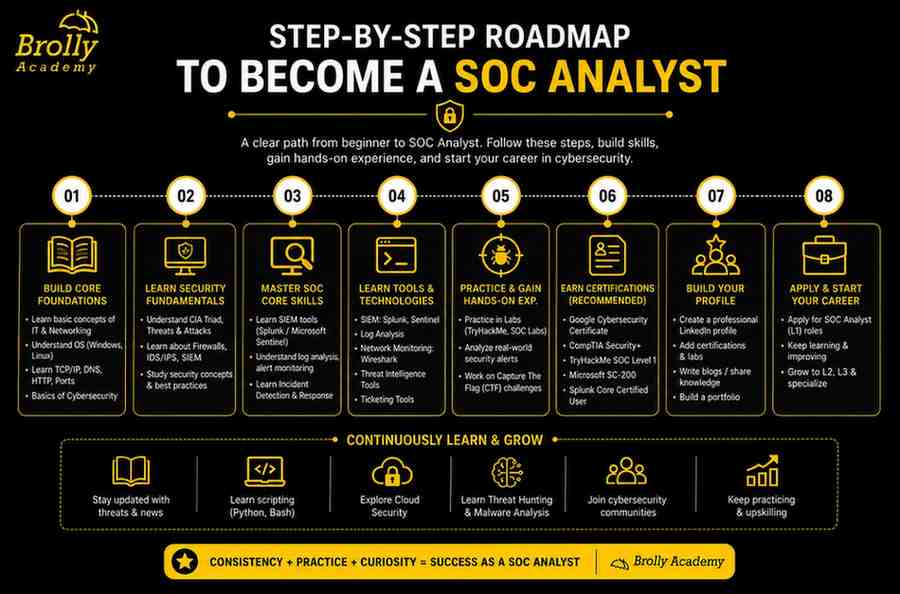
Step | What You Need to Learn | Why It Is Important | Recommended Resources |
Step 1 | Learn Networking Fundamentals | Understand TCP/IP, DNS, HTTP, HTTPS, Firewalls, VPNs, Routing, and Switching. Networking is the foundation of cybersecurity. | Cisco Networking Basics, CompTIA Network+ |
Step 2 | Learn Linux & Windows Administration | SOC Analysts investigate systems running Linux and Windows. Learn file systems, user management, permissions, services, and command-line tools. | Ubuntu, Windows Server, Microsoft Learn |
Step 3 | Understand Cybersecurity Fundamentals | Learn the CIA Triad, malware, phishing, ransomware, vulnerabilities, authentication, encryption, and common cyber threats. | CompTIA Security+, Microsoft SC-900 |
Step 4 | Master SIEM & Security Monitoring Tools | Learn how to monitor security logs, analyze alerts, investigate incidents, and correlate events using SIEM platforms. | Splunk, Microsoft Sentinel, IBM QRadar |
Step 5 | Learn Incident Response & Threat Detection | Understand the incident response lifecycle, threat detection techniques, malware analysis, and endpoint security concepts. | MITRE ATT&CK, Microsoft Defender XDR |
Step 6 | Gain Hands-on Experience | Practice using virtual labs, Capture the Flag (CTF) challenges, and simulated SOC environments to build practical skills. | Develop practical cybersecurity skills by practicing real-world scenarios on platforms such as TryHackMe, Hack The Box, and Blue Team Labs Online. |
Step 7 | Earn Industry Certifications | Certifications validate your knowledge and improve your job prospects in the cybersecurity industry. | Security+, SC-200, CEH, CySA+ |
Step 8 | Build a Cybersecurity Portfolio | Showcase projects, lab exercises, SIEM dashboards, detection rules, and incident reports to demonstrate practical expertise. | GitHub, Personal Portfolio Website |
Step 9 | Apply for Internships & Entry-Level Jobs | Gain real-world experience through internships, apprenticeships, or SOC Analyst L1 positions. | LinkedIn, Naukri, Indeed, Company Career Pages |
Step 10 | Continue Learning & Specialize | Learn cloud security, threat hunting, digital forensics, SOAR, scripting, and automation to progress to senior roles. | AWS, Azure, Python, PowerShell |
Beginner to Professional Learning Path
Career Stage | Learning Focus | Outcome |
Beginner | Networking, Linux, Windows, Cybersecurity Basics | Build a strong technical foundation |
Intermediate | SIEM Tools, Log Analysis, Incident Response | Become job-ready for SOC Analyst L1 roles |
Advanced | Threat Hunting, Cloud Security, Malware Analysis | Qualify for SOC Analyst L2/L3 positions |
Expert | Security Automation, Digital Forensics, Leadership | Progress to SOC Lead or SOC Manager |
Future Scope of SOC Analysts (2026–2030)
The future of SOC (Security Operations Center) Analysts in India and across the world looks extremely promising. As organizations continue to adopt cloud computing, artificial intelligence (AI), Internet of Things (IoT), 5G networks, and digital transformation, the number and complexity of cyber threats are increasing rapidly. Businesses can no longer rely solely on traditional security solutions—they need skilled SOC Analysts who can continuously monitor systems, detect threats, investigate security incidents, and respond quickly to cyberattacks.
Between 2026 and 2030, the role of a SOC Analyst will evolve beyond traditional security monitoring. Modern SOC professionals will be expected to work with AI-powered security tools, cloud-native security platforms, Security Orchestration, Automation and Response (SOAR), Extended Detection and Response (XDR), threat intelligence, and Zero Trust security architectures. Professionals who continuously upgrade their technical skills and earn relevant certifications will enjoy excellent career growth, higher salaries, and opportunities to move into leadership positions.
Future Trends Shaping SOC Analyst Careers
Future Trend | Impact on SOC Analysts | Career Opportunity |
Artificial Intelligence (AI) in Cybersecurity | AI automates repetitive alert analysis, allowing analysts to focus on complex investigations. | Very High |
Cloud Security Growth | More organizations are migrating to AWS, Azure, and Google Cloud, increasing demand for cloud security expertise. | Very High |
Security Automation (SOAR) | Automation improves incident response efficiency and reduces manual work. | High |
Threat Intelligence | Organizations require analysts who can identify emerging attack techniques and predict cyber threats. | High |
Zero Trust Security | As organizations increasingly adopt Zero Trust security models, the demand for skilled cybersecurity professionals continues to grow. | Very High |
Extended Detection and Response (XDR) | Unified security monitoring across endpoints, networks, cloud, and email is becoming standard. | High |
Managed Security Service Providers (MSSPs) | Growing adoption of outsourced SOC services creates more job opportunities. | High |
Compliance & Data Privacy Regulations | Regulations such as DPDP, GDPR, ISO 27001, and PCI DSS continue to increase demand for cybersecurity professionals. | High |
Frequently Asked Questions (FAQs)
1. What is the average salary of a SOC Analyst in India in 2026?
The average SOC Analyst salary in India ranges from ₹6 LPA to ₹10 LPA, depending on factors such as experience, technical skills, certifications, company type, and location. Freshers generally start with ₹3.5–6 LPA, while experienced professionals can earn ₹20–45+ LPA in senior roles.
2. Is SOC Analyst a good career in India?
Yes. A SOC Analyst is one of the most promising cybersecurity careers in India due to the increasing demand for skilled professionals. Organizations across IT, banking, healthcare, telecom, e-commerce, and government sectors are actively hiring SOC Analysts to protect their digital infrastructure from cyber threats.
3. Can freshers become SOC Analysts?Absolutely. Freshers with a strong understanding of networking, Linux, cybersecurity fundamentals, and SIEM tools can begin their careers as SOC Analyst L1. Completing practical training and earning certifications further improves job opportunities.
4. What are the essential skills required to become a SOC Analyst?
To become a SOC Analyst, you should learn networking, Linux, Windows administration, cybersecurity fundamentals, SIEM tools, incident response, threat hunting, log analysis, cloud security, and basic scripting using Python or PowerShell.
5. Which certifications help increase a SOC Analyst’s salary?
Popular certifications include CompTIA Security+, Microsoft SC-200, CompTIA CySA+, Certified Ethical Hacker (CEH), Splunk Core Certified, AWS Security – Specialty, and CISSP. These certifications improve technical knowledge and increase employability.
6. Which city offers the highest salary for SOC Analysts in India?
Cities such as Bangalore, Hyderabad, Mumbai, Pune, and Delhi NCR generally offer the highest salaries due to the presence of multinational companies, product-based organizations, and growing cybersecurity demand.
7. Does coding knowledge help increase a SOC Analyst’s salary?
Basic programming knowledge in Python, PowerShell, or Bash is highly beneficial. It helps automate security tasks, analyze logs, and improve incident response, making professionals more valuable to employers.
8. How long does it take to become a SOC Analyst?
With consistent learning and hands-on practice, most beginners can become job-ready within 6 to 9 months. The timeline depends on your learning pace, practical experience, and certification preparation.
9. What is the career path after becoming a SOC Analyst?
A typical career path is:
SOC Analyst L1 → SOC Analyst L2 → SOC Analyst L3 → Senior SOC Analyst → SOC Lead → SOC Manager → Cybersecurity Manager → Chief Information Security Officer (CISO).
Each stage offers greater responsibilities and higher salary potential.
10. Does Brolly Academy provide practical SOC Analyst training?
Yes. Brolly Academy offers industry-focused SOC Analyst training that combines comprehensive theoretical knowledge with practical, hands-on experience, helping students become job-ready for cybersecurity roles. Students gain experience with cybersecurity tools, real-world SOC scenarios, security monitoring, incident response, and log analysis to prepare for job roles in the cybersecurity industry.
11. Who can join the SOC Analyst course at Brolly Academy?
The course is suitable for students, fresh graduates, IT professionals, network engineers, system administrators, career switchers, and anyone interested in starting a cybersecurity career. No prior cybersecurity experience is required, although basic computer knowledge is helpful.
12. Does Brolly Academy provide placement assistance for SOC Analyst training?
Yes. Brolly Academy offers comprehensive placement assistance, including resume preparation, mock interviews, technical interview guidance, career mentoring, and job support to help students confidently pursue SOC Analyst and other cybersecurity career opportunities.
13. Which industry-standard cybersecurity tools will I learn in the SOC Analyst course at Brolly Academy?
Students are introduced to industry-relevant tools and technologies, including SIEM platforms, Microsoft Sentinel, Splunk, Windows Security, Linux, network monitoring tools, incident response techniques, and cybersecurity frameworks commonly used by organizations.
14. Why should I choose Brolly Academy for SOC Analyst training?
Brolly Academy focuses on industry-oriented learning, practical labs, experienced trainers, real-world cybersecurity projects, interview preparation, certification guidance, and placement support. The curriculum is designed to help students build job-ready skills aligned with current industry requirements.
15. How can I enroll in the SOC Analyst course at Brolly Academy?
You can enroll by visiting the Brolly Academy website, contacting the admissions team, or requesting a free career counseling session. The team will guide you through the course curriculum, batch schedules, training format, fees, and career opportunities to help you choose the right learning path.