
Brolly Academy | Generative AI
Google Cloud Generative AI Leader Certification
Google Cloud Exam Format, Cost, the Four Domains, How to Register, Free Prep, Study Plans and Practice Questions (2026)
A complete, plain-English guide to Google Cloud's Generative AI Leader exam for October 2026: what it tests, who it suits, what it costs, every product in the official exam guide explained, how to book it from India, free prep, two study plans and 10 practice questions with answers.
Google Cloud Generative AI Leader certification guide: $99 exam format, four domains and weights, how to register, free prep, study plans, practice tests.
By Brolly Academy Team · Brolly Academy · Updated 24 October 2026
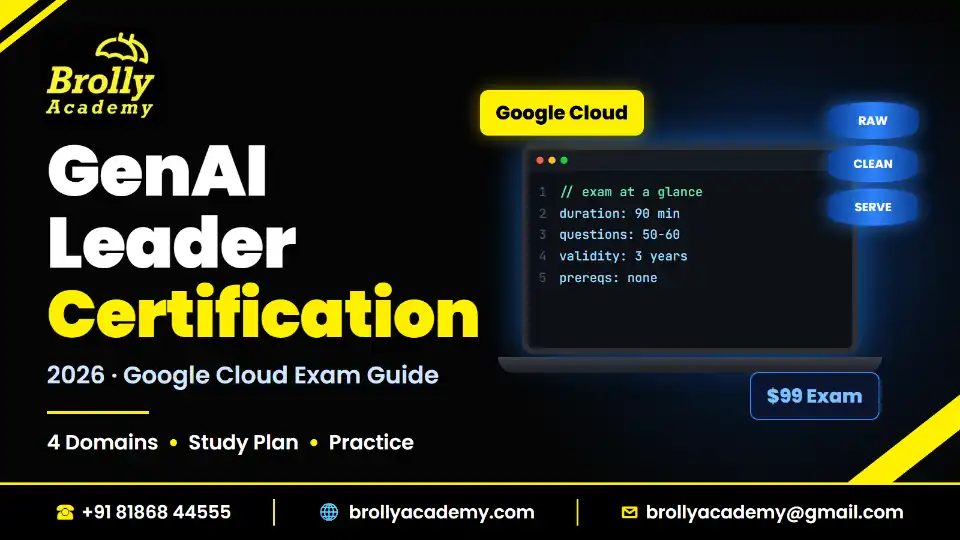
Table of Contents
1. Generative AI Leader certification at a glance
2. What is the Google Cloud Generative AI Leader certification?
3. Generative AI Leader exam syllabus: the four domains and weights
4. Domain 1 in plain English: fundamentals of gen AI (about 30%)
5. Domain 2 in plain English: Google Cloud's gen AI offerings (about 35%)
6. Domain 3 in plain English: techniques to improve gen AI model output (about 20%)
7. Domain 4 in plain English: business strategies (about 15%)
8. Generative AI Leader certification cost in India
9. How to register for the Generative AI Leader exam, step by step
10. Free official prep resources
11. Study plans: 3 weeks and 6 weeks
12. 10 Generative AI Leader practice questions with answers
13. Exam-day tips: online vs test centre
14. After you pass: validity, renewal and using it
15. Is the Generative AI Leader certification worth it?
Quick answer
The Google Cloud Generative AI Leader certification is a foundational, non-technical exam that proves you understand generative AI and Google Cloud's AI products well enough to lead and judge AI projects at work. It is a 90-minute exam with 50 to 60 multiple-choice questions, costs $99 plus tax where applicable, has no prerequisites and stays valid for 3 years (Google Cloud, October 2026). You can take it online or at a Pearson VUE test centre, and you need no coding. Google's free five-course learning path takes about 7 to 8 hours.
- Format: 90 minutes, 50 to 60 multiple-choice questions, in English, Japanese, Spanish or Portuguese
- Cost: $99 (plus tax where applicable), paid in dollars; your bank converts it to rupees
- Syllabus: four sections: fundamentals (about 30%), Google Cloud's gen AI offerings (about 35%), techniques to improve output (about 20%) and business strategy (about 15%)
- Who it suits: managers, business analysts, product managers, presales and consultants, marketers, HR and finance leads, and freshers who want a first AI credential
- Prep time: roughly 3 weeks if you already use AI tools, 6 weeks if you are starting from zero
Key takeaways
- This is a business-level exam. The official guide says the certified person's expertise is "strategic leadership and influence, not technical implementation".
- The biggest section (about 35%) is Google Cloud's own products, so product names matter. The October 2026 guide uses the new names, such as Gemini Enterprise Agent Platform (formerly Vertex AI) and Agent Search.
- Google's official prep is free: a five-course learning path, an exam guide, a study guide and untimed sample questions.
- The exam fee is $99 plus tax. Google does not publish a rupee price, a passing score or retake waiting periods on the certification page, so do not trust sites that "quote" them.
- It helps you talk about AI with confidence, but no job description we read on 24 October 2026 required it. Treat it as a strong signal, not a job guarantee.
1. Generative AI Leader certification at a glance
Short answer: Every exam fact below comes from Google Cloud's official certification page, read on 24 October 2026.
Bookmark the official Generative AI Leader certification page before you start. It is the only place to confirm the current price, languages and rules. The page also notes that the exam "was recently updated to reflect branding changes", which matters because several product names changed in 2026.
The certification page does not publish a passing score, a scored versus unscored question split, retake waiting periods or a rupee price, so be wary of anyone who quotes them.
2. What is the Google Cloud Generative AI Leader certification?
Short answer: It is Google Cloud's credential for people who need to understand, choose and guide generative AI projects in a business, rather than build them in code.
Google Cloud announced the exam in a launch blog dated 15 May 2025, written by Erin Rifkin, Managing Director of Google Cloud Learning. The blog calls it a first-of-its-kind credential for non-technical learners and says it became available globally on 14 May 2025. It names managers, administrators and leaders in HR, marketing, finance and sales as the people it was designed for (Google Cloud, May 2025).
The official exam guide describes the ideal candidate as someone with "business-level knowledge" of Google Cloud's gen AI products, who can spot use cases across business functions, talk with both technical and non-technical teams, and push for responsible AI adoption. In short, you are the person in the meeting who knows what the AI can and cannot do, which Google product fits, and what could go wrong.
If generative AI itself is still new to you, read our explainer on what generative AI is first. This post focuses only on the exam.
Who should take it in India
The exam suits people whose job is to decide, explain, sell or manage, not to code.
3. Generative AI Leader exam syllabus: the four domains and weights
Short answer: The exam has four sections: fundamentals of gen AI (about 30%), Google Cloud's gen AI offerings (about 35%), techniques to improve model output (about 20%) and business strategies (about 15%).
These weights appear in the launch blog and in the official Generative AI Leader exam guide (PDF), which we re-read on 24 October 2026. Google marks them as approximate, so read them as "about".
On a 50 to 60 question paper, about 35% means roughly 17 to 21 questions on Google Cloud products alone. That is why candidates who only "know AI in general" often find the exam harder than expected.
4. Domain 1 in plain English: fundamentals of gen AI (about 30%)
Short answer: This section checks that you understand the basic ideas behind generative AI, how machine learning works at a high level, why data quality matters, and what Google's own models are for.
1.1 Core concepts and use cases
You must be able to define these terms in one line each:
- Machine learning (ML): AI that learns patterns from data instead of following hand-written rules
- Generative AI: AI that creates new content (text, images, audio, video, code) from patterns it learned
- Foundation model: a large model trained on broad data that can be adapted to many tasks
- Large language model (LLM): a foundation model trained on huge amounts of text to predict the next token (a small chunk of text, often part of a word)
- Multimodal model: a model that handles more than one type of data, such as text plus images
- Diffusion model: an image or video model that turns random noise step by step into a clear picture
- Prompt engineering: writing and refining the instructions (prompts) you give a model
- Prompt tuning: adapting a model by training a small set of prompt settings instead of the whole model
The guide also lists the three ML approaches (supervised, unsupervised and reinforcement learning) and the ML lifecycle: data ingestion, data preparation, model training, model deployment and model management. It asks how to choose a foundation model for a business use case using modality, context window (how much text the model can read at once), security, availability and reliability, cost, performance and customisation options.
1.2 Data types and data quality
Know structured data (rows and columns, such as a sales table) versus unstructured data (emails, PDFs, images, call recordings), and labelled versus unlabelled data. Learn the data-quality words from the guide: completeness, consistency, relevance, availability, cost and format.
1.3 The layers of the gen AI landscape
The guide lists five layers. Think of them as a stack, from bottom to top:
- Infrastructure: chips, servers and data centres that run models
- Models: the foundation models themselves
- Platforms: the tools to access, customise and manage models
- Agents: AI systems that plan and take actions using tools, such as looking up an order and drafting a reply
- Applications: the finished products people use
If agents are new to you, our comparison of agentic AI vs generative AI explains the difference simply.
1.4 Google's foundation models
One practical note: the exam guide still lists Imagen, but Google's Gemini API model page marked Imagen 4 as shut down and listed newer image models branded "Nano Banana" (Google AI for Developers, October 2026). Learn Imagen for the exam, and know that real projects may use the newer models.
5. Domain 2 in plain English: Google Cloud's gen AI offerings (about 35%)
Short answer: This is the largest section. It tests whether you can match a business need to the right Google product, from ready-made assistants to the developer platform.
2.1 Why Google Cloud for gen AI
Expect questions on Google's selling points as the guide words them: an AI-first approach, an enterprise-ready platform (responsible, secure, private, reliable, scalable), an open approach (Google and non-Google models), customer control over data, low-code tools that make AI available to non-experts, and AI-optimised infrastructure such as the hypercomputer and TPUs (Google's custom AI chips).
2.2 to 2.5 Product map
Here is every product family the October 2026 guide names, in plain English.
The naming change trips people up. On 22 April 2026, Vertex AI became part of Gemini Enterprise Agent Platform, and Vertex AI Studio became Agent Studio (Google Cloud release notes, April 2026). Older blogs, videos and practice tests still say "Vertex AI" and "Vertex AI Search". The concepts are the same, but the current exam guide uses the new names, so study with them.
A simple way to answer Domain 2 questions is to ask three things in order:
- Who is the user? An individual, every employee, customers, contact-centre staff, or developers?
- Is a ready-made product enough? If yes, pick the Gemini app, Gemini Enterprise, Gemini for Workspace or Customer Engagement Suite.
- Does it need custom building? If yes, pick Gemini Enterprise Agent Platform and its parts (Model Garden, Agent Search, RAG, AutoML, Agent Studio).
For agents, the guide names four tool types: extensions, functions, data stores and plugins. A function lets an agent call your code, such as "check order status"; a data store gives it documents to search.
6. Domain 3 in plain English: techniques to improve gen AI model output (about 20%)
Short answer: This section tests why models make mistakes and which fix to use: grounding, RAG, prompt engineering, fine-tuning, human review or changing model settings.
3.1 Limits of foundation models and how to fix them
The guide lists these limits: data dependency (a model is only as good as its training data), knowledge cutoff (it does not know events after training), bias, fairness problems, hallucinations (confident but wrong answers) and edge cases (rare situations the model handles badly).
Match each limit to a fix. This table is the single most useful thing to memorise for Domain 3.
RAG, or retrieval-augmented generation, means the system first searches your documents, then passes the relevant passages to the model so its answer is based on them. Grounding is the wider idea of tying answers to a trusted source. Fine-tuning means training an existing model further on your own examples.
3.2 Prompting techniques
Know these by name and by example:
- Zero-shot: ask with no examples
- One-shot and few-shot: show one or a few examples first
- Role prompting: "You are a customer support lead at an Indian bank..."
- Prompt chaining: split a big task into steps, feeding one answer into the next prompt
- Chain-of-thought: ask the model to reason step by step before answering
- ReAct: the model alternates between reasoning and taking actions, such as a search
Here is a worked example of the same request written two ways (simplified example):
Weak prompt:
Write about our new credit card.
Better prompt (role + context + format + example):
You are a marketing writer at a mid-size Indian bank.
Write 3 short WhatsApp messages (under 40 words each)
announcing our new cashback credit card for salaried
customers aged 25 to 35. Tone: friendly, no jargon.
Example style: "Your weekend shopping just got cheaper..."
3.3 Grounding and model settings
The guide separates grounding with first-party enterprise data (your own documents), third-party data (bought or partner data) and world data (public web). Google's grounding offerings are prebuilt RAG with Agent Search, RAG APIs and Grounding with Google Search.
You must also know the sampling settings. Temperature controls randomness: lower gives focused, repeatable answers; higher gives varied, creative ones. Top-p (nucleus sampling) limits choices to the most likely words. Token count and output length cap how long the answer is. Safety settings filter harmful content. A typical question: "a legal team wants consistent contract summaries; which setting should they lower?" The answer is temperature.
7. Domain 4 in plain English: business strategies (about 15%)
Short answer: This section checks that you can plan a gen AI rollout, measure its value, keep it secure and use it responsibly.
4.1 Implementing a gen AI solution
The guide asks you to recognise solution types (text, image and code generation, personalised experiences), the factors that shape needs (business requirements and technical limits), how to pick the right solution, how to integrate gen AI into an organisation and how to measure impact. A practical flow you can use in answers:
- Pick a clear business problem with a measurable goal
- Check data availability and quality
- Choose buy (ready product) or build (platform)
- Run a small pilot with real users
- Measure impact against the goal, such as time saved or customer satisfaction
- Add governance, then scale
4.2 Secure AI
Know Google's Secure AI Framework (SAIF), which is Google's approach to protecting AI systems through their whole lifecycle. The guide also names secure-by-design infrastructure, Identity and Access Management (IAM, which controls who can access what), Security Command Center (Google Cloud's central security dashboard) and workload monitoring tools.
4.3 Responsible AI
Expect questions on transparency, privacy, bias, fairness, accountability and explainability. Learn two privacy terms well. Anonymisation removes personal details so a person cannot be identified. Pseudonymisation replaces details with codes that can be linked back using a separate key. If a scenario says the data must be fully unlinkable, the answer is anonymisation.
8. Generative AI Leader certification cost in India
Short answer: The registration fee is $99 plus tax where applicable (Google Cloud, October 2026). Google does not publish a rupee price, so the amount on your statement depends on taxes and your bank's conversion.
Here is what to plan for when paying from India:
- Exam fee: $99, plus tax "where applicable"; you see the final amount at checkout.
- Currency conversion: your bank or card converts dollars to rupees at its own rate, and some cards add a foreign-transaction charge.
- Renewal: after 3 years you take the renewal exam; check its fee in CertMetrics when you become eligible.
- Prep: Google's learning path, exam guide, study guide and sample questions are free. Paid practice tests are optional.
The fee sits in the same band as other entry-level AI exams: AWS lists its AI Practitioner exam at $100 (AWS, October 2026), while Microsoft prices exams by country. For a wider view of what GenAI courses and exams cost in India, see our guide to generative AI course fees.
9. How to register for the Generative AI Leader exam, step by step
Short answer: You book through Google Cloud's CertMetrics portal, choose online or test-centre delivery with Pearson VUE, pay the $99 fee and pick a slot.
- Read the official page and exam guide. Confirm the current price, languages and rules on the certification page.
- Open CertMetrics. Use the "Register" link on the certification page, which takes you to Google Cloud's CertMetrics portal. Sign in, or create your own profile there. Use your name exactly as it appears on your government ID.
- Choose the exam. Select Generative AI Leader (the standard exam, not the renewal exam).
- Pick delivery. Online-proctored (from home or office) or onsite at a Pearson VUE test centre.
- Check online requirements. If you choose online, run Pearson VUE's system test on the same computer, network and room you will use.
- Choose a language, date and time. English, Japanese, Spanish or Portuguese.
- Pay. Pay the $99 fee plus any tax by card.
- Save your confirmation. Note the ID rules and reschedule policy shown during booking, and add the slot to your calendar.
A simple tip: book the exam when you start studying, not when you "feel ready". A fixed date keeps a 3-week or 6-week plan on track.
10. Free official prep resources
Short answer: Google gives you everything you need for free: a five-course learning path of about 7 to 8 hours, an exam guide, a study guide and untimed sample questions.
The launch blog lists five no-cost courses in the Generative AI Leader learning path on Google Cloud Skills Boost (Google Cloud, May 2025). Take them in this order:
- Gen AI: Beyond the chatbot
- Gen AI: Unlock foundational concepts
- Gen AI: Navigate the landscape
- Gen AI Apps: Transform your work
- Gen AI Agents: Transform your organization
Reach the learning path, study guide, exam guide and sample questions from the official certification page. Google says the sample questions are untimed, do not cover every topic and do not predict your result, so use them to learn the question style, not to judge readiness.
Skip "dumps". They often carry outdated product names (such as Vertex AI Search), can be wrong, and using leaked exam content breaks certification rules. Official material plus honest practice questions, like the ten below, is the safer path.
11. Study plans: 3 weeks and 6 weeks
Short answer: If you already use AI tools at work, 3 weeks of about an hour a day is usually enough. If you are new to AI or cloud, take 6 weeks.
3-week fast-track plan (about 1 hour a day)
6-week steady plan (about 45 minutes a day)
How hard is the exam?
It is a foundational exam, so the questions are short scenarios, not coding or maths. People find it hard in two ways. First, the product section is large and the names are new. Second, many answers look reasonable, and you must pick the one Google recommends. Study Google's way of solving problems, not only general AI knowledge.
12. 10 Generative AI Leader practice questions with answers
Short answer: These are practice questions written by Brolly Academy, not from the real exam. They follow the style and topics of the official exam guide so you can test yourself.
Try each one before reading the answer.
Question 1. A retail company wants its customer support chatbot to answer questions using the latest return policy stored in internal PDFs. What is the best approach?
- A. Fine-tune the model every week on the PDFs
- B. Use retrieval-augmented generation (RAG) to ground answers in the PDFs
- C. Raise the temperature setting
- D. Use a larger model with no changes
Answer: B. RAG fetches the relevant policy text at answer time, so answers stay current without retraining. Fine-tuning is slow and costly for documents that change often, and temperature does not add knowledge.
Question 2. A legal team needs consistent, repeatable contract summaries. Which setting should they lower?
- A. Output length
- B. Temperature
- C. Safety settings
- D. Context window
Answer: B. Lower temperature makes outputs more focused and predictable. Higher temperature adds variety, which suits creative work, not legal summaries.
Question 3. A marketing manager wants Gemini to help draft emails and documents inside the tools her team already uses every day. Which product fits best?
- A. Gemini for Google Workspace
- B. Model Garden
- C. Agent Platform AutoML
- D. Cloud Vision API
Answer: A. Gemini for Google Workspace brings Gemini into Gmail, Docs and other Workspace apps. The other options are developer tools.
Question 4. Which layer of the gen AI landscape includes TPUs and GPUs?
- A. Applications
- B. Agents
- C. Infrastructure
- D. Platforms
Answer: C. TPUs and GPUs are hardware, which belongs to the infrastructure layer at the bottom of the stack.
Question 5. A model confidently states a wrong fact about a product launch. What is this limitation called?
- A. Drift
- B. Hallucination
- C. Knowledge cutoff only
- D. Overfitting
Answer: B. A confident but false answer is a hallucination. A knowledge cutoff can cause it, but the behaviour itself is called hallucination. Grounding and human review help reduce it.
Question 6. A developer team wants to compare several Google, partner and open models before choosing one for a project. Where should they look?
- A. Gemini app
- B. Conversational Insights
- C. Model Garden
- D. Security Command Center
Answer: C. Model Garden on Gemini Enterprise Agent Platform (formerly Vertex AI) is a catalogue of models to explore and choose from.
Question 7. A user shows the model three examples of correctly formatted invoice summaries and then asks for a fourth. Which technique is this?
- A. Zero-shot prompting
- B. Few-shot prompting
- C. Fine-tuning
- D. Prompt chaining
Answer: B. Giving a few examples inside the prompt is few-shot prompting. The model is not permanently changed, which is the difference from fine-tuning.
Question 8. A contact centre wants live suggestions shown to human agents during customer calls. Which offering fits?
- A. Agent Assist in Customer Engagement Suite
- B. Google AI Studio
- C. Imagen
- D. Cloud Storage
Answer: A. Agent Assist supports human agents in real time. Conversational Agents handle customers directly, and Conversational Insights analyses conversations afterwards.
Question 9. A hospital must share patient data for research so that no individual can ever be re-identified. Which technique meets this need?
- A. Pseudonymisation
- B. Anonymisation
- C. Encryption only
- D. Prompt tuning
Answer: B. Anonymisation removes identifying details permanently. Pseudonymisation replaces them with codes that can be linked back, so it does not meet a "never re-identified" requirement.
Question 10. A company launches a gen AI pilot. What should it do first to judge success?
- A. Roll out to all employees immediately
- B. Choose the largest model available
- C. Define measurable goals and key performance indicators
- D. Turn off human review to save time
Answer: C. Google's recommended approach starts with a clear business goal and metrics. Without them, you cannot measure impact or decide whether to scale.
13. Exam-day tips: online vs test centre
Short answer: Choose online if you have a quiet private room and stable internet; choose a Pearson VUE centre if your home setup is unreliable.
Practical tips for the day:
- Keep your government ID ready, with the same name as your CertMetrics profile.
- For online exams, clear your desk, close other apps, keep your phone out of reach and plug in your laptop. A mobile hotspot as backup helps.
- Read every option. Many questions have two good answers; pick the one Google recommends for that scenario.
- Watch for keywords: "least effort" often points to a ready-made product; "custom" points to the Agent Platform; "latest information" points to grounding.
- Watch the clock: 90 minutes for up to 60 questions is about a minute and a half per question.
14. After you pass: validity, renewal and using it
Short answer: Your certification stays valid for 3 years, and you keep it by taking the renewal exam within the renewal eligibility period.
The certification page says candidates may renew within a renewal eligibility period, and CertMetrics handles both the standard and renewal exams. Google's certification renewal FAQ explains the process and timeline. Keep your CertMetrics login safe and set a calendar reminder for about two and a half years after you pass.
Then put it to work. Add it to your resume and LinkedIn with the month you passed. In interviews, explain one use case, the Google product you would pick and how you would measure impact. Then plan your next step: a technical certification if you build, or AI product and strategy work if you lead.
15. Is the Generative AI Leader certification worth it?
Short answer: Yes, if you lead, sell, analyse or manage AI work and want a low-cost, credible proof of AI literacy. No, if you expect it alone to land a hands-on engineering job.
Look at what employers actually ask. We read 12 GenAI job descriptions on 24 October 2026 from Indian listings at firms such as Capgemini, Infosys, TCS, PwC and Wells Fargo. Only PwC's listing mentioned that relevant AI or GenAI certifications are preferred, and none required one (our analysis of listings seen on 24 October 2026). The engineering roles asked for Python, RAG, LLM APIs, vector databases and cloud skills.
Demand for GenAI skills itself is broad. On 24 October 2026, Naukri showed about 10,953 results for "generative ai" across India, including 2,258 in Hyderabad and 4,007 in Bengaluru. These are keyword-match counts, not open jobs, but they show how widely GenAI now appears in listings.
It is worth it when:
- You are a BA, PM, consultant, presales or delivery lead and want to speak confidently about AI with clients
- Your company uses Google Cloud or Google Workspace
- You want a first AI credential with free official prep and a modest fee
- You plan to move from a non-technical role into AI product or strategy work
Think twice when:
- You want a developer or ML engineer job; a technical certification and a project portfolio prove more
- Your company runs mainly on AWS or Microsoft; their AI exams may help more day to day
16. Generative AI Leader vs technical certifications
Short answer: The Leader exam is the business-level entry point; AWS AI Practitioner and Microsoft AI-901 are its closest peers, and the technical exams from Google, AWS, NVIDIA and Databricks prove building skills.
Leader vs AWS AI Practitioner. The AWS AI Practitioner page lists 65 questions in 90 minutes for $100 and says it does not require building AI solutions (AWS, October 2026). Choose by cloud: Google Cloud or Workspace users should take the Leader exam, AWS users AI Practitioner.
Leader vs Microsoft. Microsoft's Azure AI Fundamentals now requires exam AI-901, which has replaced AI-900. For builders, the current associate is Azure AI Apps and Agents Developer Associate (exam AI-103). The older AI-102 certification is retired, so ignore advice that recommends it.
For a full comparison of every major GenAI certification, including free options and a pick-by-profile guide, read our generative AI certification guide.
17. How Brolly Academy helps
Short answer: The Leader exam teaches you to understand and guide AI. Brolly's 3-month Generative AI course teaches you to build with it, which is the natural next step if you want a hands-on role.
Brolly's Generative AI Training in Hyderabad is a 3-month programme offered in classroom and live online batches, plus a self-paced video recording plan (Brolly course page, October 2026). The 16-module syllabus covers prompt engineering, LLMs, embeddings, RAG with LangChain, vector databases such as Chroma DB, FAISS and Pinecone, fine-tuning with LoRA and QLoRA, LLM evaluation, LLMOps and LLMs on cloud with Amazon Bedrock and Azure OpenAI.
- Fees: Video Recording ₹14,999, Online ₹35,000, Classroom ₹40,000, with EMI on the Classroom and Online plans
- Trainer: Mr. Dinesh, Generative AI Specialist and Cloud Architect with 12+ years in AI, ML and Generative AI, supported by co-trainers Ms. Madhumitha and Tabassum
- Projects: capstones such as an AI chatbot with GPT and LangChain, customer service automation and multi-agent workflows
- Career support: resume help, mock interviews and placement assistance, as described on the course page
- Eligibility: the page says coding is not mandatory and graduates from any stream can join
The course gives a Brolly Academy completion certificate. It does not include a Google Cloud exam voucher, so you register for the Leader exam yourself. A practical combination is the free Google path for the Leader exam and the Brolly course for hands-on skills.
Passed the Leader exam? Learn to build what you now understand.
The Generative AI Leader certification shows you know what AI can do for a business. Brolly Academy's 3-month Generative AI course in Hyderabad and online helps you build it: prompts, RAG, LangChain, vector databases, fine-tuning and cloud deployment, with real projects and career support. Book a free demo class to see the syllabus and batch timings.
Frequently asked questions
What is the Google Cloud Generative AI Leader certification?
It is a foundational Google Cloud certification that proves you understand generative AI and Google Cloud's AI products at a business level. It is designed for people who lead, plan or sell AI projects rather than code them. The exam covers fundamentals, Google Cloud's gen AI offerings, techniques to improve model output and business strategy, and it became available globally on 14 May 2025.
How much does the Generative AI Leader certification cost?
The registration fee is $99 plus tax where applicable, according to Google Cloud's certification page in October 2026. Google does not publish a rupee price, so the final amount for Indian candidates depends on taxes at checkout and your bank's currency conversion. Google's official prep material, including the five-course learning path and sample questions, is free.
How much does the Generative AI Leader exam cost in India in rupees?
Google lists the fee only in dollars: $99 plus tax where applicable. There is no official rupee price. Your card or bank converts the amount at its own rate, and some cards add a foreign-transaction charge. Check the total at checkout in CertMetrics and ask your bank about forex fees before you pay to avoid surprises.
How many questions are in the Generative AI Leader exam?
The exam has 50 to 60 multiple-choice questions, and you get 90 minutes to finish it. That works out to about a minute and a half per question. Questions are short business scenarios that ask you to pick the best concept, Google Cloud product or approach, so careful reading matters more than speed.
What is the passing score for the Generative AI Leader exam?
Google Cloud does not publish a passing score on the certification page. Treat any exact figure you see on blogs or videos with caution, because it is not official. Aim to understand every topic in the exam guide well and to answer the official sample questions and good practice questions correctly, rather than chasing a target score.
Does the Generative AI Leader exam require coding?
No. The exam is non-technical and needs no coding. The official exam guide says the certified person's expertise is strategic leadership and influence, not technical implementation. You do need a conceptual understanding of terms such as LLM, RAG, grounding, fine-tuning and temperature, and you must know which Google Cloud product fits which business need.
What are the Generative AI Leader exam domains and their weightage?
There are four sections with approximate weights: fundamentals of gen AI about 30%, Google Cloud's gen AI offerings about 35%, techniques to improve gen AI model output about 20%, and business strategies for a successful gen AI solution about 15%. Google marks these weights as approximate, so check the latest exam guide before you start studying.
What is the syllabus for the Generative AI Leader certification?
The syllabus covers core AI and gen AI terms, ML approaches and lifecycle, data types and quality, the five layers of the gen AI landscape and Google's models Gemini, Gemma, Imagen and Veo. It then covers Google Cloud products, ways to fix model limits such as RAG and prompting, and business topics such as adoption steps, secure AI and responsible AI.
How hard is the Google Generative AI Leader exam?
It is a foundational exam, so there is no coding or maths, but it is not a walkover. The product section carries about 35% of the marks and uses new 2026 product names. Many options look reasonable, and you must choose the one Google recommends. With the free learning path and steady practice, most motivated candidates can prepare in three to six weeks.
How long does it take to prepare for the Generative AI Leader exam?
If you already use AI tools at work, about three weeks of an hour a day is usually enough. If you are new to AI or cloud, plan six weeks of about 45 minutes a day. Google's free five-course learning path takes about 7 to 8 hours, and the rest of your time should go into revision and practice questions.
How do I prepare for the Google Generative AI Leader certification?
Start with the official exam guide, then complete Google's free five-course Generative AI Leader learning path. Build a glossary for fundamentals, a product map for Google Cloud offerings and a problem-to-fix table for model limits. Try prompting techniques in the Gemini app, then do the official sample questions and honest practice questions. Book your exam date early to stay on track.
Is the Generative AI Leader certification free?
The exam itself is not free; it costs $99 plus tax where applicable. The preparation is free. Google offers a no-cost five-course learning path of about 7 to 8 hours, plus a free exam guide, study guide and untimed sample questions, all linked from the official certification page. You do not need to buy any paid course to pass.
Can I take the Generative AI Leader exam online from India?
Yes. Google Cloud offers the exam online-proctored, as long as your computer, internet and room meet Pearson VUE's online testing requirements. You can also choose a Pearson VUE test centre if your home setup is unreliable. Registration for both options happens through Google Cloud's CertMetrics portal. Run the system test before exam day to avoid problems.
What languages is the Generative AI Leader exam available in?
The exam is available in English, Japanese, Spanish and Portuguese, according to Google Cloud's certification page in October 2026. Most Indian candidates take it in English. The questions use plain business English, but product names and AI terms appear often, so learn the official names from the latest exam guide before you sit the exam.
How long is the Generative AI Leader certification valid?
The certification is valid for 3 years. To keep it, you take the renewal exam within the renewal eligibility period, which you can book through CertMetrics. Google's certification renewal FAQ explains the timeline. Set a reminder for about two and a half years after you pass so you have time to prepare and renew.
Are there any prerequisites for the Generative AI Leader exam?
No. Google Cloud lists no prerequisites, and the certification page says it is for anyone in any job role, with or without hands-on technical experience. You do not need a technical degree, cloud experience or another certification first. A basic comfort with using AI tools such as the Gemini app will make preparation faster.
Who should take the Generative AI Leader certification?
It suits managers, business analysts, product managers, presales and solution consultants, project and delivery leads, marketers, and HR and finance professionals who work with AI projects. Freshers can also take it as a first AI credential. Developers and data scientists may use it as a warm-up, but a technical certification will prove their building skills better.
Is the Google Generative AI Leader certification worth it?
It is worth it if you lead, sell, analyse or manage AI work and want low-cost proof of AI literacy, especially in a company that uses Google Cloud or Workspace. It will not land an engineering job on its own. Of 12 GenAI job descriptions we read in October 2026, only one said certifications were preferred and none required one.
What jobs can I get with the Generative AI Leader certification?
The certification supports roles where you guide AI work rather than build it, such as business analyst, product manager, presales consultant, delivery manager and AI adoption or strategy roles. It strengthens your profile but is rarely the deciding factor. Pair it with real examples of AI use cases you have planned or improved, and add hands-on skills if you want a technical role.
Google Generative AI Leader vs AWS AI Practitioner: which is better?
Neither is better overall; choose by cloud. Both are foundational exams of 90 minutes. The Leader exam has 50 to 60 questions for $99, while AWS AI Practitioner has 65 questions for $100, and both are valid 3 years. Pick the Leader exam if your work uses Google Cloud or Workspace, and AWS AI Practitioner if your company runs on AWS.
Generative AI Leader vs Microsoft AI-900: which should I take?
AI-900 is no longer the current exam, because Microsoft's Azure AI Fundamentals certification now requires exam AI-901. Compare the Leader exam with AI-901 instead. Both suit non-builders. Choose the Google Leader exam if your organisation uses Google Cloud, and AI-901 if it uses Microsoft Foundry and Azure. Microsoft sets its exam price by country.
Where can I find Generative AI Leader sample questions?
Google provides free, untimed sample questions linked from the official certification page. Google notes they do not cover every topic and do not predict your result. This article also includes 10 practice questions written by Brolly Academy, not taken from the real exam, with answers and explanations. Avoid exam dumps, which are often outdated, sometimes wrong and against certification rules.
Do I need to know Vertex AI for the Generative AI Leader exam?
You need to know the platform, but under its new name. On 22 April 2026, Vertex AI became part of Gemini Enterprise Agent Platform, and Vertex AI Studio became Agent Studio. The current exam guide uses the new names, including Model Garden, Agent Search and Agent Platform AutoML. Older videos and practice tests may still say Vertex AI, so map the names carefully.
What happens after I pass the Generative AI Leader exam?
Your certification is valid for 3 years, and you can renew it through the renewal exam within the eligibility period. Add it to your resume and LinkedIn with the month you passed, and use what you learned in interviews by explaining a use case, the product you would choose and how you would measure impact. Then plan a next step, technical or strategic.
Does Brolly Academy prepare students for the Generative AI Leader exam?
Brolly's 3-month Generative AI course focuses on hands-on building skills such as prompt engineering, RAG with LangChain, vector databases, fine-tuning and LLMs on cloud, rather than this specific exam. It does not include a Google Cloud exam voucher. You can prepare for the Leader exam with Google's free learning path and use the Brolly course to move into practical, hands-on GenAI work.
Learn with Brolly Academy
Review the syllabus, practical projects and batch timings, and book a free demo before you enrol.
Related Articles
Continue Your Learning
Generative AI Training in Hyderabad
3-month course covering LLMs, prompt engineering, RAG, fine-tuning and GenAI app building, with classroom, live online and recorded plans.
View CourseAgentic AI Course
Go beyond chat: build AI agents that plan, call tools and complete multi-step tasks, the next step after generative AI.
View CourseHugging Face Course
Work hands-on with open models, transformers and datasets on Hugging Face, the core toolkit behind many GenAI projects.
View Course