Microsoft Fabric Salary
- Microsoft Fabric Salary in India depends on your experience, job role, location, company, and technical skills.
- Microsoft Fabric is a data and analytics platform from Microsoft that brings together tools for data engineering, data analytics, data warehousing, real-time analytics, and business intelligence.
-
v contact
- No Comments
Table of Contents
Microsoft Fabric Salary in India – Career & Salary Guide
Prefer listening instead of reading?
Listen to our complete Microsoft Fabric Salary in India guide and learn about salary ranges, experience levels, career roles, required skills, learning roadmap, and career growth opportunities.
Microsoft Fabric Salary
- Microsoft Fabric is becoming an important platform for professionals working in data engineering, business intelligence, analytics, and cloud data solutions. Because of this, students and working professionals are increasingly interested in understanding Microsoft Fabric Salary in India.
- However, there is no single fixed salary for a Microsoft Fabric professional. Salary can change based on several factors such as years of experience, job role, technical skills, location, company type, project complexity, current CTC, and interview performance.
- Microsoft Fabric skills can open opportunities across data engineering, analytics and BI roles. If you want structured practical learning, explore our Microsoft Fabric Training in Hyderabad.
Microsoft Fabric Salary by Experience
| Experience Level | Approximate Salary | Typical Career Stage | Important Skills |
|---|---|---|---|
| 0–1 year | ₹4–8 LPA | Fresher / Junior | SQL, Python, Power BI, Fabric basics |
| 1–3 years | ₹6–12 LPA | Junior / Associate | SQL, Power BI, Azure, Fabric, pipelines |
| 3–5 years | ₹10–18 LPA | Mid-level | Data engineering, PySpark, Lakehouse, modeling |
| 5–8 years | ₹15–25+ LPA | Senior | Architecture, optimization, cloud, Fabric |
| 8–12 years | ₹20–35+ LPA | Lead / Senior | Architecture, governance, system design |
| 12+ years | ₹30 LPA+ | Architect / Leadership | Enterprise architecture, strategy, governance |
What Is Microsoft Fabric Salary?
Microsoft Fabric Salary means the compensation earned by a professional working with Microsoft Fabric technologies as part of their job.
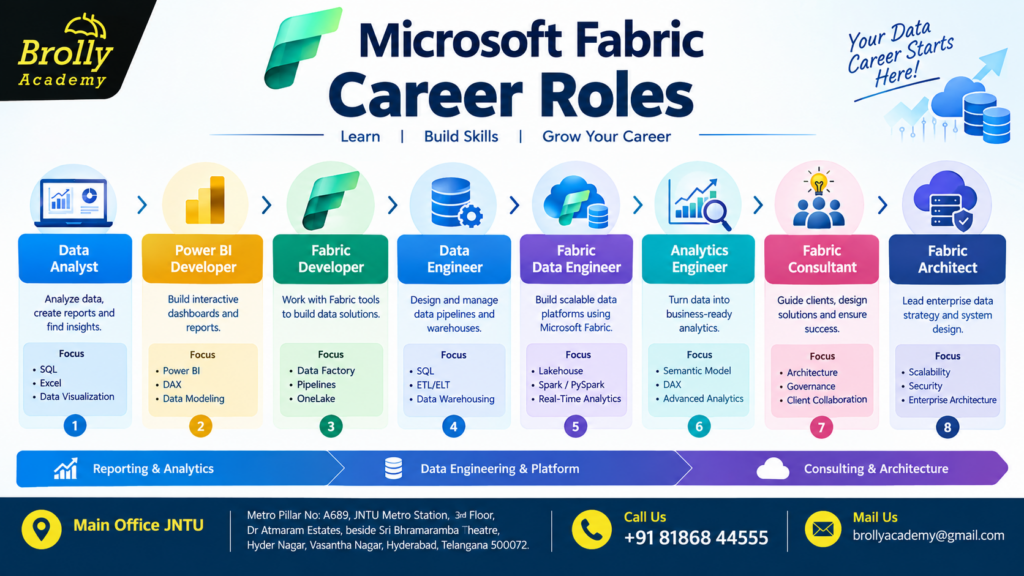
Microsoft Fabric can be used across different areas of data and analytics. Therefore, professionals working with Fabric may have different job titles, such as:
- Microsoft Fabric Data Engineer
- Data Engineer
- Fabric Developer
- Analytics Engineer
- Power BI Developer
- Fabric Consultant
- Fabric Architect
- Data Analyst
Each role can have different responsibilities and salary levels.
For example, a person who mainly creates Power BI reports may have a different salary from a Data Engineer who designs complete data pipelines using Fabric Data Factory, OneLake, Lakehouse, Spark, SQL, and Delta Lake.
Simple Example
Imagine two students complete Microsoft Fabric training.
Student A learns only the basic Fabric interface and creates simple dashboards.
Student B learns:
- SQL
- Python
- PySpark
- Power BI
- DAX
- Azure
- Fabric Data Factory
- OneLake
- Lakehouse
- Data Warehouse
- Delta Lake
- Data modeling
- Git and CI/CD
Student B can demonstrate a wider range of practical skills and may qualify for different types of data and analytics roles.
This is why students should focus on skills + projects + practical experience, rather than looking at salary alone.
Average Microsoft Fabric Salary in India
The salary ranges in the source material indicate that Microsoft Fabric-related compensation can vary significantly with experience.
The following table provides a market-indicator range, not a guaranteed salary band.
| Experience | Approximate Salary Range |
|---|---|
| 0–1 year | ₹4–8 LPA |
| 1–3 years | ₹6–12 LPA |
| 3–5 years | ₹10–18 LPA |
| 5–8 years | ₹15–25+ LPA |
| 8–12 years | ₹20–35+ LPA |
| 12+ years | ₹30 LPA+ |
What Does LPA Mean?
LPA = Lakhs Per Annum.
For example:
- ₹6 LPA = ₹6 lakh per year
- ₹10 LPA = ₹10 lakh per year
- ₹20 LPA = ₹20 lakh per year
LPA refers to annual compensation. The actual monthly amount received in hand can be different because of taxes, provident fund, bonuses, variable pay, and other components.
How Experience Affects Microsoft Fabric Salary
Experience is one of the major factors affecting compensation.
But experience does not simply mean the number of years you have worked.
Companies may also consider:
- What technologies you have worked with
- What type of projects you handled
- Whether you worked on production systems
- Your understanding of data architecture
- Your ability to solve technical problems
- Your cloud experience
- Your communication skills
- Your ability to work with business requirements
Example
A professional with three years of experience who has worked on:
SQL + Python + PySpark + Azure + Fabric + Lakehouse + Power BI
may have a different profile from another professional with three years of experience whose work has mainly involved basic reporting.
Therefore, students should think about quality of experience, not only the number of years
Important Note for Students
Do not read this table as:
“If I learn Microsoft Fabric, I will automatically get ₹10 LPA.”
That is not how salary works.
Instead, use the table to understand how compensation can change as your skills, responsibilities, and experience increase.
Microsoft Fabric Salary by Job Role
Microsoft Fabric is not limited to one job role. Different professionals can use Fabric in different ways.
| Job Role | Approximate Salary Range | Main Work |
|---|---|---|
| Data Analyst | ₹4–12 LPA | Analysis, reporting, dashboards |
| Power BI Developer | ₹5–15 LPA | Reports, dashboards, DAX, semantic models |
| Fabric Developer | ₹6–18 LPA | Fabric solutions, pipelines, Lakehouse, Warehouse |
| Data Engineer | ₹6–18 LPA | Data pipelines, ETL/ELT, transformation |
| Fabric Data Engineer | ₹8–25+ LPA | Advanced Fabric data engineering |
| Analytics Engineer | ₹8–25+ LPA | Data modeling, analytics, semantic models |
| Fabric Consultant | ₹12–30+ LPA | Client solutions, architecture, implementation |
| Fabric Architect | ₹20–35+ LPA | Enterprise architecture and technical design |
Note: These salary ranges should be treated as
market indicators rather than guaranteed salary levels. Actual
compensation may vary based on experience, skills, location,
company, certifications, and job responsibilities.
Strong SQL knowledge is an important foundation for many data and analytics roles. You can build these skills through our SQL Course in Hyderabad.
Why Does Salary Differ Between Job Roles?
- The main reason is responsibility.
- A Data Analyst may primarily focus on analyzing data and creating reports.
- A Data Engineer may be responsible for building pipelines that move and transform large amounts of data.
- A Fabric Architect may be responsible for designing an organization’s overall data architecture.
- Therefore, as responsibilities become broader and more technically complex, compensation can also differ.
- Professionals who want to build Power BI and business intelligence skills can explore Power BI Training in Hyderabad.
Role Responsibility Comparison
| Role | Beginner Understanding | Typical Responsibility |
|---|---|---|
| Data Analyst | Understand and analyze data | Reports, dashboards, insights |
| Power BI Developer | Build BI solutions | Reports, DAX, semantic models |
| Fabric Developer | Build Fabric components | Pipelines, Lakehouse, Warehouse |
| Data Engineer | Build data systems | ETL/ELT, pipelines, transformation |
| Analytics Engineer | Connect data and analytics | Modeling, SQL, semantic layer |
| Consultant | Solve client requirements | Implementation and technical guidance |
| Architect | Design complete solutions | Architecture, governance, scalability |
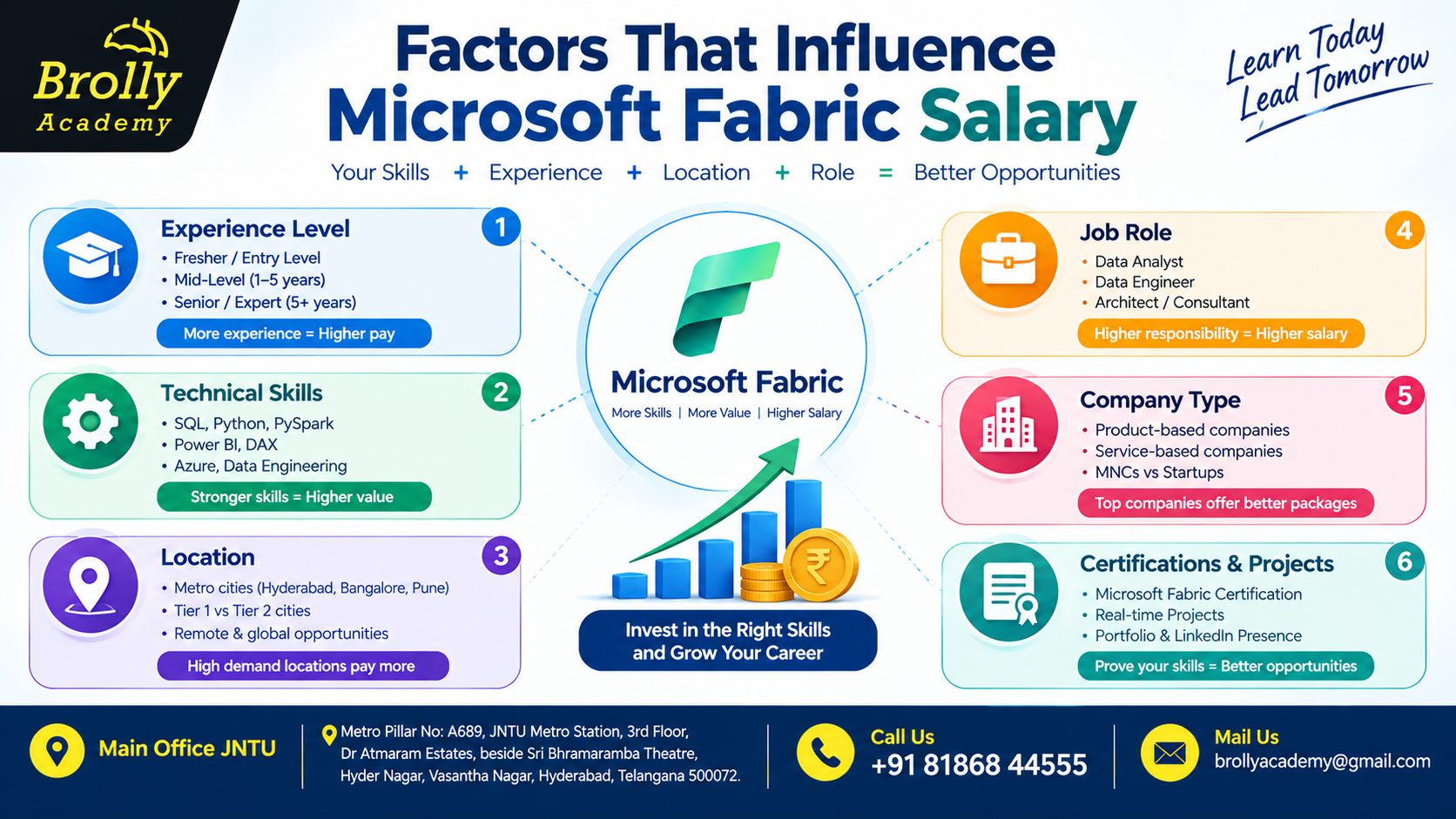
Factors That Influence Microsoft Fabric Salary
| Factor | How It Can Affect Salary |
|---|---|
| Years of Experience | More relevant experience can support progression into higher-level roles. |
| SQL Skills | Important for querying and working with data. |
| Python/PySpark | Useful for data transformation and engineering. |
| Power BI | Important for analytics and visualization. |
| DAX | Useful for Power BI and semantic models. |
| Azure | Helps with cloud-based data solutions. |
| Fabric Knowledge | Enables work with Microsoft Fabric services. |
| OneLake | Important for Fabric’s data storage architecture. |
| Lakehouse | Important for modern data engineering. |
| Data Warehouse | Useful for structured analytical workloads. |
| Delta Lake | Important for Lakehouse-based data processing. |
| Data Modeling | Helps build efficient analytical solutions. |
| Git/CI/CD | Useful for development and deployment workflows. |
| Real-Time Analytics | Relevant for real-time data scenarios. |
| Communication | Important when working with teams and stakeholders. |
| Company Type | Compensation can vary between organizations. |
| Project Complexity | Advanced production projects can require deeper expertise. |
| Interview Performance | Technical and scenario-based interviews influence hiring. |
| Current CTC | Existing compensation can influence offers. |
| Negotiation | Candidates may negotiate compensation based on their profile. |
Which Skills Are Important for a High-Level Microsoft Fabric Career?
For students, it is useful to understand the skill progression instead of trying to learn everything at once.
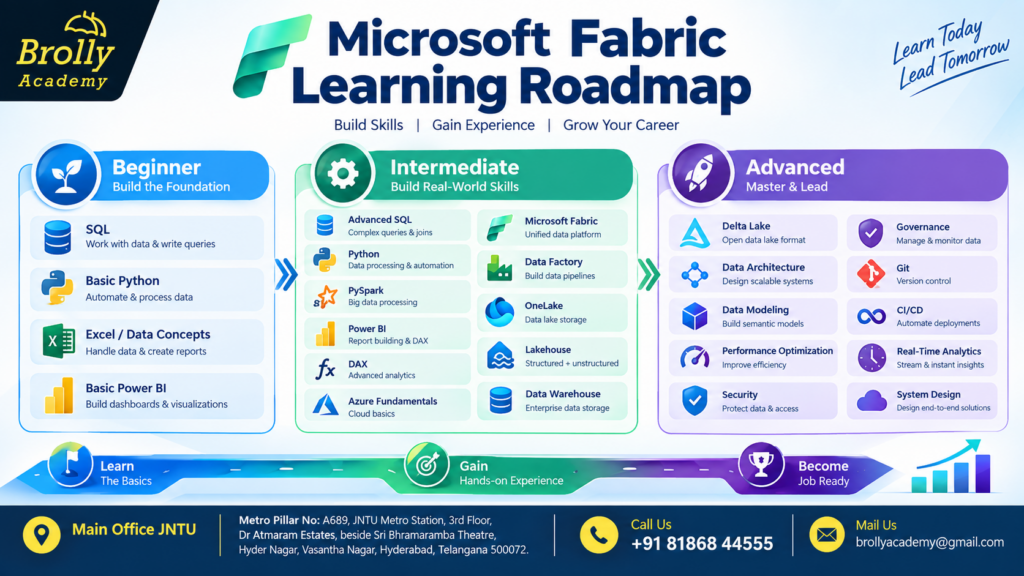
Beginner Level
Start with:
- SQL
- Basic Python
- Excel/data concepts
- Basic Power BI
- Basic data concepts
Intermediate Level
Then learn:
- Advanced SQL
- Python
- PySpark
- Power BI
- DAX
- Azure fundamentals
- Microsoft Fabric
- Data Factory
- OneLake
- Lakehouse
- Data Warehouse
Advanced Level
After gaining a strong foundation, move toward:
- Delta Lake
- Data architecture
- Data modeling
- Performance optimization
- Security
- Governance
- Git
- CI/CD
- Real-time analytics
- System design
Microsoft Fabric Salary: Skills vs Career Level
| Skill Area | Beginner | Job-Ready | Advanced |
|---|---|---|---|
| SQL | Basic queries | Joins, CTEs, optimization | Advanced optimization |
| Python | Syntax & basics | Data processing | Advanced automation |
| Power BI | Basic dashboards | Reports + DAX | Advanced BI solutions |
| Fabric | Basic concepts | Real projects | Architecture |
| OneLake | Understand concept | Use in projects | Enterprise data architecture |
| Lakehouse | Understand architecture | Build solutions | Optimization |
| PySpark | Basic syntax | Data transformation | Large-scale processing |
| Azure | Fundamentals | Data services | Cloud architecture |
| Data Modeling | Basic concepts | Build models | Advanced modeling |
| Git/CI/CD | Basic Git | Team workflow | Deployment automation |
Practical Example: How Microsoft Fabric Skills Come Together
Suppose a company wants to analyze its retail sales data.
The company has data coming from:
- Online orders
- Physical stores
- Customer records
- Product databases
- Excel files
- CRM systems
A Microsoft Fabric professional could work on a data flow such as:
Data Sources → Fabric Pipeline → OneLake → Lakehouse → Spark/PySpark → Data Model → Power BI → Business Dashboard
Microsoft Fabric Data Engineer Salary
| Stage | Technology | Purpose |
|---|---|---|
| Data Sources | SQL, Excel, APIs | Collect business data |
| Data Ingestion | Fabric Data Factory / Pipelines | Bring data into Fabric |
| Storage | OneLake | Centralize organizational data |
| Data Processing | Lakehouse + Spark | Clean and transform data |
| Transformation | SQL / PySpark | Prepare analytical data |
| Modeling | Semantic Model | Organize data for analysis |
| Visualization | Power BI | Create dashboards |
| Business Output | Reports | Help teams make decisions |
What Should a Student Focus on First?
If you are a beginner, don’t start by trying to learn every Fabric feature.
Follow a structured sequence:
SQL → Python → Power BI → Azure Basics → Microsoft Fabric → PySpark → Projects → Interview Preparation
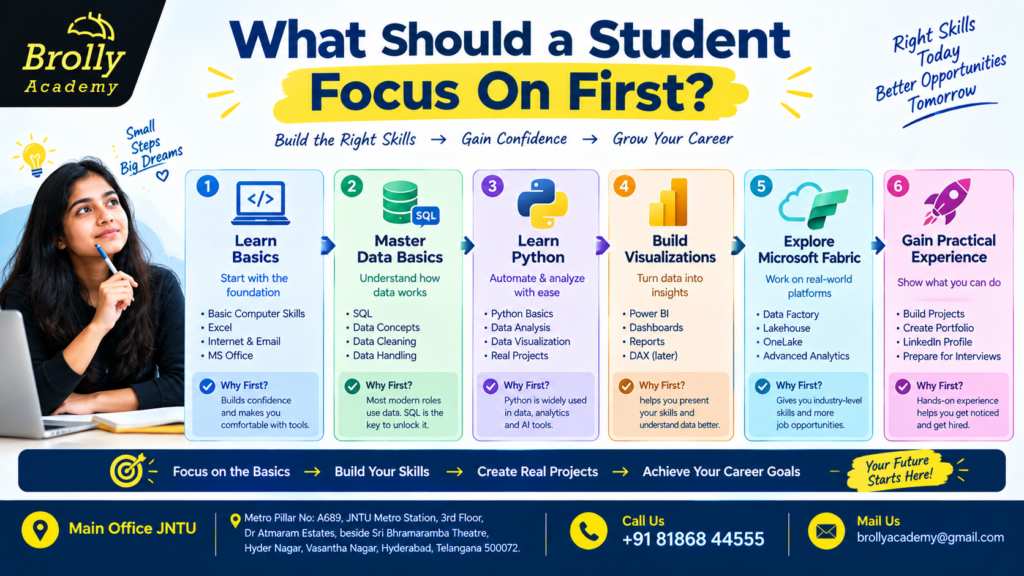
| Stage | What to Learn | Goal |
|---|---|---|
| 1 | SQL | Work confidently with databases |
| 2 | Python | Learn programming and data processing |
| 3 | Power BI | Build dashboards and reports |
| 4 | Azure Basics | Understand cloud data services |
| 5 | Microsoft Fabric | Understand the Fabric platform |
| 6 | PySpark | Process larger datasets |
| 7 | Projects | Apply skills practically |
| 8 | Portfolio | Demonstrate your work |
| 9 | Interview Preparation | Prepare for technical questions |
| 10 | Job Applications | Apply for suitable roles |
Key Takeaway
Microsoft Fabric Salary depends on much more than simply knowing Microsoft Fabric. Experience, job role, technical skills, project complexity, location, company type, interview performance, current CTC, and negotiation can all influence compensation.
For students, the practical approach is to build a strong foundation in SQL, Python, Power BI, Azure, and data engineering, then apply those skills through Microsoft Fabric projects.
The goal should not be only to learn the names of Fabric features. The goal is to understand how to use Fabric to solve real business data problems.
Who is suited for this role?
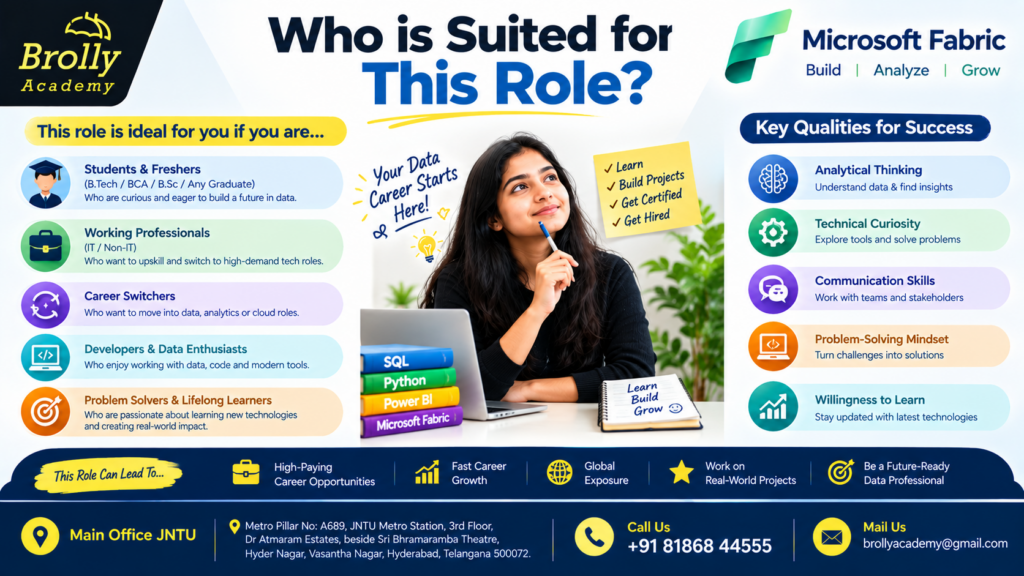
This path can be especially suitable for:
- Power BI Developers
- Data Analysts
- BI Professionals
- SQL Developers
- Business Analysts with strong technical skills
- Data Engineers moving toward analytics
- Professionals working with enterprise reporting
Frequently Asked Questions

1. What is the average Microsoft Fabric salary in India?
Microsoft Fabric salary in India varies based on experience, job role, technical skills, location, company, and project responsibilities. A broad market-indicator range in the article is approximately ₹4–8 LPA for 0–1 year, increasing to ₹20–35+ LPA for professionals with 8–12 years of experience.
2. What is the Microsoft Fabric salary for freshers?
Freshers entering Microsoft Fabric-related roles may start in positions such as Junior Data Engineer, Data Analyst, Power BI Developer, BI Developer, or Associate Data Engineer. Salary depends on the employer, location, technical skills, interview performance, and whether the candidate has practical project experience.
3. Can a fresher get a job in Microsoft Fabric?
Yes. A fresher can target entry-level data and BI roles where Microsoft Fabric is part of the technology stack. Strong fundamentals in SQL, Python, Power BI, data concepts, and Fabric basics, combined with practical projects, can help build a job-ready profile.
4. What skills are required for a Microsoft Fabric job?
Important skills can include SQL, Python, PySpark, Power BI, DAX, Azure, Fabric Data Factory, OneLake, Lakehouse, Data Warehouse, Delta Lake, data modeling, Git, and CI/CD. The exact requirements depend on the role and experience level.
5. Which Microsoft Fabric role has the highest salary?
There is no single universally highest-paying Fabric role because compensation varies by company, experience, location, responsibilities, and individual profile. Senior roles such as Fabric Architect, senior Data Engineer, Consultant, and other architecture or leadership positions can carry higher compensation because they involve broader technical and business responsibilities.
6. What is the Microsoft Fabric Data Engineer salary in India?
The salary of a Microsoft Fabric Data Engineer varies according to experience and technical responsibilities. Data engineering roles can involve ingestion, transformation, orchestration, Lakehouse, OneLake, SQL, PySpark, data quality, monitoring, and optimization. Current job listings show that employers are hiring for these combinations of skills.
7. What is the Microsoft Fabric salary in Hyderabad?
Microsoft Fabric-related salaries in Hyderabad vary by experience, employer, role, and skill level. For example, a current Hyderabad listing for a Microsoft Fabric & Power BI Data Engineer advertised ₹20 lakh per year for a 5+ year profile and requested experience with Fabric Pipelines, OneLake, Lakehouse, Warehouse, Delta Lake, SQL, and PySpark. This is one job listing, not a city-wide average.
8. What is the Microsoft Fabric salary for 1–3 years of experience?
For professionals with 1–3 years of experience, the article uses an indicative range of approximately ₹6–12 LPA. Actual compensation can vary depending on technical skills, current CTC, company, location, project experience, and interview performance.
9. What is the Microsoft Fabric salary for 3–5 years of experience?
The article uses an indicative range of approximately ₹10–18 LPA for 3–5 years of experience. Professionals at this level may be expected to handle more advanced data engineering, pipelines, PySpark, Lakehouse, data modeling, and cloud-based workloads.
10. What is the Microsoft Fabric salary for 5–8 years of experience?
The article uses an indicative range of approximately ₹15–25+ LPA for professionals with 5–8 years of experience. At this stage, employers may expect stronger architecture, optimization, cloud, governance, and production data-engineering experience.
11. Does Microsoft Fabric certification increase salary?
Certification can strengthen a candidate’s profile, but it does not guarantee a specific salary increase. Microsoft describes the Fabric Data Engineer Associate certification as an intermediate-level credential focused on data engineering, including data loading, architecture, orchestration, ingestion, transformation, security, monitoring, and optimization
12. Is DP-700 useful for a Microsoft Fabric career?
DP-700 is relevant to the Microsoft Fabric Data Engineer path. Microsoft’s certification information highlights skills such as ingesting and transforming data, implementing a Lakehouse and Warehouse, real-time intelligence, and managing a Fabric environment.
13. Can Power BI developers move into Microsoft Fabric?
Yes. Power BI experience can provide a useful foundation for moving into Fabric because Fabric connects analytics and data workloads. A Power BI professional can expand into SQL, data modeling, semantic models, Data Factory, OneLake, Lakehouse, PySpark, and other Fabric capabilities.
14. Can an Azure Data Engineer move into Microsoft Fabric?
Yes. Azure Data Engineers can transfer many existing data-engineering concepts into Fabric, including SQL, ETL/ELT, pipelines, data warehousing, Spark, data modeling, orchestration, and cloud architecture. They may still need hands-on knowledge of Fabric-specific components.
15. Is SQL important for Microsoft Fabric jobs?
Yes. SQL is an important skill for many Fabric-related roles. It is used for querying, transformation, analysis, data validation, and working with analytical data structures. Current Fabric Data Engineer requirements commonly include strong SQL skills.
16. Is Python required for Microsoft Fabric?
Python can be important, particularly for data engineering and PySpark-based workloads. However, the exact requirement depends on the job role. Microsoft’s Fabric Data Engineer certification information specifically identifies SQL, PySpark, and KQL among the relevant skills.
17. Is PySpark important for a Microsoft Fabric Data Engineer?
Yes. PySpark is particularly relevant when working with large-scale data transformation and Spark-based processing. Current Fabric Data Engineer job descriptions also commonly request PySpark or Spark SQL alongside SQL.
18. Does Power BI knowledge help with Microsoft Fabric?
Yes. Power BI can be useful for Fabric professionals because Fabric supports analytics and integrates with Power BI. Knowledge of Power BI, DAX, semantic models, data modeling, and reporting can be valuable for BI and analytics-focused Fabric roles.
19. What is OneLake and why is it important for a Fabric job?
OneLake is a central data layer within Microsoft Fabric. Professionals working with Fabric may use it as part of data ingestion, storage, and analytics workflows. Current Fabric job descriptions can require hands-on OneLake knowledge, especially for data-engineering positions.
20. What is a Microsoft Fabric Lakehouse?
A Fabric Lakehouse is a data architecture component used for storing and working with analytical data. It can support data engineering and analytics workloads, and professionals may combine it with pipelines, Spark, SQL, OneLake, and Power BI.
21. Does experience with Azure help increase Microsoft Fabric salary?
Azure experience can be valuable because many Fabric roles involve cloud data engineering concepts and Microsoft data services. However, the impact on compensation depends on the complete candidate profile, role, company, and level of responsibility.
22. Does company type affect Microsoft Fabric salary?
Yes. Compensation can vary between product companies, global capability centers, IT services companies, consulting organizations, startups, and other employers. Job responsibilities, technology requirements, location, and compensation structure can also differ between companies.
23. Does location affect Microsoft Fabric salary in India?
Yes. Salary can vary between cities because technology-job markets, employers, cost structures, and demand differ by location. Hyderabad, Bengaluru, Pune, Chennai, and other technology hubs have different sets of Fabric and data-engineering opportunities.
24. Can Microsoft Fabric help a Power BI professional increase career opportunities?
It can broaden the range of technologies a Power BI professional can work with. Instead of focusing only on visualization and reporting, the professional can learn data ingestion, pipelines, Lakehouse, Warehouse, OneLake, Spark, semantic models, and other Fabric workloads.
25. Is Microsoft Fabric a data engineering technology?
Microsoft Fabric includes data engineering as one of its workloads, but it is broader than only data engineering. The platform brings together capabilities for data engineering, analytics, business intelligence, real-time workloads, and other data-related scenarios.
26. What projects should a student build to get a Microsoft Fabric job?
Students can build end-to-end projects such as:
- Retail sales analytics
- Customer analytics
- Finance reporting
- HR analytics
- E-commerce analytics
- Data pipeline projects
- Lakehouse projects
- Power BI + Fabric dashboards
- Real-time analytics projects
The project should demonstrate data ingestion → transformation → storage → modeling → analytics → visualization, rather than only showing a dashboard.
27. Can Microsoft Fabric skills help a student become a Data Engineer?
Yes. Microsoft Fabric can be part of a Data Engineer learning path. However, students should also develop core data-engineering skills such as SQL, Python/PySpark, ETL/ELT, data modeling, pipelines, data warehousing, cloud concepts, and problem-solving.
28. How can I increase my Microsoft Fabric salary?
Focus on building deeper technical capability rather than learning only tool names. A practical progression can be:
SQL → Python → Power BI → Azure → Fabric → PySpark → Data Engineering → Projects → Advanced Architecture
Also develop communication, problem-solving, system-design, and interview skills.
29. Is Microsoft Fabric certification enough to get a high-paying job?
No. Certification alone does not guarantee employment or a particular salary. A stronger profile combines certification + technical fundamentals + hands-on projects + relevant experience + interview preparation.
30. Is Microsoft Fabric a good career option for students?
Microsoft Fabric can be a useful technology to learn for students interested in data engineering, analytics, Power BI, cloud data platforms, and business intelligence. The most important approach is to learn the underlying data concepts and build practical projects instead of relying only on certification or theoretical knowledge.
Key Takeaways
- Generative AI chatbots use large language models to generate original, human-like answers.
- They differ from rule-based bots by understanding meaning instead of matching scripts.
- They work by turning text into tokens and embeddings, then predicting the answer word by word.
- RAG grounds their answers in your own data and is the key to accuracy.
- You build one by choosing a model, adding retrieval, memory, and guardrails, then testing.
- Popular examples include ChatGPT, Gemini, Claude, Copilot, and Perplexity.
- The field is moving toward agents, multimodal input, and private grounded models.
- The most valuable skills are prompting, retrieval, evaluation, and clean data design.
Conclusion
Generative AI chatbots are no longer a novelty. They are becoming a normal part of how businesses answer questions, how learners study, and how teams get work done. The technology behind them, language models, retrieval, and careful design, is learnable. You do not need to be a researcher to build something useful.
If you understand the basics in this guide, you already know more than most people using these tools every day. The next step is to build. Start small, ground your bot in real data, test it with real questions, and improve it week by week.
If you want a guided, hands-on path from beginner to builder, we are here to help. Brolly Academy offers practical Generative AI training in Hyderabad with real projects, certification guidance, and 100% Placement Assistance.
Talk to our team today. Call: +91 81868 44555 Email: brollyacademy@gmail.com Web: brollyacademy.com Visit: Metro Pillar No. A689, JNTU Metro Station, 3rd Floor, Hyderabad 500072

Brolly Academy Team
AI, Data Science & Software Training Experts | 20+ Years of Training Experience
Brolly Academy Team is a group of AI, Data Science, Cloud Computing, and Software Development professionals dedicated to helping learners gain practical skills and industry knowledge. Since 2015, Brolly Academy has supported thousands of students and professionals through technology training, certification guidance, and career-focused learning.