Brolly Academy | Data Science
Data Science Skills
Essential Technical and Soft Skills to Build a Career
Data science helps businesses use data to answer questions, find patterns, predict outcomes, and make better decisions. But becoming a data scientist is not only about learning Python or machine learning. You need a mix of technical, analytical, business, and communication skills.
If you are a beginner, the large number of tools can feel confusing. The good news is that you don’t have to master every skill at the same time. Start with the basics, practice them with real datasets, and slowly move toward advanced topics.
This guide explains the most important data science course in Hyderabad skills, why they matter, and what you should learn first.

Share
Table of Contents

What Are Data Science Skills?
Data science skills are the abilities needed to collect, clean, understand, analyze, model, and explain data.
They can be divided into four simple groups:
- Technical skills: Python, SQL, statistics, machine learning, databases, and cloud tools.
- Data skills: data cleaning, exploration, feature engineering, and visualization.
- Business skills: understanding problems and turning data into useful decisions.
- Soft skills: communication, curiosity, teamwork, and problem-solving.
A strong data scientist combines these areas instead of depending on only one skill.
1. Python Programming
Python is a popular programming language for data science. It helps data scientists analyze data, automate tasks, create visualizations, and build machine learning models.
Important Python tools include:
- NumPy for numerical work
- Pandas for working with tables
- Matplotlib for charts
- Seaborn for statistical visualization
- Scikit-learn for machine learning
You don’t need advanced software engineering skills to get started in data science. First learn variables, conditions, loops, functions, lists, dictionaries, files, and basic error handling. Then practice using Python with datasets.
2. SQL and Database Skills
Data is often stored inside databases. SQL helps you ask questions and retrieve the information you need.
For example, a company may have millions of customer records. SQL can help you find customers from a particular city, calculate sales, compare months, or identify repeated purchases.
Start with:
- SELECT
- WHERE
- GROUP BY
- ORDER BY
- JOIN
- CASE
- Subqueries
- Window functions
SQL is especially valuable because data scientists frequently need to obtain and prepare data before analysis.
3. Statistics and Probability
Statistics / R helps you understand whether a pattern in data is meaningful or simply happened by chance.
Important topics include:
- Mean, median, and mode
- Variance and standard deviation
- Probability
- Distributions
- Correlation
- Sampling
- Hypothesis testing
- Confidence intervals
- Regression
You do not need to memorize every mathematical formula in detail. Focus on understanding when and why a statistical method should be used.
4. Data Cleaning and Data Wrangling
Real-world data is rarely perfect. It can contain missing values, duplicate records, incorrect formats, spelling differences, and unusual values.
Data Cleaning / Pandas means finding and fixing these problems. Data wrangling transforms the cleaned information into a useful structure for analysis.
For example, if one dataset records “Hyderabad” while another records “HYD,” you may need to standardize them before combining the datasets.
This skill is extremely important because a sophisticated model cannot fix badly prepared data.
5. Exploratory Data Analysis
Exploratory Data Analysis, or EDA, means looking at data carefully before building a machine learning model.
You might ask:
- Which values appear most often?
- Are there missing values?
- What trends exist?
- Are two variables related?
- Are there unusual observations?
- Which variables may be useful?
EDA helps you understand what the dataset is actually saying. A good data scientist does not immediately start training a model. They first investigate the data.
6. Data Visualization and Storytelling
Numbers can be difficult to understand when they are presented as a large table. Charts can make important patterns easier to see.
Learn when to use:
- Bar charts
- Line charts
- Histograms
- Scatter plots
- Box plots
- Heatmaps
- Dashboards
Tools such as Power BI, Tableau, Matplotlib, and Seaborn can help.
But visualization is not only about making attractive charts. The real goal is to communicate the right message to the right audience.
7. Machine Learning
Machine Learning course in Hyderabad learning allows computers to learn patterns from data and make predictions or classifications.
Start with the basic ideas behind:
- Linear regression
- Logistic regression
- Decision trees
- Random forests
- K-nearest neighbors
- Clustering
- Model evaluation
You should understand concepts such as training data, testing data, overfitting, underfitting, accuracy, precision, recall, and cross-validation.
Do not focus only on calling a library function. Learn what the model is trying to do and when it is appropriate.
8. Feature Engineering
Feature engineering means creating or changing input variables so that a machine learning model can learn more effectively.
For example, instead of using a customer’s date of birth directly, you might create an “age” feature.
You may need to:
- Create new variables
- Convert categories into numbers
- Scale numerical values
- Handle missing information
- Remove unhelpful features
Good feature engineering can make a simple model much more useful.
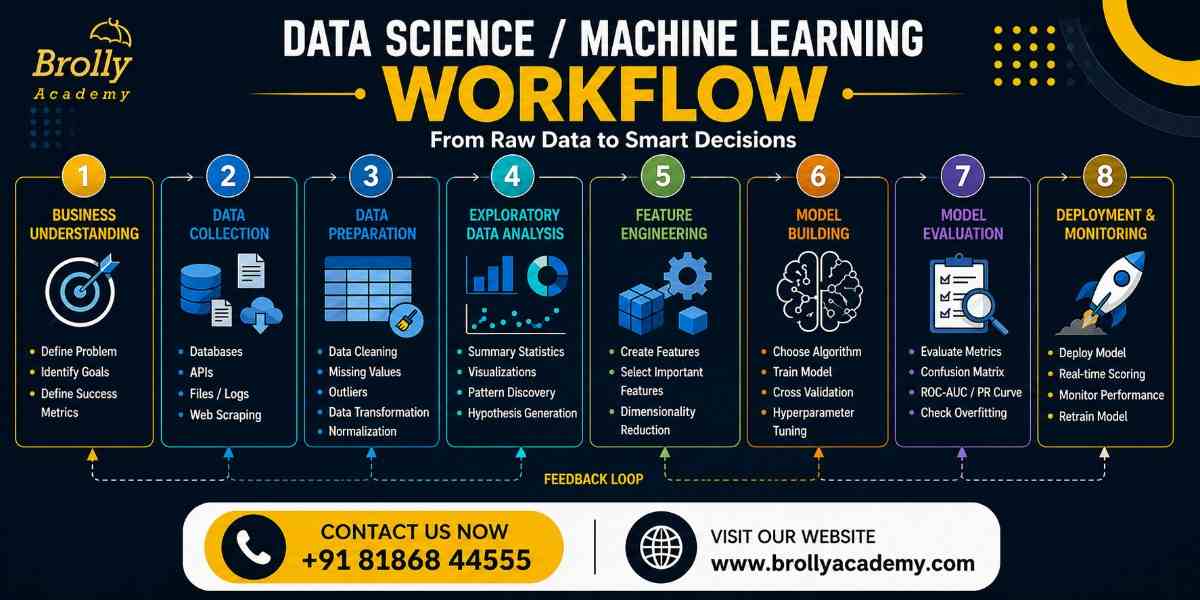
9. Cloud, Deployment, and MLOps Basics
A model that works inside a notebook is not always enough for a real business.
Modern data science increasingly involves moving models into useful applications. This creates a need for basic knowledge of cloud platforms, APIs, model deployment, version control, testing, and monitoring.
You don’t need to learn every cloud platform when you’re starting out. Start by understanding the idea of a complete workflow:
Data → Cleaning → Model → Testing → Deployment → Monitoring
This practical knowledge can help you move beyond classroom projects toward production-focused work. For a deeper understanding of MLOps practices, see the Google Cloud MLOps guide.
10. Business Understanding
A data scientist should understand the problem behind the dataset.
For example, imagine a company wants to know whether it can use customer data to identify which customers may stop using its products or services in the future.
Do not immediately build a model. First ask:
- What does churn mean?
- Why does the business care?
- What action will happen after prediction?
- What could be the impact of an incorrect prediction?
- Which customers should receive attention?
Business understanding helps turn technical work into useful results.
11. Communication and Teamwork
A data scientist may work with managers, developers, marketers, finance teams, analysts, and customers.
You need to explain your findings in simple language.
For example:
For example, the model achieved an F1 score of 0.84, indicating how well it balances precision and recall.
You may also need to explain what that result means for the business.
Clear writing, presentations, listening, teamwork, and storytelling are valuable data science skills.
12. Critical Thinking and Problem-Solving
Data does not always give us a clear or correct answer on its own. It must be carefully collected, cleaned, analyzed, and interpreted.
You must question the quality of the data, check assumptions, compare different approaches, and understand whether a result makes sense.
Critical thinking helps you avoid mistakes such as treating correlation as proof of causation or trusting a model simply because it produces a high score.
13. Ethics and Responsible Data Use
Data science can affect real people. Therefore, ethical thinking should be part of your skill set.
Learn about:
- Privacy
- Data security
- Bias
- Fairness
- Responsible AI
- Explainability
A model can be technically accurate but still create an unfair result if the training data contains harmful bias.
You can learn more about responsible AI through the NIST AI Risk Management Framework.
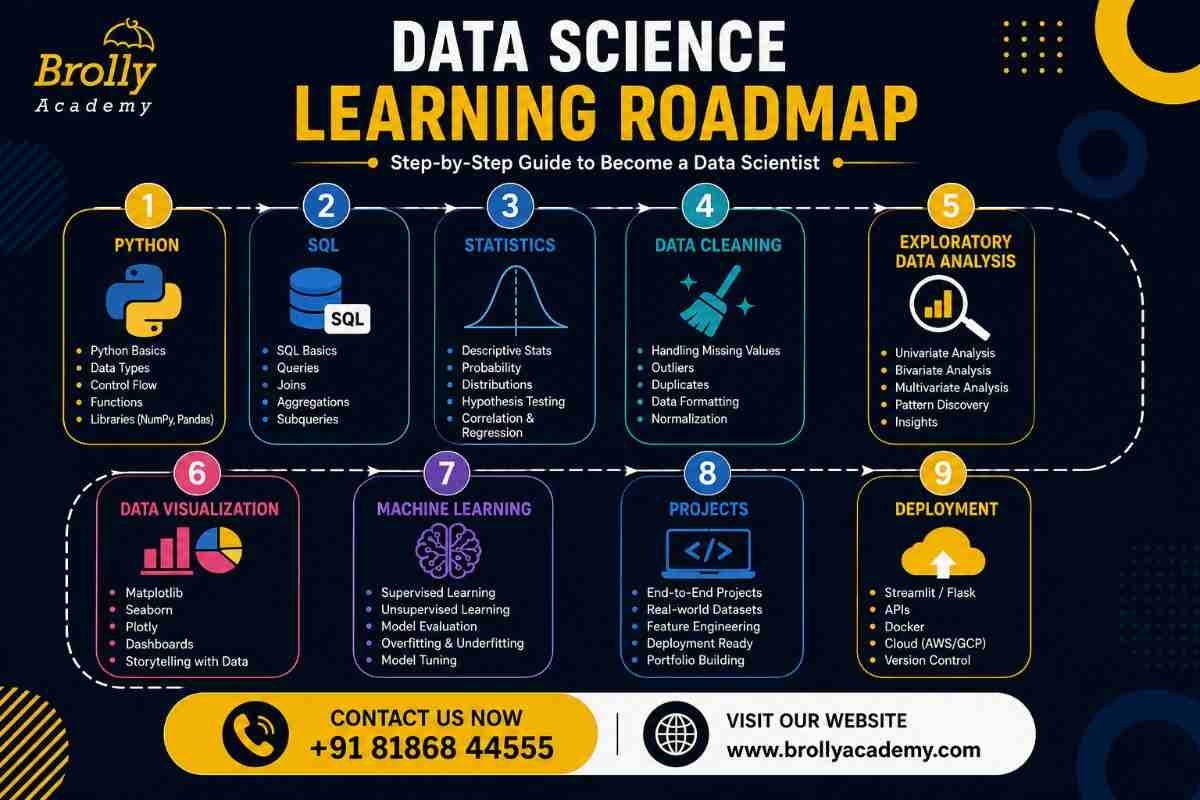
14. How to Build Data Science Skills as a Beginner
Do not try to learn 20 technologies together.
A simple learning order is:
Python → SQL → Statistics → Data Cleaning → EDA → Visualization → Machine Learning → Projects → Deployment
Then choose advanced areas based on your career goal. You can also check the data science course eligibility requirements before choosing a program.
For example, someone interested in machine learning engineering may study cloud platforms and MLOps more deeply. Someone interested in analytics may spend more time on SQL, dashboards, and business analysis.
15. How to Prove Your Data Science Skills
Knowing a tool is different from proving that you can use it.
Build 3–5 practical projects that show your complete thinking.
A project could include:
- A real-world question
- Data collection
- Data cleaning
- Exploratory analysis
- Visualization
- Model building, if required
- Evaluation
- Business recommendations
For example, instead of making a generic “Iris flower” project, create a customer churn analysis and explain what a company could do with the results.
A project portfolio can show employers how you solve problems, not just which tools you have studied.
Data Science Skills Checklist
For a beginner, the most useful foundation is:
Python + SQL + Statistics + Data Cleaning + EDA + Visualization + Machine Learning + Communication + Business Understanding + Projects
You can add cloud, MLOps, deep learning, NLP, and other advanced skills later.
The important thing is to build skills step by step and practice them together.
FAQ'S
1.Which data science skills are essential for beginners?
2.Is Python necessary for data science?
3.Is SQL important for data scientists?
4.Do data scientists need mathematics?
5.Do I need to learn calculus?
6.Do I need machine learning to become a data scientist?
7.Is Excel useful for data science?
8.Should I learn R or Python first?
9.Is Power BI a data science skill?
10.What SQL topics should beginners learn?
11.What is data cleaning?
12.What is EDA in data science?
13.Why is data visualization important?
14.Are soft skills important in data science?
15.Do I need a degree to learn data science skills?
16.Can a beginner learn data science?
17.How long does it take to learn data science?
18.Are data science projects important?
19.Do data scientists need cloud skills?
20.What is MLOps?
21.Do data scientists need deep learning?
22.Is machine learning the same as data science?
23.Can I learn data science without coding experience?
24.Which data science skill should I learn first?
25.What is the best way to improve data science skills?
Final Thoughts
The best data science skills are not simply a list of programming languages and tools. A successful data professional knows how to understand a problem, work with messy data, analyze information, build appropriate models, communicate results, and connect findings to real decisions.
Start small. Learn Python and SQL, strengthen your statistics, practice with real datasets, and build projects. Once your foundation is strong, move into machine learning, cloud technologies, deployment, and advanced AI.
You do not need to know everything on day one. Consistent practice and the ability to solve real problems are what turn individual skills into a data science career. Explore data science training options at Brolly Academy.