Brolly Academy | Data Science
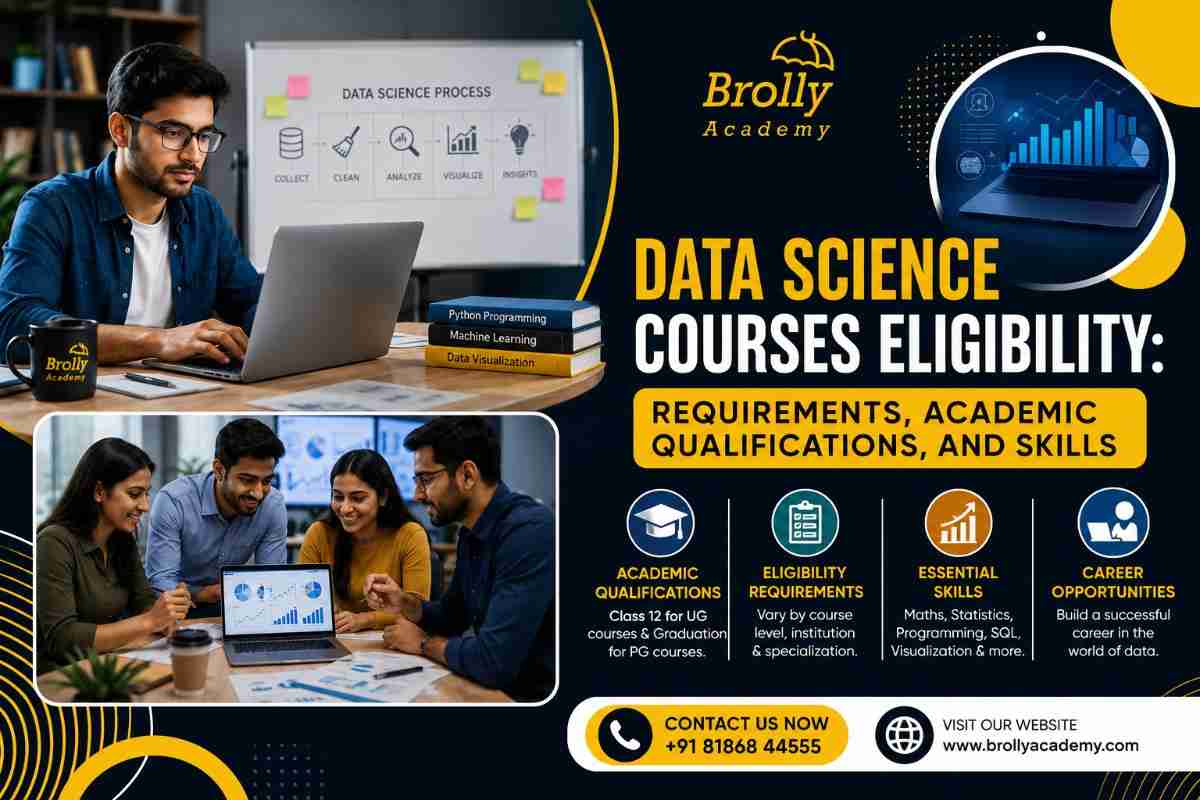
Data Science Courses Eligibility
Requirements,Academic Qualifications,and Skills
If you are planning to build a career in data science, one of the first questions you may have is: What are the eligibility requirements for data science courses?
The answer depends on the type of course you want to pursue. Eligibility can be different for undergraduate degrees, postgraduate programs, diplomas, and online or certificate courses.
Generally, students who have completed Class 12 can apply for several undergraduate data science programs, while postgraduate programs usually require a bachelor’s degree. Some programs prefer Mathematics, Statistics, Computer Science, or another quantitative subject, while “…beginner-friendly certificate courses may have fewer academic requirements. If you are looking for a structured Data Science course, you can explore the course curriculum and learning options.”
The important thing is that there is no single eligibility rule for every data science course. Requirements vary by university, course level, admission method, and program structure. Current course guides also show differences between UG, PG, diploma, and certification pathways.

Share
Table of Contents
Quick Answer: Who Can Join a Data Science Course?
You may be eligible for a data science course if you fall into one of these categories:
- You have completed Class 12 and want to pursue an undergraduate data science program.
- You have a bachelor’s degree and want to study data science at the postgraduate level.
- You are a graduate from Computer Science, IT, Mathematics, Statistics, Engineering, Commerce, or another field and want to transition into data science.
- You want to start with an online certificate or beginner-level program.
- You are a working professional looking to move into data analytics or data science.
However, meeting the minimum eligibility criteria does not automatically mean that every data science program will accept you. Check the institution’s specific admission requirements before applying.
Data Science Courses Eligibility by Course Level
The easiest way to understand eligibility is to separate data science courses according to their education level.
These are common guidelines, not universal requirements.. For example, current course listings show that some BSc programs accept Class 12 students with combinations involving Mathematics, Computer Science, or Statistics, while some BTech programs require PCM
Who Is Eligible for Data Science Courses?
1. Educational Qualification
Your educational qualification is usually the first eligibility factor considered.
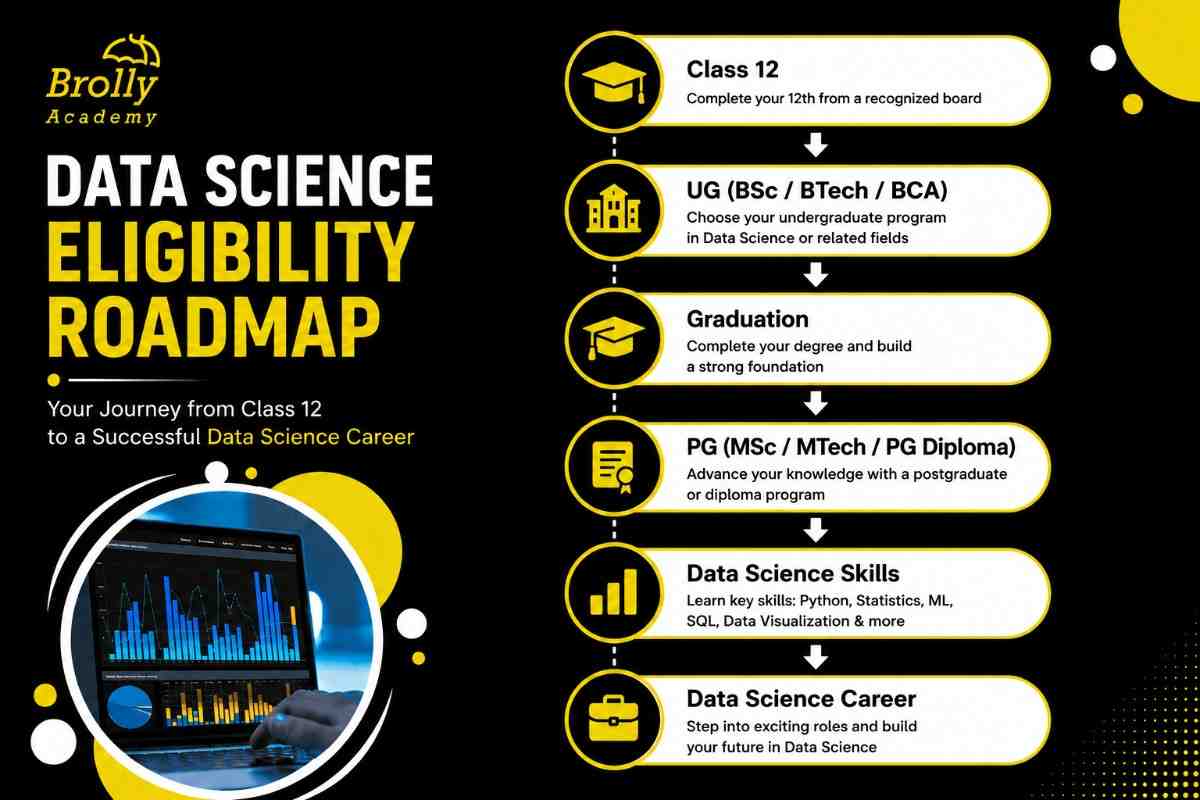
For undergraduate data science programs, students generally need to complete Class 12 or an equivalent examination from a recognized board.
Many institutions prefer students who studied Mathematics in Class 11 and 12 because data science involves statistics, probability, algebra, and quantitative reasoning.
postgraduate programs, applicants are generally expected to have completed a bachelor’s degree or an equivalent undergraduate qualification before applying.
Depending on the institution, degrees in areas such as Computer Science, Information Technology, Mathematics, Statistics, Engineering, or related subjects may be preferred.
Some programs have broader eligibility rules and may accept graduates from other disciplines.
2. Class 12 Eligibility for Data Science
If you have completed Class 12 and want to enter data science, you have several possible routes.
Depending on the institution, you may have the option to choose:
- BSc Data Science
- BTech Data Science
- BCA followed by data science specialization
- Undergraduate data analytics programs
- Diploma programs
- Certificate programs
Many undergraduate programs ask for a minimum percentage, but the exact requirement varies. Current education portals commonly report around 50–60% as a general range, while individual institutions can set different marks and subject requirements.
Therefore, don’t assume that one percentage applies to every college.
What if I studied Science in Class 12?
Students from PCM backgrounds are generally well positioned for quantitative data science programs because they already have exposure to mathematics.
If you studied:
- Physics
- Chemistry
- Mathematics
you may meet the academic requirements for many BTech or BSc-level data science programs, subject to the institution’s individual rules.
What if I studied Commerce?
Commerce students should not assume that data science is completely closed to them.
A commerce background can actually be useful for areas involving:
- Business analytics
- Financial analytics
- Customer analytics
- Marketing analytics
- Business intelligence
However, you may need to build additional skills in Python, statistics, SQL, and mathematics.
3. Is Mathematics Required for Data Science?
Students often ask this question when exploring their study options.
Mathematics is important in data science, but the admission requirement depends on the specific course.
Some degree programs require Mathematics in Class 12. Others may accept students without it, depending on their admission rules.
From a learning perspective, mathematics becomes useful for understanding:
- Statistics
- Probability
- Linear algebra
- Functions
- Optimization
- Machine learning algorithms
You do not necessarily need advanced mathematics before starting a beginner-level course. But if you want to progress into machine learning and advanced data science, developing a strong mathematical foundation will make the concepts easier to understand.
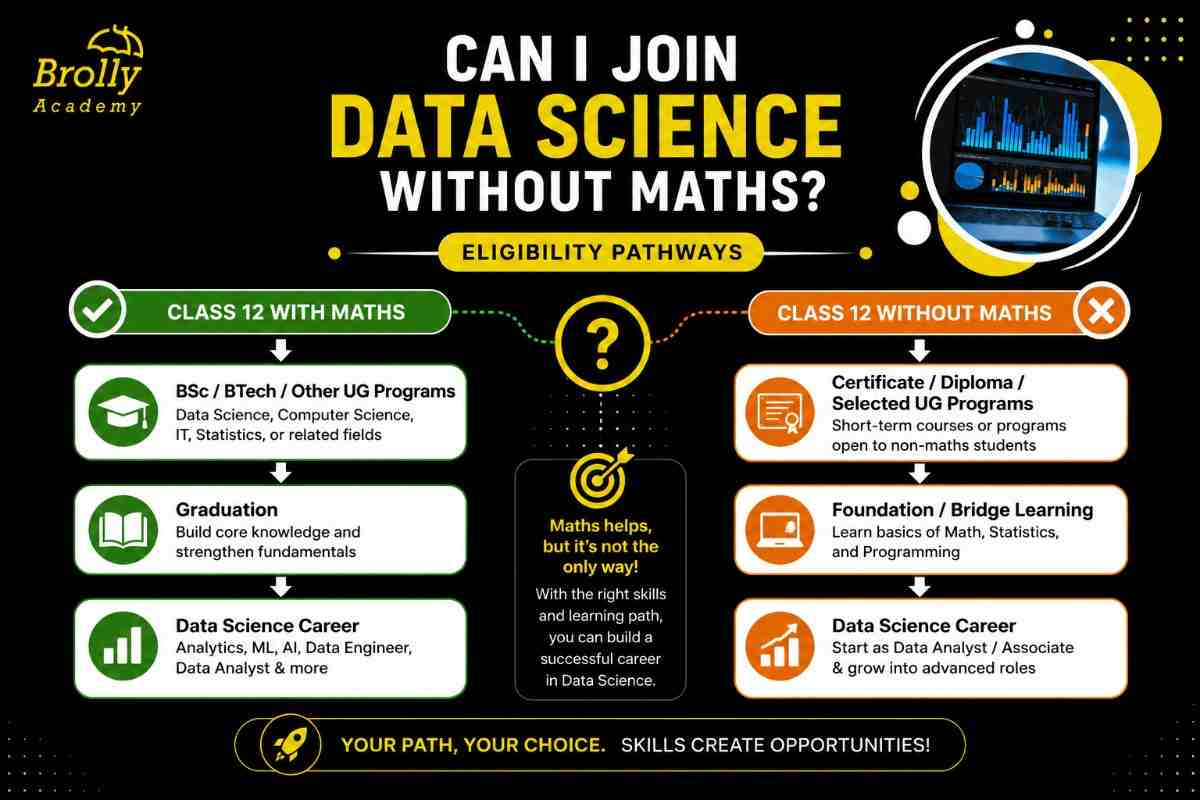
Can I Do Data Science Without Maths in Class 12?
This is where students need to distinguish between course admission eligibility and skills required to learn data science.
A course may allow admission without Class 12 Mathematics, but another university may make Mathematics compulsory.
Some beginner-level or flexible programs accept students from different academic backgrounds. On the other hand, several formal BSc and BTech programs have specific subject requirements.
So the correct answer is:
Yes, some data science courses may be available without Class 12 Maths, but you must check the eligibility criteria of the specific course.
If Mathematics is not part of your previous education, you can still learn the necessary concepts through a foundation or bridge course.
Can Non-Technical Students Join Data Science?
Yes, but the learning path may require additional preparation.
Students from non-technical backgrounds can enter data science through beginner-friendly courses, especially when the program starts with programming, statistics, and data analysis fundamentals.
For example, someone with a background in:
- B.Com
- BBA
- Economics
- Finance
- Business
- Mathematics
- Statistics
- Science
may transition into data analytics and eventually data science by developing the required technical skills.
Some current course providers explicitly describe data science programs as accessible to graduates from different backgrounds, while emphasizing the importance of mathematics, programming, and analytical ability.
Is Data Science a Good Career Option After B.Com ?
Yes, depending on the program.
A B.Com graduate can start with:
- Excel and data analysis
- SQL
- Statistics
- Python
- Data visualization
- Machine learning
- Data science projects
For a B.Com student, business analytics can also be a practical starting point because your existing knowledge of finance, accounting, and business can complement analytical skills.
However, a postgraduate degree may have specific academic prerequisites, so check the university’s eligibility rules before applying.
Can I Do Data Science After BBA?
Yes.
BBA students can build on their understanding of business, marketing, operations, and management.
A possible learning path is:
BBA → Excel → SQL → Statistics → Python → Power BI/Tableau → Data Analytics → Machine Learning → Data Science
This route can be particularly useful if you are interested in business intelligence, marketing analytics, customer analytics, or business data.
Can I Join Data Science After Engineering?
Engineering graduates are among the common candidates entering data science.
Graduates from:
- Computer Science
- Information Technology
- Electronics
- Electrical Engineering
- Mechanical Engineering
- Civil Engineering
can potentially move into data-related roles by building programming, statistics, SQL, and machine learning skills.
Your engineering degree may already give you exposure to mathematics, problem-solving, programming, or technical subjects.
However, having an engineering degree alone does not make someone a data scientist. Practical skills and projects are still important.
Can Graduates Learn Data Science?
Yes.
Graduates can choose from several pathways depending on their career goals:
- Postgraduate degree
- PG diploma
- Professional certification
- Online data science course
- Data analytics course
- Specialized machine learning program
A graduate who is completely new to programming should generally start with foundational topics instead of immediately choosing an advanced machine learning program.
What Skills Should You Have Before Starting Data Science?
Eligibility and skills are two different things.
A university may allow you to enroll based on your academic qualification, but you still need to develop the skills required to succeed.
Important skills include:
Mathematics and Statistics
You should gradually learn
- Probability
- Descriptive statistics
- Inferential statistics
- Correlation
- Regression
- Basic linear algebra
Programming
Python is among the most commonly used programming languages in data science.
You should eventually become comfortable with:
- Variables
- Data types
- Conditional statements
- Loops
- Functions
- Lists and dictionaries
- Libraries such as NumPy and pandas
SQL
SQL is important for working with databases.
You should understand:
- SELECT
- WHERE
- GROUP BY
- ORDER BY
- JOIN
- Aggregate functions
- Subqueries
Data Visualization
You should learn how to communicate findings using charts and dashboards.
Common tools include
- Power BI
- Tableau
- Matplotlib
- Seaborn
- SAS
Analytical Thinking
Data science involves more than simply writing programs.
You also need to understand:
- What problem are you solving?
- What data is available?
- Is the data reliable?
- What patterns exist?
- What does the result actually mean?
- How can the result help a business?
Is Prior Coding Knowledge Required for a Data Science Course?
Not always.
Beginner-level courses often teach programming from the fundamentals.
However, having some basic programming knowledge can make your learning experience easier.
If you have never written code before, start with Python fundamentals rather than trying to learn advanced machine learning immediately.
A good beginner sequence is
Python basics → pandas → SQL → statistics → data analysis → visualization → machine learning
Are Entrance Exams Required for Data Science Courses?
It depends on the institution and program.
Some degree programs may use entrance examinations, while others may offer admission based on Class 12 or graduation marks.
Depending on the program, students may encounter entrance exams such as:
- JEE Main
- CUET
- University-specific entrance tests
- State-level entrance examinations
- GATE for certain postgraduate pathways
Current education guides list different entrance exams depending on whether the candidate is applying for UG or PG-level programs.
Therefore, do not assume that every data science course requires an entrance examination.
What Documents Are Usually Required?
During admission, institutions may ask for documents such as:
- Class 10 certificate
- Class 12 marksheet
- Graduation marksheets
- Degree certificate
- Government-issued identification
- Passport-size photographs
- Transfer certificate, where applicable
- Category certificate, where applicable
- Entrance examination scorecard, if required
The exact document list varies by institution.
Data Science Eligibility: UG vs PG vs Certification
The biggest mistake students make is treating all data science courses as if they have the same requirements.
This comparison helps you choose a course based on where you are now instead of simply searching for the “best data science course.”
What Should You Learn Before Joining a Data Science Course?
There is no need to master all the skills before joining.
But learning these basics can give you a strong starting point
Before the course
- Basic mathematics
- Basic statistics
- Logical reasoning
- Python fundamentals
- Basic Excel
- Basic SQL
During the course
- Data cleaning
- Exploratory data analysis
- Statistics
- Machine learning
- Data visualization
- Feature engineering
- Model evaluation
- Real-world projects
After learning the fundamentals
Work on practical projects.
For example
- Sales analysis
- Customer churn prediction
- House price prediction
- Customer segmentation
- E-commerce analysis
- Financial data analysis
Projects help you demonstrate that you can apply concepts rather than simply explain them.
Can a Data Science Certificate Help You Get a Job?
No.
A certificate can demonstrate that you completed a learning program, but it does not automatically qualify you for a data science job.
Employers may also evaluate
- Technical skills
- Projects
- Problem-solving ability
- SQL knowledge
- Python skills
- Statistics
- Communication
- Business understanding
- Interview performance
Therefore, your goal should not be “How many certificates can I collect?”
A better goal is
“Can I solve real data problems and explain my solution?”
How Do I Choose the Right Data Science Course Based on Eligibility?
Before enrolling, check these points:
1. Check the academic requirement
Find out whether the program requires
- Class 12
- Mathematics
- Graduation
- A specific degree
- A minimum percentage
2. Check the course level
A beginner certificate and an MSc in Data Science are not equivalent.
Choose a program according to your current qualification and experience.
3. Check the syllabus
A useful beginner program should cover appropriate fundamentals rather than simply listing dozens of tools.
Look for subjects such as
- Python
- SQL
- Statistics
- Data analysis
- Visualization
- Machine learning
- Projects
4. Check practical learning
Projects are particularly important because data science is an application-oriented field.
5. Check the admission rules directly
Eligibility information can change between institutions and admission cycles.
Always verify the current requirements on the official course or university page before paying an admission fee.
FAQ's
1. What is the eligibility for data science courses?
Eligibility depends on the course. Undergraduate programs generally require Class 12, while postgraduate programs usually require a bachelor’s degree. Certificate programs can have more flexible requirements.
2. Is Maths compulsory for data science?
Not for every data science course. Some degree programs require Mathematics, while others may accept students without it. Mathematics is nevertheless useful for learning statistics and machine learning.
3. Can I learn data science after 12th?
Yes. Students can explore BSc, BTech, BCA-related pathways, diplomas, and certificate courses depending on their academic background and the institution’s requirements.
4. Can commerce students do data science?
Yes. Commerce students can transition into data science or data analytics by developing programming, statistics, SQL, and analytical skills.
5. Can I do data science after B.Com?
Yes. A B.Com graduate can start with data analytics and progress toward data science after building Python, SQL, statistics, and machine learning skills.
6. Can arts students learn data science?
Yes, particularly through beginner-level programs that teach the technical foundations from scratch. However, students should be prepared to learn mathematics, statistics, and programming.
7. Do I need coding experience before joining?
No, not necessarily. Many beginner programs start with programming fundamentals. Prior Python knowledge is helpful but is not always an admission requirement.
8. Is a Computer Science Background Necessary for Data Science?
No. Computer Science is a useful background, but data science is also relevant to Mathematics, Statistics, Engineering, Business, Economics, and other fields.
9. What percentage is required for a data science course?
There is no universal percentage. Many programs mention around 50–60% for certain UG or PG pathways, but requirements vary by institution and course.
10. Can working professionals learn data science?
Yes. Working professionals can choose online, part-time, certificate, diploma, or postgraduate programs depending on their education and career goals.
Final Checklist: Are You Eligible for Data Science?
Before applying, ask yourself:
- Have I completed the required educational qualification?
- Does my Class 12 subject combination meet the course requirement?
- Does the course require Mathematics?
- Do I meet the minimum percentage?
- Do I need a bachelor’s degree?
- Is an entrance exam required?
- Do I have basic mathematical knowledge?
- Am I willing to learn programming?
- Does the course include practical projects?
- Have I checked the latest eligibility criteria from the institution?
If you can answer these questions, you can make a much more informed decision about which data science course is suitable for you.
Conclusion
Data science courses eligibility depends mainly on the course level, academic qualification, subject requirements, and the institution offering the program.
Students after Class 12 can explore undergraduate data science pathways, while graduates can consider postgraduate programs, diplomas, and professional courses. Students from non-technical backgrounds can also enter the field, but they may need additional preparation in mathematics, statistics, programming, and SQL.
Most importantly, do not judge your eligibility based only on your previous academic stream.
Instead, look at three things:
Your current qualification + the course’s admission requirements + the skills you are willing to develop.
Data science requires continuous learning. If you build a foundation in Python, SQL, statistics, data analysis, and machine learning and apply those skills through real projects, you can create a much stronger pathway into data-related careers.
Before applying to any institution, always verify its current eligibility criteria because requirements can vary between courses and admission cycles.