

Table of Contents
Learning Path 2026
Generative AI Roadmap 2026: Your Step-by-Step Path to Learn GenAI
The exact order to learn generative AI, phase by phase, with the skills, tools and projects that take you from beginner to job ready.
AI Overview
A generative AI roadmap is a step-by-step plan to learn generative AI, from the basics to building real applications. It starts with Python and maths, then machine learning and deep learning, then core topics like transformers, large language models, prompt engineering, RAG, fine-tuning and AI agents, and ends with deployment and portfolio projects. Most beginners can follow it in three to six months.
By Brolly Academy
Updated June 2026
12 min read
Category: Generative AI
Overview
What Is a Generative AI Roadmap?
A generative AI roadmap is simply the right order to learn things, so you never feel lost.
Generative AI has many topics, like Python, transformers, large language models, RAG and AI agents. Without a plan, beginners jump between random tutorials and end up with gaps. A roadmap fixes that. It tells you what to learn first, what comes next, and what to build at each step.
This guide gives you a clear, six-phase generative AI roadmap for 2026. It works whether you are a student, a working professional or a career switcher. If you are brand new, it helps to first see some real generative AI examples, then come back and follow the path below.
Why follow a roadmap at all? Because generative AI is huge, and it is easy to waste months on random videos that do not connect. A roadmap turns a confusing field into a simple, ordered path. You always know what you are learning, why it matters, and what comes next.
Before You Start
What You Need Before You Start
The good news is you do not need much to begin. A good roadmap meets you where you are.
- Coding. None needed to start. Python is taught from zero in Phase 1.
- Maths. School level maths is enough. The extra bits, like basic linear algebra and statistics, are taught along the way.
- Time. Around 8 to 12 hours a week lets most people finish in three to six months.
- A computer and internet. That is it. Most tools are free or have free tiers.
If you can give steady time each week, you can follow this roadmap. The biggest thing that matters is not your background, it is finishing each phase with a small project.
Audience
Who This Roadmap Is For
This generative AI roadmap works for many kinds of learners. You do not need a special background to follow it.
- Students. Build skills and projects that make your resume stand out before you graduate.
- Working professionals. Add generative AI to your current role, whether you are in software, data or another field.
- Career switchers. Move into AI from a different career, step by step, without quitting first.
- Non-coders. Start with Python from zero and grow into a builder at your own pace.
Wherever you are starting from, the order stays the same. Follow the phases, finish the projects, and you will get there.
At a Glance
The Generative AI Roadmap at a Glance
The generative AI roadmap has six phases. Each one builds on the last, so follow them in order.
- Python and maths foundations
- Machine learning and deep learning
- Core generative AI: transformers, LLMs and prompt engineering
- Building real systems: RAG, vector databases and fine-tuning
- AI agents and agentic AI
- Deployment, projects and your portfolio
Here is the same path with a rough time for each phase, so you can plan your study.
| Phase | Focus | Typical Time |
|---|---|---|
| 1. Foundations | Python, maths, data handling | 4 to 6 weeks |
| 2. ML and Deep Learning | Machine learning, neural networks | 4 to 6 weeks |
| 3. Core Generative AI | Transformers, LLMs, prompt engineering | 4 to 6 weeks |
| 4. Real Systems | RAG, vector databases, fine-tuning | 3 to 5 weeks |
| 5. AI Agents | Agentic AI, tools, MCP | 2 to 3 weeks |
| 6. Deployment and Projects | LLMOps, portfolio building | 3 to 4 weeks |
Notice how each phase builds on the one before. You cannot skip ahead, because Phase 4 needs the language models from Phase 3, and Phase 3 needs the basics from Phases 1 and 2.
Phase 1
Phase 1: Foundations, Python, Maths and Data
Every AI tool is built with code, so this is where you start. The goal is to get comfortable with Python and a little maths.
- Python. Variables, loops, functions, object-oriented programming (OOP), error handling, and working with APIs and JSON.
- Data tools. NumPy and Pandas, used to handle and clean data.
- A little maths. Basic linear algebra, probability and statistics. Just enough to understand how models work.
You can learn the basics from free resources like DeepLearning.AI and official docs. Keep it light and practical.
Do not rush this phase. Strong Python and a little maths make everything after it easier.
Build this: a small Python program that reads a data file and prints a simple summary. It proves you can handle data.
Phase 2
Phase 2: Machine Learning and Deep Learning
Generative AI sits on top of machine learning and deep learning, so you need the basics of both. If you want to see how it differs from older AI, compare generative AI and predictive AI.
- Machine learning. How models learn from data, common methods like classification, and key ideas like overfitting and the bias-variance balance.
- Deep learning. Neural networks and how they power modern AI, including layers, activation functions and backpropagation.
- Building blocks. CNNs and RNNs, then the move toward transformers.
You do not need to master every algorithm. Aim to understand the ideas well enough to move on to large language models with confidence.
Build this: a simple model that predicts something from a small dataset, like house prices. It shows you understand the training loop.
Phase 3
Phase 3: Core Generative AI, Transformers, LLMs and Prompt Engineering
This is the heart of the roadmap. Here you learn the technology behind tools like ChatGPT and Gemini.
- Transformers. The design that powers almost every modern AI model.
- Large language models. How they work, how they are trained with human feedback (RLHF), and how to use models like GPT, Llama and Mistral.
- Prompt engineering. Writing instructions that get great results, including context engineering.
- Embeddings. How words and sentences become numbers, so an AI can compare meaning. This idea quietly powers search and RAG.
Generative AI is not only about text. This phase also introduces the generative AI models that create images, behind tools like Midjourney and Stable Diffusion.
Open models are easy to try on Hugging Face. By the end of this phase, you can talk to models and shape their answers.
Build this: a simple chatbot that uses a large language model and a few smart prompts to answer questions.
Phase 4
Phase 4: Building Real Systems, RAG, Vector Databases and Fine-Tuning
This phase is where learners become hireable. You move from chatting with models to building real apps.
- RAG. Retrieval augmented generation lets an AI look up facts before it answers, like an open-book test.
- LangChain. A toolkit that joins models, data and tools into a working app, with LangSmith to test and debug it.
- LlamaIndex. A tool for indexing and querying your own documents, often used alongside LangChain.
- Vector databases. Tools like Pinecone and Chroma that store and search AI data fast.
- Chunking. Splitting documents into smart pieces, so the AI can find the right part to answer from.
- Fine-tuning. Adapting a ready-made model to your own data, with light methods like LoRA and QLoRA.
These are the skills companies ask for most. See how they fit the full path in our generative AI learning path.
Build this: a document assistant that uses RAG to answer questions from your own files. This is a strong portfolio project.
Phase 5
Phase 5: AI Agents and Agentic AI
This is the newest and fastest growing area in 2026, and most older roadmaps skip it. An AI agent can plan, use tools and finish tasks on its own.
- What agents do. They break a goal into steps, use tools, and act, not just chat.
- Key ideas. The Model Context Protocol (MCP), agent memory, and thinking patterns like ReAct.
- Frameworks. Building multi-agent systems with tools like LangGraph and CrewAI.
Agentic AI is where a lot of new jobs are being created, so learning it now puts you ahead.
Build this: a small agent that can search the web and write a short summary on its own.
Phase 6
Phase 6: Deployment, Projects and Your Portfolio
Building an AI is one thing. Running it for real users and showing your work is what gets you hired.
- Deployment basics. Putting your app online so others can use it.
- LLMOps. Keeping AI fast, safe and low cost, and watching it so it keeps working.
- Cloud. Running models on platforms like Azure OpenAI and Amazon Bedrock.
- Portfolio. Three or four real projects, shared on GitHub, that you can show in interviews.
Your projects matter more than any single certificate. For more ideas, see our generative AI projects.
Build this: take your best project, deploy it online, and write a short post explaining how you built it.
Timeline
How Long Does the Generative AI Roadmap Take?
With steady effort of around 8 to 12 hours a week, most beginners finish the full roadmap in three to six months.
- Foundations (Phases 1 to 2). About 8 to 12 weeks to get comfortable with Python, maths and machine learning.
- Core generative AI (Phase 3). About 4 to 6 weeks for transformers, LLMs and prompt engineering.
- Advanced and real-world (Phases 4 to 6). About 8 to 12 weeks for RAG, agents, deployment and projects.
If you already know Python or machine learning, you can move faster and skip ahead. The timeline is a guide, not a rule.
Avoid These
Common Mistakes to Avoid
A few simple mistakes slow most beginners down. Knowing them helps you move faster.
- Jumping to tools too early. Learning a tool before the basics leaves gaps. Follow the order.
- Tutorial hopping. Watching endless videos without building anything. Stop and build instead.
- Skipping projects. Projects are what prove your skill. Finish one at the end of each phase.
- Ignoring deployment. Many learners can build but never ship. Learn to put your work online.
Tip. The fastest learners are not the ones who watch the most videos. They are the ones who build the most projects.
Resources
Best Resources to Learn
You do not need to pay for everything. A mix of free and paid resources covers the whole roadmap.
- Foundations. The Google Machine Learning Crash Course and DeepLearning.AI.
- Models and practice. Hugging Face for open models, datasets and free hands-on courses.
- Official docs. Microsoft Learn and provider docs.
- Free practice. Kaggle and fast.ai.
- Guided learning. Brolly Academy covers this full roadmap with live projects and placement support.
Our generative AI course follows this exact roadmap, phase by phase.
Outcomes
Careers After the Roadmap
Finishing this roadmap opens some of the best paid roles in tech. A NASSCOM and Deloitte report expects India’s AI talent pool to grow to over 1.25 million by 2027.
- Roles. Generative AI Engineer, LLM Engineer, Prompt Engineer, AI Engineer and Data Scientist.
- Salary. Indicative pay in India starts around 6 to 12 LPA for freshers and rises to 30 LPA or more with experience.
- Freshers welcome. A strong portfolio of projects often gets you hired faster than expected.
When you start applying, prepare with common generative AI interview questions.
Credentials
Certifications That Help
A certification is not required, but it helps you prove your skills to an employer.
- Microsoft. Azure AI Fundamentals (AI-900) and Azure AI Engineer (AI-102).
- AWS. The AWS Certified AI Practitioner, a good entry point.
- Google Cloud and Databricks. Google's generative AI and Vertex AI paths, and the Databricks Generative AI Engineer Associate.
A certification works best next to real projects. Your portfolio still matters more than any single exam.
Download
Download the Generative AI Roadmap PDF
Want this roadmap to keep and follow at your own pace? You can download the full generative AI roadmap as a PDF.
Print it, save it to your phone, and tick off each phase as you go.
Get the full roadmap as a PDF you can keep.
People Also Ask
Frequently Asked Questions
How do I start learning generative AI?
Start with Python and basic maths, then machine learning and deep learning, then transformers and large language models, then RAG, fine-tuning and agents. Build a small project at each step.
How long does it take to learn generative AI?
Most beginners can follow a generative AI roadmap in three to six months with steady effort. Foundations take four to six weeks, core generative AI another four to six weeks, and advanced topics a few more weeks.
What is the roadmap to learn generative AI?
The roadmap has six phases: Python and maths, machine learning and deep learning, core generative AI, building real systems (RAG, vector databases, fine-tuning), AI agents, and deployment with projects.
Do I need maths to learn generative AI?
You only need school level maths to begin. A good roadmap teaches the extra maths you need, like basic linear algebra, probability and statistics, along the way.
Can a beginner learn generative AI?
Yes. A clear roadmap starts with Python from zero and builds step by step. Hands-on projects are the key to learning fast.
Is Python required for generative AI?
Yes. Python is the main language for generative AI, used for data, model work and building apps. A good roadmap teaches Python from the basics.
What should I learn first in generative AI?
Learn Python first, then the basics of machine learning. These give you the base to understand deep learning, transformers and large language models later.
Is there a generative AI roadmap PDF?
Yes, a downloadable generative AI roadmap PDF helps you plan and track your progress. It lists each phase, the skills, the tools and a project for each step.
Can I learn generative AI without a degree?
Yes. Employers care most about real skills and a strong project portfolio. If you can build chatbots, RAG apps and agents, your projects speak louder than any certificate.
Can I learn generative AI on my own?
Yes, you can self study generative AI using free resources and this roadmap. A guided course helps if you want structure, feedback and mentorship.
Is generative AI hard to learn?
Generative AI is easier when you follow a roadmap. The order matters more than raw difficulty, even for complete beginners.
What programming language is best for generative AI?
Python is the best and most used language for generative AI. Almost every tool, library and framework supports Python.
Do I need to know machine learning before generative AI?
You need the basics of machine learning, not deep expertise. The roadmap covers these basics in Phase 2 before the generative AI topics.
What is the difference between AI, machine learning and generative AI?
AI is the broad field of smart machines. Machine learning is a part of AI where systems learn from data. Generative AI is a newer branch that creates new content like text, images and code.
What are the prerequisites for learning generative AI?
You need basic computer skills and a willingness to learn. No coding or advanced maths is required to start. Around 8 to 12 hours a week of study is enough.
How much maths is needed for generative AI?
Only a small amount. Basic linear algebra, probability and statistics are enough for most generative AI work, and a good roadmap teaches them as you go.
What tools should I learn for generative AI?
Key tools are Python, PyTorch or TensorFlow, Hugging Face, LangChain, LlamaIndex, a vector database like Pinecone or Chroma, and cloud platforms like Azure OpenAI or Amazon Bedrock.
What is RAG in the generative AI roadmap?
RAG, or retrieval augmented generation, lets an AI look up information before it answers. It makes answers more accurate and current, and is covered in Phase 4.
What are AI agents in generative AI?
AI agents are systems that can plan, use tools and finish tasks on their own, not just chat. The roadmap covers agents, MCP and multi-agent frameworks in Phase 5.
Should I learn LLMs or diffusion models first?
Learn large language models first. Most generative AI jobs and apps are built around LLMs, RAG and agents.
How many projects should I build to learn generative AI?
Aim for at least three to four solid projects. A chatbot, a RAG document assistant, a fine-tuned model and a small AI agent make a strong portfolio.
Can I learn generative AI in one month?
One month is enough to learn the basics and build a simple project, but not the full roadmap. Becoming job ready usually takes three to six months.
Is generative AI worth learning in 2026?
Yes. Generative AI is one of the most in-demand skills in 2026, with demand running ahead of supply across software, finance, healthcare and more.
What jobs can I get after learning generative AI?
You can target roles like Generative AI Engineer, LLM Engineer, Prompt Engineer, AI Engineer and Data Scientist.
What is the salary after learning generative AI?
In India, generative AI roles often start around 6 to 12 LPA for freshers and rise to 30 LPA or more with experience.
Do I need a GPU to learn generative AI?
No. Most learning and projects can be done with free cloud notebooks and model APIs. A GPU only helps for heavy training.
What are the best free resources to learn generative AI?
Great free resources include the Google Machine Learning Crash Course, DeepLearning.AI short courses, Hugging Face courses and Microsoft Learn.
What comes after the generative AI roadmap?
Keep building harder projects, specialise in an area like agents or fine-tuning, and apply for roles. Stay current by following new models and tools.
Key Takeaways
- A generative AI roadmap is the right order to learn skills, so you never feel lost.
- It has six phases, from Python and maths to RAG, AI agents, deployment and projects.
- You can start with no coding and only school level maths.
- Most beginners finish in three to six months with steady weekly effort.
- Building a project at the end of each phase is what makes you job ready.
Follow This Generative AI Roadmap With Expert Guidance
Learn every phase with experienced trainers, live projects and placement support. Turn this roadmap into real, job ready skills.
Table of Contents
ToggleGenerative AI Syllabus Introduction
If you have ever opened a Generative AI course page and felt lost in a wall of buzzwords — transformers, embeddings, RAG, fine-tuning — you are not alone. Most people want one clear thing before they enrol: what exactly will I learn, and in what order?
That is precisely what a Generative AI syllabus answers.
This guide walks through the complete Generative AI curriculum module by module, from your first line of Python to deploying a working AI application. Whether you are a student, a working professional switching into AI, or simply curious about how tools like ChatGPT and Gemini are built, this is the structured learning path you have been looking for.
Generative AI is the branch of artificial intelligence that creates new content — text, images, code, audio, and video — rather than simply analysing existing data. A traditional model might predict whether an email is spam. A generative model writes the email for you.
Learning this in a structured way matters more than people expect. Generative AI sits on top of several layers — programming, mathematics, machine learning, and deep learning — and skipping a layer leaves gaps that surface later when you try to build something real. A well-designed syllabus removes that risk by sequencing topics so each one builds naturally on the last.
Let’s break the entire curriculum down.
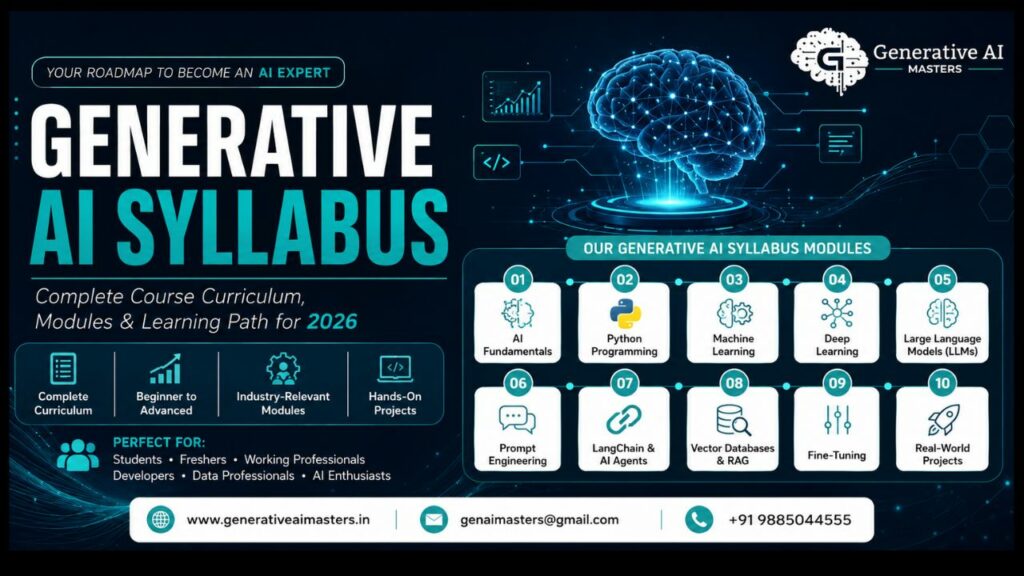
What is a Generative AI Syllabus?
A Generative AI syllabus is a structured outline of all the topics, modules, tools, and projects you study to learn how to design, build, and deploy generative AI systems. It defines the learning path from foundational concepts to advanced, production-level skills.
Think of it as the blueprint for your learning journey. Instead of randomly watching tutorials, a syllabus tells you what to learn first, what comes next, and how each topic connects to the bigger picture. A structured syllabus is the backbone of any serious Generative AI training program, which is why it’s worth understanding before you enrol.
A complete Generative AI course syllabus usually covers four broad layers:
- Foundations — what AI and generative AI are, plus the Python programming needed to work with them.
- Core machine intelligence — machine learning and deep learning concepts that power generative models.
- Generative AI specialisation — large language models, prompt engineering, LangChain, vector databases, RAG, and fine-tuning.
- Application — hands-on projects that turn theory into deployable products.
The best Generative AI training syllabus is practical. It does not stop at theory; it pushes you to build chatbots, document assistants, and AI agents you can actually show to others.
Complete Generative AI Syllabus Overview
Before we go module by module, here is the full Generative AI curriculum at a glance. This table maps every module to the topics it covers and what you should be able to do by the end of it.
Module | Topics Covered | Learning Outcome |
1. Introduction to AI & Generative AI | AI vs ML vs DL, types of AI, how generative models work, use cases | Understand where Generative AI fits and what it can create |
2. Python for Generative AI | Python basics, data structures, NumPy, Pandas, APIs, environments | Write clean Python code to work with AI models and data |
3. Machine Learning Fundamentals | Supervised/unsupervised learning, regression, classification, evaluation | Build and evaluate basic ML models confidently |
4. Deep Learning & Neural Networks | Neurons, layers, backpropagation, CNNs, RNNs, transformers | Understand the architecture that powers generative models |
5. Large Language Models (LLMs) | Tokenization, embeddings, attention, context windows, model families | Explain how LLMs like GPT and Claude generate text |
6. Prompt Engineering | Zero/few-shot, chain-of-thought, system prompts, prompt patterns | Design reliable prompts that produce consistent results |
7. AI Models & Platforms | ChatGPT, Claude, Gemini, Microsoft Copilot, OpenAI API | Choose and use the right model for each task |
8. LangChain & AI Agents | Chains, tools, memory, agent design, orchestration | Build multi-step AI agents that use tools |
9. Vector Databases & RAG | Embeddings, vector search, chunking, retrieval pipelines | Build AI that answers from your own documents |
10. Fine-Tuning & Custom Models | Transfer learning, LoRA, PEFT, dataset prep, evaluation | Customise models for specific domains and tasks |
11. Generative AI Tools & Platforms | Hugging Face, image/audio/video tools, deployment platforms | Work fluently across the modern GenAI tool stack |
12. Real-World Projects | Chatbots, RAG assistants, agents, content generators | Ship a portfolio of working Generative AI applications |
Now let’s unpack what actually happens inside each module.
Module 1: Introduction to Artificial Intelligence and Generative AI
Every good Generative AI syllabus starts with context. Before you write code, you need a clear mental map of the field.
This module explains the difference between Artificial Intelligence (the broad goal of machines performing intelligent tasks), Machine Learning (systems that learn from data), and Deep Learning (a powerful subset of ML using neural networks). Generative AI is a specialisation that sits inside deep learning.
You’ll learn:
- What “generative” actually means — creating new content versus classifying existing content.
- The main types of generative models, including large language models and diffusion models.
- Real use cases: text generation, image creation, code assistants, summarisation, and translation.
- The strengths and limits of generative systems, including hallucination and bias.
By the end, you can confidently explain what Generative AI is and why it works differently from older AI. To see how these capabilities show up in practice, explore these real-world Generative AI applications. This foundation makes every later module easier to absorb.
Module 2: Python Programming for Generative AI
Python is the language of Generative AI, so this module makes sure you are fluent in the parts that matter.
You don’t need to become a software engineer, but you do need to read and write Python comfortably. The syllabus focuses on the practical subset used in AI work.
Core topics include:
- Python fundamentals: variables, loops, functions, and conditionals.
- Data structures: lists, dictionaries, sets, and tuples.
- Working with libraries like NumPy for numerical data and Pandas for handling datasets.
- Reading and writing files, and working with JSON.
- Calling APIs — a critical skill, since you’ll connect to the OpenAI API and other model endpoints constantly.
- Setting up virtual environments and managing packages.
The learning outcome is simple but essential: you can write clean Python scripts to load data, call AI models, and process their responses. This is the practical bridge between theory and building.
Module 3: Machine Learning Fundamentals
Generative AI is built on machine learning, so understanding the basics is non-negotiable — even if you won’t build every model from scratch.
This module covers the core ideas that explain how machines learn from data.
You’ll study:
- Supervised learning — training models on labelled data (regression and classification).
- Unsupervised learning — finding patterns in unlabelled data (clustering).
- Key algorithms like linear regression, logistic regression, and decision trees.
- How to split data into training and testing sets.
- Model evaluation metrics: accuracy, precision, recall, and overfitting.
You don’t need a heavy maths background to start, but the syllabus introduces just enough statistics and probability to make the concepts click. The outcome: you understand the learning process that deep learning and generative models scale up dramatically.
Module 4: Deep Learning and Neural Networks
This is where the curriculum starts to feel like real Generative AI. Deep learning powers every modern generative model, and neural networks are the engine.
The module demystifies how neural networks actually work:
- Neurons and layers — the building blocks that pass and transform information.
- Activation functions and how networks introduce non-linearity.
- Backpropagation — how networks learn by adjusting weights from their mistakes.
- CNNs (Convolutional Neural Networks) for images and RNNs for sequences.
- Transformers — the breakthrough architecture behind today’s large language models.
Transformers deserve special attention because they are the foundation of ChatGPT, Claude, and Gemini. You’ll learn the core idea of attention — how a model decides which words matter most when generating the next one — first introduced in the landmark paper “Attention Is All You Need”. Frameworks like TensorFlow and PyTorch are usually introduced here so you can build and train small networks hands-on.
By the end, you understand the architecture that makes generation possible — which makes everything in the LLM modules far more intuitive.
Module 5: Large Language Models (LLMs)
Large Language Models are the heart of modern Generative AI, and this module is often where learners get genuinely excited.
An LLM is a deep learning model trained on enormous amounts of text so it can predict and generate human-like language. The syllabus explains exactly how that works without drowning you in maths.
Key topics:
- Tokenization — how text is broken into pieces a model can process.
- Embeddings — turning words and meaning into numbers.
- The attention mechanism and how transformers use it.
- Context windows — how much text a model can “see” at once.
- Model families: the GPT series behind ChatGPT, Anthropic’s Claude, Google’s Gemini, and open models like Llama, Mistral, and Qwen.
- Capabilities and limits: reasoning, hallucination, and why prompts matter so much.
You’ll also explore multimodal models, which now handle text, images, audio, and video together — a baseline expectation in 2026 rather than a premium feature. The outcome: you can explain how an LLM generates a response and what influences its quality.
Module 6: Prompt Engineering
If LLMs are the engine, prompt engineering is how you steer them. This module teaches you to communicate with AI models so they produce reliable, useful output.
A surprisingly large part of working with Generative AI is knowing how to ask. Small changes in wording can dramatically change results, and this prompt engineering syllabus turns that into a repeatable skill.
You’ll learn:
- Zero-shot, one-shot, and few-shot prompting — giving the model zero, one, or several examples.
- Chain-of-thought prompting — guiding the model to reason step by step.
- System prompts and roles — setting behaviour and tone.
- Prompt patterns for summarisation, extraction, classification, and generation.
- Techniques to reduce hallucination and improve consistency.
- How to iterate and test prompts systematically.
This module is practical and immediately rewarding — you’ll see your results improve in real time. It is also the gateway skill to building agents and RAG systems in later modules.
Knowing the theory is one thing; using the actual tools is another. This module gives you fluency across the major AI models and platforms you’ll use every day.
Here’s how the leading tools fit into the syllabus:
- ChatGPT (OpenAI) — the most widely used conversational assistant, great for general tasks, coding help, and content.
- Claude (Anthropic) — known for long-context understanding, careful reasoning, and document work.
- Gemini (Google) — strong multimodal capabilities and tight integration with Google’s ecosystem.
- Microsoft Copilot — AI embedded directly into productivity tools like Word, Excel, and Windows.
- OpenAI API — the programmatic way to build apps on top of GPT models, where you send prompts and receive responses in code.
You’ll learn to compare models, understand pricing and rate limits at a high level, and — most importantly — choose the right model for each job. A coding task, a long legal document, and an image-based query may each call for a different model. For a practical look at how these models are used day to day, browse these Generative AI examples. The outcome: you can build on top of these platforms instead of just chatting with them.
Module 7: OpenAI, ChatGPT, Claude, Gemini, and AI Models
Module 9: Vector Databases and Retrieval-Augmented Generation (RAG)
LLMs are powerful but have two big limits: they don’t know your private data, and they can make things up. RAG solves both, and this module is one of the most practically valuable in the syllabus.
Retrieval-Augmented Generation combines an LLM with a search system. Instead of relying only on what the model memorised during training, RAG retrieves relevant information from your own documents and feeds it to the model before it answers.
To make that work, you need vector databases.
You’ll learn:
- Embeddings — converting text into numerical vectors that capture meaning.
- Vector databases like Pinecone, Chroma, and FAISS that store and search those vectors.
- Chunking — splitting documents into searchable pieces.
- Similarity search — finding the most relevant chunks for a query.
- Building a full RAG pipeline: ingest documents, embed, store, retrieve, and generate.
In 2026, RAG has matured into the standard way enterprises build trustworthy AI — with controlled sources and traceable, auditable answers. The outcome: you can build an AI assistant that answers accurately from your own company documents, manuals, or knowledge base.
Module 10: Fine-Tuning and Custom AI Models
Sometimes prompting and RAG aren’t enough, and you need a model that behaves a specific way by default. That’s where fine-tuning comes in.
Fine-tuning means taking a pre-trained model and training it further on your own data so it adapts to a particular domain, tone, or task. This module teaches you when fine-tuning is worth it — and when a good prompt or RAG setup is the smarter choice.
You’ll study:
- Transfer learning — building on a model’s existing knowledge.
- LoRA and PEFT (Parameter-Efficient Fine-Tuning) — modern, cost-effective techniques that fine-tune models without retraining everything.
- Dataset preparation — collecting and formatting high-quality training examples.
- Training and evaluation — running the fine-tune and measuring whether it actually improved.
- Open models you can fine-tune, often through Hugging Face.
The outcome is the ability to create custom AI models tailored to specialised use cases — medical, legal, customer support, or any domain with its own language and rules.
Advanced Topics Included in a Modern Generative AI Syllabus
Beyond the core twelve modules, an up-to-date 2026 curriculum layers in advanced topics that reflect where the field is heading.
These often appear in the later stages of a Generative AI learning path:
- Multi-agent systems — multiple AI agents collaborating to solve complex problems.
- AI orchestration and model routing — dynamically assigning tasks to the best-suited model.
- Advanced RAG — re-ranking, hybrid search, and evaluation frameworks for reliable outputs.
- AI evaluation and observability — measuring quality, monitoring behaviour, and catching errors.
- Responsible AI and governance — bias, safety, data privacy, and frameworks like the EU AI Act.
- On-device and edge AI — running smaller models locally for speed and privacy.
- Mixture-of-experts and efficient architectures — getting more capability at lower cost.
These topics separate a basic introduction from a genuinely modern, professional-grade Generative AI course content set.
Latest Trends Covered in Generative AI Training Programs
A syllabus written even a year ago can feel dated, because Generative AI moves quickly. A current 2026 program reflects several major shifts.
- Agentic AI is now central. The field has moved from chat-based assistants to goal-driven agents that plan tasks, call tools, and execute multi-step workflows under human oversight. Analysts expect a large share of enterprise applications to embed AI agents by the end of 2026.
- Multimodality is the baseline. Handling text, images, audio, and video together is now expected rather than special, so modern syllabi treat multimodal work as standard.
- AI orchestration and model routing. Instead of relying on one model, systems now route tasks dynamically — fast models for simple queries, deep reasoning models for hard ones.
- RAG as an enterprise truth system. Retrieval pipelines have evolved into governed, auditable systems with controlled sources, which is why RAG gets serious attention in current curricula.
- Domain-specific models. Narrow, industry-focused models often outperform general ones, so fine-tuning and customisation feature prominently.
- Governance and responsible AI. With regulations like the EU AI Act in force, topics like auditability, safety, and data privacy are now part of the syllabus, not an afterthought.
A program that includes these signals you’re learning the field as it exists today, not as it looked two versions ago.
Conclusion
A Generative AI syllabus is, at its heart, a map. It takes you from “I’ve heard of ChatGPT” to “I can build an AI agent that reads documents, reasons through a problem, and returns an accurate answer.”
The journey is logical when laid out properly. You begin by understanding what Generative AI is and learning enough Python to work with it. You build a foundation in machine learning and deep learning so the inner workings of neural networks and transformers make sense. Then you specialise — large language models, prompt engineering, LangChain and agents, vector databases and RAG, and fine-tuning — before pulling it all together in real-world projects.
What makes a syllabus valuable is not the length of its topic list but its sequence. Each module earns its place by preparing you for the next. By the end, you don’t just know about Generative AI — you can build with it, across the same tools and techniques professionals use today.
If you’re deciding where to start, start at the top: understand the foundations, commit to the path, and build something at every stage. A guided program from Generative AI Masters sequences the full path for you, so you can focus on learning instead of assembling the curriculum yourself. That is how a syllabus turns curiosity into capability.
How do I start learning generative AI?
Start with Python and basic maths, then machine learning and deep learning, then transformers and large language models, then RAG, fine-tuning and agents. Build a small project at each step.
How long does it take to learn generative AI?
Most beginners can follow a generative AI roadmap in three to six months with steady effort. Foundations take four to six weeks, core generative AI another four to six weeks, and advanced topics a few more weeks.
What is the roadmap to learn generative AI?
The roadmap has six phases: Python and maths, machine learning and deep learning, core generative AI, building real systems (RAG, vector databases, fine-tuning), AI agents, and deployment with projects.
Do I need maths to learn generative AI?
You only need school level maths to begin. A good roadmap teaches the extra maths you need, like basic linear algebra, probability and statistics, along the way.
Can a beginner learn generative AI?
Yes. A clear roadmap starts with Python from zero and builds step by step. Hands-on projects are the key to learning fast.
Is Python required for generative AI?
Yes. Python is the main language for generative AI, used for data, model work and building apps. A good roadmap teaches Python from the basics.
What should I learn first in generative AI?
Learn Python first, then the basics of machine learning. These give you the base to understand deep learning, transformers and large language models later.
Is there a generative AI roadmap PDF?
Yes, a downloadable generative AI roadmap PDF helps you plan and track your progress. It lists each phase, the skills, the tools and a project for each step.
Can I learn generative AI without a degree?
Yes. Employers care most about real skills and a strong project portfolio. If you can build chatbots, RAG apps and agents, your projects speak louder than any certificate.
Can I learn generative AI on my own?
Yes, you can self study generative AI using free resources and this roadmap. A guided course helps if you want structure, feedback and mentorship.
Is generative AI hard to learn?
Generative AI is easier when you follow a roadmap. The order matters more than raw difficulty, even for complete beginners.
What programming language is best for generative AI?
Python is the best and most used language for generative AI. Almost every tool, library and framework supports Python.
Do I need to know machine learning before generative AI?
You need the basics of machine learning, not deep expertise. The roadmap covers these basics in Phase 2 before the generative AI topics.
What is the difference between AI, machine learning and generative AI?
AI is the broad field of smart machines. Machine learning is a part of AI where systems learn from data. Generative AI is a newer branch that creates new content like text, images and code.
What are the prerequisites for learning generative AI?
You need basic computer skills and a willingness to learn. No coding or advanced maths is required to start. Around 8 to 12 hours a week of study is enough.
How much maths is needed for generative AI?
Only a small amount. Basic linear algebra, probability and statistics are enough for most generative AI work, and a good roadmap teaches them as you go.
What tools should I learn for generative AI?
Key tools are Python, PyTorch or TensorFlow, Hugging Face, LangChain, LlamaIndex, a vector database like Pinecone or Chroma, and cloud platforms like Azure OpenAI or Amazon Bedrock.
What is RAG in the generative AI roadmap?
RAG, or retrieval augmented generation, lets an AI look up information before it answers. It makes answers more accurate and current, and is covered in Phase 4.
What are AI agents in generative AI?
AI agents are systems that can plan, use tools and finish tasks on their own, not just chat. The roadmap covers agents, MCP and multi-agent frameworks in Phase 5.
Should I learn LLMs or diffusion models first?
Learn large language models first. Most generative AI jobs and apps are built around LLMs, RAG and agents.
How many projects should I build to learn generative AI?
Aim for at least three to four solid projects. A chatbot, a RAG document assistant, a fine-tuned model and a small AI agent make a strong portfolio.
Can I learn generative AI in one month?
One month is enough to learn the basics and build a simple project, but not the full roadmap. Becoming job ready usually takes three to six months.
Is generative AI worth learning in 2026?
Yes. Generative AI is one of the most in-demand skills in 2026, with demand running ahead of supply across software, finance, healthcare and more.
What jobs can I get after learning generative AI?
You can target roles like Generative AI Engineer, LLM Engineer, Prompt Engineer, AI Engineer and Data Scientist.
What is the salary after learning generative AI?
In India, generative AI roles often start around 6 to 12 LPA for freshers and rise to 30 LPA or more with experience.
Do I need a GPU to learn generative AI?
No. Most learning and projects can be done with free cloud notebooks and model APIs. A GPU only helps for heavy training.
What are the best free resources to learn generative AI?
Great free resources include the Google Machine Learning Crash Course, DeepLearning.AI short courses, Hugging Face courses and Microsoft Learn.
What comes after the generative AI roadmap?
Keep building harder projects, specialise in an area like agents or fine-tuning, and apply for roles. Stay current by following new models and tools.
Key Takeaways
- A generative AI roadmap is the right order to learn skills, so you never feel lost.
- It has six phases, from Python and maths to RAG, AI agents, deployment and projects.
- You can start with no coding and only school level maths.
- Most beginners finish in three to six months with steady weekly effort.
- Building a project at the end of each phase is what makes you job ready.

Our Relevant Generative Ai Article

This is the heading
This is the heading
This is the heading
This is the heading
This is the heading
This is the heading
Our Relevant Generative Ai Courses
This is the heading
This is the heading
This is the heading
This is the heading
This is the heading