
Brolly Academy | Agentic AI
Agentic AI Roadmap
A 10-Stage, Week-by-Week Learning Path From Python to Multi-Agent Systems (2026)
A clear, stage-by-stage agentic AI roadmap for 2026: what to learn, in what order, how many weeks each stage takes, which free official resources to use, and how the path changes if you are a fresher, a developer, a data scientist or a non-coder.
Agentic AI roadmap for 2026: a 10-stage weekly path from Python to tool calling, RAG, frameworks, multi-agent systems, MCP, evaluation and a portfolio.
By Brolly Academy Team · Brolly Academy · Updated 23 October 2026
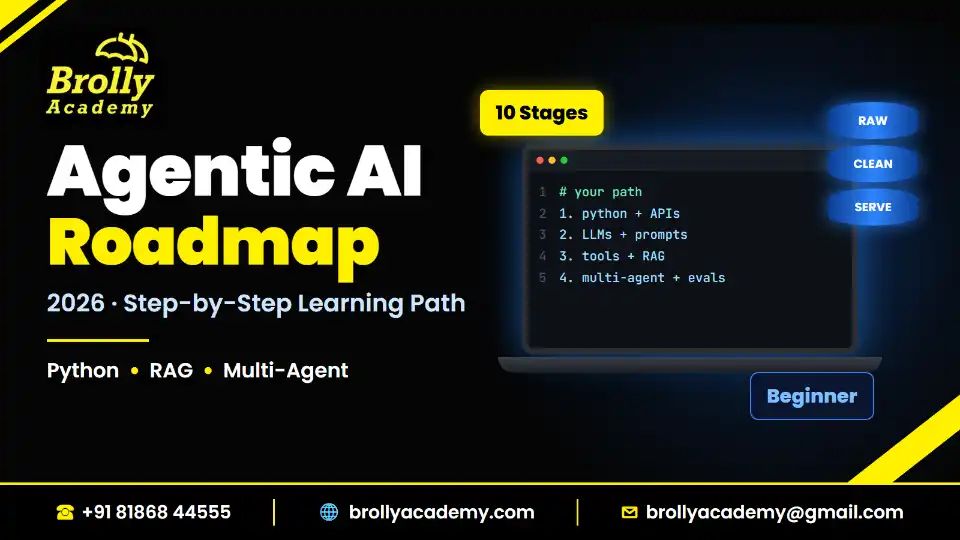
Table of Contents
1. What is an agentic AI roadmap?
2. Before you start: prerequisites, time and setup
3. Stage 1: Python and APIs (weeks 1 to 4)
4. Stage 2: LLM basics and prompting (weeks 5 and 6)
5. Stage 3: Tool calling and structured output (weeks 7 and 8)
6. Stage 4: RAG and memory (weeks 9 to 11)
7. Stage 5: Learn one agent framework (weeks 12 to 14)
8. Stage 6: Multi-agent orchestration and workflow patterns (weeks 15 and 16)
9. Stage 7: MCP and A2A protocols (weeks 17 and 18)
10. Stage 8: Evaluation, guardrails and observability (weeks 19 and 20)
11. Stage 9: Deployment and cost control (weeks 21 and 22)
12. Stage 10: Build your portfolio (weeks 23 to 26, then ongoing)
13. The complete agentic AI roadmap table
14. Free official learning resources
15. Agentic AI roadmap by background
Quick answer
The best agentic AI roadmap takes you through 10 stages in about 6 months: Python and APIs, LLM basics, tool calling, RAG and memory, one framework, multi-agent orchestration, MCP and A2A, evaluation and guardrails, deployment and cost, and finally a portfolio. Each stage builds on the one before it. You do not need a machine learning degree. You do need steady practice, about 10 to 12 hours a week, and small working projects at every stage instead of only watching videos.
- Months 1 and 2: Python, APIs, how LLMs work, prompting, tool calling and structured output
- Months 3 and 4: RAG, memory, one agent framework and multi-agent patterns
- Month 5: MCP, A2A, evaluation, guardrails and observability
- Month 6: deployment, cost control and 3 to 4 portfolio projects
- Shortcut for developers: skip most of stage 1 and finish in about 4 months
Key takeaways
- Learn in order. Agents are LLMs plus tools plus memory plus control logic, so each skill depends on the one before it.
- Start simple. Anthropic's own guide advises building the simplest solution first and adding agent complexity only when it clearly helps (Anthropic, December 2024).
- Pick one framework and go deep before you sample others. The concepts transfer; the syntax does not matter much.
- Evaluation, guardrails and cost control are what separate a demo from a job-ready skill. Do not skip stage 8 and stage 9.
- Your portfolio is your proof. Finish every stage with a small project you can show on GitHub.
1. What is an agentic AI roadmap?
Short answer: An agentic AI roadmap is an ordered learning plan that takes you from basic programming to building, testing and deploying AI agents that can plan, use tools and complete tasks with limited human help.
Agentic AI means AI systems that pursue a goal on their own. They break a task into steps, call tools such as APIs or databases, check results and keep going until the job is done. A chatbot answers a question. An agent can answer the question, look up your order, raise a refund ticket and email you the status.
Because an agent combines many parts, learners often jump into a framework tutorial, copy working code, and then cannot fix it when it breaks. A roadmap tells you what to learn first and what "done" looks like at each stage. If you are completely new, start with our agentic AI for beginners guide and come back here for the full path.
2. Before you start: prerequisites, time and setup
Short answer: You need basic computer skills, comfort with English documentation, a laptop with internet, and 10 to 12 hours a week. Python helps a lot, but you can learn it in stage 1. Maths and machine learning theory are not required to start.
Time plan. At 10 to 12 hours a week, the full roadmap takes about 24 to 26 weeks. If you can study full time, you can finish in about 3 months. If you already code daily at work, you can skip most of stage 1.
Setup. Install Python, VS Code and Git, and create a GitHub account. Get an API key from one model provider, set a small monthly budget, and keep keys out of your code.
Rule for every stage. Learn, build something small, then write a README on what you built and what broke.
3. Stage 1: Python and APIs (weeks 1 to 4)
Short answer: Learn core Python, how to call web APIs, how to read and write JSON, and how to handle errors. By the end, you should be able to write a script that calls a public API and saves clean results.
Python is the main language of agentic AI. You do not need to be an expert, but you must be comfortable reading and changing code.
What to learn:
- Data types, lists, dictionaries, loops, functions and basic classes
- Virtual environments and pip
- Reading and writing JSON files
- HTTP requests to APIs, with error handling, retries and timeouts
- Async basics and type hints, which most agent libraries use
Mini project: a weather or news script that calls a free public API, cleans the data and saves it to a JSON file. Add error handling for a failed request.
Done when: you can read an API's documentation and write working code for it without copying a tutorial line by line.
4. Stage 2: LLM basics and prompting (weeks 5 and 6)
Short answer: Understand what a large language model is, how tokens, context windows and temperature work, why models hallucinate, and how to write clear prompts. Then call an LLM from your own Python code.
An LLM (large language model) is an AI model trained on huge amounts of text. It predicts the next piece of text, called a token, one step at a time. Chat assistants are built on LLMs. In an agent, the LLM is the "brain" that decides what to do next.
What to learn:
- Tokens and context windows: how much text a model can see at once, and why long inputs cost more
- Temperature and other settings that change how creative or fixed the output is
- System prompts, user prompts and conversation history
- Prompt patterns: clear instructions, examples (few-shot prompting), step-by-step reasoning and output format rules
- Hallucination: why models sometimes state wrong facts confidently, and how to reduce it
- The difference between open-weight models you can run yourself and hosted models you call through an API
Mini project: a command-line chat assistant that keeps conversation history and uses a system prompt to act as a study helper for one subject.
Done when: you can explain what a token is, call a model from Python, and change the output reliably by changing the prompt.
If you are still unsure how generative AI and agentic AI differ, keep it simple: generative AI creates content; agentic AI uses that ability to plan and take actions towards a goal.
5. Stage 3: Tool calling and structured output (weeks 7 and 8)
Short answer: Learn how an LLM asks your code to run a function (tool calling), how to get reliable JSON back (structured output), and how to build the basic agent loop: think, call a tool, read the result, repeat.
This is the stage where a chatbot becomes an agent. Tool calling (also called function calling) means you describe your functions to the model, such as "get_order_status(order_id)". The model does not run the function itself. It replies with the name of the tool and the arguments it wants. Your code runs the tool and sends the result back. The model then decides the next step.
Structured output means asking the model to reply in a fixed format, usually JSON that matches a schema. This matters because your code cannot reliably use free text. If the model returns clean JSON, your program can check it and act on it.
What to learn:
- Writing clear tool names, descriptions and parameter schemas
- The agent loop: the model reasons, picks a tool, gets the result and continues until the task is done
- The ReAct pattern (reasoning plus acting), where the model alternates between thinking and calling tools
- Validating model output against a schema and handling bad output
- Limiting the number of loop steps so an agent cannot run forever
Anthropic's guide calls this core building block the "augmented LLM": a model improved with retrieval, tools and memory. The same guide stresses that designing your tools carefully matters as much as writing good prompts (Anthropic, December 2024).
Mini project: a calculator and unit-converter agent with two or three tools, written with the plain model API and no framework. Doing it by hand once teaches you what every framework does behind the scenes.
Done when: you can draw the agent loop on paper and build it in plain Python.
6. Stage 4: RAG and memory (weeks 9 to 11)
Short answer: Learn retrieval-augmented generation (RAG) so your agent can answer from your own documents, and learn short-term and long-term memory so it can remember context across steps and sessions.
RAG (retrieval-augmented generation) means fetching relevant information from your data and passing it to the model along with the question. The model then answers based on that information instead of only its training data. This reduces hallucination and lets agents work with company documents, policies or product catalogues.
What to learn:
- Embeddings: turning text into numbers so similar meanings sit close together
- Chunking: splitting documents into useful pieces
- Vector databases: storing and searching embeddings (popular options include ChromaDB, FAISS and Pinecone)
- Retrieval quality: better chunking, metadata filters and re-ranking
- Agentic RAG: letting the agent decide when to search, what to search and whether the result is good enough
- Short-term memory (the current conversation and task state) and long-term memory (facts saved across sessions)
Mini project: a document question-answering agent over 20 to 30 PDFs, such as your college syllabus or a set of public policy documents. Show the source chunk with each answer.
Done when: your agent answers from your documents, says "I don't know" when the answer is not there, and shows where each answer came from.
7. Stage 5: Learn one agent framework (weeks 12 to 14)
Short answer: Choose one framework, such as LangGraph, the OpenAI Agents SDK, CrewAI, Google ADK, Pydantic AI or Microsoft Agent Framework, and build two projects with it. Depth in one beats shallow knowledge of five.
A framework gives you ready-made pieces for the agent loop, tools, memory, state, retries and tracing, so you do not rewrite them every time. Because you built a loop by hand in stage 3, you will now understand what the framework is doing for you.
How to choose your first one:
Our agentic AI frameworks guide compares owners, licences, languages and strengths in detail, so here we keep it short: pick the one that matches your goal and stick with it for this stage.
What to learn inside the framework: defining agents and tools, managing state, streaming output, handling errors, adding a human approval step, and reading traces to see each decision the agent made.
Mini projects: rebuild your stage 3 agent and your stage 4 RAG agent in the framework. Compare the code and note what became easier.
Done when: you can build a new agent in your framework from the official docs alone.
8. Stage 6: Multi-agent orchestration and workflow patterns (weeks 15 and 16)
Short answer: Learn when one agent is enough, when a fixed workflow is better, and when several agents should work together. Practise the main patterns: prompt chaining, routing, parallel work, orchestrator-workers and evaluator-optimizer.
Orchestration means coordinating steps, tools and agents so they work together towards one goal. Not every problem needs many agents. Often a simple workflow with clear steps is cheaper and more reliable.
Anthropic separates two ideas that you should keep clear in your head (Anthropic, December 2024):
- Workflows: the LLM and tools follow predefined code paths that you design.
- Agents: the LLM directs its own process and decides which tools to use.
The same guide lists five common patterns, which make a good practice list:
Mini project: a research assistant where a lead agent plans the work, two worker agents gather information, and a reviewer agent checks the final report.
Done when: you can explain why you chose one agent, a workflow, or several agents for a given problem, and defend that choice on cost and reliability.
9. Stage 7: MCP and A2A protocols (weeks 17 and 18)
Short answer: Learn the Model Context Protocol (MCP), the open standard for connecting agents to tools and data, and Agent2Agent (A2A), the open protocol for agents to talk to other agents. Build one MCP server and connect it to an agent.
MCP (Model Context Protocol) is a standard way for an AI application to connect to tools and data sources. Instead of writing a custom connector for every tool, you expose the tool once as an MCP server and any MCP-compatible agent can use it. Anthropic introduced MCP on 25 November 2024. On 9 December 2025, Anthropic donated it to the Agentic AI Foundation, a fund under the Linux Foundation co-founded by Anthropic, Block and OpenAI, and reported more than 10,000 active public MCP servers and over 97 million monthly SDK downloads (Anthropic, December 2025). That level of adoption is why MCP is now a core skill, not an optional extra.
A2A (Agent2Agent) solves a different problem. MCP connects an agent to tools; A2A lets separate agents, possibly built by different teams or vendors, discover each other and work together. Google created A2A, and the Linux Foundation launched it as an open project on 23 June 2025 (Linux Foundation, June 2025).
What to learn:
- MCP basics: servers, clients, tools and resources
- Building a small MCP server that exposes one or two of your own functions
- Connecting your framework agent to an MCP server
- Security basics for MCP: only connect trusted servers and limit what each tool can do
- A2A basics: how one agent describes its skills and hands a task to another
Mini project: an MCP server that exposes your RAG search as a tool, used by your stage 5 agent.
Done when: you can explain the difference between MCP and A2A in two sentences and show a working MCP connection.
10. Stage 8: Evaluation, guardrails and observability (weeks 19 and 20)
Short answer: Learn to measure whether your agent works, to stop it from doing unsafe things, and to see every step it took. This is the stage most learners skip and most employers care about.
An agent that works once in a demo is not ready. You need to know how often it succeeds, why it fails and how to stop harmful actions.
Evaluation means testing your agent against a fixed set of tasks and checking the results. Build a small test set of 20 to 50 realistic tasks with expected outcomes. Measure task success, correct tool choice, answer accuracy, number of steps, time taken and cost per task. Run the same tests after every change so you know if you made things better or worse. You can use an LLM as a judge for open-ended answers, but check its scores by hand on a sample.
Guardrails are checks that keep the agent safe and on topic. Common ones include:
- Input checks that block off-topic or harmful requests
- Filters that stop personal data leaking into prompts or outputs
- Output validation against a schema before any action runs
- Tool limits, such as read-only access by default
- Human-in-the-loop approval before high-risk actions, such as payments, deletions or sending emails
- Defences against prompt injection, where text in a web page or document tries to give the agent new instructions
Observability means recording what happens inside the agent: each prompt, tool call, result, token count and error. These records are called traces. When an agent fails, traces tell you which step went wrong. Most frameworks support tracing, and dedicated tools exist for it.
Mini project: add a test set, a simple scoring script, two guardrails and tracing to one of your earlier agents. Write down the success rate before and after one improvement.
Done when: you can show a number for how well your agent performs and explain how you improved it.
11. Stage 9: Deployment and cost control (weeks 21 and 22)
Short answer: Learn to wrap your agent in an API, package it, deploy it to the cloud, secure it, and keep model costs under control with smaller models, caching and step limits.
Deployment basics:
- Wrap the agent in a web API using a Python framework such as FastAPI
- Package it with Docker so it runs the same everywhere
- Deploy to a cloud service on AWS, Azure or Google Cloud
- Store secrets safely and add authentication
- Handle long-running tasks with background jobs and saved state
- Log errors and set up alerts
Cost control matters because agents call the model many times per task. One user request can trigger many model calls, and each call costs money. Ways to keep costs down:
- Use a smaller, cheaper model for simple steps, such as routing, and a stronger model only for hard reasoning
- Cache repeated prompts and tool results
- Keep prompts and retrieved context short
- Limit the maximum number of steps and tokens per task
- Track cost per task as part of your evaluation from stage 8
Mini project: deploy one agent behind an API with a simple web page in front of it, and show its cost per task in your README.
Done when: someone else can use your agent through a link, and you know roughly what each request costs.
12. Stage 10: Build your portfolio (weeks 23 to 26, then ongoing)
Short answer: Turn your stage projects into 3 to 4 polished portfolio pieces with clean code, a README, a demo video, evaluation results and a short write-up of design choices.
Recruiters and interviewers want proof that you can build, test and ship. A strong agentic AI portfolio usually has:
- A RAG agent over real documents, with source citations and an evaluation score
- A tool-using workflow agent that automates a real task, such as triaging support emails, with a human approval step
- A multi-agent system with a clear reason for using several agents
- An MCP project, such as a custom MCP server for a tool or database
For each project, include: the problem, the architecture diagram, how you evaluated it, what failed and how you fixed it, cost per task, and a 2-minute demo video. For more ideas, browse our list of AI agent projects.
Done when: you can walk an interviewer through any project for 10 minutes, including its weak points.
13. The complete agentic AI roadmap table
Short answer: Here is the whole roadmap on one page, with weeks, key topics and the project that proves each stage, at about 10 to 12 hours a week.
If you prefer a module-by-module course outline with outcomes and assessments instead of a weekly plan, see our agentic AI syllabus.
14. Free official learning resources
Short answer: You can cover most of this roadmap for free using official courses and documentation: the DeepLearning.AI Agentic AI course (free to audit), the Hugging Face Agents Course, Anthropic's "Building effective agents" guide, the MCP documentation, and the official docs of whichever framework you choose.
Use official sources first. They are accurate, current and free.
- DeepLearning.AI, "Agentic AI" by Andrew Ng. An intermediate course of about 9 hours 55 minutes that teaches four design patterns: reflection, tool use, planning and multi-agent collaboration. You can audit it free; the certificate needs a Pro plan at $25 a month billed annually (DeepLearning.AI, October 2026). Best for stages 3 and 6.
- Hugging Face Agents Course. A free course that covers smolagents, LangGraph and LlamaIndex, with a fundamentals certificate after Unit 1 and a completion certificate at the end (Hugging Face, October 2026). Best for stages 3 to 5.
- Anthropic, "Building effective agents". A short, practical guide to workflows, agents and the five patterns covered in stage 6. Read it twice: once in stage 3 and again in stage 6.
- MCP documentation and Anthropic's MCP announcements. Use the official MCP site and the posts linked in stage 7 for protocol basics.
- Official framework docs. Whichever framework you choose in stage 5, its own documentation and examples are the most reliable source, because frameworks change quickly.
If you want a formal credential at the end of the roadmap, our agentic AI certification guide compares vendor exams and course certificates, with costs and who each one suits.
15. Agentic AI roadmap by background
Short answer: The stages stay the same, but your starting point and speed change. Freshers follow the full 6-month path, developers can finish in about 4 months, data scientists can move faster through stages 2 and 4, and non-coders can start with low-code tools before learning Python.
Roadmap for freshers and students
Follow all 10 stages in order. Spend the full 4 weeks on Python, because weak Python slows down every later stage. Build one project per stage and push everything to GitHub from week 1, so your profile shows steady progress. In your final year, aim to finish stages 1 to 5 before placement season and continue with stages 6 to 10 alongside interview preparation. Look for internships where you can work on a real RAG or automation task, even a small one. Expected time: about 6 months at 10 to 12 hours a week.
Roadmap for software developers
You already know programming, APIs, Git and deployment, so compress stage 1 to a week of Python refresh if you come from Java, .NET or JavaScript. Stage 9 will also feel familiar. Put your saved time into stages 3, 4, 7 and 8. Your edge is engineering discipline: testing, error handling, logging and security. Show that in your projects. Choose a framework that matches your current stack; for example, .NET developers may prefer Microsoft Agent Framework, which supports .NET as well as Python. Expected time: about 4 months.
Roadmap for data scientists and ML engineers
You know Python, data handling and model evaluation, so stage 1 is mostly done and stage 8 will come naturally. Move quickly through stage 2, but take time to unlearn one habit: in agentic AI you rarely train models. You orchestrate pretrained ones. Focus on stages 3, 5, 6, 7 and 9, especially software engineering skills such as APIs, Docker and clean project structure. Your evaluation skills are a strong selling point, so make evaluation the centre of your portfolio. Expected time: about 3 to 4 months.
Roadmap for non-coders and career switchers
Start with understanding, not code. Spend 2 to 3 weeks learning what agents are, how LLMs work and how prompting works (stage 2 concepts). Then build simple agents in a low-code or no-code builder, such as n8n or Langflow, to understand tools, triggers and workflows visually. After that, decide your direction. If you want an engineering role, go back to stage 1 and learn Python properly; low-code skills alone rarely lead to developer jobs. If you want a business, product or automation role, go deeper into workflow design, evaluation and guardrails, and learn enough Python to read code. Expected time: about 2 months for a low-code foundation, then the full path if you choose engineering.
16. Common mistakes to avoid on your agentic AI roadmap
Short answer: The biggest mistakes are skipping Python, jumping between frameworks, building multi-agent systems too early, ignoring evaluation and cost, and copying tutorials without understanding them.
- Skipping fundamentals. If you cannot debug Python, you cannot debug an agent.
- Framework hopping. Learning five frameworks at a shallow level teaches less than building three projects in one.
- Going multi-agent too early. Many problems are solved better by one agent or a fixed workflow. Use several agents only when you can explain why.
- No evaluation. "It worked when I tried it" is not evidence. Keep a test set from stage 8 onwards.
- Ignoring cost and safety. An agent that calls the model dozens of times per task, or can send emails without approval, will not pass a real review.
- Following outdated content. Agent tools change fast, so check the official docs for the current version before you build.
17. How Brolly Academy helps
Short answer: Brolly Academy's 3-month Agentic AI Course in Hyderabad follows the same journey as this roadmap, from foundations to tools and workflows to projects and deployment, with live training, six capstone projects and placement assistance.
If you prefer a guided path with a trainer, deadlines and feedback, the Agentic AI Course in Hyderabad is structured in three months: Month 1 covers foundations, Month 2 covers tools and workflows, and Month 3 covers projects and deployment, followed by career preparation.
What the course includes, as listed on the course page (October 2026):
- 9 modules: Introduction to Agentic AI; Foundations of AI Agents; Multi-Agent Systems; Reinforcement Learning for Agentic AI; LLMs and Agentic AI; Tools and Frameworks for Building AI Agents; Agentic AI for Security and Cloud Automation; Ethics and Risks of Agentic AI; Hands-on Projects and Case Studies
- Roadmap topics: tool calling, MCP basics, agentic RAG, human-in-the-loop and evaluation, with the OpenAI Agents SDK, Google ADK and Foundry Agent Service
- Six capstone projects: a customer support agent, a document Q&A and RAG agent, a workflow automation agent, an email and sales research agent, a resume screening and HR agent, and a data analysis agent
- Trainer: Mr. Dinesh, an Agentic AI and Generative AI specialist and cloud architect with 12+ years in AI, ML, cloud computing and generative AI
- Modes: classroom and online, with weekend batches and flexible schedules
- Fees: Video Recording ₹9,999, Online Course ₹24,999 and Classroom Training ₹29,999, with easy EMI available
- Career support: placement assistance, resume and LinkedIn help, mock interviews and internship opportunities
- Eligibility: no AI experience needed and Python is optional; you must be 18 or older
The next batch starts on Monday, 2 November 2026, and a free demo class is available so you can check the teaching style before you join. You receive a Brolly Academy Agentic AI course completion certificate at the end. Note that this is a course certificate, not a vendor certification.
Want a trainer to guide you through this roadmap?
Brolly Academy's 3-month Agentic AI Course in Hyderabad takes you from foundations to tool calling, RAG, MCP, multi-agent systems and deployment, with six capstone projects and placement assistance. Join classroom or online batches, starting Monday, 2 November 2026. Book a free demo class to see if it suits you.
Frequently asked questions
What is an agentic AI roadmap?
An agentic AI roadmap is an ordered learning plan for building AI agents that plan, use tools and finish tasks with limited human help. A good roadmap moves through Python and APIs, LLM basics, tool calling, RAG and memory, one framework, multi-agent orchestration, MCP and A2A, evaluation and guardrails, deployment and cost, and finally a portfolio. Each stage ends with a small project that proves you can apply what you learned.
How long does it take to learn agentic AI?
It takes about 6 months to learn agentic AI to a job-ready level if you study 10 to 12 hours a week. Full-time learners can finish in about 3 months. Software developers who already know programming and deployment can usually finish in about 4 months, and data scientists in about 3 to 4 months, because they can move faster through the early stages.
Can I learn agentic AI without coding?
Yes, you can start without coding by learning the concepts and building simple agents in low-code builders such as n8n or Langflow. This helps you understand tools, triggers and workflows. However, low-code skills alone rarely lead to developer roles. If you want an engineering job, plan to learn Python properly after your low-code foundation, then follow the full roadmap.
What are the prerequisites to learn agentic AI?
The main prerequisites are basic computer skills, comfort reading English documentation, a laptop with internet and about 10 to 12 hours a week. Python is very helpful, but you can learn it in the first stage of the roadmap. You do not need machine learning theory or advanced maths to start building agents, because you use pretrained models rather than training them.
Is Python required for agentic AI?
Python is effectively required for engineering roles in agentic AI, because almost every agent framework and SDK is Python first. You need core Python, working with APIs and JSON, error handling, async basics and type hints. You do not need to be an expert. Comfort reading and changing code is enough to start, and your skills will grow with each project.
How can I learn agentic AI for free?
You can learn most of agentic AI for free using official resources. The DeepLearning.AI Agentic AI course can be audited free, the Hugging Face Agents Course is free, and Anthropic's Building effective agents guide is free to read. Add the official MCP documentation and the docs of your chosen framework. You will only pay small model API costs for your own projects.
Should I learn generative AI before agentic AI?
You should learn the generative AI basics first, but you do not need to master it. Agentic AI is built on LLMs, so you must understand tokens, context windows, prompting and hallucination. In this roadmap that takes about two weeks in stage 2. After that, you move to tool calling, which is where generative AI turns into agentic AI.
Do I need machine learning or maths to learn agentic AI?
No, you do not need machine learning theory or advanced maths to start learning agentic AI. Agent builders use pretrained models through APIs and focus on tools, workflows, retrieval, evaluation and deployment. Some understanding of embeddings helps when you learn RAG, but you can pick that up as you go. Deeper maths becomes useful later only if you move into model training.
Which agentic AI framework should I learn first?
Learn the framework that matches your goal. LangGraph suits fine control over steps and state, the OpenAI Agents SDK offers a light start, CrewAI fits role-based teams of agents, Pydantic AI suits type-safe Python, and Google ADK or Microsoft Agent Framework fit those cloud stacks. Build two projects in one framework before trying another, because the concepts transfer.
What is tool calling in agentic AI?
Tool calling, also called function calling, lets an LLM ask your code to run a function such as checking an order status. The model does not run the tool itself. It returns the tool name and arguments, your code runs it, and the result goes back to the model, which decides the next step. This loop is what turns a chatbot into an agent.
What is RAG and why does an agent need it?
RAG, or retrieval-augmented generation, fetches relevant information from your own data and passes it to the model with the question. An agent needs it to answer from company documents, policies or catalogues instead of only its training data. RAG reduces hallucination and lets the agent show sources. Agentic RAG goes further by letting the agent decide when and what to search.
What is MCP and should beginners learn it?
MCP, the Model Context Protocol, is an open standard for connecting AI agents to tools and data sources. Anthropic introduced it in November 2024 and donated it to the Agentic AI Foundation under the Linux Foundation in December 2025, reporting more than 10,000 active public MCP servers. Beginners should learn it after tool calling and one framework, around stage 7 of the roadmap.
What is the A2A protocol?
A2A, or Agent2Agent, is an open protocol that lets separate AI agents discover each other and work together, even when different teams or vendors built them. Google created it, and the Linux Foundation launched it as an open project in June 2025. MCP connects an agent to tools, while A2A connects agents to other agents. Learn its basics alongside MCP.
When should I learn multi-agent systems?
Learn multi-agent systems only after you can build a reliable single agent with tools, RAG and one framework, which is around weeks 15 and 16 of this roadmap. Many problems are solved better by one agent or a fixed workflow. Practise patterns such as routing, parallel work, orchestrator-workers and evaluator-optimizer, and always be ready to explain why several agents were needed.
How do I evaluate an AI agent?
Evaluate an AI agent by testing it against a fixed set of 20 to 50 realistic tasks with expected outcomes. Measure task success, correct tool choice, answer accuracy, number of steps, time and cost per task. Run the same tests after every change. You can use an LLM as a judge for open-ended answers, but check a sample of its scores by hand.
What are guardrails in agentic AI?
Guardrails are checks that keep an agent safe, accurate and on topic. Common guardrails include input checks for harmful requests, filters that stop personal data leaking, output validation against a schema, read-only tool access by default, defences against prompt injection, and human approval before high-risk actions such as payments, deletions or sending emails. Employers expect you to know these well.
How much does it cost to run AI agents while learning?
The cost of running agents while learning is usually small if you control it, but agents call the model many times per task, so costs can grow quickly. Set a monthly budget in your provider dashboard, use smaller models for simple steps, cache repeated calls, keep prompts short and limit the steps per task. Track cost per task as part of your evaluation.
What projects should I build for an agentic AI portfolio?
Build 3 to 4 strong projects: a RAG agent over real documents with source citations, a tool-using workflow agent with a human approval step, a multi-agent system with a clear reason for using several agents, and an MCP project such as a custom server. For each one, include an architecture diagram, evaluation results, cost per task and a short demo video.
What is the agentic AI roadmap for freshers?
Freshers should follow all 10 stages in order over about 6 months at 10 to 12 hours a week. Spend the full four weeks on Python, build one project per stage and push everything to GitHub from the first week. Final-year students should aim to finish stages 1 to 5 before placement season, then continue the later stages alongside interview preparation.
How can a software developer move into agentic AI?
A software developer can move into agentic AI in about 4 months by compressing the Python and deployment stages and spending the saved time on tool calling, RAG, MCP and evaluation. Your strengths in testing, logging, error handling and security matter a lot, so show them in your projects. Choose a framework that fits your current stack, such as Microsoft Agent Framework for .NET.
How should a data scientist learn agentic AI?
A data scientist can learn agentic AI in about 3 to 4 months because Python, data handling and evaluation are already familiar. The key shift is that you orchestrate pretrained models instead of training them. Focus on tool calling, one framework, multi-agent patterns, MCP and deployment skills such as APIs and Docker. Make evaluation the centre of your portfolio, because it is your strongest advantage.
Is agentic AI hard to learn?
Agentic AI is not hard to learn if you follow the stages in order, but it is broad. Each stage is manageable on its own: Python, prompting, tool calling, retrieval, a framework and so on. Learners struggle when they skip fundamentals or jump between frameworks. With 10 to 12 hours a week and a small project at every stage, most learners make steady progress.
Is learning agentic AI worth it in 2026?
Learning agentic AI is worth it in 2026 if you build real, tested projects rather than only collecting course videos. The ecosystem is growing fast, shown by more than 10,000 active public MCP servers reported in December 2025. Skills such as tool calling, RAG, evaluation, guardrails and deployment are useful across many AI roles, so they hold value even as specific tools change.
Do I need a certification to follow this roadmap?
No, you do not need a certification to follow this roadmap or to get started in agentic AI. Your portfolio of working, evaluated projects is the strongest proof of skill. A certification can help at the end as extra evidence, especially a vendor exam linked to the cloud platform you want to work with. Free courses such as the Hugging Face Agents Course also offer certificates.
Does Brolly Academy offer a course that follows this roadmap?
Yes, Brolly Academy offers a 3-month Agentic AI Course in Hyderabad covering foundations, tools and workflows, and projects and deployment. It includes tool calling, MCP basics, agentic RAG, human-in-the-loop and evaluation, six capstone projects and placement assistance. Fees are ₹9,999 for video recordings, ₹24,999 for online and ₹29,999 for classroom training, with EMI available and a free demo class.
Learn with Brolly Academy
Review the syllabus, practical projects and batch timings, and book a free demo before you enrol.
Related Articles
Continue Your Learning
Agentic AI Course in Hyderabad
3 months of hands-on training in AI agents, multi-agent systems, LLMs, tools and frameworks, with 6 capstone projects and placement assistance.
View CourseAI Orchestration Course in Hyderabad
Build LLM workflows with LangGraph, APIs, RAG and human approvals, and learn to run AI pipelines that are reliable in production.
View CourseAzure AI Course
Microsoft Foundry, Azure OpenAI, RAG, agents and evaluation, for building AI apps and agents on Azure.
View Course