
Brolly Academy | Agentic AI
Agentic AI vs AI Agents
What Is the Difference? Definitions, Table and Examples (2026)
A plain-English guide to the difference between agentic AI and AI agents in 2026: what each term means, a side-by-side table, the five classic types of AI agents, how multi-agent systems turn agents into agentic AI, how IBM and Google Cloud define both, real examples, and which word to use when.
Agentic AI vs AI agents explained: what an AI agent is, what agentic AI means, a differences table, 5 types of AI agents, multi-agent systems and examples.
By Brolly Academy Team · Brolly Academy · Updated 23 October 2026
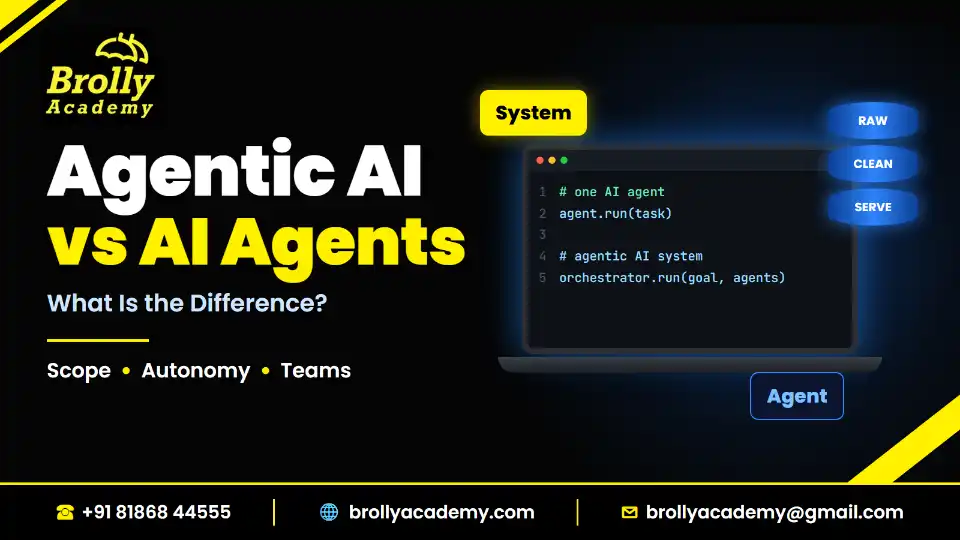
Table of Contents
3. Agentic AI vs AI agents: key differences
4. How AI agents and agentic AI fit together: a worked example
6. Multi-agent systems: where agents become agentic AI
7. How vendors define AI agents and agentic AI
8. Examples of AI agents and agentic AI
9. Agent washing: why the terms get blurred
Quick answer
An AI agent is a single piece of software that pursues a goal by sensing, deciding and acting, while agentic AI is the broader approach of building whole systems, often with several coordinated agents, that plan and complete multi-step goals with limited human supervision. Think of an AI agent as one worker and agentic AI as the way the whole team is organised, managed and given freedom to act. Every agentic AI system uses agents, but not every agent is part of an agentic system. A simple chatbot that looks up your order status is an agent. A system that reads your complaint, checks the order, talks to the courier, issues a refund and follows up a week later is agentic AI.
- AI agent: one unit, usually focused on a specific task, with tools and some memory
- Agentic AI: the system or paradigm, with planning, coordination, memory and autonomy across many steps
- Relationship: agents are the building blocks; agentic AI is what you build with them
- Vendors agree: IBM and Google Cloud both describe agents as components and agentic AI as the system that coordinates them
- Practical rule: say "AI agent" for one specific tool, say "agentic AI" for the overall approach or a multi-step system
Key takeaways
- AI agents are the components and agentic AI is the system that coordinates them, according to IBM's explainer on agentic AI (October 2026).
- Google Cloud calls AI agents "the building blocks of agentic AI" and describes agentic AI as a subset of generative AI that uses large language models as a "brain" (October 2026).
- Classic AI textbooks group agents into five types, from simple reflex agents to learning agents. Modern LLM agents mostly sit in the goal-based and learning end of that range.
- Multi-agent systems, where several specialised agents share work, are the most common way an agent becomes part of agentic AI.
- Gartner warns of "agent washing" and estimates only about 130 of the thousands of agentic AI vendors are real (June 2025), so always check what a product actually does before trusting its label.
1. What is an AI agent?
Short answer: An AI agent is software that observes its environment, decides what to do, and takes actions to reach a goal. Modern AI agents use a large language model to reason and call tools to act.
The idea of an "agent" is much older than ChatGPT. In computer science, an agent is anything that perceives its surroundings and acts on them. A thermostat that switches on a heater when the room gets cold is a very simple agent. So is a robot vacuum that maps your room.
In 2026, when people say "AI agent", they usually mean an agent built on a large language model. A large language model (LLM) is the AI model behind tools like ChatGPT, Claude and Gemini. It is trained on huge amounts of text and can understand instructions and generate answers.
An LLM on its own can only produce text. It becomes an agent when you give it three extra things:
- Tools: functions or APIs it can use, such as "search orders", "send email" or "run SQL query". Letting the model choose and call these functions is called tool calling (or function calling).
- Instructions: a clear goal and rules, such as "help customers track orders, never share card details".
- Memory: a record of what has happened so far in the conversation or task, so it does not start from zero at every step.
An agent is different from a plain assistant or chatbot. An assistant mostly answers when you ask. An agent pursues a goal and takes actions, such as looking up data, updating a record or sending a message.
Here is a simple AI agent in action. You build a "leave balance agent" for an HR team in Hyderabad. An employee types, "How many casual leaves do I have left?" The agent reads the question, decides it needs data, calls the HR system's API, gets the number, and replies, "You have 4 casual leaves left this year." It has a goal, it uses a tool, and it acts. That is an AI agent. It does not plan a week of work or hand tasks to other agents. It does one job well.
2. What is agentic AI?
Short answer: Agentic AI is the broader approach of building AI systems that take a goal, break it into steps, use tools and agents to carry those steps out, check the results and adjust, all with limited human supervision.
The word "agentic" means "having agency", which is the ability to act on your own. Agentic AI describes a system's behaviour and design, not a single piece of software.
IBM describes agentic AI as an AI system that reaches a specific goal with limited supervision. It runs through a loop of perception, reasoning, planning, decision-making, action, and learning or adaptation. In the same explainer, IBM says AI agents are the components and agentic AI is the system that coordinates them (IBM, October 2026).
An agentic AI system usually has these parts:
- One or more LLMs that act as the reasoning engine.
- Several agents or steps, each with its own tools and responsibility.
- Orchestration: the logic that decides which agent or step runs next, passes information between them and handles errors. Think of it as the project manager of the system.
- Memory: short-term memory for the current task and long-term memory for facts, past results and user preferences.
- Retrieval: often RAG, short for retrieval-augmented generation. RAG lets the system search your documents or database and feed the relevant parts to the LLM so its answers are based on your data, not only on its training.
- Guardrails and human checkpoints: rules that block unsafe actions and ask a person to approve risky ones, such as a refund above a set amount.
Let us extend the HR example. Now the goal is "Onboard every new joiner this Monday." An agentic AI system might plan the work like this: one agent creates email and laptop requests, another schedules induction meetings, a third prepares the welcome pack using company policy documents (with RAG), and an orchestrator tracks progress and asks the HR manager to approve anything unusual. If a laptop is out of stock, the system notices, finds an alternative and updates the joiner. That is agentic AI.
For a deeper explanation of how agentic AI works, its components and its risks, read our full guide on what is agentic AI.
3. Agentic AI vs AI agents: key differences
Short answer: AI agents are individual units that complete tasks. Agentic AI is the system-level approach that combines planning, coordination, memory and autonomy across many steps and, often, many agents.
The two terms overlap, so compare them on a few clear points.
Three differences matter most. First, scope: an AI agent is a thing you can point to, such as "the order-status agent", while agentic AI describes the whole setup. Second, autonomy: an agent usually gets a task ("find this customer's order"), while an agentic system gets a goal ("resolve this complaint") and works out the tasks itself. Autonomy is a scale, not a switch. Third, coordination: most agentic systems split work between specialised agents and an orchestrator, and shared memory and hand-offs are what turn separate agents into one system.
If you are also confused about where generative AI fits, the short version is this: generative AI creates content such as text, images or code when you ask, while agentic AI uses generative models to pursue goals by taking actions. We compare the two in detail in agentic AI vs generative AI.
4. How AI agents and agentic AI fit together: a worked example
Short answer: Start with one AI agent for one job, then add planning, more agents, shared memory and orchestration. At some point the whole setup becomes an agentic AI system.
Let us follow one real-world style problem from a simple agent to a full agentic system. The problem: an online electronics store in India gets thousands of "Where is my order?" and "I want to return this" messages every day.
Stage 1: a single AI agent
You build one agent with an LLM and two tools: "get order status" and "get courier tracking". A customer asks, "Where is my order 4521?" The agent calls the tools and replies with the delivery date. This is an AI agent. It is useful, cheap and easy to test.
Stage 2: an agent with more tools and memory
You add a "create return request" tool, access to the return policy through RAG, and memory of past chats. Now the agent can say, "Your phone is within the 7-day return window. Shall I book a pickup?" It is still one agent, but more capable. Many teams stop here, and that is fine.
Stage 3: several agents with a coordinator
Returns now need a quality check, a refund and an inventory update. You split the work:
- Support agent: talks to the customer and understands the request.
- Policy agent: checks the return rules and fraud signals.
- Logistics agent: books the pickup with the courier.
- Finance agent: starts the refund once the item reaches the warehouse.
- Orchestrator: decides which agent acts next, keeps the shared record of the case and asks a human to approve refunds above a set amount.
Stage 4: the agentic AI system
Now give the system a goal, not a script: "Resolve every return within 5 days and keep customers informed." The system plans each case, tracks it over several days, notices when a pickup fails, rebooks it, updates the customer and learns which couriers cause delays. This whole setup is agentic AI. The individual agents inside it are still AI agents. Agentic AI is not a different technology; it is what you get when you give agents goals, coordination, memory and room to act over time.
5. Types of AI agents
Short answer: The classic five types are simple reflex agents, model-based reflex agents, goal-based agents, utility-based agents and learning agents. They range from fixed rules to systems that improve with feedback.
These categories come from traditional AI textbooks and are still widely taught. IBM's guide to types of AI agents describes the same five, with examples (IBM, October 2026). Knowing them helps you in interviews and helps you see where modern LLM agents fit.
Each type adds one ability to the one before. Simple reflex agents react only to what they sense right now and have no memory. Model-based agents keep an internal picture of the world. Goal-based agents think ahead and ask which action gets them closer to the goal. Utility-based agents pick the best option when many actions reach the goal. Learning agents get better with experience; IBM describes a performance element that acts, a learning element that improves, a critic that gives feedback and a problem generator that suggests new things to try.
Where LLM agents fit
A modern LLM agent is mostly goal-based: you give it a goal and it plans tool calls to reach it. Some designs add a utility flavour (choosing the cheapest or fastest tool) and a learning flavour (storing feedback in memory). An agentic AI system often mixes several types. IBM's own example is a smart factory where reflex agents handle safety shut-offs, goal-based agents handle scheduling and learning agents refine workflows, all inside one multi-agent system.
6. Multi-agent systems: where agents become agentic AI
Short answer: A multi-agent system is a group of AI agents that share a goal and divide the work between them. It is the most common way individual agents are combined into an agentic AI system.
One agent with twenty tools gets confused and becomes hard to test. Splitting the job between focused agents usually works better, just as a company splits work between departments.
Common multi-agent patterns
- Manager and workers: one orchestrator agent breaks the goal into subtasks and hands them to worker agents, then combines the results. This is often called the orchestrator-workers pattern.
- Hand-offs: agents pass the conversation to each other. A support agent hands a billing question to a billing agent.
- Pipeline or chain: each agent does one step and passes its output to the next, like research, then draft, then review.
- Evaluator and optimiser: one agent produces an answer and another checks it and asks for fixes until the result is good enough.
How agents talk to tools and to each other
As systems grow, agents need standard ways to connect. Two open protocols matter here:
- MCP (Model Context Protocol): a standard way for an agent to connect to tools and data sources, such as a database, a file system or a SaaS app, without writing custom code for each one. Think of it as a common plug for tools.
- A2A (Agent2Agent): a standard way for agents built by different teams or vendors to discover each other and exchange tasks.
Is agentic AI the same as a multi-agent system?
Not exactly. A multi-agent system is one way to build agentic AI, and it is the most common. But a single, well-designed agent that plans, uses many tools, remembers context and works towards a long goal can also be called agentic. And a group of agents that each follow a fixed script with no planning is a multi-agent system that is not very agentic. Agentic is about autonomy and goal pursuit; multi-agent is about structure.
7. How vendors define AI agents and agentic AI
Short answer: IBM and Google Cloud both treat AI agents as the building blocks and agentic AI as the coordinated system. Anthropic adds a useful split between fixed workflows and true agents.
IBM
IBM defines agentic AI as a system that achieves a specific goal with limited supervision, working through perception, reasoning, planning, decision-making, action and learning. It is clear on the relationship: AI agents are the components, agentic AI is the system that coordinates them, and generative AI is the part that creates content (IBM, October 2026).
Google Cloud
Google Cloud describes agentic AI as AI that sets goals, plans and executes tasks with minimal human intervention, in a continuous cycle of perception, planning, action and reflection. It calls agentic AI "a subset of generative AI" that orchestrates agents, using LLMs as a "brain" that acts through tools, and calls AI agents "the building blocks of agentic AI". Its example: generative AI writes marketing material, while agentic AI deploys it, tracks results and adjusts (Google Cloud, October 2026).
Anthropic: workflows vs agents
Anthropic, the company behind Claude, uses a different but helpful lens. In its engineering guide, it calls both kinds "agentic systems" but separates workflows, where LLMs and tools follow predefined code paths, from agents, where the LLM directs its own process and tool use. It advises starting with the simplest solution and adding complexity only when needed (Anthropic, December 2024).
The common thread is clear. An AI agent is a unit. Agentic AI is the behaviour and design of the whole system.
8. Examples of AI agents and agentic AI
Short answer: A single tool that does one job, such as answering FAQs or summarising a document, is an AI agent. A system that plans and completes a multi-step goal across tools, agents and days is agentic AI.
Here are side-by-side examples from areas you will recognise.
Where popular tools sit
People often ask whether a particular tool is "agentic AI" or "an AI agent". Usually the honest answer is: it is a tool for building one or both.
- Agent frameworks such as LangGraph, CrewAI, the OpenAI Agents SDK, Google's Agent Development Kit and Microsoft Agent Framework are code libraries for building agents and multi-agent systems. Older projects like Microsoft AutoGen are now legacy, and Microsoft points new users to Microsoft Agent Framework. See our guide to agentic AI frameworks for a full comparison.
- Workflow automation tools such as n8n let you connect apps and add AI agent steps. A simple n8n flow with one AI step is an agent inside a workflow. A larger flow where the AI decides which branches to run and which tools to call starts to look agentic.
If you want hands-on ideas, our list of AI agent projects shows what you can build at each level.
9. Agent washing: why the terms get blurred
Short answer: Many products use "agent" or "agentic" as a marketing label even when they are simple chatbots or rule-based automation. Gartner calls this "agent washing".
In June 2025 it predicted that over 40% of agentic AI projects will be cancelled by the end of 2027, due to escalating costs, unclear business value or inadequate risk controls. It also estimated that only about 130 of the thousands of agentic AI vendors are real, and warned about "agent washing", where existing products are rebranded with agentic labels (Gartner, June 2025).
The same Gartner release still expects real growth. It predicts that by 2028 at least 15% of day-to-day work decisions will be made autonomously through agentic AI, up from 0% in 2024, and that 33% of enterprise software applications will include agentic AI, up from under 1% in 2024.
A quick test for real agents and real agentic AI
Ask these questions about any product or project:
- Does it take actions, or does it only generate text?
- Does it choose its own tools and steps, or does it follow a fixed script?
- Does it remember context across steps and sessions?
- Can it handle a multi-step goal and recover when a step fails?
- Is there a human checkpoint for risky actions?
If the answer to the first two is no, it is a chatbot or an automation script, not an agent. If it passes all five and coordinates several steps or agents towards a goal, it is fair to call it agentic AI.
10. Which term should you use, and when?
Short answer: Use "AI agent" when you mean one specific piece of software with a clear job. Use "agentic AI" when you mean the overall approach, or a system that plans and acts across many steps or agents.
Here is a simple guide you can apply in projects, interviews and on your resume.
For students and freshers
In interviews, show that you know the difference. A strong answer is: "An AI agent is a unit that uses an LLM, tools and memory to complete a task. Agentic AI is the system-level approach where one or more agents plan, coordinate and act towards a goal with limited supervision." Then give a project example of each.
For developers and working professionals
Be precise in design documents, because calling a fixed workflow an "autonomous agent" sets the wrong expectations for testing, cost and risk. Following Anthropic's advice, start with the simplest design that works: a single LLM call, then a workflow, then an agent, and only then a multi-agent agentic system.
What to learn first
Learn to build one good AI agent before you build agentic systems. A sensible order is: Python and APIs, LLM basics and prompting, tool calling, RAG and memory, one framework, then multi-agent orchestration, protocols like MCP, evaluation and guardrails. Each step builds directly on the one before.
11. How Brolly Academy helps
Short answer: Brolly Academy's 3-month Agentic AI course takes you from single AI agents to multi-agent systems and deployment, with six capstone projects and placement assistance.
If you want to move from understanding the difference to actually building both, the Agentic AI Course in Hyderabad at Brolly Academy covers the full path. Here is what the course page lists (checked October 2026):
- Duration and structure: 3 months. Month 1 covers foundations, Month 2 tools and workflows, Month 3 projects and deployment, plus career preparation.
- Modules that match this article: Introduction to Agentic AI, Foundations of AI Agents, Multi-Agent Systems (MAS), Large Language Models (LLMs) and Agentic AI, Tools and Frameworks for Building AI Agents, and Ethics and Risks of Agentic AI, among nine modules in total.
- Hands-on topics: tool calling, MCP basics, agentic RAG, human-in-the-loop and evaluation, with the OpenAI Agents SDK, Google ADK and Foundry Agent Service shown on the roadmap.
- Six capstone projects: a customer support agent, a document Q&A and RAG agent, a workflow automation agent, an email and sales research agent, a resume screening and HR agent, and a data analysis agent.
- Modes and fees: Video Recording ₹9,999, Online Course ₹24,999 and Classroom Training ₹29,999, with easy EMI available. Classroom and online batches, weekend batches and flexible schedules.
- Career support: placement assistance, resume and LinkedIn help, mock interviews and internship opportunities. The certificate is a Brolly Academy course completion certificate, not a vendor certification.
- Who can join: no AI experience needed, Python optional, age 18 and above. A free demo class is available, and the next batch starts on Monday, 2 November 2026.
Build your first AI agent, then your first agentic AI system
Knowing the difference is step one. Building both is what gets you hired. Join a free demo class of Brolly Academy's 3-month Agentic AI course in Hyderabad, available in classroom and online modes, and see how you go from a single tool-calling agent to a multi-agent system with six real capstone projects. The next batch starts on Monday, 2 November 2026. Call +91 81868 44555 to book your seat.
Frequently asked questions
What is the difference between agentic AI and AI agents?
An AI agent is a single unit of software that uses tools and some memory to complete a task, while agentic AI is the broader system or approach that plans, coordinates and acts across many steps, often using several agents. IBM puts it simply: agents are the components and agentic AI is the system that coordinates them. One is a worker; the other is how the whole team is organised and given freedom to act.
Are agentic AI and AI agents the same thing?
No, they are related but not the same. Every agentic AI system uses agents, but not every agent is part of an agentic system. A chatbot that checks your order status is an AI agent. A system that resolves your complaint end to end, books a return, issues a refund and follows up later is agentic AI. The terms overlap, which is why people often use them as if they meant the same thing.
Is agentic AI a type of AI agent?
No, it works the other way round. Agentic AI is the larger idea, and AI agents are the building blocks inside it, which is how Google Cloud describes the relationship. You can think of agentic AI as a way of designing systems where agents have goals, coordination, memory and room to act over time. An individual agent can be one part of that design, but the agentic system is bigger than any single agent.
Can a single AI agent be agentic?
Yes, a single agent can be agentic if it plans its own steps, chooses its own tools, remembers context and works towards a longer goal with limited supervision. Agentic describes autonomy and goal pursuit, not the number of agents. Multi-agent systems are simply the most common way to build agentic AI. A single agent that only answers one question at a time with a fixed tool is an AI agent, but not very agentic.
What is an AI agent in simple words?
An AI agent is software that observes its situation, decides what to do and takes action to reach a goal. Modern AI agents use a large language model to understand instructions and reason, tools such as APIs to act, and memory to keep track of the task. A leave balance bot that reads your question, calls the HR system and replies with your remaining leaves is a simple example of an AI agent.
What is agentic AI in simple words?
Agentic AI is AI that can take a goal, break it into steps, carry out those steps using tools and agents, check the results and adjust, with limited human help. The word agentic means having agency, or the ability to act on your own. An example is a system that onboards every new joiner on Monday by arranging accounts, laptops, meetings and welcome packs, and fixing problems as they come up.
What is an example of agentic AI vs AI agents?
Take an online electronics store. An AI agent answers "Where is my order?" by calling the order and courier tools. An agentic AI system gets the goal "resolve every return within 5 days", then uses a support agent, policy agent, logistics agent and finance agent, coordinated by an orchestrator, to plan each case, rebook failed pickups, issue refunds and keep the customer informed over several days.
Is a chatbot an AI agent?
A chatbot is an AI agent only if it can take actions towards a goal, such as calling tools or updating systems. A chatbot that only generates replies from its training is better described as an assistant or a generative AI app, because it answers rather than acts. Many chatbots are now being relabelled as agents for marketing, which Gartner calls agent washing.
What are the 5 types of AI agents?
The five classic types are simple reflex agents, model-based reflex agents, goal-based agents, utility-based agents and learning agents. Simple reflex agents follow fixed rules, model-based agents also remember past states, goal-based agents plan towards a goal, utility-based agents choose the best overall outcome, and learning agents improve from feedback. Modern LLM agents are mostly goal-based, sometimes with utility and learning features added on top.
What is a multi-agent system in AI?
A multi-agent system is a group of AI agents that share a goal and divide the work between them. Common patterns include a manager agent handing subtasks to worker agents, agents handing conversations to each other, pipelines where each agent does one step, and evaluator agents that check another agent's work. Splitting work this way usually works better than giving one agent too many tools and instructions.
Is agentic AI the same as a multi-agent system?
Not exactly. A multi-agent system is the most common way to build agentic AI, but the two terms describe different things. Multi-agent describes structure, meaning several agents working together. Agentic describes behaviour, meaning autonomy and goal pursuit. A group of agents following fixed scripts is multi-agent but not very agentic, while a single agent that plans and acts over a long goal can be agentic.
How are generative AI, AI agents and agentic AI different?
Generative AI creates content such as text, images or code when you ask for it. An AI agent uses a generative model plus tools and memory to complete a task by taking actions. Agentic AI is the system-level approach where one or more agents plan, coordinate and act towards a broader goal. Google Cloud's example is that generative AI writes marketing material, while agentic AI deploys it, tracks results and adjusts.
What is the difference between an agentic workflow and an AI agent?
In an agentic workflow, an LLM and tools follow steps that a developer has defined in code. In an AI agent, the LLM decides its own steps and which tools to use. Anthropic calls both agentic systems but draws this line clearly and advises starting with the simplest option. Workflows are more predictable and easier to test, while agents suit open-ended tasks where the steps cannot be known in advance.
How do IBM and Google Cloud define agentic AI and AI agents?
IBM defines agentic AI as a system that reaches a specific goal with limited supervision, and says AI agents are the components while agentic AI is the system that coordinates them. Google Cloud calls agentic AI a subset of generative AI that orchestrates agents using LLMs as a brain, and calls AI agents the building blocks of agentic AI. Both treat agents as parts and agentic AI as the whole.
Where do LLMs and RAG fit in agentic AI and AI agents?
An LLM, or large language model, is the reasoning engine inside a modern AI agent. RAG, or retrieval-augmented generation, lets an agent search your documents or database and use the relevant parts in its answer, so it relies on your data rather than only its training. Both are ingredients. AI agents combine an LLM with tools, memory and often RAG, and agentic AI combines several such parts with orchestration.
Is n8n agentic AI or an AI agent?
n8n is neither by itself. It is a workflow automation tool that lets you connect apps and add AI agent steps. A simple n8n flow with one AI step is an agent inside a fixed workflow. A larger flow where the AI decides which branches to run and which tools to call starts to behave like agentic AI. What you build with the tool decides the label, not the tool's name.
What is agent washing?
Agent washing is the practice of labelling ordinary chatbots, assistants or rule-based automation as AI agents or agentic AI for marketing. Gartner used the term in June 2025 and estimated that only about 130 of the thousands of agentic AI vendors are real. To check a product, ask whether it takes actions, chooses its own steps and tools, remembers context, handles multi-step goals and includes human checkpoints.
Do AI agents always need a large language model?
No, agents existed long before large language models. A thermostat that turns on heating when the room gets cold is a simple reflex agent, and a robot that remembers obstacles it has already found in a room is a model-based agent. In 2026, though, most people who say AI agent mean an LLM-based agent with tools and memory, because LLMs let agents understand natural language and plan flexibly.
Which is better, agentic AI or AI agents?
Neither is better in general, because they work at different levels. For a narrow, well-defined task, a single AI agent or even a fixed workflow is cheaper, faster and easier to test. Agentic AI makes sense when a goal needs many steps, several tools or agents, and recovery from failures. Gartner predicts over 40% of agentic AI projects will be cancelled by the end of 2027, so start simple.
Should I write AI agent or agentic AI on my resume?
Use both, accurately. Write AI agent when you describe one specific project, for example an agent that answers HR policy questions using tool calling. Write agentic AI system when your project plans and coordinates several agents or steps towards a goal, such as end-to-end onboarding. Using the right term shows interviewers that you understand the difference and did not just copy buzzwords.
Which frameworks are used to build AI agents and agentic AI?
Popular code frameworks include LangGraph, CrewAI, the OpenAI Agents SDK, Google's Agent Development Kit and Microsoft Agent Framework. They help you build single agents and multi-agent systems with tools, memory and orchestration. Microsoft AutoGen is now a legacy project, and Microsoft points new users to Microsoft Agent Framework instead. Workflow tools such as n8n are another option if you prefer less code.
What are the risks of agentic AI compared to a single AI agent?
Agentic AI has more moving parts, so it costs more, is harder to test and can take wrong actions across several systems before anyone notices. A single agent is easier to control. Gartner cites escalating costs, unclear business value and inadequate risk controls as reasons agentic projects get cancelled. Guardrails, human approval for risky actions, careful tool design and evaluation reduce these risks in both cases.
Should a beginner learn AI agents first or agentic AI?
Learn to build a single AI agent first. A good order is Python and APIs, LLM basics and prompting, tool calling, RAG and memory, and one framework. Once you can build a reliable agent, move to multi-agent orchestration, protocols like MCP, evaluation and guardrails. Agentic AI systems are built from agents, so skipping the basics usually leads to fragile systems that are hard to debug.
Does Brolly Academy teach both AI agents and agentic AI?
Yes. Brolly Academy's Agentic AI course in Hyderabad includes modules on Foundations of AI Agents, Multi-Agent Systems, LLMs and Agentic AI, and Tools and Frameworks for Building AI Agents. The roadmap covers tool calling, MCP basics, agentic RAG, human-in-the-loop and evaluation. You also build six capstone projects, including a customer support agent and a workflow automation agent, with classroom and online options available.
How long does it take to learn to build AI agents and agentic AI systems?
With a structured course, you can learn the core skills in about three months. Brolly Academy's Agentic AI course runs for 3 months: foundations in Month 1, tools and workflows in Month 2, and projects and deployment in Month 3, plus career preparation. No AI experience is needed and Python is optional. Your pace also depends on how much you practise building projects on your own.
Learn with Brolly Academy
Review the syllabus, practical projects and batch timings, and book a free demo before you enrol.
Related Articles
Continue Your Learning
Agentic AI Course in Hyderabad
3 months of hands-on training in AI agents, multi-agent systems, LLMs, tools and frameworks, with 6 capstone projects and placement assistance.
View CourseAI Orchestration Course in Hyderabad
Build LLM workflows with LangGraph, APIs, RAG and human approvals, and learn to run AI pipelines that are reliable in production.
View CourseAzure AI Course
Microsoft Foundry, Azure OpenAI, RAG, agents and evaluation, for building AI apps and agents on Azure.
View Course