Brolly Academy | Agentic AI
Agentic AI vs Generative AI
Key Differences, Side-by-Side Table and Examples (2026)
Generative AI creates content when you ask. Agentic AI takes a goal and works towards it by planning, using tools and acting. Here is the difference in plain English, with a side-by-side table, real examples, when to use which, and what it means for your AI career in 2026.
Agentic AI vs generative AI in plain English: definitions, the core difference, a side-by-side table, real examples, when to use which and your AI career.
By Brolly Academy Team · Brolly Academy · Updated 23 October 2026
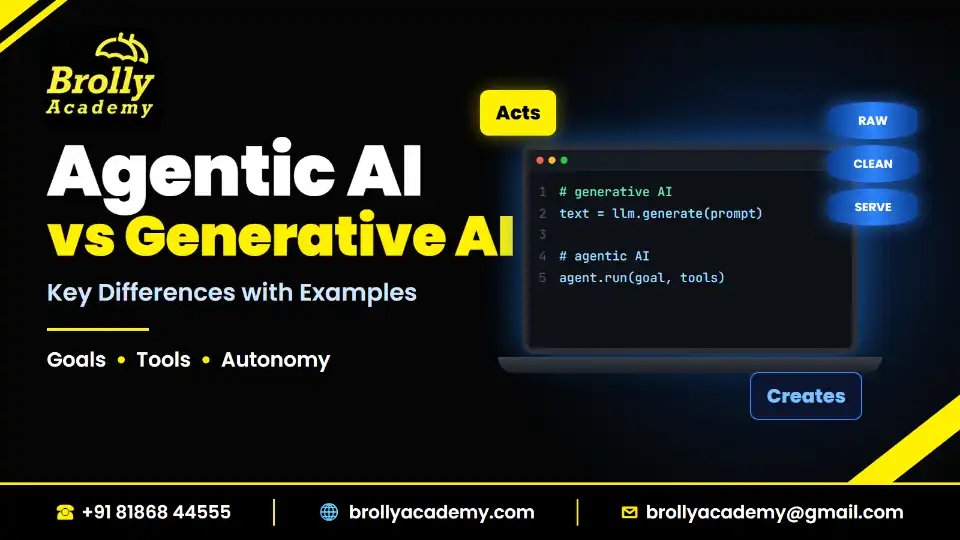
Table of Contents
3. Agentic AI vs generative AI: the core difference
4. Agentic AI vs generative AI: side-by-side comparison
5. How agentic AI is built on generative AI
6. Examples of generative AI and agentic AI
7. When to use generative AI and when to use agentic AI
10. Agentic AI vs generative AI vs predictive AI and traditional AI
Quick answer
Generative AI creates new content such as text, images or code in response to a prompt, while agentic AI pursues a goal on its own by planning steps, calling tools and acting, usually with a generative AI model as its brain. Think of generative AI as a very good writer who answers when you ask. Agentic AI is closer to an assistant who takes a task, breaks it into steps, uses apps and data to finish it, checks the result and asks you only when it needs approval. Agentic AI does not replace generative AI. It is built on top of it.
- Generative AI: prompt in, content out. One request, one response.
- Agentic AI: goal in, finished task out. Many steps, tools and decisions in a loop.
- The link: most agentic systems use a large language model (LLM) to reason and decide.
- Use generative AI to draft, summarise, translate and brainstorm.
- Use agentic AI for multi-step work that needs data, tools and judgement.
Key takeaways
- Generative AI produces content. Agentic AI produces outcomes by taking actions towards a goal.
- Google Cloud describes agentic AI as a subset of generative AI that uses LLMs as a "brain" and acts through tools (October 2026).
- Not every task needs an agent. A simple prompt or a fixed workflow is often cheaper, faster and safer.
- Gartner predicts over 40% of agentic AI projects will be cancelled by the end of 2027 because of cost, unclear value or weak risk controls (June 2025).
- For your career, learn generative AI basics first, then tool calling, RAG, one agent framework and evaluation. That is the path employers now ask for.
1. What is generative AI?
Short answer: Generative AI is a type of AI that creates new content, such as text, images, audio, video or code, based on patterns it learned from large amounts of data. You give it a prompt and it gives you an output.
The most familiar form of generative AI is the large language model, or LLM. An LLM is a model trained on huge amounts of text so it can predict and generate language. When you type a question into a chatbot and get a well-written answer, an LLM is doing the work.
Generative AI works in a request-and-respond pattern. You ask, it answers, and then it waits for your next message. It does not go off and do things in the world unless someone connects it to tools and gives it permission.
Common things generative AI does well:
- Writing emails, blog drafts, product descriptions and social posts
- Summarising long documents, meeting notes or research papers
- Translating between English, Hindi, Telugu and other languages
- Generating and explaining code snippets
- Creating images, slides, voice-overs and short videos
- Answering questions in a chat window
For example, ask a generative AI tool to "write a polite email to my manager asking for leave on Friday" and it writes the email in seconds. It does not check your leave balance, send the email or block your calendar. You do that yourself.
That gap, between producing content and actually getting the task done, is exactly where agentic AI comes in.
2. What is agentic AI?
Short answer: Agentic AI is an AI system that takes a goal and works towards it with limited human supervision. It plans the steps, uses tools such as APIs, databases and apps, remembers context, acts, and checks its own results.
IBM defines agentic AI as an AI system that can reach a specific goal with limited supervision (IBM, October 2026). IBM describes a loop of perception, reasoning, planning, decision-making, action, and learning or adaptation. In simple words, an agentic system looks at the situation, thinks about what to do, does it, and learns from what happened.
Google Cloud describes agentic AI as a system that sets goals, plans and executes tasks with minimal human intervention, working in a continuous cycle of perception, planning, action and reflection (Google Cloud, October 2026).
The word "agentic" comes from "agency", which means the ability to act on your own. An agentic system has some agency. It decides the next step instead of waiting for you to type every instruction.
The main building blocks of an agentic system are:
- A reasoning model: usually an LLM that understands the goal and decides what to do next
- Tools: APIs, search, databases, code runners, email, calendars or business apps the agent can use
- Memory: short-term memory for the current task and long-term memory for facts and past work
- Orchestration: the logic that runs the loop, passes work between steps or agents, and decides when to stop
- Guardrails: rules, approvals and checks that keep the agent safe and on task
Take the same leave example. You tell an agentic assistant, "Apply for leave this Friday and let my manager know." It checks your leave balance in the HR system, submits the request, drafts and sends the email, blocks your calendar and reports back. If your balance is zero, it stops and asks you what to do.
For a deeper explanation of how agentic AI works, read our full guide on what is agentic AI.
3. Agentic AI vs generative AI: the core difference
Short answer: Generative AI creates content in answer to a prompt. Agentic AI pursues a goal by deciding and taking actions over many steps. One responds, the other acts.
Look at what goes in and what comes out.
- Generative AI: input is a prompt, output is content. "Write a product description" gives you a product description.
- Agentic AI: input is a goal, output is a completed task or a changed state in the world. "Launch this product on our store" gives you a live listing with a description, price, images and stock levels.
Google Cloud gives a clear marketing example on the same page: generative AI writes the marketing material, while agentic AI deploys it, tracks how it performs and adjusts the campaign based on the results (Google Cloud, October 2026).
Here are the three differences that matter most.
Reactive vs proactive
Generative AI is reactive. It waits for your prompt. Agentic AI is proactive within its task. Once you give it a goal, it decides the next step itself and keeps going until the goal is met or it needs your input.
Single step vs multi-step
Generative AI usually finishes in one step: one prompt, one answer. Agentic AI works in a loop. It plans, acts, looks at the result, and plans again. A single task can involve dozens of model calls and tool calls.
Content vs action
Generative AI changes nothing outside the chat. Agentic AI can change things in real systems: it can send emails, update records, run code, place orders or raise tickets. That is why agents need permissions and approvals.
4. Agentic AI vs generative AI: side-by-side comparison
Short answer: Generative AI is prompt-driven, low-autonomy and content-focused. Agentic AI is goal-driven, higher-autonomy and action-focused, with tools, memory and guardrails.
Watch the risks row: a wrong answer in a chat is an annoyance, but a wrong action in your bank or CRM system is a real problem.
5. How agentic AI is built on generative AI
Short answer: Agentic AI wraps a generative AI model with tools, memory and a control loop. The LLM reasons and decides, the tools let it act, the memory keeps context, and the orchestration layer runs the loop safely.
This is the most important idea in the whole comparison. Agentic AI is not a separate kind of model. It is a system design that uses generative AI as one part.
Google Cloud says this directly: it calls agentic AI "a subset of generative AI" that orchestrates agents using LLMs as a "brain" and acts through tools (Google Cloud, October 2026). IBM makes a similar split: AI agents are the components, agentic AI is the system that coordinates them, and generative AI is the technology that creates content (IBM, October 2026).
Step 1: Start with an LLM
Every agent needs a model that can understand instructions and reason about what to do. This is the generative AI part.
Step 2: Add tool calling
Tool calling (also called function calling) lets the LLM ask your code to run a specific function, such as "get_order_status" or "search_flights", with the right inputs. The model does not run the tool itself. It picks the tool and the inputs, your code runs it, and the result goes back to the model. This one feature turns a writer into a doer.
Step 3: Add knowledge with RAG
RAG stands for retrieval-augmented generation. Before the model answers, the system searches your documents or database, pulls the most relevant pieces and adds them to the prompt. This keeps answers grounded in your own data, such as your company policies or product manuals, instead of only what the model learned in training.
Step 4: Add memory
Short-term memory holds the current task: what the user asked, which steps are done, what the tools returned. Long-term memory stores useful facts across sessions, such as a customer's preferences or past tickets.
Step 5: Add orchestration
Orchestration is the logic that runs the loop. It decides which step comes next, which agent or tool handles it, when to retry, when to ask a human and when to stop. Frameworks such as LangGraph, CrewAI, Microsoft Agent Framework, OpenAI Agents SDK and Google ADK exist mainly to make orchestration easier.
Step 6: Connect with standard protocols
MCP, the Model Context Protocol, is an open protocol that gives AI applications a standard way to connect to tools and data sources. Instead of writing custom code for every app, you connect an agent to an MCP server that exposes those tools. The Microsoft Agent Framework overview describes agents that use LLMs to process inputs, call tools and MCP servers, and generate responses (Microsoft, October 2026).
Step 7: Add guardrails and evaluation
Guardrails keep the agent safe: input filters, tool limits, human approval for risky actions and output checks. Evaluation means testing the agent on real cases to see if it completes tasks correctly.
Workflows vs agents
Anthropic draws a useful line in its engineering guide Building effective agents (Anthropic, December 2024). Workflows are systems where LLMs and tools follow predefined code paths that you write. Agents are systems where the LLM directs its own process and decides which tools to use. Anthropic calls the basic building block an "augmented LLM", meaning an LLM enhanced with retrieval, tools and memory, and it advises teams to start with the simplest solution and add complexity only when it helps.
6. Examples of generative AI and agentic AI
Short answer: Generative AI examples include chat assistants, writing tools, image generators and code completion. Agentic AI examples include support agents that resolve tickets, coding agents that fix bugs and open pull requests, and research agents that gather, compare and report.
Compare the same job done both ways.
A few more agentic AI examples:
- An IT helpdesk agent resets passwords, unlocks accounts and raises tickets for anything it cannot fix.
- A sales research agent finds company details, summarises recent news and drafts a personalised outreach note for a human to send.
- A data analysis agent connects to a database, runs queries, builds charts and writes a short findings report.
- A document Q&A agent searches thousands of policy PDFs with RAG and answers employee questions with citations.
Notice that in every agentic example, a generative AI model still writes the text. The difference is that the agent also decides, uses tools and acts. For 20 detailed examples across industries, see our guide to agentic AI examples.
7. When to use generative AI and when to use agentic AI
Short answer: Use generative AI when you need content and a human will take the next step. Use a fixed workflow when the steps are known. Use an agent only when the task is open-ended, needs several tools and the right path changes from case to case.
Jumping straight to agents often leads to slow, costly and fragile systems. Microsoft's guidance is blunt: use an agent for open-ended tasks and a workflow for well-defined steps, and "If you can write a function to handle the task, do that instead" (Microsoft Agent Framework overview, October 2026).
Choose generative AI when
- The output is content: a draft, summary, translation, caption or code snippet.
- A human reviews and acts on the output anyway.
- You want low cost, fast responses and predictable behaviour.
- Mistakes are easy to spot and cheap to fix.
Choose a workflow when
- The steps are the same every time, such as "extract invoice fields, validate, save".
- You need reliability and easy auditing.
Choose agentic AI when
- The task needs several steps and the order depends on what the agent finds.
- The agent must use multiple tools or systems to finish the job.
- Rules are too many or change too often to hard-code.
- The input is messy, such as emails, chats or scanned documents.
- The value of finishing the task end to end is worth the extra cost and oversight.
A quick decision checklist
Ask these five questions before you build:
- Is the output just content? If yes, start with generative AI.
- Can I write the steps as fixed code? If yes, build a workflow.
- Does the task need tools and decisions that change each time? If yes, consider an agent.
- What is the worst action the agent could take? Add approvals for anything risky.
- How will I measure success? If you cannot test it, do not ship it.
8. Risks and limits of each
Short answer: Generative AI can hallucinate, reflect bias and raise copyright questions. Agentic AI has all of those risks plus wrong actions in real systems, security gaps, runaway costs and harder testing.
Generative AI risks
- Hallucination: the model states something false with confidence.
- Bias: output can reflect bias in the training data.
- Data leakage: users may paste confidential data into public tools.
- Copyright and ownership questions around generated content.
Extra risks with agentic AI
- Wrong actions: a hallucination now becomes a wrong refund, a deleted record or an email to the wrong person.
- Security: an agent with access to tools can be tricked by malicious instructions hidden in emails, web pages or documents (prompt injection).
- Cost: many model and tool calls per task can make bills unpredictable.
- Testing: an agent can take different paths each time, so it is harder to test than a single prompt.
- Accountability: when an agent acts, your team must still own the result.
The industry is learning this the hard way. In a June 2025 press release, Gartner predicted that over 40% of agentic AI projects will be cancelled by the end of 2027 due to escalating costs, unclear business value or inadequate risk controls (Gartner, June 2025). The same release warned about "agent washing", where existing chatbots and assistants are rebranded as agents, and estimated that only about 130 of the thousands of agentic AI vendors are real.
Gartner also sees strong long-term growth. In the same release, it predicts that by 2028 at least 15% of day-to-day work decisions will be made autonomously through agentic AI, up from 0% in 2024, and that 33% of enterprise software applications will include agentic AI, up from less than 1% in 2024 (Gartner, June 2025).
The lesson: agents pay off only with clear use cases, guardrails and testing.
9. Where AI agents fit
Short answer: An AI agent is a single software component that perceives, decides and acts. Agentic AI is the broader system, often made of one or more agents, tools and orchestration, that pursues a goal.
People often mix up three terms: generative AI, AI agents and agentic AI. Generative AI is the content-creating technology, usually an LLM. An AI agent is one unit that uses that model plus tools to do a job, like a support agent or a research agent. Agentic AI is the overall approach and system that coordinates one or many agents towards a goal, which matches IBM's view that agents are the components and agentic AI is the system (IBM, October 2026). We compare the two terms in detail, with a differences table and the classic types of agents, in our guide to agentic AI vs AI agents.
10. Agentic AI vs generative AI vs predictive AI and traditional AI
Short answer: Traditional AI follows rules, predictive AI forecasts outcomes from past data, generative AI creates new content, and agentic AI combines these with tools to take goal-driven action.
Searchers often compare all four, so here is a simple map.
These types are not rivals. A real agentic system can use a predictive model to score risk, a generative model to reason and write, and rules as guardrails. For example, a loan-processing agent might use a predictive score, ask an LLM to summarise the documents, and follow fixed rules on who must approve.
Agentic AI vs LLM
An LLM is a model. Agentic AI is a system. The LLM is the reasoning engine inside many agentic systems, but on its own it only generates text. You need tools, memory and orchestration to make it agentic.
Agentic AI vs RAG
RAG is a technique to feed relevant documents to an LLM before it answers. It improves accuracy but does not make a system agentic by itself. When an agent decides on its own when to search, what to search for and whether the results are good enough, people call it agentic RAG.
Agentic AI vs MCP
MCP is not a type of AI. It is a protocol, a standard way for AI applications to connect to tools and data. Agentic systems use MCP to reach the tools they need.
11. Agentic AI vs generative AI for your career
Short answer: You do not have to choose one. Generative AI skills are the foundation, and agentic AI skills build on top of them. Learn generative AI first, then move to tool calling, RAG, an agent framework, evaluation and deployment.
A common question from Indian students and working professionals is "Which is better to learn, agentic AI or generative AI?" The honest answer is that agentic AI is generative AI plus more. You cannot build a good agent without understanding how LLMs behave, how to write strong prompts, how to call model APIs and how to ground answers with RAG.
Here is how the skills stack up:
Who should start where
- Freshers and students: start with Python and generative AI basics, then build one RAG app and one simple agent. Projects matter more than titles.
- Software developers: you already know APIs and backends, so tool calling and orchestration will feel natural. Move quickly to a framework and build a real agent.
- Data scientists and ML engineers: add LLM application skills, RAG and evaluation. Your testing mindset is a big advantage in agent work.
- Non-coders and business roles: learn generative AI tools well, then try low-code agent builders and learn to design agent use cases and guardrails.
What employers look for
Job titles now mix both words: Generative AI Engineer, Agentic AI Engineer, LLM Engineer and AI Engineer often share the same core skill list. Employers want people who can take a business problem, decide whether it needs a prompt, a workflow or an agent, and then build and test it. To see job titles, skills asked and how to apply, read our guide to agentic AI jobs.
12. How Brolly Academy helps
Short answer: Brolly Academy's 3-month Agentic AI Course in Hyderabad takes you from generative AI foundations to building, testing and deploying real agents, with six capstone projects and placement assistance.
If you want to move from using generative AI to building agentic systems, the Agentic AI Course in Hyderabad at Brolly Academy is built for that path. The course page (updated September 2026) lists:
- Duration: 3 months. Month 1 covers foundations, Month 2 tools and workflows, and Month 3 projects and deployment, plus career preparation.
- Modules: 9 modules, from Introduction to Agentic AI and Foundations of AI Agents to Multi-Agent Systems, Large Language Models and Agentic AI, Tools and Frameworks for Building AI Agents, Agentic AI for Security and Cloud Automation, Ethics and Risks of Agentic AI, and Hands-on Projects and Case Studies.
- Hands-on topics: tool calling, MCP basics, agentic RAG, human-in-the-loop and evaluation.
- Six capstone projects: a customer support agent, a document Q&A and RAG agent, a workflow automation agent, an email and sales research agent, a resume screening and HR agent, and a data analysis agent.
- Modes: classroom and online, with weekend batches and flexible schedules. The next batch starts on Monday, 2 November 2026.
- Fees: Video Recording ₹9,999, Online Course ₹24,999 and Classroom Training ₹29,999, with easy EMI available. The classroom option includes a dedicated placement officer.
- Trainer: Mr. Dinesh, an Agentic AI and Generative AI specialist and cloud architect with 12+ years in AI, ML, cloud computing and generative AI.
- Career support: placement assistance, resume and LinkedIn help, mock interviews and internship opportunities.
- Eligibility: no AI experience needed and Python is optional.
On completion you receive the Brolly Academy Agentic AI course completion certificate. You can also book a free demo class before you join.
Go beyond prompts. Build agents that get work done.
Generative AI is the starting point, and agentic AI is where the next wave of roles is heading. Brolly Academy's 3-month Agentic AI Course in Hyderabad, in classroom and online modes, takes you through LLMs, tool calling, RAG, multi-agent systems and evaluation, with six capstone projects you can show recruiters. The next batch starts on 2 November 2026. Book a free demo class and see if it fits your goals.
Frequently asked questions
What is the difference between agentic AI and generative AI?
Generative AI creates content such as text, images or code when you give it a prompt. Agentic AI takes a goal and works towards it by planning steps, using tools, remembering context and acting, usually with a generative AI model as its reasoning engine. In short, generative AI responds with content, while agentic AI acts to finish a task. Most agentic systems are built on top of generative AI rather than replacing it.
What is agentic AI vs generative AI in simple words?
In simple words, generative AI is a smart writer and agentic AI is a smart assistant. The writer gives you a draft when you ask. The assistant takes your request, figures out the steps, uses apps and data to complete it, checks the result and comes back only when it needs your approval. Both use similar models underneath, but the assistant also has tools, memory and permission to act.
Is agentic AI a part of generative AI?
Many experts see it that way. Google Cloud describes agentic AI as a subset of generative AI that uses large language models as a brain and acts through tools. Others see agentic AI as a broader system design that uses generative AI as one component. Either way, the practical point is the same: almost every agentic system today relies on a generative AI model to reason, plan and write.
Are agentic AI and generative AI the same thing?
No, they are related but not the same. Generative AI is the technology that creates content from prompts. Agentic AI is a system that combines that technology with tools, memory, orchestration and guardrails so it can pursue a goal over many steps. You can use generative AI without any agentic features, but you cannot build most agentic systems without generative AI at the core.
Which is better, agentic AI or generative AI?
Neither is better in general, because they solve different problems. Generative AI is better for drafting, summarising, translating and brainstorming, where a human takes the next step. Agentic AI is better for multi-step tasks that need tools and decisions, such as resolving a support ticket end to end. Agents also cost more and carry more risk, so the best choice depends on the task.
Is ChatGPT agentic AI or generative AI?
ChatGPT is best known as a generative AI chatbot, because its core job is generating text, code and images from your prompts. When an AI assistant like this is connected to tools and allowed to plan and carry out multi-step tasks for you, that mode behaves like agentic AI. So the label depends on how the product is set up and used, not just on the model inside it.
Are Claude, Gemini and Copilot agentic AI or generative AI?
They are generative AI assistants at their core, because they are built on large language models that generate content. Like other assistants, they can behave agentically when connected to tools and given permission to plan and act over several steps. A simple test helps: if it only answers your prompt, it is acting as generative AI. If it takes actions towards a goal, it is acting as an agent.
What are examples of agentic AI vs generative AI?
A generative AI example is a tool that drafts a reply to a customer email. The agentic version reads the ticket, checks the order system, issues a refund within policy, replies and closes the ticket. Similarly, generative AI suggests code for a function, while a coding agent reads a bug report, writes a fix, runs tests and opens a pull request for human review.
How is agentic AI built on generative AI?
Agentic AI wraps a large language model with extra parts. Tool calling lets the model ask your code to run functions such as checking an order. RAG adds knowledge from your own documents. Memory keeps track of the task. Orchestration runs the plan, act and check loop and decides when to stop. Guardrails and evaluation keep the whole system safe and reliable.
What is the difference between AI agents, agentic AI and generative AI?
Generative AI is the content-creating technology, usually a large language model. An AI agent is a single unit that uses that model plus tools to do a specific job, such as answering support tickets. Agentic AI is the broader system and approach that coordinates one or more agents towards a goal. IBM describes agents as the components and agentic AI as the system that coordinates them.
What is the difference between agentic AI, generative AI and predictive AI?
Predictive AI learns from past data to forecast or classify, such as scoring loan default risk. Generative AI creates new content, such as drafting an email. Agentic AI plans and acts towards a goal using models and tools. They work well together: an agent might use a predictive score, ask a generative model to summarise documents and follow fixed rules for approvals.
How is agentic AI different from traditional AI?
Traditional AI usually means rule-based systems that follow instructions written by people, such as a chatbot with fixed menu options. It cannot handle situations its rules do not cover. Agentic AI uses large language models to understand goals in plain language, plan its own steps, choose tools and adapt when something unexpected happens, while still following guardrails set by humans.
What is the difference between an LLM and agentic AI?
An LLM, or large language model, is a model that generates text. Agentic AI is a complete system. The LLM is the reasoning engine inside many agentic systems, but on its own it only produces text in response to a prompt. To become agentic, it needs tools to act, memory to track progress and orchestration to run the loop until the goal is reached.
Is RAG agentic AI?
Not by itself. RAG, or retrieval-augmented generation, is a technique that searches your documents and adds relevant pieces to the prompt so the model gives grounded answers. It improves generative AI accuracy. It becomes agentic RAG when an agent decides on its own when to search, what to search for and whether the results are good enough before it answers or acts.
What is MCP and how does it relate to agentic AI?
MCP, the Model Context Protocol, is an open protocol that gives AI applications a standard way to connect to tools and data sources. It is not a type of AI. Agentic systems use MCP so they can reach tools such as databases, files or business apps without custom code for every connection. Microsoft describes agents in its Agent Framework that call tools and MCP servers.
When should I use generative AI instead of an AI agent?
Use generative AI when the output is content, a human will review and act on it, and mistakes are cheap to fix. It is faster, cheaper and more predictable than an agent. Microsoft's guidance puts it simply: if you can write a function to handle a task, do that instead of building an agent. Use agents only for open-ended, multi-step work that needs tools.
What are the risks of agentic AI compared to generative AI?
Agentic AI carries every generative AI risk, such as hallucination and bias, plus new ones. A mistake becomes a wrong action in a real system, like an incorrect refund. Agents can be tricked by hidden instructions in emails or web pages, their costs can grow quickly with many model calls, and they are harder to test because they may take different paths each time.
Why do agentic AI projects fail?
Gartner predicted in June 2025 that over 40% of agentic AI projects will be cancelled by the end of 2027 because of escalating costs, unclear business value or inadequate risk controls. Common causes include choosing agents for tasks a simple prompt or workflow could handle, weak testing and missing guardrails. Gartner also warned about agent washing, where ordinary chatbots are rebranded as agents.
What is the future of agentic AI compared to generative AI?
Gartner expects strong growth for agentic AI. In a June 2025 release it predicted that by 2028 at least 15% of day-to-day work decisions will be made autonomously through agentic AI, up from 0% in 2024, and that 33% of enterprise software applications will include agentic AI. Generative AI will remain the foundation, since agents depend on it to reason and write.
Should I learn generative AI or agentic AI first?
Learn generative AI first. Agentic AI builds directly on it, so you need to understand how large language models behave, how to write good prompts, how to call model APIs and how to use RAG. Once those basics feel comfortable, move to tool calling, memory, one agent framework, multi-agent design, evaluation and guardrails. This order saves time and helps you build better agents.
Can a non-coder learn agentic AI?
Yes, a non-coder can start. Begin by using generative AI tools well, then try low-code agent builders to understand how agents use tools and steps. Learning to design use cases, write clear instructions and set guardrails is valuable in business roles. If you want to build production agents yourself, basic Python and API knowledge will help a lot, and it can be learned step by step.
Which skills do I need for an agentic AI career?
You need Python, API basics, an understanding of large language models and prompting, and RAG with vector databases. On top of that, agentic roles ask for tool calling, structured output, memory, orchestration with a framework such as LangGraph, CrewAI or Microsoft Agent Framework, multi-agent design, MCP, evaluation, guardrails and human-in-the-loop design. Real projects that show these skills matter more than certificates alone.
Are agentic AI jobs different from generative AI jobs?
They overlap heavily. Titles such as Generative AI Engineer, Agentic AI Engineer, LLM Engineer and AI Engineer often share the same core skill list. Agentic roles usually add tool calling, orchestration, evaluation and guardrails on top of generative AI skills. Employers want people who can decide whether a business problem needs a prompt, a workflow or an agent, and then build and test it.
Is there an agentic AI course in Hyderabad that covers both generative and agentic AI?
Yes. Brolly Academy offers a 3-month Agentic AI Course in Hyderabad in classroom and online modes. It starts with foundations and large language models, then moves to tools, frameworks, multi-agent systems, tool calling, agentic RAG and evaluation. It includes six capstone projects, such as a customer support agent and a data analysis agent, plus placement assistance. Python is optional to start.
How much does Brolly Academy's Agentic AI course cost?
Brolly Academy's Agentic AI Course in Hyderabad lists three options: Video Recording at ₹9,999, Online Course at ₹24,999 and Classroom Training at ₹29,999. Easy EMI is available. All options lead to the Brolly Academy Agentic AI course completion certificate, and the classroom option includes a dedicated placement officer. You can book a free demo class before deciding which mode suits you.
Learn with Brolly Academy
Review the syllabus, practical projects and batch timings, and book a free demo before you enrol.
Related Articles
Continue Your Learning
Agentic AI Course in Hyderabad
3 months of hands-on training in AI agents, multi-agent systems, LLMs, tools and frameworks, with 6 capstone projects and placement assistance.
View CourseAI Orchestration Course in Hyderabad
Build LLM workflows with LangGraph, APIs, RAG and human approvals, and learn to run AI pipelines that are reliable in production.
View CourseAzure AI Course
Microsoft Foundry, Azure OpenAI, RAG, agents and evaluation, for building AI apps and agents on Azure.
View Course