
Brolly Academy | Agentic AI
What Is Agentic AI
Meaning, How AI Agents Plan, Act and Learn, With Examples (2026)
A plain-English guide to agentic AI in 2026: what it means, how an AI agent plans, uses tools, remembers and acts, a full step-by-step example, the parts every agent needs, single-agent and multi-agent systems, levels of autonomy, real benefits, honest risks and how you can start learning it.
What is agentic AI? Learn the meaning, how AI agents plan, use tools, remember and act, a real example, key parts, benefits, risks and how to get started.
By Brolly Academy Team · Brolly Academy · Updated 23 October 2026
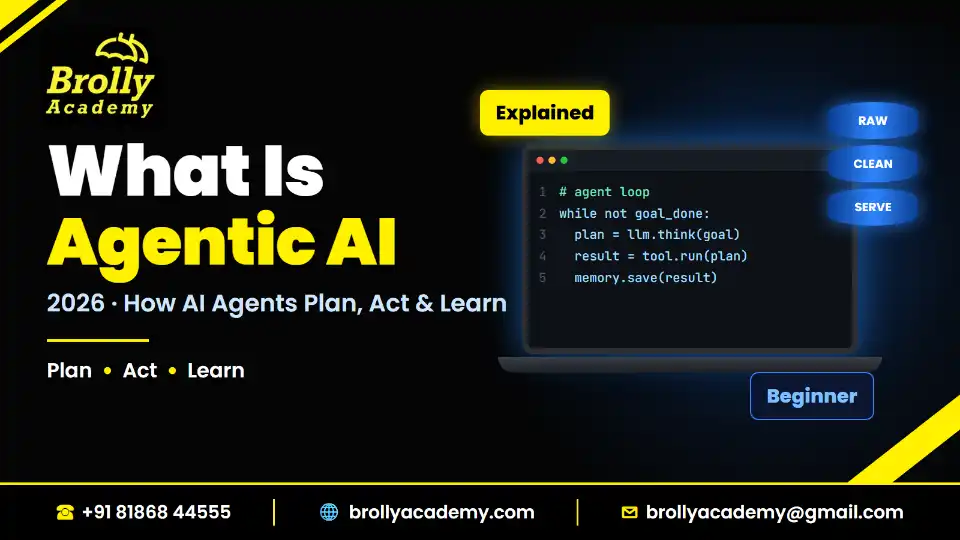
Table of Contents
3. A step-by-step example: a travel booking agent
4. Key components of an agentic AI system
5. Single-agent vs multi-agent systems
6. Levels of autonomy in agentic AI
7. Agents vs workflows: when you do not need an agent
9. Frameworks and tools used to build agents
10. Risks and limits of agentic AI
Quick answer
Agentic AI is AI that works towards a goal on its own: it plans the steps, uses tools such as APIs, apps and databases to take action, checks the results and adjusts, with limited human supervision. A normal chatbot answers one question and stops. An agentic AI system takes a goal like "resolve this customer's refund" and keeps working until the job is done or it needs a human. It is usually built on a large language model (LLM), which acts as the "brain" that reasons and decides, connected to tools, memory and safety rules.
- Goal driven: you give an outcome, not step-by-step instructions
- Plans and acts: it breaks the goal into steps and calls tools to do real work
- Remembers: it keeps track of what it has done and what it learned
- Self-checks: it reviews results and tries again when something fails
- Needs guardrails: cost, security and wrong answers are real risks, so humans stay in the loop
Key takeaways
- IBM describes agentic AI as a system that reaches a specific goal with limited supervision (IBM, October 2026). The key word is "act": agentic AI does things, not just says things.
- Every agent runs a loop: understand the goal, plan, use tools, observe the result, reflect and repeat.
- The core parts are an LLM, tools and APIs, memory, orchestration (the logic that controls the loop) and guardrails.
- Gartner predicts that over 40% of agentic AI projects will be cancelled by the end of 2027 because of rising costs, unclear value or weak risk controls (Gartner, June 2025). Start small and measure.
- You can learn agentic AI with basic Python, API skills and a clear roadmap. Coding helps a lot, but low-code tools let non-coders begin.
1. What is agentic AI?
Short answer: Agentic AI is an AI system that can pursue a goal by itself. It decides what to do next, uses tools to act in the real world, and adapts based on results, with only limited human supervision.
The word "agentic" comes from "agency", the ability to act on your own. So the meaning of agentic AI is simple: AI with agency. It takes actions to reach an outcome. Here is how two major technology companies define it:
- IBM describes agentic AI as an AI system that can accomplish a specific goal with limited supervision, working through perception, reasoning, planning, decision-making, action and learning (IBM, October 2026). IBM also explains that AI agents are the individual components, while agentic AI is the larger system that coordinates them.
- Google Cloud describes it as AI that can set goals, plan and carry out tasks with minimal human intervention, in a "continuous cycle of perception, planning, action, and reflection" (Google Cloud, October 2026). Google calls agentic AI a subset of generative AI that uses LLMs as a "brain" and acts through tools.
Put both together and you get a working definition you can use in an interview:
Agentic AI definition: a goal-driven AI system, usually powered by an LLM, that plans multi-step tasks, takes actions through tools, remembers context, and evaluates its own results with limited human supervision.
A quick everyday comparison
- Generative AI is a friend giving advice. You ask "What is a good hotel in Goa?" and get a helpful answer. Then you do all the work.
- Agentic AI is a personal assistant. You say "Book me a hotel in Goa for next weekend within my budget." It searches, compares, checks your calendar, books the room and sends the confirmation, coming back to you only when it needs a decision.
That shift from answering to acting is what makes agentic AI different.
Agentic AI, generative AI and AI agents
Generative AI creates content such as text, images or code in response to a prompt. Agentic AI uses that ability to pursue goals by taking actions. AI agents are the individual workers inside an agentic system; Google Cloud calls them "the building blocks of agentic AI" (Google Cloud, October 2026). Google's example: generative AI writes marketing material, while agentic AI also publishes it, tracks results and adjusts the campaign. For a full side-by-side table, read our guide on agentic AI vs generative AI.
2. How does agentic AI work?
Short answer: Agentic AI works in a loop. It understands the goal, makes a plan, picks a tool and acts, observes the result, stores what it learned in memory, reflects on whether the goal is met, and repeats until it finishes or hands over to a human.
Every agent, from a simple support bot to a coding agent, follows the same six steps.
Step 1: The goal
Everything starts with a goal. A good goal has a clear finish line, such as "Refund order 4512 if it meets the policy." Vague goals like "improve sales" lead to vague, expensive agents.
Step 2: Planning
The LLM reasons about the goal and decides the steps. Simple agents plan one step at a time. Advanced agents write a full plan first and then work through it. A well-known pattern is ReAct, short for "reasoning and acting": the model thinks, acts, looks at the result and thinks again.
Step 3: Tool use
This is where agentic AI becomes powerful. Tool calling (also called function calling) means the LLM picks a tool from a list you give it, fills in the inputs, and your code runs that tool. Tools can be a web search, a database query, a booking or payment API, a CRM, a calendar or a Python code runner. The LLM decides which tool to use and when. Your software decides what the agent is allowed to touch.
Step 4: Acting and observing
After each tool call, the agent reads the result. Did the API return an error? Was the flight sold out? This feedback shapes the next step, which is the big difference from a one-shot chatbot answer.
Step 5: Memory
Short-term memory holds the current task and the steps taken so far. Long-term memory stores facts that matter across sessions, such as a customer's past tickets. Long-term memory often uses RAG, short for retrieval-augmented generation: the agent searches a store of documents, pulls out the most relevant pieces and adds them to the LLM's input, so its answer is grounded in real data instead of guesses.
Step 6: Reflection
Finally, the agent checks its own work. Did it reach the goal? Does the output follow the rules? If not, it tries a different approach. Some systems use a second model as a reviewer that scores the output and asks for fixes. Anthropic calls this the "evaluator-optimizer" pattern in its guide Building effective agents (Anthropic, December 2024).
3. A step-by-step example: a travel booking agent
Short answer: Give a travel agent the goal "Plan and book a 3-day work trip from Hyderabad to Bengaluru under ₹20,000", and it will check your calendar, search flights and hotels, compare prices against your budget and company policy, ask you to approve, book, and send a summary.
Let us walk through what happens inside the agent. The numbers in this example (budget, prices, times) are made up for illustration.
Goal from you: "Book a work trip to Bengaluru from Monday to Wednesday next week. Total budget ₹20,000. I prefer morning flights and a hotel near Whitefield."
- Understand the goal. The LLM pulls out the key facts: route, dates, budget, flight time and hotel area.
- Check memory. Your saved profile shows a preferred airline and that you need a GST invoice for expense claims.
- Plan. Check calendar, search flights and hotels, compare totals, ask for approval, book, send summary.
- Call the calendar tool. A 10 am Monday meeting in Bengaluru means only flights landing before 9 am will do.
- Call the flight and hotel APIs. It keeps early flights on your airline and hotels near Whitefield that give GST invoices.
- Reflect on budget. The best combination is slightly over budget, so instead of failing it tries another hotel that fits.
- Ask a human. Booking costs money, so a guardrail requires your approval. It sends you two options with prices.
- Act, report and remember. You approve, it books, adds the trip to your calendar, emails the tickets and saves "prefers Whitefield hotels" to long-term memory.
Nobody told the agent to filter flights by the meeting or swap the hotel. It worked that out from the goal, the tools and the results. That is what makes it agentic.
The same loop in customer support
A customer writes "My order arrived damaged, I want a refund." The support agent looks up the order, checks the refund policy using RAG, confirms the return window, and either issues the refund through the payment API or, above a set amount, routes the case to a human with a summary.
4. Key components of an agentic AI system
Short answer: An agentic AI system has five core parts: an LLM that reasons, tools and APIs that let it act, memory that stores context, orchestration that controls the loop and connects the parts, and guardrails that keep it safe.
OpenAI's practical guide to building agents boils an agent down to three parts: a model, tools and instructions (OpenAI, October 2026). In real projects you also need memory, orchestration and guardrails. Here is the full picture.
The LLM
An LLM (large language model) is an AI model trained on huge amounts of text so it can understand and generate language. In an agent, it is the decision maker: it reads the goal, the tool descriptions and past results, and decides the next step. Stronger models usually plan better and make fewer tool mistakes, but cost more per call.
Tools, APIs and MCP
Each tool has a name, a description and inputs, so the LLM knows when and how to use it. A growing standard here is MCP, short for Model Context Protocol, an open protocol that gives agents one standard way to connect to tools and data sources, a bit like a USB port for AI. Instead of writing a custom connector for every app, you plug in an MCP server for that app. A related protocol, A2A (Agent2Agent), helps agents built by different teams talk to each other.
Memory and orchestration
Memory stops the agent from repeating questions and losing track of long tasks. Most production agents combine short-term memory with long-term memory in a database or vector store, retrieved with RAG. Orchestration is the control layer: it sets the order of steps, passes results between tools and agents, handles errors and retries, and stops the loop when the job is done. Developers usually get this from an agent framework (section 9).
Guardrails
Guardrails are the safety rules around the agent. OpenAI's guide lists several layers: relevance and safety classifiers, filters for personal data (PII), moderation, safeguards on risky tools, rules-based protections such as blocklists, and output validation (OpenAI, October 2026). The same guide recommends human-in-the-loop review for high-risk actions and when the agent keeps failing. Human-in-the-loop simply means a person approves or corrects the agent at key points.
5. Single-agent vs multi-agent systems
Short answer: A single-agent system uses one agent with a set of tools to handle the whole task. A multi-agent system splits the work across several specialised agents that cooperate, usually managed by a lead agent. Start with one agent and add more only when one agent clearly struggles.
A single agent (one LLM, one set of instructions, many tools) covers most use cases, such as support tickets or travel booking, and is easier to build, test and pay for. OpenAI's guide recommends getting the most out of a single agent first (OpenAI, October 2026).
When a task is large or needs very different skills, you can split it, for example into planner, researcher and writer agents. OpenAI's guide describes two common designs (OpenAI, October 2026):
- Manager pattern: a central "manager" agent breaks the task down and calls specialist agents as if they were tools, then combines their answers.
- Decentralised handoffs: agents pass the task to each other directly. For example, a triage agent hands a billing question to a billing agent.
Multi-agent sounds exciting, but it adds cost (more LLM calls) and failure points, and it is harder to debug. Use it when a single agent's instructions get too long, or its tools overlap so much that it keeps picking the wrong one.
6. Levels of autonomy in agentic AI
Short answer: Autonomy is how much an AI system can do without a human. It ranges from simple assistants that only suggest, through agents that act after approval, to fully autonomous agents that act on their own within limits. Most real business agents today sit in the middle.
There is no single official scale that everyone uses, so here is a simple five-level way to think about it. Use it to describe any AI product you see.
The right level depends on the risk. An agent that tags support tickets can run at level 3. An agent that moves money should stay at level 2 with clear approvals. Higher autonomy is not automatically better.
7. Agents vs workflows: when you do not need an agent
Short answer: If the steps of a task are fixed and predictable, a normal workflow or script is cheaper and more reliable than an agent. Use an agent when the path changes from case to case and needs judgement.
Anthropic separates two kinds of systems in Building effective agents (Anthropic, December 2024):
- Workflows: the LLM and tools follow predefined code paths that you design. Example: every invoice goes through extract, validate, then save.
- Agents: the LLM directs its own process and decides which tools to use and in what order.
Anthropic's advice is to start with the simplest solution and add complexity only when it clearly helps, using patterns such as prompt chaining (one step feeds the next) and routing (sending each input to the right handler). OpenAI's guide says agents make the most sense for (OpenAI, October 2026):
- Complex decisions that need judgement and context
- Rules that have become too many and too messy to maintain
- Heavy use of unstructured data, such as emails, documents and chats
If none of these apply, a simple automation will probably do the job better.
8. Benefits of agentic AI
Short answer: Agentic AI can finish multi-step work end to end, run around the clock, handle messy real-world inputs, scale without hiring in proportion, and free people for higher-value work. The benefits are real only when the use case is clear and results are measured.
- End-to-end completion: the agent finishes the job (files the ticket, updates the CRM, sends the email) instead of handing you text to copy.
- Unstructured data: agents read emails, PDFs and chats that rule-based automation could not handle.
- Adapts to change: when an API fails, the agent can try another path instead of crashing.
- Always on and scalable: routine work runs at any hour, and a spike in tickets does not need a matching spike in hiring.
- Frees human time: people focus on exceptions and decisions that need judgement.
- Consistent process: the same policy every time, with every step logged for audit.
Gartner expects this shift to be big. It predicts that by 2028, at least 15% of day-to-day work decisions will be made autonomously through agentic AI, up from 0% in 2024, and that 33% of enterprise software applications will include agentic AI, up from less than 1% in 2024 (Gartner, June 2025).
9. Frameworks and tools used to build agents
Short answer: Developers usually build agents with a framework that handles the loop, tool calling, memory and multi-agent coordination. Popular options in 2026 include LangGraph, CrewAI, Microsoft Agent Framework, the OpenAI Agents SDK, Google's Agent Development Kit and Pydantic AI.
You can build a simple agent with plain Python and an LLM API, but once you need memory, retries, approvals or several agents, a framework saves a lot of work:
- LangGraph (LangChain) models an agent as a graph of steps, good for stateful, long-running agents.
- CrewAI organises role-based agents that work together as a "crew".
- Microsoft Agent Framework is Microsoft's current agent framework. It replaces Semantic Kernel and the older AutoGen project, which is now archived, so do not start new projects on AutoGen.
- OpenAI Agents SDK is a lightweight Python framework for single and multi-agent workflows.
- Google Agent Development Kit (ADK) is an open-source, model-agnostic toolkit to build, debug and deploy agents.
- Pydantic AI focuses on type-safe Python agents.
There are also low-code builders that let you create agents by dragging blocks, which is a good way for non-coders to start. For owners, licences, a comparison table and a decision guide, read our full guide to agentic AI frameworks.
10. Risks and limits of agentic AI
Short answer: The main risks are wrong answers (hallucination) that now turn into wrong actions, high and unpredictable cost, security attacks such as prompt injection, weak human oversight, and hype. Gartner predicts over 40% of agentic AI projects will be cancelled by the end of 2027.
When a chatbot makes a mistake, you get a wrong sentence. When an agent makes a mistake, it can send the wrong email or refund the wrong order.
The numbers
Gartner's June 2025 press release is the clearest warning so far (Gartner, June 2025):
- Over 40% of agentic AI projects will be cancelled by the end of 2027, due to escalating costs, unclear business value or inadequate risk controls.
- In a January 2025 Gartner poll of 3,412 webinar attendees, 19% said their organisation had made significant investments in agentic AI and 42% had made conservative investments.
- Gartner estimates only about 130 of the thousands of vendors claiming agentic AI are real. It calls the rest "agent washing", which means rebranding ordinary chatbots, assistants or automation as "agents".
Hallucination
LLMs sometimes produce confident but false information, called hallucination. In an agent, a made-up order number can trigger a real action. Ground the agent with RAG on trusted data, validate outputs before acting, and keep humans in the loop for high-impact steps.
Cost
Every step in the loop is an LLM call, and multi-agent systems make many. A task that is cheap in a demo can get expensive at scale, especially if the agent loops. Set limits on steps and spend, and use smaller models for simple sub-tasks.
Security
The biggest risk is prompt injection: hidden instructions in an email, web page or document trick the agent into doing something it should not, such as leaking data. Give each agent the minimum permissions it needs (least privilege) and require approval for risky tools such as payments.
Oversight and hype
If an agent makes a bad decision, someone must be able to explain and undo it, so keep logs of every step and a way to stop the agent. Many projects also fail simply because the use case was vague. Pick a narrow, measurable problem such as "cut first response time on refund tickets", prove value, then expand.
What it means for jobs
Agents take over routine steps, so some tasks will shrink, but companies need people to design, build, test, secure and supervise agents. Gartner's prediction that 15% of day-to-day work decisions will be autonomous by 2028 also means most decisions will still involve people (Gartner, June 2025). The safest career move is to learn how to work with agents, not to ignore them.
11. Where agentic AI is used
Short answer: Agentic AI is used in customer support, software development, IT operations, finance, healthcare administration, HR, marketing, sales, supply chain and personal productivity, wherever multi-step work with tools and judgement can be automated safely.
- Customer support: read tickets, check orders and policies, issue refunds or escalate with a summary.
- Software development: read a codebase, write changes, run tests and open pull requests for review.
- IT operations: watch alerts, diagnose common issues and run approved fixes.
- Finance: match invoices and flag unusual transactions for human sign-off.
- HR and sales: screen resumes, research leads and update the CRM.
We cover 20 real-world use cases, grouped by industry, in our guide to agentic AI examples.
12. How to start learning agentic AI
Short answer: Learn Python and APIs, understand how LLMs and prompting work, practise tool calling and structured output, add RAG and memory, pick one framework, then build and deploy two or three real projects with guardrails and evaluation.
You do not need a PhD. You need steady practice and real projects:
- Python and APIs: functions, JSON and calling a REST API.
- LLM basics and prompting: tokens, context windows, system prompts and why models hallucinate.
- Tool calling and structured output: make an LLM call your own Python function and return clean JSON.
- RAG and memory: build a question-answering bot on your own PDFs with a vector database.
- One framework: build a single agent end to end. Do not try to learn them all.
- Multi-agent and MCP: try a manager pattern and connect a tool with MCP.
- Evaluation and guardrails: test on a set of cases, add approvals and log every step.
- Deploy and show: put a project online with a clear README on GitHub.
Good first projects include a support ticket agent, a resume screening agent and a research assistant.
For a week-by-week plan with stages, free resources and paths for freshers, developers and non-coders, follow our agentic AI roadmap.
13. How Brolly Academy helps
Short answer: Brolly Academy's 3-month Agentic AI Course in Hyderabad takes you from foundations to deployed projects, with classroom and online batches, six capstone projects and placement assistance.
If you prefer a guided path with a trainer and a batch, the Agentic AI Course in Hyderabad covers what this article explains, hands-on.
- Structure: 3 months. Month 1 foundations, Month 2 tools and workflows, Month 3 projects and deployment, plus career preparation, across 9 modules including Multi-Agent Systems, LLMs and Agentic AI, and Ethics and Risks.
- Topics: tool calling, MCP basics, agentic RAG, human-in-the-loop and evaluation, with the OpenAI Agents SDK, Google ADK and Foundry Agent Service.
- Six capstone projects: customer support, document Q&A and RAG, workflow automation, email and sales research, resume screening and HR, and data analysis agents.
- Trainer: Mr. Dinesh, Agentic AI and Generative AI specialist and cloud architect with 12+ years in AI, ML and cloud.
- Modes and batches: classroom and online, with weekend batches. The next batch starts on Monday, 2 November 2026.
- Fees: Video Recording ₹9,999, Online Course ₹24,999, Classroom Training ₹29,999. Easy EMI is available.
- Career support: placement assistance, resume and LinkedIn help, mock interviews and internship opportunities.
- Eligibility: no AI experience needed and Python is optional. You get a Brolly Academy course completion certificate (not a vendor certification), and a free demo class is available.
Want to build your first AI agent with a trainer by your side?
Join Brolly Academy's 3-month Agentic AI Course in Hyderabad, in classroom or online. You will build six capstone projects, from a customer support agent to a RAG agent, and get placement assistance. The next batch starts on Monday, 2 November 2026. Book a free demo class to see if it suits you.
Frequently asked questions
What is agentic AI in simple words?
Agentic AI is AI that can work towards a goal by itself. Instead of only answering a question, it plans the steps, uses tools such as apps, APIs and databases to take action, checks the results and adjusts. Think of it as the difference between a friend who gives advice and an assistant who actually gets the job done for you, while still asking you before important decisions.
What is the meaning of agentic AI?
The meaning of agentic AI comes from the word agency, which is the ability to act on your own. So agentic AI is AI with agency. It does not just generate text or images when prompted. It takes actions to reach an outcome, such as booking a trip or resolving a support ticket, with only limited supervision from a human.
What is the definition of agentic AI?
Agentic AI is a goal-driven AI system, usually powered by a large language model, that plans multi-step tasks, takes actions through tools, remembers context and evaluates its own results with limited human supervision. IBM and Google Cloud both describe it this way, highlighting a continuous cycle of perceiving, planning, acting and reflecting until the goal is reached.
How does agentic AI work?
Agentic AI works in a loop. It understands the goal, makes a plan, picks a tool and acts, observes the result, saves useful context in memory and reflects on whether the goal is met. If not, it adjusts and repeats. The loop ends when the task is complete or when a guardrail asks a human to approve or take over.
What is an example of agentic AI?
A travel booking agent is a clear example. You say book a work trip to Bengaluru under a set budget. The agent checks your calendar, searches flights and hotels, compares prices, adjusts when the budget does not fit, asks for your approval, books everything and emails you the tickets. A support agent that checks an order and issues a refund is another example.
What is agentic AI designed to do?
Agentic AI is designed to complete multi-step tasks end to end with limited supervision. It handles work that needs judgement, changing conditions and unstructured data such as emails and documents. Typical jobs include resolving support tickets, fixing failing code, matching invoices, screening resumes and researching leads, with humans approving the high-risk steps.
Is ChatGPT agentic AI?
A plain chat where you ask a question and get one reply is generative AI, not agentic AI. A system becomes agentic when it is given a goal, connected to tools and allowed to plan, act, check results and repeat on its own. So the same underlying language model can power a simple chatbot or a full agent, depending on how it is set up.
What is the difference between agentic AI and generative AI?
Generative AI creates content such as text, images or code in response to a prompt, and then stops. Agentic AI uses that generative ability to pursue a goal by taking actions through tools, checking results and adapting. For example, generative AI writes marketing copy, while agentic AI writes it, publishes it, tracks results and adjusts the campaign.
What is the difference between agentic AI and AI agents?
AI agents are the individual workers, each with a model, instructions and tools for a specific task. Agentic AI is the broader system or approach that coordinates one or more agents to reach a goal. IBM describes agents as the components and agentic AI as the system, and Google Cloud calls AI agents the building blocks of agentic AI.
What are the key components of agentic AI?
An agentic AI system has five core parts. An LLM reasons and decides. Tools and APIs let it act. Memory stores short-term context and long-term knowledge. Orchestration runs the loop, routes tasks and connects agents. Guardrails limit what the agent can do and check its outputs, often with a human approving risky actions.
What role does an LLM play in agentic AI?
The LLM, or large language model, is the brain of an agent. It reads the goal, the descriptions of available tools and the results of earlier steps, and then decides what to do next. Stronger models usually plan better and make fewer tool mistakes, but they cost more per call, so teams often mix large and small models.
What is tool calling in agentic AI?
Tool calling, also called function calling, lets an LLM choose a tool from a list, fill in its inputs and have your code run it. Tools can be web search, a database query, a payment API, a calendar or a code runner. The model decides which tool to use and when, while your software controls which tools it is allowed to touch.
What is MCP in agentic AI?
MCP stands for Model Context Protocol. It is an open protocol that gives agents one standard way to connect to tools and data sources, a bit like a USB port for AI. Instead of writing a custom connector for every app, developers plug in an MCP server for that app, which makes agents easier to build and extend.
What is RAG and why do AI agents use it?
RAG stands for retrieval-augmented generation. The agent searches a store of documents, pulls out the most relevant parts and adds them to the model's input before answering. Agents use RAG for long-term memory and to ground decisions in real company data, such as a refund policy, which reduces hallucination and makes actions more reliable.
What is a multi-agent system?
A multi-agent system splits a large task across several specialised agents that cooperate. In the manager pattern, a lead agent breaks down the task and calls specialist agents like tools. In decentralised handoffs, agents pass the task directly to each other. Multi-agent systems handle complex work but cost more and are harder to debug than one agent.
What are the levels of autonomy in agentic AI?
There is no single official scale, but a simple way to think about it has five levels: a chat assistant that only answers, a copilot that suggests, a supervised agent that asks before key actions, a semi-autonomous agent that acts within rules, and a fully autonomous agent. The right level depends on the risk of the task.
What are the benefits of agentic AI?
Agentic AI can complete multi-step work end to end, handle unstructured data such as emails and PDFs, adapt when something fails, run at any hour and scale during demand spikes without matching hiring. It also follows the same policy every time with logged steps, and it frees people to focus on exceptions and decisions that need judgement.
What are the risks of agentic AI?
The main risks are hallucination that turns into wrong actions, high and unpredictable cost from many model calls, security attacks such as prompt injection, weak oversight when nobody can explain or undo a decision, and hype. Teams reduce these with RAG, output checks, spending limits, least-privilege access, logging and human approval for high-risk steps.
Why do many agentic AI projects fail?
Gartner predicts that over 40% of agentic AI projects will be cancelled by the end of 2027 because of escalating costs, unclear business value or inadequate risk controls. Most failures start with a vague use case. The fix is to pick a narrow, measurable problem, prove the value with clear metrics, add guardrails early and expand only after it works.
What is agent washing?
Agent washing is when vendors rebrand ordinary chatbots, assistants or automation tools as AI agents without real agentic capabilities. Gartner estimates that only about 130 of the thousands of vendors claiming agentic AI are real. Before trusting a product, check whether it can actually plan, use tools, take actions and check its own results.
When should you not use an AI agent?
Do not use an agent when the steps of a task are fixed and predictable. A normal workflow or script is cheaper, faster and more reliable for that. Agents make sense when the path changes from case to case, when rules are too messy to maintain, or when the work depends on unstructured data such as emails and documents.
Will agentic AI replace jobs?
Agentic AI will take over many routine, repetitive tasks, so some work will shrink. But companies also need people to design, build, test, secure and supervise agents, and most decisions will still involve humans. Gartner predicts about 15% of day-to-day work decisions will be made autonomously by 2028, so learning to work with agents is the smart move.
Is agentic AI the future of AI?
Agentic AI is one of the biggest directions in AI right now. Gartner predicts that by 2028, 33% of enterprise software applications will include agentic AI, up from less than 1% in 2024. At the same time, Gartner warns many projects will be cancelled, so expect strong growth along with a correction for weak or overhyped use cases.
How can I start learning agentic AI?
Start with Python and calling REST APIs. Then learn LLM basics and prompting, practise tool calling and structured output, and build a RAG bot on your own documents. Next, pick one agent framework, build a single agent end to end, add guardrails and evaluation, and deploy two or three projects you can show on GitHub.
Where can I learn agentic AI in Hyderabad?
Brolly Academy offers a 3-month Agentic AI Course in Hyderabad in classroom and online modes, with weekend batches. It covers tool calling, MCP basics, agentic RAG, multi-agent systems and evaluation, with six capstone projects and placement assistance. No AI experience is needed, Python is optional, and you can attend a free demo class first.
Learn with Brolly Academy
Review the syllabus, practical projects and batch timings, and book a free demo before you enrol.
Related Articles
Continue Your Learning
Agentic AI Course in Hyderabad
3 months of hands-on training in AI agents, multi-agent systems, LLMs, tools and frameworks, with 6 capstone projects and placement assistance.
View CourseAI Orchestration Course in Hyderabad
Build LLM workflows with LangGraph, APIs, RAG and human approvals, and learn to run AI pipelines that are reliable in production.
View CourseAzure AI Course
Microsoft Foundry, Azure OpenAI, RAG, agents and evaluation, for building AI apps and agents on Azure.
View Course