
Brolly Academy | Business Analysis
Business Analyst Certification
ECBA, CCBA, CBAP and More Compared (2026)
A plain guide to every business analyst certification that matters in 2026, from the entry-level ECBA to CBAP and the IIBA specialist credentials, with official fees, eligibility, exam formats and a simple way to pick the right one for your experience.
Business analyst certification guide for 2026: ECBA, CCBA, CBAP, AAC, CBDA and PMI-PBA compared by level, experience, exam and fee, plus which to choose.
By Brolly Academy Team · Brolly Academy · Updated 22 October 2026
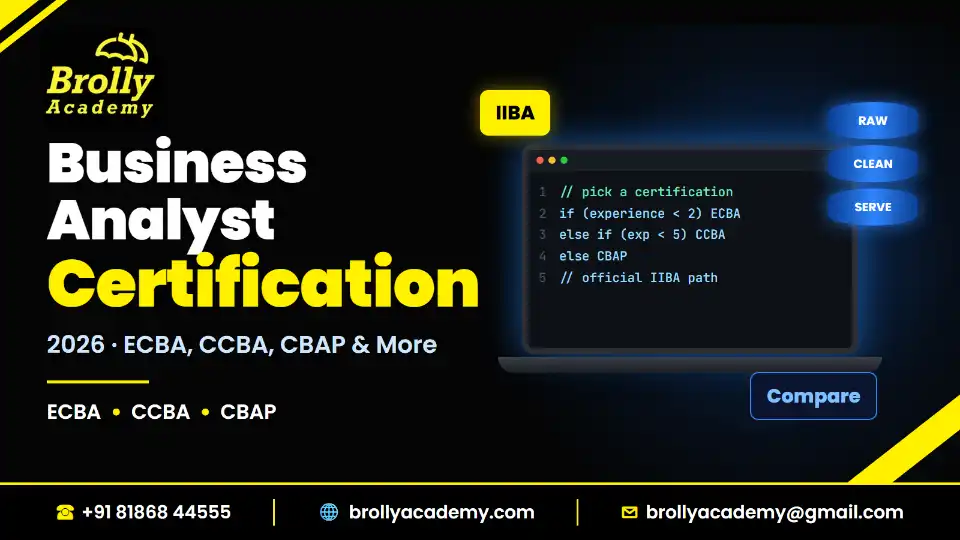
Table of Contents
1. What is a business analyst certification?
2. Why get a business analyst certification?
3. The full list of business analyst certifications in 2026
4. ECBA: Entry Certificate in Business Analysis
5. CCBA: Certification of Capability in Business Analysis
6. CBAP: Certified Business Analysis Professional
7. IIBA specialised certifications: AAC, CBDA, CCA and CPOA
8. PMI-PBA: is it still offered in 2026?
9. Other useful certifications: Agile, Scrum and Power BI
10. Business analyst certification comparison table
11. Which business analyst certification should you choose?
12. How to prepare for a business analyst certification
Quick answer
The best business analyst certification for you depends on your experience: ECBA if you are new, CCBA after about 2 to 3 years of BA work, and CBAP after 5 or more years (IIBA, October 2026). These three come from IIBA, the global body behind the BABOK Guide. IIBA also offers four specialist certifications: AAC for agile analysis, CBDA for data analytics, CCA for cybersecurity analysis and CPOA for product ownership. PMI-PBA from PMI is another option for BAs who work closely with project teams.
- Freshers and career switchers: start with ECBA. IIBA lists it at $395 or less, including the exam and membership.
- 2 to 3 years of BA work: CCBA needs 3,750 hours of BA work in the last 7 years.
- 5+ years of BA work: CBAP needs 7,500 hours of BA work in the last 10 years.
- Specialists: AAC, CBDA, CCA and CPOA are each listed at $405 or less for the exam with membership.
- Remember: a certification helps you get shortlisted, but skills and projects get you hired.
Key takeaways
- Match the certification to your hours of BA work. IIBA's core levels are built around experience, so applying too early wastes money and time.
- IIBA fees are in US dollars. Your rupee cost changes with the exchange rate on the day you pay.
- All IIBA exams follow the BABOK Guide v3, which has 6 knowledge areas and 50 techniques.
- Specialist certifications add depth, not entry. Take AAC, CBDA, CCA or CPOA when your job already touches that area.
- Plan for preparation time. Many learners set aside 6 to 12 weeks of steady study, more for CBAP.
1. What is a business analyst certification?
Short answer: A business analyst certification is a credential from a professional body, mainly IIBA or PMI, that proves you understand business analysis standards and, at higher levels, that you have real work experience. You earn it by meeting the eligibility rules and passing a proctored exam.
A business analyst (BA) turns business needs into clear requirements and checks that the solution solves the problem. For the full career picture, read our guide on how to become a business analyst.
A course completion certificate from a training institute is not the same thing. A professional certification comes only from the certifying body after you pass its exam, and recruiters know the difference.
There are two main certifying bodies. IIBA (International Institute of Business Analysis) publishes the BABOK Guide and runs the ECBA, CCBA and CBAP core certifications plus four specialist ones. PMI (Project Management Institute), best known for PMP, offers PMI-PBA. This guide focuses mainly on IIBA, because IIBA works only on business analysis and its levels match a typical BA career path.
2. Why get a business analyst certification?
Short answer: A certification gives you a structured way to learn business analysis, a common vocabulary with other BAs, and a recognised signal on your resume. It does not replace experience, but it can help you get shortlisted, especially when you are switching careers.
A certification gives your learning a structure, because the BABOK Guide organises BA work into clear knowledge areas. It makes your resume easier to trust and search. It supports career switches from testing, support, operations or development. At higher levels, CCBA and CBAP prove experience, because they require thousands of documented hours of BA work. Recertification also keeps you learning.
What a certification will not do is guarantee a job or a salary jump. Employers still test you on real skills: requirement gathering, user stories, process maps, SQL and stakeholder communication. IIBA's 2026 Global State of Business Analysis report (IIBA blog, June 2026), based on 2,120 respondents in 122 countries, found that communication was the top skill for BAs for the third year in a row. The same report found that 69% of respondents say AI has a positive impact on their careers, down from 74% in 2025. So pair your certification with strong communication and practical tools.
3. The full list of business analyst certifications in 2026
Short answer: IIBA currently lists seven certifications: three core (ECBA, CCBA, CBAP) and four specialised (AAC, CBDA, CCA, CPOA). PMI-PBA from PMI is still offered as far as we could confirm. Agile, Scrum and Power BI certifications are useful extras, not BA certifications on their own.
IIBA's certifications page (October 2026) lists these credentials:
We checked whether AAC, CCA and CPOA are still current, because some older articles say IIBA dropped them. As of October 2026, all three appear on IIBA's certifications page, each has its own active page with exam details and pricing, and we found no retirement notice.
4. ECBA: Entry Certificate in Business Analysis
Short answer: ECBA is IIBA's entry-level certificate for students, freshers and career switchers. It has no application fee, and IIBA lists the package at $395 or less, including the exam, a practice exam, a learning journey and the first year of membership (IIBA, October 2026).
ECBA is where most beginners should start. IIBA's ECBA page (October 2026) describes a package of "$395 or less" with membership, the exam, a practice exam and a learning journey. Student prices start "from $315 or less", depending on region, and free sample questions are available. Unlike CCBA and CBAP, the page lists no BA work-hours requirement. A rewrite costs $95 for members or $250 for non-members (IIBA certification fees page, October 2026). The new ECBA exam is in English only.
ECBA is knowledge-based. Pair it with two or three small BA projects to show you can apply what you know.
5. CCBA: Certification of Capability in Business Analysis
Short answer: CCBA is for BAs with about 2 to 3 years of experience. You need 3,750 hours of BA work in the last 7 years and 21 professional development hours in the last 4 years. The exam has 130 questions in 180 minutes, and you recertify every 3 years (IIBA, October 2026).
IIBA's CCBA page (October 2026) asks for 3,750 hours of BA work in the last 7 years (about 2 to 3 years) and 21 professional development hours in the last 4 years. A good BA training course usually covers the PD hours. The exam has 130 questions in 180 minutes, and you recertify every 3 years.
IIBA's certification fees page (October 2026) lists a $145 application fee and an exam fee of $250 for members or $405 for non-members. A rewrite costs $195 or $350, and recertification costs $85 or $120. The first year of membership is included with the exam fee. CCBA questions are scenario-driven, so you must think like a working BA, not just recall definitions.
6. CBAP: Certified Business Analysis Professional
Short answer: CBAP is IIBA's advanced certification for senior BAs. It needs 7,500 hours (5+ years) of BA work in the last 10 years and 35 professional development hours in the last 4 years. The exam has 120 questions in 210 minutes (IIBA, October 2026).
CBAP is the most recognised BA credential. The CBAP page (IIBA, October 2026) asks for 7,500 hours of BA work in the last 10 years and 35 PD hours in the last 4 years, with an exam of 120 questions in 210 minutes. Fees are a $145 application fee plus $350 (members) or $505 (non-members) for the exam. A rewrite costs $295 or $450, and recertification costs $85 or $120 (IIBA certification fees page, October 2026).
CBAP is a big commitment. You need to document your experience across the BABOK knowledge areas, and the exam uses longer scenarios. We cover the full application process, a week-by-week study plan and whether CBAP is worth it in India in our detailed CBAP certification guide.
7. IIBA specialised certifications: AAC, CBDA, CCA and CPOA
Short answer: IIBA's four specialist credentials add depth in one area. AAC covers agile analysis, CBDA covers business data analytics, CCA covers cybersecurity analysis (with IEEE Computer Society), and CPOA covers product ownership. Each is listed at $405 or less for the exam with membership (IIBA, October 2026).
These sit beside the ECBA, CCBA, CBAP ladder, not on it. Take one when your job is clearly in that area.
AAC: Agile Analysis Certification
IIBA's AAC page (October 2026) says the exam has 85 multiple-choice, scenario-based questions to complete in 2 hours. It is meant for professionals with two to three years of experience doing analysis work in an agile context. The listed price is $405 or less, including membership and the exam. AAC suits BAs in Scrum or hybrid teams who write user stories, refine backlogs and work in sprints.
CBDA: Certification in Business Data Analytics
IIBA's CBDA page (October 2026) lists 75 multiple-choice, scenario-based questions in 2 hours, across six domains. The price shown is $405 or less, including membership and the exam. CBDA is a good fit if you work as a data BA, write SQL, build dashboards or frame business questions for analytics teams. If you are unsure whether you lean towards data or business work, our comparison of data analysts and business analysts can help, and the skills overlap a lot.
CCA: Certificate in Cybersecurity Analysis
IIBA's CCA page (October 2026) says the exam has 75 multiple-choice, knowledge-based questions in 90 minutes. It is a joint certificate from IIBA and the IEEE Computer Society. Pricing is $405 or less for the exam with membership, or $550 or less for a package that adds learning modules. CCA suits BAs in banking, insurance, healthcare and other regulated sectors, where security requirements are part of every project.
CPOA: Certificate in Product Ownership Analysis
IIBA's CPOA page (October 2026) lists 60 multiple-choice, knowledge-based questions in 90 minutes. Pricing is $405 or less for the exam with membership, or $550 or less with learning modules. IIBA says it is for product owners, BAs who support product owners, and people considering a product owner career.
A note on eligibility: the CCA and CPOA pages do not list work-hour requirements, and IIBA points readers to the handbooks for each specialist credential. Read the handbook before you pay.
8. PMI-PBA: is it still offered in 2026?
Short answer: As far as we could confirm in October 2026, yes. PMI still hosts the PMI-PBA exam content outline and lists PMI-PBA in its renewal handbook, and we found no retirement announcement. PMI's website blocks automated access, so check fees and eligibility on pmi.org yourself before you apply.
PMI-PBA (PMI Professional in Business Analysis) suits BAs who work on projects alongside project managers. Web searches of pmi.org in October 2026 show that PMI still publishes the PMI-PBA exam content outline, with five domains: Needs Assessment, Planning, Analysis, Traceability and Monitoring, and Evaluation. PMI's continuing certification handbook lists a 3-year renewal cycle, and PMI's course registry lists a PMI-PBA boot camp scheduled for September 2026.
We could not confirm the current fee or the exact experience hours. Sources disagree on the hours and the published outline is several years old, so we do not quote them. Check pmi.org before you plan around PMI-PBA. For most Indian BAs, an IIBA certification is the better first credential. PMI-PBA makes sense if you already hold PMP or work in a PMI-heavy organisation.
9. Other useful certifications: Agile, Scrum and Power BI
Short answer: Agile and Scrum certifications help BAs who work in sprint teams, and a Power BI certification helps BAs who handle reporting and data. Treat them as add-ons to a core BA certification, not replacements.
Many BA job descriptions in India ask for Agile, Scrum and Jira skills. AmbitionBox lists SQL, Agile, Scrum, JIRA, requirement gathering, BRD and user stories among the top skills for business analysts (AmbitionBox, October 2026). Useful add-ons are Scrum product owner certifications from Scrum.org or Scrum Alliance (pair with AAC or CPOA), Scrum Master certifications if you facilitate ceremonies, and Microsoft's Power BI data analyst certification if you build dashboards (pair with CBDA). Pick one that matches the jobs you want. Badges without projects do not impress interviewers.
10. Business analyst certification comparison table
Short answer: The table below compares IIBA's core and specialist certifications by level, experience, exam and fee, using IIBA's official pages (October 2026). Fees are in US dollars and can change, so check IIBA's fees page before you pay.
Recertification for CCBA and CBAP costs $85 for members and $120 for non-members (IIBA certification fees page, October 2026). PMI-PBA is not in the table because we could not confirm its current fee and hours from PMI directly.
If you want to plan your total budget, including training costs and exam fees together, see our guide to business analyst course fees.
11. Which business analyst certification should you choose?
Short answer: Choose by your BA work hours first and your job focus second. No BA experience: ECBA. About 2 to 3 years: CCBA or AAC. 5+ years: CBAP. Add CBDA, CCA or CPOA only if your work is clearly in data, security or product.
Use this simple guide:
Two honest tips. First, count your hours honestly: only work that is truly business analysis, such as eliciting requirements, writing user stories, modelling processes or supporting UAT, should go into your application. Second, do not skip levels to save time. With 3 years of experience, CCBA is a safer bet than forcing a CBAP application. Freshers should not overspend: ECBA plus real projects beats a pile of certificates.
12. How to prepare for a business analyst certification
Short answer: Read the BABOK Guide v3, learn its 6 knowledge areas, practise with sample and mock questions, and link every concept to a real or practice project. Many learners plan 6 to 12 weeks for ECBA or CCBA, and longer for CBAP.
All IIBA exams are based on the BABOK Guide version 3, released in April 2015 and still current (IIBA, October 2026). It has 6 knowledge areas, 5 perspectives, an underlying competency model and 50 techniques. The six knowledge areas are:
- Business Analysis Planning and Monitoring
- Elicitation and Collaboration
- Requirements Life Cycle Management
- Strategy Analysis
- Requirements Analysis and Design Definition
- Solution Evaluation
A simple preparation plan:
- Confirm eligibility on the IIBA page for your certification, including PD hours for CCBA and CBAP.
- Read BABOK in chunks, one knowledge area per week, with your own one-page notes.
- Practise techniques on a sample project, such as a process model, a use case and a set of user stories.
- Practise questions weekly, starting with IIBA's free ECBA sample questions, then timed mock exams.
- Book the exam once you score well in mocks and have revised your weak areas.
Your exam prep also helps in job interviews, because many interview questions test the same ideas. Practise with our list of business analyst interview questions.
13. Is a business analyst certification worth it in India?
Short answer: Yes, if you pick the right level and back it with skills. A certification helps you get noticed, structure your learning and prove experience at higher levels. It is less useful if you collect it without projects or apply before you have the experience it assumes.
Business analysis is a well-paid career in India. AmbitionBox shows a typical business analyst salary of ₹9.7 to 10.7 lakh a year for people with 1 to 9 years of experience, based on about 1.5 lakh salaries (AmbitionBox, October 2026). AmbitionBox does not show a separate salary figure for certified BAs, so we cannot tell you how much a certification adds by itself. Experience, skills, domain and company type move pay more.
A certification is most worth it when you are switching careers, when you have the experience for CCBA or CBAP and want to prove it formally, or when your target employer asks for IIBA credentials, which is common in consulting and global delivery roles. It is least useful when you have no projects to show or choose a level that does not match your experience.
14. How Brolly Academy helps
Short answer: Brolly Academy's business analyst course in Hyderabad and online teaches the BABOK-based skills, tools and projects you need before and alongside a certification, with placement support, mock interviews and resume help.
The Business Analyst course at Brolly Academy runs for 3 months as a 10-week roadmap in 4 stages. It has 16 modules, 6 capstone projects and a junior BA real-time project. You work with Excel, SQL, Jira, Confluence, Trello, Tableau, Power BI, MS Visio, Lucidchart, Python and ChatGPT. The trainer, Mr. Sri Ram, has 15+ years in business analysis.
The course follows BABOK-aligned concepts, so the knowledge areas make sense before you sit an exam. You get classroom training in Hyderabad at Nizampet X Roads, near JNTU Metro, or live online batches, on weekdays and weekends. Placement assistance, resume building, weekly mock interviews, 100+ interview questions and a free demo class are included.
Fees listed on the course page are ₹9,999 for video recordings, ₹24,999 for live online and ₹29,999 for classroom, with EMI available. You receive a Brolly completion certificate. IIBA exam fees are paid separately to IIBA.
Not sure which BA certification fits you? Talk to us first.
Book a free demo class at Brolly Academy, meet the trainer, and get a clear plan for your certification, projects and job search based on your current experience.
Frequently asked questions
Which business analyst certification is best for beginners?
ECBA from IIBA is the best business analyst certification for beginners. It is the entry level of IIBA's core path, and its page lists no BA work-hours requirement. It tests BABOK Guide concepts and techniques. Pair it with two or three practice projects to show both knowledge and practical ability.
What is the ECBA certification cost?
IIBA lists the ECBA package at $395 or less in October 2026, including the exam, a practice exam, a learning journey and the first year of membership. There is no application fee. Student prices start from $315 or less, depending on region. A rewrite costs $95 for members and $250 for non-members.
What is the CCBA certification eligibility?
CCBA needs 3,750 hours of business analysis work in the last 7 years, about 2 to 3 years, plus 21 professional development hours in the last 4 years. The exam has 130 questions in 180 minutes, and you recertify every 3 years, according to IIBA in October 2026.
What is the CBAP certification eligibility?
CBAP needs 7,500 hours of business analysis work in the last 10 years, which is 5 or more years, plus 35 professional development hours in the last 4 years. The exam has 120 questions in 210 minutes. Most people take ECBA or CCBA first and move to CBAP later.
How much does CBAP certification cost?
CBAP has a $145 application fee and an exam fee of $350 for IIBA members or $505 for non-members, as listed by IIBA in October 2026. A rewrite costs $295 or $450. Recertification costs $85 or $120. The first year of membership is included with the exam fee.
How much does CCBA certification cost?
CCBA has a $145 application fee and an exam fee of $250 for IIBA members or $405 for non-members, according to IIBA in October 2026. A rewrite costs $195 or $350, and recertification costs $85 or $120. IIBA includes the first year of membership with the exam fee.
Can a fresher get a business analyst certification?
Yes, a fresher can take ECBA. It is designed for students, graduates and people new to business analysis, and its page lists no BA work-hours requirement. Freshers cannot apply for CCBA or CBAP, because those need thousands of hours of documented BA work.
Is IIBA certification valid in India?
Yes, IIBA certifications are recognised in India and worldwide. IIBA is the global body that publishes the BABOK Guide, the standard reference for business analysis. The exam is taken online, and the credential is the same wherever you earn it, so it travels with you between employers and countries.
What are the IIBA specialised certifications?
IIBA offers four specialised certifications in October 2026: AAC for agile analysis, CBDA for business data analytics, CCA for cybersecurity analysis and CPOA for product ownership analysis. Each is listed at $405 or less for the exam with membership. They sit beside the ECBA, CCBA and CBAP ladder.
Is the IIBA AAC certification still available?
Yes, the Agile Analysis Certification is still available in October 2026. It is on IIBA's certifications page with an active exam page. The exam has 85 scenario-based questions in 2 hours, aimed at people with two to three years of agile analysis experience. The price is $405 or less with membership.
Are IIBA CCA and CPOA still offered?
Yes, both are still offered in October 2026. CCA has 75 questions in 90 minutes and is a joint certificate with the IEEE Computer Society. CPOA has 60 questions in 90 minutes. Both are listed at $405 or less with membership, or $550 or less with learning modules.
What is the CBDA certification?
CBDA is IIBA's Certification in Business Data Analytics. It suits BAs who frame business questions, work with data and turn insights into decisions. The exam has 75 multiple-choice, scenario-based questions in 2 hours across six domains. IIBA lists it at $405 or less, including membership, in October 2026.
Is PMI-PBA still offered in 2026?
As far as we could confirm in October 2026, yes. PMI still publishes the PMI-PBA exam content outline, lists a 3-year renewal cycle for it, and its course registry shows a boot camp in 2026. We found no retirement notice. Check the current fee and experience rules on pmi.org.
Which is better, CBAP or PMI-PBA?
For most BAs in India, CBAP is the better choice. IIBA focuses only on business analysis, and CBAP sits at the top of the ECBA, CCBA, CBAP path. PMI-PBA can make sense if you already hold PMP or work in an organisation that follows PMI standards closely.
How long does it take to prepare for a BA certification?
Many learners plan 6 to 12 weeks of steady study for ECBA or CCBA, and longer for CBAP. Study one BABOK knowledge area each week, practise techniques on a sample project, and take timed mock exams. Working professionals often study an hour or two on weekdays and more at weekends.
What is the BABOK Guide?
The BABOK Guide is IIBA's standard for business analysis. Version 3, released in April 2015, is still current in October 2026. It has 6 knowledge areas, 5 perspectives, an underlying competency model and 50 techniques. All IIBA certification exams are based on it, so it is the main book to study.
What are the 6 BABOK knowledge areas?
The six BABOK knowledge areas are Business Analysis Planning and Monitoring, Elicitation and Collaboration, Requirements Life Cycle Management, Strategy Analysis, Requirements Analysis and Design Definition, and Solution Evaluation. Together they cover BA work from planning your approach to checking whether a solution delivers value.
Is business analyst certification worth it in India?
Yes, if you choose the right level and back it with practical skills. It helps you get shortlisted and proves experience at higher levels. AmbitionBox shows a typical BA salary of 9.7 to 10.7 lakh rupees a year in October 2026, but no separate figure for certified BAs.
Do I need a certification to become a business analyst?
No, you do not need a certification to become a business analyst. Many BAs are hired on skills, domain knowledge and projects. A certification helps career switchers, but interviews still test requirement gathering, user stories, process modelling, SQL and communication.
Can a non-IT person do a business analyst certification?
Yes, a non-IT person can take ECBA, because its page lists no BA work-hours requirement and it needs no coding. Many BAs come from finance, operations, sales or support and bring useful domain knowledge. Learn BABOK basics and tools such as Excel, Jira and SQL, then build practice projects.
How do I earn professional development hours for CCBA or CBAP?
You earn professional development hours through structured business analysis learning, such as BA training courses or workshops. CCBA needs 21 hours in the last 4 years, and CBAP needs 35 hours in the last 4 years. Keep your course certificates so you can record the hours accurately in your application.
How often do I need to renew an IIBA certification?
CCBA must be recertified every 3 years, according to IIBA in October 2026. CCBA and CBAP recertification costs $85 for members and $120 for non-members. The specialised certifications have their own recertification handbooks, so check the one for your credential.
Which certification should a data-focused business analyst take?
A data-focused business analyst should look at CBDA, IIBA's Certification in Business Data Analytics. Its exam has 75 scenario-based questions in 2 hours across six domains. A Power BI certificate is a useful add-on if you build dashboards, and SQL projects matter just as much.
Does Brolly Academy include the IIBA exam fee in its course?
No, Brolly Academy's course fee does not include the IIBA exam fee, which you pay to IIBA separately. The course page lists 9,999 rupees for video recordings, 24,999 rupees for live online and 29,999 rupees for classroom training, with EMI available.
Does Brolly Academy help with business analyst certification preparation?
Yes, Brolly Academy's business analyst course teaches BABOK-aligned concepts, tools and projects that support certification preparation. It runs for 3 months with 16 modules and 6 capstone projects. You also get placement assistance, resume building, weekly mock interviews and a free demo class.
Learn with Brolly Academy
Review the syllabus, practical projects and batch timings, and book a free demo before you enrol.
Related Articles
Continue Your Learning
Business Analyst Course in Hyderabad
Requirements, BRD and user stories, UML, Agile, Jira, SQL, Excel and Power BI with six capstone projects and placement support.
View CourseData Analytics Course in Hyderabad
Excel, SQL, Python, Power BI and Tableau with real business datasets and projects.
View CourseProduct Management Course
Product discovery, roadmaps, user research, metrics and Agile delivery for aspiring product managers.
View Course