
Brolly Academy | Embedded Systems
What Are Embedded Systems?
Types, Examples and How They Work (2026)
A plain-English guide to embedded systems: what they are, their parts, how they work, the main types, everyday and industry examples, RTOS basics, embedded C with a small code example, and how embedded systems differ from computers, IoT and VLSI.
What embedded systems are, explained simply: characteristics, components, types, examples, RTOS, embedded C, IoT and VLSI comparisons and how to start learning.
By Brolly Academy Team · Brolly Academy · Updated 21 October 2026
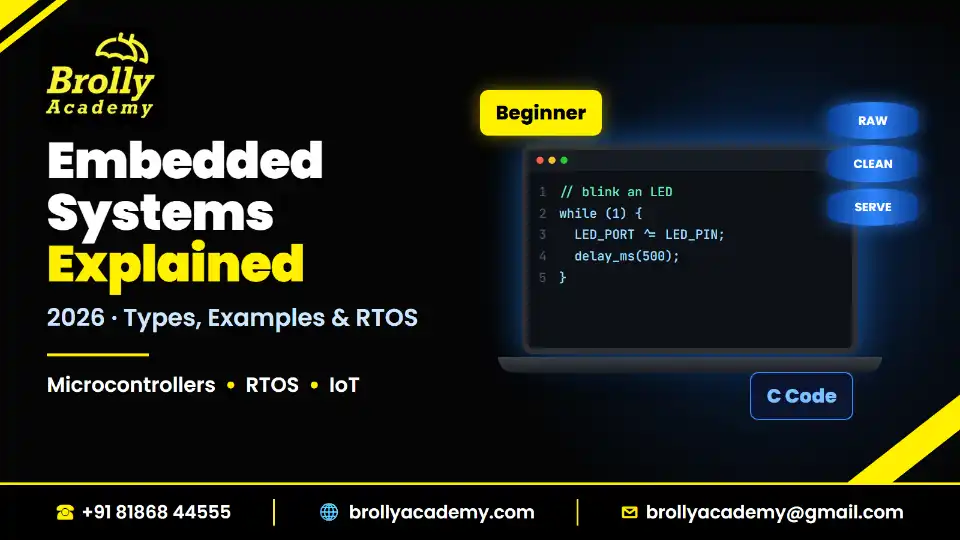
Table of Contents
1. What is an embedded system?
2. Characteristics of embedded systems
3. Components of an embedded system
4. How does an embedded system work?
6. Embedded systems examples by industry
7. Real-time operating system for embedded systems
8. Embedded systems with C (and other languages)
9. Embedded systems vs general-purpose computers
10. Difference between IoT and embedded systems
12. Applications of embedded systems
13. Careers and skills in embedded systems
Quick answer
Embedded systems are small computers built inside a bigger product to do one specific job, such as controlling a washing machine, a car's airbag or a UPI payment soundbox. Each one combines hardware (usually a microcontroller, memory, sensors and actuators) with software called firmware that runs that single task again and again. Most embedded systems must react on time, use little power and cost little, and many run without a screen or keyboard.
- What it is: a dedicated computer inside a device, not a general-purpose PC
- Main parts: microcontroller or microprocessor, memory, input/output, sensors, actuators and firmware
- Main types: standalone, real-time, networked and mobile; also small, medium and sophisticated
- Common languages: C first, then C++, with Rust and MicroPython growing
- Where you see them: phones, cars, ATMs, medical devices, smart meters, factories and satellites
Key takeaways
- An embedded system is built for one job. A laptop can do anything; a microwave controller only heats food.
- The microcontroller is the heart of most embedded systems. It puts the CPU, memory and input/output pins on one chip.
- Many embedded systems are real-time. A late answer from an airbag controller is a wrong answer.
- Embedded C is still the main language. Learn C, pointers and bit operations before anything else.
- IoT is built on embedded systems, and VLSI designs the chips that embedded systems use. They are related fields, not the same field.
1. What is an embedded system?
Short answer: An embedded system is a combination of hardware and software designed to do a specific task inside a larger device. It is "embedded" because it is hidden inside the product. You use the product, not the computer.
Think about your home. The washing machine knows when to fill water, spin and stop. The microwave counts down time and beeps. The TV remote sends a signal when you press a button. The digital meter on your wall records how much electricity you use. Each of these has a small computer inside. None of them is a laptop. Each one does one job well. That small computer is an embedded system.
A simple way to define it:
- Embedded means placed inside something else.
- System means parts working together under a set of rules.
So an embedded system is a set of electronic parts and a program, placed inside a product, working together to control that product.
A simple embedded system example: the digital thermometer
Take a digital body thermometer you buy at a pharmacy in India.
- A temperature sensor at the tip measures your body heat as a small voltage.
- A microcontroller reads that voltage and converts it into a number.
- The firmware (the program stored on the chip) checks when the reading is stable.
- The microcontroller shows the value on a small display and sounds a beep.
- After some time without use, the firmware turns the device off to save the battery.
That is a complete embedded system: input, processing, output, a fixed job, low power and low cost.
Why embedded systems matter
There are far more embedded systems in the world than PCs. A modern car contains many separate control units, and factories, hospitals, railways and satellites all depend on them. For ECE, EEE and CSE students, this is one of the most practical areas to learn, because almost every electronic product needs firmware.
2. Characteristics of embedded systems
Short answer: Embedded systems are task-specific, resource-constrained, reactive, often real-time, reliable, low-power and built around a microcontroller or microprocessor. Hardware and software are designed together for that one product.
Two more points help you understand the field:
- Firmware lives in non-volatile memory. The program is stored in flash memory (older systems used ROM), so it stays even when power is off.
- Updates are rare and careful. You cannot just "reinstall" a pacemaker's software. Many modern devices support over-the-air (OTA) updates, but these must be designed to be safe.
Advantages and limitations at a glance
3. Components of an embedded system
Short answer: Every embedded system has a hardware part (processor, memory, input/output, power, timers and communication interfaces) and a software part (firmware, sometimes an RTOS, and drivers). The processor is usually a microcontroller.
Hardware components
For a deeper look at buses, memory types and processor architecture, read our guide to the hardware architecture of an embedded system.
Software components
- Firmware (application code): the main program that does the product's job.
- Device drivers: small pieces of code that talk to each peripheral, such as the ADC or UART.
- Bootloader: code that starts the system and can load new firmware.
- RTOS (optional): a real-time operating system that runs several tasks on time. Small devices often skip it and use a simple loop.
- Embedded Linux (in bigger systems): used in routers, smart TVs, set-top boxes and industrial gateways.
Microcontroller vs microprocessor
This is one of the most common interview questions for freshers.
Simple rule: if the product controls something (a motor, a pump, a sensor), it usually uses a microcontroller. If it runs a full operating system with a screen and apps, it usually uses a microprocessor.
4. How does an embedded system work?
Short answer: An embedded system works in a loop: sensors read the real world, the processor runs the firmware to decide what to do, and actuators carry out the decision. This loop repeats many times every second.
The basic flow looks like this:
- Sense. A sensor produces a signal, for example a voltage that rises with temperature.
- Convert. The ADC turns that voltage into a digital number.
- Process. The processor compares the number with rules in the firmware.
- Decide. The firmware decides an action, such as "turn the compressor on".
- Act. The processor sets an output pin, sends a PWM signal or a message, and the actuator responds.
- Communicate (optional). The system sends data to a display, another controller or the cloud.
- Repeat or sleep. The system loops again or sleeps until the next event.
Example: an inverter air conditioner
A sensor reads the room temperature and the controller compares it with the value you set on the remote. If the room is too warm, the firmware raises the compressor speed; near the set point, it lowers it. This constant checking is why an inverter AC holds a steady temperature.
Polling vs interrupts
Embedded programs react to events in two main ways:
- Polling: the program keeps checking a pin or flag in a loop. It is simple but wastes time and power.
- Interrupts: the hardware stops the main program the moment an event happens (a button press, a byte received on UART, a timer tick) and runs a short function called an interrupt service routine (ISR). Interrupts make systems faster and more power-efficient.
Most real products use both: a main loop for routine work and interrupts for urgent events.
5. Types of embedded systems
Short answer: Embedded systems are usually grouped in two ways. By function and performance: standalone, real-time, networked and mobile. By complexity: small-scale, medium-scale and sophisticated.
Types by function and performance
Hard real-time vs soft real-time
Real-time systems are further split into two kinds:
- Hard real-time: missing a deadline is a failure and can be dangerous. Examples: airbag deployment, anti-lock brakes, pacemakers, railway signalling.
- Soft real-time: missing a deadline lowers quality but does not cause failure. Examples: video streaming on a set-top box, audio playback, an online game console.
Some engineers also use firm real-time for systems where a late result is useless but not harmful, such as a dropped frame in a video call.
Types by complexity
A product can belong to more than one type: a smartwatch is mobile, networked and partly real-time.
6. Embedded systems examples by industry
Short answer: You use dozens of embedded systems every day: in your phone, bike, kitchen, bank, hospital and office. Industries such as automotive, consumer electronics, healthcare, telecom, energy, railways, defence and space depend on them.
Everyday embedded systems examples you can spot today
If you want a quick list for an exam or interview, these are easy to explain:
- Traffic signal controller: changes lights on a timer or based on vehicle sensors.
- Digital weighing scale at a kirana shop: reads a load cell, converts it and shows the weight.
- Lift (elevator) controller: reads floor buttons and sensors, moves the car and opens doors safely.
- Car airbag system: reads crash sensors and fires the airbag within milliseconds.
- UPI soundbox: receives a payment message over the mobile network and announces the amount.
- Smart electricity meter: measures usage and sends readings to the power company.
7. Real-time operating system for embedded systems
Short answer: A real-time operating system (RTOS) is a small operating system that runs several tasks and guarantees that the most important task gets the processor on time. FreeRTOS and Zephyr are two widely used open-source RTOSes.
Why an RTOS?
A small device can run everything in one loop. But imagine a medical monitor that must read sensors, update a display, talk over Bluetooth and sound alarms. If the Bluetooth code runs long, the alarm could be late. An RTOS splits the work into tasks and always runs the most urgent one first.
Key RTOS concepts
How the scheduler picks tasks (priority-based, round-robin, rate-monotonic and so on) is a big topic on its own. Our guide to task scheduling in embedded systems explains each method with examples.
RTOS vs a general-purpose OS
Popular RTOS options
- FreeRTOS: distributed under the MIT open-source licence, maintained by AWS, and supports "40+ processor architectures" according to FreeRTOS.org (checked October 2026). It is often the first RTOS students learn.
- Zephyr: available under the Apache 2.0 licence, and the Zephyr Project says it supports more than 1,000 boards (checked October 2026). It is popular for connected and IoT devices.
- Others you will hear about: VxWorks, QNX and SafeRTOS in safety-critical and automotive work, and ThreadX (now Eclipse ThreadX) and Micrium in commercial products.
Tip for students: learn bare-metal programming on a microcontroller first. Then move to FreeRTOS on the same board, so you can see exactly what the RTOS adds.
Learn embedded systems hands-on in Hyderabad or online
Brolly Academy's 3-month Embedded Systems course takes you from C fundamentals to microcontrollers, communication protocols, ARM, RTOS and Linux device drivers, with projects on STM32, Arduino and Raspberry Pi. Book a free demo class to see the syllabus and batch timings.
8. Embedded systems with C (and other languages)
Short answer: C is the main language of embedded systems because it is fast, small and gives direct control of hardware registers. C++ is common in larger firmware, Rust is growing for memory safety, and MicroPython is great for learning and quick prototypes.
Why C dominates embedded systems
- Close to the hardware. Pointers let you read and write memory-mapped registers directly.
- Small and fast. C compiles into compact machine code that fits in kilobytes of flash.
- Predictable. There is no hidden garbage collector pausing your program.
- Supported everywhere. Almost every microcontroller vendor ships a C compiler and C libraries.
- Huge base of existing code. Drivers, RTOSes and vendor libraries are mostly written in C.
Embedded C concepts you must know
A small embedded C example: blinking an LED
This is the "hello world" of embedded systems. It toggles one output pin to blink an LED. The register address below is the GPIOA output data register on an STM32F4 microcontroller; on other chips you take the address from the datasheet or the vendor header file.
#include <stdint.h>
/* GPIOA output data register on STM32F4 (check your chip's reference manual) */
#define GPIOA_ODR (*(volatile uint32_t *)0x40020014u)
#define LED_PIN 5u
static void delay(volatile uint32_t count)
{
while (count--) { } /* simple busy-wait delay */
}
int main(void)
{
/* Enable the GPIOA clock and set pin 5 as output here (omitted for brevity) */
while (1) {
GPIOA_ODR ^= (1u << LED_PIN); /* toggle the LED */
delay(500000u);
}
}
What this teaches you:
- volatile stops the compiler from removing reads and writes it thinks are useless.
- (1u << LED_PIN) builds a mask with only bit 5 set.
- ^= toggles that one bit and leaves the other pins unchanged.
- while (1) is the endless main loop: embedded programs do not "exit".
In real projects you would use a hardware timer and the vendor's header files instead, but writing it this way once shows you what those libraries do.
Other languages in embedded systems
To see how these languages fit into the full workflow (requirements, toolchains, IDEs, debuggers, testing and flashing), read our post on the embedded software development process and tools.
9. Embedded systems vs general-purpose computers
Short answer: A general-purpose computer is built to run any software you install. An embedded system is built to run one fixed program inside a product, with tight limits on cost, power and response time.
10. Difference between IoT and embedded systems
Short answer: An embedded system is a computer inside a device that does a specific job, and it may or may not be connected to anything. IoT (Internet of Things) means devices connected to the internet that send data to the cloud and can be controlled remotely. Every IoT device contains an embedded system, but not every embedded system is IoT.
An easy way to remember it: an IoT device is an embedded system plus connectivity plus the cloud. A plain washing machine is embedded. A Wi-Fi washing machine you control from your phone is IoT, and it still has an embedded system at its core.
For a career, embedded skills come first. Once you can write firmware and use protocols such as UART, I2C and SPI, adding Wi-Fi, MQTT and a cloud dashboard is the natural next step.
11. VLSI vs embedded systems
Short answer: VLSI (Very Large Scale Integration) is about designing and verifying the chips themselves. Embedded systems is about using those chips to build products, by writing firmware and designing boards. VLSI works inside the chip; embedded works with the chip.
VLSI or embedded: which should you choose?
- Choose VLSI if you enjoy digital electronics, Verilog and the idea of designing a processor or memory block, and you are ready for a deep, specialised path.
- Choose embedded systems if you enjoy programming, like seeing hardware respond to your code, and want a wider range of industries to work in.
- Many ECE students start with embedded systems because a laptop and a cheap board are enough to begin. The two fields meet in FPGA work and firmware for new chips, so skills in one help in the other.
12. Applications of embedded systems
Short answer: Embedded systems are used wherever a product needs to sense, decide and act on its own: in homes, vehicles, hospitals, factories, networks, energy, farming, defence and space.
Grouped by what the system does:
- Control: motors in fans, pumps and EVs; temperature in ACs and fridges; engines in cars and bikes.
- Monitoring: patient monitors, smart meters, air quality sensors.
- Safety: airbags, ABS, fire alarms, railway signalling.
- Communication: routers, modems, Bluetooth and Wi-Fi modules.
- Automation: PLCs, robots, CNC machines, conveyor systems.
- Edge AI (TinyML): small machine learning models running on microcontrollers, for example to spot a wake word or detect machine faults from vibration.
13. Careers and skills in embedded systems
Short answer: Common roles include embedded software engineer, firmware engineer, embedded Linux developer, device driver developer, automotive embedded engineer, IoT engineer and embedded test engineer. You need C, microcontrollers, protocols, RTOS basics, debugging and basic electronics.
Core skills
Salary in brief
According to PayScale (page updated August 2026, checked October 2026), the average base salary for an Embedded Software Engineer in India is ₹5,81,811 a year, based on 186 salary profiles, with a base range of about ₹2.33 lakh to ₹10 lakh. The same page shows average total pay of ₹4,08,012 for entry-level engineers with less than one year of experience (based on 32 salaries). Pay rises with experience, strong C and Linux skills, and domain knowledge such as automotive or semiconductors.
Employers include automotive and EV companies, consumer electronics makers, semiconductor firms, industrial automation, medical device, telecom, defence and aerospace companies, and IT services firms with engineering divisions.
14. How to start learning embedded systems
Short answer: Learn C well, buy a low-cost microcontroller board, practise one peripheral at a time, then add protocols, an RTOS and embedded Linux. Build three or four small projects and put them on GitHub.
Follow this step-by-step path:
- Strengthen C. Focus on pointers, arrays, structures, bit operations, the volatile keyword and memory layout. Write small programs every day.
- Learn basic electronics. Ohm's law, voltage dividers, pull-up resistors, transistors as switches, and how to read a datasheet.
- Pick one board. An Arduino Uno is the easiest start. An STM32 "Blue Pill" or Nucleo board teaches you ARM Cortex-M, which is common in industry. An ESP32 adds Wi-Fi and Bluetooth.
- Master GPIO, timers and interrupts. Blink an LED, read a button with an interrupt, generate PWM to dim an LED or control a motor.
- Learn communication protocols. Print data over UART, read a temperature sensor over I2C, write to a display or SD card over SPI. Learn CAN if you want automotive work.
- Use real debugging tools. Step through code with a debugger and check signals with a logic analyser.
- Add an RTOS. Port one project to FreeRTOS with two or three tasks and a queue.
- Try embedded Linux. Cross-compile a program for a Raspberry Pi and write a simple character device driver.
- Build and share projects. Put code, a wiring diagram and a short video of each project on GitHub. Interviewers love working hardware.
Beginner project ideas
If you prefer a guided path with a trainer, labs and placement support, our Embedded Systems course in Hyderabad follows this same order, from C to microcontrollers, protocols, ARM, RTOS and Linux drivers.
15. How Brolly Academy helps
Brolly Academy's Embedded Systems Course in Hyderabad is built for engineering graduates (EEE, ECE, CSE, Mechanical, Mechatronics, Aerospace, M.Sc. and M.Tech) and working professionals who want to move into embedded roles. Basic C helps but is not required, because C is taught from the fundamentals.
- Duration: 3 months, with 80+ hours of training, on weekday and weekend schedules.
- Syllabus: 31 modules covering embedded basics, microcontroller architecture (ARM, AVR, PIC), communication protocols (UART/RS232/RS485, I2C, SPI, CAN, Ethernet, Bluetooth, Wi-Fi), C programming from basics to advanced, system programming, Linux kernel and device drivers, ARM peripherals, and RTOS scheduling and synchronisation.
- Hardware and tools: ARM Cortex, STM32, Arduino and Raspberry Pi boards, with Keil µVision, Arduino IDE, PlatformIO, Zephyr OS, Wireshark and CANalyzer among the tools.
- Projects: an embedded Linux device driver, embedded C sensor control on STM32 or Arduino, an IoT automation system with RTOS, an automotive embedded controller, and an industrial PLC interface with SCADA.
- Trainer: Mr. Vamsi Raju, an embedded systems specialist with 15+ years of experience.
- Formats and fees (as listed on the course page, October 2026): video recording ₹15,000, live online ₹40,000, classroom training ₹45,000 at the Kukatpally/Nizampet centre, with EMI available on all plans.
- Career support: 100% placement assistance, resume building, mock interviews and access to our network of 75+ hiring partners.
- Try first: attend a free demo class before you enrol.
Frequently asked questions
What are embedded systems in simple words?
Embedded systems are small computers built inside products to do one fixed job. A washing machine controller, a car's airbag unit and a digital thermometer are all embedded systems. They combine hardware such as a microcontroller and sensors with firmware that runs the task.
What are 5 examples of embedded systems?
Five common examples are a washing machine controller, a car's anti-lock braking system (ABS), an ATM, a smart electricity meter and a pulse oximeter. Others include traffic signal controllers, Wi-Fi routers, fitness bands and UPI payment soundboxes.
What are the main types of embedded systems?
By function, embedded systems are standalone, real-time, networked and mobile. By complexity, they are small-scale (8-bit or 16-bit microcontrollers), medium-scale (16-bit or 32-bit, often with an RTOS) and sophisticated (32-bit or 64-bit, often running embedded Linux).
Is a mobile phone an embedded system?
A smartphone is often called a mobile embedded system because it is battery-powered and built around a system-on-chip. But it behaves like a general-purpose computer because you can install any app. Inside it, several smaller embedded systems handle the modem, camera, battery and sensors.
Why is C used in embedded systems?
C is fast, produces small code, gives direct access to hardware registers through pointers, and has compilers for almost every microcontroller. Most vendor libraries, drivers and RTOS kernels are also written in C, so it is the first language every embedded engineer learns.
What is an RTOS in embedded systems?
An RTOS (real-time operating system) is a small operating system that runs several tasks and guarantees that the highest-priority task runs on time. It provides a scheduler, priorities, queues, semaphores and mutexes. FreeRTOS and Zephyr are two popular open-source options.
What is the difference between IoT and embedded systems?
An embedded system is a dedicated computer inside a device and does not need the internet. IoT adds internet connectivity, cloud storage and remote control on top of an embedded system. Every IoT device contains an embedded system, but not every embedded system is part of IoT.
Which is better, VLSI or embedded systems?
Neither is better for everyone. VLSI is about designing chips with Verilog and EDA tools. Embedded systems is about writing firmware and building products with those chips. Choose VLSI if you love digital circuit design, and embedded systems if you enjoy coding close to hardware across many industries.
What are embedded systems used for?
Embedded systems are used to sense, decide and act inside a product without a person running a computer. They control motors in fans, pumps and EVs, monitor patients and electricity use, run safety systems such as airbags and ABS, and handle communication in routers and Wi-Fi modules. They also run automation in factories through PLCs, robots and CNC machines. You find them in homes, vehicles, hospitals, farms, defence and space.
What are the main components of an embedded system?
An embedded system has hardware and software parts. The hardware includes a processor (usually a microcontroller), memory, sensors, an ADC, actuators, timers, communication interfaces, a power supply and a watchdog timer. The software includes the firmware that does the main job, device drivers for each peripheral and a bootloader. Some systems also use an RTOS, and bigger ones run embedded Linux.
What are the characteristics of embedded systems?
Embedded systems are task-specific, which means they do one job or a small set of jobs. They are also resource-constrained, reactive, often real-time, reliable, low-power and small in size. Hardware and software are designed together for one exact product. Most have few or no screens and keyboards, and the firmware is stored in flash memory so it stays when power is off.
How does an embedded system work?
An embedded system works in a repeating loop. A sensor reads the real world, the ADC turns that signal into a number, and the processor runs the firmware to decide what to do. Then it sets an output so an actuator such as a motor or relay responds. It may send data to a display or the cloud, then loop again or sleep until the next event.
Is a microcontroller the same as an embedded system?
No, a microcontroller is a part of an embedded system, not the whole system. A microcontroller is one chip that holds the CPU, flash, RAM, timers, ADC and input/output pins. The embedded system is that chip plus sensors, actuators, power supply and the firmware that runs the product. A microprocessor is different again: it mainly holds the CPU and needs separate memory chips, and it usually runs a full OS.
What is the difference between hard and soft real-time embedded systems?
In a hard real-time system, missing a deadline is a failure and can be dangerous, as in airbags, anti-lock brakes, pacemakers and railway signalling. In a soft real-time system, a late result only lowers quality, as in video streaming on a set-top box or audio playback. Some engineers also use firm real-time for cases where a late result is useless but not harmful.
Which RTOS is used in embedded systems?
FreeRTOS and Zephyr are the most common open-source choices of real time operating system for embedded systems. FreeRTOS is under the MIT licence, is maintained by AWS and supports 40+ processor architectures according to FreeRTOS.org (checked October 2026). Zephyr is under the Apache 2.0 licence and supports more than 1,000 boards according to the Zephyr Project. VxWorks, QNX and SafeRTOS are used in safety-critical and automotive work.
What is the difference between an RTOS and a normal operating system?
An RTOS is built to meet deadlines every time, while a general-purpose OS such as Windows aims for good average speed and a smooth user experience. An RTOS is very small and can fit in kilobytes, uses strict priority scheduling and runs on microcontrollers. A general-purpose OS needs gigabytes, shares time fairly between many programs and runs on PCs, laptops and servers.
Do embedded systems use C or C++?
Embedded systems use both, but C comes first. Most microcontroller firmware, drivers and RTOS kernels are written in C, so learning embedded systems with C is the standard starting point. C++ is common in larger firmware, automotive and consumer devices and Arduino sketches, usually as a careful subset that avoids heavy dynamic memory on small chips. Rust and MicroPython are also growing.
What is firmware in an embedded system?
Firmware is the program stored on the chip that makes an embedded system do its job. It lives in non-volatile flash memory, so it stays even when the power is off. In a digital thermometer, for example, the firmware reads the sensor, checks when the reading is stable, shows the value, beeps and later switches the device off to save the battery.
Can embedded systems be reprogrammed?
Yes, most modern embedded systems can be reprogrammed, but updates are rare and careful. The firmware sits in flash memory, and a bootloader can load new firmware onto the chip. Many devices now support over-the-air (OTA) updates, but these must be designed to be safe. For devices such as a pacemaker, you cannot simply reinstall the software like you would on a laptop.
What is the difference between an embedded system and a general-purpose computer?
An embedded system runs one fixed program inside a product, while a general-purpose computer can run any software you install. An embedded system uses a microcontroller or SoC chosen for the job, often has no screen, must often meet real-time deadlines and uses very little power. A laptop or desktop has a powerful CPU, lots of RAM, a full OS and a much higher cost.
What are the advantages and disadvantages of embedded systems?
The main advantages are low cost per unit in large numbers, low power use, small size, fast response and high reliability for one task. The main disadvantages are that they are hard to change once the product ships, have limited memory and processing power, and are harder to debug than a PC. Development can also take longer because hardware and software must match.
What are some embedded systems examples in a car?
A modern car contains many separate embedded control units. Common embedded systems examples in a car are the engine control unit (ECU), the anti-lock braking system (ABS), the airbag controller, the instrument cluster and, in electric vehicles, the battery management system. Car infotainment is a sophisticated embedded system that often runs embedded Linux. Airbag and ABS controllers are hard real-time systems that must act within milliseconds.
Is embedded systems hard to learn for beginners?
Embedded systems is manageable for beginners if you learn in the right order. Start with C, especially pointers, bit operations and the volatile keyword, then learn basic electronics and pick one low-cost board such as an Arduino Uno or STM32. Practise one peripheral at a time, then add protocols, an RTOS and embedded Linux. Debugging takes patience, so build small projects and share them on GitHub.
What is the salary of an embedded software engineer in India?
According to PayScale (page updated August 2026, checked October 2026), the average base salary for an Embedded Software Engineer in India is ₹5,81,811 a year, with a base range of about ₹2.33 lakh to ₹10 lakh. The same page shows average total pay of ₹4,08,012 for entry-level engineers with less than one year of experience. Pay rises with experience, strong C and Linux skills and domain knowledge.
Is embedded systems a good career for ECE students?
Yes, embedded systems is a practical career for ECE, EEE and CSE students because almost every electronic product needs firmware. Roles include embedded software engineer, firmware engineer, device driver developer, automotive embedded engineer and IoT engineer. Employers range from automotive and EV companies to medical, telecom and semiconductor firms. Brolly Academy's embedded systems course in Hyderabad trains freshers in C, microcontrollers, protocols, RTOS and Linux drivers for these roles.
Learn with Brolly Academy
Review the syllabus, practical projects and batch timings, and book a free demo before you enrol.
Related Articles
Embedded Software Development Process and Tools
Tools and steps used to build embedded software.
Read ArticleContinue Your Learning
Embedded Systems Course in Hyderabad
Embedded C, microcontrollers, RTOS and hands-on hardware projects.
View Course