PROMPTING · RESEARCH · CONTENT · AUTOMATION
AI Generalist Course in Hyderabad
Build practical AI skills for everyday work in a one-month AI Generalist course with Ravi Varma. Learn to research, write, analyse data, create media and connect useful workflows, then review results before you use them. Choose online, classroom or hybrid learning, with a free demo before enrolment.
Brolly Academy · Teaching since 2021 · Classroom and live online learning
Trainer: Ravi Varma · AI Generalist course · Updated October 2026
TrainerRavi Varma
Duration1 month
Online fee₹14,000
ModesOnline · Offline · Hybrid
AI Generalist Course in Hyderabad
Brolly Academy's AI Generalist Course in Hyderabad is a one-month, practical program with Ravi Varma for applying AI across research, communication, content, data and business workflows. Tuition is ₹14,000 online, ₹18,000 offline and ₹16,500 hybrid. The learning path connects 16 modules with project work, output checking and a final portfolio presentation.
An AI generalist connects the task, the right tool and the people using the result. You do not need to train a machine-learning model to start. You do need to frame a clear problem, protect private information, question an answer and explain what you changed. This course builds those habits through realistic exercises using public, synthetic or authorised data.
Why choose Brolly Academy for AI Generalist training?
Practical learning and support✓ A connected path from foundations to a finished workflow
✓ Exercises in research, writing, spreadsheets and presentations
✓ Creative media with a clear brief and review checklist
✓ Workflow automation with human approval
✓ Projects that show inputs, decisions and results
✓ Portfolio and interview preparation
✓ Course-related doubt clarification
✓ A free demo to discuss your learning goals
Flexibility and value✓ Online, offline and hybrid learning options
✓ One-month course duration
✓ Ravi Varma as the course trainer
✓ Weekday and weekend schedules discussed with admissions
✓ ₹14,000 online, ₹18,000 offline or ₹16,500 hybrid
✓ EMI terms explained before payment
✓ Tool access requirements clarified upfront
✓ Corporate training scope can be customised
AI Generalist Course Syllabus (16 Modules)
The syllabus moves from understanding a task to creating a reliable result. Each module includes a practical output and a review step. Tool choices may change as products evolve; the core skills remain clear instructions, appropriate data, repeatable workflows and accountable human decisions.
Module 1: AI Foundations and Use-Case Selection
Understand generative AI, model limitations and the difference between a generalist and an AI engineer. Compare manual, assisted and automated approaches. Practice: choose one task, describe its users and define what a successful result must contain.
Module 2: Prompting and Output Requirements
Write instructions with context, examples, constraints and a clear output format. Break complex work into reviewable steps and compare revisions. Practice: produce a reusable prompt with normal and ambiguous-input tests.
Module 3: Research and Source Verification
Plan a research question, compare primary sources, check dates and distinguish evidence from a generated summary. Practice: create a short research brief with a claim-to-source table and unresolved questions.
Module 4: Writing and Business Communication
Draft emails, proposals, reports and standard operating procedures for different audiences. Edit for tone, factual accuracy, privacy and useful next steps. Practice: turn an approved brief into three communication formats.
Module 5: Spreadsheets and Data Analysis
Clean small datasets, inspect formulas, summarise trends and create charts. Validate totals and avoid inferring causation from a pattern. Practice: build a checked report from synthetic business data and explain every conclusion.
Module 6: Presentations and Visual Storytelling
Turn research into a presentation with a clear narrative, concise slides and readable charts. Check that visuals support the claim. Practice: create a five-slide decision brief with references and speaker notes.
Module 7: Image Creation and Brand Consistency
Write image briefs, select suitable formats and refine generated visuals. Review text accuracy, likeness permissions, licensing and accessibility. Practice: create a consistent small asset set for a fictional campaign.
Module 8: Video, Audio and Content Repurposing
Plan a storyboard, script, captions and a review process for short-form media. Use only authorised voices and footage. Practice: repurpose a source brief into a short video plan, audio script and accessible transcript.
Module 9: Web and App Prototyping
Describe a simple interface, inputs, user journey and acceptance criteria. Review AI-assisted prototypes for usability, validation and basic accessibility. Practice: demonstrate a small prototype using sample data, not production credentials.
Module 10: Knowledge Assistants and Retrieval Basics
Understand document preparation, retrieval and source-grounded answers without assuming model training. Practice: organise permitted documents, test an assistant on supported and unsupported questions, and record citation errors.
Module 11: No-Code Workflow Automation
Connect a trigger, structured inputs, transformations and an output using a workflow tool such as n8n. Practice: route a sample enquiry into a draft response with human approval, error handling and a manual fallback.
Module 12: API, JSON and Data Foundations
Read structured JSON, recognise authentication and permissions, and understand request and response errors. Practice: map fields from a public or mock API into a report while keeping secrets out of prompts and shared files.
Module 13: AI Assistants, Agents and Human Approval
Distinguish a fixed workflow from an agent that chooses steps. Limit tool permissions and add approval before messages or external changes. Practice: test a bounded assistant that pauses for review and handles a denied action.
Module 14: Evaluation, Privacy and Responsible Use
Use representative examples and a simple rubric for accuracy, relevance and completeness. Check sensitive data, permissions, prompt injection and bias risks. Practice: document failures and decide when a task should remain manual.
Module 15: Business Workflow Design and Value
Map the existing process, select a small improvement and compare time, quality, cost and correction effort. Practice: write a before-and-after workflow note with explicit assumptions instead of invented ROI claims.
Module 16: Capstone, Portfolio and Handover
Combine a brief, approved data, a working workflow and an evaluation checklist. Present the result, its limits, access requirements and running costs. Deliver a short demo, project notes and a handover guide another person can follow.
Get the AI Generalist syllabus and fee details on WhatsApp
Tell us your current role, learning goal and preferred mode. The admissions team will share the syllabus, available batch schedules, fee details and demo arrangements. Ask for written payment terms and any separate tool costs before enrolling.
AI Generalist Course Roadmap: A Practical One-Month Path
Follow four connected learning stages across one month. Start with clear prompts and reliable research, move into content and data tasks, connect a small workflow and finish by testing and presenting your work. Confirm class hours, practice expectations and the batch calendar with admissions.
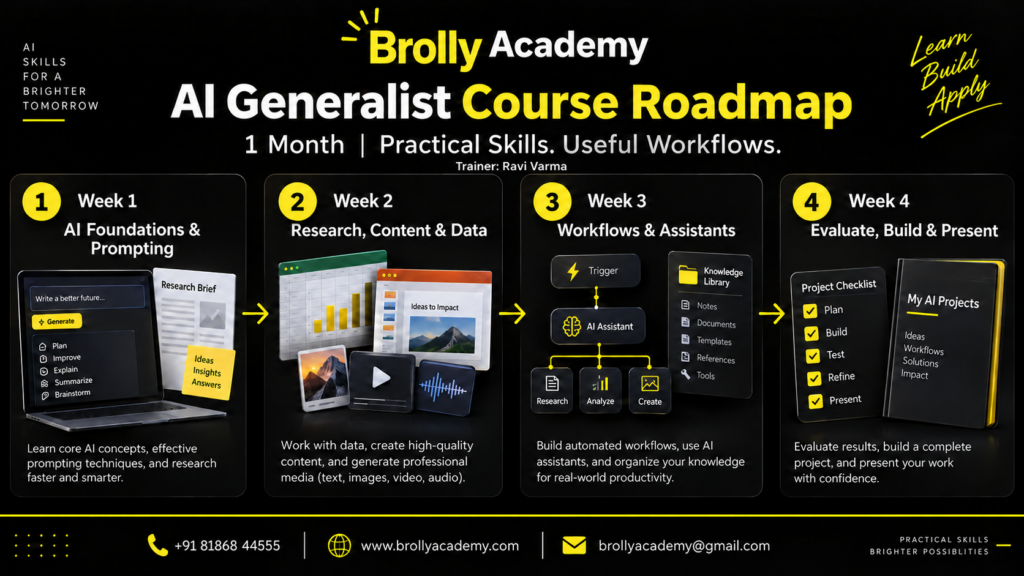
Week 1AI foundations and promptingChoose a useful task, define a good answer, compare prompts and verify sources. Keep a prompt log and an evidence-backed research brief.
Week 2Research, content and dataBuild a campaign brief, spreadsheet analysis and presentation. Review calculations, consistency, accessibility and rights before sharing.
Week 3Workflows and assistantsConnect forms, documents and approved tools. Add validation, approval and a fallback so a small automation can be understood and controlled.
Week 4Evaluate, build and presentTest a capstone on ordinary and failed cases, record limitations and costs, and prepare a short demo with a clear handover guide.
What Is an AI Generalist and Why Learn These Skills?
An AI generalist applies AI tools across several kinds of work instead of specialising only in model development. The role combines problem framing, prompting, research, content creation, data handling and workflow design. The value is a useful, checked outcome, not the number of tools you can name. It complements domain expertise and does not replace specialist engineering, legal or professional judgement.
Research with evidenceTurn a question into a source-backed brief, distinguish facts from assumptions and open the original references.
Create clear communicationDraft proposals, emails and reports for a defined audience, then check accuracy, tone and confidential details.
Work with dataClean a small spreadsheet, explain formulas and validate the numbers behind a summary or chart.
Develop visual contentTranslate a brief into presentations, images or short video plans with consistent branding and accessible text.
Prototype an ideaOutline a simple page or app, define the inputs and expected behaviour, and review an AI-generated first version.
Organise knowledgePrepare authorised documents for an assistant and check whether answers are supported by the source.
Connect repeatable tasksUse workflow tools to route data and drafts while keeping approval around messages, changes and sensitive actions.
Measure usefulnessCompare the workflow against the original task using time, quality, cost and correction effort.
Know when to stopRecognise missing evidence, unsuitable automation and work that needs a qualified specialist.
Benefits of the AI Generalist Course in Hyderabad
Build skills you can carry across tools and roles. In classroom or online learning, the focus is the same: understand the task, produce a useful output, check it and explain the result.
01Start with a real needChoose a workflow that matters to your work or portfolio instead of collecting unrelated prompts.
02Learn tool selectionCompare capabilities, access limits, privacy settings and costs before choosing an AI tool.
03Create portfolio evidenceKeep the brief, inputs, output versions, review checklist and lessons from each project.
04Explain your decisionsPractise describing why a tool was used, what it missed and how you corrected it.
05Complete a structured pathConnect module practice with a capstone and course completion requirements.
06Build data confidenceWork with spreadsheets, structured fields and simple JSON without assuming advanced programming.
07Review AI criticallyCheck references, calculations, omissions and unsupported claims before relying on a result.
08Automate responsiblyAdd validation, permissions and a human approval step to repeatable workflows.
09Choose a suitable modeJoin online, offline or hybrid training. Discuss video-learning enquiries and customised corporate requirements with admissions.
Choosing an AI Generalist Course? Compare the Learning Experience
Use these points when comparing course outlines and demos. Other providers vary; the comparison below describes learning approaches, not unsupported claims about a named institute.
A tool-tour approachTools shown separately
Prompts without a defined quality check
One polished example with no failed cases
Outputs without supporting sources
Automation shown only on a successful run
Unclear tool access and subscription costs
Certificates without project evidence
A generic syllabus unrelated to your goal
The Brolly Academy learning pathConnect tools around a useful task
Define output requirements before prompting
Test normal, missing-input and incorrect-output cases
Keep references and review decisions
Add approval and recovery to workflows
Discuss access, subscriptions and fees upfront
Build a documented project portfolio
Use the demo to discuss your role and goals
Meet Your AI Generalist Trainer
COURSE TRAINER
Ravi Varma
AI Generalist Course Trainer · One-month practical learning path
Ravi Varma is the trainer for the AI Generalist course at Brolly Academy. The course focuses on practical prompting, research, content, data and workflow applications, with attention to checking the result rather than simply generating it. Meet Ravi Varma in the free demo, review a sample exercise and discuss your starting level, project goals and feedback arrangements.
Skills You Will Practise in the AI Generalist Course
Task framingDefine the audience, inputs, constraints and acceptance criteria for a useful result.
Prompt designUse context, examples and output formats; revise based on specific errors.
Research verificationTrace important claims to original sources and record unresolved questions.
Business communicationTurn a brief into clear, accurate drafts tailored to the reader.
Spreadsheet analysisCheck formulas, missing values, totals and the meaning of a chart.
Creative productionDevelop branded images, presentations and video plans with a human review step.
Structured dataUnderstand fields, JSON, simple API requests and validation.
Workflow automationConnect approved tools, handle errors and request approval before consequential actions.
Evaluation and handoverDocument quality checks, limitations, costs and operating instructions.
AI Generalist Projects and Capstone Portfolio
Build small, complete projects that show how you use AI with judgement. Each project should include a brief, permitted inputs, an output, a review checklist and a note about limitations. The final capstone combines selected skills into one workflow you can demonstrate.
Project 1Source-backed research briefCompare public sources, organise findings and prepare a decision brief. Deliver a claim-to-source table and flag facts you could not verify.
Project 2Branded content campaignCreate a campaign brief, copy variations, visuals and a short video script. Check factual claims, brand consistency, image rights and audience fit.
Project 3Spreadsheet insight reportUse synthetic sales or service data to clean fields, validate calculations and create an insight presentation. Explain assumptions and avoid unsupported conclusions.
Project 4Document knowledge assistantPrepare an authorised document set and test source-grounded answers. Include missing-answer cases, citation checks and a clear boundary for unsupported questions.
Project 5Approval-based enquiry workflowRoute a sample enquiry through validation, categorisation and a draft reply. Keep human approval before sending and document what happens when a step fails.
CapstoneOne useful business workflowChoose a scoped problem, build a working version and compare it with the original process. Deliver a demo, test cases, cost notes and an understandable handover.
Tool practiceAI assistants such as ChatGPT, Gemini or Claude; source-based research tools; spreadsheets and presentations; design and media tools; and workflow automation such as n8n. The batch tool list and access requirements are confirmed before enrolment. Paid subscriptions and API usage are not automatically included in tuition.
AI Generalist Course Fees and Learning Options
Choose online, offline or hybrid learning for the one-month AI Generalist course with Ravi Varma. Get the batch timetable, session format, inclusions, tool access and payment terms in writing before paying.
Online Training₹14,000One-month live online course
Trainer: Ravi Varma
16 connected learning modules
Research, content and data practice
Workflow and assistant exercises
Capstone and portfolio preparation
Confirm session timings and recording access
Classroom optionOffline Training₹18,000One-month classroom course
Trainer: Ravi Varma
Training centre near JNTU Metro
16 connected learning modules
Practical exercises and workflow projects
Capstone and portfolio preparation
Confirm class hours and lab arrangements
Hybrid Training₹16,500One-month blended learning course
Trainer: Ravi Varma
Online and classroom participation
16 connected learning modules
Practical exercises and workflow projects
Capstone and portfolio preparation
Confirm the online/offline session split
A free demo is available before enrolment. Ask about EMI options, video-learning availability and customised corporate training. Confirm any interest, processing charges, taxes, subscription costs and access periods in the written offer. Review our refund policy and terms and conditions before payment.
Career and Placement Preparation for AI Generalist Learners
Turn your project work into clear evidence of what you can do. Preparation focuses on a relevant portfolio, honest role positioning and explaining decisions. Placement assistance is not a job, interview or salary guarantee; hiring depends on the employer, your background and demonstrated skills.
Role-focused resumeDescribe the task, your contribution and the evidence behind a result. Label learning projects as projects, not client employment.
Job-search preparationRead actual role requirements and separate entry-level opportunities from positions that need prior domain experience.
Interview practice topicsPrepare to explain tool selection, prompt revisions, verification, privacy and failed workflow cases.
Project evidenceBuild a portfolio from course exercises and the capstone. Do not present a training project as a guaranteed internship.
Practical demonstrationsShow the input, working process and result, including a case that needs manual review.
Problem-solving practiceBreak a vague request into steps and identify missing information before asking AI to generate an answer.
Professional communicationPresent a concise recommendation with evidence, limitations and an appropriate next action.
Portfolio explanationPractise walking through a project and answering why a choice was made or a result was rejected.
Application readinessMatch your existing strengths with a realistic target role. Confirm any batch-specific career-support arrangements before enrolling.
Academy Student Reviews: Generative AI Course Feedback
"The Generative AI training in Hyderabad at Brolly Academy was fantastic. The hands-on experience made complicated ideas much easier to understand. The instructions were clear, and the instructors were very helpful and knowledgeable. I now feel much more confident in my skills and ready to use what I’ve learned in real-world situations."Saikumar
"I had a great experience with the Generative AI training in Hyderabad at Brolly Academy. The real-world examples and hands-on projects helped me understand how to apply what I learned. The instructors were very supportive, always available to help with questions, and made learning smooth and enjoyable."Minakshi Thakur
"Attending the Generative AI course at Brolly Academy was very valuable. The lessons were practical and helped me use new techniques in real situations. I gained useful skills that I can apply directly to my job. The instructors gave great guidance and support, and the training really boosted my confidence."Alka
"The Gen AI course at Brolly Academy in Hyderabad was a great experience. As someone interested in NLP, I found the topics on language generation, machine learning and prompt engineering helpful. If you want something hands-on, this is a good choice. The trainers were supportive, and I learned a lot from the professionals during the sessions."Vishnu
"The Generative AI training at Brolly Academy in Hyderabad was invaluable for my work in computer vision. The focus on practical applications of generative models in image synthesis was incredibly useful, and the curriculum was closely aligned with industry needs."Mithali
"The Generative AI course at Brolly Academy in Hyderabad went beyond what I expected. It covered both basic and advanced topics, making it great for learners of all levels. Thanks to the Brolly Academy team for their support. I’m now employed at a great company."Pranav
Learning Community and Continued Practice
Learning and collaborationCompare approaches to a shared exercise, explain your changes and review each other's outputs respectfully.
Resources and toolsKeep reusable briefs, prompt logs, checklists and project notes. Confirm recording access separately for your batch.
Peer feedbackShare permitted examples and ask focused questions about the task, output or workflow step you are improving.
Course-related doubtsUse the support arrangements agreed with admissions to clarify topics and discuss project questions.
Continued developmentChoose a deeper specialisation after building foundations, based on your role and the work you want to do.
AI Generalist Course Prerequisites and Eligibility
Students, graduates, working professionals, freelancers and business owners can join. Advanced coding or a computer-science degree is not required for the core workflow. You should be comfortable using a computer, willing to practise and ready to check AI output rather than accept it automatically.
Computer basicsUse a browser, manage files, write a document and work with a simple spreadsheet.
Coding is optional to beginStart with tool-based exercises. Basic API and JSON concepts are introduced for understanding connected workflows.
Basic numeracyRead percentages, totals and charts so you can spot mistakes in generated analysis.
A laptop and connectionBring a suitable laptop and reliable internet access. Confirm any tool or account requirements before the batch.
Safe practice dataUse public, synthetic or authorised inputs. Do not upload employer or customer information without permission.
Time for practicePlan time between sessions to revise outputs, test workflows and document what you learned.
Who Should Join AI Generalist Training?
Students and freshersBuild practical project evidence and learn how to explain an AI-assisted task clearly.
Working professionalsImprove a repeatable research, reporting, communication or operational task in your existing role.
Analysts and operations teamsCombine spreadsheet reasoning, documentation and controlled workflow automation.
Marketing and content professionalsPlan campaigns, draft assets and review accuracy, brand consistency and audience fit.
Business owners and foundersPrototype a useful workflow and assess its quality, cost and risks before a wider rollout.
Freelancers and consultantsDevelop a scoped service with clear deliverables, review steps and honest boundaries.
AI Generalist Career Paths and Practical Applications
AI-enabled operationsImprove reporting, document handling and repeatable processes alongside your operations knowledge.
Content and marketing workflowsCreate researched briefs and coordinated assets with editorial and brand review.
Research supportOrganise sources and produce clear summaries, keeping evidence and uncertainty visible.
Workflow automationBuild and maintain simple approved automations; deeper integration roles need additional technical skills.
Business analysisMap a process, define requirements and evaluate whether an AI-assisted change improves it.
Data-assisted reportingUse spreadsheets and clear visual explanations. Specialist analyst roles may also require SQL, statistics and domain knowledge.
Customer-support enablementPrepare knowledge content and draft assistance while retaining escalation and human oversight.
Product and project supportCreate prototypes, document decisions and test assumptions under experienced product leadership.
Freelance AI servicesOffer a narrow, demonstrable service with clear scope, review and delivery responsibilities, not unlimited automation promises.
AI Generalist Salary and Role Expectations
Entry-level applicantsCompare the actual roleLook at assistant, content, operations or junior analyst openings that match your existing qualifications. There is no verified single fresher salary for every AI generalist role.
Experienced professionalsBuild on domain experiencePay depends on responsibilities, industry, location and evidence of results. A short course alone does not establish seniority or guarantee a salary increase.
Before accepting an offerCheck the complete packageCompare fixed pay, variable pay, benefits, working hours and role requirements. Do not use an AI engineer salary as a promise for a non-engineering generalist role.
AI Generalist Course Completion and Certification
Complete the learning activities and capstone requirements to qualify for a Brolly Academy AI Generalist course completion certificate. Keep your project portfolio alongside it so you can show the work behind the certificate. This is an academy course certificate, not a Google, Microsoft, OpenAI or other vendor certification. Confirm completion and assessment requirements before enrolment.
AI Generalist Learning Priorities and Industry Context
Workplace AI literacyUnderstand the task and the limits of the tool before using it. Google's AI Essentials overview also emphasises practical workplace use and responsible AI.
Human judgementGood AI use includes deciding what to delegate and checking the result. See Anthropic's AI Fluency overview for its approach to effective, responsible collaboration.
Connected workflowsWorkflow tools link data, applications and AI steps. Explore the official n8n documentation to understand triggers, integrations and workflow building.
Approval before actionA generated draft should not automatically become an external action. Build review into messages, publishing and sensitive changes.
Quality over tool countsEvaluate a workflow on useful outputs, source accuracy, correction effort and costs, rather than the number of tools in a list.
Specialise after foundationsUse generalist skills to identify a direction, then build deeper domain, data or engineering skills where the work requires them.
AI Generalist Training in Kukatpally, Hyderabad
Visit Brolly Academy at Metro Pillar No: A689, JNTU Metro Station, 3rd Floor, Dr Atmaram Estates, beside Sri Bhramaramba Theatre, Hyder Nagar, Vasantha Nagar, Hyderabad, Telangana 500072. Discuss classroom availability if you are travelling from Kukatpally, KPHB, Nizampet or Miyapur. Live online learning is also available; confirm the batch timetable before planning your visit.
Other relevant courses
Prompt EngineeringDesign effective prompts for LLMs, chatbots and AI workflows.
ChatGPTUse ChatGPT productively for work, content and automation.
Machine LearningGo deeper into ML algorithms, model tuning and deployment.
Data SciencePython, statistics, SQL, Power BI and machine learning.
MLOpsDeploy, monitor and scale machine learning models in production.
Quantum AIExplore quantum computing concepts applied to AI.
AI Generalist Course FAQs
1. What is an AI Generalist course?
An AI Generalist course teaches you to apply AI across research, writing, data, creative work and business workflows. The focus is selecting tools, producing useful outputs and checking them. It is broader than a single-tool class and different from a specialist machine-learning engineering program.
2. How long is the AI Generalist course at Brolly Academy?
The course runs for one month with Ravi Varma. The learning path covers 16 modules across four stages: foundations, content and data tasks, workflows and assistants, then a capstone. Contact admissions for the actual class hours, batch calendar and independent practice expectations.
3. What are the AI Generalist course fees?
Tuition is ₹14,000 for online training, ₹18,000 for offline classroom training and ₹16,500 for hybrid training. Confirm taxes, tool subscriptions, API credits and other inclusions in the written offer. A separate video-course price has not been confirmed.
4. Do I need coding or a technical degree?
Advanced coding and a computer-science degree are not required to begin. You should be comfortable using a computer, documents and simple spreadsheets. The course introduces API and JSON concepts for connected workflows; specialist software and model-development roles need further technical study.
5. Can freshers and non-IT professionals join?
Yes. The course suits beginners who want practical AI skills, and professionals who want to apply AI in their current work. Your projects should connect with your background. Completing the course does not by itself guarantee a career change or eligibility for every AI job.
6. Which AI tools will I practise?
Practice may include ChatGPT, Gemini or Claude, source-based research tools, spreadsheets, presentation and media tools, and n8n-style workflow automation. The final tool list depends on the batch and access availability. Confirm paid plans and usage limits before subscribing.
7. Is AI Generalist the same as Generative AI engineering?
No. A generalist applies AI across tasks and workflows. Generative AI engineering usually goes deeper into software development, retrieval systems, model integration, evaluation and deployment. Choose the route that matches the kind of work you want to do.
8. What projects will I build?
The project path includes a source-backed research brief, branded content campaign, spreadsheet insight report, document assistant and an enquiry workflow with human approval. The capstone combines selected skills into one useful workflow with tests, limitations and a handover guide.
9. Will I receive a certificate?
A Brolly Academy course completion certificate is available after meeting the course and capstone requirements. It is not a vendor-issued certification from Google, Microsoft or OpenAI. Ask for the assessment and completion requirements before enrolment and keep project evidence alongside the certificate.
10. Can I join online, offline or on weekends?
You can choose online, offline classroom or hybrid training. Weekday and weekend schedules can be discussed with admissions, subject to batch availability. For hybrid learning, confirm which sessions are online and which are in person. Corporate schedules can be scoped to team requirements.
11. Are EMI, a free demo and video learning available?
A free demo is available. Ask admissions for the current EMI arrangement and any interest, provider, processing or cancellation charges before payment. Video-learning availability, price and access period must be confirmed separately; no lifetime recording access is implied.
12. What salary can an AI generalist expect?
There is no single reliable salary band for everyone described as an AI generalist. Pay depends on the actual role, employer, location, experience and domain skills. Compare current openings and written offers for your target role rather than borrowing a senior AI engineer salary.
13. Does the course guarantee a job or freelance income?
No. Project and career preparation can help you present your skills, but hiring and freelance work depend on demand, your background, quality of work and the client or employer. No job, interview, salary or income outcome is guaranteed.
14. Can I use company documents in exercises?
Only with appropriate permission and an approved tool or environment. Use public or synthetic data by default. Remove sensitive details, review the service's data settings and do not upload customer records, credentials or confidential documents just to complete an exercise.
15. Where is the training centre and how do I join?
The centre is at JNTU Metro Station, Metro Pillar No: A689, 3rd Floor, Dr Atmaram Estates, beside Sri Bhramaramba Theatre, Hyderabad 500072. Call +91 81868 44555 or use the demo and WhatsApp buttons to discuss the syllabus, trainer, schedule and written fee offer.
Ready to Discuss Your AI Generalist Learning Plan?
Tell us your current role, learning goal and preferred schedule. Review the syllabus with Ravi Varma, confirm your learning mode, access requirements and fees, then attend a free demo before deciding.