AI OPPORTUNITIES / EVALUATION / RESPONSIBLE LAUNCH
AI Product Management Course
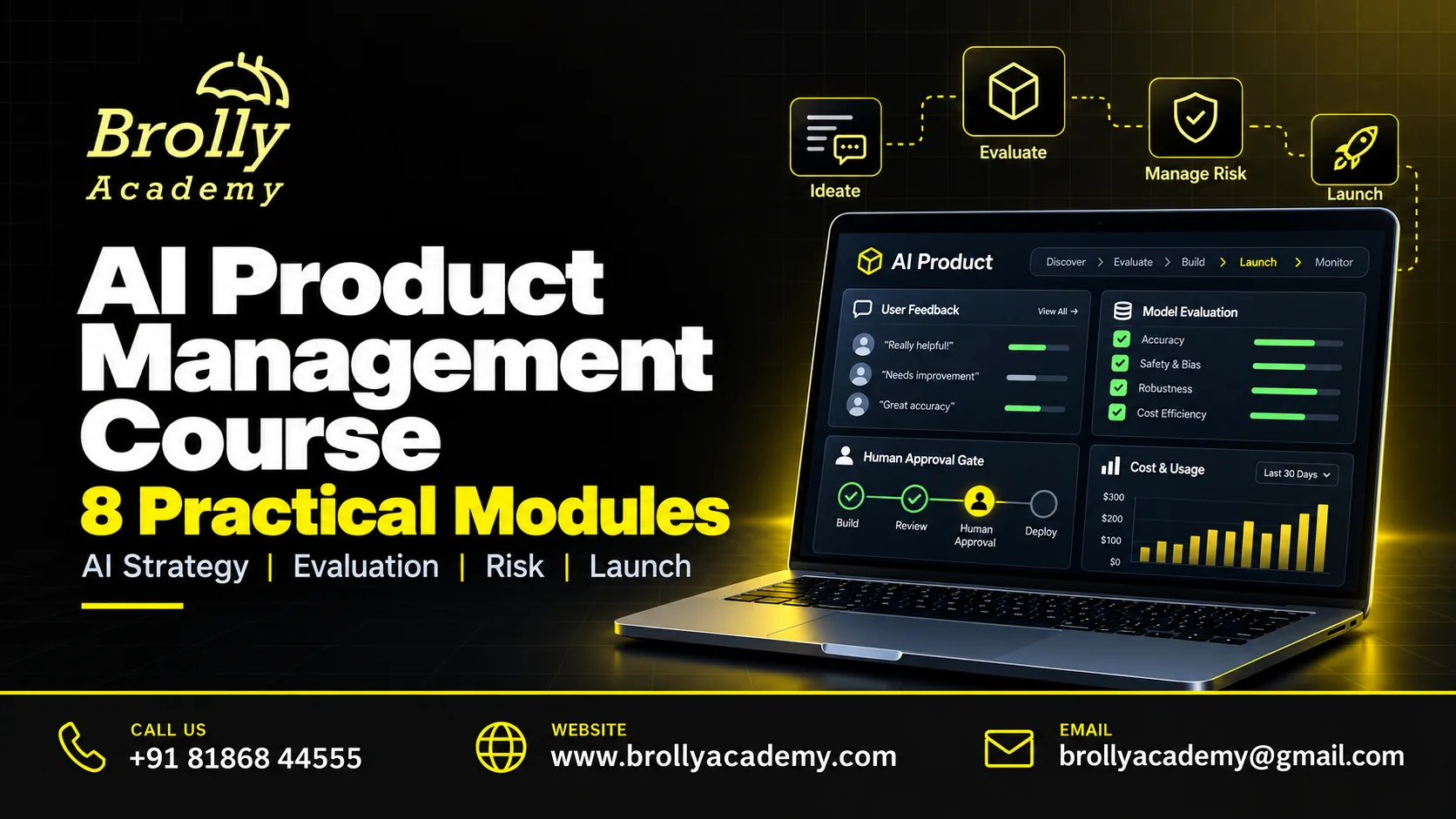
Learn to manage an AI feature from a useful customer problem to a measured release decision. This AI Product Management Course focuses on what product teams must decide about data, model quality, cost, user trust and human oversight.
Course outline8 modules
Practice3 project scenarios
Next batch12 October 2026
Course feeINR 10,999
About the AI Product Management Course
An AI product can return different answers to similar inputs, depend on changing data and fail in ways that ordinary feature tests do not capture. Product managers need to specify acceptable behaviour, evaluation evidence and operational limits. You will build a product brief and release plan that make those decisions explicit.
This is a product-decision course, not a broad Generative AI overview or a framework-coding bootcamp. You will compare approaches and interpret evaluation results rather than train foundation models. Product Management covers the wider lifecycle; LangChain, RAG and AI Testing courses offer deeper technical specialisation.
For further background, read Google People + AI Guidebook. Use current guidance that matches your learning task and the tools in your batch.
What Is AI Product Management and Why Does It Matter?
AI product management is the work of choosing, planning and evaluating products that depend on AI behaviour. It adds model quality, data permissions, variable outputs, operating costs and human oversight to normal product decisions. An impressive model demo is only the start.
Choose AI only when usefulCompare a model-based workflow with simpler rules, search or manual work before selecting the solution.
Define acceptable behaviourTurn broad ideas such as accuracy and trust into test cases, review rules and release conditions.
Plan safe operationsAssign fallback paths, review responsibilities, spending limits and stop conditions before launch.
Benefits of Learning AI Product Management
Learn when AI is useful, when a simpler solution is better and what evidence is needed before releasing an AI feature.
Select a suitable use caseCheck whether uncertain model outputs are acceptable for the task. Compare AI with a rules-based or manual baseline.
Connect quality and economicsBalance useful answers, latency, review effort and operating cost. A fluent demo is not enough to establish product value.
Plan responsible releasesDefine permitted data, human review, fallback behaviour and monitoring before extending access to real users.
Who Should Join?
Basic product or business-analysis knowledge helps. You should understand a user journey, read a spreadsheet and explain trade-offs. No advanced mathematics is required for the product exercises. Basic API and machine-learning vocabulary will make technical discussions easier.
Product managers and ownersAdd AI quality, risk and cost decisions to established product practice.
Analysts and business leadersEvaluate when an AI proposal is useful and when a simpler approach is better.
Technical professionals moving into productTranslate model and system constraints into customer-facing decisions.
For complementary learning, explore Generative AI Training. Choose the broader program if you need an introduction to AI models, prompting and the wider application landscape before specialising.
AI Product Management Prerequisites and Readiness Checklist
Basic product or business-analysis knowledge helps. You should understand a user journey, read a spreadsheet and explain trade-offs. No advanced mathematics is required for the product exercises. Basic API and machine-learning vocabulary will make technical discussions easier.
Product basicsUnderstand a user problem, a simple workflow and a success metric. Beginners should practise those foundations before complex AI strategy.
Comfort with uncertaintyBe ready to examine wrong or inconsistent outputs. The work involves evaluation and trade-offs, not only prompt writing.
Safe project materialUse public, synthetic or explicitly permitted data. Do not upload customer records or confidential documents into external tools.
AI Product Management Course Syllabus: 8 Practical Modules
Each module connects a concept to an exercise and an output you can explain. Work through the foundations before attempting the integrated project.
1. Finding a worthwhile AI opportunity
Start with a customer task and compare an AI approach with rules, search or a manual workflow. Define the expected value and the cost of a mistake. Write a decision brief explaining why AI is appropriate, or why you would not use it.
2. AI system literacy for product teams
Distinguish predictive models, generative models, retrieval and agent workflows. Map where data enters, where a model responds and where application rules act. Identify which decisions require engineering expertise instead of treating every AI feature as a chatbot.
3. Data readiness and user permissions
List required data, access boundaries, quality concerns and ownership. Define permitted use and retention questions for the appropriate reviewers. Specify how the experience should behave when data is missing, outdated or unavailable to the current user.
4. AI requirements and evaluation design
Write expected behaviours, unacceptable failures and a representative evaluation set. Combine task success with factuality, safety and usability checks. Define release thresholds with relevant stakeholders and avoid using a single headline accuracy score for every risk.
5. Prototypes and human-centred experience
Create a low-risk prototype using permitted sample inputs. Design uncertainty, source display, correction and escalation states. Decide when a person must approve an action and how users can recover when the system cannot complete a task.
6. Costs, latency and sourcing decisions
Compare build-versus-buy options and estimate cost per completed task. Include retries, retrieval, human review and support, not just the price of one model call. Evaluate latency and quality trade-offs using the same task examples.
7. Risk controls and staged launch
Create a risk register and a staged release plan. Define access controls, monitoring, incident ownership and rollback triggers with technical and compliance partners. Treat governance as ongoing work, not a badge that makes a product automatically safe.
8. Monitoring and capstone review
Present a complete AI product proposal with evaluation evidence, operating costs and a launch decision. Plan feedback collection, drift checks and reassessment after model or data changes. Explain why a polished demo is not enough evidence for a full rollout.
Discuss Your Learning Goals
Tell the team about your experience and preferred schedule. Book a free demo to discuss the course, lab access and the practical work expected from you.
Practical Skills You Will Develop
Use the exercises to build an explanation as well as a result. You should be able to show what you did, how you checked it and where the limits are.
Opportunity selectionChoose AI only when it offers useful value over simpler alternatives.
Evaluation requirementsDefine quality and risk checks tied to the user task.
Cost reasoningEstimate cost per successful outcome, including failure and review.
Trust and controlSpecify uncertainty, approval and escalation behaviour.
Cross-team decisionsCommunicate data, engineering and operational dependencies.
Release ownershipPlan monitored rollout, incident response and reassessment.
Tools and Lab Requirements
Use synthetic documents and an approved model environment. Do not share private customer or employer data for a demonstration. Confirm model/API access and usage budgets. Product exercises can begin with saved example outputs before paid integration work.
Product documents and scorecardsCreate a PRD, risk register, evaluation rubric and launch checklist.
Approved model sandboxUse permitted sample data to compare outputs; API charges depend on the selected service.
Spreadsheet and prototype toolModel unit economics and design human-review or fallback experiences.
Consult NIST AI Risk Management Framework for current guidance. Confirm the software, account permissions and costs needed for your exercises.
Set Up Your AI Product Management Practice Environment
Use synthetic documents and an approved model environment. Do not share private customer or employer data for a demonstration. Confirm model/API access and usage budgets. Product exercises can begin with saved example outputs before paid integration work.
Prototype workspaceCreate a small permitted task and a clear expected outcome. Keep instructions, model settings and sample outputs in a versioned log.
Evaluation setBuild representative examples, edge cases and unacceptable-output rules. Keep development examples separate from a held-out review set.
Cost and risk sheetRecord token or request costs, latency and human-review needs. Assign an owner and response for each important failure type.
AI Product Management Learning Roadmap: Foundations to Portfolio
Build confidence in stages. Practice time and your starting knowledge matter as much as the number of scheduled sessions.
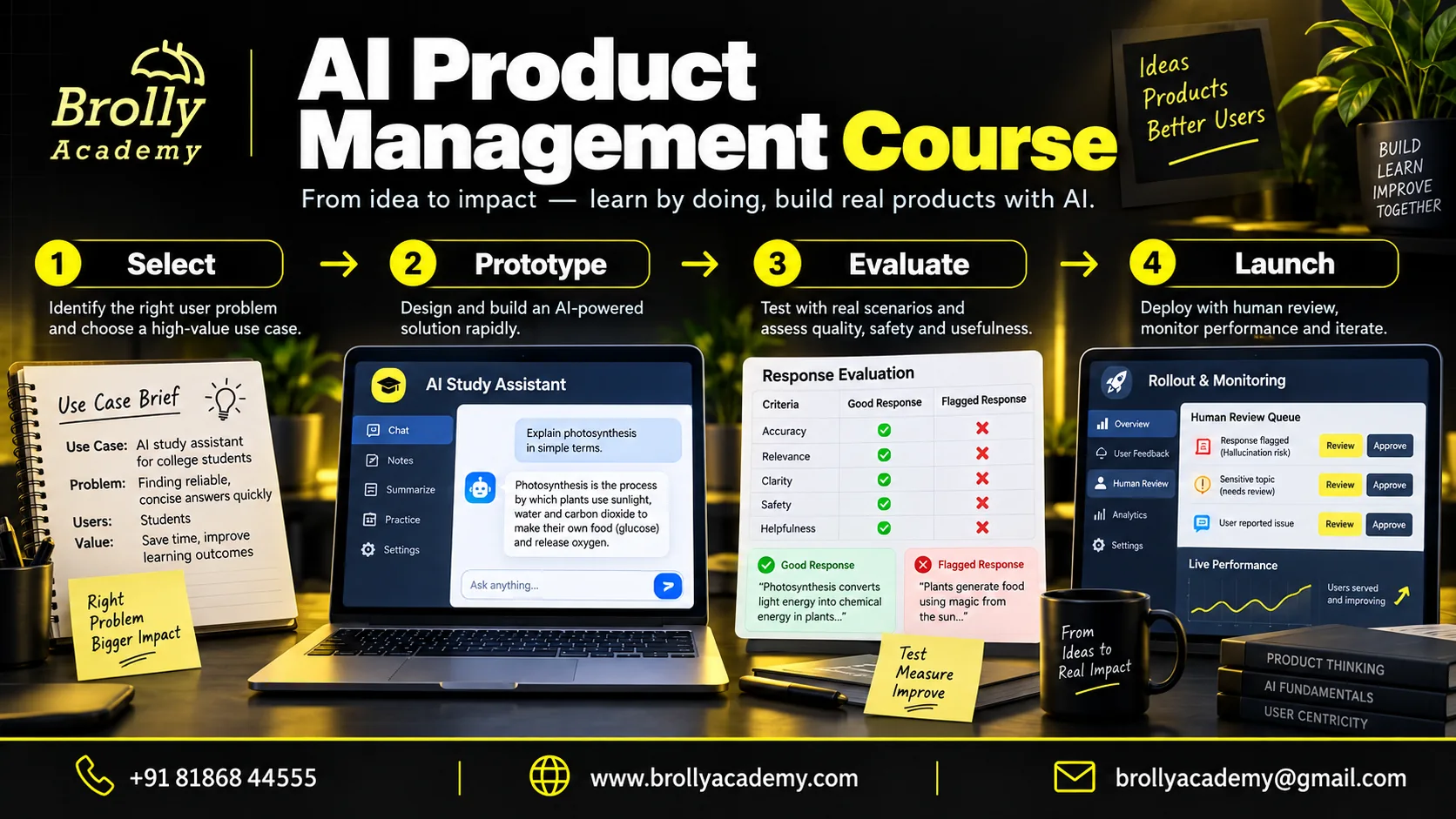
Illustrative learning workflow. Screens, figures and scenarios are examples, not student results or live product screenshots.
Stage 1: Build the foundationChoose a narrow use case, define the current workflow and decide what improvement would justify using AI.
Stage 2: Apply and validateWrite a PRD, test a model-assisted workflow and create an initial evaluation set. Compare prompts and simpler alternatives.
Stage 3: Present your workPresent a release memo with readiness criteria, rollout scope, monitoring, stop conditions and unresolved risks.
AI Product Management: 6-Week Study Plan
Use these milestones to organise practice around the eight modules. Move on when you can explain and demonstrate the output, not just when you have watched a lesson. This suggested pace is separate from your batch timetable.
Week 1: Problem and baselineChoose a narrow use case, define the current workflow and decide what improvement would justify using AI.
Weeks 2-3: PrototypeWrite a PRD, test a model-assisted workflow and create an initial evaluation set. Compare prompts and simpler alternatives.
Weeks 4-5: Evaluate and controlMeasure task quality, failure types, latency and cost. Define human review, fallback and data-handling boundaries.
Week 6: Launch decisionPresent a release memo with readiness criteria, rollout scope, monitoring, stop conditions and unresolved risks.
3 Practical Project Scenarios
These are teaching scenarios using approved lab systems and synthetic data. They are not claims about live client work or previous student results.
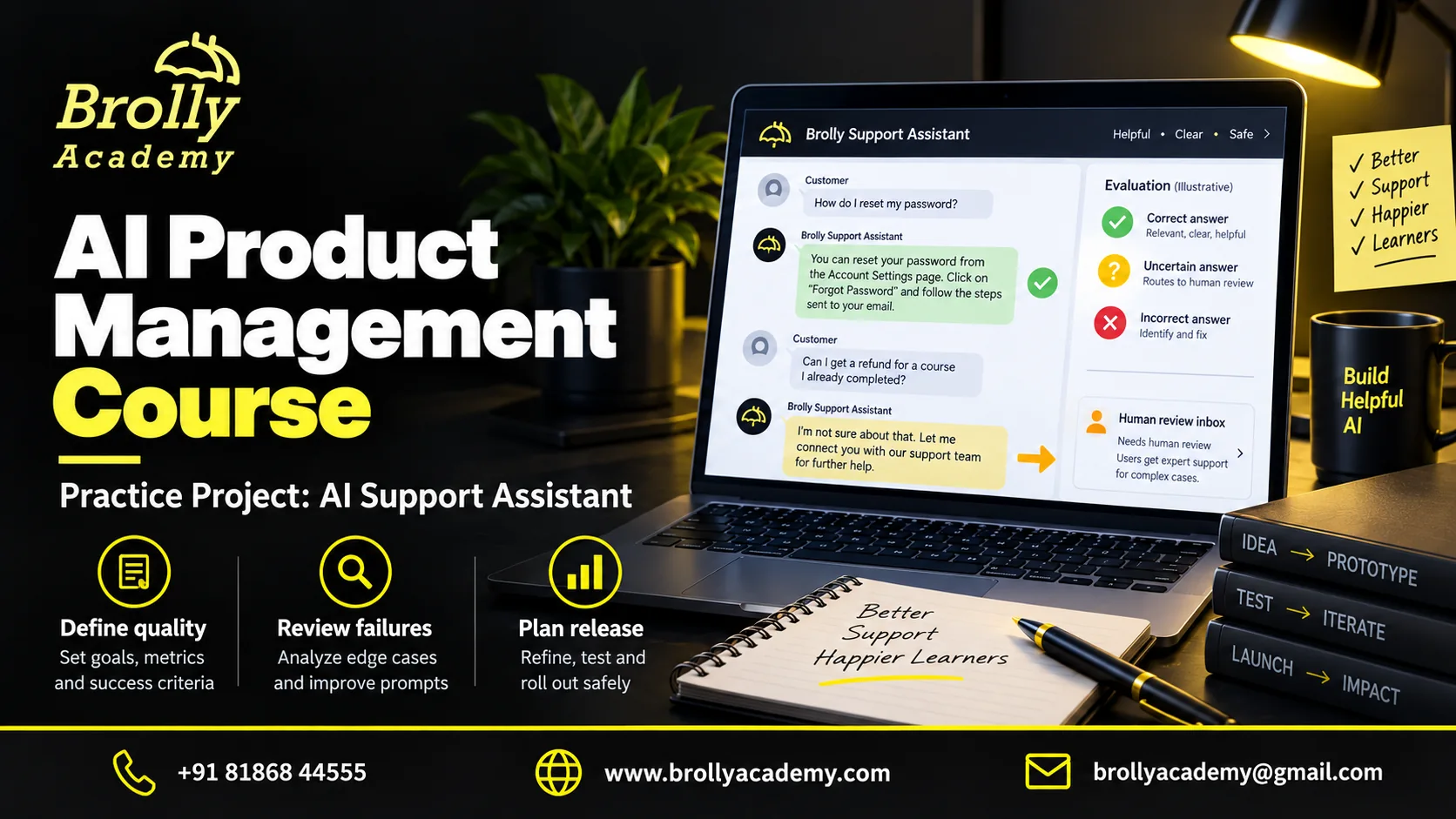
Illustrative practice project. Screens, figures and scenarios are examples, not student results or live product screenshots.
Support-assistant product planDefine a source-grounded assistant that escalates uncertain answers. Create evaluation cases, access requirements and an operating-cost model.
Document-review copilot proposalDesign a human-reviewed extraction feature using fictional documents. Specify evidence display, correction flow and unacceptable errors.
AI ticket-triage launch decisionCompare rules with model-assisted classification. Interpret test results and recommend a staged launch, redesign or no-go decision.
How the Skills Work in Practice
A support manager wants an assistant to answer every question automatically. Your evaluation finds that some questions require account access and others have no approved source. The product should not pretend to know the answer.
Define separate outcomes: answer with evidence, ask for clarification, or transfer to a human. Measure successful resolution and harmful errors as well as cost. The product decision is about acceptable service behaviour, not selecting the model with the most impressive demo.
Try an AI Product Exercise: Define a Release Quality Check
Use a fictional support assistant that answers questions from a short approved help document. Your task is to define acceptable behaviour before choosing a model or writing a launch announcement. Include situations where a useful answer is a clear admission of uncertainty and a route to human help.
1. Prepare a small evaluation setWrite ten test questions: four directly answered by the help document, three missing needed information and three asking for an action outside the assistant's scope. Record the expected behaviour and supporting source for each. Use no customer records.
2. Write a review rubricCheck whether the reply is supported, relevant and within scope. Flag invented policy details, leaked private information and actions without authorisation. Review the same questions after a change so you can compare behaviour rather than relying on a single impressive demo.
3. Define a controlled release decisionRecord the failures, their severity and the proposed correction. Decide which cases must reach a human and who can pause the release. A good average score must not hide a serious failure in a high-impact case.
What to keep: Create a test sheet, a short quality rubric and a release note with unresolved risks. Ten questions are a starting exercise, not enough evidence to prove production safety. Explain the additional evaluation and monitoring you would need for a real launch.
How Your AI Product Management Project Can Be Reviewed
Present an AI PRD, representative evaluation cases, a cost model and a staged release decision. Show how the product handles uncertainty and high-impact errors. Explain what evidence would cause you to pause the launch or choose a non-AI solution.
Common AI Product Management Mistakes and How to Avoid Them
Use this checklist when reviewing your practice work. Correct the cause of an issue and keep a short explanation of what changed.
Measuring only response speedA quick unsupported answer can still be harmful. Balance latency and cost with source support, task success and appropriate escalation.
Testing only easy questionsInclude missing context, conflicting requests and out-of-scope actions. Track behaviour by case type, not just a single average.
Confusing a demo with a dependable productDescribe data permissions, human review, failure handling and monitoring. Do not promise that a model will never make a mistake.
What Your AI Product Management Portfolio Should Show
An AI product portfolio should explain why the feature is useful and how you know its behaviour is acceptable, not merely show an impressive conversation.
AI opportunity briefDefine the user task, baseline, value hypothesis and reasons for choosing or rejecting AI.
Evaluation evidenceInclude a test set, rubric, observed failures and comparisons across versions. Label synthetic cases and do not present them as customer results.
Launch and operating planShow cost assumptions, review workload, fallback and monitoring. Explain the conditions under which you would delay release.
Why Learn with Brolly Academy?
Choose a course that connects the subject to work you can actually demonstrate. Use a demo to discuss the learning path and decide whether it fits your starting point.
A connected learning pathThe eight-module outline moves from foundations to an integrated task. Each module identifies an output rather than leaving practice as a vague promise.
Discuss your own learning goalShare your experience and preferred format with the course team. Use a demo to assess whether the technical depth, pace and project expectations fit your needs.
Clear course boundariesThe page explains prerequisites, product scope and the difference between training completion and independent certification. You can compare the offer with your actual requirements.
Compare Brolly Academy with Other Training Institutes
Compare the same evidence from each provider: the tasks you will complete, the feedback you will receive and the services the fee includes. Request a demo and a written outline before deciding.
What to discuss with Brolly AcademyReview these eight modules and the three project scenarios.
Ask for the assigned trainer profile.
Check the lab version and access period.
Review the fee, schedule and certificate terms.
Use the demo to assess the teaching approach.
What to check with any instituteRequest a detailed outline, not just product names.
Verify the trainer information supplied.
Separate demonstrations from your own lab work.
Check licences, exam costs and refund conditions.
Compare the total commitment, not only the advertised price.
AI Product Management vs General Product Management vs AI Engineering
The right path depends on whether you want to own product decisions, learn broad PM foundations or implement the technical system.
General product managementBuilds discovery, strategy, prioritisation, delivery and growth foundations across many kinds of products.
AI product managementAdds data readiness, model behaviour, evaluation, trust, human review and AI operating economics to product decisions.
AI engineeringBuilds and operates the model-connected application, retrieval pipeline, integrations and deployment. This course does not replace that engineering depth.
Classroom, Online and Corporate Learning
Discuss the currently available delivery format with the academy before booking. Batch availability and session timings should be agreed in writing.
Classroom learning enquiryConfirm the venue, next available batch and computer requirements before arranging travel.
Live online enquiryCheck the session time zone, remote lab access and arrangements for asking questions or catching up on a missed session.
Corporate team enquiryShare your team size, current tools and learning objectives. Agree a scoped program without sharing confidential business data.
For a team program, explore Brolly Academy corporate training.
Upcoming Batch: 12 October 2026
The upcoming AI Product Management Course batch starts on Monday, 12 October 2026. Contact the course team for class timings and total live teaching hours. The suggested study plan above organises your practice; it is separate from the class timetable.
Brolly Academy lists weekday morning, weekday evening and weekend learning options. Share your preferred format when enquiring. See the academy course schedule and ask about availability for your selected course.
Check Batch TimingsHow Your AI Product Management Learning Sessions Work
Connect every topic to a task and a piece of evidence. Use this learning cycle with the modules, practice scenarios and review checklist on this page.
1. Understand the taskStart with the problem, the expected output and the reason the concept matters. Write a brief describing one task, the current non-AI workflow and the harm a wrong AI answer could cause.
2. Practise and investigateComplete a small exercise in the agreed learning environment. Build representative examples, edge cases and unacceptable-output rules. Keep development examples separate from a held-out review set.
3. Review and improveCompare your work with the project checklist, record one weakness and revise it. Explain why the task needs AI and the evidence that a non-AI baseline is insufficient.
How to Join the AI Product Management Course
Choose a learning format that fits your starting skills and practice time. A course enquiry does not commit you to a payment.
1. Share your goalTell us your present role, prior knowledge and the kind of work you want to do. Use the demo form or WhatsApp so the team can suggest the appropriate starting point.
2. Attend a demoAsk to compare a successful output and a subtle failure using the same evaluation rubric. Discuss the product decision that follows.
3. Review your course offerCheck the fee, final taxes, learning scope, assigned mentor, batch timings, venue or online access, practice resources and support arrangements in writing.
4. Start with a baseline taskWrite a brief describing one task, the current non-AI workflow and the harm a wrong AI answer could cause.
AI Product Management Course Fee, Duration and Course Offerings
AI Product Management Course training fee: INR 10,999. The fee covers the course learning path and practical exercises described here. Ask for the final payable amount and the batch timetable before payment; any applicable taxes and optional third-party charges must be itemised in your enrolment quotation.
Training fee: INR 10,999Eight learning modules, structured practice and project preparation. Build a body of work that you can revise, explain and demonstrate. Corporate or individually customised training is quoted separately.
6-week learning planUse six weeks to frame a use case, prototype behaviour, evaluate outputs and prepare a launch decision. Allow extra time if product fundamentals are new. This is a suggested study plan, not a published batch calendar. Teaching dates, live hours and classroom availability are agreed at enrolment.
Understand the complete costModel API usage, paid AI tools and hosted evaluation services may incur usage charges. Set budgets and keep optional vendor subscriptions separate from tuition. External examinations, paid software and optional subscriptions are not included unless your written quotation lists them. Review payment and refund terms before enrolling.
What the Learning Package Covers
Eight-module syllabusA connected sequence of foundations, applied work and project preparation. The complete outline is visible above and available as an editable download.
Course-specific practiceCreate a small permitted task and a clear expected outcome. Keep instructions, model settings and sample outputs in a versioned log.
Three project scenariosChoose an integrated task from the three scenarios on this page and retain evidence of your decisions and checks.
Portfolio and interview preparationExplain why the task needs AI and the evidence that a non-AI baseline is insufficient.
Editable learning resourcesUse the syllabus checklist to track modules and the project-review sheet to record completed work and open questions.
Completion and next stepsComplete the agreed coursework and assessment, then document the skills and project evidence that support your course completion.
AI Product Management Course Completion Certificate and Assessment
After completing the coursework and assessment agreed for your batch, you receive a Brolly Academy AI Product Management course completion certificate. Keep your project evidence alongside it so you can explain the skills you practised. Attendance and submission requirements are provided in your course offer.
Academy course completionSubmit an AI opportunity brief, a small evaluation set with a scoring rubric, a cost model and a release-readiness memo.
Know which credential you receiveThe academy certificate recognises completion of this course. It does not certify a product as safe or make the learner a credential holder of an AI vendor.
1. Complete the learning workWork through the agreed modules and practical assignments. Keep a record of completed tasks and questions needing review.
2. Present and revise your projectSubmit an AI opportunity brief, a small evaluation set with a scoring rubric, a cost model and a release-readiness memo. Explain what you personally completed and address the assessment feedback.
3. Record your completionConfirm the name and course title for your certificate with the academy. Keep your own project link, completion record and certificate together for future applications.
Career Roles and Skill Applications
Match the learning path to a role, then compare its requirements with your existing experience. The course can support skill development; it does not guarantee employment.
AI product managerOwn product decisions around AI capabilities, quality and operating constraints.
AI business analystTranslate workflows into requirements and evaluation evidence.
Product operations specialistCoordinate feedback, review processes and controlled feature releases.
You can also explore Business Analyst Course. Develop requirements analysis and stakeholder communication for business change.
Evidence to Prepare for Your Target Role
An AI business caseExplain why the task needs AI and the evidence that a non-AI baseline is insufficient.
An evaluation reviewShow failure cases, scoring disagreements and the release decision they support.
An operating-cost discussionExplain model usage, latency, human-review effort and the conditions that make the feature uneconomic.
AI Product Management Industry Applications and Changing Skills
AI product work appears in support, document workflows, search, productivity and decision assistance. Sensitive use cases need domain-specific review. The course builds decision-making skills; it does not grant regulatory approval, vendor certification or a guaranteed AI product role.
Support assistantsMeasure helpful resolution alongside incorrect advice and escalation. Keep a clear route to a human when the assistant is uncertain.
Internal knowledge toolsCheck source permissions, citations and stale content. Retrieval quality and access controls matter as much as generated wording.
Workflow automationDefine which actions are reversible and which need approval. A system that can take actions needs stronger controls than a text-only suggestion tool.
AI Product Management Market Trends and Current Learning Priorities
AI product work requires more than prompt writing. Evaluation, lifecycle risk management and human oversight are practical themes reflected in the NIST AI RMF and its generative-AI profile. Further reading: NIST AI Risk Management Framework.
Evaluation as product workPlan test cases and human review together with the feature requirements, then compare changes against a baseline.
Risk across the lifecycleReview data, misuse and failure risks during design, release and operation instead of adding a safety paragraph at the end.
Human control in automated actionsSeparate suggestions from actions. Irreversible or sensitive actions need an appropriate approval step and recovery plan.
AI Product Management Placement Preparation and Career Support
Build a job-search package around work you can demonstrate. The preparation below covers your resume, profile, project explanation and interview practice. Confirm which guided sessions are included in your batch; this is placement preparation, not a guaranteed job or employer referral.
Explain a projectDescribe the requirement, your decisions, the result and one limitation. Be ready to answer what you would change for a real deployment.
Show useful evidenceKeep approved files, test results and a concise README or runbook. Remove secrets and private information before sharing a portfolio.
Discuss support servicesAsk the academy which resume, mock-interview or job-search services are included in your batch. Placement assistance is not a job or salary guarantee.
AI opportunity selectionExplain why the problem benefits from AI and what simpler baseline you would test first.
Quality and cost trade-offDiscuss whether a slower or more expensive model produces enough extra value to justify the change.
Release readinessExplain your evaluation set, acceptable failure boundaries, human review and rollback plan without promising perfect accuracy.
Use your completed project to write an honest resume entry: problem, your contribution, tools, checks and what changed after feedback. Label practice projects as learning work. Course completion and interview preparation do not guarantee a job, a salary increase or interviews with named employers.
Resume preparationTurn your course project into a clear entry: the problem, your contribution, tools, validation and limitation. Label it as training work rather than paid employment.
LinkedIn and portfolio profileUse a role-focused headline, concise skills and links to permitted work. Describe what you can demonstrate instead of adding unsupported experience.
Technical or case interviewExplain why the problem benefits from AI and what simpler baseline you would test first.
Mock presentation and HR practiceRehearse a short introduction, a project walkthrough and a specific example of responding to feedback. Ask for feedback on clarity as well as subject knowledge.
Application planningChoose vacancies that match your current experience, note their requirements and track applications and follow-ups. A course name alone is not a role match.
Skill-gap follow-throughUse interview feedback to plan the next exercise. Revisit weak foundations rather than repeatedly memorising a model answer.
AI Product Management Career and Salary Benchmarks
Salary depends on the role, prior experience, location and the employer. A tool course alone does not establish a salary band. Compare recent job descriptions, required experience and responsibilities rather than relying on a headline income promise.
AI PM roles vary from established product managers adding AI responsibilities to technically demanding specialist roles. Compare actual responsibilities and experience requirements, not just the title. The course does not establish an individual salary or replace prior product experience.
Product Manager: broader comparisonINR 13,41,621 per yearReported average base salary in India. This is market context, not take-home pay or a course outcome.
Source and dateIndeed: Product Manager. 164 reported salaries; source updated 22 September 2026. Checked 4 October 2026.
How to interpret this figureThis source covers general Product Managers in India, not an AI-PM-only sample. Use it for broad context, not an assumed AI salary premium. Compare like-for-like responsibilities, location and experience; averages cannot predict your individual offer.
Meet Ravi, Your AI Product Management Trainer
Learn AI Product Management with Ravi. Use a free demo to discuss your starting skills, the practical work in the syllabus and how your assignments will be reviewed. Bring a question from the course outline so the discussion is relevant to your goal.
Use-case judgementAsk the mentor to identify a task where AI should not be used and explain the alternative.
Evaluation discussionReview a sample answer set together. Discuss what a quality rubric misses and when a human should make the final judgement.
Delivery discussionAsk how feedback on the PRD, evaluation plan and release memo will be provided during your batch.
Read about Brolly Academy instructors and request the profile of the trainer assigned to your batch.
Get Trainer ProfileBrolly Academy Learner Feedback
Read available academy feedback and ask whether a review relates to this particular course, trainer and delivery format. General academy reviews should not be mistaken for verified results from this new course.
These excerpts come from the academy's published Data Science testimonials, not reviews of this new AI Product Management course. Read the full context on the Brolly Academy reviews page.
Aditya - Data Science"a clear and practical understanding of data science concepts"
Kavita Singh - Data Science"The hands-on projects helped me apply the concepts effectively."
Keep Learning with the Brolly Academy Community
Follow the Brolly Academy WhatsApp channel for public academy updates. Ask which batch discussion or mentor-support options are available for this course. When requesting help, share a small permitted example, the result you expected and the specific problem you found. Remove private data, credentials and employer material.
Rubric calibrationHave two learners score the same sample outputs, compare disagreements and clarify the review criteria.
Risk walkthroughExchange fictional release plans and identify a failure the author did not consider, then propose a practical fallback.
Download Your Practice Checklists
Download an eight-module syllabus checklist and a project-review sheet. Both are editable CSV files with usable content, so you can track practice and discuss your questions during a demo.
Download Syllabus (CSV) Project Checklist (CSV)Official Documentation for Further Reading
These original sources support further learning. Their availability does not imply that Brolly Academy is endorsed, accredited or authorised by the organisations that publish them.
Google People + AI Guidebook
NIST AI Risk Management Framework
Atlassian product discovery
Related Courses at Brolly Academy
Choose complementary learning based on your current skill gaps. These are separate courses, not automatically included in this program.
Generative AI TrainingChoose the broader program if you need an introduction to AI models, prompting and the wider application landscape before specialising.
View Generative AI Training
AI Testing TrainingDevelop a deeper QA practice for AI answers, tool behaviour and release decisions.
View AI Testing Training
Business Analyst CourseDevelop requirements analysis and stakeholder communication for business change.
View Business Analyst Course
Visit Brolly Academy or Enquire Online
Call +91 81868 44555 or send a course enquiry to discuss the syllabus and current batch options. For a classroom visit, confirm the venue and appointment with Brolly Academy before travelling.
Main office near JNTU MetroMetro Pillar No. A689, 3rd Floor, Dr Atmaram Estates, beside Sri Bhramaramba Theatre, Hyder Nagar, Vasantha Nagar, Hyderabad, Telangana 500072. Confirm your classroom venue and appointment before travel.
Directions and course enquiryGet directions to Brolly Academy. Call +91 81868 44555 to discuss your course and a suitable visit time.
Online learning enquirySend your preferred time zone and learning goal to brollyacademy@gmail.com. Discuss current online batches, lab access and the device you plan to use.
Read our contact details for the academy location and enquiry options. Online delivery, session time zones and tool access should be confirmed for your batch.
Call +91 81868 44555 Get DirectionsAI Product Management Course FAQs
How is this different from using AI to write a PRD?
Writing assistance is only one tool. AI product management concerns the behaviour of a product that depends on AI: data access, quality, risk, cost, user experience and release decisions.
Do I need to code?
Coding is not required for the core product documents and evaluation exercises. Basic API literacy helps you work with engineers. Building production integrations is a separate technical learning path.
Is this the same as Generative AI Training?
No. Generative AI Training covers the broader technology landscape and applications. This course focuses on product judgement, measurable outcomes and responsible deployment decisions.
Will I learn RAG and agents?
You will learn enough to compare their product implications, dependencies and failure modes. Detailed retrieval implementation and agent orchestration belong in the dedicated engineering courses.
Is model accuracy enough to approve a launch?
No. A release decision also depends on error severity, user groups, privacy, latency, cost, reliability and recovery. The evaluation should represent the intended use rather than an easy demonstration set.
How do I estimate AI feature costs?
Estimate cost per completed user task, including model calls, retrieval, retries, storage, human review and support. Test assumptions with representative workloads instead of multiplying a single call price by all users.
Does retrieval eliminate hallucinations?
No. Retrieval can provide relevant context, but the source, retrieval step or generated interpretation may still be wrong. Product requirements should cover evidence, uncertainty and escalation.
What belongs in an AI product portfolio?
Include the user problem, alternatives, AI PRD, data assumptions, evaluation rubric, cost model, risk controls and launch recommendation. A clear no-go decision can show stronger judgement than an untested prototype.
What are the course fee and duration?
The training fee is INR 10,999. The page includes a suggested 6-week learning plan. Confirm the actual class calendar, live hours and final payable amount before payment. Paid third-party tools and external exam fees are separate unless listed in the enrolment quotation.
Can I attend online or in a classroom?
Contact the course team to check current online and classroom availability. Confirm the session time zone, venue, equipment and missed-session arrangements before you enrol.
Does training include an external certification?
Course completion and an external vendor or professional certification are different. Ask for Brolly Academy completion requirements. External exam registration, eligibility, fees and vouchers must be confirmed separately with the issuing body.
How can I check whether this course suits me?
Book a free demo or send your background and learning goal on WhatsApp. Request the assigned trainer profile, sample exercise, confirmed syllabus and complete enrolment terms before making a decision.
Is this a prompt-engineering course?
Prompt design appears in prototyping, but the main focus is product decisions: use-case value, requirements, evaluation, cost, risk and launch readiness.
Will I train a large language model from scratch?
No. The course focuses on planning and evaluating AI-enabled products using existing capabilities. Model training and infrastructure engineering require separate technical study.
How do I judge an AI product prototype?
Compare it with a baseline on representative tasks. Check usefulness, factual errors, unsafe behaviour, latency, cost and human-review effort rather than judging only how fluent it sounds.
Will I get a job guarantee?
No job or salary guarantee is included. The course develops skills and project evidence. Hiring depends on your preparation, wider experience, interview performance and employer requirements. Discuss the career-support services included in your batch.
What happens if I miss a class?
Ask the team for the catch-up arrangement for your selected batch before enrolling. Recording access, repeat sessions and individual reviews depend on the written course offer; do not assume unlimited access or lifetime support.
How can I get a free demo and the syllabus?
Use Book Free Demo to open the enquiry form, or WhatsApp Us to message the course team. The syllabus and project-review checklist are available in the downloads section on this page.
When does the next AI Product Management Course batch start?
The upcoming batch starts on Monday, 12 October 2026. Use Check Batch Timings or call +91 81868 44555 for the class timetable and total live teaching hours. Ask about alternative weekday or weekend options if this date does not suit you.
Got Questions About the AI Product Management Course?
Talk to our team about your starting skills, learning goal and current batch availability. Request a demo, ask for the assigned trainer profile and review the complete fee and course terms before enrolling.