DOCUMENT RETRIEVAL / SOURCE-GROUNDED ANSWERS / EVALUATION
RAG Training
Learn to build an assistant that answers from a defined collection of documents and shows its evidence. RAG Training focuses on the complete retrieval pipeline, from cleaning source files to testing citations, missing answers and document updates.
Course outline8 modules
Practice3 project scenarios
ScheduleDiscuss batch options
Course feeRequest current details
About the RAG Training
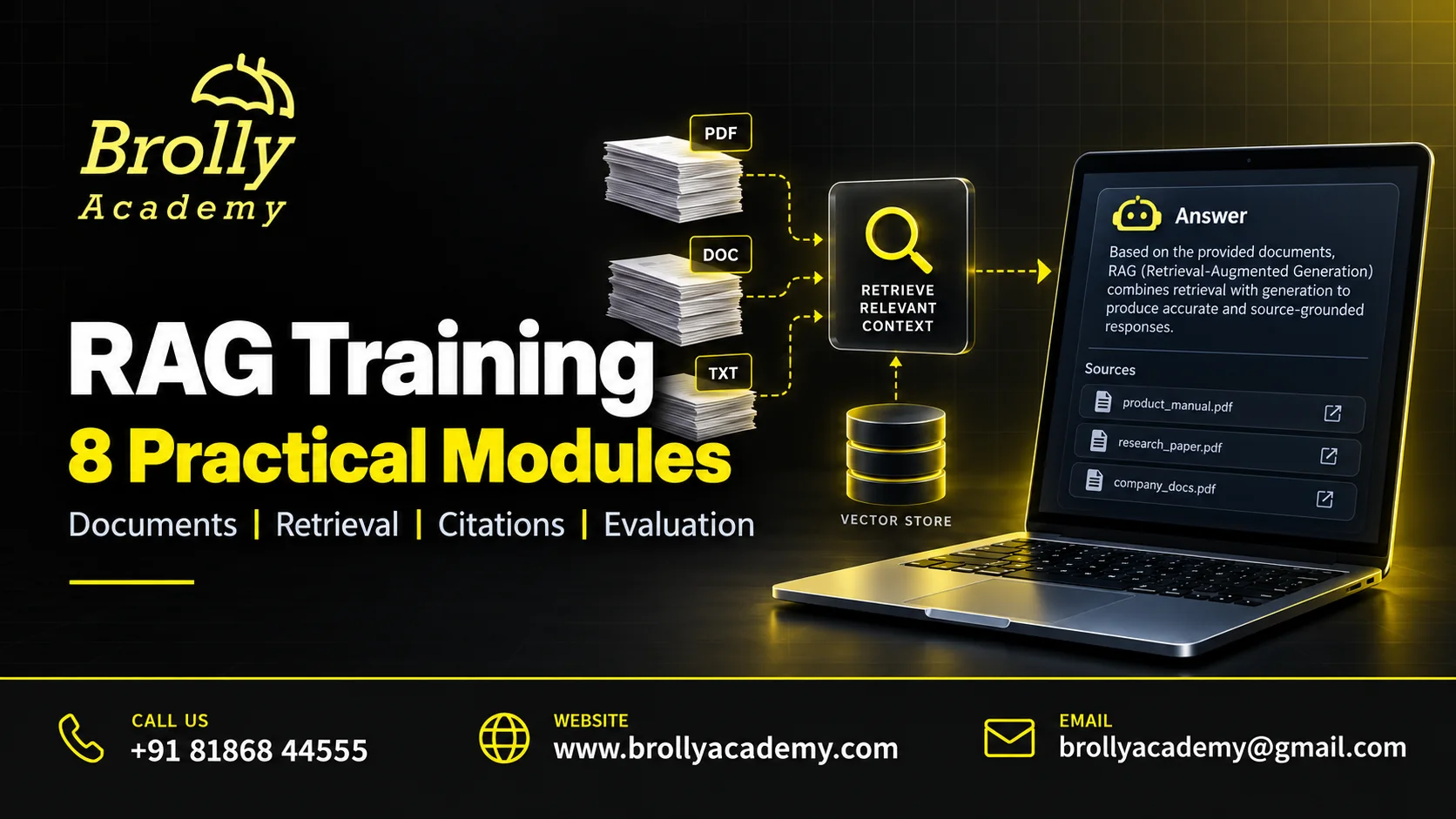
Retrieval-augmented generation combines a search step with a generation step. A system finds relevant passages and supplies them as context to a language model. This can improve access to specific information, but it does not guarantee a correct answer. The course treats document quality, retrieval quality and answer quality as separate engineering problems.
Choose this course for deeper work on knowledge retrieval, not for a general introduction to every Generative AI tool. LangChain and LlamaIndex may support lab implementations, but neither defines RAG itself. Model fine-tuning, broad agent orchestration and training a foundation model are outside the core learning path.
For product-specific terminology and behaviour, use Retrieval architecture. Match the documentation to the environment used in your exercises.
Who Should Join?
Basic Python, JSON and API knowledge are expected. You should be comfortable reading a small dataset and comparing expected with actual results. Some understanding of language models helps; advanced calculus is not required for the introductory retrieval exercises.
AI application developersImprove document-based assistants beyond a first demonstration.
Data and search engineersConnect ingestion, indexing and access-aware retrieval.
QA and evaluation practitionersInvestigate whether failures come from search, context or generation.
For complementary learning, explore Generative AI Training. Choose the broader program if you need an introduction to AI models, prompting and the wider application landscape before specialising.
RAG Training Syllabus: 8 Practical Modules
Each module connects a concept to an exercise and an output you can explain. Work through the foundations before attempting the integrated project.
1. RAG architecture and baselines
Draw the path from a user question to a retrieved passage and generated answer. Build a simple keyword-search baseline first. Define a small set of questions with known evidence, including questions the collection cannot answer.
2. Document ingestion and provenance
Load permitted text and PDF material while retaining document IDs, dates, headings and page references. Inspect tables and extraction errors before indexing. Record source ownership and document versions so a citation can be traced back to its origin.
3. Chunking and metadata
Compare fixed-size and structure-aware chunks on the same collection. Keep useful headings and source metadata with each chunk. Test whether an answer requires information split across chunks rather than assuming a single chunk size is always best.
4. Embeddings and vector indexing
Create embeddings and index them in a selected vector store. Understand similarity scores, dimensionality and model compatibility. Demonstrate why changing an embedding model can require rebuilding an index, and document how duplicate records are handled.
5. Hybrid retrieval and reranking
Compare keyword, vector and combined retrieval on labelled questions. Use metadata filters and a reranker where useful. Measure whether the relevant evidence reaches the final context; more retrieved passages are not automatically better.
6. Grounded answers and citations
Construct context with clear source boundaries. Require the assistant to identify evidence and state when the sources do not answer a question. Check each important claim against its cited passage and handle disagreement between documents explicitly.
7. Evaluation and access controls
Evaluate retrieval separately from generation. Include paraphrases, stale documents, missing answers and permission boundaries in the test set. Treat instructions inside documents as untrusted content and enforce document access before supplying context to a model.
8. Updates, monitoring and capstone
Design ingestion updates, deletion handling and repeatable regression checks. Track quality, latency and usage without retaining unnecessary private content. Deliver a document assistant with an evaluation report and a runbook explaining known failure modes.
Discuss Your Learning Goals
Tell the team about your experience and preferred schedule. Book a free demo to discuss the course, lab access and the practical work expected from you.
Practical Skills You Will Develop
Use the exercises to build an explanation as well as a result. You should be able to show what you did, how you checked it and where the limits are.
Evidence-aware ingestionPreserve source identity and detect extraction problems before indexing.
Retrieval diagnosisTrace a weak answer back to missing or poorly ranked source material.
Index maintenancePlan re-indexing, updates and deletion rather than treating ingestion as a one-time task.
Citation checkingVerify that an accessible passage supports the actual answer claim.
Access-aware searchApply user permissions before protected passages reach a model.
Evaluation designCreate representative questions and report component-level results.
Tools and Lab Requirements
Use a personal practice environment with synthetic or openly licensed data. Keep credentials outside notebooks and source control. Confirm software access, hardware and any paid API usage with the course team before enrolling.
Document processingPython loaders and parsers appropriate to the permitted source files.
Retrieval stackAn embedding model, a vector store and a keyword baseline selected for the lab.
Evaluation workspaceA labelled question set, source references and a repeatable result sheet.
Consult LlamaIndex RAG documentation during practice. Use documentation matching the installed version and check applicable permissions and service costs.
Your Learning Roadmap
Build confidence in stages. Practice time and your starting knowledge matter as much as the number of scheduled sessions.
1. Set up and understandCheck the prerequisites and lab access. Complete the first two modules and explain the basic workflow in your own words.
2. Build and investigateWork through the middle modules. Keep notes of errors, what you tried and the evidence that supported a fix.
3. Test and presentComplete the final modules and an integrated scenario. Present your output, validation and a short handover guide.
3 Practical Project Scenarios
These are teaching scenarios using approved lab systems and synthetic data. They are not claims about live client work or previous student results.
Policy knowledge assistantUse a fictional handbook with dated revisions. Answer policy questions with passage references and decline questions outside the collection.
Product documentation searchCompare keyword, vector and hybrid retrieval for technical queries. Record the cases where exact product identifiers matter more than semantic similarity.
Permission-aware helpdesk searchCreate two synthetic user groups with different source access. Demonstrate that restricted documents and citation metadata are not revealed to the wrong group.
How the Skills Work in Practice
A fictional returns handbook contains a 14-day policy, while an archived version says 30 days. A customer question retrieves both. First diagnose whether the archive should have been filtered out. Then check how the answer handles dates and whether its citation supports the chosen rule.
The exercise separates three possible fixes: better document metadata, improved retrieval filtering and clearer answer instructions. Re-run the same questions after each change so you can identify which modification helped rather than crediting a longer prompt for everything.
Why Learn with Brolly Academy?
Choose a course that connects the subject to work you can actually demonstrate. Use a demo to discuss the learning path and decide whether it fits your starting point.
A connected learning pathThe eight-module outline moves from foundations to an integrated task. Each module identifies an output rather than leaving practice as a vague promise.
Discuss your own learning goalShare your experience and preferred format with the course team. Use a demo to assess whether the technical depth, pace and project expectations fit your needs.
Clear course boundariesThe page explains prerequisites, product scope and the difference between training completion and independent certification. You can compare the offer with your actual requirements.
Compare Brolly Academy with Other Training Institutes
Compare the same evidence from each provider: what you will build, what you will test and which services the fee includes. Ask for specific examples rather than relying on broad claims about advanced AI.
What to discuss with Brolly AcademyReview these eight modules and the three project scenarios.
Ask for the assigned trainer profile.
Check the lab version and access period.
Review the fee, schedule and certificate terms.
Use the demo to assess the teaching approach.
What to check with any instituteRequest a detailed outline, not just product names.
Verify the trainer information supplied.
Separate demonstrations from your own lab work.
Check licences, exam costs and refund conditions.
Compare the total commitment, not only the advertised price.
Classroom, Online and Corporate Learning
Discuss the currently available delivery format with the academy before booking. Batch availability and session timings should be agreed in writing.
Classroom learning enquiryConfirm the venue, next available batch and computer requirements before arranging travel.
Live online enquiryCheck the session time zone, remote lab access and arrangements for asking questions or catching up on a missed session.
Corporate team enquiryShare your team size, current tools and learning objectives. Agree a scoped program without sharing confidential business data.
For a team program, explore Brolly Academy corporate training.
RAG Training Fee and Duration
Contact Brolly Academy for the current fee, available delivery format and batch timetable. Discuss your starting skills and the practical work you want to complete before choosing a batch.
Request the current course feeAsk for the complete written quotation, taxes, payment terms and refund conditions. Confirm whether API usage, cloud compute, software plans or external examinations are separate.
Confirm the learning scheduleAsk about instructor-led hours, independent practice, project review and the access period. Eight modules describe the learning sequence, not a fixed completion time.
Before you enrolCheck lab access, materials, project feedback, missed-session arrangements, refund terms and any additional charges. Keep a copy of the agreed offer.
Course Completion and Certification Guidance
Brolly Academy course completion recognizes the training and assessment work agreed for your batch. It is separate from a credential awarded by a software vendor or another certification body.
Brolly Academy course completionAsk for the attendance, assignment and assessment requirements, the certificate wording and how completion will be verified.
Independent certificationUse official vendor information to check whether a relevant credential is currently offered and what preparation it requires. No vendor authorization, exam voucher or pass guarantee is implied.
Career Roles and Skill Applications
Match the learning path to a role, then compare its requirements with your existing experience. The course can support skill development; it does not guarantee employment.
RAG application developerBuild and maintain source-grounded assistants.
Search and retrieval engineerImprove evidence selection and indexing behaviour.
AI evaluation engineerMeasure retrieval and answer quality with reproducible tests.
You can also explore MLOps Training. Extend a working prototype into a monitored, repeatable deployment workflow.
Where These Skills Are Used
RAG can support internal documentation, product help centres, research collections and policy lookup. It is unsuitable as a promise of perfect truth: access rules, freshness and source quality remain essential. Sensitive applications need qualified review appropriate to their use.
Interview and Portfolio Preparation
Prepare evidence you can discuss clearly. Label practice work as training work and do not present a teaching scenario as paid client experience.
Explain a projectDescribe the requirement, your decisions, the result and one limitation. Be ready to answer what you would change for a real deployment.
Show useful evidenceKeep approved files, test results and a concise README or runbook. Remove secrets and private information before sharing a portfolio.
Discuss support servicesAsk the academy which resume, mock-interview or job-search services are included in your batch. Placement assistance is not a job or salary guarantee.
Career Planning and Salary Expectations
Salary depends on the role, prior experience, location and the employer. A tool course alone does not establish a salary band. Compare recent job descriptions, required experience and responsibilities rather than relying on a headline income promise.
Meet the Trainer Through a Demo
Request the assigned trainer profile for this specialist subject. In a demo, ask how the trainer would investigate a practical RAG failure and review a learner's project evidence.
Relevant experienceAsk for examples of work with RAG that can be discussed without revealing confidential client information.
Practical explanationAsk the trainer to explain a failure scenario and how a learner would investigate it, rather than only showing a finished result.
Feedback and supportDiscuss how assignments are reviewed, how questions are handled and the support period included in the course.
Brolly Academy Learner Feedback
Read available academy feedback and ask whether a review relates to this particular course, trainer and delivery format. General academy reviews should not be mistaken for verified results from this new course.
Read Academy ReviewsDownload Your Practice Checklists
Use these editable CSV files to organize your learning. They open in common spreadsheet tools and contain real module and project-checklist content.
Download Syllabus (CSV) Project Checklist (CSV)Official Documentation for Further Reading
Use the documentation that matches your product version and environment. These sources support technical learning; linking to them does not imply endorsement of Brolly Academy.
Retrieval architecture
LlamaIndex RAG documentation
Haystack retrieval pipelines
Related Courses at Brolly Academy
Choose complementary learning based on your current skill gaps. These are separate courses, not automatically included in this program.
Generative AI TrainingChoose the broader program if you need an introduction to AI models, prompting and the wider application landscape before specialising.
View Generative AI Training
AI Testing TrainingDevelop a deeper QA practice for AI answers, tool behaviour and release decisions.
View AI Testing Training
MLOps TrainingExtend a working prototype into a monitored, repeatable deployment workflow.
View MLOps Training
Talk to the RAG Course Team
Call +91 81868 44555 or send a course enquiry to discuss the syllabus and current batch options. For a classroom visit, confirm the venue and appointment with Brolly Academy before travelling.
Read our contact details for the academy location and enquiry options. Online delivery, session time zones and tool access should be confirmed for your batch.
Call +91 81868 44555RAG Training FAQs
Can I learn RAG without LangChain?
Yes. RAG is an architecture, not a single library. You can implement its components directly or use a framework. The course explains the pipeline before relying on framework shortcuts.
Does RAG remove hallucinations?
No. It can supply useful evidence, but retrieval may miss the right passage and generation can still misstate it. Source checks, missing-answer tests and evaluation remain necessary.
Is RAG the same as fine-tuning?
No. RAG retrieves information at application time. Fine-tuning changes model parameters through additional training. The right choice depends on the problem, data, cost and evaluation results.
Do all RAG systems need a vector database?
No. Retrieval may use keyword search, SQL, structured filters or other methods. Vector search is useful for many semantic queries, but the baseline should fit the information and question type.
What is the main capstone output?
A working document assistant, a documented source collection, a question-and-evidence evaluation set and a failure analysis. A chatbot screenshot by itself is not enough to explain retrieval quality.
Will this cover advanced RAG?
The outline includes hybrid retrieval, reranking, metadata, source updates and permission checks. More specialised graph or multimodal retrieval should be agreed as an extension, not assumed to be included.
How much does the RAG Training cost?
Contact Brolly Academy for the current quotation. Ask for the total payable, taxes, payment terms, lab access and any separate API, compute or subscription charges. The outline does not imply an external exam voucher or paid tool licence.
What is the course duration and batch schedule?
The eight modules describe the learning sequence, not a fixed number of days. Ask the team to confirm instructor-led hours, practice expectations, batch dates and the support period for your starting level.
Can I attend a free demo before enrolling?
Use Book Free Demo to open the enquiry form, or contact the team on WhatsApp. Share your experience and learning goal so the counsellor can discuss a suitable session and current availability.
What certificate will I receive?
Discuss the Brolly Academy course-completion requirements for your batch, including attendance, assignments and project assessment. Course completion is separate from any credential issued by a software vendor or independent examination body.
Does the course guarantee a job or salary?
No. The learning path is designed to build demonstrable skills. Ask which portfolio, resume or interview-support services are included. Hiring decisions depend on your wider experience, preparation, location and employer requirements.
How should I compare this course with another institute?
Compare the actual syllabus, your own lab work, trainer experience, project feedback, tool costs and written terms. Ask each provider the same questions and use a demo to assess the teaching style before committing.