DEPENDENCIES | BUILD LIFECYCLE | TESTS | CI
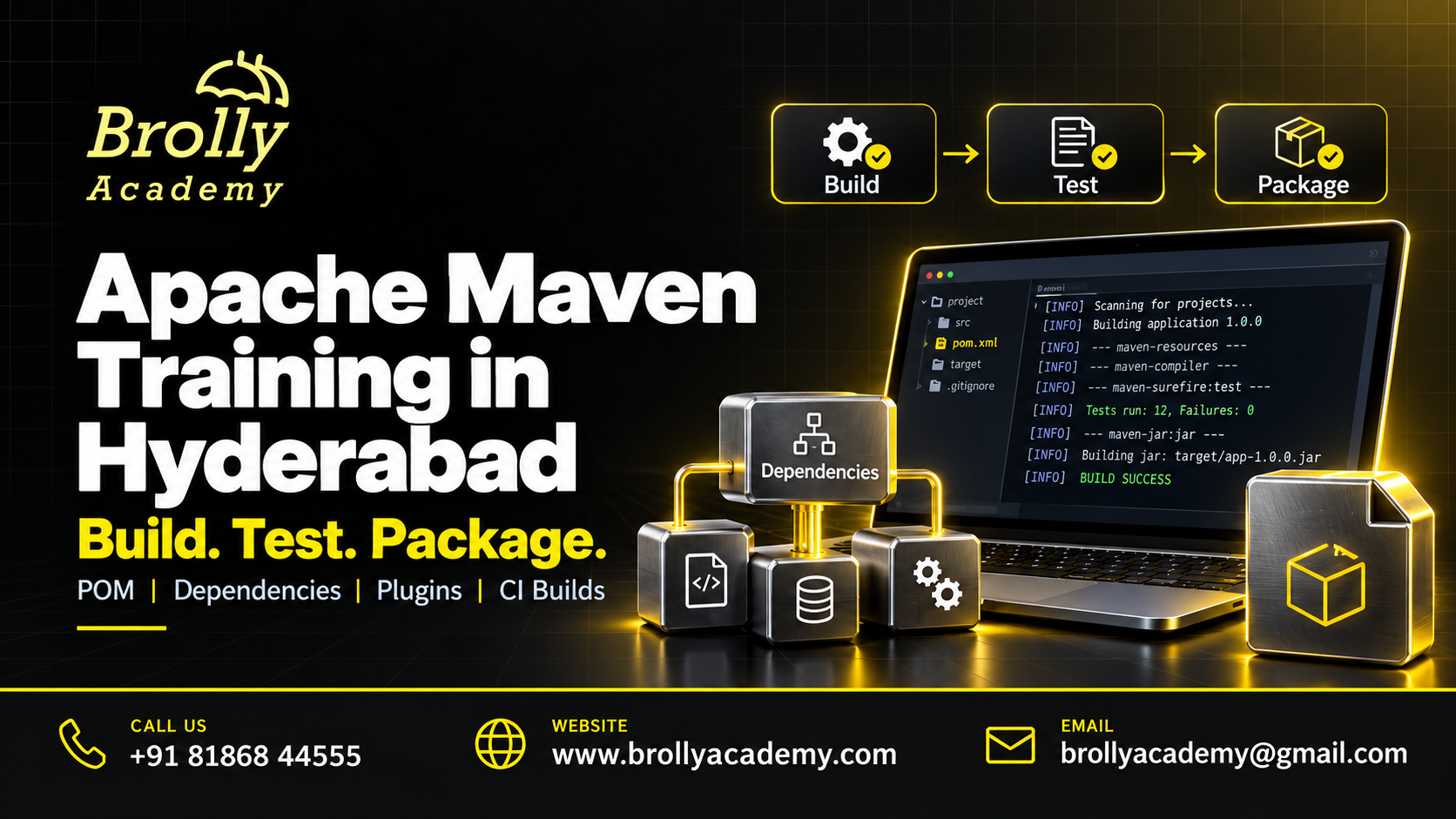
Apache Maven Training in Hyderabad
Understand what your Java build is doing and learn how to fix it when it fails. Work with POM files, dependencies, plugins and multi-module projects, then connect a repeatable build to a controlled delivery pipeline.
Course outline8 modules
Practice3 project scenarios
Duration12 learning hours
Course feeINR 24,999
About Apache Maven Training
Apache Maven is a build and project-management tool widely used in Java projects. A POM describes project coordinates, dependencies and build configuration. Maven uses conventions and plugin goals to carry out work such as compilation, testing and packaging.
Maven is not a source-control system, an application server or a complete CI platform. Git stores changes, Maven builds artifacts and a CI tool runs a wider workflow. Understanding those boundaries makes build failures easier to diagnose.
For product-specific terminology and behaviour, use Apache Maven build lifecycle. Match the documentation to the environment used in your exercises.
Who Should Join?
You should be able to read a basic Java project, use a terminal and understand files and folders. Familiarity with Git is useful. This is a focused build-tool course, not a substitute for Java or an end-to-end DevOps program.
Java developersMake local and team builds more understandable and consistent.
Automation testersManage test dependencies and separate test execution from packaging concerns.
Build and DevOps engineersInspect dependency resolution and integrate controlled builds into CI.
For complementary learning, explore Core Java training. Strengthen the programming foundation for build exercises.
Apache Maven Syllabus: 8 Practical Modules
Each module connects a concept to an exercise and an output you can explain. Work through the foundations before attempting the integrated project.
1. Maven setup and project conventions
Check the JDK and Maven environment and inspect the standard source and test layout. Read groupId, artifactId, version and packaging. Output: a small project that builds from a clean checkout with clearly documented prerequisites.
2. POM structure and build lifecycle
Distinguish a lifecycle phase from a plugin goal. Explore validate, compile, test, package, verify, install and deploy at the appropriate level. Explain why deploy normally refers to an artifact repository rather than starting a production application. Output: an annotated build flow.
3. Dependencies, scopes and conflict diagnosis
Understand direct and transitive dependencies, scopes and version selection. Inspect a dependency tree and explain an unexpected library version. Use dependency management carefully rather than adding exclusions blindly. Output: a diagnosed conflict with a reproducible before-and-after test.
4. Plugins and build configuration
Configure a plugin with a suitable version and understand goal binding. Separate plugin configuration from ordinary project dependencies. Inspect the effective POM to understand inherited settings. Output: a controlled build configuration with a reason for each non-default setting.
5. Unit tests and integration tests
Study how Surefire and Failsafe fit different testing needs. Keep failures visible and understand why skipping tests is not a general fix for a broken build. Output: a small test suite and a build that produces useful results at the verify stage.
6. Repositories, settings and credentials
Distinguish local, central and private repositories. Review mirrors, proxies and settings separately from project logic. Keep passwords and tokens out of committed POM files. Output: a repository-access checklist with secret values excluded from documentation and logs.
7. Parent POMs, modules and profiles
Build a small multi-module project and explain inheritance versus aggregation. Use profiles only when their activation and effect are clear. Discuss pinned tool versions and a wrapper as part of reproducibility. Output: a documented reactor build that another learner can run.
8. CI integration and troubleshooting project
Run the build in a clean CI environment, inspect logs and retain test results and artifacts. Diagnose one dependency failure and one test failure without suppressing the evidence. Output: a small pipeline and a troubleshooting guide that distinguishes environment, configuration and code problems.
Discuss Your Learning Goals
Tell the team about your experience and preferred schedule. Book a free demo to discuss the course, lab access and the practical work expected from you.
Practical Skills You Will Develop
Use the exercises to build an explanation as well as a result. You should be able to show what you did, how you checked it and where the limits are.
Read a POM confidentlyExplain the configuration that affects your build.
Diagnose dependency issuesUse evidence to find the source of version conflicts.
Keep tests meaningfulChoose the right phase and retain useful failure information.
Improve repeatabilityAlign tools and configuration between local and CI environments.
Tools and Lab Requirements
Use an agreed Maven and JDK combination for the exercises. The course explains stable concepts and checks version-specific behaviour against Apache documentation. Private repositories and hosted CI services may require separate access.
Apache Maven and a JDKBuild and test a small Java project with explicit tool versions.
Git and a terminalReproduce the build from tracked source and inspect meaningful changes.
Jenkins or another agreed CI toolRun the same build in a controlled pipeline and retain results.
Keep Apache Maven dependency mechanism available when checking an exercise. Use the instructions for your installed version and authorized access level.
Your Learning Roadmap
Build confidence in stages. Practice time and your starting knowledge matter as much as the number of scheduled sessions.
1. Set up and understandCheck the prerequisites and lab access. Complete the first two modules and explain the basic workflow in your own words.
2. Build and investigateWork through the middle modules. Keep notes of errors, what you tried and the evidence that supported a fix.
3. Test and presentComplete the final modules and an integrated scenario. Present your output, validation and a short handover guide.
3 Practical Project Scenarios
These are teaching scenarios using approved lab systems and synthetic data. They are not claims about live client work or previous student results.
Clean Java buildCreate a small project with production code, tests and a packaged artifact. Document the command and required environment.
Dependency conflict investigationIntroduce a controlled library-version conflict, inspect resolution and justify the fix with a test.
Multi-module CI pipelineBuild related modules, run unit and integration tests and publish a teaching artifact to an approved repository or local lab target.
How the Skills Work in Practice
A project builds on one laptop but fails in CI. Compare the JDK, Maven version, settings, active profiles and repository access before blaming the source code. A locally cached artifact can hide a missing repository configuration.
Repeat the build in a clean test environment and preserve the relevant logs. Fix the declared configuration rather than copying random files into a local cache. The aim is a build that a teammate can reproduce.
Why Learn with Brolly Academy?
Choose a course that connects the subject to work you can actually demonstrate. Use a demo to discuss the learning path and decide whether it fits your starting point.
A connected learning pathThe eight-module outline moves from foundations to an integrated task. Each module identifies an output rather than leaving practice as a vague promise.
A practical local conversationSpeak to the Hyderabad team about your goals, availability and lab needs. Ask questions before committing to a course or a particular schedule.
Clear course boundariesThe page explains prerequisites, product scope and the difference between training completion and independent certification. You can compare the offer with your actual requirements.
Brolly Academy and Other Institutes: Compare the Details
Compare the same evidence from every provider. A long syllabus or a low headline fee does not by itself show how much practical work you will complete.
What to discuss with Brolly AcademyReview these eight modules and the three project scenarios.
Ask for the assigned trainer profile.
Check the lab version and access period.
Review the fee, schedule and certificate terms.
Use the demo to assess the teaching approach.
What to check with any instituteRequest a detailed outline, not just product names.
Verify the trainer information supplied.
Separate demonstrations from your own lab work.
Check licences, exam costs and refund conditions.
Compare the total commitment, not only the advertised price.
Classroom, Online and Corporate Learning
Discuss the currently available delivery format with the academy before booking. Batch availability and session timings should be agreed in writing.
Hyderabad classroom enquiryAsk about the next classroom batch, venue, system requirements and whether you should bring a laptop.
Live online enquiryCheck the session time zone, remote lab access and arrangements for asking questions or catching up on a missed session.
Corporate team enquiryShare your team size, current tools and learning objectives. Agree a scoped program without sharing confidential business data.
For a team program, explore Brolly Academy corporate training.
Apache Maven Course Fee and Duration
Review the course fee and planned learning duration below. Contact the academy to agree the batch dates and receive the complete enrolment terms.
Course fee: INR 24,999Ask for the written quotation showing applicable taxes, payment terms and the full amount payable. Do not assume an external exam or commercial software subscription is included.
Duration: 12 learning hoursConfirm the session timetable, the split between guided learning and practice, and the expected work outside scheduled sessions.
Before you enrolCheck lab access, materials, project feedback, missed-session arrangements, refund terms and any additional charges. Keep a copy of the agreed offer.
Course Completion and Certification Guidance
Brolly Academy course completion recognizes the training and assessment work agreed for your batch. It is separate from a credential awarded by a software vendor or another certification body.
Brolly Academy course completionAsk for the attendance, assignment and assessment requirements, the certificate wording and how completion will be verified.
Independent certificationUse official vendor information to check whether a relevant credential is currently offered and what preparation it requires. No vendor authorization, exam voucher or pass guarantee is implied.
Career Roles and Skill Applications
Match the learning path to a role, then compare its requirements with your existing experience. The course can support skill development; it does not guarantee employment.
Java developerMaintain understandable builds and dependency choices.
Build or release engineerCoordinate repeatable artifacts and traceable build results.
Automation or DevOps engineerIntegrate tests and packaging into a broader delivery workflow.
You can also explore DevOps training. Place build management in a wider operational learning path.
Where These Skills Are Used
Maven skills are useful where teams build Java applications and libraries. Employers generally expect them alongside programming, testing or delivery skills rather than as a complete standalone job qualification.
Interview and Portfolio Preparation
Prepare evidence you can discuss clearly. Label practice work as training work and do not present a teaching scenario as paid client experience.
Explain a projectDescribe the requirement, your decisions, the result and one limitation. Be ready to answer what you would change for a real deployment.
Show useful evidenceKeep approved files, test results and a concise README or runbook. Remove secrets and private information before sharing a portfolio.
Discuss support servicesAsk the academy which resume, mock-interview or job-search services are included in your batch. Placement assistance is not a job or salary guarantee.
Salary and Hiring Expectations
Salary depends on the role, prior experience, location and the employer. A tool course alone does not establish a salary band. Compare recent job descriptions, required experience and responsibilities rather than relying on a headline income promise.
Meet the Trainer Through a Demo
Request the assigned trainer profile and discuss the experience most relevant to your goals. We recommend using the demo to evaluate how clearly the trainer explains a practical problem.
Relevant experienceAsk for examples of work with Apache Maven that can be discussed without revealing confidential client information.
Practical explanationAsk the trainer to explain a failure scenario and how a learner would investigate it, rather than only showing a finished result.
Feedback and supportDiscuss how assignments are reviewed, how questions are handled and the support period included in the course.
Explore Learner Feedback
Read available academy feedback and ask whether a review relates to this particular course, trainer and delivery format. General academy reviews should not be mistaken for verified results from this new course.
Read Academy ReviewsDownload Your Practice Checklists
Use these editable CSV files to organize your learning. They open in common spreadsheet tools and contain real module and project-checklist content.
Download Syllabus Checklist (CSV) Download Project Review Sheet (CSV)Official Documentation for Further Reading
Use the documentation that matches your product version and environment. These sources support technical learning; linking to them does not imply endorsement of Brolly Academy.
Apache Maven build lifecycle
Apache Maven dependency mechanism
Apache Maven getting started
Related Courses at Brolly Academy
Choose complementary learning based on your current skill gaps. These are separate courses, not automatically included in this program.
Core Java trainingStrengthen the programming foundation for build exercises.
View Core Java training
Jenkins trainingLearn more about pipeline execution and delivery automation.
View Jenkins training
DevOps trainingPlace build management in a wider operational learning path.
View DevOps training
For a complementary learning path, also explore Hybris training and AppDynamics training. These are separate programs; choose the one that fits your role and prerequisites.
Apache Maven Training Enquiries in Hyderabad
Speak to Brolly Academy near JNTU Metro Station. The centre address is Metro Pillar No. A689, Dr Atmaram Estates, 3rd Floor, Nizampet X Roads, Hyderabad 500072. Confirm the batch venue before travelling.
Learners from Kukatpally, KPHB, Nizampet, Miyapur and other parts of Hyderabad can contact the academy to discuss classroom or online availability.
Call +91 81868 44555Apache Maven Training FAQs
Can I learn Maven without Java?
You can understand basic commands, but practical work is easier if you can read a small Java project and its tests. Build that foundation first for the best result.
What is the difference between install and deploy?
Install places the built artifact in the local Maven repository. Deploy copies it to a configured remote artifact repository. Neither term automatically means launching your application in production.
Does dependencyManagement add a dependency?
Not by itself. It manages values such as versions for dependencies that are actually declared or otherwise used in the relevant project context. Inspect the effective POM and dependency tree when checking the result.
Will the course cover Jenkins?
A small CI exercise shows how Maven fits into a pipeline. A complete Jenkins or DevOps curriculum is a separate learning path.
Is there an official Apache Maven certification included?
No vendor exam or Apache endorsement is claimed. Brolly Academy course completion is separate from any independently offered assessment.
Why is this shorter than a full DevOps course?
Maven is a focused build tool. The course concentrates on eight related modules and practical exercises, while a broader DevOps program includes many additional technologies and operational topics.
Request a Free Demo
Share your contact details and the team can discuss course availability, prerequisites and the next suitable session.
Your details are used to respond to this enquiry. Read our Privacy Policy.