AI Testing Course Syllabus
Simple Guide, Syllabus, Projects, Tools & Career Roadmap
AI Testing Course Syllabus explains what a learner should study to test modern AI-powered software. This guide is written in simple words for freshers, manual testers, automation testers and QA engineers who want to move into AI Testing.
This blog is written in simple words for 15-year-old learners, freshers, manual testers and QA professionals who want a clear AI Testing learning path.
-
Nani
- No Comments
Table of Contents
Quick Answer
A good AI Testing course syllabus should teach normal QA basics first, then automation, API testing, AI-assisted testing, LLM testing, RAG testing, safety checks and portfolio projects. This helps a learner test both regular software and AI-based applications.
| Question | Short Answer |
|---|---|
| Who can learn it? | Freshers, manual testers, automation testers, QA engineers and developers. |
| Coding required? | Basic scripting helps, but beginners can start with testing logic first. |
| Main tools? | Playwright, Selenium, Cypress, API tools, prompts, evaluation sheets and AI assistants. |
| Best outcome? | A portfolio that proves you can test web apps, APIs, chatbots and AI outputs. |
Key Takeaways
- AI Testing is not only tool learning. It is quality checking for AI-powered software.
- The syllabus should include LLM testing, hallucination checks, bias checks, RAG testing and prompt testing.
- Playwright, Selenium and API testing are still useful because most AI products are also web or API products.
- ISTQB CT-AI topics are useful because they explain AI system testing in a structured way.
- Projects are important because interviews ask what you built, not only what you studied.
AI Testing Syllabus in Simple Words
AI Testing means checking whether an AI-based product works correctly, safely and usefully. A learner should understand normal testing first, then learn how AI changes testing. If you are new to AI, you can also read Brolly Academy’s Generative AI Training in Hyderabad page to understand the bigger AI learning path.
Unlike normal software, AI output may change for the same question. That is why testers need special checks for accuracy, relevance, hallucination, privacy, bias and unsafe answers. For hallucination basics, read Hallucination in Generative AI.
Complete AI Testing Course Syllabus
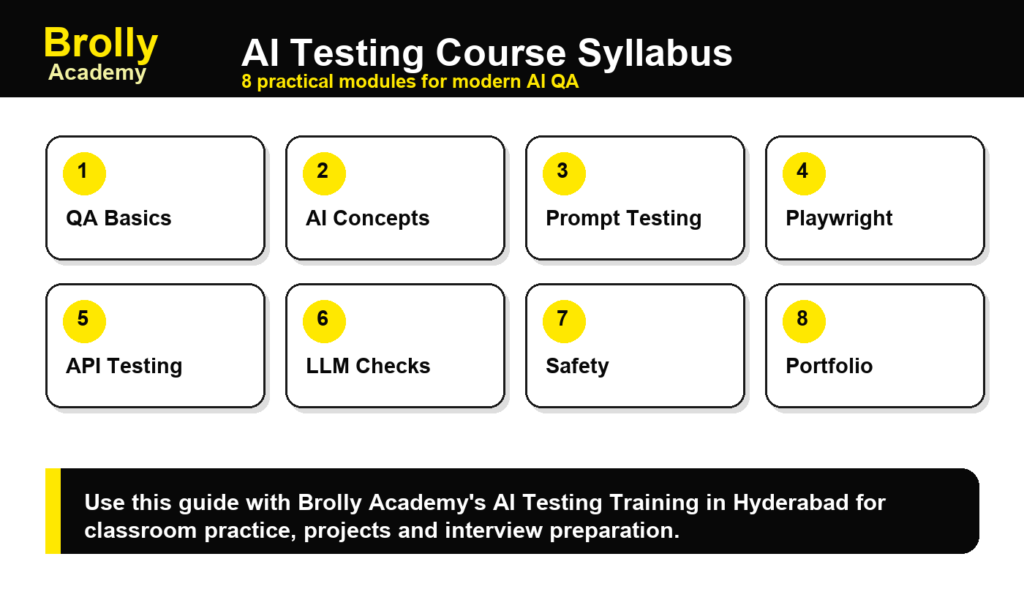
Module 1: Software Testing Foundations
- SDLC and STLC
- Test case writing
- Bug life cycle
- Smoke, sanity, regression and functional testing
- How QA work changes in AI projects
Module 2: AI and Machine Learning Basics for Testers
- What AI, ML and GenAI mean
- Training data and test data
- Model behavior
- Probabilistic output
- Why AI answers are not always fixed
Module 3: Prompt Engineering for Testers
- Prompt structure
- Role-based prompts
- Negative prompts
- Prompt versioning
- Testing prompt quality with ideas from Prompt Engineering Course in Hyderabad
Module 4: Web Automation with Playwright, Selenium and Cypress
- Locators and assertions
- Page flows
- Screenshots and traces
- Cross-browser checks
- Flaky test reduction
Module 5: API Testing and Data Validation
- HTTP methods
- Status code checks
- Request and response validation
- Authentication checks
- Error and boundary cases
Module 6: LLM, Chatbot and RAG Testing
- Golden question sets
- Answer accuracy checks
- RAG source verification
- Context relevance
- Hallucination review
- Citation checking
Module 7: AI Safety, Bias and Security Testing
- Prompt injection basics
- Jailbreak testing awareness
- Privacy checks
- Bias and fairness review
- Human review workflow
Module 8: Portfolio Projects
- AI test case generator
- Playwright regression suite
- Chatbot answer evaluation sheet
- RAG assistant test plan
- Defect report assistant
Topics Many Course Pages Miss
Many AI Testing course pages mention tools, but they do not clearly explain how testers should evaluate AI answers. A stronger syllabus should cover these missing areas.
| Common Gap | What Brolly Learners Should Study |
|---|---|
| Only Selenium or manual testing | Add Playwright, API checks and AI-assisted workflows. |
| No LLM testing | Learn hallucination, relevance, context and answer-quality checks. |
| No RAG testing | Check retrieval, source grounding, citation support and context matching. |
| No safety testing | Learn prompt injection, privacy, bias and unsafe-output checks. |
| No portfolio | Build projects that can be shown in interviews. |
Official References
Frequently Asked Questions
1. What is included in an AI Testing syllabus?
It should include software testing basics, automation, API testing, AI concepts, LLM testing, RAG testing, prompt testing, safety checks and projects.
2. Is AI Testing good for freshers?
Yes. Freshers can start with manual testing concepts and slowly move into automation and AI output validation.
3. Is Playwright required for AI Testing?
Playwright is not the only tool, but it is useful because many AI products are web applications that need reliable browser automation.
4. Does AI Testing replace automation testing?
No. AI Testing adds new checks on top of existing testing skills. Automation testing is still important.
5. Where can I learn this syllabus with projects?
You can start from AI Testing Training in Hyderabad at Brolly Academy.
Final Thoughts
A strong AI Testing syllabus should not stop at normal automation tools. It should teach testers how to check AI answers, prompts, RAG workflows, safety risks and real projects. That is what helps learners become job-ready.
Brolly Academy Team
AI, Data Science & Software Training Experts | 20+ Years of Training Experience
Brolly Academy Team is a group of AI, Data Science, Cloud Computing, and Software Development professionals dedicated to helping learners gain practical skills and industry knowledge. Since 2015, Brolly Academy has supported thousands of students and professionals through technology training, certification guidance, and career-focused learning.